AI Voice Agents for Inbound Support with Complex Query Escalation
September 21, 2026
|

12 min read
A compliant empathetic healthcare voice AI can handle appointment reminders, follow-up calls, and slot confirmations without crossing into clinical...
A compliant empathetic healthcare voice AI can handle appointment reminders, follow-up calls, and slot confirmations without crossing into clinical territory, as long as it is built around India's regulatory constraints from the start. The Telemedicine Practice Guidelines 2020 draw a clear line: AI may not counsel patients or prescribe medicines, but administrative communication is entirely within scope. Getting empathy and compliance right together is a design and audit problem, not just a technology one.
Healthcare is one of the few sectors where a bad call does real harm. A patient waiting on a post-surgery follow-up is not the same as a lead who ignored a loan offer. The stakes are different, the regulatory environment is specific, and the tolerance for a tone-deaf script is essentially zero.
That is why most healthcare operators in India are cautious about voice AI, even as their contact floors buckle under appointment volumes, no-show rates, and lapsed-patient lists that run into the millions. The question is not whether AI can make the calls. It is whether AI can make them correctly, compliantly, and in a way that does not frighten or mislead a patient who is already anxious.
This post answers that question directly, grounded in India's regulatory framework and in what a production-grade healthcare voice AI actually needs to do. For a broader overview, see SquadStack's healthcare industry page and the dedicated AI voice agent for healthcare hub.
A compliant empathetic healthcare voice AI handles administrative patient communication within legally defined boundaries, in a tone calibrated for anxious or unwell patients, with a clear escalation path to a human for anything clinical.
The compliance part is binary: either the agent operates within the Telemedicine Practice Guidelines 2020 and the DPDP Act, or it does not. The empathy part is harder to measure but no less important: a technically compliant call that leaves a patient feeling dismissed or confused still fails.
The two are not in tension. A well-designed agent is more empathetic precisely because it stays in its lane: it confirms your appointment, tells you the report is ready, asks if you want to reschedule, and hands off to a human the moment the conversation moves toward something clinical. That predictability is reassuring, not robotic.
The core rule under Telemedicine Practice Guidelines 2020 (Clause 5.4) is clear: AI and ML platforms may not counsel patients or prescribe medicines. Only a Registered Medical Practitioner can do that.
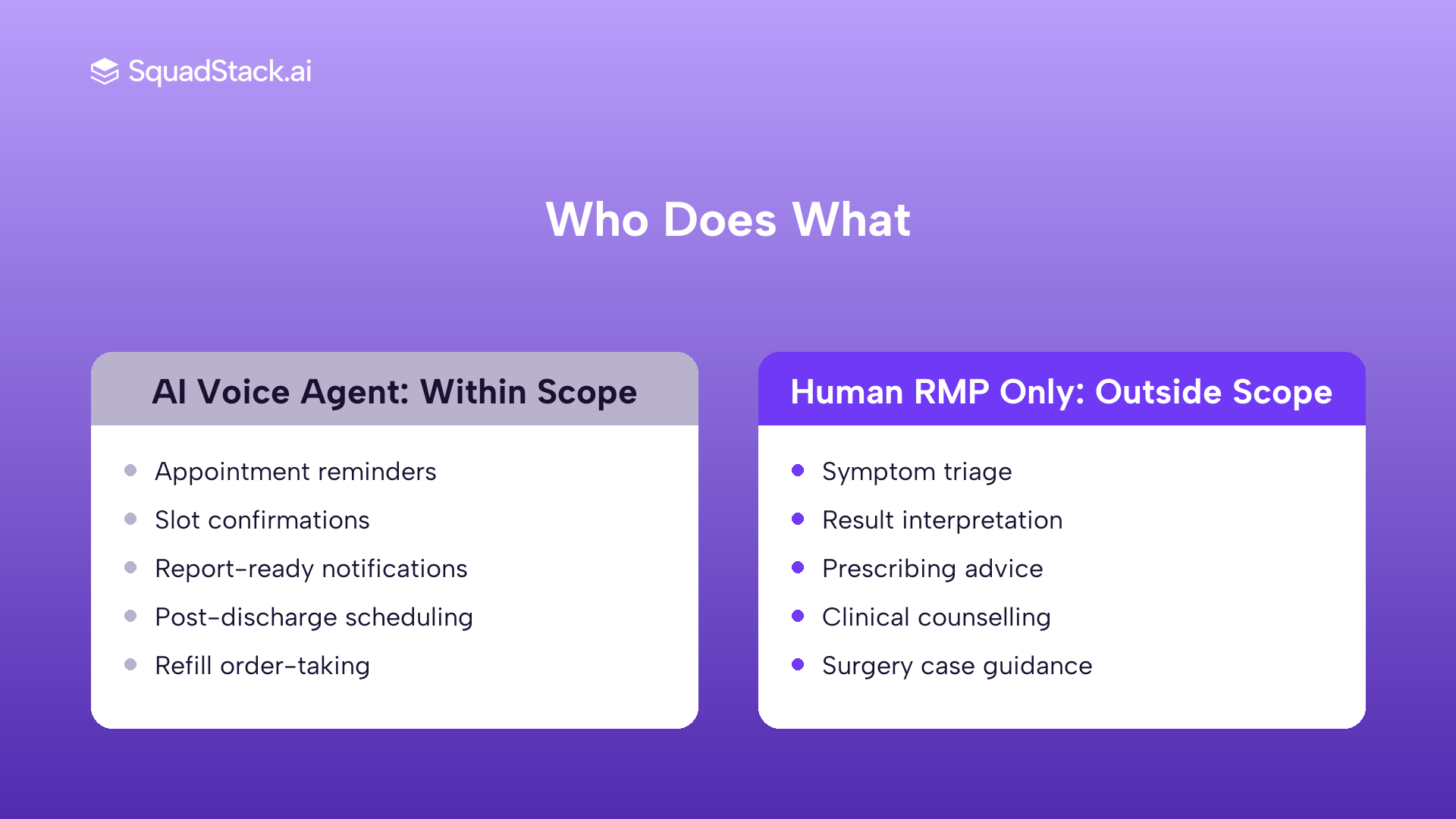
What this does not prohibit is administrative communication. Appointment reminders, slot confirmations, report-ready notifications, post-discharge logistics, and refill reminders framed as order-taking against an existing prescription are all outside the clinical prohibition.
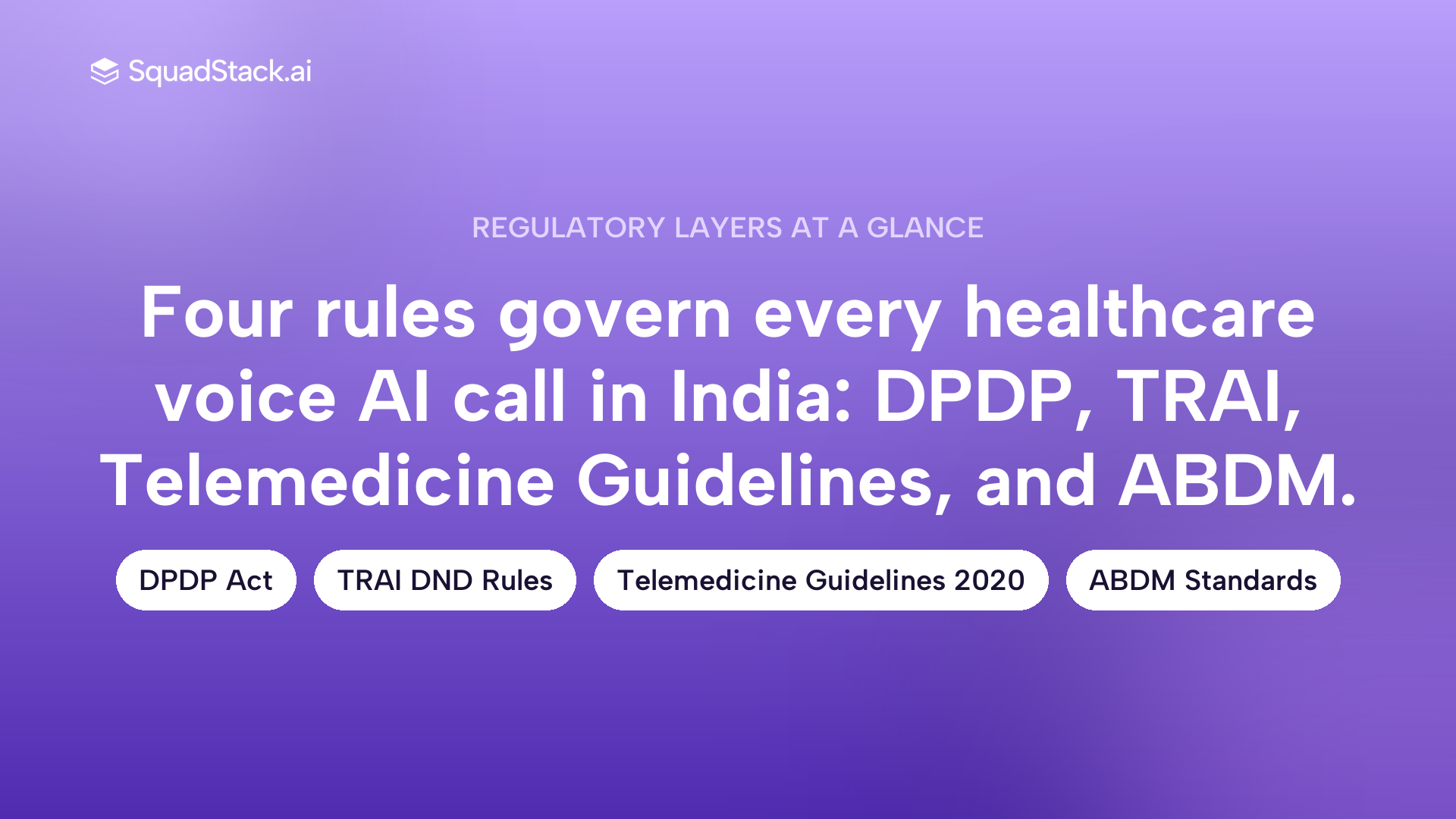
Beyond the telemedicine guidelines, three other regulatory layers apply to any outbound healthcare voice AI deployment in India.
The DPDP Act (Digital Personal Data Protection Act, 2023) requires explicit, informed consent before an outbound call where personal health data is referenced; data minimisation, meaning the agent should not access or surface more data than the call requires; and India-based data residency for any personal data processed.
TRAI calling rules require 140-series numbers for commercial communication, calling only between 9:30 AM and 8:30 PM, and DND registry scrubbing before dialing. These rules apply whether the caller is human or AI.
ABDM (Ayushman Bharat Digital Mission) establishes the Health ID framework and linked health records infrastructure. Any platform accessing or referencing ABDM-linked records must operate within its consent-manager architecture.
The table below maps each rule to its practical meaning for a healthcare voice AI deployment.
| Regulation | What it requires | How a compliant agent handles it |
|---|---|---|
| Telemedicine Guidelines 2020, Clause 5.4 | No AI counselling or prescribing | Scope calls to administrative acts only; escalate any clinical question to a human immediately |
| DPDP Act | Explicit consent, data minimisation, India residency | Consent gated in the conversation layer; agent accesses only the data needed for that call; all models hosted in India |
| TRAI | 140-series numbers, 9:30 AM to 8:30 PM window, DND scrub | Hard-enforced at platform level, not by convention |
| ABDM | Consent-based access to linked health records | Only reference data the patient has consented to share; no unsolicited health-data surfacing |
| Advertising Standards / Drugs Act | No cure claims for scheduled conditions; no sex-determination content | Script-level guardrails in locked prompt sections that no optimisation loop can modify |
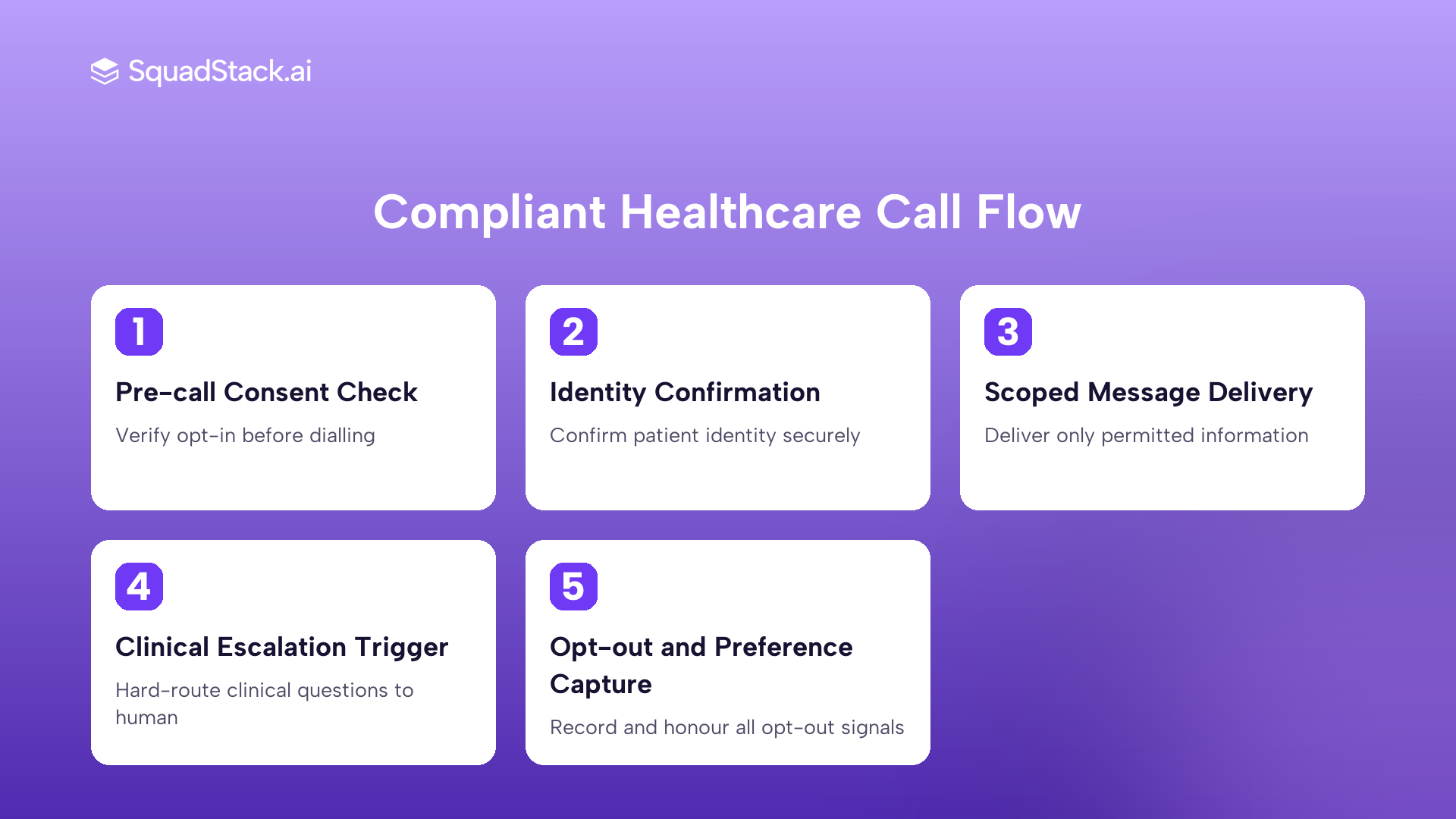
A healthcare voice AI call has five layers. Here is what each looks like for a post-investigation follow-up call at a diagnostics chain.
1. Pre-call consent check. Before the agent dials, the platform checks whether the patient has consented to this type of outreach. If consent is absent or expired, the call is blocked, not skipped and retried.
2. Identity confirmation. The agent confirms it is speaking with the right person using name and appointment reference only. It does not read out a diagnosis, a test name linked to a sensitive condition, or any report value.
3. Scoped message delivery. The agent delivers the administrative action: "Your report is ready. Would you like to book a doctor consultation to discuss it?" It does not say what the report contains, whether values are normal or abnormal, or offer any interpretation.
4. Escalation trigger. If the patient asks a clinical question ("Is my value okay?" or "What does this mean?"), the agent does not attempt an answer. It says the doctor is the right person for that and offers to connect them or book a consultation. This is a designed, mandatory behaviour, not a fallback.
5. Opt-out and preference capture. If the patient says they do not want further calls, the agent records the opt-out and the platform removes them from the outreach queue. This is a hard stop.
The same five-layer logic applies to appointment reminders, slot confirmations, and post-discharge scheduling calls. The script changes; the structure does not.
Empathy in a healthcare voice AI comes from dialogue engineering: the specific language choices, pause patterns, and response behaviours that make an anxious patient feel heard rather than processed.
SquadStack's approach is grounded in the same method used across all its Indian-language deployments. Transcripts of top-performing human agents are reverse-engineered per language by native speakers. The words and patterns that signal genuine engagement are identified and coded explicitly: backchannels in Hindi ("ji, bilkul"), reformulators in Tamil, tag questions that signal the agent is listening rather than reciting. Every line is hand-written, because generated filler sounds formal rather than conversational.
In healthcare specifically, three additional design rules matter.
First, the agent never front-loads clinical terms. Confirming an appointment for a "lipid profile" is fine. Announcing "your cholesterol and triglyceride panel results" in an opener is not, because it loads anxiety before the patient has engaged.
Second, pace is calibrated to the patient's responses. An older patient or one speaking a vernacular language gets more time between turns. SquadStack's in-house voice activity detection is tuned for Indian conversational patterns so a thinking pause is not interrupted.
Third, sentiment is monitored after every call through the Eval System, which scores calls on Outcome, Sentiment, and Execution in sequence. A call that achieved its administrative goal but left the patient distressed still gets flagged. Human reviewers audit those calls and the pattern feeds back into prompt refinement.
Most vendors will tell you they are DPDP compliant. Fewer can show you the mechanism. Here are the specific questions to ask.
On data residency: Where are your speech models hosted? A platform that routes audio through overseas servers fails the DPDP residency requirement regardless of its privacy policy.
On consent enforcement: Is consent gating handled at the conversation layer, or only at list-upload? If a patient withdraws consent mid-call, the agent must stop and the platform must record it.
On clinical escalation: Is escalation to a human hard-coded or a configurable option? If a vendor lets a client turn it off to save costs, the clinical safeguard is not real.
On audit trails: Can you produce a call-level record showing what was said, what consent was recorded, and what data was accessed, for every call?
On locked compliance sections: Can your optimisation system modify the parts of the script containing compliance language, clinical boundaries, and disclosure statements? If yes, the guardrail is fragile.
SquadStack addresses all five in production. All models are hosted in India. Consent gating and opt-out handling are enforced in the conversation layer. Clinical escalation is hard-coded in locked prompt sections that the Lift self-improvement system cannot touch. Every call is audited by the Eval System on Outcome, Sentiment, and Execution, with human review layered on top.
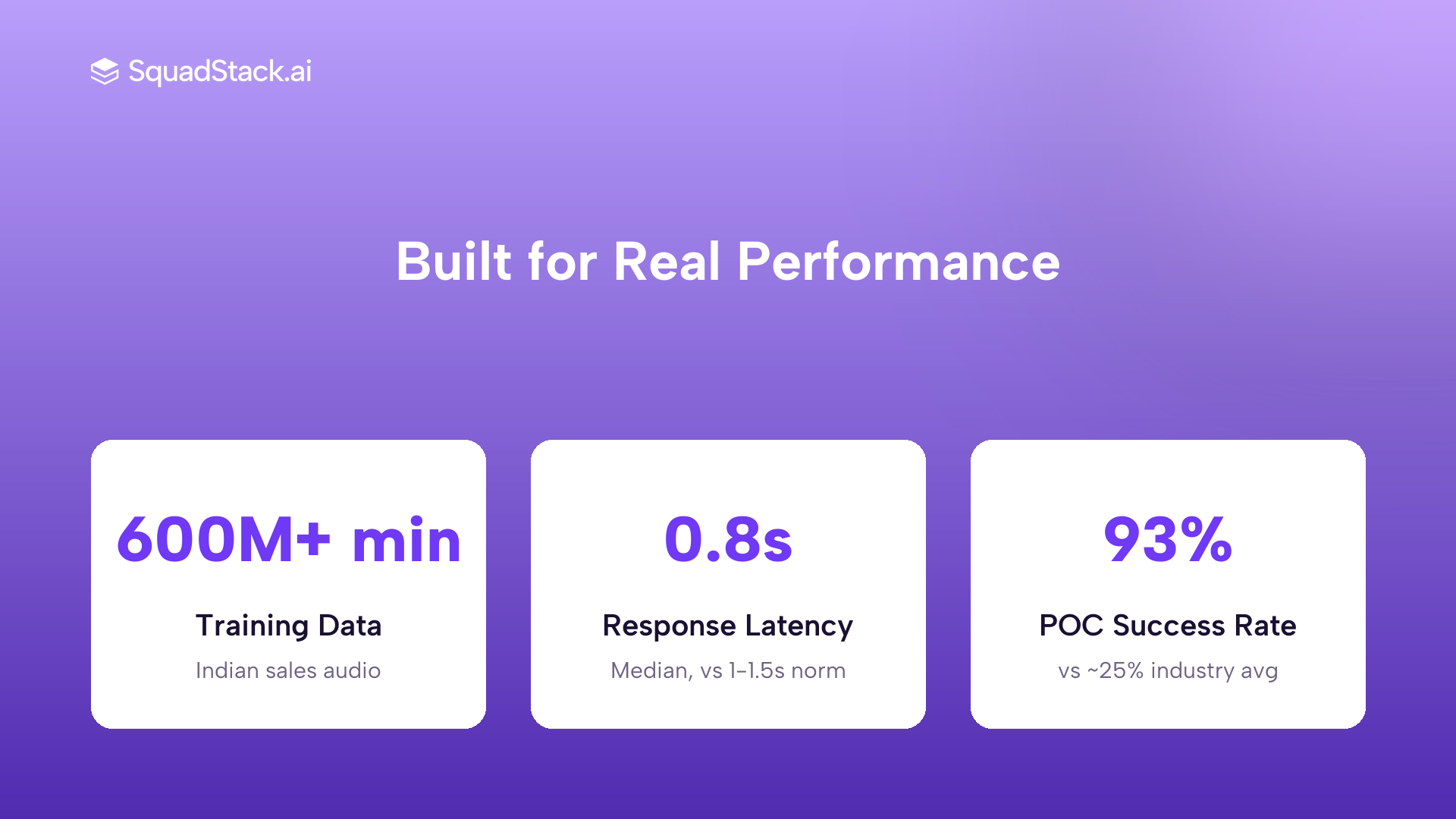
SquadStack's speech model, Arth, is trained on 600M+ minutes of real Indian contact-center conversations, including code-switched speech across Hindi, Tamil, Telugu, Kannada, and English. Medibuddy runs appointment confirmation on both the patient and hospital legs using SquadStack. For a detailed look at what a healthcare deployment produces, the Medfin case study is worth reading.
With a 93% POC success rate against an industry average of around 25%, and 50 lakh+ calls running daily across 60+ large consumer brands, the compliance and empathy framework described here runs at scale in production.
Is a healthcare AI voice agent legal in India for patient communication?
Yes, within limits. The Telemedicine Practice Guidelines 2020 prohibit AI from counselling patients or prescribing medicines, but administrative communication such as appointment reminders, report-ready notifications, and slot confirmations is permitted. The agent must escalate any clinical question to a Registered Medical Practitioner immediately.
Which AI voice bots are DPDP compliant and support appointment reminders in India?
A DPDP-compliant healthcare voice AI must store and process patient data in India, enforce consent at the conversation layer, and minimise the data the agent accesses per call. SquadStack's platform meets all three requirements: all models are India-hosted, consent gating is built into the dialogue, and the system processes 50 lakh+ calls daily on this infrastructure.
What is the best voice AI for appointment booking and follow-up calls in healthcare?
The best platform combines compliance guardrails, multilingual support for Indian patients, and a hard escalation path for clinical questions. It should handle Hindi, Tamil, Telugu, Kannada, and English natively with code-switching, enforce TRAI's 9:30 AM to 8:30 PM calling window automatically, and provide full call-level audit trails.
Is AI voice calling TRAI compliant in India?
It can be, if the platform enforces the rules at the infrastructure level. TRAI requires 140-series numbers for outbound commercial calls, a calling window of 9:30 AM to 8:30 PM, and DND registry scrubbing before dialing. SquadStack hard-blocks out-of-window dialing at the platform level and scrubs against the TRAI DND registry before every campaign.
How does a healthcare voice AI handle a distressed or anxious patient?
Empathy comes from dialogue engineering, not a generic warm tone. Agents are built with calibrated pacing, language appropriate to the patient's dialect and age, and a mandatory escalation trigger when the patient expresses distress or asks a clinical question. The Eval System scores every call on Sentiment, and calls that achieved their goal but left the patient distressed are still flagged for human review.
What data can a healthcare voice AI legally access during a call?
The DPDP Act requires data minimisation: the agent should access only the data needed for the specific call. For an appointment reminder, that means name, appointment time, and doctor name. It should not surface diagnosis codes, test values, or prescription history. ABDM-linked records may only be referenced where the patient has given consent through the ABDM consent-manager framework.
Can a voice AI deliver lab results or tell a patient their values are abnormal?
No. Communicating that a report is ready and routing the patient to a consultation is within scope. Interpreting results, reading out values, or flagging an abnormal finding is not. Critical values are an accreditation-governed clinical communication that belongs exclusively to the treating practitioner. Any platform that allows an agent to read out lab values is operating outside the Telemedicine Practice Guidelines.
How do you ensure a voice AI stays compliant as the script is optimised over time?
Compliance language, clinical boundaries, disclosure statements, and escalation triggers must sit in locked prompt sections that no automated optimisation system can modify. At SquadStack, Lift proposes edits only to conversational sections. Every proposed change passes a human review gate and is validated on live traffic before scaling. The locked sections are untouchable by design.
What languages does a healthcare voice AI need to support in India?
Patients in India communicate in a wide range of languages and often switch mid-sentence between English and their regional language. A production-ready platform needs native code-switching, not a translation layer. SquadStack runs Hindi, English, Tamil, Telugu, Kannada, Marathi, Malayalam, Bengali, and Gujarati live today, with additional languages including more regional languages are available on demand. The speech model is trained on real Indian telephony audio, so the agent sounds native rather than like a textbook recording.
What should a healthcare operator look for in a voice AI quality audit framework?
Look for a framework that evaluates calls in three layers: did the call achieve its objective (Outcome), how did the conversation land with the patient (Sentiment), and did the agent run the conversation correctly (Execution). AI auditing alone is not sufficient for healthcare. Human review of flagged calls, particularly those with poor sentiment scores, is necessary to catch empathy failures that a model might score as technically correct. SquadStack's Eval System runs this three-layer review on every call, with human super-audits layered on top.
Ready to see a compliant healthcare voice AI deployment in practice? Talk to the SquadStack team to discuss your appointment reminders, follow-up workflows, and data-residency requirements.