.svg)






Subscriber Churn Prediction Calls: AI Voice for OTT and Streaming
October 10, 2026
|

12 min read
What to know about using AI voice agents for FD maturity reinvestment calls: personalised outreach, objection handling, compliance, and retention at scale.
FD maturity reinvestment calls using voice AI let banks and NBFCs reach every FD holder in the reinvestment window with a personalised, compliant conversation, not a generic IVR blast. The AI knows the maturity amount, the customer's tenure, and the best reinvestment option to pitch, all before the call begins. Done right, this turns a predictable churn moment into a retention and upsell opportunity at scale.
An FD maturing is one of the most predictable events in retail banking. The bank knows the exact date, the exact amount, and the customer's history. Yet a large share of maturing FDs leak to competitors, or roll over passively without a renewal conversation ever happening.
The reason is not a data problem. Banks have the data. The gap is in execution: call center teams are stretched across too many campaigns, IVR systems offer rigid menus that customers ignore, and personalised one-on-one outreach at scale is expensive. So the customer either gets a generic SMS or hears a recorded prompt that gives them no real reason to reinvest.
AI voice agents change this equation completely, because the FD maturity use case is almost perfectly shaped for them.
FD maturity reinvestment calls using voice AI are outbound calls placed by an AI agent to FD holders in the days before their deposit matures. The agent carries the customer's maturity amount, tenure, and product history into the conversation. It then pitches a reinvestment option: a higher-rate FD, a recurring deposit, or a liquid fund, depending on the customer's profile and what the bank wants to promote.
The call is not a recorded message. It is a live, two-way conversation. The agent listens, responds to objections, handles language switches, and can book a callback or send a WhatsApp follow-up while still on the call. If the customer wants to speak to a human relationship manager, the agent transfers them with full context already passed across.
This is a narrow, high-value BFSI use case that most generic voice AI content does not cover. The FD maturity date is a hard deadline. Miss the window and the customer walks.
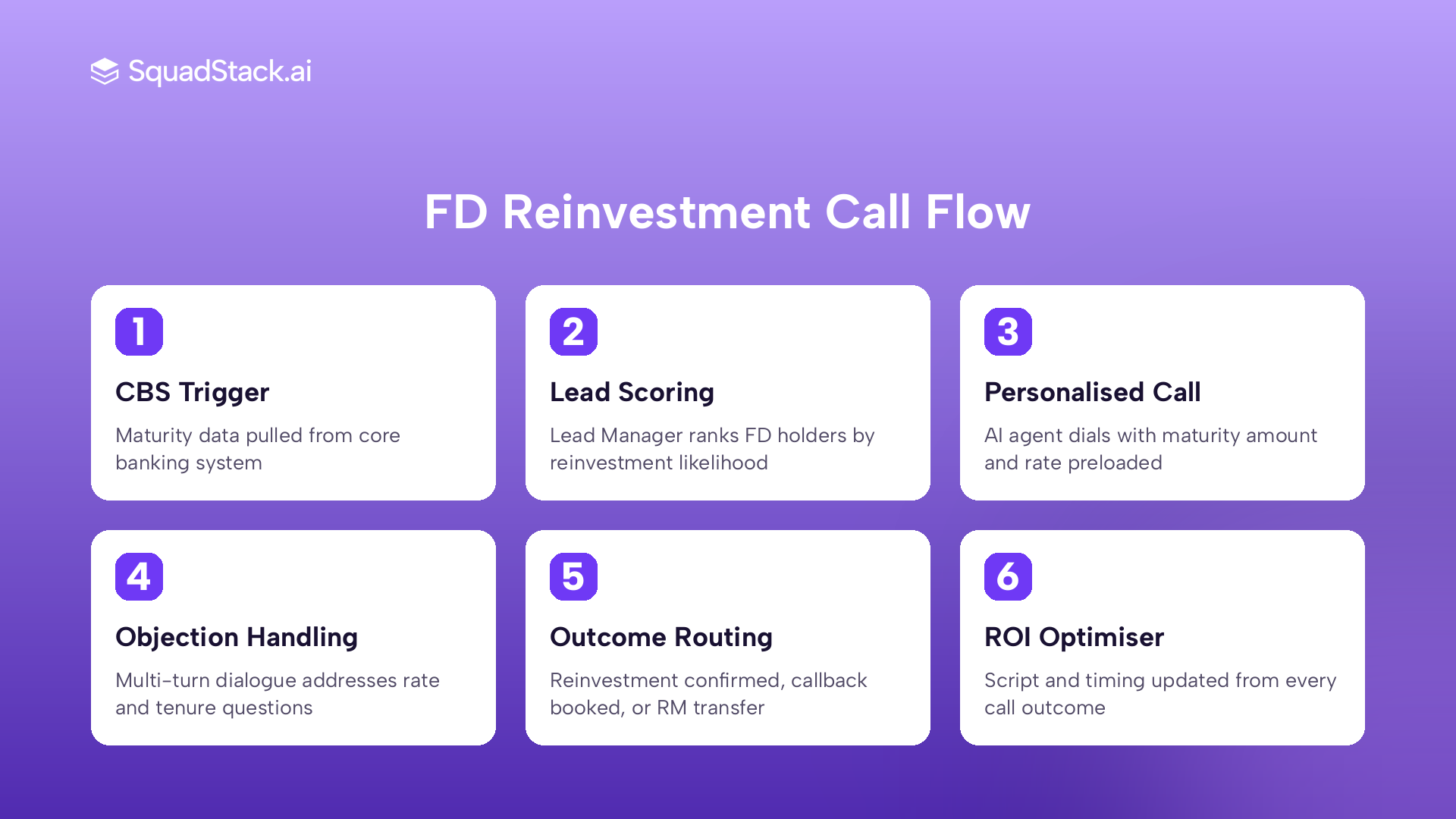
Step 1: Data trigger. The core banking system (CBS) surfaces FDs approaching maturity, typically 30 to 7 days out. These records flow into the AI Lead Manager with the maturity date, principal amount, interest rate on the existing FD, and any tenure or product preferences on file.
Step 2: Lead prioritisation. The platform scores and ranks FD holders based on factors like deposit size, relationship tenure, and prior interaction history. Larger deposits and longer-standing customers move up the queue.
Step 3: Personalised call. The voice agent opens with the customer's name and references their specific FD: the amount and when it matures. It then presents a reinvestment option tied to their profile, a new FD with a higher rate, an RD, or a liquid fund. It does not read a generic script.
Step 4: Live objection handling. Common objections come in three forms. The customer wants time to think. The customer has seen a better rate elsewhere. The customer wants to withdraw. The agent is built to handle all three with multi-step responses, not a single canned line. If the customer switches from English to Hindi mid-call, the agent switches with them.
Step 5: Outcome routing. Interested customers are offered an immediate booking confirmation or a warm transfer to a relationship manager. Those who want a callback get one scheduled. All outcomes write back to the CRM automatically.
Step 6: Continuous learning. Every completed call feeds the ROI Optimizer. Conversion rates by script variant, objection type, language, and call timing are tracked in real time. The system A/B tests different reinvestment pitches and opening lines, so the agent gets sharper with every campaign cycle. A script that performs well in Gujarati for large-ticket deposits gets promoted; one that causes early drop-offs gets flagged and revised.
FD maturity is the clearest trigger, but the same call architecture applies across several adjacent retention jobs in banking and lending:
FD reinvestment: The core use case. AI contacts holders before maturity with a specific, personalised offer to reinvest at the current rate or switch to a higher-yield product.
RD maturity follow-up: Recurring deposit customers finishing their tenure are strong candidates for FD or SIP cross-sells. The conversation is similar, and the data trigger is identical.
Savings account reactivation: Dormant savings customers have left money idle. A well-timed outbound call with a relevant product offer, liquid FD, sweep-in facility, can restart the relationship.
Loan prepayment and reinvestment: Customers who have repaid a loan early often have funds available. An AI agent can proactively reach them with a short-duration deposit offer.
Credit card and account anniversary: Tenure milestones are another predictable trigger for loyalty-driven outreach or product upgrades.
Banks working across the lending and credit space face the same underlying challenge in all these cases: they have the data to personalise but lack the infrastructure to act on it at scale without blowing up cost per contact.

An IVR has been the default tool for maturity notifications in Indian banking for years. The gap in outcomes between an IVR and a conversational AI agent is significant for this use case specifically.
| Dimension | IVR | AI Voice Agent |
|---|---|---|
| Personalisation | Reads the maturity date aloud; no context on amount, tenure, or customer preference | Knows the maturity amount, tenure, and product history; pitches the most relevant reinvestment option |
| Language handling | Plays a recorded message in a fixed language; caller presses 1 for Hindi | Detects language from the customer's first response and switches mid-sentence, natively |
| Objection handling | Cannot process an objection; caller either presses a key or hangs up | Engages with the objection across multiple turns: rate comparison, tenure flexibility, liquidity options |
| Reinvestment booking | Directs caller to a branch or a callback number | Confirms reinvestment intent on the call, books a callback, or transfers to a RM with context |
| Compliance | Plays a static disclosure; no dynamic consent gating | Enforces TRAI calling windows, captures consent, handles opt-outs in the conversation layer |
| Memory across attempts | Every call starts from zero | Remembers the previous call's outcome and opens the follow-up from where the conversation left off |
The IVR tells the customer their FD is maturing. The AI agent gives them a reason to reinvest and handles the conversation all the way to a confirmed intent.
For more on how AI is changing recovery and retention workflows in BFSI, the AI in collections overview covers the broader landscape.
Not every voice AI platform is built for the complexity of an FD reinvestment conversation. A few things to check before selecting one:
Genuine personalisation, not mail-merge. The platform should pull CBS data into the call flow dynamically, not just slot a name and a number into a fixed script. The pitch for a Rs. 10 lakh deposit maturing in 7 days should differ from the pitch for a Rs. 50,000 deposit maturing in 30 days.
Native multilingual support. FD holders in India span every language region. The platform needs to handle language switching mid-call without losing context or sounding mechanical. Listing nine languages on a feature page is not the same as sounding native in them.
Compliance built into the conversation layer. TRAI calling windows (9:30 AM to 8:30 PM), DND scrubbing, consent gating, and opt-out handling should be enforced by the platform, not managed manually by a compliance team reviewing call logs after the fact.
Persistent memory across attempts. FD reinvestment often takes two or three conversations. A platform that starts every call cold wastes the customer's time and loses the context needed to move the conversation forward.
A continuous optimisation loop. A campaign that runs the same script from day one to day thirty will underperform one that tests variants, measures outcomes, and improves the agent as the data comes in.
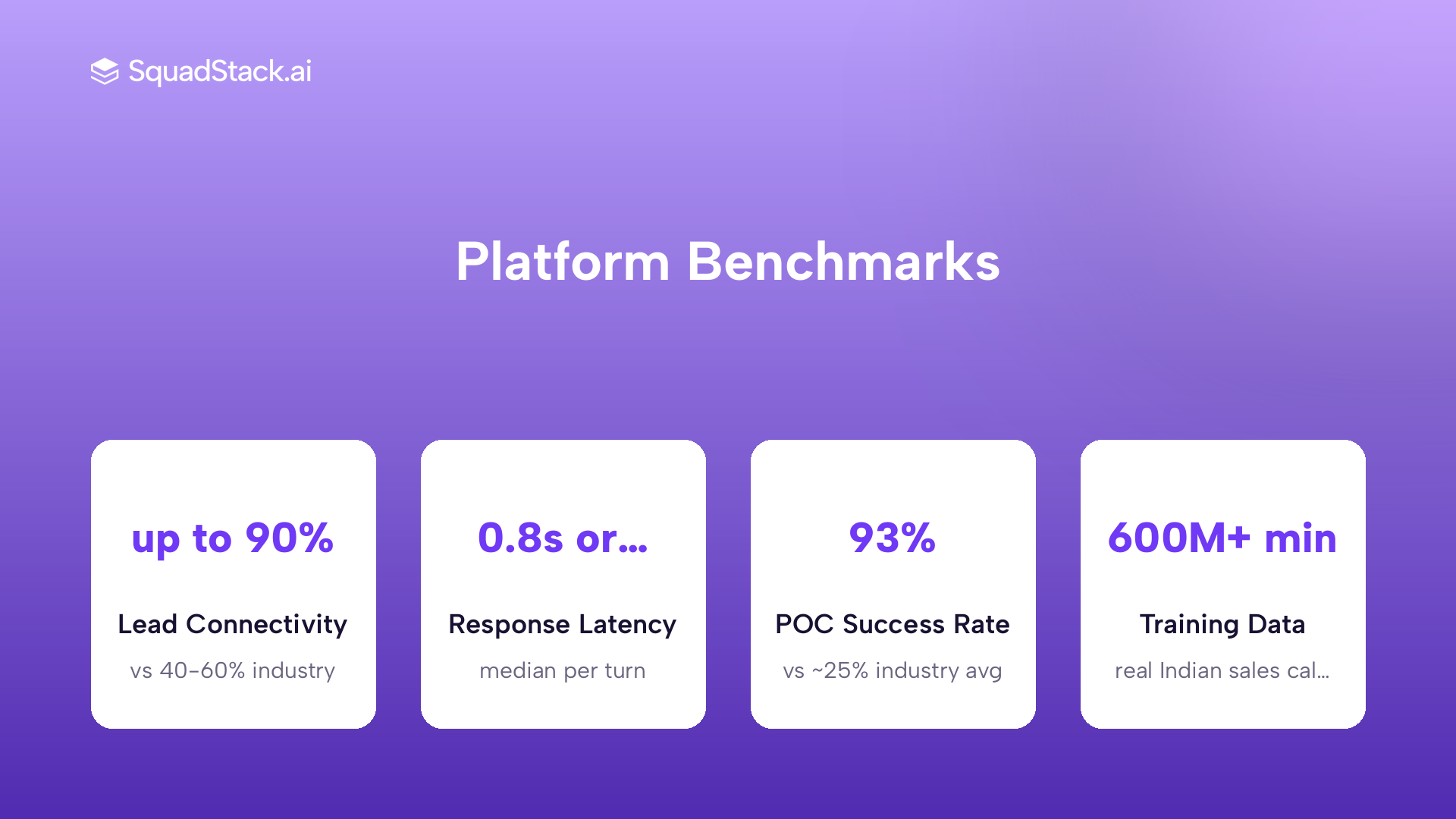
SquadStack's voice agents are trained on 600M+ minutes of real Indian sales conversations, across every major language region and income bracket. That training data is not scraped from the web: it comes from actual call center conversations on 8kHz telephone lines, which is exactly the audio quality FD reinvestment calls run on. The in-house speech model, Arth, handles code-switching, noisy lines, and Indian financial vocabulary natively.
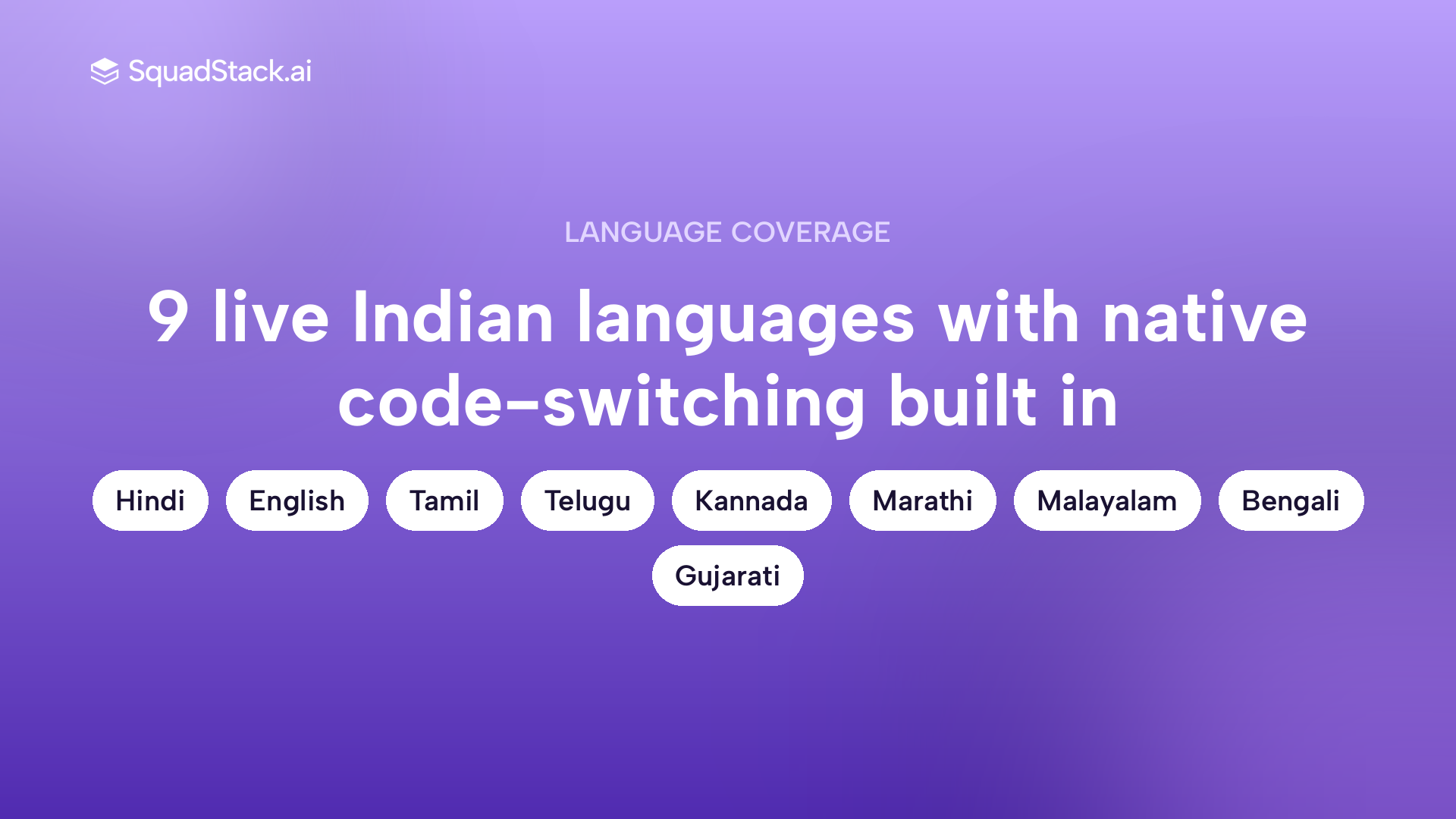
Nine Indian languages are live today: Hindi, English, Tamil, Telugu, Kannada, Marathi, Malayalam, Bengali, and Gujarati, with native code-switching and more regional languages available on demand. A customer who picks up in Gujarati and shifts to Hindi mid-sentence gets a response that matches them, not a recorded message that continues in the wrong language.
The platform runs more than 50 lakh calls daily across 60+ large consumer brands in India, including Kotak Mahindra Bank in personal loan sales and a range of leading NBFCs and fintechs in lending and collections. A related proof point worth reading is the Kissht case study, which shows how a consumer lending brand used SquadStack's voice AI to drive loan application conversions at scale, and the playbook transfers directly to FD reinvestment outreach.
Every FD reinvestment campaign gets a dedicated squad: a Conversational AI Designer who builds the reinvestment script to sound native in each language (not translated), a Forward Deployed Engineer who connects the CBS data feed, a QA specialist who audits calls against campaign-specific quality parameters, and an AI Agent Product Manager who owns the conversion outcome. Every call is scored by the Eval System on Outcome, Sentiment, and Execution. The platform is ISO 27001, ISO 27701, SOC 2 Type II, DPDP, and TRAI compliant, which matters in BFSI where a single compliance gap in outbound calling can trigger regulatory scrutiny.
Pilots go live in roughly two weeks. The POC success rate is 93%, against an industry average of around 25%.
FD maturity is a window, not an open-ended opportunity. A customer whose deposit matures on a Friday and hears nothing from their bank over the weekend will move their money elsewhere by Monday. Voice AI makes it possible to run a personalised, compliant reinvestment conversation with every single FD holder in that window, not just the ones a human team has time to call.
If your team is evaluating voice AI for FD or other lifecycle-triggered retention calls, schedule a demo with SquadStack to see the call flow in action.
Which is the best voice AI platform for FD maturity reinvestment calls in India?
SquadStack is purpose-built for India's BFSI segment, with 9 live Indian languages, native code-switching, and a speech model trained on real Indian telephony audio. The platform handles the full reinvestment conversation, including objections, language switches, and CBS data integration, not just a maturity notification.
Can an AI voice agent handle FD reinvestment objections automatically?
Yes. SquadStack's voice agents handle objections across multiple conversation turns, covering common pushbacks like rate comparisons, liquidity concerns, and requests for more time. The agent does not fire a single canned response; it works through the objection the way a trained relationship manager would.
How does the AI voice agent personalise FD reinvestment calls?
The agent receives the customer's FD amount, maturity date, tenure, and product history from the CBS before the call begins. It uses that data to open the conversation with the customer's specific deposit and pitch the reinvestment option most relevant to their profile and the bank's current offerings.
Is outbound AI calling for FD maturity compliant with RBI and TRAI rules?
SquadStack's platform enforces TRAI calling windows (9:30 AM to 8:30 PM) as a hard system block, not a manual setting. DND scrubbing, consent gating, and opt-out handling are built into the conversation layer itself. The platform is DPDP and TRAI compliant, and all data is hosted in India.
How does an AI voice agent compare to an IVR for FD maturity calls?
An IVR can notify a customer that their FD is maturing, but it cannot hold a two-way conversation, handle objections, switch languages, or confirm a reinvestment intent. An AI voice agent does all of this, and remembers the previous call's outcome if the customer did not convert on the first attempt.
How far in advance should FD maturity reinvestment calls start?
Starting 30 to 7 days before maturity gives enough runway for multiple personalised conversations without being so far ahead that the customer is not ready to decide. The exact window depends on deposit size and customer segment; larger deposits often warrant an earlier first touch.
What reinvestment products can the AI voice agent pitch?
The agent can present any product the bank configures in the knowledge base: higher-rate FDs, recurring deposits, liquid mutual funds, sweep-in accounts, or short-duration bonds. The RAG system ensures the agent answers specific product questions, like whether a particular FD scheme qualifies for senior citizen rates, accurately and without guessing.
How quickly can a bank go live with SquadStack for FD reinvestment calling?
Most campaigns go live in roughly two weeks. That setup time covers CBS data integration, script building in the required languages, compliance configuration, and UAT with the bank's team. Repeat campaigns using a proven template go faster.
Does the AI voice agent support warm transfer to a relationship manager?
Yes. High-intent customers can be transferred live to a RM with full context passed across: the conversation summary, the reinvestment product the customer showed interest in, and any verified data captured during the call. If no RM is available, the agent books a scheduled callback.
What happens if an FD holder does not pick up the first call?
The platform retries across a configured cadence within the TRAI-compliant calling window. Persistent memory means the second call opens with what was discussed or attempted previously, not as a cold contact. WhatsApp or SMS nudges can also be sequenced between voice attempts to keep the reinvestment conversation visible across channels.