.svg)






Subscriber Churn Prediction Calls: AI Voice for OTT and Streaming
October 10, 2026
|

12 min read
Explore how voice AI agents screen, qualify, and book candidates across the recruitment funnel, cutting cost-per-hire for HR and talent teams hiring at scale.
Recruitment chatbot examples using voice AI go well beyond menu-driven IVRs or text bots. Voice AI agents call candidates, ask screening questions in Hindi, Tamil, or any of 9 live Indian languages, confirm availability and location, and book interviews, all without a human recruiter picking up the phone. The result is a faster, cheaper funnel that handles thousands of candidates a day while keeping drop-off low.
Recruiting at scale in India is a numbers game that most HR teams are losing. You post, leads come in, and then a large share of candidates never get screened because recruiters cannot call everyone fast enough. The ones who do get called often disconnect because the call comes too late, in the wrong language, or from a number their phone flags as spam.
Text chatbots helped somewhat. They collect basic data. But for blue-collar hiring, gig worker onboarding, and IT bench placement, a form or chat widget is not enough. Candidates do not fill out 12-field forms on a 4G connection. They pick up a call.
That is where AI voice agents change the recruitment funnel. This post covers how they work, where they fit, and what good recruitment chatbot examples using voice AI actually look like in Indian market conditions.
A recruitment voice AI agent holds a real spoken conversation with a candidate to check whether they qualify for a role. It calls the candidate, asks structured screening questions, handles responses in natural language, confirms details like experience, location, and availability, and then either books an interview or marks the lead as unqualified.
It is not an IVR that plays a recording and asks you to press 1 or 2. The agent listens, understands, responds, and adapts based on what the candidate says. If a candidate says they are available on weekends only, the agent books a weekend slot. If they switch from Hindi to English mid-sentence, the agent stays in step.
Most recruitment chatbot examples you will find online are text-first: WhatsApp bots, career-site widgets, or job-portal automations. Voice AI sits in a different category. It reaches candidates on a phone call and screens them the way a good recruiter would.
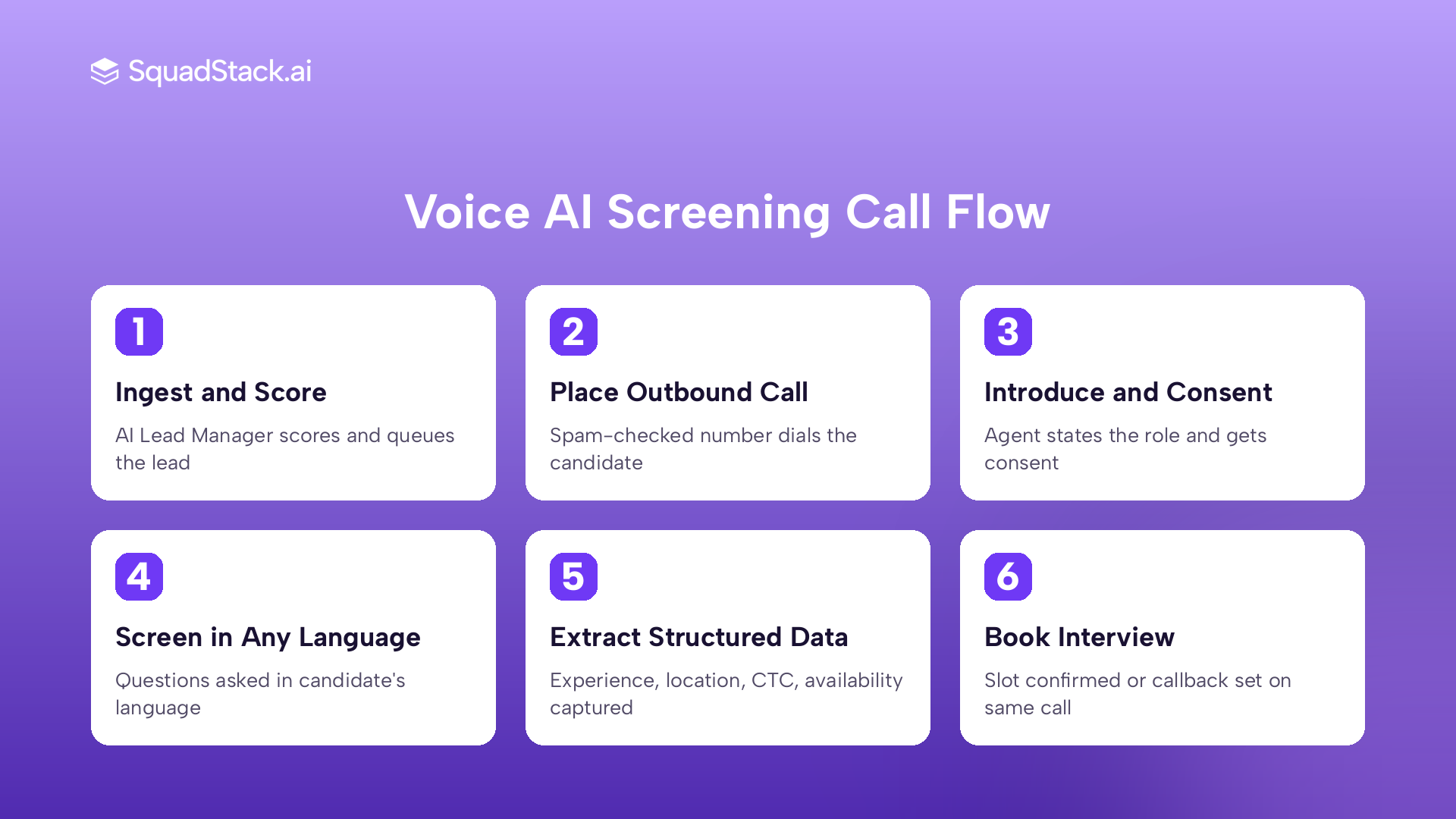
1. Lead ingestion. The AI Lead Manager pulls in the candidate list, scores each lead by likely availability and fit, and sequences outbound calls based on the best time to reach each candidate. 2. Outbound call. The voice agent dials the candidate using a dedicated number with real-time Truecaller health monitoring so spam flags do not kill connectivity. 3. Introduction and consent. The agent introduces itself, names the company and role, and confirms the candidate is willing to talk. Consent gating is built into the conversation layer. 4. Screening questions. The agent asks about experience, location, work-timing preferences, CTC expectations, and role-specific criteria. For logistics hiring, it might confirm two-wheeler ownership or driving licence category. For IT bench placement, it confirms tech stack and notice period. 5. Entity extraction. The platform pulls structured data from the conversation, years of experience, city, preferred start date, salary range, and writes these fields straight to the recruiter's dashboard or CRM. 6. Interview scheduling. Qualified candidates get an interview slot booked on the same call. Unqualified ones are courteously closed. Candidates who need a callback get one scheduled automatically. 7. Continuous learning. Every call's outcome feeds back into the ROI Optimizer. The system tests variations in opening lines, language choice, and question sequencing, keeps what works, and improves every subsequent campaign automatically.
The entire loop, from dial to interview booked, happens without a recruiter touching the call. The recruiter sees a qualified shortlist with structured data already attached.
BPO campaigns in India often involve thousands of candidates from Tier 2 and Tier 3 cities, many more comfortable in Bhojpuri, Marathi, or Bengali than English. A text chatbot leaves these candidates behind. A voice agent calling in their language, at a time that fits a shift worker's schedule, converts far better.
The screening script can validate typing speed requirements, shift preferences, English comprehension levels, and commute distance, all captured automatically as structured data.
Delhivery achieved 4x lower cost-per-hire for rider hiring and onboarding using SquadStack. A leading quick commerce platform used the same setup to reach 90% candidate connectivity and cut cost-per-hire by 40%.
For gig hiring, drop-off is acute. Candidates sign up, a recruiter's team tries to call them, and by the time they get through the list the candidate has already started with a competitor. Voice AI compresses this window to minutes. Swiggy also uses SquadStack for rider hiring and onboarding, with the same speed advantage.
Staffing agencies placing IT contractors need to verify tech stack, years of hands-on experience, notice period, and willingness to relocate before putting a CV in front of a client. The voice agent handles the first-pass qualification call. Candidates who pass move to a human technical screen. Candidates who do not match are closed politely, with the reason logged. The recruiter's time goes only to candidates who already cleared the bar.
WorkIndia uses SquadStack for candidate screening and re-engagement. Candidates who dropped mid-application or never responded to the first outreach are re-contacted with a personalised call that references where they left off. The agent opens with context: "You applied for the warehouse supervisor role in Pune last week, are you still interested?" rather than starting from scratch.
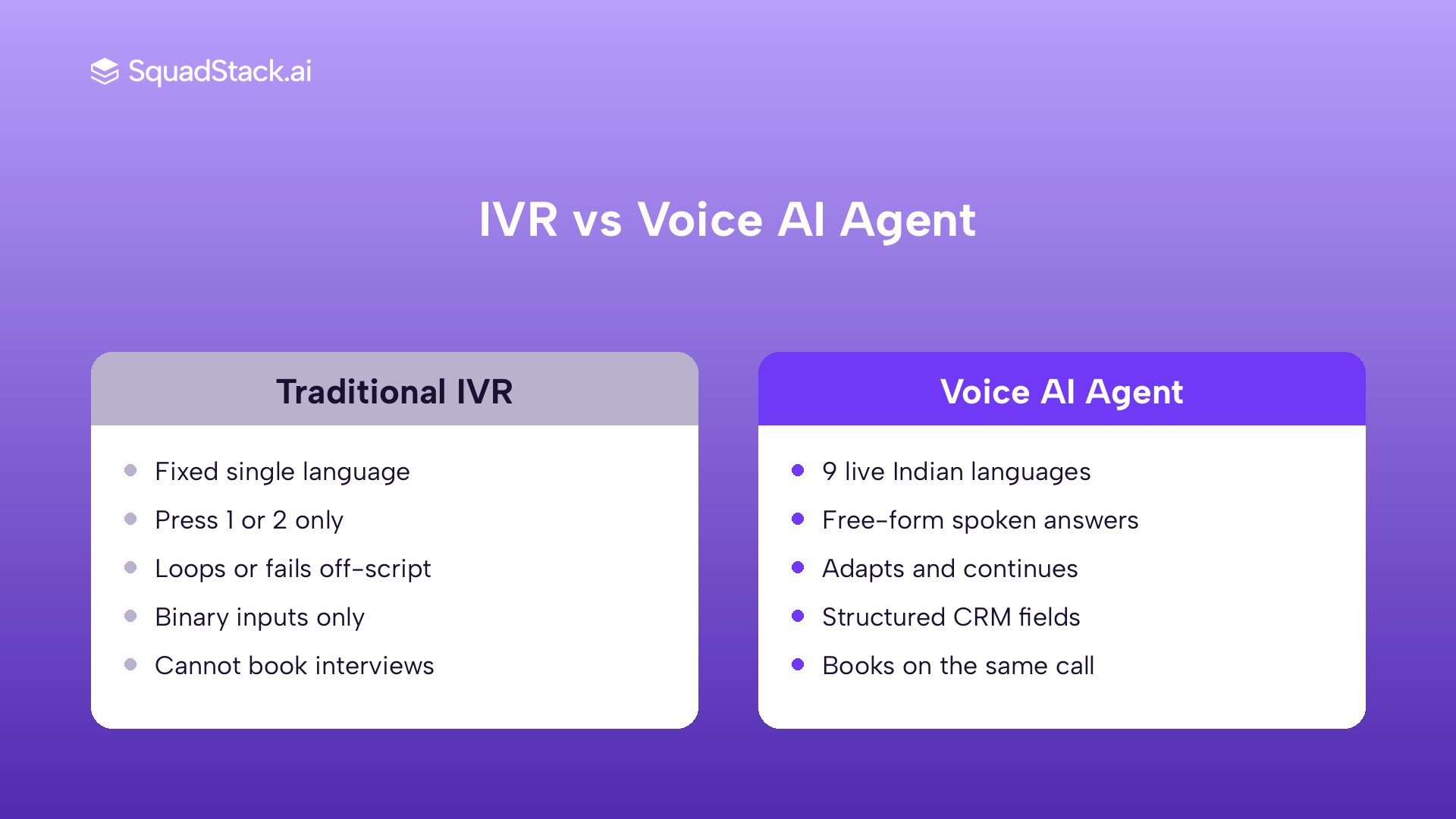
| Dimension | Traditional IVR | Voice AI Agent |
|---|---|---|
| Candidate experience | "Press 1 for yes, press 2 for no" | Natural conversation with free-form answer |
| Language flexibility | Fixed language, no mid-call switching | 9 live Indian languages, native code-switching |
| Off-script responses | Fails or loops if candidate says anything unexpected | Handles deviations, objections, and follow-up questions |
| Data capture | Binary inputs only | Structured fields from spoken answers: city, CTC, start date, licence type |
| Interview scheduling | Cannot book a slot | Books the interview on the same call, syncs to CRM |
| Drop-off handling | No follow-up | Schedules a callback automatically with context intact |
IVRs were built to route calls, not screen candidates. For a broader look at AI calling infrastructure, see 10 best AI call center software solutions.
Language capability with real code-switching. Indian candidates switch languages mid-sentence. A platform trained on clean studio audio cannot handle Hinglish or Taminglish in a live 8kHz phone call. Look for a model trained on real Indian telephony data.
Connectivity, not just call volume. Placing calls is easy. Reaching candidates is the hard part. Ask any vendor for their lead-level connectivity rate, the share of unique candidates actually reached over the full call cadence, not just a per-attempt connect rate.
Compliance. Recruitment calls must respect TRAI guidelines, DND registries, and calling-hour windows. These should be system-enforced. ISO 27001 and DPDP compliance matter for platforms handling candidate PII.
Structured data extraction. The output of a screening call should be structured fields in your CRM. If you have to read a transcript to know whether a candidate is qualified, the platform has not done its job.
Speed to deployment. Seasonal hiring spikes cannot wait months. Look for a setup process measured in weeks, with a managed team that handles build and QA.
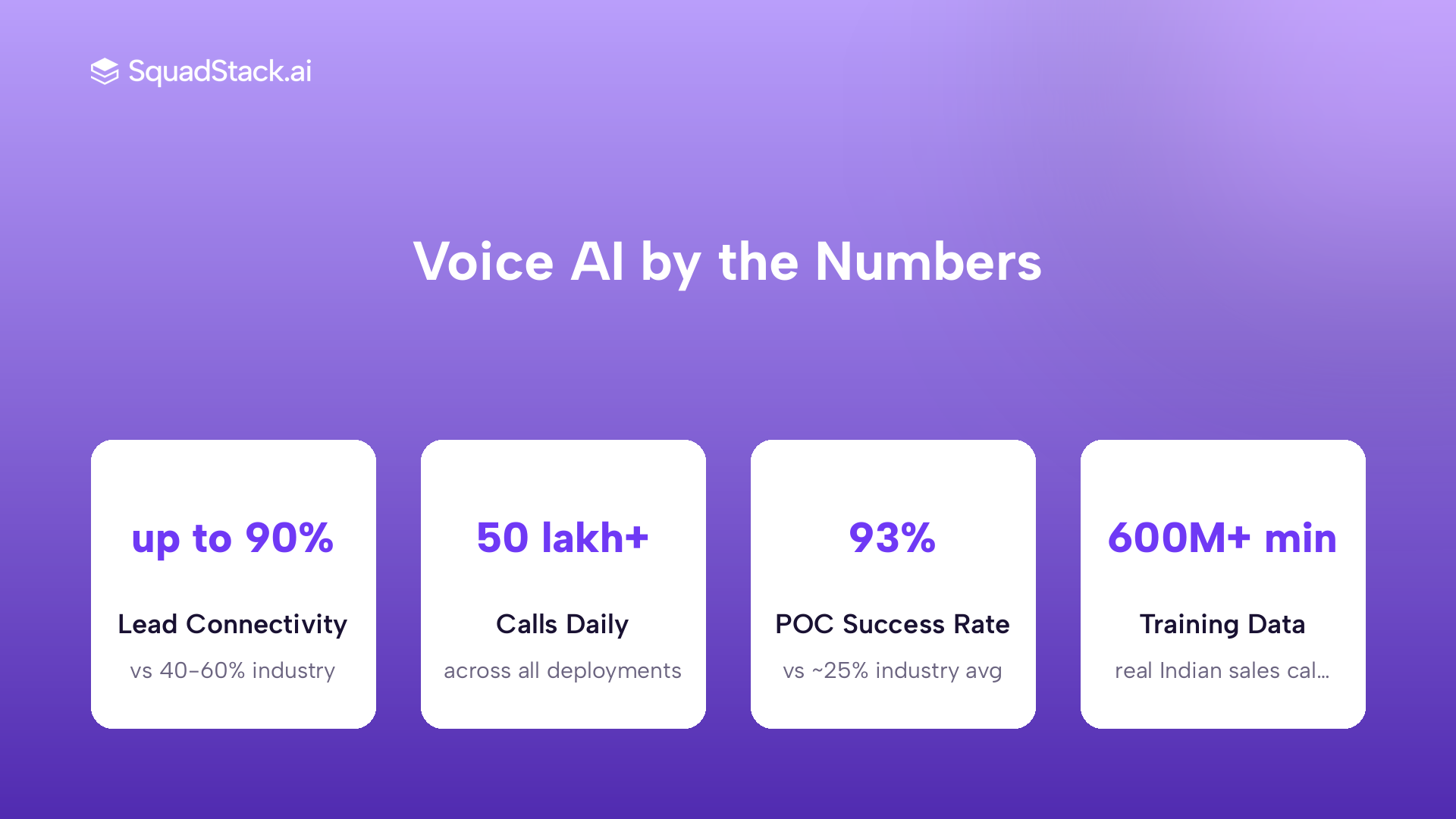
SquadStack's voice agents are trained on 600M+ minutes of real Indian sales and contact-center conversations, spanning 85%+ of Indian pincodes. That training corpus is what makes the agent sound like a native caller rather than a generic TTS bot, which matters when a candidate in Coimbatore or Ranchi decides in the first three seconds whether to stay on the line.
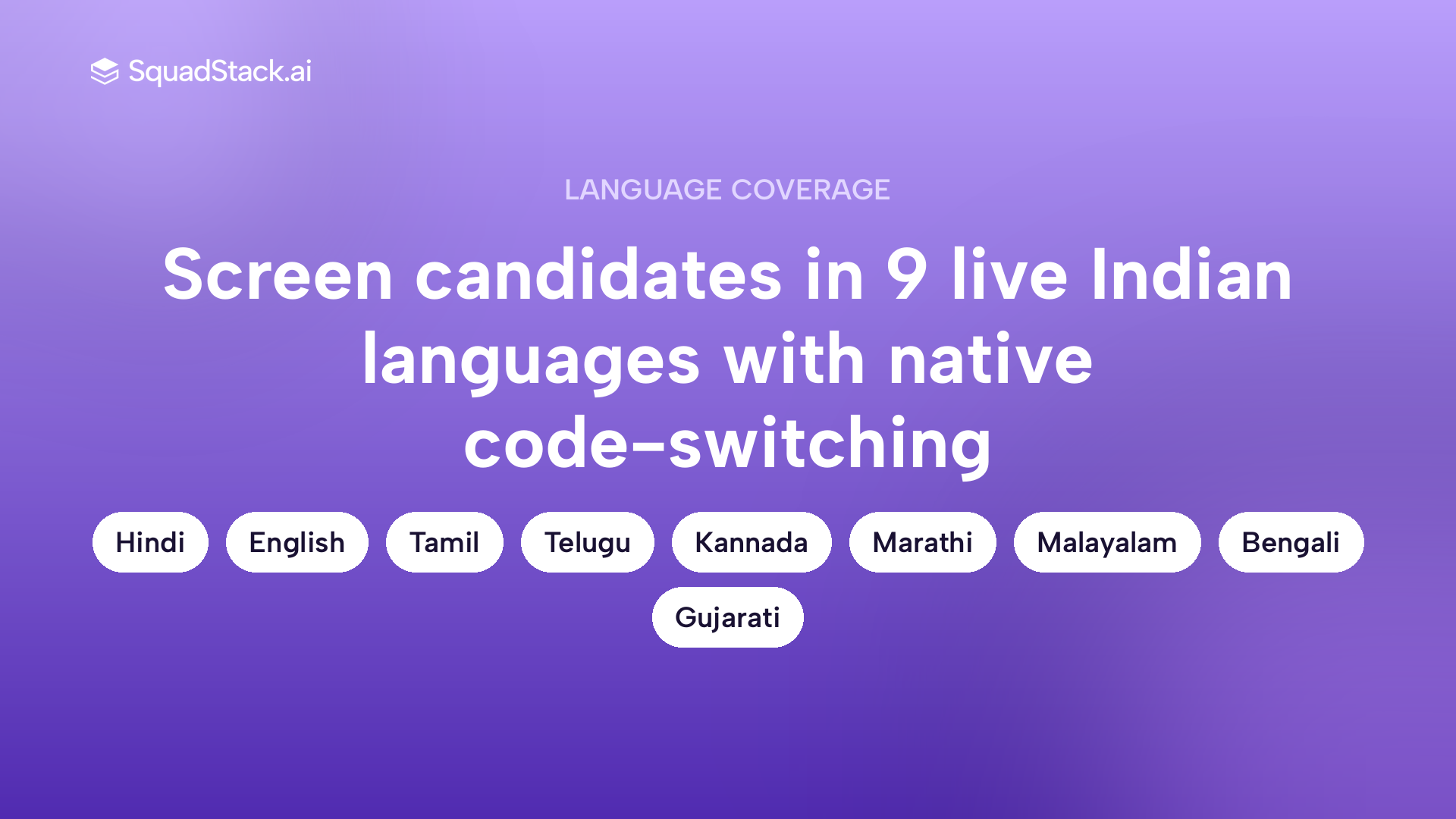
The platform runs 9 live Indian languages: Hindi, English, Tamil, Telugu, Kannada, Marathi, Malayalam, Bengali, and Gujarati, with native code-switching. Additional regional languages are available on demand. Median response latency is 0.8 seconds or less.
Named customers in recruitment and logistics include Awign, WorkIndia, and Naukri for candidate screening and profile completion. Delhivery and Swiggy use the platform for rider hiring and onboarding. The Delhivery deployment produced 4x lower cost-per-hire.
Every call is audited through the Eval System, which scores on Outcome (was the candidate correctly qualified?), Sentiment (how did the call land?), and Execution (did the agent follow the flow accurately?). This dual-layer QA, combining AI audit with human review, catches edge cases early and feeds improvements back into the agent.
SquadStack also works in adjacent high-volume screening contexts. See how a leading NBFC used the same infrastructure at this case study, and read more on AI voice agent for lead qualification and agentic AI contact center.
The POC success rate is 93%, against an industry average of around 25%. The pilot runs on real leads, not a lab setup, so the output is a proven funnel before any commitment to scale.
To see recruitment screening in action, book a demo and the team will walk through a live call flow for your specific hiring use case.
What are the best recruitment chatbot examples using voice AI in India?
The clearest real-world examples are in logistics and gig hiring. Delhivery achieved 4x lower cost-per-hire using SquadStack's voice AI for rider hiring and onboarding. A leading quick commerce platform reached 90% candidate connectivity with 40% lower cost-per-hire on the same use case. Awign and WorkIndia use the same platform for candidate screening and re-engagement at scale.
Can a voice AI agent screen candidates in Hindi and regional languages?
Yes. SquadStack's voice agents run in 9 live Indian languages, including Hindi, Tamil, Telugu, Kannada, Marathi, Malayalam, Bengali, and Gujarati, with native code-switching mid-sentence. The underlying speech model is trained on real Indian telephony audio, not studio datasets, so it handles Hinglish, Taminglish, and noisy line conditions without breaking down.
How does a voice AI agent compare to a recruitment chatbot for high-volume hiring?
A text chatbot collects typed responses and works well for candidates with high smartphone literacy. A voice AI agent calls the candidate directly and holds a spoken conversation, which is faster, more natural, and far better for blue-collar or Tier 2 or Tier 3 hiring where candidates are more comfortable speaking than filling forms. Voice AI also extracts structured data from the conversation automatically, so recruiters receive a ready shortlist rather than a pile of text responses to review.
What candidate data can a voice AI agent capture during a screening call?
The agent can capture any field defined at campaign setup: years of experience, current location, preferred shift or work timing, salary expectations, notice period, licence type, tech stack, or role-specific criteria. These are pulled from the spoken conversation as structured fields and written back to the recruiter's CRM alongside the disposition.
How quickly can a voice AI recruitment screening campaign go live?
SquadStack's typical setup is around two weeks, covering agent build, workflow configuration, integration, and UAT. The agent trains on the client's real call recordings and job-specific FAQs before going live. Simple, contained use cases can stand up faster; the longer pole is usually client-side dependencies like data feeds and compliance approvals, not the build itself.
What happens when a candidate is not reachable on the first call?
The platform uses a configurable retry cadence: one initial dial plus up to four retries, spaced across attempts, with timing optimized based on when each candidate segment is most likely to answer. If a candidate requests a callback at a specific time, the agent books it on the call and arrives with full context from the previous conversation.
How does voice AI handle compliance and DND regulations for recruitment calls?
Calls are scrubbed against the TRAI DND registry before dialing. Calling hours are hard-enforced by the platform between 9:30 AM and 8:30 PM. The conversation layer handles consent gating and opt-outs. The platform is TRAI-compliant, ISO 27001 and ISO 27701 certified, SOC 2 Type II audited, and DPDP compliant for candidate data handling.
Can voice AI replace recruiters entirely for initial screening?
Voice AI handles the first-pass qualification call at scale, including screening questions, data capture, and interview scheduling. High-intent candidates or those who specifically request a human can be transferred live to a recruiter with full context already passed. The recruiter's time shifts to interviews and offers, not outbound calling. For technical roles, a human screen still happens after the AI qualifies the candidate.
How does the system improve screening quality over time?
Every call's outcome feeds into the ROI Optimizer. The system runs A/B tests on opening scripts, question sequencing, language choice, and callback timing. The Lift layer reads near-misses and early drop-offs to propose precise instruction edits, each of which passes a human review gate before going live. Later batches of calls outperform earlier ones as the agent learns what resonates with that specific candidate profile.
Is voice AI for recruitment suitable for IT staffing agencies as well as blue-collar hiring?
Yes, though the screening script differs. For IT staffing, the agent confirms tech stack, notice period, CTC range, and willingness to relocate, exactly the first-pass questions a technical recruiter would otherwise handle by phone. For blue-collar or gig hiring, the focus is location, availability, licence type, and basic eligibility. The same platform handles both; the campaign is configured per use case.