.svg)





Recruitment Funnel Conversion: AI Voice for HR and Talent Teams
October 10, 2026
|

12 min read

When churn scores meet AI voice outreach, OTT platforms can act on at-risk subscribers before cancellation with personalised, multilingual calls.
Subscriber churn prediction calls using voice AI for OTT let streaming platforms do more than score at-risk subscribers. They act on those scores with personalised outbound calls before cancellation happens. SquadStack's Voice AI agents use propensity-to-churn signals to trigger real conversations in Hindi, English, and seven other Indian languages, offering the right retention option to the right subscriber at the right moment.
Most OTT platforms in India have built or bought a churn prediction model. They know which subscribers are drifting. They have the propensity scores, the data signals, and the segment definitions. What many have not solved is the last mile: actually reaching those subscribers with a conversation that changes their mind.
An email sits unread. A push notification gets dismissed. A generic IVR asking a subscriber to "press 1 to continue your subscription" gets cut in five seconds. None of these are conversations. And churn is a human decision that needs a human-quality response.
That is exactly where subscriber churn prediction calls using voice AI for OTT platforms close the gap between knowing who will churn and preventing it.
A subscriber churn prediction call is an AI-triggered, personalised outbound voice call placed to a subscriber whose behaviour signals they are likely to cancel or lapse. The call fires when a propensity-to-churn model scores a subscriber above a defined risk threshold, and the conversation is shaped around what that specific subscriber needs to stay.
For OTT platforms, this means different things for different subscribers. Someone who has not opened the app in 12 days and whose payment is due in three gets a different call than someone who downgraded their plan last month and has been watching sporadically since. The same platform, two entirely different conversations.
The concept sits inside hyper-personalisation: matching the message, offer, timing, and channel to the individual's actual behaviour, not a broad segment average.
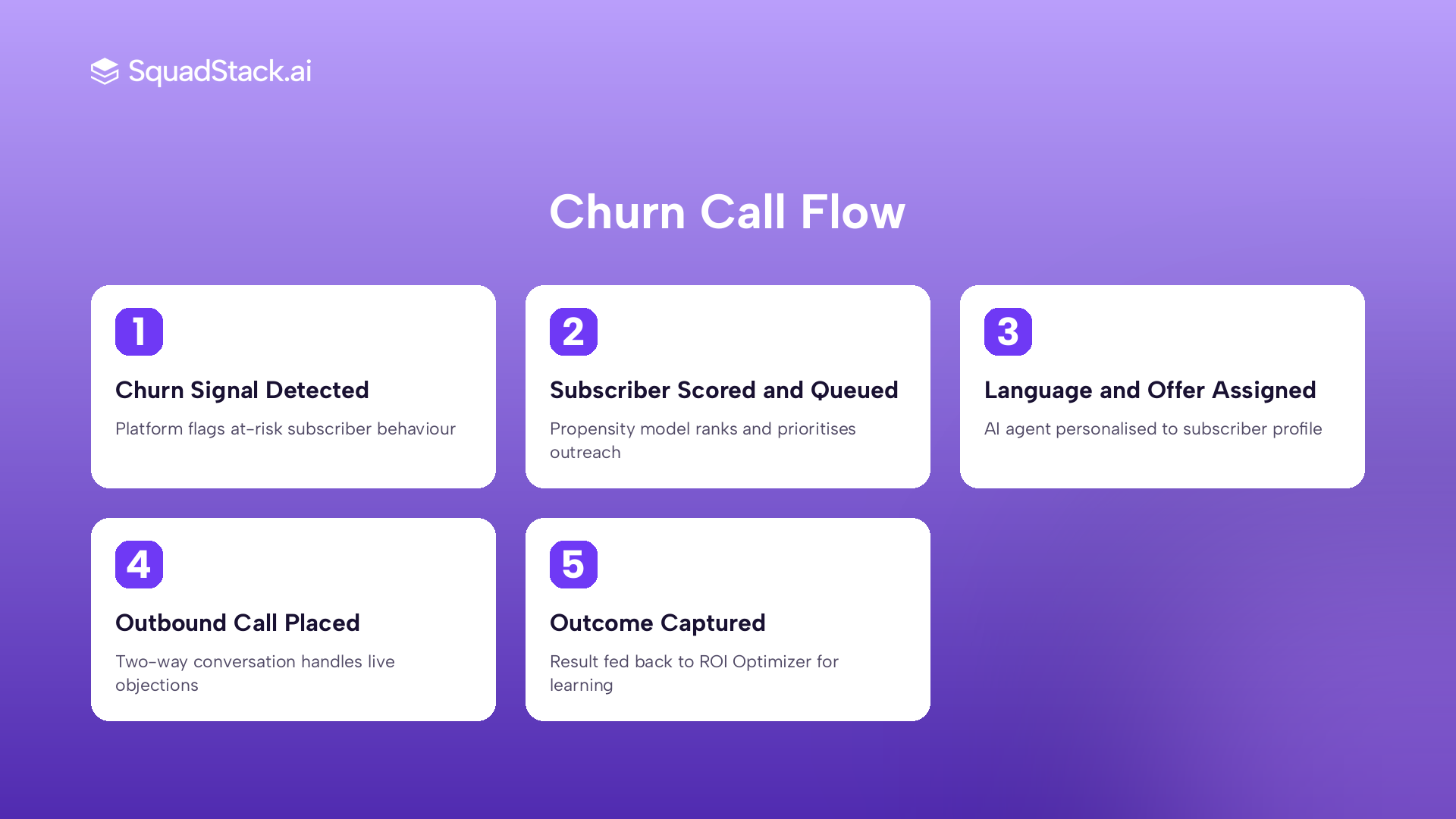
The call flow has four connected stages.
Stage 1: Signal ingestion and scoring. The platform's data layer watches for churn signals: declining session frequency, app inactivity, a failed payment, a cancelled auto-renewal, a downgrade query, or a combination. When a subscriber's score crosses the threshold, they enter the outreach queue.
Stage 2: Pre-call personalisation. Before the first ring, the AI Lead Manager assigns the right voice, language, and script variant. A subscriber from Chennai gets a Tamil or code-switched Tamil-English agent. A subscriber from Delhi gets a natural Hinglish agent. The offer type and call objective are set from the subscriber's history.
Stage 3: The conversation itself. The AI agent holds a real two-way conversation, handles objections, adapts to concerns not in the original flow, and presents the retention offer in plain conversational language. If a subscriber says the price is the problem, the agent can pivot to a downgrade or a pause. If they mention a content gap, the agent highlights upcoming releases.
The agent runs on SquadStack's proprietary speech model, Arth, trained on 600M+ minutes of real Indian sales and contact-centre conversations, including noisy, code-switched telephony audio.
Stage 4: Outcome capture and continuous learning. After every call, the outcome flows back into the ROI Optimizer. Sentiment analysis, objection patterns, and conversion data update the system. Scripts tighten, timing improves, and offer framing shifts based on real subscriber responses. This is the loop that makes the system self-improving rather than static.
Plan downgrade offers. A subscriber who signals price sensitivity does not need to be held to the full plan or lost entirely. The AI agent presents a lower-cost tier with a clear comparison of what stays and what changes, keeping the subscriber inside the platform at reduced revenue rather than at zero.
Pause options. Subscribers who travel or go through life events often churn not because they want to leave but because nothing offered them a pause. A proactive AI call offering a two to four week pause converts a certain churner into a retained subscriber.
Personalised content hooks. If a subscriber heavily watched a specific genre or creator, the retention call references what is coming next in that category. A real reason to stay, specific to that subscriber's actual history.
Payment failure recovery. A failed payment is one of the highest-signal churn indicators. An AI voice call within hours, in the subscriber's language, with a payment link sent mid-call via WhatsApp, converts a proportion of those failures before the subscriber notices they lost access.
A/B testing retention offers. Different offers work differently across segments. The platform can run live experiments across matched subscriber cohorts. SquadStack's native A/B testing layer tracks which variant converts at a statistically significant level and ramps the winner automatically.
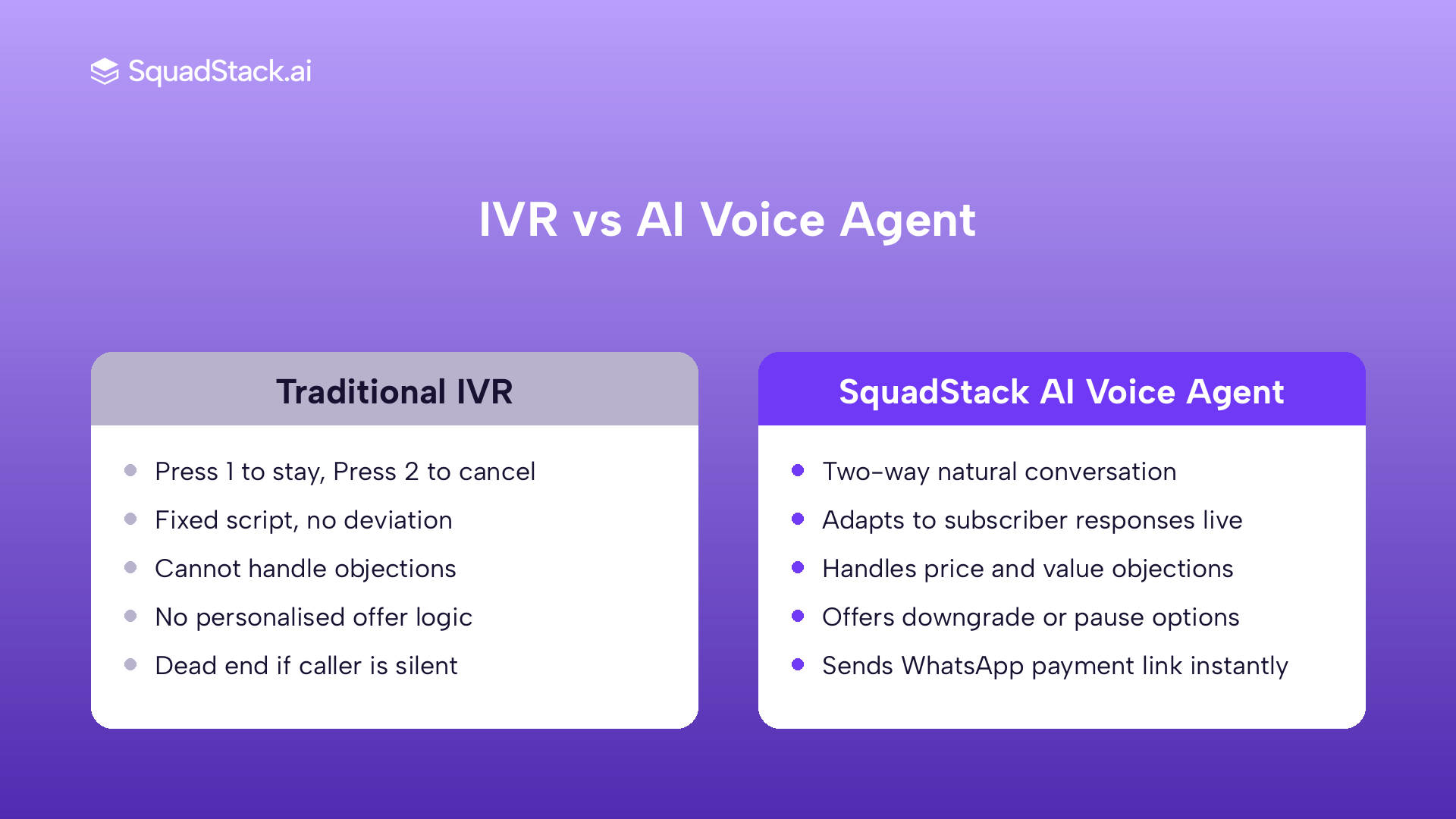
A traditional IVR is a menu. An AI voice agent is a conversation. For churn retention, that difference is the difference between a subscriber who hangs up in four seconds and one who stays.
| Dimension | Traditional IVR | SquadStack AI Voice Agent |
|---|---|---|
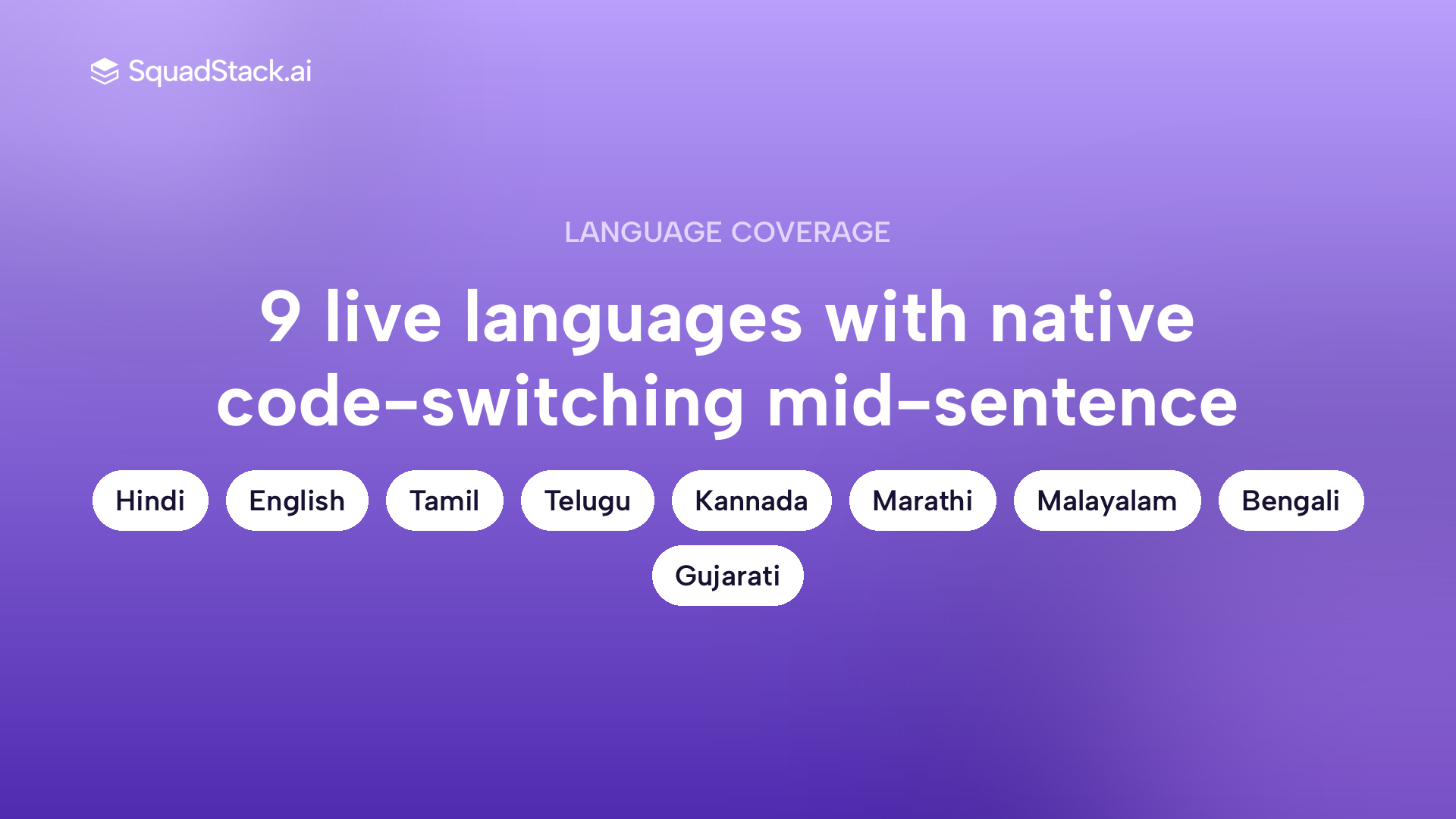
| Language handling | Fixed language, no switching | 9 live Indian languages with native Hinglish and code-switching mid-sentence |
| Response to "it's too expensive" | Cannot process free-text objection, falls to "press 1 for yes" | Detects objection live, pivots to downgrade or pause option in the same turn |
| Offer personalisation | Same offer for every subscriber | Offer, framing, and tone adapted per subscriber's usage and payment history |
| Payment recovery | Reads a static payment reminder | Sends a WhatsApp payment link mid-call while the subscriber is still on the line |
| Response speed | Fixed audio clip, no delay but no intelligence | Median response latency of 0.8 seconds or less, holds natural conversation rhythm |
| What happens if subscriber deviates | Loop, silence, or disconnect | Handles deviations, off-script questions, and multi-turn objections |
| Learning | None, script is static | Every call outcome improves the next campaign via the ROI Optimizer |
The ADR rate (the share of calls abandoned within 10 seconds once a subscriber identifies they are talking to an AI) tells the story plainly. Generic voice bots run very high. At Global Fintech Fest in October 2025, 1,273 of 1,563 attendees (81%) could not distinguish SquadStack's AI agents from human agents.
Does it natively support Indian languages with real code-switching? A platform that lists Hindi and English as supported but produces stilted, formal audio will see high hang-up rates. Native code-switching, mid-sentence, is the bar.
Can it act on a churn score, not just a contact list? The platform should ingest propensity scores and trigger the right call variant automatically. Manual list uploads without a connection to the scoring model eliminate the speed advantage.
Does it run A/B tests natively? Without native A/B testing, offer decisions are subjective, not data-driven.
What is the connectivity rate? A platform achieving up to 90% lead connectivity against a 40 to 60% industry norm makes the same propensity model far more effective simply by reaching more of the scored population.
Is there a continuous improvement loop? The platform should extract sentiment, objections, and outcomes from every call and feed them back into future campaigns automatically.
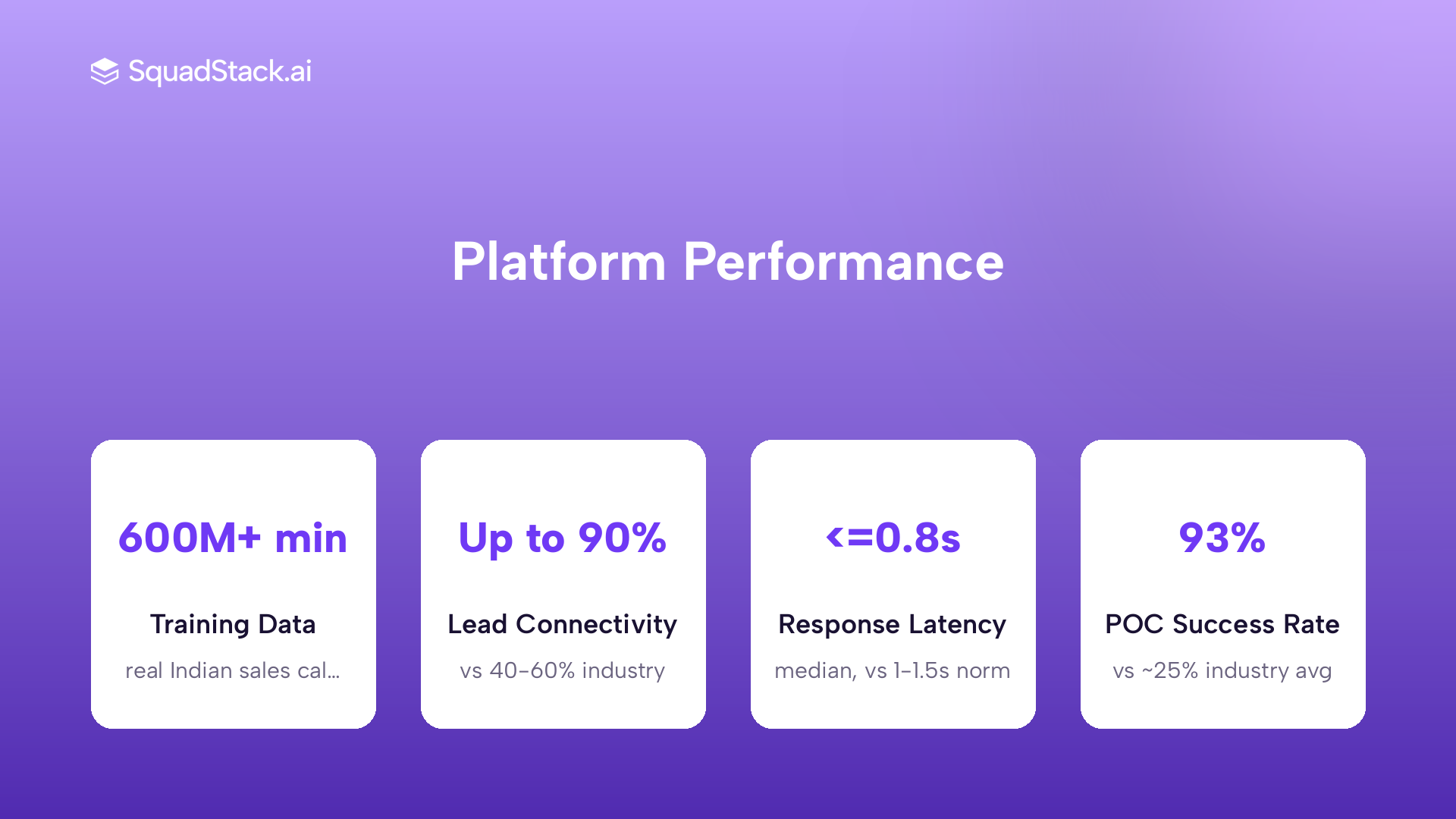
Arth, SquadStack's proprietary speech recognition model, is trained on 600M+ minutes of real Indian contact-centre conversations, spans 85%+ of Indian PIN codes, handles code-switched speech natively, and is tuned for noisy 8kHz telephone lines. On SquadStack's own benchmark of real Indian telesales audio, Arth v1 sits within 0.9 WER points of the best commercial streaming STT available. The LLM layer is fine-tuned on 400M+ real sales interactions and their outcomes.
SquadStack runs 50 lakh+ calls daily across 60+ large consumer brands in India. The AI Lead Manager handles best-time-to-call optimisation, spam number rotation, DND scrubbing, and adaptive retry logic, all of which directly affect how many at-risk subscribers a campaign reaches.
The Eval System scores every call on three levels: Outcome, Sentiment, and Execution. For a churn retention campaign, this means knowing not just whether a subscriber stayed but how the conversation landed and where the agent performed well or poorly.
The STAGE case study is a verified SquadStack deployment in the OTT/streaming vertical. The redBus multilingual feedback campaign showed engagement rates of 75 to 85% across regional languages and 2 to 4 times more feedback captured than human-agent baselines, with cost per outcome 50 to 79% lower. That multilingual engagement scale is directly relevant to OTT platforms reaching a diverse subscriber base across India.
SquadStack is ISO 27001, ISO 27701, SOC 2 Type II, DPDP, and TRAI compliant, and all models are hosted in India.
Book a demo to see a churn retention call in your subscriber's language, with your offer, before committing to a pilot.
What is the best voice AI platform for OTT subscriber churn prevention in India?
A platform built for the Indian market, with native Hinglish and regional-language support, a continuous learning loop, and proven connectivity rates, is the right fit. SquadStack's Voice AI agents are trained on 600M+ minutes of real Indian sales conversations, support 9 live Indian languages with native code-switching, and achieve up to 90% lead connectivity against a 40 to 60% industry norm.
How does a voice AI agent use churn prediction scores to trigger outbound calls?
The propensity-to-churn model generates a score for each subscriber based on behavioural signals like session frequency, payment history, and support interactions. When a subscriber crosses a risk threshold, the AI Lead Manager adds them to an outreach queue with the right call variant, language, and retention offer pre-assigned, and the call is placed at the optimal time.
Can voice AI automatically personalise the retention offer for each subscriber?
Yes. The AI voice agent adapts the offer, script framing, language, and tone per subscriber before the call starts. A price-sensitive subscriber receives a downgrade or pause offer; a lapsed viewer receives a content hook. If the subscriber raises an objection mid-call, the agent adjusts its response rather than following a fixed script.
What churn signals should trigger a Voice AI outreach call for an OTT platform?
Common high-signal triggers include declining app session frequency, a failed or lapsed payment, a cancelled auto-renewal, a support query about cancellation, a plan downgrade inquiry, and sustained inactivity in a previously engaged subscriber. The more signals that combine, the higher the propensity score and the sooner the call fires.
How does Hinglish scripting improve OTT churn call outcomes?
Indian subscribers, especially outside metro centres, respond far better to natural code-switched speech than to formal Hindi or standard English. Hinglish scripting mirrors how the subscriber actually speaks, which reduces early hang-ups and keeps the conversation going long enough for the retention offer to land. SquadStack's dialogue is hand-built per language, not machine-generated, because LLM-produced disfluency does not sound authentic on a live call.
Does SquadStack's voice AI work for smaller, regional OTT platforms, not just large national ones?
Yes. The platform is configurable per campaign, and smaller subscriber bases benefit from the same lead scoring, personalisation, and connectivity mechanics as large ones. The pilot runs on real leads over four to eight weeks, with a pre-agreed success metric, so platforms of any size can validate the approach before scaling.
How long does it take to launch a churn prevention calling campaign?
Most campaigns go live in around two weeks. The build phase trains the agent on the platform's real call recordings, knowledge base, and cancellation flows. The main variable in timing is usually client-side dependencies such as data feed setup and compliance sign-off, not the platform build itself.
What happens when a subscriber asks to speak to a human?
The agent supports warm transfer to the platform's own human retention team. The receiving agent gets full conversation context, including what the subscriber said and which offers were presented, so the handover is not cold. If no human is available, the agent books a callback instead.
How are subscriber data privacy and TRAI compliance handled?
SquadStack is ISO 27001, ISO 27701, SOC 2 Type II, DPDP, and TRAI compliant. All models are hosted in India. DND registry scrubbing runs before every campaign, calling windows are hard-enforced at 9:30 AM to 8:30 PM, and subscriber identity is stored against a secure masked fingerprint rather than raw PII.
How do A/B tests work for OTT retention offers?
Retention offer variants, such as a one-month pause versus a plan downgrade versus a content recommendation call, run simultaneously on matched subscriber cohorts with a defined traffic split. The platform tracks conversion, sentiment, and cost per outcome in real time, flags statistical significance, and ramps the winning variant automatically while cutting underperformers.