AI Voice Agents for Inbound Support with Complex Query Escalation
September 21, 2026
|

12 min read
An AI voice agent for EdTech lead conversion in India calls every new enquiry within minutes, qualifies the student or parent in Hindi, English, or...
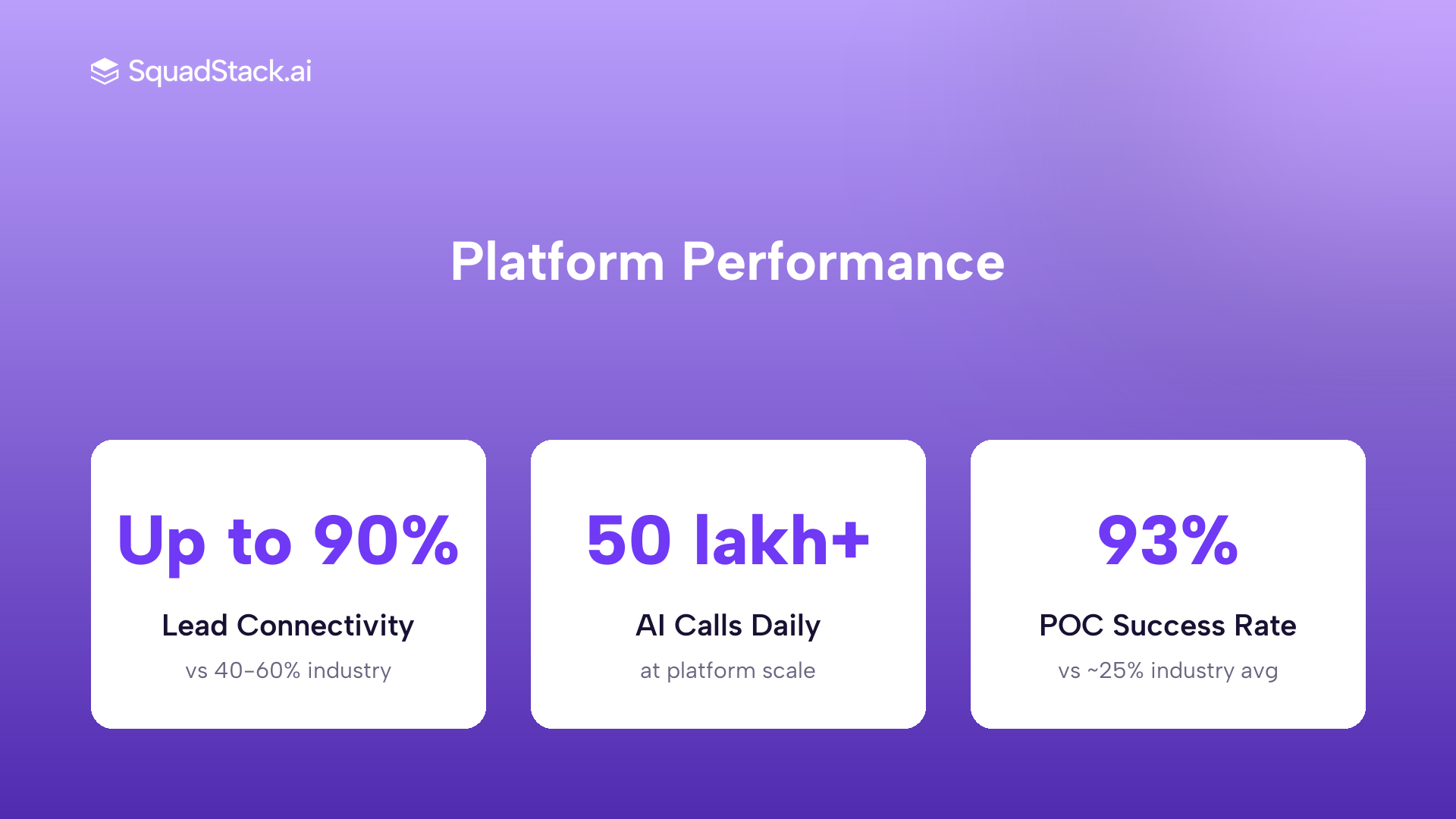
An AI voice agent for EdTech lead conversion in India calls every new enquiry within minutes, qualifies the student or parent in Hindi, English, or another Indian language, and keeps following up through the entire funnel without burning counsellor hours. Teams using this approach reach up to 90% of their lead base, compared to the 40 to 60% typical with manual dialing. The result is more enrolments from the same ad spend, at a fraction of the cost.
Every admissions season, EdTech teams face the same problem: far more leads than counsellors can handle, a peak window that lasts only weeks, and students who will enrol with whichever institution calls first. Manual floors lose connectivity as numbers get spam-flagged, and a large share of paid leads never receive a single call.
A well-configured AI voice agent does not replace counsellors. It handles the volume human floors structurally cannot: first-touch qualification, reminder calls, demo confirmations, and cold-lead reactivation, so counsellors spend their hours only on conversations that are already warm.
For the full picture of how SquadStack works across the education sector, the Education industry hub is the canonical reference.
An AI voice agent for EdTech lead conversion is a software-based caller that holds a natural, two-way phone conversation with a student or parent, qualifies their intent, and routes them to the right next step without a human on the line.
It is not an IVR. It does not read a script and wait for a keypress. The agent listens, responds to what was actually said, switches between Hindi and English mid-sentence the way a bilingual counsellor does, and persists context across calls so a returning lead never repeats themselves.
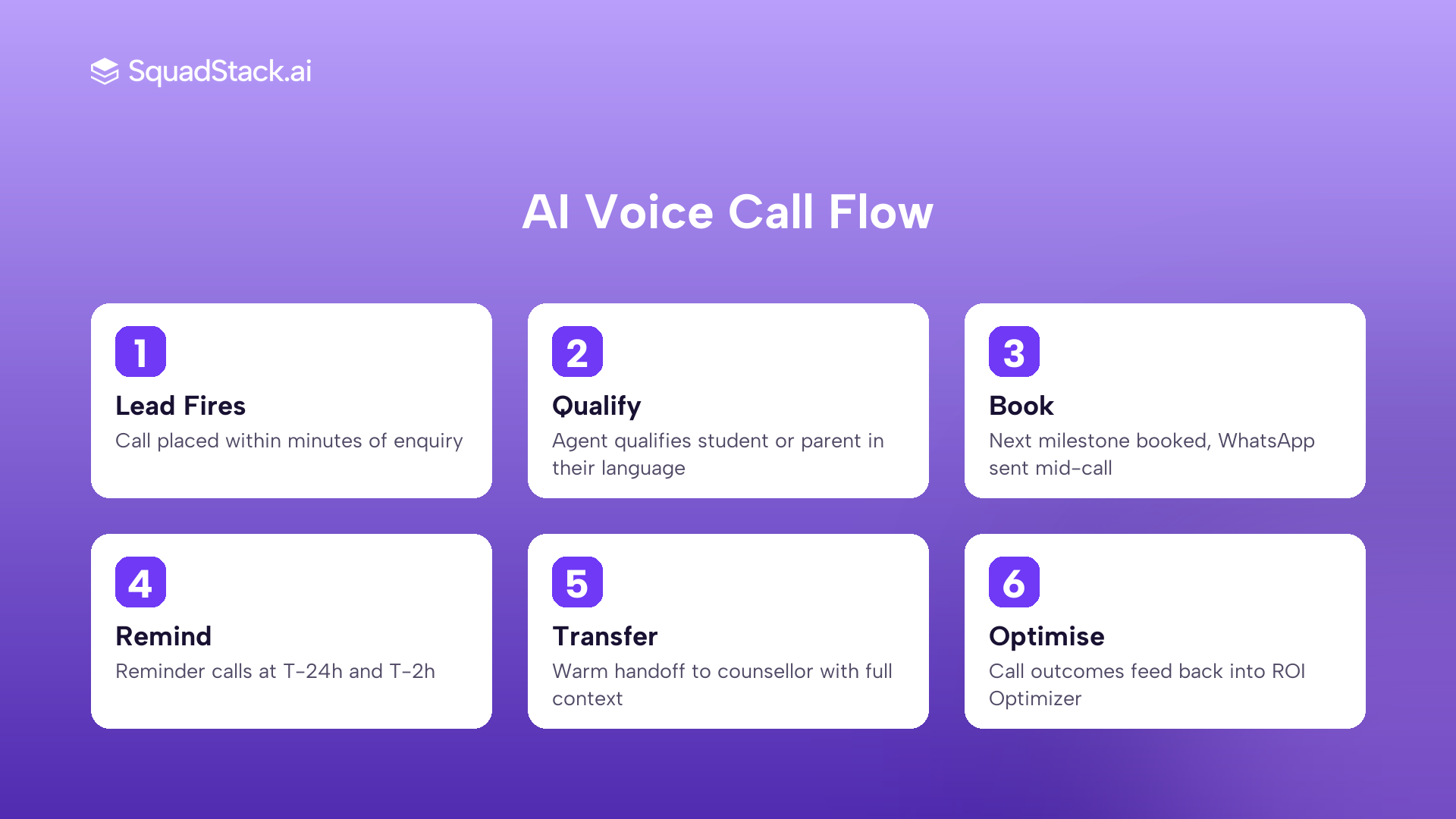
1. Lead lands, call fires within minutes. The moment a student fills a form, clicks an ad, or completes a scholarship test, the AI Lead Manager scores the lead and dials. There is no queue, no shift change, no missed hour.
2. The agent qualifies. The voice agent asks about stream, eligibility, program interest, city, and budget. It surfaces whether a parent or spouse is part of the decision for high-ticket upskilling. It responds in the student's language, whether that is Hinglish, Telugu, or Tamil.
3. It books the next milestone. Qualified leads get a counsellor slot, a demo class time, or a campus visit booked on the call. The agent sends a WhatsApp confirmation mid-conversation, while the student is still on the line.
4. Reminders go out automatically. At 24 hours and again 2 hours before the session, the agent calls to confirm. Disciplined reconfirmation moves show rates significantly, and show rates are one of the highest-leverage numbers in the EdTech funnel.
5. Warm leads transfer to a human. When a student is ready to commit, the agent hands off to a counsellor with full context already typed out: what was said, what the student confirmed, where they are in the funnel.
6. Every call improves the next. After each conversation, the ROI Optimizer logs what worked: which opening kept the student on the line, which objection handling led to a booking, which language and voice performed best for a given segment. That learning feeds back automatically through A/B testing on voice, script, and cadence. The agent running week four is measurably sharper than the one that ran week one.
Shared marketplace leads go to four or five competing institutions simultaneously. Whoever calls first wins. The AI agent calls within minutes, qualifies the student, and routes the good ones to a counsellor before a rival's telecaller has opened their CRM.
Show rates on booked sessions often run below 40% without active reconfirmation. The agent calls at T-24 hours and T-2 hours, reschedules no-shows on the spot, and captures a reason when the student is genuinely not interested. Counsellors stop spending selling time on reminder calls.
A student who stalled at the payment screen or document upload is still warm. The agent calls, identifies the exact step where they stopped, sends the link during the call, and walks them through it. Most institutions never systematically call this segment, so it is near-free incremental enrolment.
Last year's unconverted enquiries sit in the CRM untouched. Re-inquired leads convert at several times the rate of a first-time enquiry and cost nothing in lead-gen spend. The agent re-opens these leads with new-cycle context, a fresh scholarship window, or a new program.
Between offer issue and orientation, deposit-paid students drift toward better seats or go quiet. A weekly warm check-in from the agent covering document completion, hostel information, and loan-process guidance keeps students engaged and surfaces warning signs early, exactly when the counsellor floor is too busy to staff this.
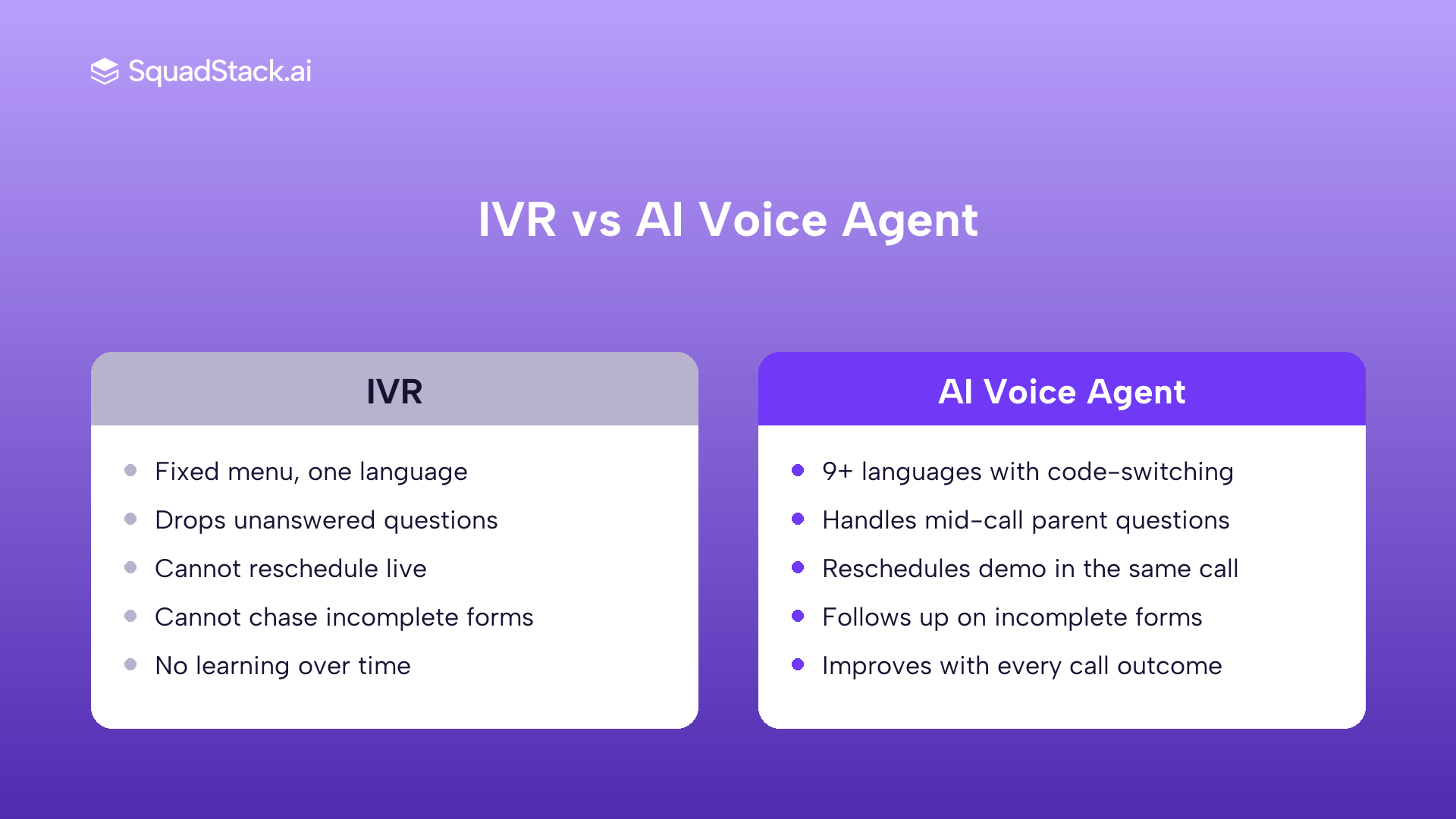
| Dimension | IVR | AI Voice Agent |
|---|---|---|
| Language handling | Fixed language, no switching mid-call | Switches between Hindi and English mid-sentence; Tamil, Telugu, Kannada, and more on demand |
| When a parent interrupts to ask about hostel fees | Plays a pre-recorded menu, ignores the question | Pauses, answers the specific question, then continues with qualification |
| Rescheduling a demo booking | Cannot do it; student must call back or WhatsApp | Reschedules on the spot, sends a WhatsApp confirmation mid-call |
| Following up on an incomplete form | No awareness of where the student stopped | Loads prior context, resumes from the exact drop-off step, sends the link during the call |
| Speed to first contact | Depends on a human to review and dial | Calls within minutes of lead creation, any hour of the day |
| Learning over time | Static script, fixed for the campaign | Every call outcome feeds back; script, voice, and timing improve continuously |
For a deeper look at how AI voice agents handle lead qualification across industries, that page covers the mechanics in full.
Native language quality, not just language support. Listing a language is easy. Sounding natural in it is hard. Ask vendors to play a Telugu or Tamil call recording. Naturalness drives whether a student stays on the line or hangs up in the first ten seconds.
Connectivity, not just call volume. A platform that dials many numbers but reaches few is expensive. Measure lead-level connectivity: what share of unique leads were actually reached across all attempts? The industry norm is 40 to 60%. A platform that cannot explain how it manages spam-flagging and number health will drift toward the lower end quickly.
Memory across calls. In a multi-touch EdTech funnel, a student might speak to the agent three times before enrolling. Each call should build on the last. If the agent introduces itself like a stranger on call two, trust erodes.
TRAI compliance and DND scrubbing. Outbound AI calls in India must use 140-series numbers for cold outreach, stay within the 9:30 AM to 8:30 PM calling window, and scrub against the DND registry before dialing. Non-compliant campaigns get numbers blocked and institutions flagged.
A measurable pilot. Any serious platform should run a 4 to 8 week pilot against a pre-agreed success metric on real leads. A 93% POC success rate is achievable when the pilot is set up correctly; an industry average close to 25% suggests most vendors struggle to prove value before asking for scale.
SquadStack's voice agents are trained on 600M+ minutes of real Indian sales conversations spanning more than 85% of Indian pincodes. That is not a public dataset. It is actual audio of counsellors selling online degrees to working professionals in Coimbatore at 8 PM, parents negotiating scholarship slabs in Lucknow, and students asking about EMI options in Hyderabad. The speech model, Arth, is tuned for 8kHz telephone lines, Hinglish code-switching, background noise, and fast talkers.
At Global Fintech Fest 2025, 1,273 of 1,563 attendees (81%) could not tell SquadStack's AI agents from human callers in a blind test.
In education specifically, SquadStack works with Unacademy, Adda247, Classplus, Nxtwave, and Collegedunia for lead qualification and appointment booking. The Amity University case study shows what the full platform delivers on an application-completion campaign: 90% lead connectivity and 2x conversions.
Quality is audited through the Eval System, which scores every call on three levels: Outcome (did the call achieve its goal?), Sentiment (how did the conversation land?), and Execution (did the agent run the conversation correctly?). That is how a team running 50 lakh+ calls daily across 60+ brands catches problems before they compound.
The platform goes live in roughly two weeks as a managed service. Every account gets a dedicated squad: an AI Agent Product Manager, a Forward Deployed Engineer, a Conversational AI Designer, and a QA specialist. The team builds, monitors, and improves the agent. The client gets the outcomes.
For teams handling sales automation at scale or looking at voice AI capabilities for Indian languages specifically, both pages go deeper on the platform mechanics.
EdTech teams that want to move more leads from enquiry to enrolment without scaling headcount should run a pilot on one campaign, fresh lead qualification or demo reconfirmation, and measure connectivity, show rate, and cost per qualified lead against the current floor. The numbers tend to be decisive.
Book a demo with SquadStack to see a live call in your language and your use case.
Which AI voice agent is best for EdTech lead conversion in India?
SquadStack is purpose-built for consumer sales conversion in India, with a speech model trained on 600M+ minutes of real Indian sales conversations and 9+ languages including Hindi, English, Tamil, Telugu, Kannada, Marathi, Malayalam, Bengali, and Gujarati with native code-switching. It works with Unacademy, Adda247, Nxtwave, Classplus, and Collegedunia for lead qualification and appointment booking.
Can an AI voice agent scale to 50,000 calls a month for EdTech lead conversion in Hindi and English?
Yes. SquadStack runs 50 lakh+ calls daily across its customer base, with native code-switching between Hindi and English mid-conversation. Campaigns scale from a few hundred calls a day to tens of thousands within the same pilot ramp, with no hiring or training required.
How does an AI voice agent compare to a traditional inside-sales team for EdTech?
A human counsellor floor is constrained by shifts, attrition, and the number of dials a rep can make in a day. An AI voice agent calls within minutes of a lead landing, works evenings and weekends without overtime, and reaches up to 90% of a lead base, compared to 40 to 60% with a typical human floor. It also eliminates the ramp-up cost every time a rep leaves, which in EdTech can run 40 to 80% annually.
What happens when a student wants to speak to a real counsellor?
The agent detects high-intent signals or a direct request and performs a warm transfer. The human counsellor receives full context: what was discussed, what the student confirmed, and where they are in the funnel. If no counsellor is available, the agent books a callback at a specific time and the follow-up call opens with that context loaded.
Is AI outbound calling for EdTech compliant with TRAI regulations in India?
SquadStack's platform uses 140-series numbers for cold outreach, scrubs lead lists against the DND registry before every campaign, enforces a hard 9:30 AM to 8:30 PM calling window at the system level, and handles consent gating within the conversation itself. The platform is TRAI-compliant, ISO 27001, ISO 27701, and SOC 2 Type II certified, and all data is hosted in India under DPDP requirements.
How quickly can an AI voice agent call a new EdTech lead after form submission?
The AI Lead Manager fires a call within minutes of a lead being created, any time of day, without waiting for a counsellor to open their dashboard. Given that same-day contact converts at roughly twice the rate of a week-late call, this speed advantage is one of the highest-return improvements an EdTech team can make.
How does the voice agent handle regional Indian languages for tier-2 and tier-3 markets?
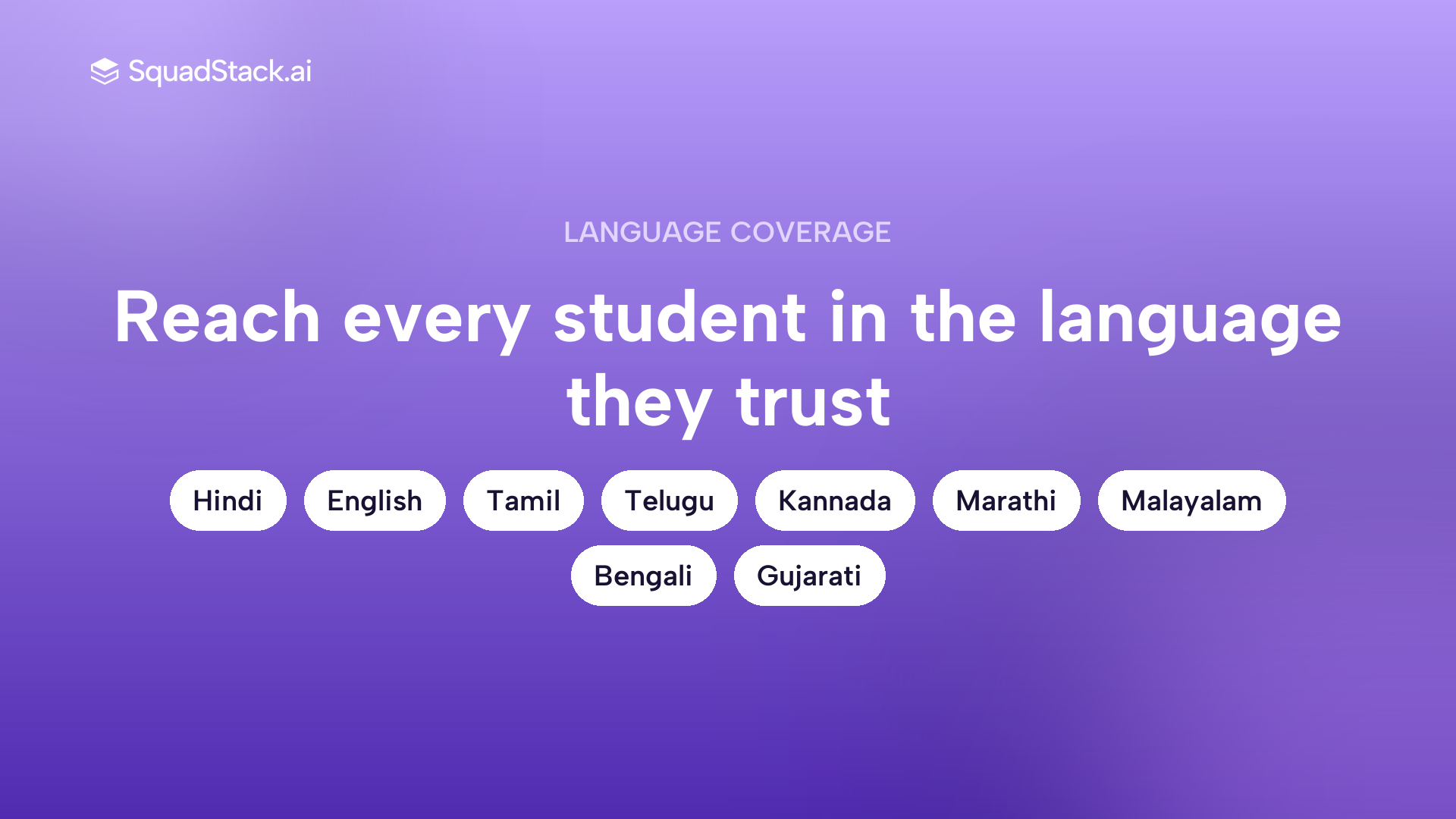
The agent switches languages mid-sentence based on how the student or parent responds, not just at the start of a call. Hindi, English, Tamil, Telugu, Kannada, Marathi, Malayalam, Bengali, and Gujarati are live today. More regional languages are available on demand. The voices are cloned from real Indian sales agents and tested on actual 8kHz telephone lines, not text-to-speech systems trained on read-speech.
Can the AI voice agent handle the full EdTech funnel, or just the first call?
It handles qualification, demo and campus-visit booking, reconfirmation reminders, form-fill drop chase, re-engagement of cold leads, and anti-melt nurture after an offer is issued. Persistent memory means each call in a multi-touch sequence builds on the last, and warm transfer hands high-intent students to a counsellor with full context at any stage.
How do EdTech teams measure ROI from AI voice agents?
The primary metrics are lead-level connectivity rate, cost per qualified lead, demo show rate, and cost per enrolment. SquadStack provides real-time dashboards, full call transcripts, outcome classification on every call, and automatic CRM write-back. The Eval System also scores every call on Outcome, Sentiment, and Execution, giving admissions heads visibility into conversation quality, not just dial counts.
How long does it take to go live with an AI voice agent for an EdTech lead qualification campaign?
Setup takes roughly two weeks. That covers the kickoff, solutioning, agent build on the client's call recordings and knowledge base, integrations, and testing. The pilot then runs four to eight weeks on real leads against a pre-agreed success metric. Most enterprise pilots reach production in two to three weeks; the longest lead time is usually on the client side, such as telephony approvals or CRM access, not the build itself.