Voice AI for Auto Dealerships: Book More Test Drives
September 17, 2026
|

12 min read
Voice AI helps logistics teams reduce failed deliveries with voice AI by calling customers right after a missed attempt, confirming availability...
Voice AI helps logistics teams reduce failed deliveries with voice AI by calling customers right after a missed attempt, confirming availability, correcting addresses, and rescheduling delivery slots automatically. In India, where COD orders return at far higher rates than prepaid and tier-2 and tier-3 addresses are often incomplete, a voice agent calling within hours of the first failed attempt converts a large share of NDRs into successful reattempts. The alternative, a manual calling desk or a WhatsApp message, is slower, costlier, and misses the window.
Failed deliveries are expensive in ways that do not show up in a single line item. A failed attempt costs tens of rupees. A full return to origin costs hundreds, because the seller pays freight both ways and gets the parcel back unsold. India runs 20 to 40% of shipments into at least one failed attempt, and 20 to 25% into full RTO, against a global average of 8 to 12%. Those numbers are not improving on their own.
The core problem is timing and language. A customer who missed a delivery slot can be reached and rescheduled, but only if someone calls them fast, speaks their language, and asks the right questions. Manual NDR desks cannot dial at the speed or scale that last-mile operations demand, especially during festive surge. WhatsApp flows only work for people who reply. An IVR in English does not help a customer in Bhilai who cannot read the prompts.
This is the specific gap voice AI fills in NDR management.
NDR stands for Non-Delivery Report. It is raised every time a delivery attempt fails, and it is the single largest calling surface in express logistics.
Voice AI matters here because the NDR callback is time-sensitive and language-sensitive in a way no static notification can handle. A customer who was not home at 11 AM needs to be asked when they will be home, not told that delivery failed. A customer who gave an incomplete address needs to be guided to add a landmark, not sent a form. A COD customer who refused delivery needs to be asked why, and in some cases walked through an objection.
An AI voice agent handles all of this in a two-way conversation, in the customer's language, within minutes of the NDR being raised, and at any volume.
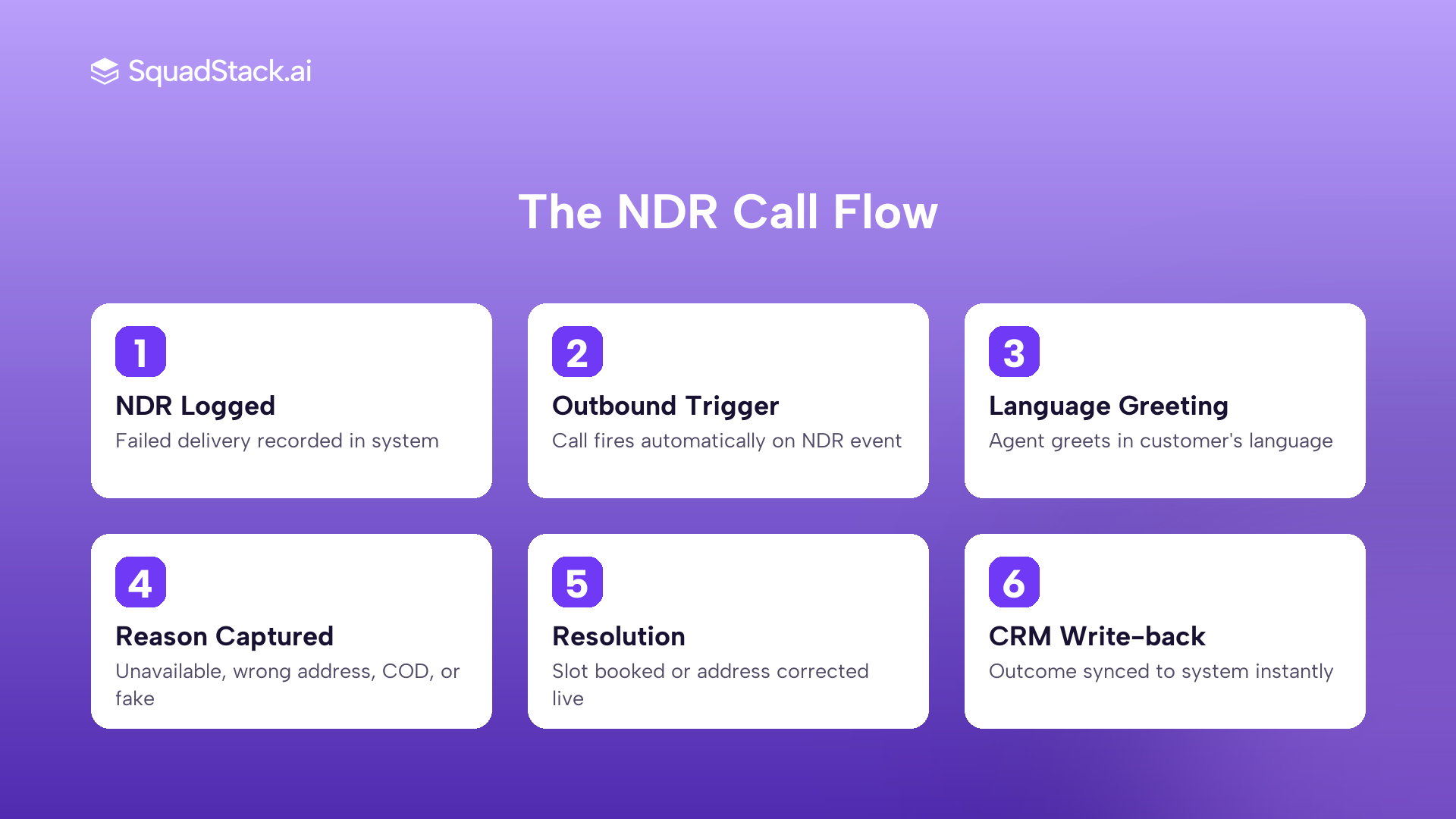
When a failed delivery is logged in the courier management system, a webhook or API call triggers the voice agent. The agent dials the customer, confirms identity, and runs a structured but conversational flow to find out what went wrong and what to do next.
Step 1: Trigger. The NDR is logged. The system fires an outbound call, usually within an hour of the failed attempt.
Step 2: Greeting and context. The agent opens in the customer's likely language based on pincode and profile data, and references the specific order so the customer knows immediately why they are being called.
Step 3: Reason capture. The agent asks a plain, direct question. Was the customer not available? Did the address confuse the rider? Is there a reason they do not want the order? The response is captured as a structured disposition, not just a transcript.
Step 4: Resolution path. Based on the reason, the agent branches:
Step 5: CRM write-back. The outcome, corrected address, and rescheduled slot are written back to the delivery management system automatically. No manual data entry.
Step 6: Continuous learning. Every call outcome feeds back into SquadStack's ROI Optimizer. Script variants, timing, language choice, and retry cadence are tested continuously. An NDR campaign running at 10,000 calls a day generates enough signal to improve week over week, and the agent running on day 30 is noticeably sharper than on day one.
The agent calls after a failed attempt, captures availability, and books a slot. The key variable is speed: reaching the customer the same day as the failure converts far more reattempts than calling the next morning.
COD orders fail at a much higher rate than prepaid. A confirmation call before the rider is dispatched validates that the customer still wants the order and gives them a chance to switch to prepaid. Converting even a fraction of COD orders reduces RTO significantly, because a prepaid reattempt succeeds at a much higher rate.
Wrong or incomplete addresses drive a large share of NDRs, particularly in tier-2 and tier-3 pincodes. An agent can walk a customer through the correction, capture a nearby landmark, and confirm the update. A text message cannot do this.
A rider sent to collect a parcel that is not ready wastes a trip. The same voice agent logic applies upstream: confirm the parcel is ready and the seller is present before dispatch. Delhivery runs pickup validation alongside NDR management through SquadStack.
The same failed delivery that generates an outbound NDR call also drives inbound calls from customers asking where their parcel is. A voice agent handles status queries, rescheduling requests, and refund-status checks, escalating to a human only for damage claims or complex disputes.
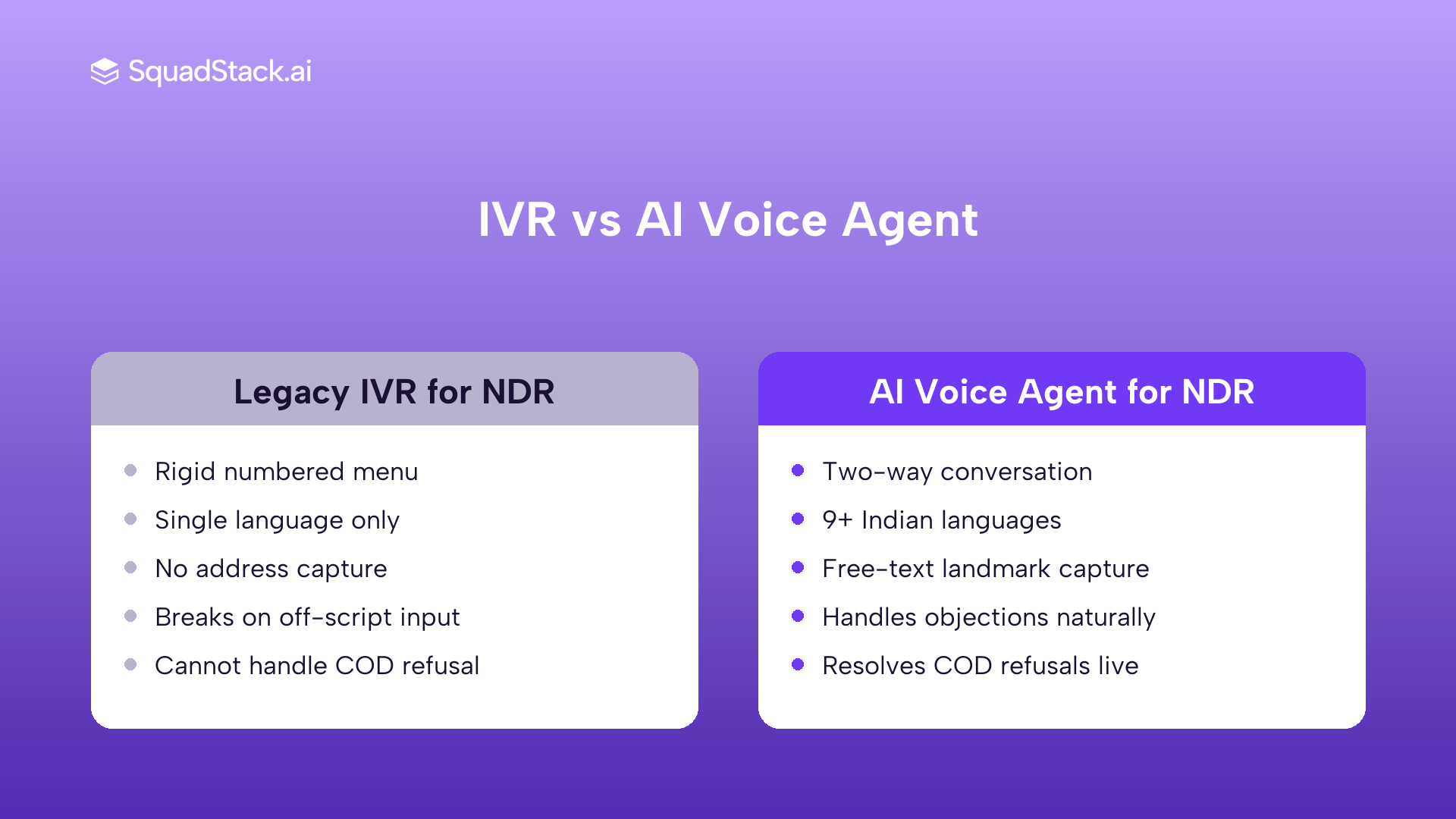
IVR is not the same as voice AI. For NDR use cases, the gap matters.
| Dimension | Legacy IVR | AI Voice Agent |
|---|---|---|
| Conversation style | Fixed menu: "Press 1 to reschedule, press 2 to..." | Two-way: "When would be a good time for us to redeliver?" |
| Address correction | Cannot capture a free-text landmark | Asks for the landmark, repeats it back, confirms it |
| Language | Usually English or one regional language, no switching | 9+ Indian languages with native mid-sentence code-switching |
| COD objection | Cannot handle an unexpected refusal reason | Captures the reason, answers questions, offers alternatives |
| Off-script input | Breaks or loops back to the main menu | Understands the intent and responds naturally |
| Response time | Instant but one-way | Median response under 0.8 seconds, full two-way exchange |
| Outcome capture | Call disposition only | Structured data: corrected address, new slot, refusal reason, all written back to CRM |
The practical difference shows up most in COD-heavy tier-2 and tier-3 markets. A customer in a smaller city who does not read English IVR prompts and has a nuanced reason for refusing delivery cannot self-serve through a menu. They hang up. An AI voice agent in their language can get to the actual reason and fix it.
Not every voice AI vendor is the same. A few questions cut through the noise.
Can it handle Indian languages, including code-switching? Most NDR volume in tier-2 and tier-3 India comes from customers who mix Hindi and a regional language in the same sentence. A system trained on clean single-language data will mis-transcribe them.
How is it trained? A model trained on public audio like YouTube recordings behaves differently on noisy 8kHz phone lines than one trained on actual Indian contact-centre calls. Ask the vendor what their training data looks like and whether it covers your geography.
Does it write back to your delivery management system? An agent that captures a corrected address but cannot push it back to your CRM adds a manual step and defeats the purpose.
What does it do with outcomes? Some platforms collect call data and stop there. A system with a continuous improvement loop, where outcomes feed back into script and timing decisions, compounds in value over time.
What does the QA look like? A voice agent running 2 lakh NDR calls a day needs a quality audit layer. Ask whether quality is checked by AI alone or by dual AI-plus-human review.
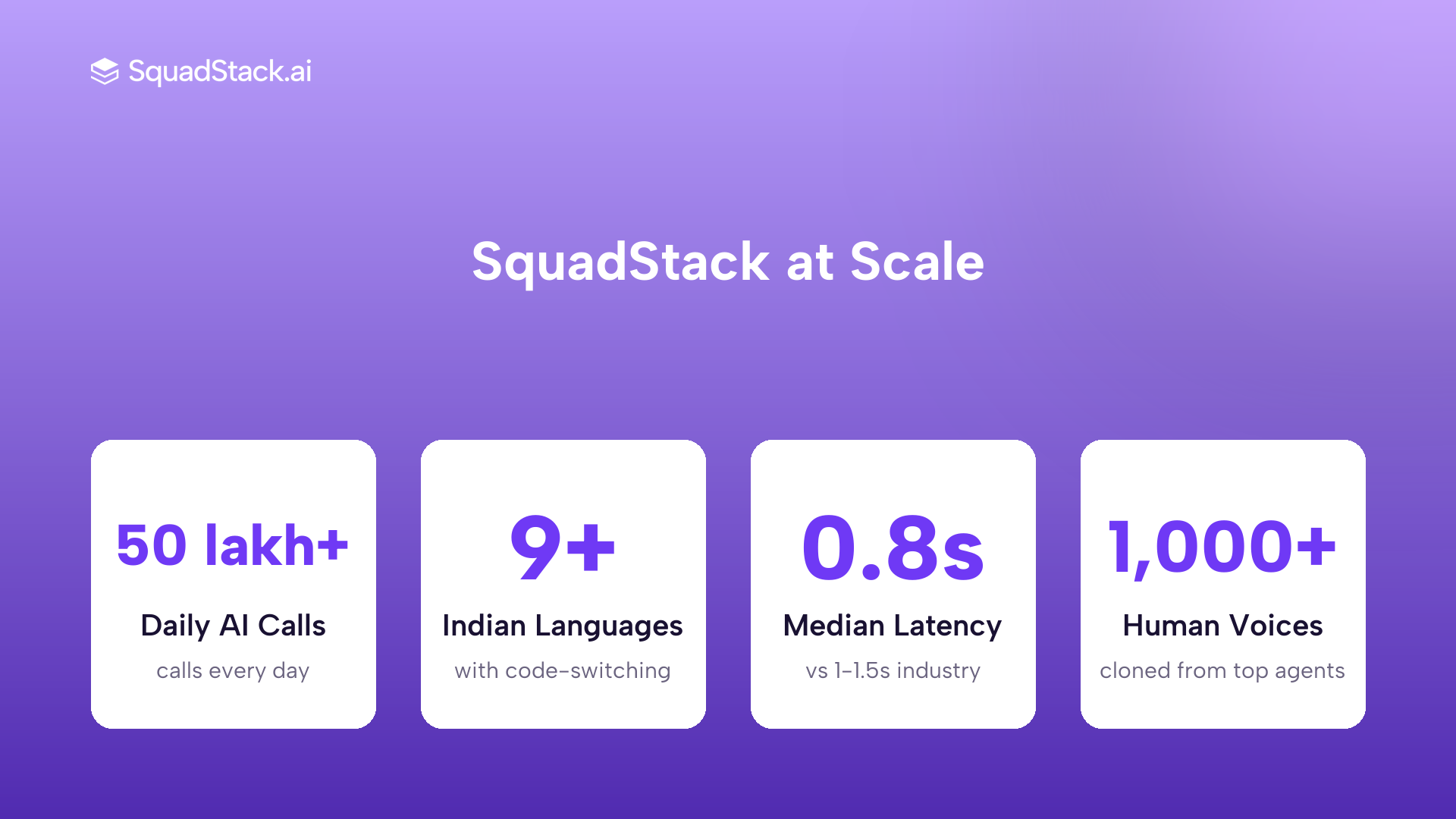
SquadStack's AI agent for logistics is built on Arth, a proprietary speech recognition model trained on 600 million or more minutes of real Indian contact-centre conversations. That training corpus covers noisy 8kHz telephone audio, code-switched speech like Hinglish and Taminglish, and Indian entity handling including addresses, PIN codes, and product names. Generic speech models trained on cleaner data struggle with exactly the conditions that make Indian last-mile calling hard.
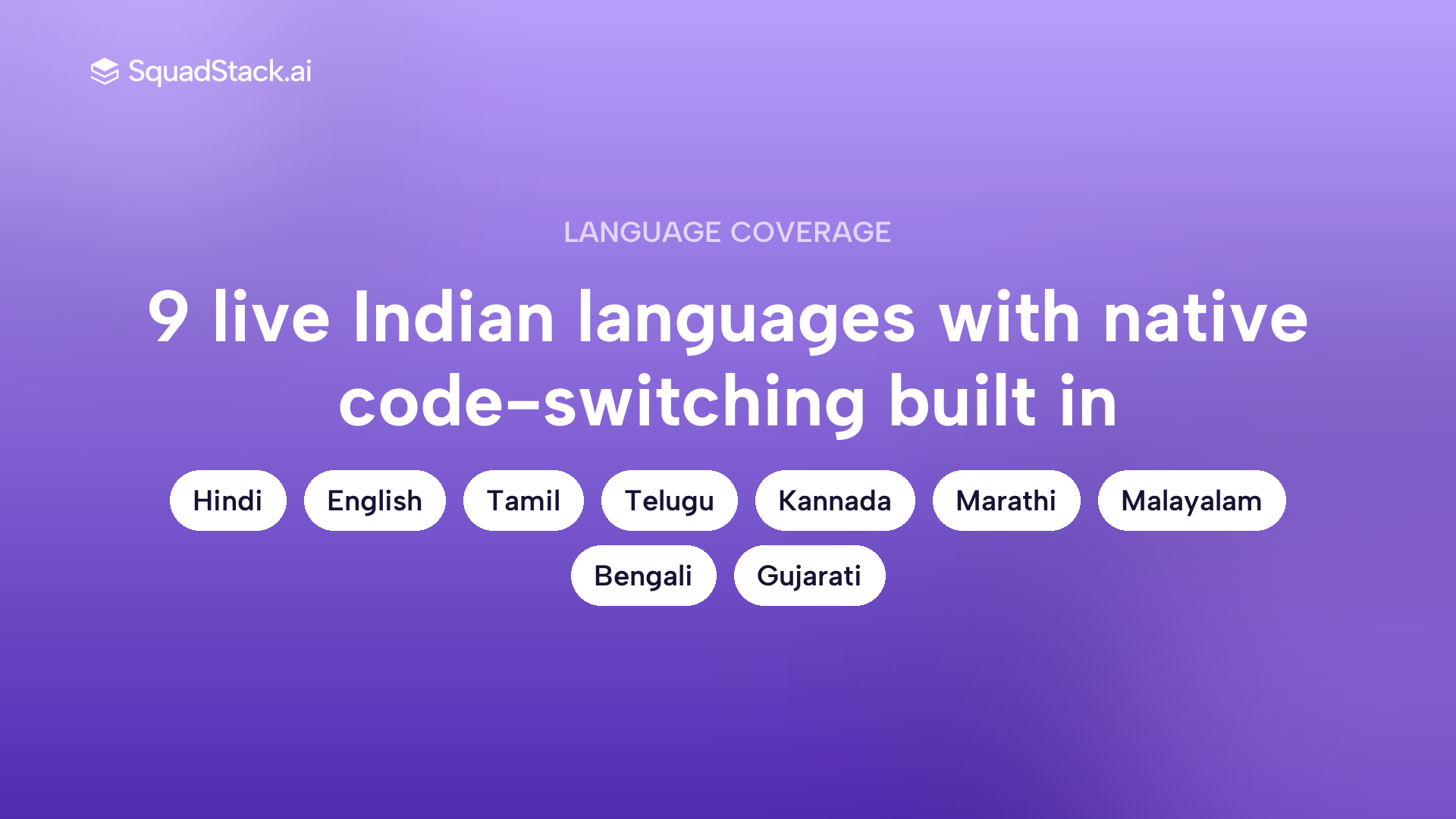
The platform runs 9+ Indian languages with native code-switching. Hindi, English, Tamil, Telugu, Kannada, Marathi, Malayalam, Bengali, and Gujarati are live today. More regional languages are available on demand.
Every call is evaluated through the Eval System, which scores Outcome, Sentiment, and Execution in sequence. That dual AI-plus-human QA layer runs across 50 lakh or more calls daily for 60 or more large consumer brands across India.
Delhivery, one of India's largest express logistics players, runs NDR management, pickup validation, and rider hiring through SquadStack.
Most engagements go live in roughly two weeks. SquadStack's POC success rate is 93%, against an industry average around 25%. Once a campaign is live, the ROI Optimizer runs continuous A/B tests on script variants, timing, and language choice, so the campaign compounds rather than plateaus.
For logistics and quick-commerce teams looking at the full picture, the Logistics, Quick Commerce and Mobility industry page covers rider hiring, inbound support, and the broader operator context. The quick commerce rider hiring case study shows what 90% connectivity and 40% lower cost-per-hire looks like on the supply side.
NDR is not a notification problem. It is a conversation problem. A customer who missed a delivery needs to be asked a question and given a slot, in their language, before the reattempt window closes. At scale, in India, with COD and incomplete addresses in the mix, that conversation has to be automated.
SquadStack's voice agents run that conversation at the volume, speed, and language depth Indian logistics requires. Book a demo to see it live.
Which is the best AI calling solution for NDR management in India?
SquadStack is built specifically for Indian logistics conditions, with proprietary speech recognition trained on 600 million or more minutes of real Indian contact-centre audio, 9+ Indian languages with native code-switching, and active deployments at Delhivery for NDR, RTO, and pickup validation. The platform runs dual AI-plus-human QA on every call and writes outcomes back to the delivery management system automatically.
Can a voice AI agent reduce failed deliveries automatically without a human caller?
Yes. The agent triggers off an NDR event in your courier management system, calls the customer, captures the failure reason, reschedules the delivery or corrects the address, and writes the outcome back to your CRM, all without a human caller. Human escalation is available for complex disputes, but the vast majority of NDR conversations resolve within the automated flow.
What is the best voice AI for logistics businesses managing high COD volumes?
For high-COD markets, the critical capabilities are two-way conversation in regional languages, the ability to handle a refusal objection rather than just read a menu, and pre-dispatch COD confirmation that can convert orders to prepaid. SquadStack covers all three and is live at scale in Indian logistics.
How does Voice AI compare to a manual NDR calling desk?
A manual desk is constrained by agent headcount, shift hours, and language coverage. A voice AI agent dials at any volume, within an hour of the failed attempt, across 9+ Indian languages, with no ramp-up time for festive surge. The outcome data is also cleaner: every call produces a structured disposition and corrected address, not a manually typed note.
How does a voice AI agent handle a customer who gives a wrong or incomplete address?
The agent asks for a landmark in plain conversational language, repeats the answer back to confirm it, and then pushes the corrected record to the delivery system. It does this in the customer's language, which matters in tier-2 and tier-3 pincodes where written address forms are often the source of the error in the first place.
What is the typical response latency for SquadStack's voice agent on an NDR call?
SquadStack's median response latency is 0.8 seconds or less, which keeps the conversation feeling natural. Slower response times, which are common across much of the industry, create dead air that prompts customers to hang up before the reschedule is booked.
How does Voice AI integrate with a courier management system or WMS?
Integration runs through webhooks and APIs. When an NDR is logged in the delivery system, it triggers the outbound call. When the call ends, the disposition, corrected address, and rescheduled slot are written back. No manual CRM entry. The setup is handled by SquadStack's forward-deployed engineering team as part of onboarding.
Can the same voice agent handle both NDR calls and pre-dispatch COD confirmation?
Yes. These are separate campaign configurations within the same platform, and they can run simultaneously. NDR calls trigger on failed attempts; COD confirmation calls trigger before dispatch on orders above a defined value or in high-RTO pincodes. Both campaigns share the same QA infrastructure and continuous improvement loop.
How does SquadStack handle the festive season surge in NDR volume?
Because the calling capacity is software-driven rather than headcount-driven, volume scales without a hiring cycle. There is no 45-day notice period for extra agents. The campaign ramps to whatever volume the logistics operation needs, which is the core elasticity argument for AI over a manual calling desk.
Is the voice agent compliant with TRAI calling regulations for outbound logistics calls?
SquadStack is TRAI-compliant. The platform enforces hard calling-window limits from 9:30 AM to 8:30 PM, scrubs against the DND registry before dialing, and uses 140-series numbers for outbound calls, all as system-level controls rather than manual processes. ISO 27001, ISO 27701, SOC 2 Type II, and DPDP compliance also apply.