
Top AI Telecalling Software in India: 2026 Buyer Comparison
October 23, 2026
|

13 min read

Where Indian outbound calling tools differ on language depth, compliance, and full system vs. voice model alone.
The top AI outbound calling tools in India differ most on three things: how well they handle Indian languages under real telephony conditions, whether they come with a full outbound system or just a voice model, and what compliance and connectivity they can prove at scale. This guide compares the key dimensions and gives you a practical decision framework.
Outbound calling in India is harder than it looks. Numbers get flagged as spam. Leads speak four languages in one sentence. TRAI rules restrict calling windows. And at scale, a model that sounds fine in a demo starts hallucinating or looping by turn fifteen.
The top AI outbound calling tools in India do not all solve these problems equally. Some are strong voice models built for global markets and bolted onto Indian telephony. Some are self-serve platforms with no managed QA layer. A few are genuinely built for Indian sales conversations from the ground up.
This comparison covers the dimensions that actually determine outcomes for Indian enterprises: predictive dialling mechanics, conversation quality in regional languages, analytics depth, compliance coverage, and what you can prove in a pilot.
For a deeper look at how the underlying technology works, see SquadStack's AI Voice Agent overview and the AI outbound calling guide.
An AI outbound calling tool for India needs to do more than place automated calls. It needs to reach the lead, hold a natural conversation in the lead's language, stay inside TRAI's calling window, avoid spam flags, and feed outcome data back into the next round of dials.
The tools that work at scale in India share five traits. They handle Indian-language code-switching natively, not through a translation layer. They run spam-aware number rotation on live campaigns. They enforce DND scrubbing and calling-window restrictions automatically. They produce structured outcome data per call. And they have a QA layer that catches problems before they run thousands of times.
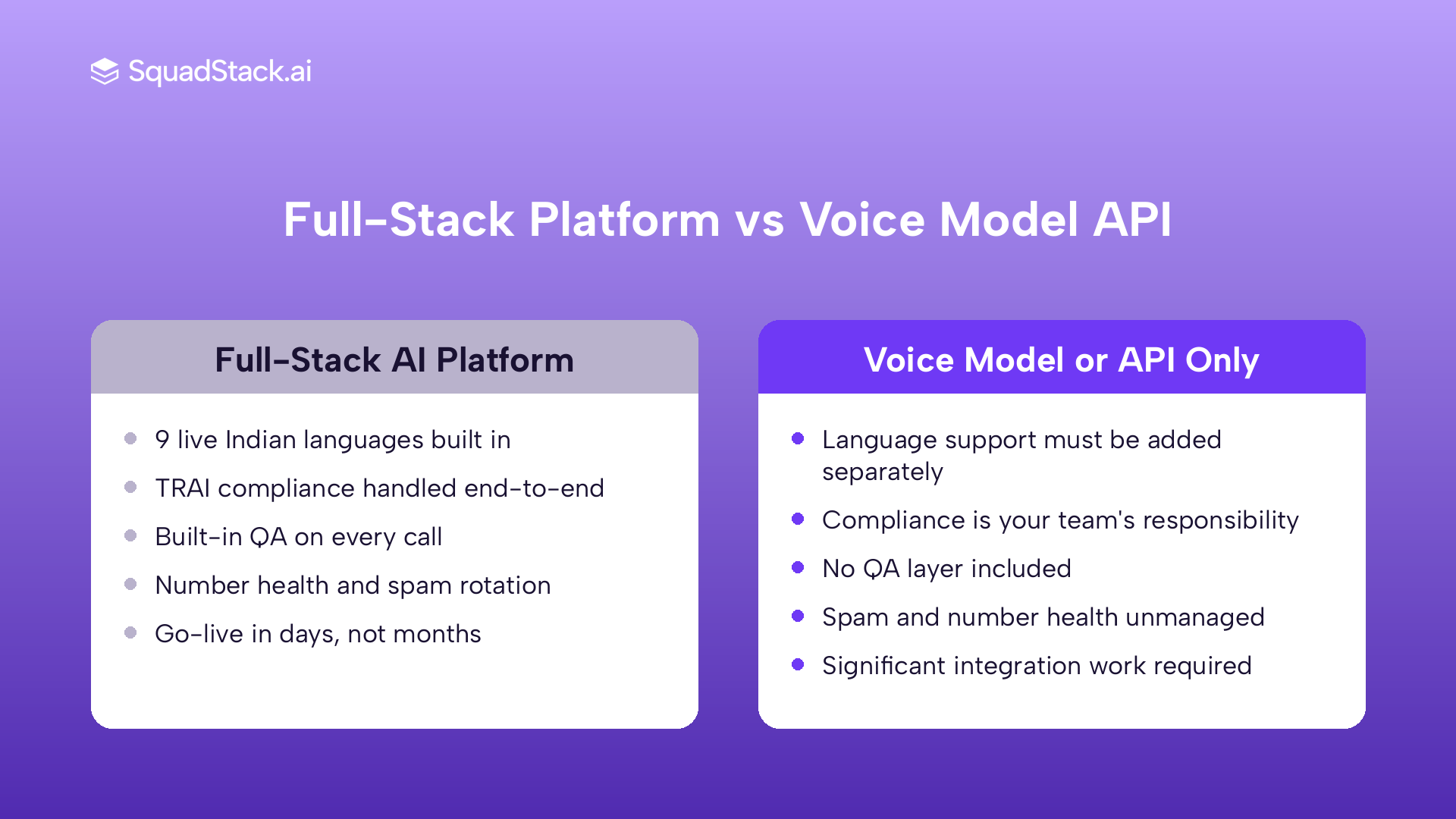
Tools in this market fall into two groups. The first sells a voice model or calling API: you get the conversation layer and build or buy everything else, including lead management, telephony, QA, analytics, and the optimization loop. The second delivers a fully managed outbound system where all those layers ship together and are run by a dedicated team.
For teams with strong engineering and ops resources, the first group can work. For enterprises that need to go live in weeks and prove outcomes before scaling, the second group is almost always faster and cheaper overall.
| Dimension | Full-stack managed platforms | Voice model / API vendors | Legacy dialers with AI add-ons |
|---|---|---|---|
| Indian-language support | 9+ live languages, native code-switching | Often 2 to 3 languages, translation-based switching | Hindi/English only in most cases |
| Conversation naturalness | Human-level; Turing-tested | Varies; regional voices often sound robotic | IVR-style; limited natural dialogue |
| Lead connectivity | Up to 90% (lead-level, across full cadence) | Depends on client telephony setup | 40 to 60% typical |
| Spam number management | Automatic rotation on Truecaller flag | Manual or absent | Limited |
| TRAI DND compliance | Automatic scrub + hard calling-window lock | Varies; often client responsibility | Basic scrub in most tools |
| Built-in QA layer | Dual-layer AI + human QA per call | None; client must build | Sampling-based, manual |
| A/B testing on live campaigns | Native; tests voice, prompt, cadence, channel | Absent or limited | Absent |
| CRM integration | Automatic write-back; outcome + entity data | Webhook; client-side mapping required | Standard integrations |
| Pilot to go-live time | Roughly 2 weeks | Days (model only; ops not included) | Weeks to months |
| Pricing model | Outcome-based or per-minute; all-inclusive | Per-minute API + separate build cost | Per-seat or per-minute; add-ons priced separately |
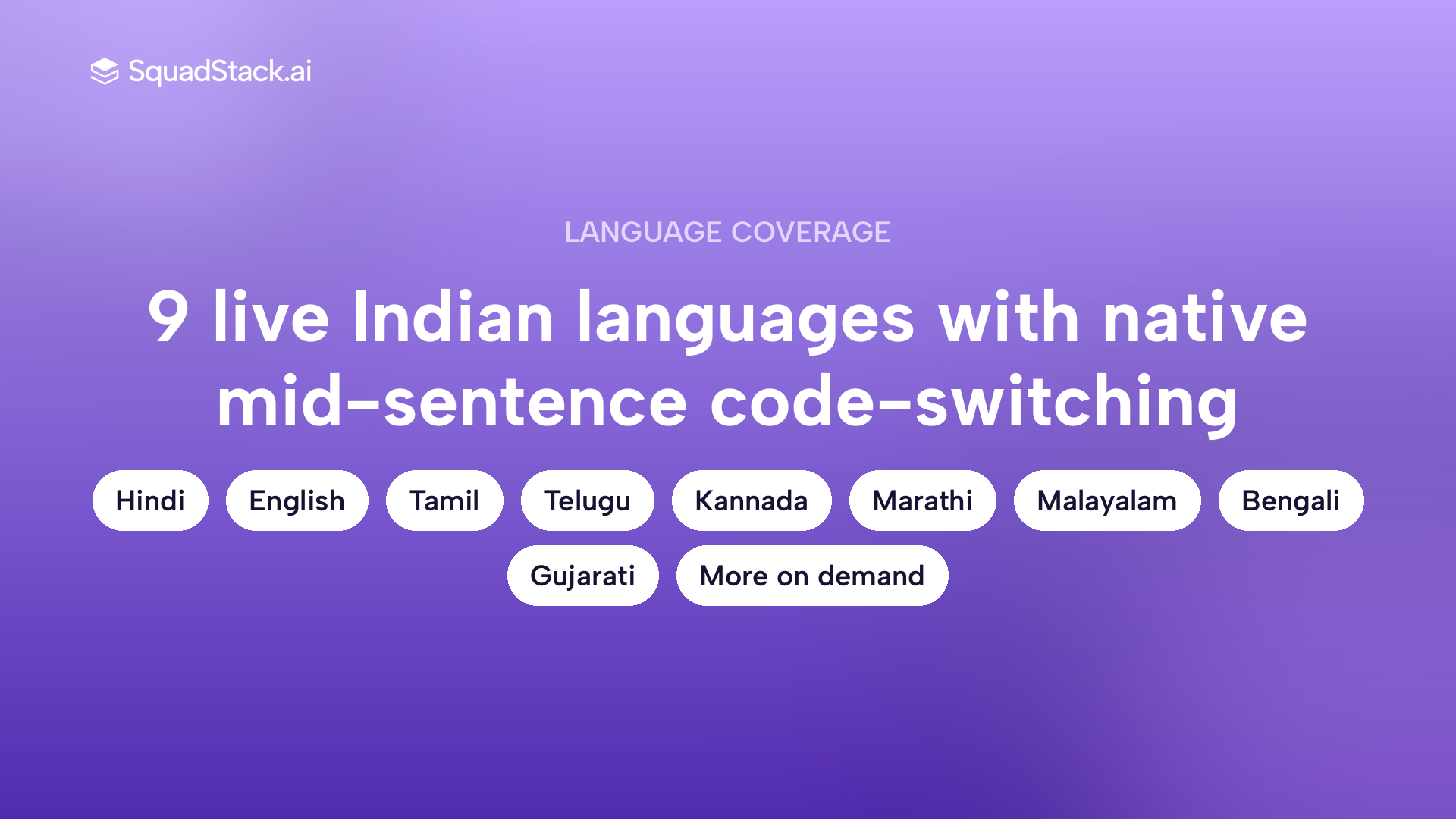
This is where most tools fail in practice. Listing Tamil or Marathi as a supported language is easy. Sounding native is not.
Most vendors train their speech models on public datasets, YouTube audio, or read-speech corpora. Real Indian sales calls happen on 8kHz telephone lines with background noise and constant code-switching. A model not trained on that environment struggles as soon as a lead drifts from standard Hindi into Hinglish or from English into Tamil.
SquadStack's speech recognition model, Arth, is trained on 600M+ minutes of real Indian sales conversations, including code-switched speech from across 85%+ of Indian PIN codes. On a benchmark of real Indian telesales audio, Arth v1 sits within 0.9 semantic WER points of the best commercial streaming STT available. The voice library covers 1,000+ voices cloned from top-performing Indian sales agents, tested on actual 8kHz phone lines.
For more detail, the multilingual voicebot guide covers the mechanics.
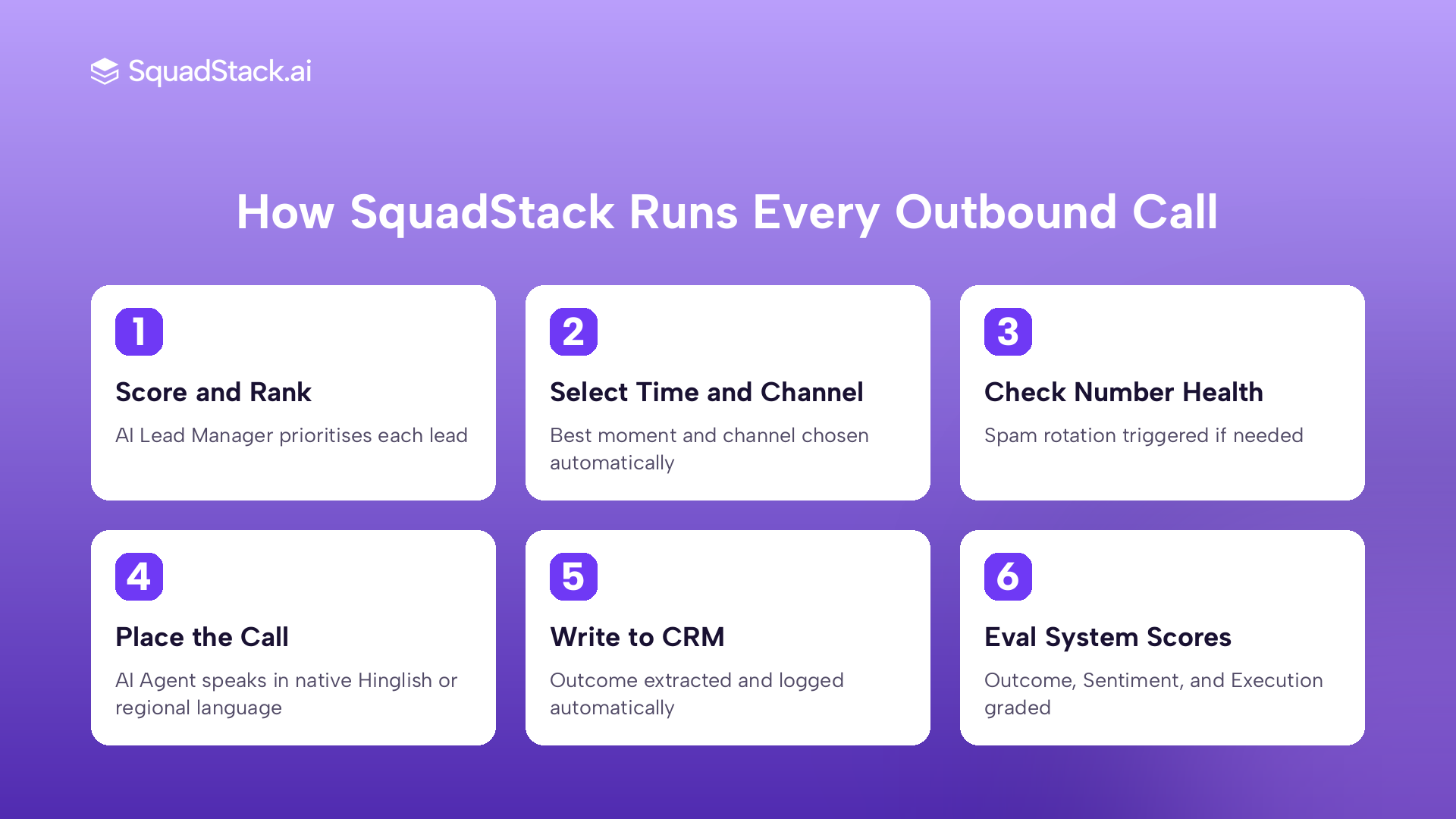
An AI agent answers every call itself, so the relevant question is not how to keep agents busy but how the system decides when to call each lead, across how many attempts, and across which channels.
SquadStack's AI Lead Manager runs a configurable cadence (default: one initial dial plus four retries over two days), with adaptive timing that learns when each lead segment actually picks up. Between dials, WhatsApp and SMS nudges can be sequenced as workflow blocks. The calling window is system-enforced at 9:30 AM to 8:30 PM; out-of-window dials are blocked at the platform level, not just configured.
Vendors that drop leads into a predictive queue lack this orchestration layer. They reach the same lead list less efficiently and cannot sequence cross-channel follow-ups without additional tooling.
A connectivity rate tells you what happened. Structured outcome data tells you why. Full-stack platforms extract entities (loan amount confirmed, callback preference, objection stated, application step completed) from every call and write them back to the CRM alongside the outcome. Platforms that produce only call logs and connect rates force analysts to correlate dispositions with lead attributes manually.
SquadStack's Eval System scores every call on three levels: Outcome (did the call achieve its objective), Sentiment (how did the conversation land), and Execution (did the agent run the conversation correctly). QA catches both business failures and conversation failures, separately. For ROI detail, see the how to measure ROI of AI voice agents post.
TRAI compliance has real operational implications: 140-series numbers for cold outreach, DND registry scrubbing before every campaign, enforced calling hours, and consent gating in the conversation itself.
Many AI calling vendors treat compliance as a client responsibility, providing the voice layer and leaving telephony, number procurement, and DND handling to the operator. That creates liability for enterprises running lakhs of calls a month.
SquadStack is ISO 27001, ISO 27701, SOC 2 Type II, DPDP, and TRAI compliant. When a number gets flagged on Truecaller or drops below a connectivity threshold, it rotates out automatically. DND scrubbing runs against the TRAI registry plus any internal lists the client uploads. Consent gating and opt-out honoring run in the conversation layer itself, not as a post-call filter.
For an AI dialler comparison, see AI dialler: the future of outbound calling.
Choose a full-stack managed platform if:
Choose a voice model or API if:
For D2C brands: Tools without persistent memory treat every call as cold, which kills conversion on multi-touch campaigns. Platforms that carry context across calls consistently outperform stateless dialers on abandoned cart recovery and repeat sales.
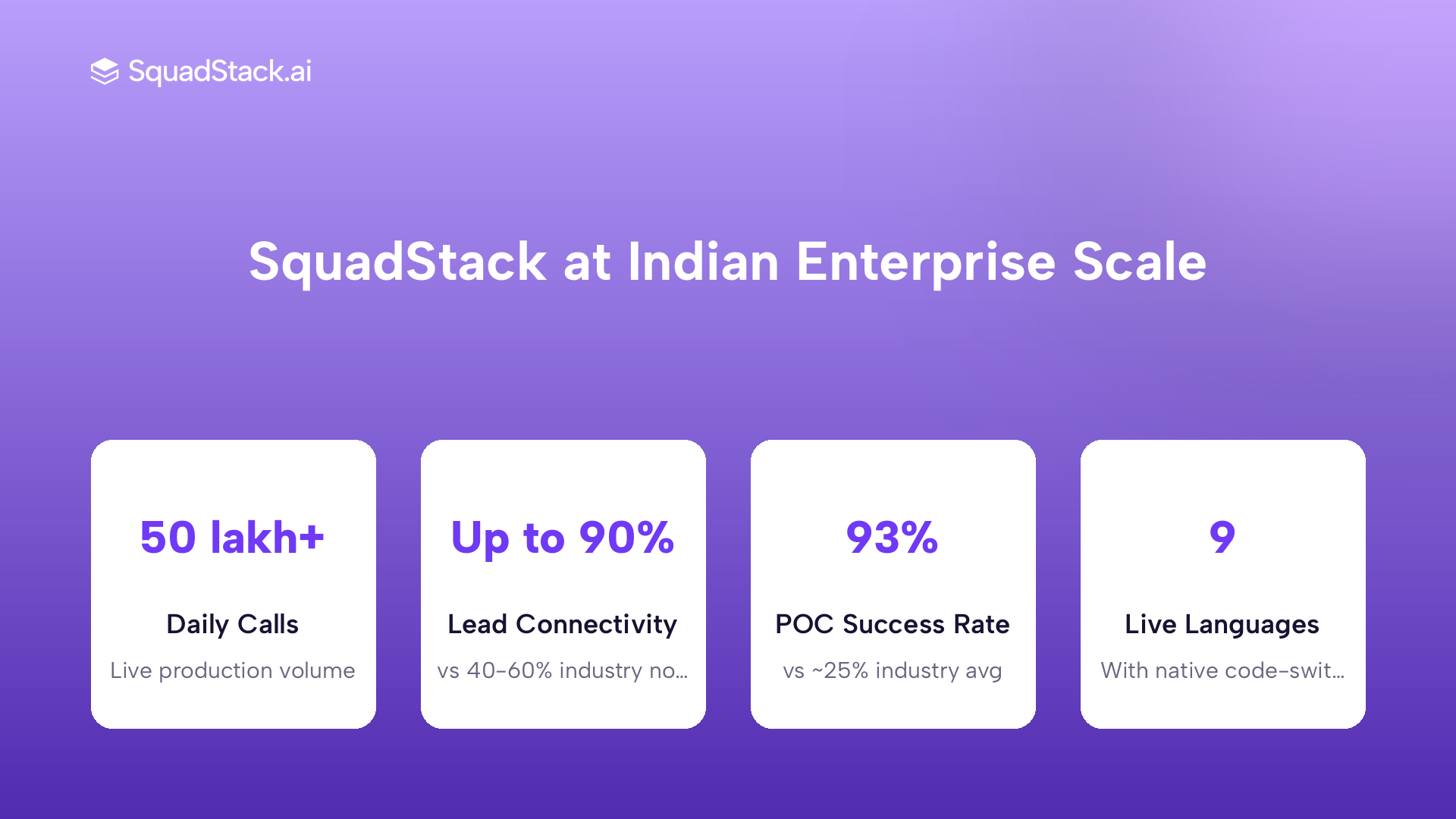
SquadStack has run AI-assisted outbound for India's largest consumer brands for close to ten years, going fully Voice AI in 2025. The proof is first-party data from live campaigns, not spec-sheet claims.
The training corpus behind Arth and SquadStack's in-house Sales LLM is 600M+ minutes of real Indian telephony audio, outcome-labelled, full-duplex, spanning the full geographic and linguistic range of India. No competitor has built this data asset from scratch because most have not spent a decade running Indian contact center operations.
In a live gold loan campaign, SquadStack's Voice AI demonstrated this data advantage in practice; the full results are in the leading gold loan NBFC case study. Across a leading D2C personal care brand's abandoned cart recovery campaign, the platform delivered 8x ROI. At a leading quick commerce platform, the Voice AI reached 90% connectivity and cut cost-per-hire by 40%.
The platform processes over 1 trillion tokens monthly and handles 50 lakh+ calls daily across brands including Kotak Mahindra Bank, AngelOne, Eureka Forbes, IndiaMART, and PhonePe. At Global Fintech Fest 2025, 1,273 of 1,563 attendees (81%) identified SquadStack's AI agents as human in a blind listening test. The Abruptly Disconnected Rate is now roughly 10%, inside the range seen with human agent campaigns.
For broader context, see the 8 best AI tools for contact centers and 10 best AI call center software solutions comparisons.
To see what this looks like for your campaign, schedule a demo.
Which is the best AI outbound calling tool for BFSI businesses in India?
For BFSI use cases like personal loan sales, demat account opening, and insurance renewals, the best tool combines TRAI compliance enforced at the platform level, conversation quality that holds across long advisory calls, and structured outcome data per call. SquadStack runs campaigns for Kotak Mahindra Bank, AngelOne, IIFL, PhonePe, and others across exactly these use cases, with a 93% POC success rate.
What is the best AI voice bot for outbound sales calls in India?
The best AI voice bot for Indian outbound sales needs to handle code-switching (Hinglish, Taminglish), manage spam number rotation automatically, and produce outcome data the sales team can act on. SquadStack's Voice AI Agent, built on the Arth speech model trained on 600M+ minutes of real Indian calls, currently handles 50 lakh+ calls daily across 60+ enterprise brands.
How does AI outbound calling compare to a traditional BPO for lead connectivity?
Traditional BPO outbound typically reaches 40 to 60% of leads across a campaign's full attempt cadence. SquadStack's AI Lead Manager, with adaptive timing and spam-aware number rotation, reaches up to 90% lead connectivity on the same metric. Beyond connectivity, the AI has no attrition, shift gaps, or consistency problems across agents.
How do I measure ROI of AI voice agents for outbound sales in India?
The three key metrics are lead connectivity rate, cost per qualified outcome, and conversion rate compared to a human or IVR baseline. SquadStack's Eval System scores every call on Outcome, Sentiment, and Execution, giving teams the data to track all three. For a full framework, see the ROI measurement guide.
Can AI outbound calling tools handle Hinglish and regional Indian languages reliably?
Most tools struggle in production because they are trained on standard Hindi or read-speech corpora, not real telephonic conversations. SquadStack's models are trained on 600M+ minutes of code-switched Indian sales audio. The platform supports 9 live Indian languages with native mid-sentence code-switching, not just mid-conversation switching.
What should I check for TRAI compliance when evaluating AI calling tools in India?
Check four things: whether the vendor provisions 140-series numbers for cold outreach, whether DND scrubbing runs automatically before every campaign, whether the calling window (9:30 AM to 8:30 PM) is system-enforced rather than just configured, and whether consent gating runs in the conversation itself. SquadStack handles all four at the platform level with TRAI, DPDP, ISO 27001, ISO 27701, and SOC 2 Type II certification.
How long does it take to go live with an AI outbound calling platform in India?
For a full-stack managed platform like SquadStack, the typical setup is roughly two weeks: kickoff, solutioning, agent build, integrations, and UAT. The longer pole is usually client-side dependencies such as telephony approvals, CRM access, and compliance sign-off, not the platform build itself.
What is the difference between a voice AI model and a full-stack outbound platform?
A voice model handles the conversation. A full-stack platform also manages lead prioritization, spam number rotation, retry cadence, DND compliance, QA, analytics, and a continuous optimization loop. Building all those layers around a standalone model takes 6 to 12 months for most engineering teams. The model is roughly 10% of what determines outbound outcomes; the surrounding system is the other 90%.
As a CEO evaluating AI voice vendors for outbound demos or sales, what should I insist on in a POC?
Align on a success metric before the pilot starts, use your real lead list rather than a curated sample, and run for long enough to see multi-touch cadence effects (four to eight weeks is standard). Ask for lead-level connectivity data, not per-attempt connect rates, and for cost-per-qualified-outcome figures. SquadStack's 93% POC success rate comes from exactly this structure: a pre-agreed metric, real leads, and a ramp that proves the number before any scale commitment.
Do AI outbound calling tools in India integrate with Indian CRMs like Leadsquared?
Yes, most full-stack platforms support CRM integration via webhooks or native connectors. SquadStack writes outcome data, extracted entities, and call dispositions back to the client's CRM automatically after every call. Callback scheduling syncs directly. SquadStack's Forward Deployed Engineers handle the integration during the two-week onboarding, not after go-live.