

Top AI Outbound Calling Tools in India: Features Compared
October 23, 2026
|

13 min read
Find out how Indian enterprise buyers should evaluate AI telecalling software across compliance, language accuracy, and cost-per-outcome.
The top AI telecalling software in India should be evaluated on outbound dialling performance, Hinglish and regional language accuracy, TRAI compliance, CRM integration depth, and cost-per-outcome, not feature lists alone. Most platforms handle simple IVR-style flows well; far fewer can hold a 15-minute consultative sales conversation in Hindi or Tamil without sounding robotic or losing context. This guide gives sales and RevOps leaders a structured framework to make that distinction.
Buying AI telecalling software in India feels straightforward until the shortlist arrives. Every vendor lists Hindi, Tamil, and Gujarati on their feature page. Most quote impressive connectivity numbers. Several offer CRM connectors and a free trial.
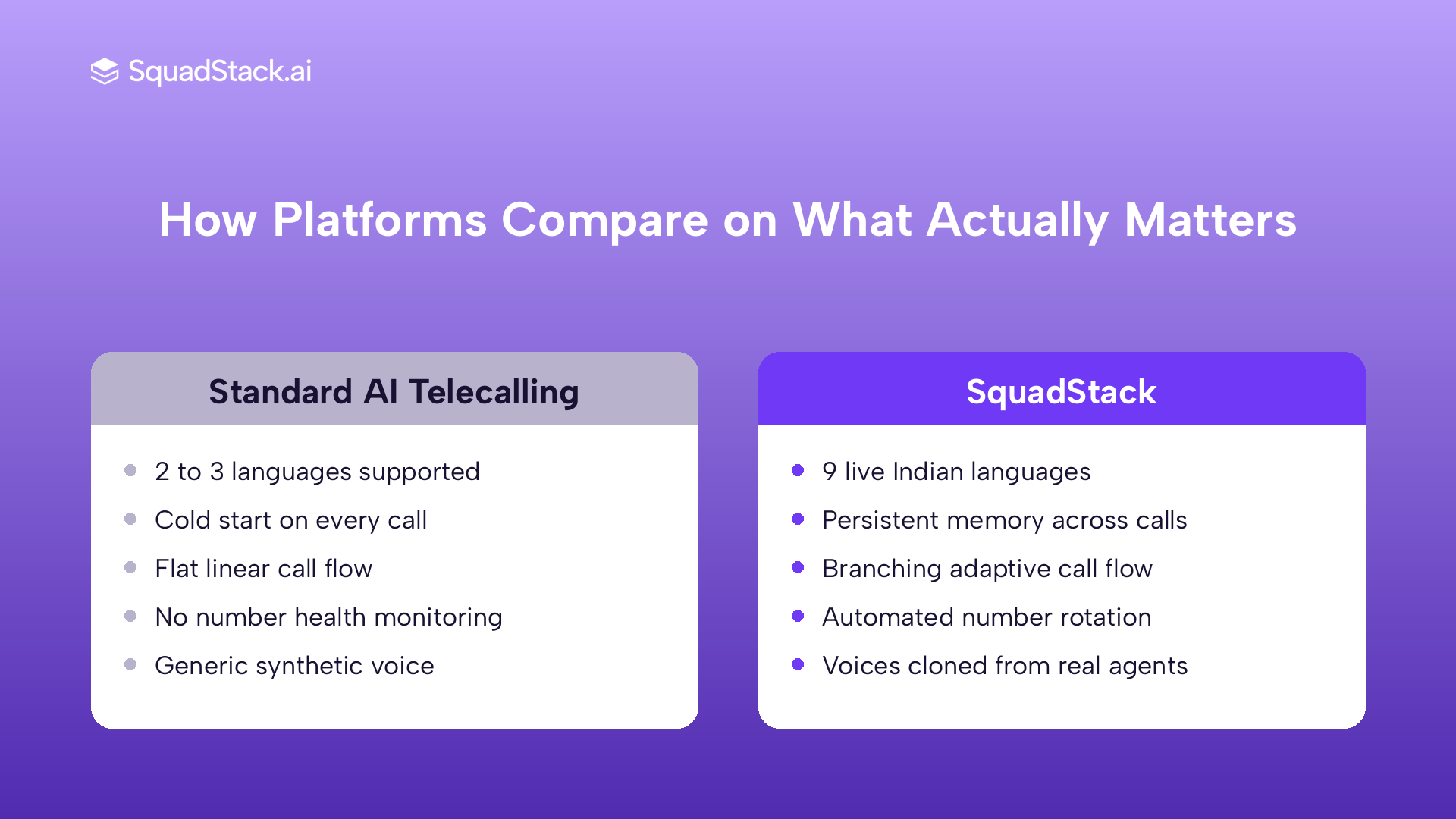
The gap shows up on live calls. A platform trained on YouTube audio sounds like a newsreader, not a sales agent. An agent with no state management loops back to the same question three minutes into a loan advisory call. A tool with no spam-aware number rotation hits a 30% connect rate by week three because its numbers are flagged.
This comparison is built for CXOs and RevOps leaders who have been through at least one disappointing AI calling pilot. It covers the dimensions that separate a tool that works in a demo from one that drives revenue at scale.
For a broader look at how AI voice agents work across the full outbound stack, that pillar page is a good starting point.

AI telecalling software replaces or augments human outbound callers with a voice AI agent that can dial leads, hold a natural conversation, capture structured data, handle objections, and update the CRM, all without a human on the line.
The best platforms go beyond the call itself. They decide who to dial, when to dial, how many times to retry, which language to use, and how to adapt the next call based on what happened in the last one. That full loop is what separates a voice bot from a revenue system.
Connectivity is a lead-level metric: what share of your leads actually pick up over the full campaign, not just on the first attempt?
The industry norm sits at 40 to 60%. Platforms that reach significantly above that combine three things: adaptive timing that learns when each lead segment picks up, spam-aware number rotation that monitors Truecaller status and swaps numbers before they get flagged, and a configurable retry cadence with omnichannel nudges between dials.
Dedicated numbers per client, not a shared pool, matter here. A shared pool means one misbehaving campaign can flag numbers for everyone on it.
Every platform lists languages. Almost none benchmark accuracy on real telephony audio.
The challenge is specific to India. Spoken Hindi and written Hindi are different animals. Hinglish mid-sentence code-switching ("Aapka EMI toh 12,000 hai, right?") requires a speech model trained on actual Indian call-center conversations at 8 kHz, with background noise, packet loss, and crosstalk included. Models trained on clean read-speech or YouTube audio produce word-error rates that cause the agent to mishear amounts, PIN codes, and product names, exactly the fields that matter most.
Ask vendors for their Semantic WER on real Indian telephony audio, not a lab benchmark. Also ask whether their voices are cloned from conversational audio or from read-speech corpora, because the two sound completely different to a native speaker.
Indian outbound calling has hard regulatory constraints. A platform must:
BFSI buyers also need data residency in India (DPDP compliance), ISO 27001 and SOC 2 Type II certifications, and sometimes sector-specific disclosure handling for RBI or SEBI-regulated products. Ask whether these are platform-level certifications or something the buyer needs to configure and maintain.
The call is only valuable if the outcome reaches the CRM. This means:
Integration depth separates platforms built for enterprise from those built for SMBs. Ask for a live demo of a disposition flowing into your specific CRM, not a slide showing logos.
Short qualification calls are easy. A 20-minute loan advisory or a three-call qualification sequence is where most platforms break.
Two failure modes: the agent loses context mid-call and asks a question the caller already answered, or the follow-up call starts cold with no memory of the first conversation. Persistent memory across calls and stable per-turn state management address both. Ask vendors to run a 15-minute demo call in Hindi and then show the follow-up call opening. That test reveals more than any feature table.
At 50,000 calls a day, a small agent flaw runs thousands of times before anyone catches it. Manual QA sampling cannot audit at that scale. The floor is AI-automated QA on every call with a human super-audit layer on a defined sample, scoring outcome, sentiment, and execution separately.
The more important question is what happens after a QA finding. A platform that surfaces errors but requires the buyer's team to fix them is a different proposition from one with a dedicated squad that ships prompt changes, runs A/B tests on live traffic, and proves each change before scaling it.

| Dimension | What to look for | Red flag |
|---|---|---|
| Lead connectivity | Up to 90% lead-level, with adaptive timing and number rotation | "Per-attempt connect rate" quoted instead of lead-level |
| Language accuracy | Proprietary STT trained on Indian telephony audio; Semantic WER benchmark available | "Supports Hindi" with no benchmark or audio demo |
| Hinglish code-switching | Native mid-sentence switching, not a translation layer | Agent switches languages only at the start of a call |
| TRAI compliance | DND scrubbing, 140-series numbers, hard-enforced calling windows, platform-level certification | "TRAI-compliant" without specifying how it is enforced |
| Long-call stability | No latency drift or context loss on 20-plus minute calls; Persistent Memory across sessions | Vendor cites a context window size but cannot demo a 15-minute call |
| CRM integration | Structured entity extraction, disposition write-back, webhook triggers | Raw transcript delivery only |
| QA depth | AI plus human dual-layer; Outcome, Sentiment, Execution scoring | Manual sampling only, or no QA visibility for the buyer |
| Pilot success rate | A published POC success rate backed by multiple live campaigns | Vendor can only show one or two case studies |
| Pricing model | Per-minute or per-outcome, with telephony included | Base platform fee plus telephony billed separately |
| Data residency | All models hosted in India; ISO 27001, SOC 2 Type II, DPDP | Models hosted abroad, or residency not confirmed |
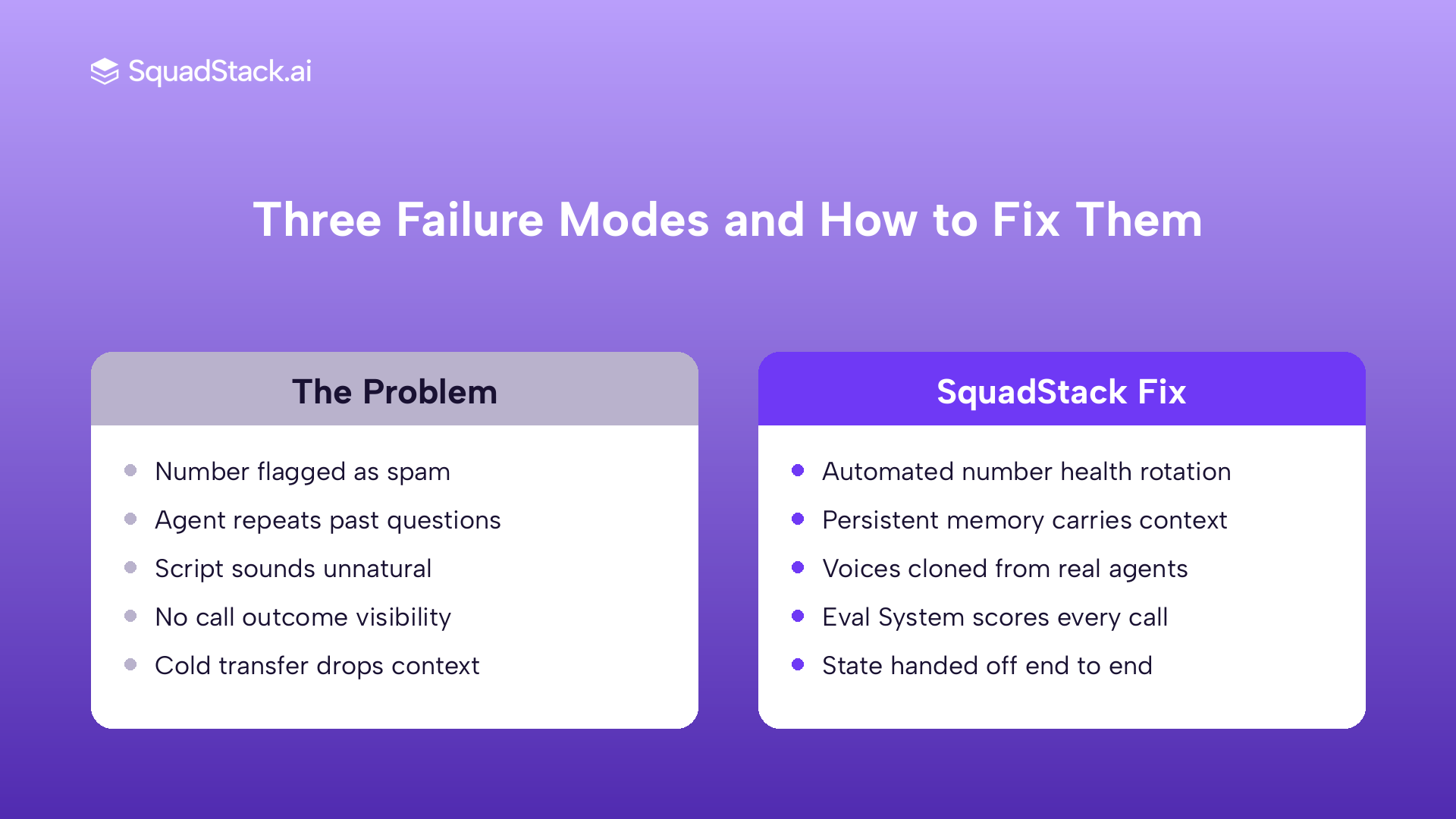
Post-deployment failures in India tend to cluster around four areas that no vendor demo covers:
Number spam. Outbound numbers get flagged on Truecaller quickly when volume is high. Without automated rotation and health monitoring, connectivity drops sharply within weeks.
Language quality in tier-2 and tier-3 cities. The agent may sound fine in Mumbai Hindi but unnatural to a speaker from Patna or Ahmedabad. Voices built from conversational telephonic audio across Indian pincodes perform far better than those built from studio recordings.
Agent drift on complex products. A personal loan or insurance call involves multiple eligibility questions, objection handling, and conditional flows. Agents without proper state management loop back, contradict themselves, or break after the tenth turn.
No outcome loop. A platform that dials well but cannot tell you which script variant converted better, or why certain lead cohorts dropped off, leaves the team flying blind.
For a deeper look at how SquadStack's speech recognition addresses Indian telecalling conditions, this piece on Hinglish and Indian telephony covers the technical ground in detail.
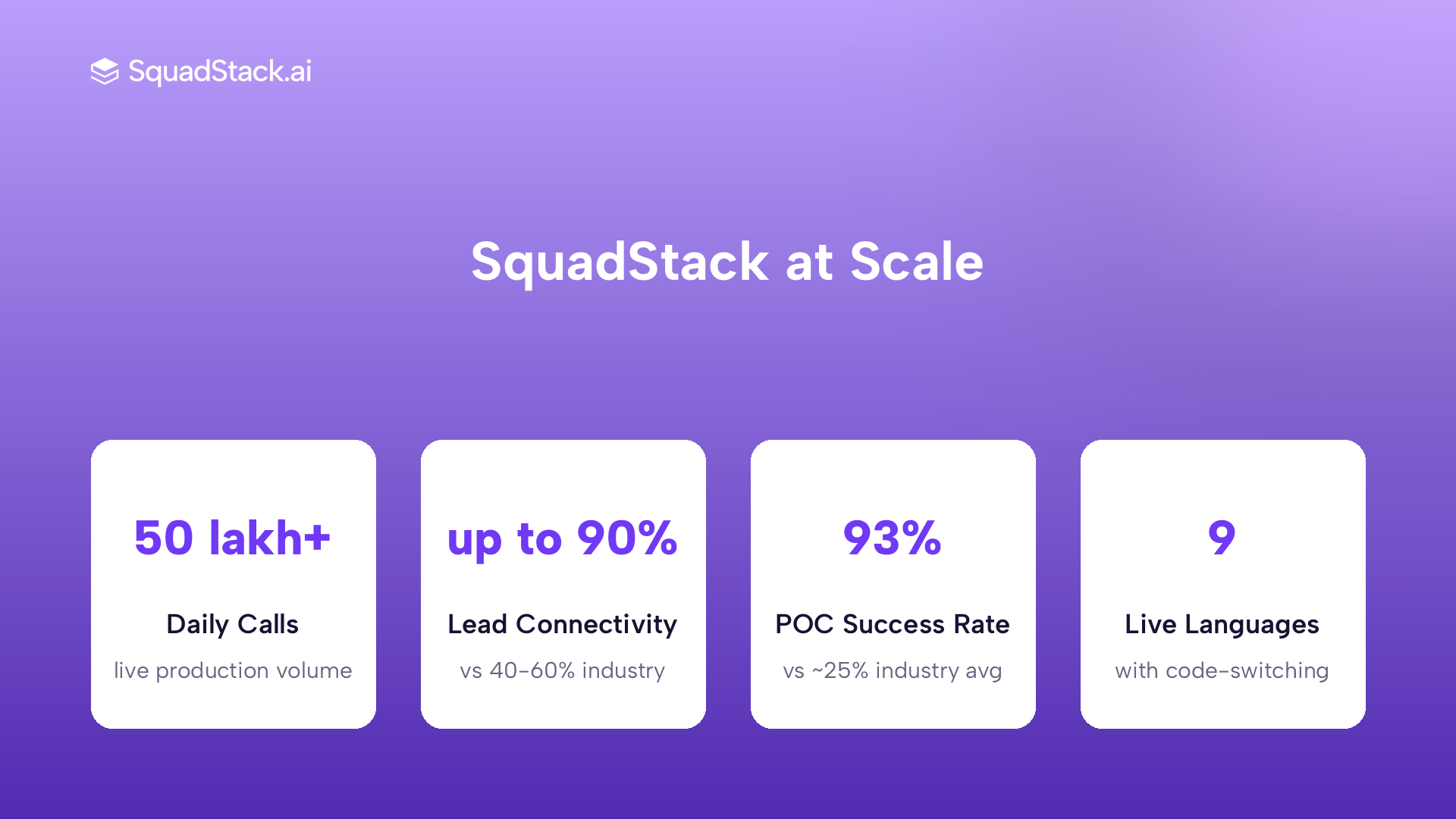
SquadStack's advantage over generic AI calling platforms comes from one fact that cannot be replicated quickly: the Arth speech model is trained on 600 million-plus minutes of real Indian sales conversations, spanning code-switched Hinglish, Taminglish, and nine live languages including Hindi, Tamil, Telugu, Kannada, Marathi, Malayalam, Bengali, and Gujarati, all recorded on actual 8 kHz telephone lines. In SquadStack's own benchmark on real Indian telesales audio, Arth v1 reaches a Semantic WER of 11.9%, within 0.9 points of the best commercial streaming STT and ahead of Deepgram Nova-3 (12.6%) and Sarvam Saaras v3 (13.6%).
That accuracy matters most where errors are costliest: amounts, PIN codes, PAN numbers, and product names.
The platform runs 50 lakh-plus AI calls daily for 60-plus large consumer brands including Kotak Mahindra Bank, AngelOne, Eureka Forbes, IndiaMART, and PhonePe.
In a published gold loan NBFC deployment, SquadStack's Voice AI Agent handled consultative loan calls end-to-end, demonstrating the persistent memory and long-call state management that most platforms cannot sustain on financial products.
The platform is fully managed: every client gets a dedicated squad (AI Agent Product Manager, Forward Deployed Engineer, Conversational AI Designer, QA specialist) who builds the campaign, runs A/B tests on live traffic through the Optimize module, and monitors quality through the Eval System, which scores every call on Outcome, Sentiment, and Execution. Compliance is built in at the platform level: TRAI-compliant calling windows are hard-enforced, DND scrubbing runs before every dial, 140-series numbers are provisioned, and certifications include ISO 27001, ISO 27701, SOC 2 Type II, and DPDP.
SquadStack's POC success rate is 93%, against an industry average of roughly 25%. Go-live takes approximately two weeks, and pilots run on real leads against a pre-agreed success metric.
For teams evaluating the broader agentic contact center space, or looking at a broader comparison of AI call center software, those pages cover related ground.
Ready to see what the platform produces on your lead list? Schedule a demo.
Which is the best AI telecalling software in India for outbound sales in 2026?
The best platform depends on your use case, but for high-volume outbound sales with multilingual requirements, the key criteria are lead-level connectivity (not per-attempt), native Hinglish accuracy, and a managed service model with QA built in. SquadStack is the only fully managed platform with a speech model trained on 600 million-plus minutes of real Indian telephony audio, running for 60-plus large consumer brands at 50 lakh-plus calls daily.
What is the best AI telecalling software for BFSI businesses in India?
BFSI businesses need TRAI compliance, DPDP data residency, long-call stability for loan advisory and insurance conversations, and sector-specific disclosure handling. SquadStack is certified ISO 27001, ISO 27701, SOC 2 Type II, and DPDP-compliant, with all models hosted in India. Clients include Kotak Mahindra Bank, AngelOne, PhonePe, and KreditBee.
How does AI telecalling software compare to a traditional human call center in India?
AI telecalling agents can run 50 lakh-plus calls daily without hiring, training, or attrition delays. Outcome data from SquadStack campaigns shows up to 90% lead connectivity versus a 40 to 60% industry norm, and up to 2 to 3x lower customer acquisition cost compared to human agents in specific deployments. The consistent advantage is that every lever of the conversation is optimizable and runs identically across every call.
Can AI telecalling software handle Hinglish and regional Indian languages accurately?
It depends on what the speech model was trained on. Platforms using public datasets or clean studio audio struggle with real telephony conditions. SquadStack's Arth model is trained on real Indian contact center conversations at 8 kHz, including Hinglish and Taminglish code-switching. It supports 9 live languages with mid-sentence language switching, not just a language-selector at the start of a call.
What are the TRAI compliance requirements for AI outbound calling in India?
Outbound AI calling in India requires: DND registry scrubbing before each dial, use of 140-series numbers for cold outreach, calling hours restricted to 9:30 AM to 8:30 PM, and honoring client DND lists. These rules must be enforced at the platform level, not left to the operator to configure. SquadStack hard-enforces calling windows and scrubs DND automatically.
How long does it take to go live with an AI telecalling platform?
With SquadStack, most enterprise pilots go live in two to three weeks. The build period trains the agent on the client's real call recordings, knowledge base, and FAQs. The long pole is usually client-side dependencies like telephony approvals and compliance sign-off, not the platform build itself.
How should I evaluate an AI telecalling vendor's language support claims?
Ask for a live call demo in your target language, not a recorded sample. Ask for Semantic WER data on real telephony audio. Listen for whether the agent can handle a mid-sentence code-switch, and whether the voice sounds like a human sales agent or a news anchor. Also check whether the vendor's voices are cloned from conversational phone audio or from studio read-speech.
What does AI telecalling software cost in India?
Pricing across the market typically follows a per-minute or per-outcome model. SquadStack includes telephony infrastructure (the dialer, numbers, carrier routing) in its platform, where many vendors bill these separately. Specific pricing depends on call volume, language requirements, and use case. For a cost comparison relevant to your volumes, the best path is a direct conversation at squadstack.ai.
What are the most common failure modes in AI telecalling deployments in India?
The four most common issues are number spam (outbound numbers flagged on Truecaller as volume scales), poor regional language quality in tier-2 and tier-3 markets, agent drift on complex multi-turn conversations, and no feedback loop to improve scripts after the pilot. Platforms with automated number rotation, conversational telephony-trained models, state management for long calls, and built-in A/B testing avoid all four.
Is AI telecalling software suitable for both inbound and outbound calling?
Yes. SquadStack's Voice AI Agent handles both outbound dialling campaigns and inbound support calls on the same platform, with the same persistent memory, so a lead who calls back after an outbound campaign is met by an agent with full context of the prior conversation. Channels extend to WhatsApp, SMS, and in-app touchpoints within the same workflow.