AI Voice Agent for Microfinance: Grameen Model at Scale
November 7, 2026
|

13 min read
Learn how AI voice agents help banks and NBFCs meet RBI re-KYC mandates at scale, across languages, with full audit trails.
KYC re-verification calls using AI voice for banks and NBFCs let lenders reach thousands of dormant or high-risk account holders simultaneously, guide them through document re-submission or video KYC steps, and generate audit-ready records that satisfy RBI's KYC Master Direction. AI voice handles the scale that human teams cannot, in the customer's own language, while keeping every conversation logged and compliant.
Banks and NBFCs sit on millions of accounts that have gone dormant or triggered a periodic review under RBI's KYC Master Direction. The obligation is clear: re-verify the customer's identity and update records within the prescribed timeline. The problem is the math. A lender with millions of such accounts cannot staff a calling team large enough to reach all of them before the compliance clock runs out. The result is regulatory exposure, frozen accounts, and customers who feel ignored.
This is exactly where AI voice agents for KYC re-verification calls change the operational picture for banks and NBFCs. This post covers how they work, where they fit the re-KYC funnel, what to look for in a platform, and the compliance specifics the RBI framework demands.
AI-driven KYC re-verification is the use of conversational voice agents to conduct RBI-mandated periodic KYC refresh calls at scale, replacing or augmenting the manual telecalling programmes most banks and NBFCs currently run.
Under the RBI KYC Master Direction, regulated entities must classify customers by risk category and re-verify their KYC details periodically: every two years for high-risk, every eight to ten years for low-risk, and any time an account shows dormancy or unusual behaviour. The re-verification process typically involves confirming personal details, prompting the customer to re-submit documents, and in some cases completing a fresh video KYC (V-CIP) session.
The challenge is not the process but the volume. A mid-sized private bank or digital NBFC can carry hundreds of thousands of accounts due for re-KYC refresh in any given quarter. Human calling teams cannot cover that base without significant cost and headcount. AI voice agents run those calls simultaneously, at any scale, without adding a single seat.
A well-designed AI re-KYC call follows a structured five-step flow, from first contact to audit record, while adapting to what the customer says at each turn.
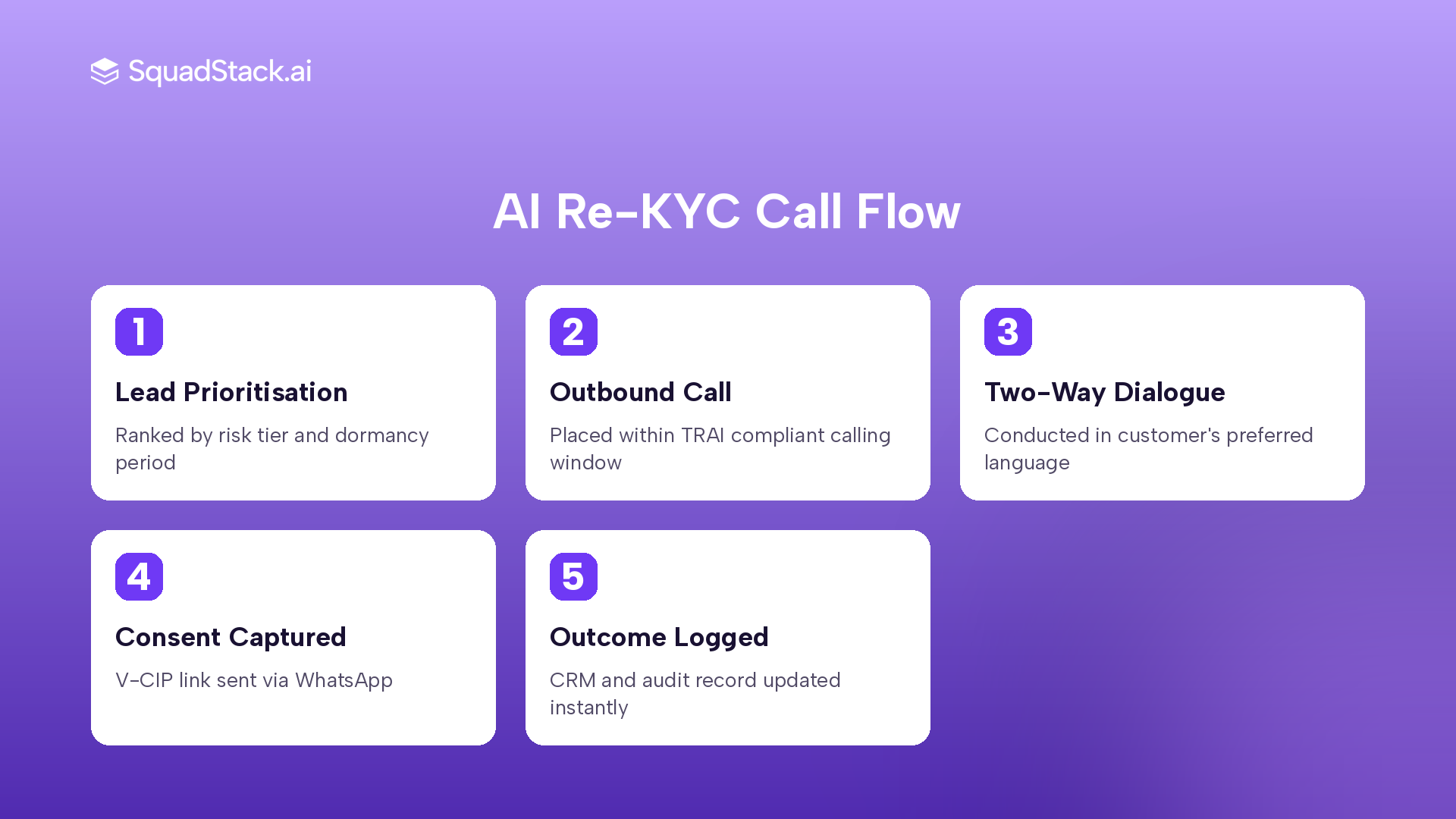
1. Lead prioritisation and scheduling. The AI Lead Manager ranks accounts by risk tier, dormancy period, and previous failed contact attempts, then picks the right time to call each customer based on response patterns. Calls go out only inside the TRAI-compliant window (9:30 AM to 8:30 PM), enforced at the platform level.
2. Opening and identity confirmation. The agent opens with an automated-caller disclosure, then confirms the customer's name, date of birth, or registered mobile number. If the customer responds in Hindi, the agent continues in Hindi. If they switch to Telugu mid-sentence, the agent follows without pausing or restarting.
3. Re-verification dialogue. The agent walks the customer through what the lender needs: confirm current address, check whether PAN or Aadhaar details have changed, and prompt them to upload a fresh document or schedule a V-CIP session. For confused or elderly customers, the agent slows down, re-explains, and can book a callback with a human agent if a defined escalation trigger is reached.
4. Consent capture and document dispatch. The agent captures explicit verbal consent, logged against the call recording. WhatsApp links for document upload or V-CIP scheduling can be sent mid-call while the customer is still on the line.
5. Outcome recording and audit trail. Every call ends with a structured outcome: verified, document pending, V-CIP scheduled, not contactable, or escalated to human. These outcomes write back to the lender's CRM automatically. The platform's Eval System scores every call on Outcome, Sentiment, and Execution, and recordings are stored and retrievable for RBI inspection.
Every outcome also feeds the ROI Optimizer, which reshapes script, language selection, and timing for the next round of calls so the programme improves as it runs.
AI voice agents attach to three specific re-KYC scenarios where volume, language complexity, and compliance demands are highest.
Dormant account reactivation. Accounts inactive beyond a regulatory threshold need re-KYC before reactivation. These customers are harder to reach and need a clear explanation of why the call is happening. AI agents handle this at scale, in the customer's preferred language, without the inconsistency of a large BPO floor rotating staff.
High-risk customer periodic refresh. Customers classified as high-risk face more frequent re-verification cycles. Running this manually is expensive and auditable only up to a point. AI-driven calls ensure every customer in the cohort is contacted, every outcome is logged, and evidence is available for inspection.
V-CIP scheduling and drop-off recovery. Even when a customer agrees to re-KYC, V-CIP completion is a known drop-off point. The agent can call customers who started but did not complete a V-CIP session, remind them what they need, and book a fresh slot.
These use cases sit within the broader lending and credit calling programmes that banks and NBFCs run across origination, servicing, and collections.
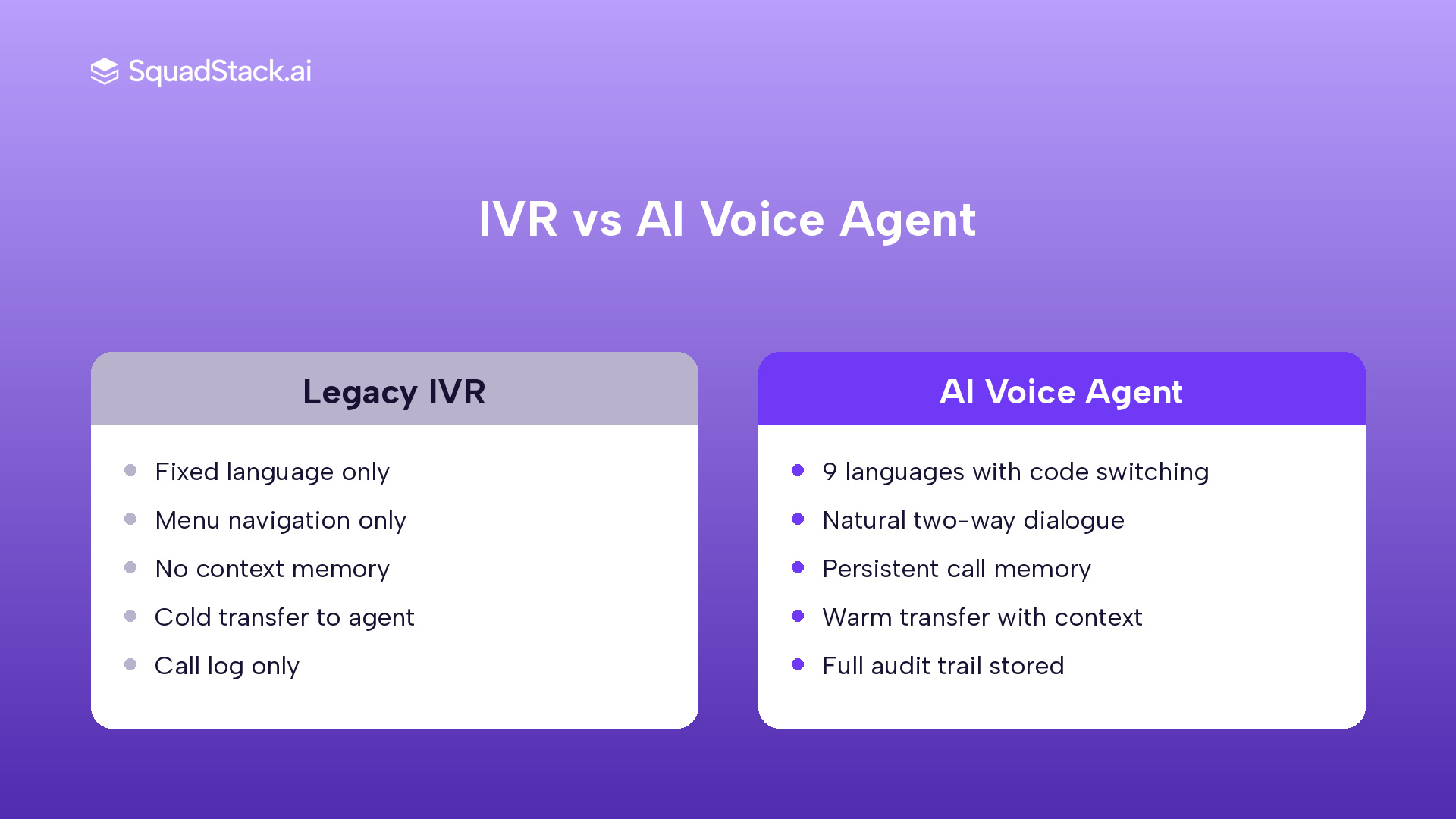
An IVR cannot conduct a KYC re-verification. It can deliver a message. The moment a customer has a question, an objection, or speaks in a language the menu does not support, the call fails.
| Dimension | Legacy IVR | AI Voice Agent |
|---|---|---|
| Language handling | Fixed language, no code-switching | 9 live Indian languages with native code-switching mid-sentence |
| Customer response | Menu navigation only ("Press 1 to confirm") | Natural two-way dialogue; handles free-form replies |
| Compliance disclosure | Static recorded message | Configurable per campaign; consent captured, logged, and retrievable |
| V-CIP scheduling | Cannot book or reschedule on the spot | Books a V-CIP slot live, sends the link via WhatsApp mid-call |
| Escalation | Transfers to a queue with no context | Warm transfer with full conversation context passed to the human agent |
| Audit trail | Call connected/disconnected only | Structured outcome, consent log, recording, entity extraction, CRM write-back |
| Edge case handling | Breaks or loops on off-menu input | Detects confusion or distress and escalates per configured triggers |
The customers most likely to need re-verification, dormant, elderly, or banking in a regional language, are exactly the customers least likely to navigate a keypad menu. An AI voice agent can explain why the call is happening, answer basic compliance questions, and reassure someone worried about a fraud call. An IVR cannot do any of that.
The right platform must pass five tests: regulatory compliance, language depth, audit trail quality, escalation design, and integration speed.
Regulatory compliance built in. The platform should enforce TRAI calling-window rules at the system level, support 140-series and 160-series numbers, scrub against DND registries before dialing, and store consent recordings in a way that satisfies RBI outsourcing directions.
Language depth, not just language count. Supporting nine languages on a feature sheet is not the same as sounding native in them. The speech model must be trained on real telephonic audio in each language, including code-switched speech, not read-speech datasets.
A complete audit trail. Every call should produce a recording, transcript, structured outcome, captured consent, and a CRM write-back. Any gap leaves the lender carrying the compliance risk.
Escalation for edge cases. A share of re-KYC calls will involve customers who are confused, elderly, or upset. The platform needs configurable escalation triggers that hand off to a human agent with full call context, not a cold transfer.
Fast setup, with your data. The agent should train on the lender's own call recordings, knowledge base, and FAQs before going live, so it sounds like the bank's representative rather than a generic bot.
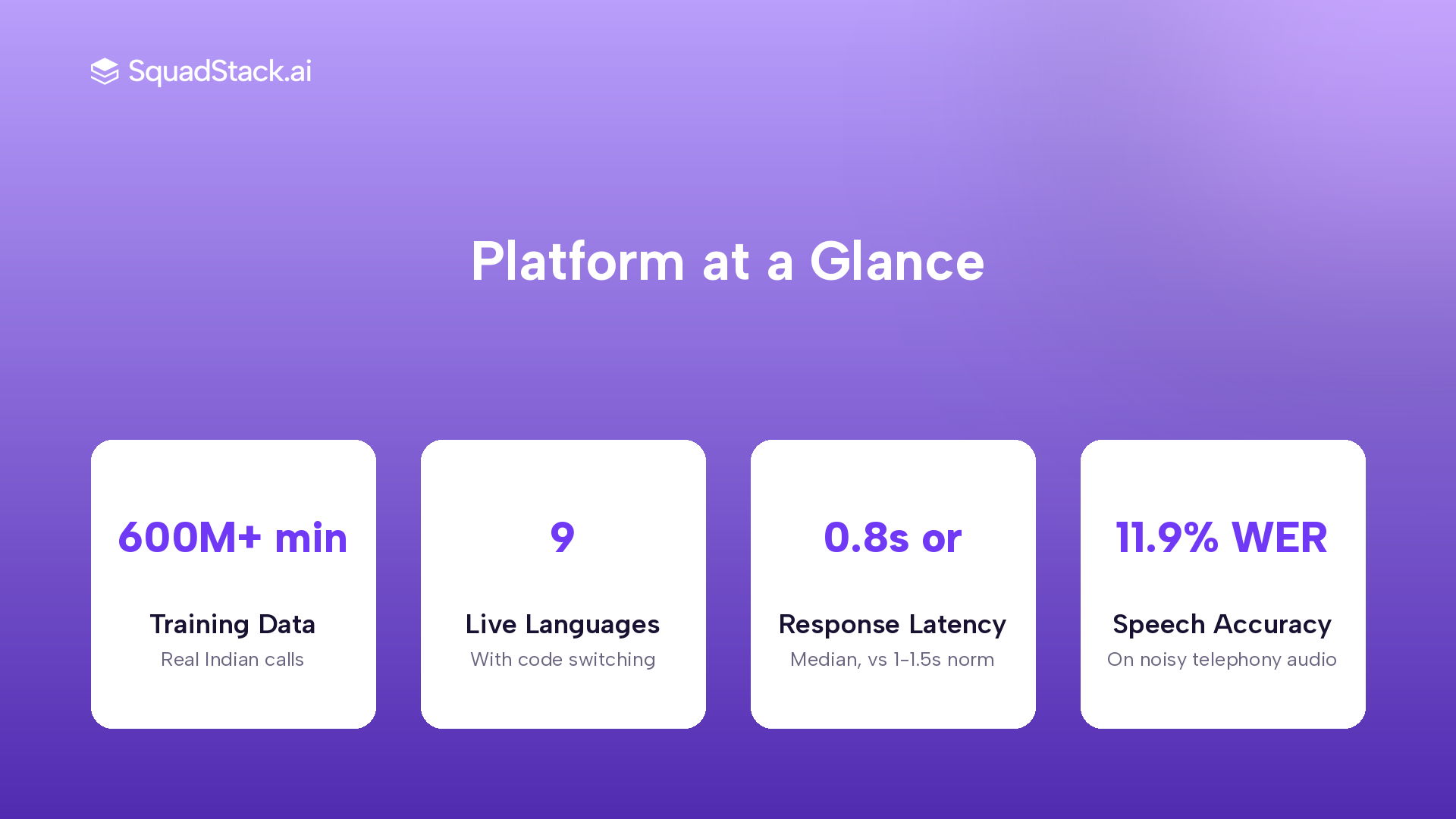
SquadStack's voice agents run on Arth, a proprietary speech model trained on 600M+ minutes of real Indian contact-center conversations, giving the platform a word-error rate of 11.9% on noisy telephony audio, within 0.9 points of the best commercial streaming STT available.
Arth is trained on real 8kHz telephone calls, including Hinglish, Taminglish, and code-switched speech across 85% of Indian pincodes, not YouTube audio or studio recordings. When a re-KYC customer in Nagpur answers in Hinglish and switches to Marathi, the agent follows without a pause.
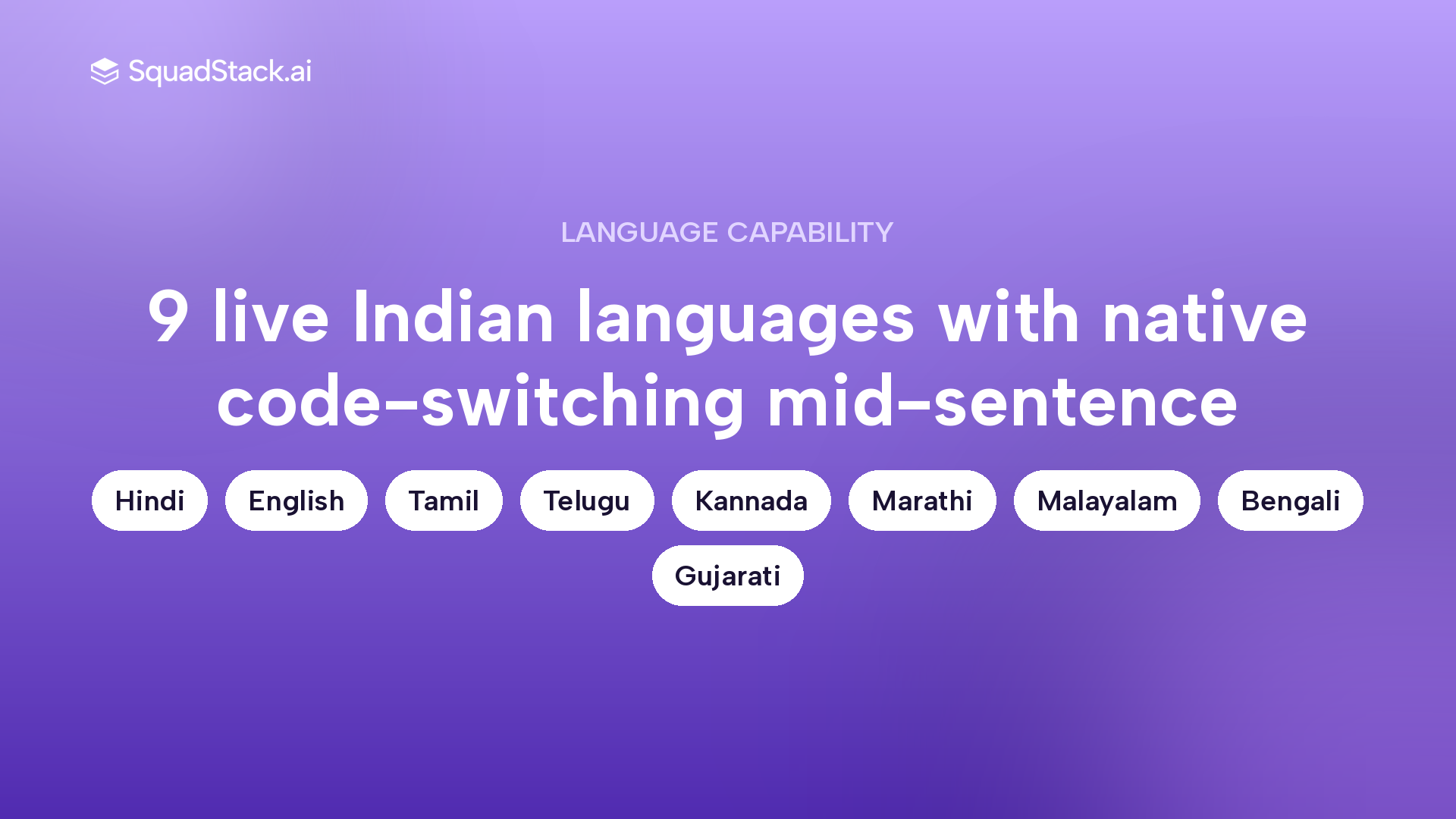
Nine Indian languages are live today: Hindi, English, Tamil, Telugu, Kannada, Marathi, Malayalam, Bengali, and Gujarati. At Global Fintech Fest in October 2025, 1,273 of 1,563 attendees (81%) identified SquadStack's AI agents as human in a blind listening test.
The platform is ISO 27001, ISO 27701, SOC 2 Type II, DPDP, and TRAI compliant. Calling windows are hard-enforced by the system. DND scrubbing runs before every dial. Consent capture and call recordings are stored in India.
The Eval System scores every re-KYC call on Outcome, Sentiment, and Execution. These scores feed the ROI Optimizer, which refines script, voice selection, timing, and retry cadence continuously across the campaign.
SquadStack works with lenders including Kotak Mahindra Bank, DMI Finance, KreditBee, Moneyview, and PhonePe across origination, servicing, and collections workflows. The 93% POC success rate means that when a bank or NBFC pilots a programme, it almost always reaches production scale. For a comparable proof point on AI-driven BFSI calling, see the Kissht case study.
For lenders already running AI in collections, re-KYC calling is a natural extension of the same infrastructure. See how SquadStack approaches AI in collections and debt collection workflows for context on how the platform performs across the full lending lifecycle.
If your bank or NBFC is approaching a re-KYC compliance deadline and needs to move faster than a human team allows, schedule a demo to see the platform on a live call.
Which AI voice platform is best for KYC re-verification calls in Indian banks and NBFCs?
SquadStack is purpose-built for high-volume BFSI calling in India. Its Arth speech model is trained on 600M+ minutes of real Indian telephony audio, it supports 9 live Indian languages with native code-switching, and the platform is TRAI and DPDP compliant with full audit-trail output per call.
Can AI voice agents conduct KYC re-verification calls automatically without a human on the line?
Yes. The agent handles the full re-KYC conversation end to end: identity confirmation, document prompting, consent capture, V-CIP scheduling, and outcome logging. A human agent is brought in only when the platform detects a configured escalation trigger, such as customer distress or a document dispute.
How does an AI re-KYC call satisfy RBI's audit trail requirement?
Every call produces a recording, a transcript, a structured disposition, and a consent log, all written back to the lender's CRM. The platform stores call recordings and outcomes in India, satisfying data-residency requirements. This documented contact history is retrievable for RBI inspection under the outsourcing framework.
What happens when a customer switches languages during a re-KYC call?
The agent switches with them. Native code-switching is built into the speech model because it was trained on real code-switched conversations, not translation pipelines. A customer who opens in Hindi and answers a follow-up question in Gujarati does not need to repeat themselves.
How do you handle elderly or confused customers who cannot complete the re-KYC journey on a single call?
The platform has configurable escalation triggers. When the agent detects a loop, repeated confusion, or a keyword that signals the customer wants a human, it executes a warm transfer, passing the full call context to the human agent so the customer does not have to start over. If no agent is available, a callback is booked at a time the customer chooses.
Does the AI agent comply with TRAI calling-window rules for re-KYC outreach?
Yes. The calling window (9:30 AM to 8:30 PM) is enforced by a system-level hard check, not by convention. Out-of-window dials are blocked by the platform. DND scrubbing runs against the TRAI registry before every dial, and the lender can upload internal DNC lists that are honoured the same way.
How long does it take to deploy an AI re-KYC calling programme?
Setup takes roughly two weeks for a new campaign. The agent trains on the lender's own call recordings, knowledge base, and compliance scripts before going live. Simple, contained flows can produce a testable prototype faster, but the main variable is usually client-side approvals, not the build itself.
What is the difference between using AI voice for new KYC onboarding versus periodic re-verification?
New KYC onboarding attaches to the application and V-CIP stages of a fresh loan or account journey. Periodic re-verification is a compliance-mandated refresh on an existing customer base, often dormant accounts, where the agent needs to re-establish contact, explain the reason for the call, and guide through document re-submission rather than initial collection. The conversation design, compliance disclosures, and escalation triggers differ between the two.
Can the AI agent send a V-CIP scheduling link while the customer is still on the call?
Yes. The agent can send a WhatsApp link mid-call, while the conversation is still live, so the customer can immediately confirm their V-CIP slot without hanging up and navigating separately to an app. This reduces the drop-off that happens when customers are asked to act after the call ends.
How does SquadStack handle the re-KYC calling programme as volume scales?
AI calling scales without adding headcount. Once the pilot metric is proven, volume ramps on the same infrastructure. There is no hiring, training, or attrition drag. The ROI Optimizer continuously refines script, timing, and language selection as the programme scales, so later calls in the campaign perform better than earlier ones.