AI Voice Agent for Microfinance: Grameen Model at Scale
November 7, 2026
|

13 min read
What to know about closing the Tier 2 conversion gap: trust signals, dialect matching, and call flow design matter more than language support alone.
AI voice calling in Tier 2 cities presents real conversion and challenges that go well beyond basic language support. Calls connect at solid rates in non-metro India, but conversions trail Tier 1 benchmarks because of trust gaps, dialect nuance, and scripts tuned for a metro buyer. Fixing these requires recalibrating the entire call flow, not just switching on a regional language.
Businesses running outbound sales campaigns in India often discover the same pattern. Their AI voice agent performs well across Tier 1 cities. Connectivity is solid, conversions are reasonable, and the funnel looks healthy. Then the same campaign rolls out to Tier 2 cities and the numbers slip. Calls get answered, but fewer go anywhere. The agent talks, the caller listens briefly, then disconnects.
This is not a language-support problem in the narrow sense. It is a calibration problem. Understanding why Tier 2 calls behave differently is the first step to fixing them.
For a broader overview of how AI voice agents work across Indian markets, that pillar resource covers the full picture. This post goes deeper into the conversion mechanics specific to non-metro India.
AI voice calling uses conversational AI agents to make and receive phone calls at scale, replacing or supplementing human callers in outbound sales, qualification, and collections. In a Tier 2 or Tier 3 Indian context, the agent must handle regional accents, frequent code-switching, lower baseline trust in unknown callers, and objection patterns shaped by a different economic and social context than what works in Mumbai or Bengaluru.
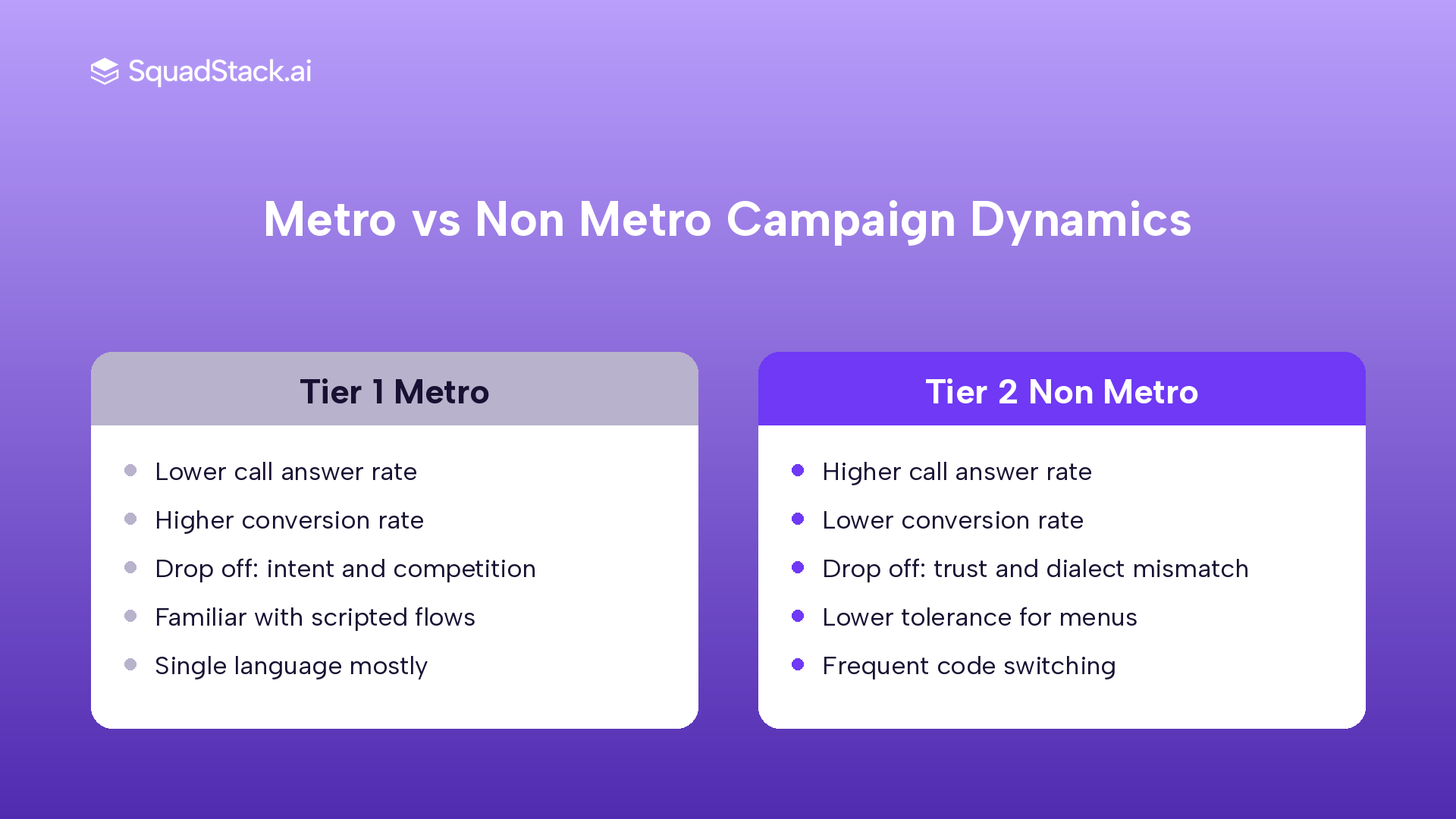
The core challenge is not whether the agent can speak Hindi or Tamil. That bar is easy to clear. The harder question is whether the agent sounds credible to that caller, responds to hesitation signals specific to non-metro buyers, and knows when to hand off versus when to persist.
A typical outbound AI voice call in a Tier 2 lending or insurance campaign runs through these stages.
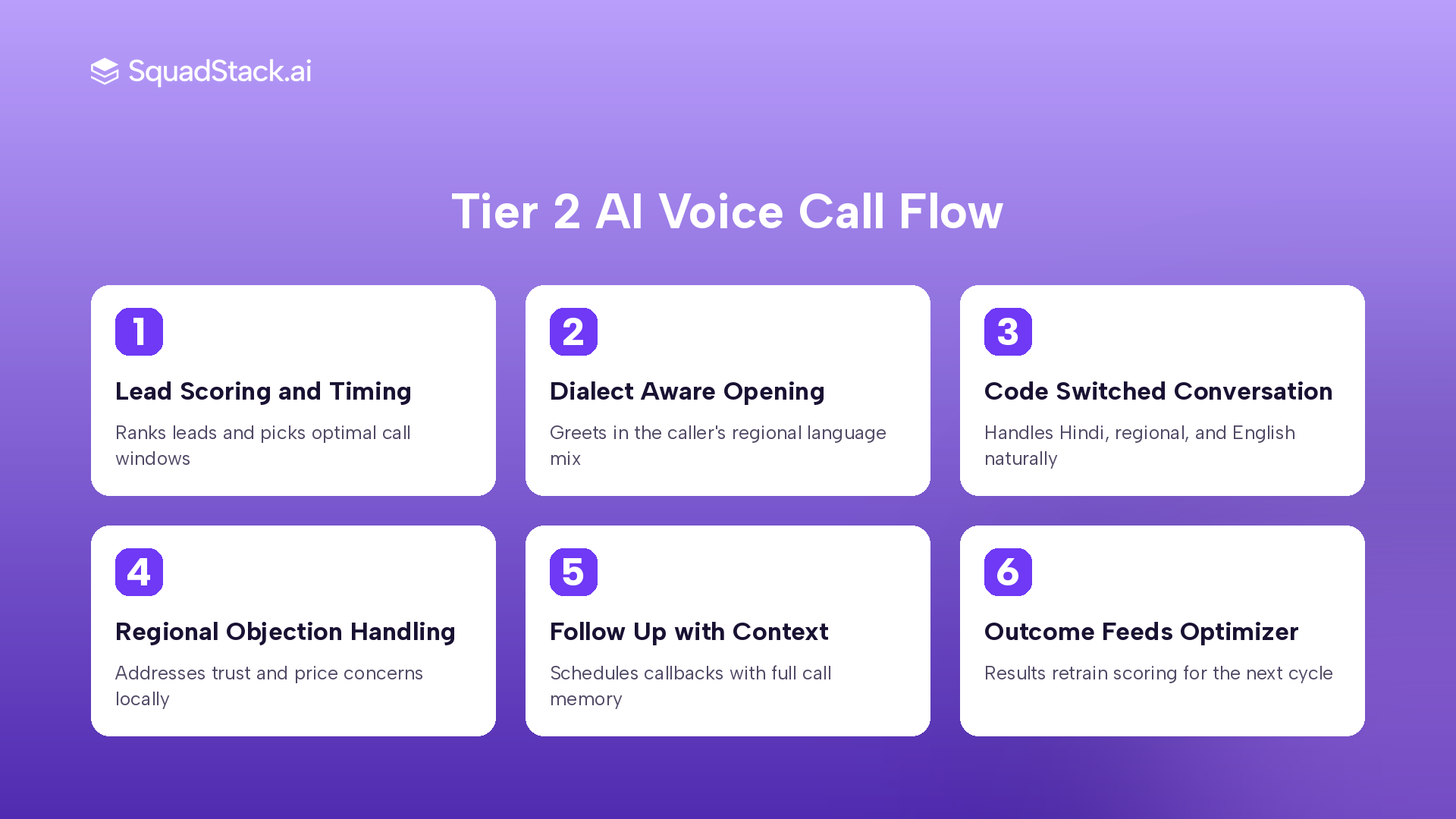
Lead scoring and timing. Before the first dial, the system ranks leads by propensity and selects the best time to call. In Tier 2 markets, effective calling windows often differ from metro patterns. Many buyers are available earlier in the day or during lunch hours, and the system adapts by learning when each segment actually picks up.
First dial and opening. The first three to five seconds determine whether the caller stays. A generic Hindi voice with a neutral newsreader accent will read as robotic to a caller in Rajasthan or Uttar Pradesh. The agent needs the right regional cues: pace, filler words, and intonation.
Objection handling and qualification. Non-metro buyers carry distinct objection patterns. Price sensitivity is higher, trust in financial products is lower, and callers often ask for time to consult family before committing. An agent trained only on metro data will misread these as hard rejections. An agent trained on a broader dataset recognizes them as soft holds that need a different response.
Follow-up scheduling. When a call ends without a conversion, the system schedules a follow-up at the right time, carries context forward, and opens the next call from where the last one ended rather than restarting cold.
Continuous learning. Every call outcome feeds back into the system. Scripts that performed well in a Kanpur campaign inform the next Lucknow campaign. Timing that worked for a Tier 2 insurance cohort gets applied to a similar gold loan cohort. For more on how this loop powers AI-driven sales automation, the linked resource covers the mechanics in detail.
Gold loan sales are a strong example. The product suits non-metro buyers who hold physical gold, but the conversation requires the agent to sound credible and patient, handle price-per-gram questions accurately, and manage concerns about collateral. SquadStack has run exactly this scenario with a leading gold loan NBFC, and the case study details are here.
Personal loan campaigns in Tier 2 cities face a different challenge. Many leads have limited prior experience with digital-first lenders. The agent needs to build enough confidence in a short call to move the lead to an application step, handling "I will think about it" and "I'll talk to my family" as real objection types, not dispositions.
Insurance renewals in non-metro markets are another strong fit, particularly when the lead holds an existing policy. Call-answer rates are higher because the number is recognized or the lead was pre-notified. The conversion challenge is walking the buyer through renewal without triggering the instinct to defer.
In Tier 1 cities, an IVR can sometimes survive because buyers are familiar with the format and willing to navigate menus. In Tier 2, that tolerance is lower. A caller who hears a scripted menu prompt and cannot respond naturally will disconnect faster.
| Dimension | IVR | AI Voice Agent |
|---|---|---|
| Response to "mujhe thoda time chahiye" | Falls back to menu or marks as not interested | Recognizes it as a soft hold, offers a callback, carries context forward |
| Dialect and code-switching | Fixed language, no adaptation | Switches mid-sentence between Hindi and Bhojpuri, or Tamil and local dialect, based on how the caller responds |
| Objection handling | Cannot process off-script input | Handles multi-turn objections, responds to price concerns, family-consult requests, and trust questions |
| Call memory | Starts cold every time | Knows what the caller said on the last call, resumes from the last completed step |
| Timing adaptation | Fixed schedule | Learns when each Tier 2 segment actually picks up and dials accordingly |
The gap is widest at the moment of hesitation. A Tier 2 buyer pausing to think is not a buyer who is done. An IVR marks that as a failed outcome. An AI voice agent trained on real Indian sales conversations knows the difference.
For a broader comparison of AI call center software across platforms, the linked resource gives more detail on how these systems stack up.
Platforms that perform well in non-metro India share a few specific characteristics. Generic voice AI tools built on public datasets do not have these by default.
Training data from real Indian telephony. Public datasets do not reflect how people speak on an 8kHz phone line in a Tier 2 city with background noise and code-switched speech. The model needs to be trained on real Indian contact center conversations spanning a genuine breadth of Indian pincodes.
Native code-switching, not just multilingual menus. Many platforms list regional languages as a feature but switch languages only at the start of a call. Native code-switching means the agent responds in the same mixed-language mode the caller uses, mid-sentence.
Objection handling built for non-metro buyer patterns. Scripts written for metro campaigns misread soft holds as rejections. The system needs to recognize the specific signals Tier 2 buyers send when they are interested but cautious.
Smart follow-up and retry logic. A single missed call in a Tier 2 market is not a lost lead. The system should know when to retry, with what gap, and carry full context into the next attempt.
Post-call QA that measures outcome, not just script compliance. A quality framework that only checks script adherence will miss cases where the agent said the right words but lost the sale. Evaluating on outcome, sentiment, and execution gives a clearer picture.
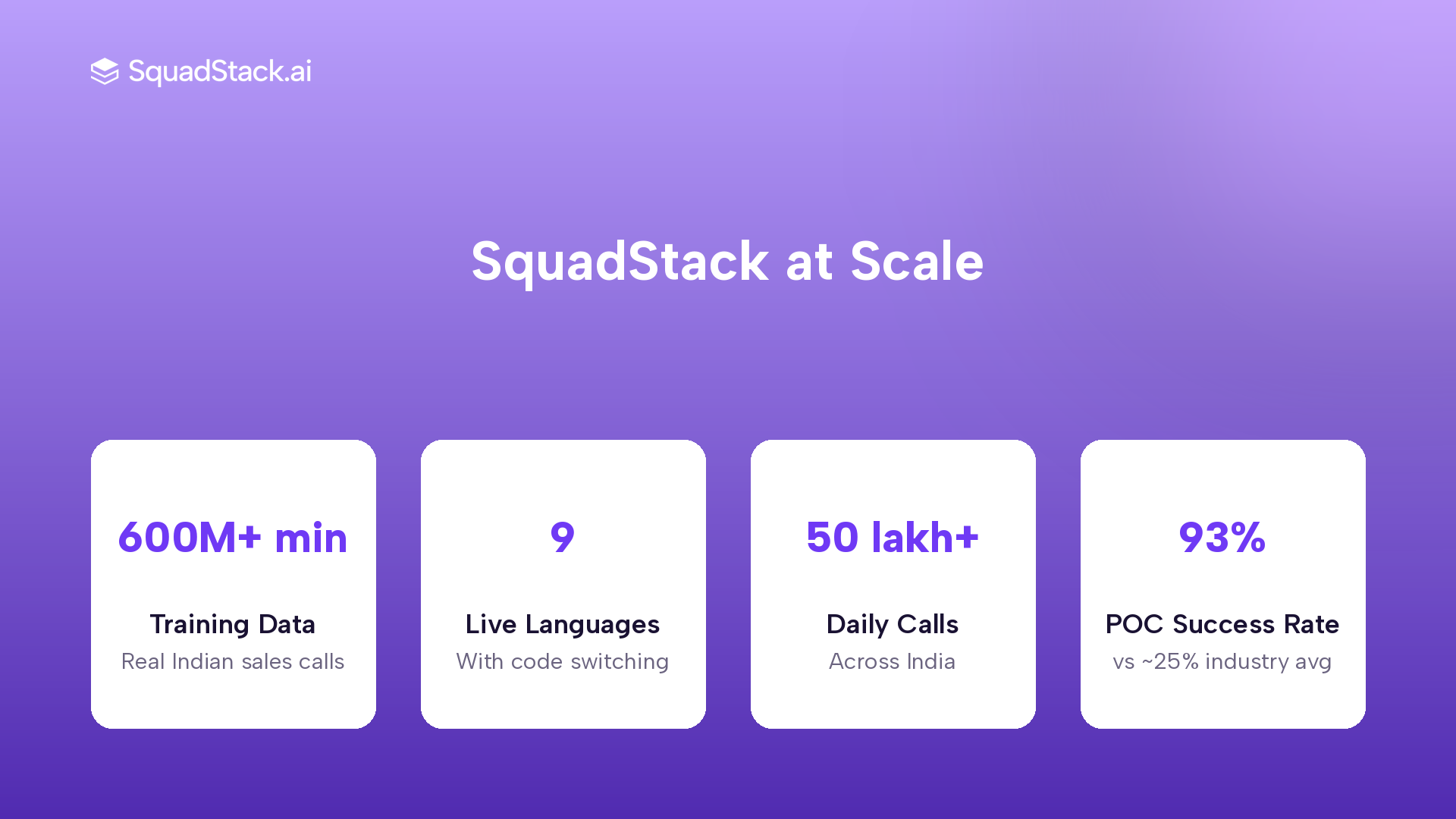
SquadStack's AI voice agent platform is trained on 600M+ minutes of real Indian sales conversations spanning more than 85% of Indian pincodes. That is not a general speech dataset. It is full-duplex, outcome-labelled telephony audio from real sales calls across India's regions, accents, and language mixes.
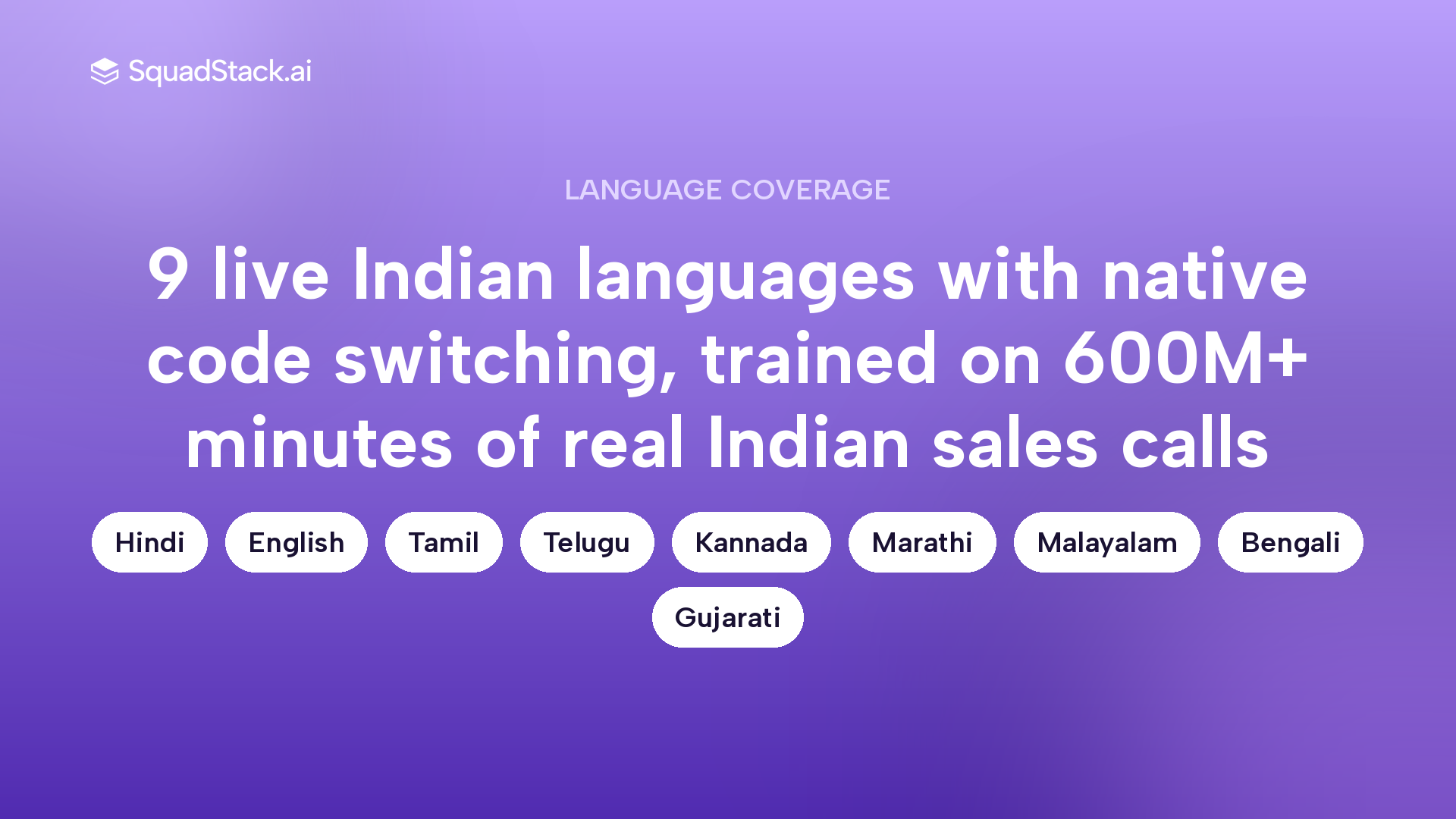
Nine Indian languages are live today: Hindi, English, Tamil, Telugu, Kannada, Marathi, Malayalam, Bengali, and Gujarati, with native code-switching across all of them. Additional regional languages are available on demand. The platform handles Indian entity types like PAN numbers, PIN codes, loan amounts, and city names accurately within each language.
The Eval System scores every call on three levels: Outcome (did the call achieve its goal?), Sentiment (how did the conversation land with the buyer?), and Execution (did the agent handle the pitch, objections, and information capture correctly?). A call that scores well on execution but produces a poor sentiment reading signals that the script needs recalibration for that market segment, not just the ASR.
SquadStack has run this at scale, with 50 lakh+ calls daily across 60+ large consumer brands including Kotak Mahindra Bank (personal loan sales), IIFL (gold loan sales), Moneyview (personal loan sales), and Eureka Forbes (AMC and product sales). The full gold loan NBFC case study is here.
Up to 90% lead connectivity against a 40 to 60% industry norm is achievable because the AI Lead Manager adapts dial timing to when each segment actually picks up, rotates numbers to avoid spam flags, and carries full context into every retry. In Tier 2 markets where call-answer rates start higher, that connectivity advantage translates directly into more conversations, provided the agent converts them. The agentic AI contact center platform overview covers how the full stack connects lead management to conversation quality to outcome optimization.
The 93% POC success rate, against an industry average of roughly 25%, reflects that this works in production, not just in demos. For teams evaluating voice bots for India, this track record is a meaningful differentiator.
Tier 2 markets represent a large and growing share of consumer credit, insurance, and consumer goods demand in India. The call-answer rates are there. The conversion gap is a calibration problem, and it is solvable with the right data, the right language stack, and the right follow-up workflows.
If your outbound AI voice campaigns are connecting in non-metro India but not converting, schedule a demo to see how SquadStack's platform handles the specific challenges covered in this post.
Which is the best AI voice calling platform for Tier 2 and Tier 3 India?
The best platform is one trained on real Indian telephony data across a broad range of Indian pincodes, not just metro samples. SquadStack's voice agents are trained on 600M+ minutes of real Indian sales conversations, support 9 live languages with native code-switching, and are specifically calibrated for the objection patterns and trust dynamics of non-metro buyers.
Can AI voice agents handle callers who only speak regional languages or mix languages mid-sentence?
Yes, but only if the underlying model is trained on code-switched speech. SquadStack's Arth STT model and Sales LLM are both trained on real Hinglish, Taminglish, and other mixed-language telephony audio. The agent switches languages mid-sentence, not just at the start of a call, which is how bilingual conversations actually work.
Why do AI voice calls connect well in Tier 2 cities but still underperform on conversion?
Call-answer rates in non-metro India are often higher than in metros. The conversion gap comes from trust deficit, dialect mismatch, and scripts written for metro buyer psychology. Objection patterns like "I'll think about it" or "I need to ask my family" are common in Tier 2 markets and are frequently misread as hard rejections by models not trained on regional sales data.
How should AI voice campaigns be recalibrated for Tier 2 vs Tier 1 markets?
The key adjustments are: dial timing (non-metro buyers have different availability windows), dialect and code-switching settings, objection handling scripts that account for higher price sensitivity and family-consult requests, and follow-up cadences that treat a missed call as a soft hold rather than a failed lead.
How does an AI voice agent compare to a traditional BPO for Tier 2 outbound sales?
A BPO scales linearly with headcount and faces attrition, training costs, and inconsistent dialect coverage. An AI voice agent scales without those constraints, runs consistent quality on every call, and learns from every outcome to improve future calls. SquadStack's platform achieves up to 90% lead connectivity against a 40 to 60% industry norm, and the 93% POC success rate means the performance is demonstrable before full rollout.
What languages does SquadStack's AI voice agent support for non-metro Indian campaigns?
Nine languages are live today: Hindi, English, Tamil, Telugu, Kannada, Marathi, Malayalam, Bengali, and Gujarati, with native code-switching across all of them. Additional regional languages are available on demand based on business requirements.
How does persistent memory help in multi-touch Tier 2 campaigns?
Tier 2 buyers often need more than one call to commit. Persistent memory means the second and third calls open from where the last one ended. The agent already knows the buyer's loan amount, their stated concern, and their preferred callback time, so the conversation builds rather than restarts.
What quality framework should teams use to diagnose Tier 2 AI call conversion leakage?
A useful framework evaluates calls on three levels: Outcome (did the call achieve its goal?), Sentiment (how did the buyer respond?), and Execution (did the agent handle the script, objections, and information capture correctly?). This is the structure of SquadStack's Eval System. A call that scores well on execution but poorly on sentiment is a signal that script recalibration is needed for that specific market segment.
How does SquadStack handle spam flagging in Tier 2 calling campaigns?
The platform monitors every outbound number's health in real time, tracks Truecaller status, and rotates a number out automatically when it gets flagged or when connectivity drops below threshold. This keeps call-answer rates stable even across high-volume Tier 2 campaigns.
Is AI voice calling compliant with TRAI regulations for non-metro outbound campaigns?
SquadStack is TRAI-compliant. The platform enforces a compliant calling window of 9:30 AM to 8:30 PM as a hard system control, scrubs lead lists against the DND registry before dialing, and uses only 140-series numbers for cold calling, as required by TRAI guidelines.