.svg)






Subscriber Churn Prediction Calls: AI Voice for OTT and Streaming
October 10, 2026
|

12 min read
A guide to lifting pipeline velocity by using AI calling to improve connect rates, conversion, and cycle time across every stage of the revenue funnel.
TL;DR: Pipeline velocity is the CFO-level metric that measures how fast revenue moves through your funnel. AI calling directly improves all four of its variables: lead count reached, win rate, deal size, and sales cycle length. For Indian consumer brands running high-volume, low-ticket sales in BFSI, EdTech, and D2C, this pipeline velocity AI calling revenue per lead equation is where the real ROI lives.
A personal loan lender generates thousands of leads a day. The sales team runs hard. But connect rates are stuck in the 40 to 60% range, follow-ups are patchy, and the deal that should close in a week takes three. The leads are there. The revenue is not.
This is a pipeline velocity problem. It is common across BFSI, EdTech, and D2C in India, where sales teams run at enormous volume but conversions stay stubbornly below potential. Understanding the metric and fixing it systematically is the difference between a good quarter and a great one.
For more on how AI voice agents fit into the broader contact center picture, see SquadStack's AI contact center ROI guide.
Pipeline velocity measures how fast your business turns leads into revenue. It combines four variables into a single number that any RevOps or CFO can track:
Multiply opportunities, win rate, and deal size together, then divide by cycle length. A higher number means faster revenue per unit of selling effort.
Each variable is a dial. Most sales teams only consciously turn one or two of them. AI calling turns all four simultaneously, which is why it matters to RevOps leaders thinking at a system level.
The first variable is the count of leads that actually enter a live conversation. In India, a large share of outbound attempts never connect because of spam labelling, bad timing, or exhausted numbers.
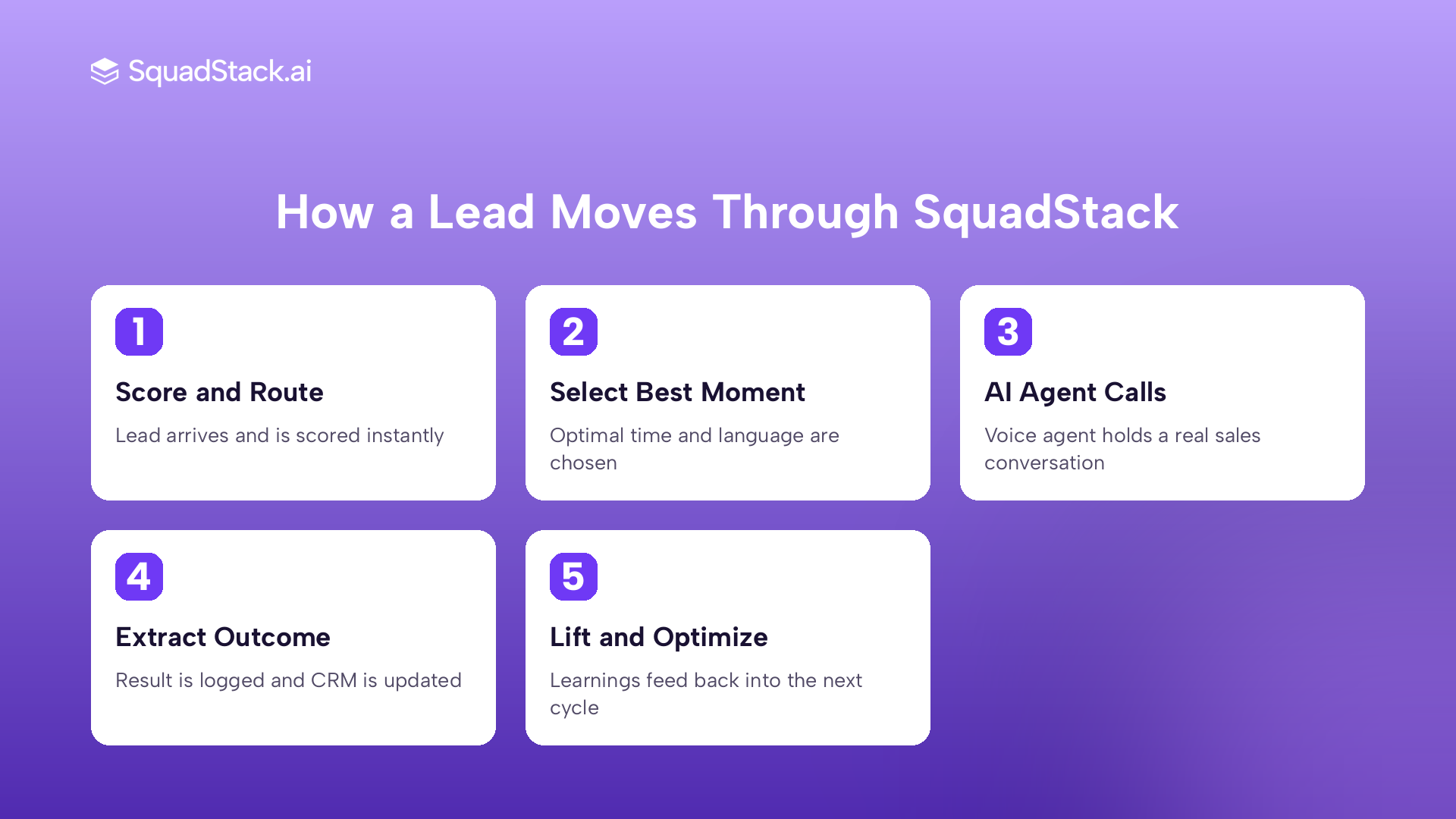
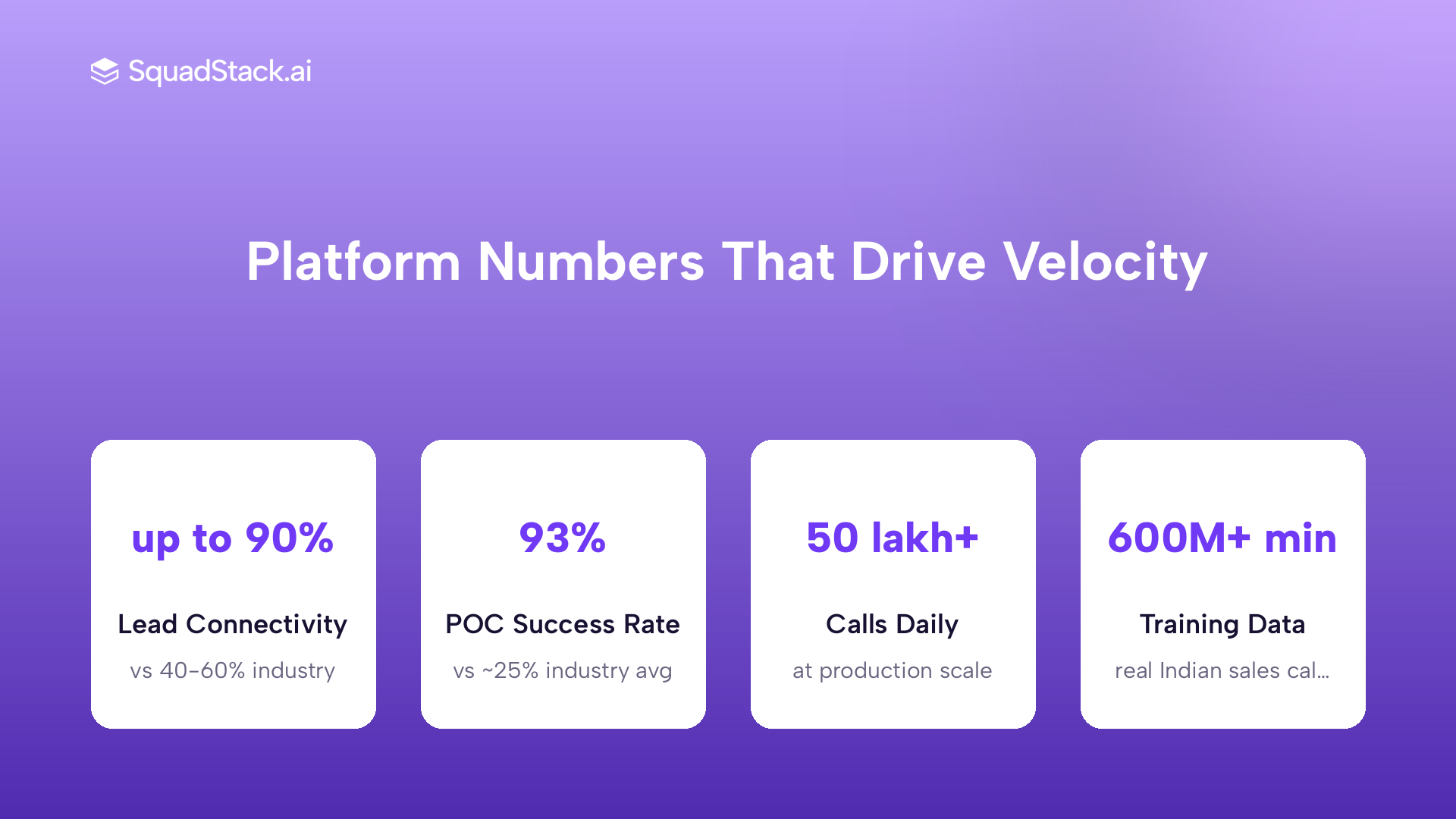
SquadStack's AI Lead Manager scores and ranks leads in real time, predicts the best time to call each segment, rotates numbers automatically when Truecaller flags them as spam, and runs up to 50 lakh calls daily. The result: up to 90% lead-level connectivity against a 40 to 60% industry norm. More leads reached means more opportunities in the pipeline, which lifts velocity directly.
AI agents also start calling the moment a lead arrives, with no queue, no shift, and no ramp-up delay. For lending and insurance products where intent decays within hours of a lead submission, that speed is a direct revenue driver.
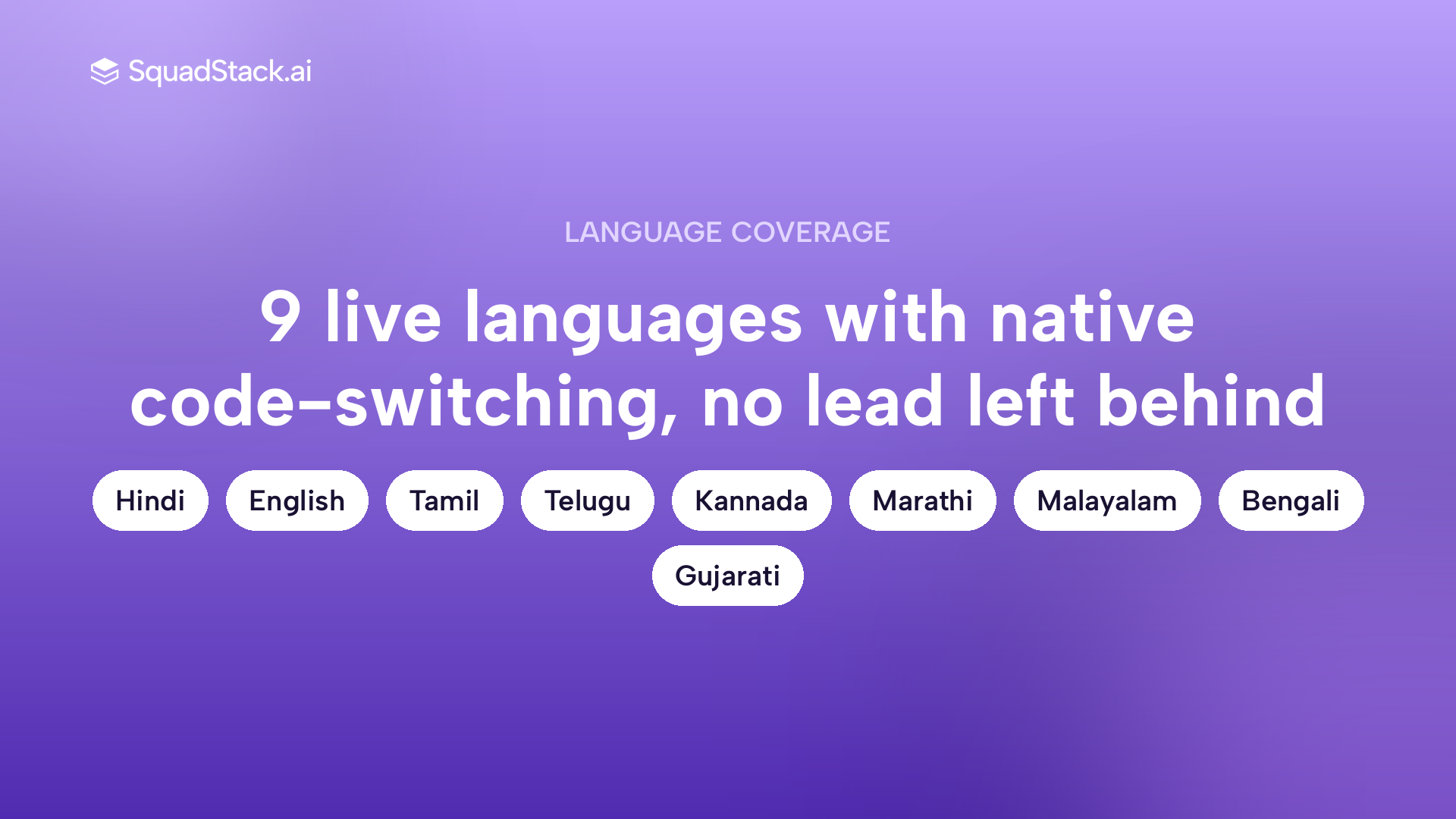
Win rate depends on what happens inside the conversation. A human agent on their fifteenth call of the day handles objections differently from their first. An AI agent does not drift. It delivers the right pitch, adjusts tone and pace, handles objections across multiple turns, and switches between Hindi, English, Tamil, or any of nine live Indian languages mid-sentence.
SquadStack's agents are trained on 600 million minutes of real Indian sales conversations, so Hinglish, Taminglish, and regional code-switching are native to the model. Naturalness matters: SquadStack's Abruptly Disconnected Rate now sits at around 10%, inside the human agent range. A lead who stays on the call is a lead who can convert.
Persistent memory compounds win rate further. A lead who dropped off at PAN verification on Monday gets a follow-up on Wednesday that opens exactly where the conversation stopped, removing friction at the moments it matters most.
For products with variable ticket sizes, such as personal loans, gold loans, or education subscriptions, deal size depends on how well the agent understands the lead's situation before proposing an amount or plan.
SquadStack's RAG system lets the AI agent pull product details, eligibility conditions, and pricing from a live knowledge base during the call, answering complex questions without transferring to a human. Entity extraction captures confirmed loan amounts, income figures, and stated preferences as structured data in real time. These capabilities push conversations toward higher-fit offers rather than defaulting to the lowest common denominator.
For EdTech customers like Adda247, Nxtwave, and Unacademy, lead qualification calls match prospects to the right course tier before the sales team follows up, so the human closer works with leads who already understand the product and its value.
Cycle length shrinks when follow-ups happen on time, every time. AI agents book their own callbacks, sync outcomes to the CRM, and trigger WhatsApp messages mid-call with payment links or documents. A lead who was told "we'll send you details" actually gets them while still on the phone.
The 1+4 default cadence (one initial call plus four retries over two days) is configurable per campaign. Omnichannel nudges between dials, SMS follow-ups, and outcome-based workflow routing all reduce the gap between interest and commitment. For a leading quick commerce platform, AI calling achieved 90% connectivity and a 40% lower cost-per-hire. For WheelsEye, it drove an 87% improvement in rate card collection at 50% lower cost.
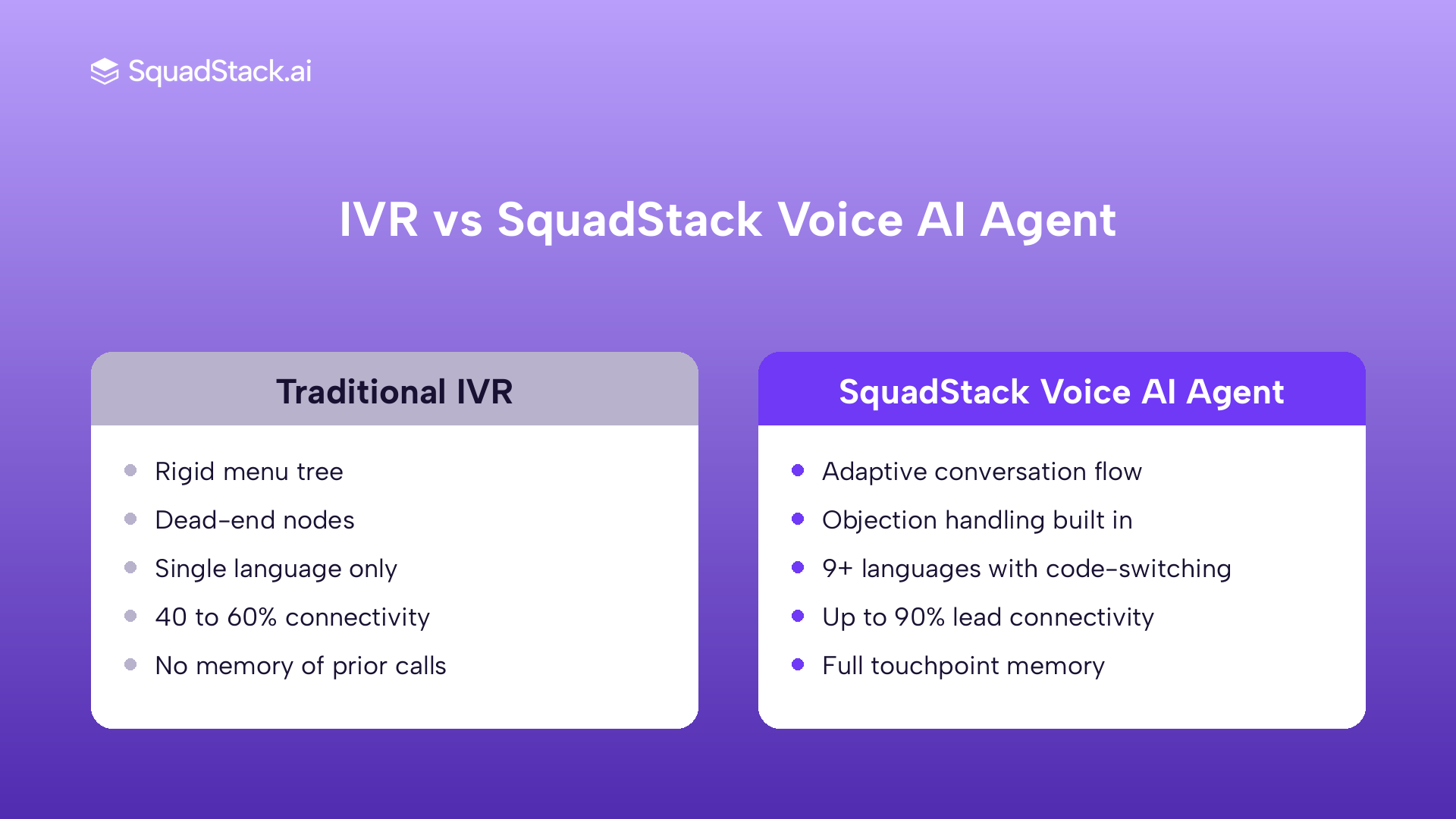
The comparison that matters for RevOps is not AI versus human. It is AI voice agent versus traditional IVR, which many teams still rely on for outbound follow-up.
| Dimension | Traditional IVR | SquadStack Voice AI Agent |
|---|---|---|
| Lead connectivity | Fixed dial cadence, no adaptive timing | Learns best call time per segment; up to 90% lead-level connectivity |
| Handling objections | Cannot; dead-ends on off-menu input | Multi-turn objection handling across a full sales conversation |
| Language | Pre-recorded in one or two languages | 9 live Indian languages with native mid-sentence code-switching |
| Follow-up memory | Every call starts cold | Persistent memory picks up from the last interaction, on any channel |
| Speed to respond | Menu navigation adds 10 to 30 seconds | Median response latency of 0.8 seconds or less |
| Cycle length impact | Adds days through failed attempts and re-queuing | Books callbacks, sends WhatsApp links mid-call, closes loops same session |
An IVR asking a credit card applicant to "press 2 for loan queries" when they want to discuss an EMI concern loses that lead. A voice AI agent that hears the concern, answers it in Hinglish with a relevant offer, and books a callback if needed is a fundamentally different revenue tool.
When evaluating platforms, the four pipeline velocity variables map directly to capabilities worth testing.
For opportunity volume, look for adaptive call timing, automated spam detection and number rotation, and a lead-level connectivity benchmark (not just per-attempt connect rate).
For win rate, test naturalness in the languages your customers speak. Ask for ADR data. Check whether the agent handles multi-turn objections or stops after one canned response.
For deal size and qualification, look for entity extraction and RAG: does structured data come out of conversations, and can the agent answer product-specific questions without transferring?
For cycle length, check omnichannel capability: can the agent send a WhatsApp message while still on the call, book its own follow-ups, and write back to your CRM?
SquadStack is built on roughly 10 years of running AI-assisted contact centers for India's largest consumer brands, now fully Voice AI since 2025. The training corpus behind every agent is 600 million minutes of real Indian sales conversations, full-duplex, outcome-labelled, spanning 85% of Indian pincodes. That data is what makes Arth, SquadStack's proprietary speech model, tuned for 8kHz telephony noise, code-switched speech, and Indian entity handling.
The pipeline velocity impact shows up in real deployments. IndiaMART achieved 20% higher conversions and 15% lower CAC, running over 1 lakh AI calls daily. A leading brokerage saw 3x higher conversions on account opening. A leading general insurer achieved 85% connectivity and 60% lower renewal cost.
The 93% POC success rate versus a roughly 25% industry average means these outcomes replicate. A pilot that proves velocity improvement in weeks two to eight of a live campaign is a strong signal for what happens at scale.
Every call feeds the ROI Optimizer. Lift, SquadStack's self-improvement layer, reads near-misses and early drop-offs, proposes instruction edits, tests them on live traffic, and only scales the changes that win. Optimize runs parallel A/B tests on voice, script, timing, and channel. Over weeks, every velocity variable tightens.
For teams thinking about the cost side of the equation, the AI outbound calling cost breakdown is a good next read. For the broader call centre KPI picture, see how AI improves contact centre KPIs.
Pipeline velocity gives RevOps and CX leaders a single, honest number: how fast is the business turning leads into revenue? AI calling is the most direct lever on every component of that number: reach, conversion, qualification, and speed.
If your current outbound process is stuck at industry-average connect rates and long cycle times, the gap is measurable and fixable. Use SquadStack's ROI calculator to model your baseline, or book a demo to see velocity metrics from live campaigns in your vertical.
What is pipeline velocity in AI calling for revenue per lead?
Pipeline velocity in AI calling is a RevOps metric that combines the number of leads reached, the win rate on those leads, average deal size, and sales cycle length into a single measure of how fast AI-powered calling converts outreach into revenue. AI calling platforms improve all four variables simultaneously, making pipeline velocity a useful north-star KPI for teams scaling outbound in India.
Which is the best AI calling platform for pipeline velocity in India?
SquadStack is purpose-built for India, with agents trained on 600 million minutes of real Indian sales conversations, nine live Indian languages with native code-switching, and up to 90% lead-level connectivity. Its 93% POC success rate, versus a roughly 25% industry average, and deployments across 60+ large consumer brands across BFSI, EdTech, and e-commerce make it the most proven option for pipeline velocity at scale in the Indian market.
Can AI voice agents automatically improve conversion rates in BFSI and EdTech?
Yes. SquadStack's voice AI agents handle multi-turn objections, switch languages mid-sentence, and maintain persistent memory across calls and channels. In verified deployments, a leading brokerage achieved 3x higher conversions on account opening and Moneyview saw 40% more loan applications. EdTech customers like Adda247, Nxtwave, and Unacademy use AI lead qualification to send better-qualified prospects to their closing teams.
How does AI calling reduce sales cycle length?
AI agents shorten sales cycles by eliminating lag between lead arrival and first conversation, booking callbacks automatically, sending WhatsApp messages and payment links mid-call, and writing outcomes back to the CRM in real time. The AI Lead Manager's adaptive timing and spam-aware number rotation means fewer failed attempts and fewer days of re-queuing before a live conversation happens.
What is the difference between pipeline velocity and revenue per lead?
Pipeline velocity is an aggregate flow metric: how fast does money move through the whole funnel? Revenue per lead is the per-unit output: how much revenue does a single lead generate on average. In high-volume, low-ticket Indian consumer sales, revenue per lead is often the more actionable number at the campaign level, while pipeline velocity is the CFO-level view. AI calling improves both simultaneously by lifting connect rates, conversion rates, and qualification quality while compressing cycle time.
How does SquadStack handle multiple Indian languages in outbound calling?
SquadStack's agents operate in nine live languages: Hindi, English, Tamil, Telugu, Kannada, Marathi, Malayalam, Bengali, and Gujarati, with additional regional languages available on demand. The agents code-switch mid-sentence the way a bilingual human agent would, because the underlying models were trained on real code-switched telephonic audio rather than translated scripts. Additional regional languages can be added based on business requirements.
Does AI calling for pipeline velocity work for D2C brands, not just BFSI?
Yes. D2C use cases like abandoned cart recovery, repeat sales, and user onboarding all benefit from the same velocity levers: faster first contact, higher connect rates, persistent memory between touchpoints, and automated follow-up. For example, a leading D2C personal care brand achieved 8x ROI on abandoned cart recovery using SquadStack's voice AI.
What is the typical timeline to go live with AI calling for outbound sales?
Most enterprise campaigns go live in two to three weeks. The setup involves five steps: kickoff, solutioning, building the agent and workflows, integrations, and testing. The agent trains on the client's real call recordings, knowledge base, and FAQs before the first live call. A four to eight week pilot against a pre-aligned success metric follows, with scaling gated on proving the outcome.
How does SquadStack prevent the AI agent from making compliance errors on sales calls?
Compliance language, product rules, pricing guardrails, and agent identity sit in locked prompt sections that no optimization loop can touch. The platform is TRAI-compliant, scrubs leads against the DND registry before dialing, enforces a hard calling window of 9:30 AM to 8:30 PM, and handles consent gating within the conversation itself. SquadStack is also ISO 27001, ISO 27701, SOC 2 Type II, and DPDP compliant.
How does the ROI Optimizer improve pipeline velocity over time?
After every call, SquadStack's Lift layer reads near-misses and early drop-offs, identifies precise instruction changes that would improve outcomes, and tests each change on a small slice of live traffic before scaling. Optimize runs simultaneous A/B tests on voice, script, cadence, and channel. VoC Insights surfaces the real reasons leads did not convert, such as a rate being uncompetitive or a specific drop-off step in the application. Each campaign cycle feeds the next, so velocity compounds rather than plateaus.