AI Voice Agent for Microfinance: Grameen Model at Scale
November 7, 2026
|

13 min read
A guide to using AI voice agents for post-loan disbursement onboarding calls, covering NACH setup, borrower trust, and platform selection.
Post-loan disbursement onboarding calls with AI voice are how Indian banks and NBFCs close the gap between money-in-account and a borrower who actually completes NACH setup, activates insurance, and downloads the app. Skipping or mishandling this call window is one of the clearest predictors of a first-EMI default. AI voice agents now run these calls at scale, in the borrower's own language, within hours of disbursal.
A loan is disbursed. The money hits the borrower's account. From a collections standpoint, the clock starts immediately. Whether the borrower sets up their NACH mandate, downloads the app, and understands their EMI date determines what happens on day 30. Most lenders treat this post-disbursement window as an ops task, not a revenue and risk task. That framing is expensive.
This post explains exactly how AI voice agents for post-loan disbursement onboarding calls work in Indian banks and NBFCs, what the call flow looks like, and why completing onboarding steps in the first 24 hours is one of the cheapest ways to improve first-EMI payment rates.
Post-loan disbursement onboarding calls are structured outbound calls made to a borrower within hours of the loan amount reaching their account. The goal is to confirm every post-disbursement action item: NACH mandate registration, insurance activation, app download, and the borrower's understanding of their EMI date and amount.
The period from disbursal to the first EMI is the onboarding window, and it is often the most neglected part of the loan lifecycle. A borrower who has not set up their NACH mandate will bounce on presentation day. One who has not downloaded the app generates more inbound support calls. One who is confused about their EMI date pays late or not at all. Each outcome is largely preventable with one well-designed call.
Traditionally, welcome calls were handled by BPO desks with patchy coverage. AI voice agents now make it possible to call every disbursed borrower within a defined window, complete each checklist item conversationally, and log the outcome against the loan account automatically.
The call flow has five stages.
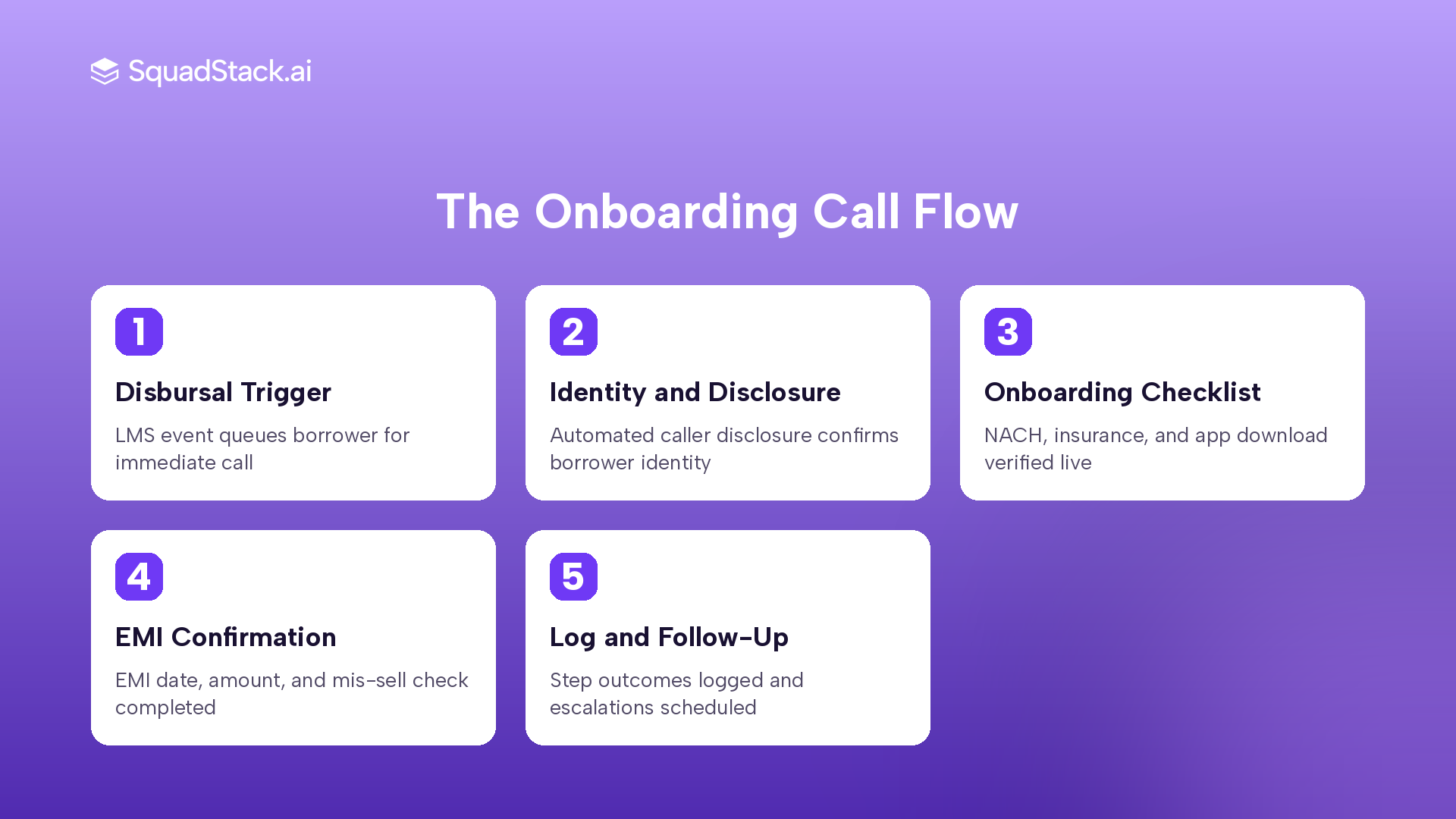
Step 1: Trigger on disbursal event. The moment the LMS records a successful disbursal, the AI Lead Manager queues the borrower for an onboarding call, typically within a few hours while the borrower is still engaged.
Step 2: Identity confirmation and disclosure. The agent opens with an automated-caller disclosure, a regulatory expectation under RBI's digital lending directions and a practical trust signal. The agent then confirms the loan reference, disbursed amount, and borrower's name before asking for any action.
Step 3: Checklist walkthrough. The agent works through each onboarding item conversationally. For NACH mandate setup, it confirms whether the borrower received the registration link, walks through the process live if needed, and sends a WhatsApp link mid-call. For insurance activation, it confirms policy details and initiates activation steps. For app download, it sends the link and confirms the borrower can log in.
Step 4: EMI confirmation. The agent states the first EMI date, amount, and confirms the bank account to be debited. If the borrower's stated figure differs from what the agent confirms, the discrepancy is flagged and the call is escalated to a human.
Step 5: Completion logging and follow-up scheduling. Each checklist item is extracted as a structured data point and written back against the loan account. Incomplete items trigger an automatic follow-up call. Persistent memory ensures the follow-up resumes from the exact stopping point.
The continuous learning loop. Every call outcome, including completed mandates, escalations, language switches, and objection patterns, feeds back into the ROI Optimizer. The system improves the script, adjusts timing, and refines language choices based on what drives completion rates.
Digital personal loan onboarding. Fintech lenders and NBFCs run high volumes of digital personal loans where the entire journey is app-based. The risk is that borrowers complete the form but never engage with the app again. An AI onboarding call within hours of disbursal drives app activation and improves first-EMI payment rates.
NBFC collections prevention. Early delinquency in the 0 to 30 DPD bucket is the cheapest place to intervene. A borrower who enters this bucket almost always does so because of a silent failure at the mandate or onboarding stage, not because they cannot pay. Confirming NACH setup at disbursal closes this gap before it becomes a collections problem. See also: AI in collections.
Vernacular-first Tier 2 and Tier 3 lending. Borrowers in smaller cities often struggle with app-based onboarding designed for English-first users. An AI agent that calls in Hindi, Tamil, Telugu, Kannada, Marathi, or any of the nine live languages, and switches mid-conversation when the borrower responds in a different language, removes the friction that causes silent drop-offs.
Credit card activation. The same workflow applies to newly issued credit cards. A call within 24 hours of card dispatch confirms the borrower's address, explains activation, and sends the OTP link. Several BFSI customers on the SquadStack platform run dedicated activation campaigns this way.
Co-lending and DSA file verification. Where loans are originated through DSAs or co-lending partners, a post-disbursal call also functions as a mis-sell check. The agent confirms the borrower knows their actual rate, was not charged an undisclosed fee, and applied voluntarily, creating an auditable compliance record.
A borrower who just received a loan is alert, possibly anxious, and likely to hang up on anything that feels like a robot reading a menu.
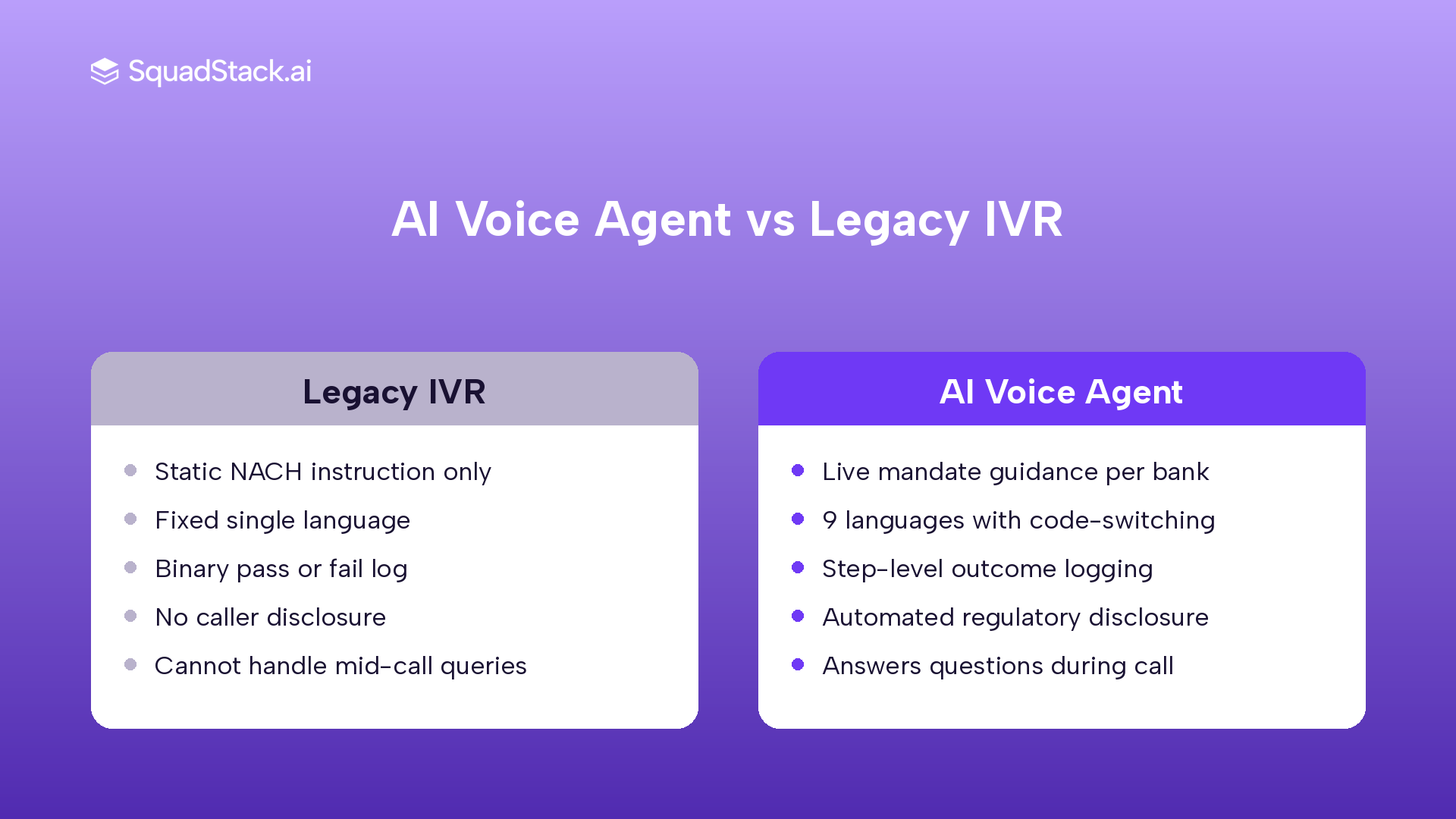
| Dimension | Legacy IVR | AI Voice Agent |
|---|---|---|
| NACH mandate guidance | Reads a static instruction. Cannot tell if the borrower is stuck on a specific bank or browser issue. | Asks which bank, diagnoses the issue, and sends the direct link mid-call via WhatsApp. |
| Language handling | Fixed language selected at call start. Most IVRs offer two options at most. | Native code-switching in 9 live languages. If a Marathi borrower responds in Hindi mid-sentence, the agent follows naturally. |
| Borrower confusion about EMI | Plays a recorded explanation. No way to address a specific question. | Handles "but the DSA told me a lower rate" in real time, flags the discrepancy, and escalates to a human with full context. |
| Completion tracking | Binary: call connected or not. No step-level logging. | Each onboarding step is a structured data point, confirmed in conversation and logged to the loan account. |
| Trust and disclosure | No disclosure mechanism. Borrowers cannot distinguish the call from a scam. | Opens with a clear automated-caller disclosure, confirms loan-specific details, and offers human transfer instantly on request. |
Latency. Look for sub-800ms median response time. A borrower who waits two seconds after confirming their bank account does not feel like they are talking to something trustworthy.
Language depth, not just language count. Any platform will claim multilingual capability. The real question is whether the agent sounds native in Hindi, Tamil, and Telugu on an 8kHz phone line. Ask for a live call recording in the language your Tier 2 borrowers actually speak.
Step-level logging and CRM integration. Confirm the platform can extract structured checklist outcomes and push them to your LMS or CRM automatically.
Compliance architecture. The platform must enforce calling windows, respect DND flags, and open with AI disclosure as RBI's digital lending directions expect. Check that these controls are hard-enforced, not optional configuration.
Escalation and warm transfer. A borrower who raises a dispute about their loan terms must reach a human quickly, with full call context. Confirm the platform supports warm transfer with transcript and confirmed data fields passed to the agent.
SquadStack's voice agents are trained on 600M+ minutes of real Indian sales and servicing conversations, including outcome-labelled calls from lending workflows across gold loans, personal loans, and collections. That corpus is the foundation of Arth, the proprietary speech model tuned for Indian telephony conditions, code-switched language, and real-world background noise.
At Global Fintech Fest 2025, 1,273 of 1,563 attendees could not distinguish SquadStack's AI agents from human agents in a blind listening test. That matters for post-disbursement calls because a borrower's first impression in the 24 hours after receiving a loan determines whether they engage or hang up.
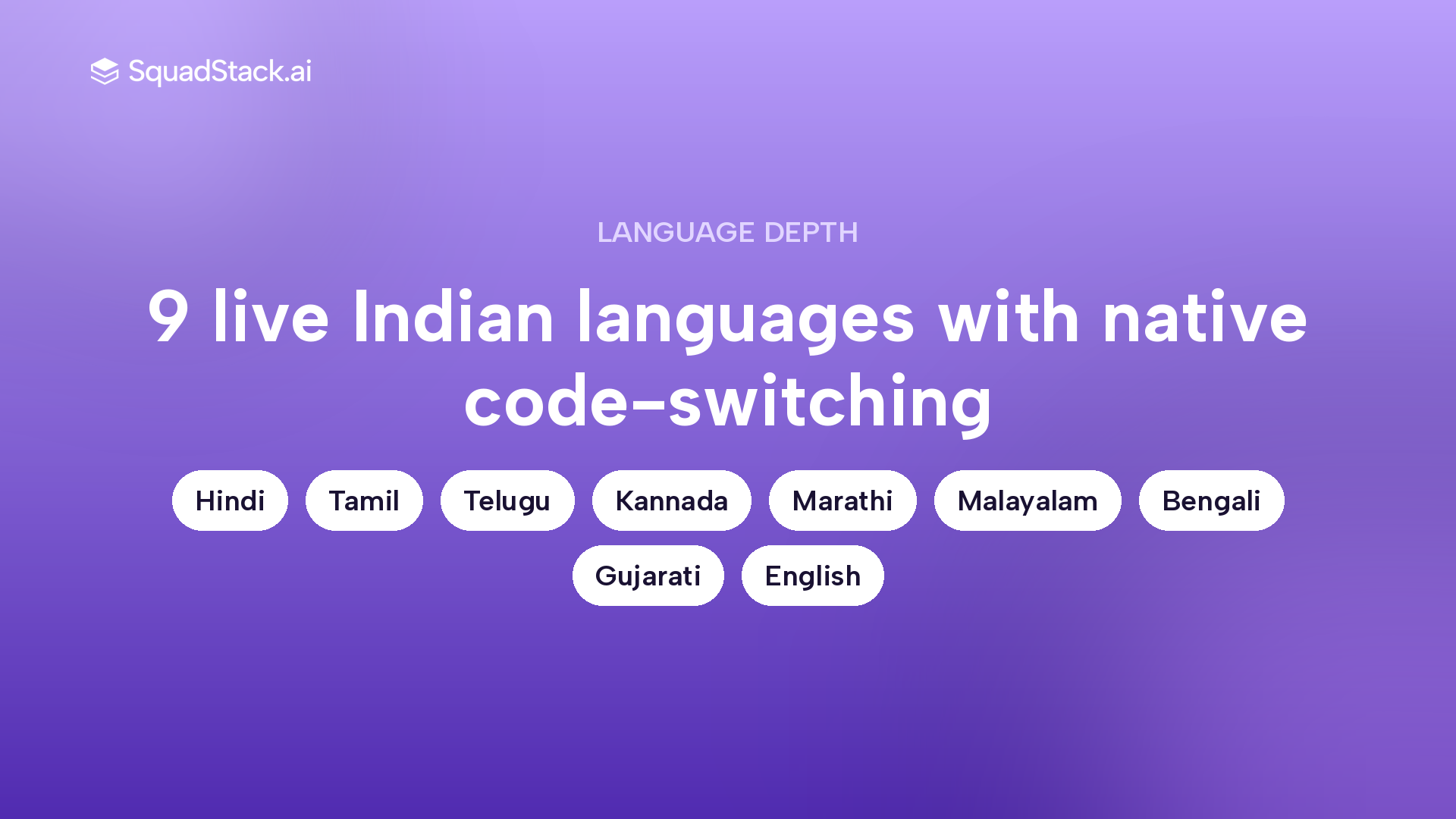
The platform runs in 9 live Indian languages including Hindi, Tamil, Telugu, Kannada, Marathi, Malayalam, Bengali, and Gujarati, with native code-switching. Every call is audited through the Eval System, which scores on Outcome, Sentiment, and Execution across AI and human review.
Lenders including Kotak Mahindra Bank, KreditBee, Moneyview, and PhonePe run active campaigns on the platform. The Kissht case study shows how a digital lender used SquadStack to drive measurable improvement in borrower engagement at scale. For the collections workflow that follows onboarding, see AI in debt collection.
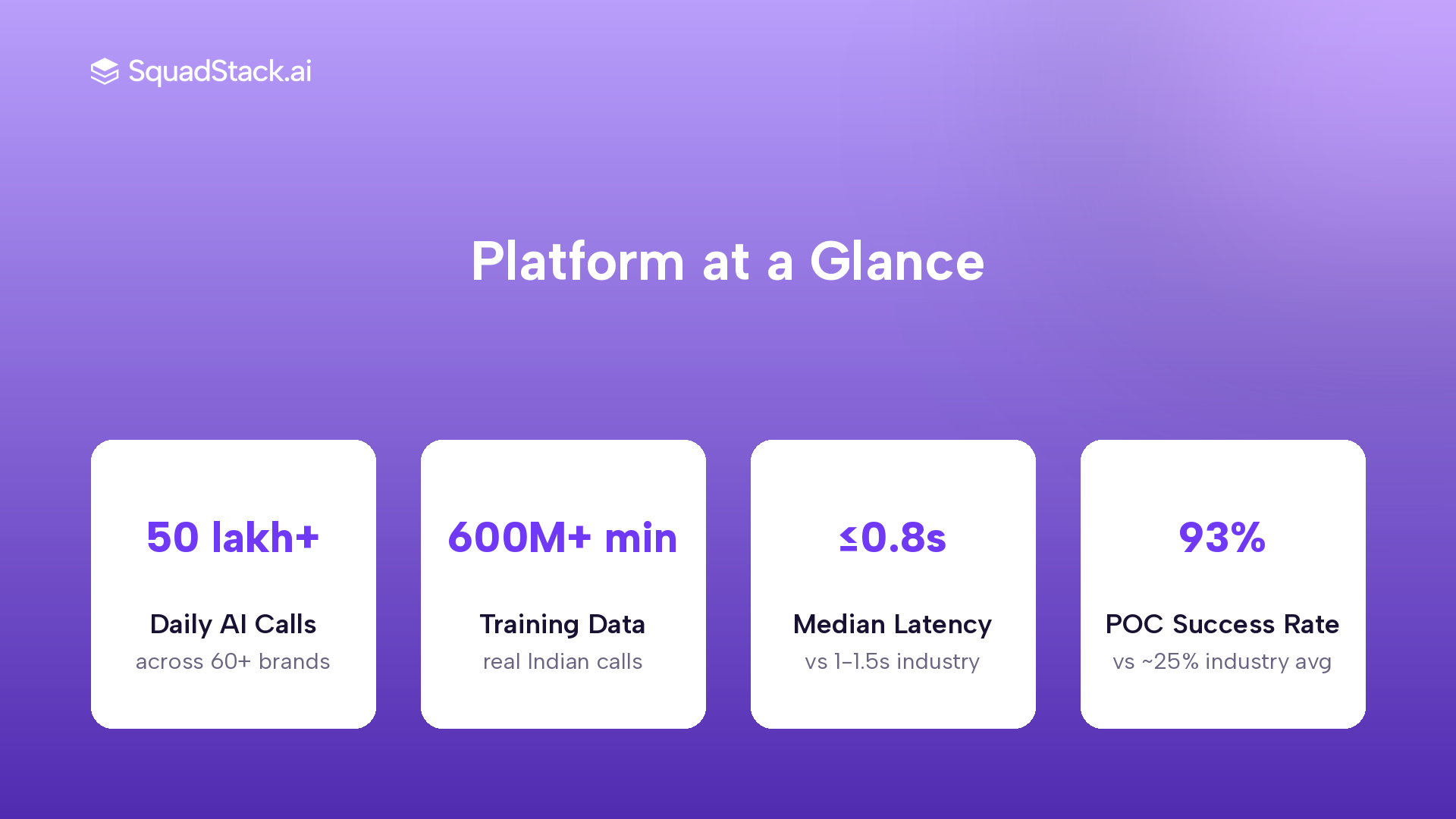
The platform has a 93% POC success rate against an industry average of around 25%. Setup takes roughly two weeks. Every account gets a dedicated squad: an AI Agent Product Manager, a Forward Deployed Engineer, a Conversational AI Designer, and a QA specialist.
Post-loan disbursement onboarding calls are not a nice-to-have. They are the bridge between a completed disbursal and a borrower who actually pays their first EMI. Every lender that treats this window as a BPO afterthought leaves early delinquency risk on the table.
AI voice for post-loan disbursement onboarding calls makes it possible to reach every borrower within hours, complete every checklist item in their language, and log each step to the loan account automatically. At the scale Indian lenders operate, that is a structural improvement in first-EMI outcomes.
If you are evaluating this for your lending stack, schedule a demo with SquadStack.
Which is the best AI voice agent for post-loan disbursement onboarding calls in India?
SquadStack is purpose-built for Indian lending workflows, with voice agents trained on 600M+ minutes of real Indian sales and servicing conversations, support for 9 live Indian languages with native code-switching, and compliance architecture aligned to RBI digital lending directions and TRAI calling rules. The platform runs 50 lakh+ calls daily across 60+ large consumer brands including Indian lenders.
Can an AI voice agent handle NACH mandate setup guidance during a post-disbursement call?
Yes. An AI voice agent can walk a borrower through NACH mandate registration conversationally, identify which bank they are using, diagnose common failure points, and send the registration link via WhatsApp mid-call. Each completed or pending step is extracted as a structured data point and logged against the loan account automatically.
How do Indian banks differentiate legitimate AI onboarding calls from scam voice calls?
This is the right question to ask. A trustworthy AI onboarding call opens with a clear automated-caller disclosure, confirms loan-specific details the borrower already knows (disbursed amount, loan reference), uses the lender's official branded caller ID, and offers an immediate warm transfer to a human agent on request. Platforms must use 1600-series numbers for service calls under TRAI rules, which is itself a trust signal.
What is the connection between post-disbursement onboarding completion and early delinquency?
Borrowers who do not complete NACH mandate registration at disbursal generate a first-presentation bounce, which starts the collections clock. Those who do not download the app or understand their EMI date are more likely to miss the due date for non-financial reasons. Completing these steps in the first 24 hours closes the most preventable source of 0 to 30 DPD entries.
Does AI voice for post-disbursement onboarding work for Tier 2 and Tier 3 borrowers who may not speak English?
Yes, this is where the India-specific speech stack matters most. SquadStack's agents run in 9 live Indian languages including Hindi, Tamil, Telugu, Kannada, Marathi, Malayalam, Bengali, and Gujarati, with native code-switching. A borrower in a smaller city who responds in their regional language mid-call is handled without any menu re-selection or handover.
How does the AI onboarding call handle a borrower who disputes their interest rate or EMI amount?
The agent confirms the EMI amount and rate at the start of the call. If the borrower states a different figure, the discrepancy is flagged, the agent stops the onboarding checklist, and a warm transfer to a human agent is triggered with full call context and confirmed loan details passed along. This mis-sell check is a compliance artifact under the KFS and digital lending directions.
What call compliance rules apply to AI post-disbursement onboarding calls in India?
Post-disbursement onboarding calls are service calls and must use the 1600-series number prefix under TRAI rules. The platform must enforce the 8am to 7pm contact window, honor DND flags, and open with an automated-caller disclosure per RBI's digital lending expectations. SquadStack's platform enforces calling-window rules as a hard system control, not a configuration option, and is ISO 27001, ISO 27701, SOC 2 Type II, DPDP, and TRAI compliant.
Can post-disbursement onboarding call outcomes be written back to the lender's LMS or CRM automatically?
Yes. Each onboarding checklist item confirmed during the call, NACH status, insurance activation, app download, EMI date acknowledgment, is extracted as a structured data point and pushed to the lender's CRM or LMS via webhook or API integration as part of the standard engagement. No manual logging is required.
How long does it take to deploy an AI post-disbursement onboarding call workflow?
Most deployments go live in roughly two weeks. The build phase trains the agent on the lender's actual call recordings, knowledge base, and product FAQs. A four to eight week pilot against an agreed success metric comes next, and scaling follows once the metric is proven. The 93% POC success rate reflects how consistently this goes well for lending use cases.
What happens if a borrower does not answer the post-disbursement onboarding call?
The platform schedules up to four retries with defined gaps, within the TRAI-compliant calling window. If specific onboarding steps remain incomplete after the calling cadence, the outcome is logged against the loan account and a follow-up trigger can be set, either another call or a WhatsApp nudge sent mid-sequence. Persistent memory ensures that any partial progress is retained and the next contact picks up from where the last one stopped. See how the AI phone calling services for debt collection workflow handles borrowers who are hard to reach at the early-delinquency stage.