AI Voice Agent for Microfinance: Grameen Model at Scale
November 7, 2026
|

13 min read
Understand how AI voice agents handle pre-delinquency intervention in retail lending, from stress-signal triggers to escalation, before a single EMI is missed.
Pre-delinquency intervention calls using AI voice for retail lending target borrowers who show early stress signals before a single EMI is missed, reducing roll-rate migration into the 30-DPD bucket. These calls are fundamentally different from standard EMI reminders in tone, timing, and offer, and AI voice agents can run them at scale across every borrower segment simultaneously. Getting this window right is one of the highest-value moves a retail lender can make.
Retail lenders know the 30-DPD wall well. Once an account crosses it, collection costs multiply, field visits begin, and the borrower's relationship with the lender changes permanently. Most of the energy in a collections org is spent on accounts that have already rolled. Very little is spent on the window just before the first bounce, when intervention is cheapest and most effective.
That upstream window is where pre-delinquency calling lives, and it is where AI voice agents are creating the most measurable impact in Indian retail lending today.
For a broader view of how AI fits across the full lending lifecycle, see SquadStack's lending and credit solutions page.
Pre-delinquency intervention is a proactive outreach strategy that identifies borrowers showing early behavioural stress signals and contacts them before the first EMI is missed.
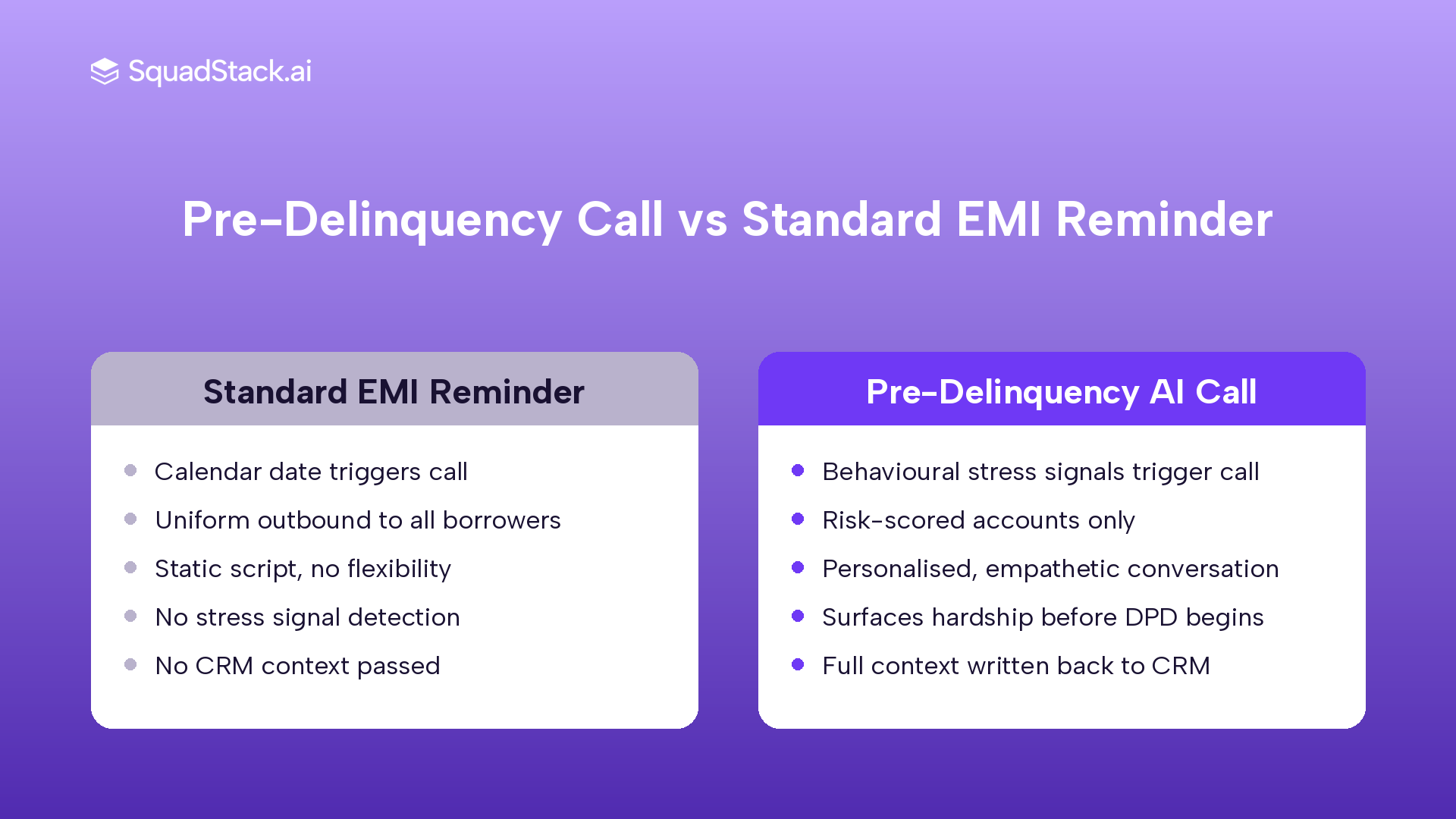
It sits in the X-bucket, before DPD begins. It is not a reminder that payment is due tomorrow. It is a structured, empathetic conversation designed to understand whether the borrower is likely to miss a payment, surface any practical barrier, and offer a resolution before the account enters SMA-0.
Signals that typically trigger a pre-delinquency call include a failed e-NACH presentation before the due date, a spike in bureau enquiry activity, a significant drop in app login frequency, a partial payment on the previous cycle, or a prior bounce in the same account's history. These signals are predictive. A borrower who bounced once has a higher probability of bouncing again. Acting on them with a well-designed call can keep accounts current at a fraction of the cost of running them through the collections ladder.
Step 1: Risk segmentation. The AI Lead Manager scores every borrower daily against stress signals from the lender's LMS and bureau data. Accounts with elevated risk flags move to the top of the outreach queue; healthy accounts are left alone.
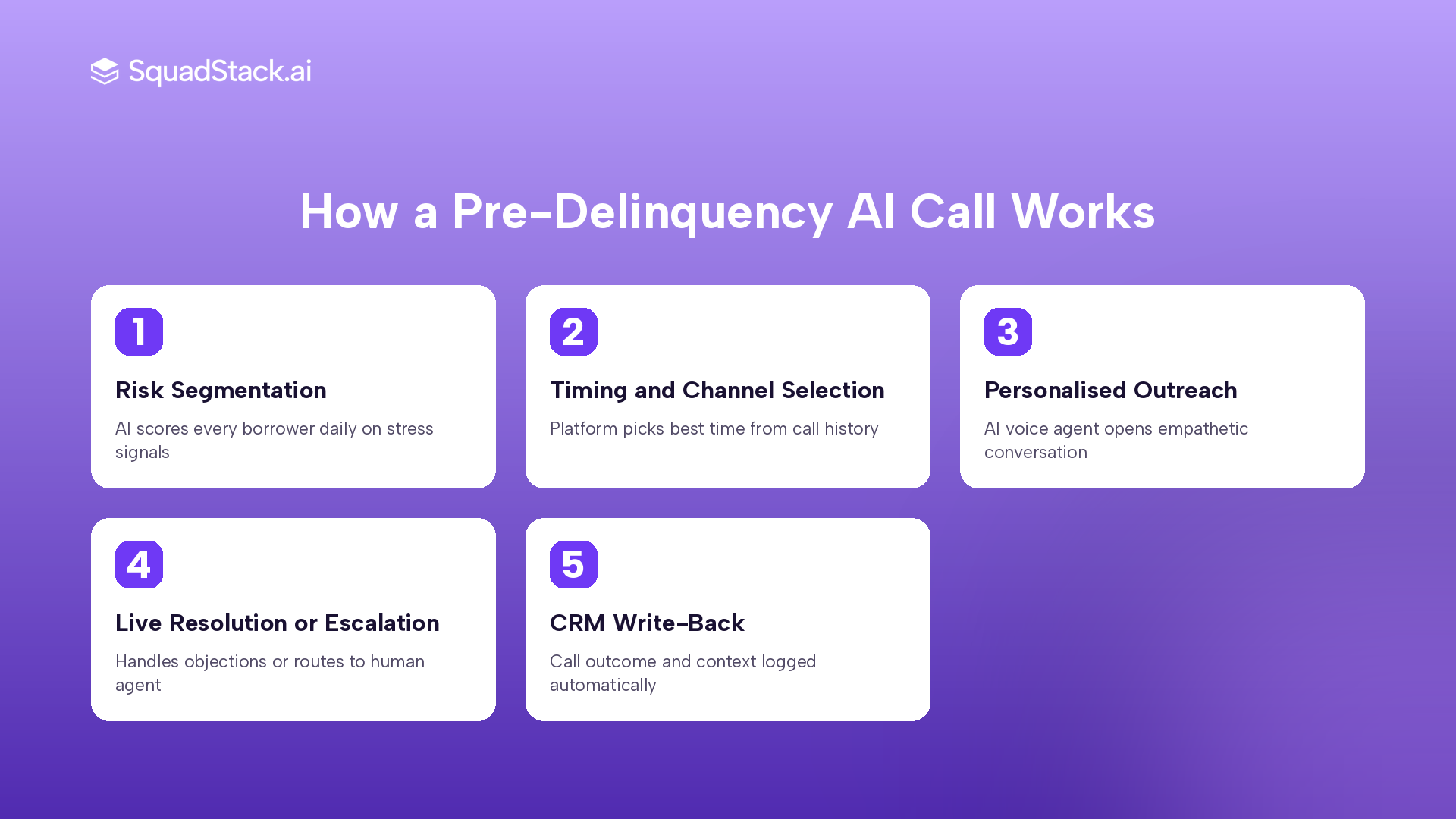
Step 2: Timing and channel selection. The platform identifies the best time to reach each borrower based on prior call history and engagement patterns. Outreach stays within the TRAI-mandated window of 9:30 AM to 8:30 PM, enforced at the system level.
Step 3: The conversation itself. The AI voice agent opens in the borrower's preferred language across 9 live Indian languages with native code-switching, so a Hinglish conversation does not feel forced. The tone is advisory, not collections-style. The agent does not mention overdue amounts because there are none. It acknowledges the upcoming payment, checks whether the borrower foresees any issue, and if a barrier surfaces, works through practical options: confirming the mandate bank account, sending a payment link mid-call via WhatsApp, or scheduling a callback.
Step 4: Escalation to a human when it matters. If the borrower discloses genuine hardship or the conversation signals high distress, the agent escalates to a relationship manager in real time, passing full context so the human does not restart from zero. The escalation trigger is configurable per campaign.
Step 5: Structured outcome capture. Every call produces a structured outcome: mandate confirmed, payment link sent, callback scheduled, restructuring referral made, or no issue identified. These outcomes feed the lender's LMS via CRM write-back automatically.
Step 6: Continuous improvement. Every completed call feeds back into SquadStack's ROI Optimizer. The Eval System scores calls across three layers: Outcome, Sentiment, and Execution. It identifies near-misses, proposes script adjustments, and A/B tests them on live traffic before scaling.
Bounce-prevention before the EMI date. Calling 3 to 5 days ahead on accounts with prior bounces or low predicted mandate balance, targeted at risk-flagged accounts, not the entire portfolio.
Post-missed-auto-debit, pre-due-date recovery. When an auto-debit fails before the official EMI date, a voice call on the same day the bounce registers dramatically improves the chance of an in-time cure.
Bureau-enquiry-spike outreach. A borrower recently making multiple bureau enquiries is likely seeking liquidity. A timely, empathetic call that surfaces a top-up or restructuring path can lock in the relationship before the borrower takes on a new obligation elsewhere.
App-inactivity re-engagement. Borrowers who have stopped logging into the app often also stop monitoring their EMI status. A gentle AI voice call reconnects them to the servicing journey, confirms mandate details, and reduces the risk of a silent first bounce.
For use cases further into the delinquency curve, see our guides to AI in collections and AI for debt recovery.
A pre-delinquency call is inherently conversational. The borrower may push back, ask about their mandate, disclose a salary delay, or ask what happens if they miss a payment. An IVR cannot hold that conversation, and a clumsy call on this touchpoint can accelerate disengagement.
| Dimension | IVR | AI Voice Agent |
|---|---|---|
| Handling unexpected responses | Falls back to menu prompts or disconnects if the borrower goes off-script | Understands free-form responses, picks up on distress signals, and adjusts in real time |
| Language and code-switching | Pre-recorded in one language per version; switching requires a separate IVR tree | Handles mid-sentence Hinglish, Taminglish, or any mix across 9 live Indian languages naturally |
| Escalation on distress signals | Cannot detect distress; routes to a generic agent queue | Detects distress, initiates a warm transfer with full call context to a relationship manager |
| Mandate and payment action mid-call | Cannot send a WhatsApp payment link or confirm banking details in the same session | Sends a payment link via WhatsApp while the borrower is still on the call; confirms account details live |
| Learning and improvement | Static script; every week of the campaign runs the same way | Every call's outcome and execution feeds back into the Eval System; the script improves across the campaign |
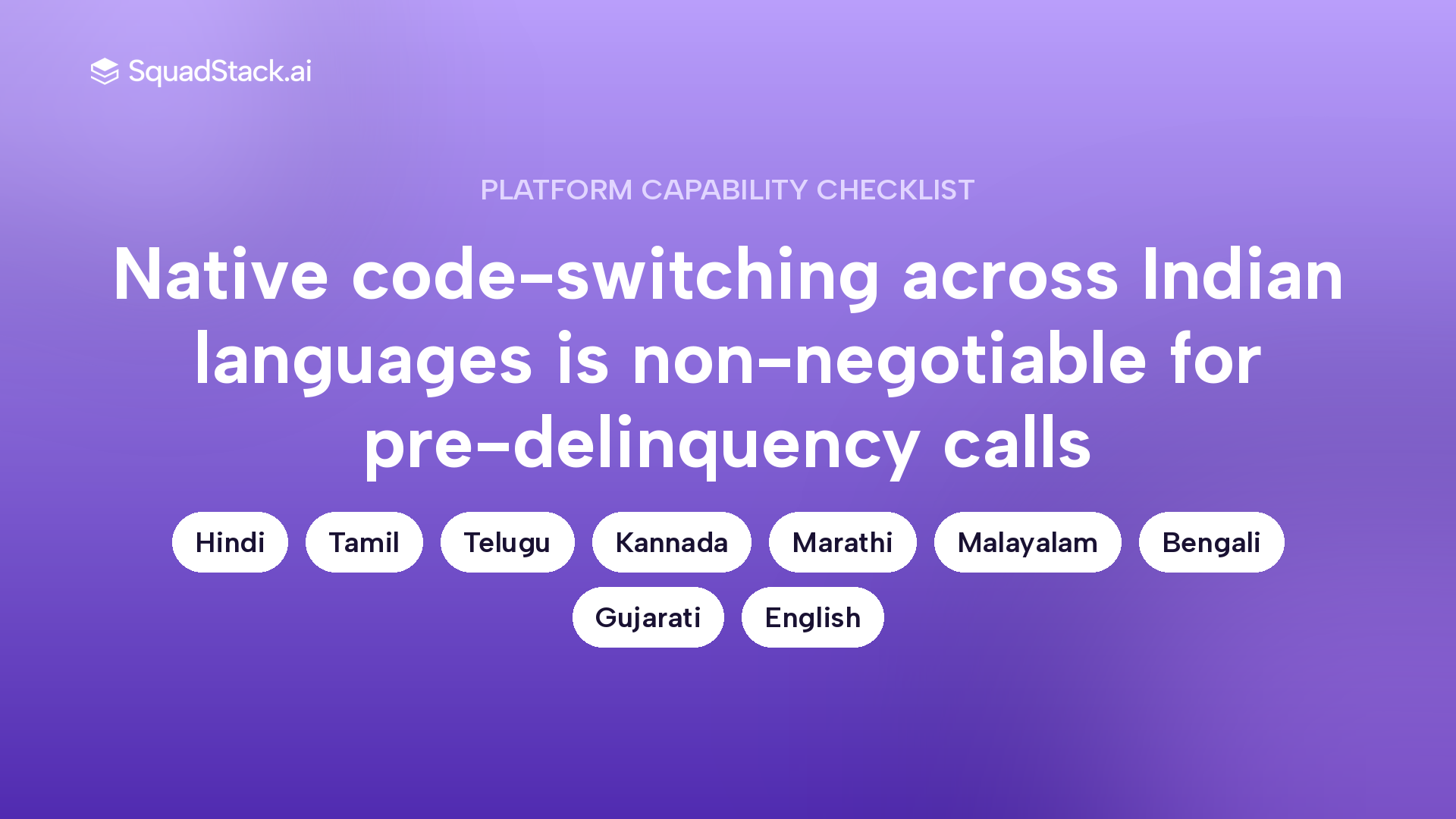
Does the platform handle Indian-language code-switching natively? A borrower in Bengaluru may switch between Kannada, Hindi, and English in a single sentence. The agent needs to follow that naturally.
How is the human escalation built? Pre-delinquency calls surface genuine hardship cases. The escalation path must pass structured context to the receiving agent, not just transfer the call cold.
What is the QA architecture? Look for a layered evaluation model that scores call outcome, borrower sentiment, and script execution separately. Single-metric scoring misses cases where the agent hit the script but alienated the borrower.
How fast does the platform iterate? The best pre-delinquency scripts evolve weekly as new signal patterns emerge. A vendor that requires weeks to ship a script change will fall behind the book's behaviour.
Is the compliance posture airtight? The platform must operate on 140-series numbers, enforce the TRAI calling window as a hard system constraint, and carry an auditable consent record for every call. DPDP and RBI outsourcing direction compliance is not optional.
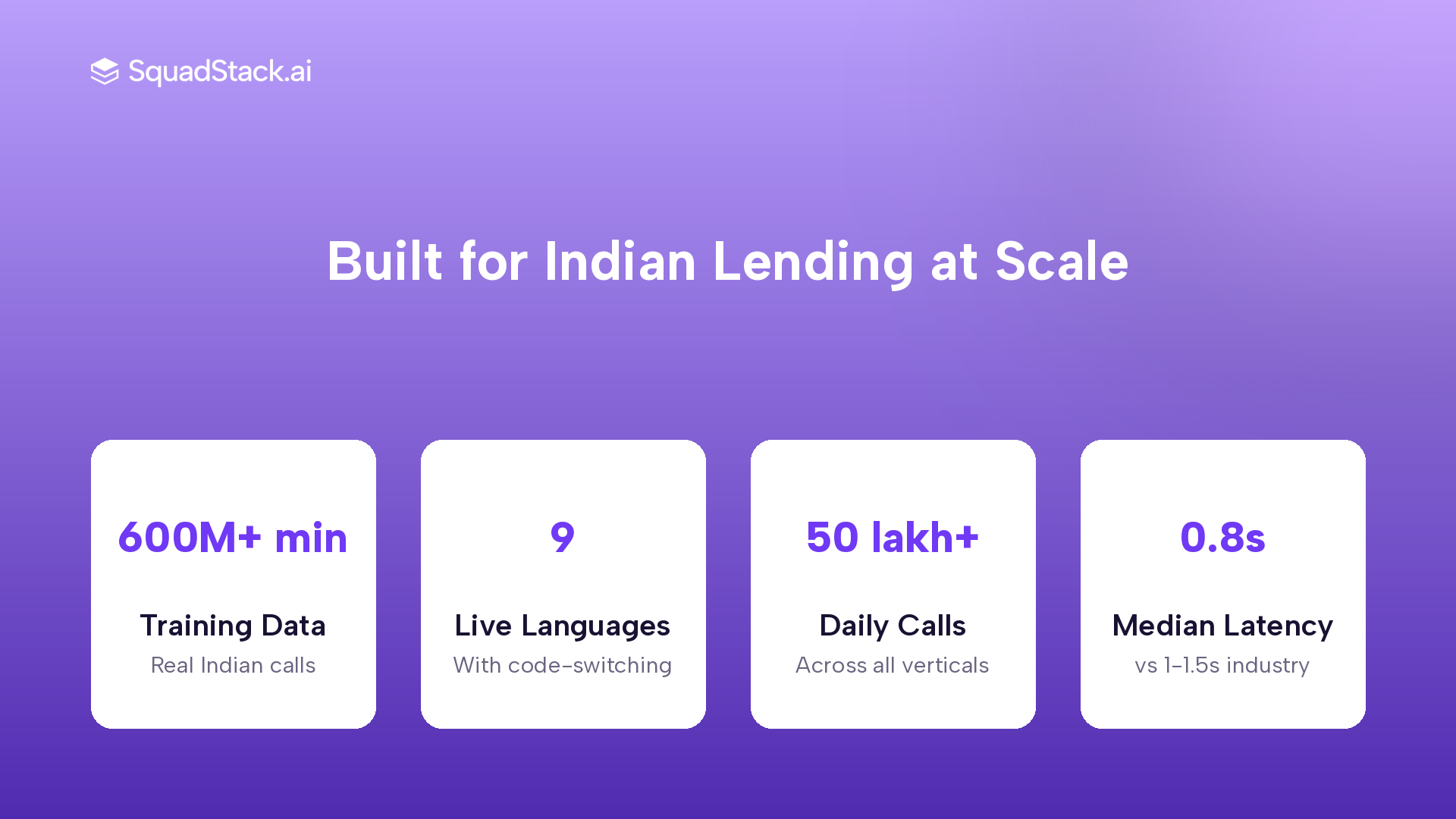
SquadStack's voice agents are built on Arth, a proprietary speech recognition model trained on 600M+ minutes of real Indian contact-centre conversations, including high-noise telephonic audio in Hinglish, Taminglish, and every major regional language blend. Generic cloud STT models are trained on YouTube and read-speech corpora. Arth is trained on the same kind of call a pre-delinquency agent will make.
On naturalness, SquadStack's agents passed a blind Turing test at Global Fintech Fest 2025, where 1,273 of 1,563 attendees could not tell the AI agents from human callers. On a pre-delinquency call, where the borrower must feel understood, that distinction matters.
Median response latency is 0.8 seconds or less. On a sensitive financial conversation, a pause between the borrower speaking and the agent responding breaks trust immediately. SquadStack's latency holds flat even on long calls with multiple branching topics.
The Eval System scores every pre-delinquency call on three layers: Outcome (mandate confirmed, payment link sent, hardship escalated), Sentiment (how the conversation landed emotionally), and Execution (whether the agent ran the script correctly). QA output feeds into Lift, SquadStack's self-improvement layer, which proposes targeted script edits, tests them on live traffic, and scales only changes that prove out on real calls.
On the lending side, PhonePe's collections track achieved a 35% PTP rate. DMI Finance's campaigns reached 85 to 90% connectivity with a 40% lift in lead qualification rate versus human agents. Moneyview's personal loan campaigns delivered 89% connectivity with 40% more loan applications.
For a concrete example, the Kissht case study shows how SquadStack's voice AI drove measurable outcomes for a digital NBFC at scale.
SquadStack works with more than 60 large consumer brands across BFSI, handles over 50 lakh calls daily, and is ISO 27001, ISO 27701, SOC 2 Type II, DPDP, and TRAI compliant. Every engagement ships with a dedicated squad: an AI Agent Product Manager, a Forward Deployed Engineer, a Conversational AI Designer, and a QA specialist.
For AI phone calling services designed for debt-adjacent workflows, see AI phone calling for debt collection.
Every rupee collected in the X-bucket and SMA-0 window costs a fraction of what it costs at 60-plus DPD. Pre-delinquency AI voice calls are not a collections tool. They are a credit-cost management tool that happens to use the calling channel.
The lenders who build this capability now will structurally lower their roll rates while others continue to pay for field visits that could have been avoided with a well-timed conversation three weeks earlier.
If you want to see how SquadStack builds and deploys pre-delinquency call campaigns for Indian retail lenders, schedule a demo.
Which is the best AI voice agent for lending NBFCs in India running pre-delinquency campaigns?
SquadStack is purpose-built for Indian retail lending, with voice agents trained on 600M+ minutes of real Indian sales and collections conversations, 9 live Indian languages with native code-switching, and active deployments at NBFCs including DMI Finance, Moneyview, KreditBee, and PhonePe. The platform handles everything from stress-signal segmentation to warm escalation and CRM write-back in one managed engagement.
What is the best AI voice solution for BFSI customer engagement in India?
For BFSI, the requirements are strict: TRAI compliance, RBI outsourcing direction readiness, DPDP data residency, and a quality architecture that scores calls on outcome, sentiment, and execution separately. SquadStack meets all of these and operates at 50 lakh+ calls daily across banking, NBFC, brokerage, and fintech clients.
Can an AI voice agent automatically identify pre-delinquency signals and trigger calls?
Yes. The AI Lead Manager scores borrower accounts daily against stress signals from the lender's LMS data. Accounts with elevated risk are automatically queued for outreach, with timing and channel selection optimised per borrower. No manual intervention is needed to trigger the campaign.
How does a pre-delinquency AI call differ from a standard EMI reminder?
A pre-delinquency call happens before any payment is missed, uses an advisory rather than reminder tone, and is triggered by behavioural signals rather than a calendar date. The script explores barriers, offers resolutions like payment links or mandate re-registration, and escalates to a human if hardship is disclosed. A standard EMI reminder notifies the borrower that payment is due and asks them to ensure funds are available.
How does the AI agent handle a borrower who reveals genuine financial hardship?
When a borrower discloses hardship, the agent detects the signal from the conversation, captures the relevant context (amount, stated reason, borrower's preferred resolution), and initiates a warm transfer to a human relationship manager. The receiving agent sees the full conversation summary before picking up, so the borrower does not need to repeat themselves.
What Indian languages does SquadStack's AI voice agent support for lending calls?
Nine Indian languages are live today: Hindi, English, Tamil, Telugu, Kannada, Marathi, Malayalam, Bengali, and Gujarati. The agent switches languages mid-sentence the way a bilingual human agent does. Additional regional languages are available on demand based on business requirements.
How does SquadStack ensure TRAI and RBI compliance on pre-delinquency calls?
The platform enforces a hard system-level block on calls outside the 9:30 AM to 8:30 PM window. It operates only on 140-series numbers, runs DND/DNC scrubs before dialing, includes AI disclosure in the opening of every call, and carries ISO 27001, ISO 27701, SOC 2 Type II, DPDP, and TRAI certifications. RBI outsourcing direction audit access and data locality requirements are addressed in the engagement contract.
What does the QA process look like for pre-delinquency call campaigns?
Every call is evaluated on SquadStack's Eval System across three layers: Outcome (did the call resolve the stress signal), Sentiment (how did the borrower respond emotionally), and Execution (did the agent follow the script and handle objections correctly). QA findings feed into the Lift self-improvement layer, which proposes script edits, tests them live, and scales only changes that improve outcomes on real traffic.
How long does it take to launch a pre-delinquency call campaign with SquadStack?
Most campaigns go live within two weeks. The setup involves a kickoff, use-case scoping, agent build using the lender's call recordings and knowledge base, integration with the LMS or CRM, and UAT before go-live. SquadStack's dedicated squad manages the entire build; no AI or ML engineers are needed on the lender's side.
What is the typical POC success rate for lending campaigns on SquadStack?
SquadStack's overall POC success rate is 93%, compared to an industry average of around 25%. Pilots run on real leads against a pre-agreed success metric, and scaling happens only after that metric is proven.