AI Voice Agents for Loan Collections in India: Pre-Due to Recovery
September 18, 2026
|

12 min read
For most Indian consumer sales teams, the answer is clear: start by augmenting, not replacing. Automate high-volume, structured call types first, prove...
For most Indian consumer sales teams, the answer is clear: start by augmenting, not replacing. Automate high-volume, structured call types first, prove outcomes on real traffic, then expand. Going all-in before that proof exists is the fastest way to lose leads, damage brand trust, and create a workforce crisis you did not budget for.
The honest version of this debate is rarely what gets published. If you are running a 50 or 100-seat calling team at an Indian NBFC, a lending marketplace, or a consumer brand, the real question is: which calls can AI handle today without hurting conversion, and which ones still need your best human agents?
Getting that boundary wrong in either direction is expensive. Automate too little and you leave significant cost reduction on the table. Move too fast and you run AI on calls where it loses deals a human would have saved.
This is a decision guide for that boundary.
An AI voice agent is a software-driven phone agent that holds a full two-way conversation with a customer, in their language, without a human on the other end. It listens, understands what the caller says, and responds in natural speech, with context from earlier in the call and from previous interactions.
This is not an IVR. An IVR reads a menu and routes calls. A voice AI agent handles the conversation itself, captures information, handles objections, books follow-ups, and sends a WhatsApp message while still on the call.
Here is what happens when a voice AI agent dials a lead for a personal loan qualification call:
1. The AI Lead Manager scores the lead, picks the right time to call, and selects the voice, language, and opening based on that lead's profile and history. 2. The agent dials, introduces itself in the customer's preferred language (or switches mid-sentence if needed), and opens the conversation. 3. Arth, SquadStack's proprietary speech recognition model, transcribes audio in real time. Trained on 600M+ minutes of real Indian sales conversations, it handles Hinglish, Taminglish, regional accents, and noisy lines. 4. The agent asks qualifying questions, answers objections, and captures structured data points such as income range, loan purpose, and tenure preference. 5. If the customer is a strong lead, the agent transfers them live to a human closer with full context already loaded. If they want a callback, the agent books it and the follow-up call arrives knowing exactly where the conversation stopped. 6. Every outcome feeds back into the ROI Optimizer, so script framing, voice selection, call timing, and follow-up cadence all improve based on what actually converted.
That feedback loop is what separates a voice AI platform from a simple dialer with a bot attached.
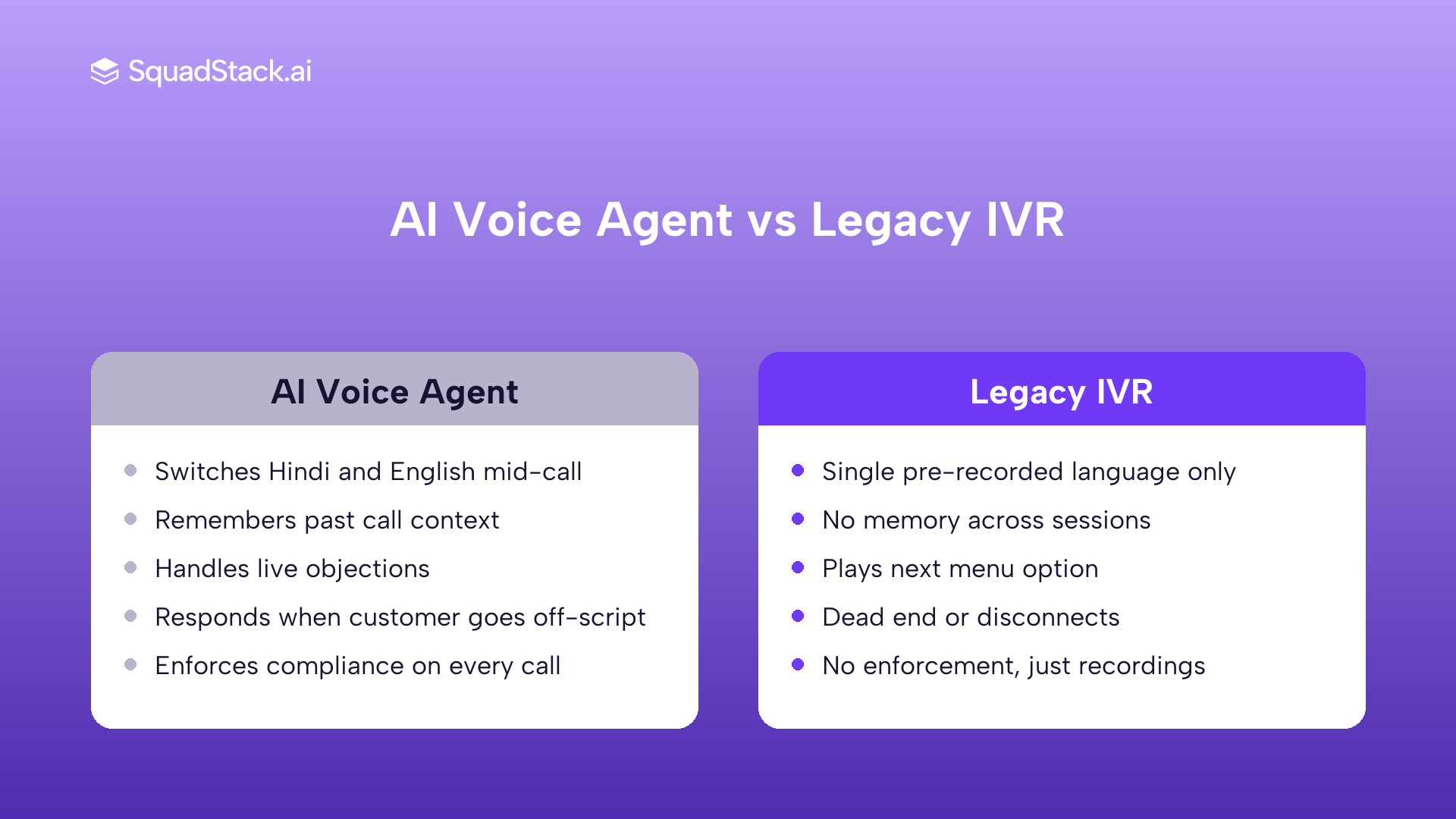
Many teams have had bad experiences with IVR and assume voice AI will feel the same. It does not.
| Dimension | Legacy IVR | AI Voice Agent |
|---|---|---|
| When a customer says "I have a question about the EMI" | Routes to a menu option, likely the wrong one | Answers the EMI question directly, in context |
| Language handling | Usually one language, pre-recorded options only | Native code-switching mid-sentence (e.g. Hinglish, Taminglish) |
| Memory across calls | Starts cold every time | Loads prior conversation history before the call begins |
| Objection like "the interest rate seems high" | Cannot handle it, drops or transfers | Works the objection across multiple turns with a reasoned response |
| Response speed | Instant (menu playback) | Median 0.8 seconds or less, within the human conversational range |
| What happens when the customer goes off-script | Breaks or loops | Continues naturally, handles unexpected turns |
If the question is whether to replace human agents with an IVR, the answer is almost always no for sales calls. If the question is about a voice AI agent trained on real Indian sales conversations, the calculus is different.
The right starting point is calls where the conversation is structured, the outcome is binary, and volume is high. These are also the calls that exhaust your human agents fastest.
Start with AI on these:
Keep humans on these, at least initially:
The goal is to free your human agents from calls that do not need them, so they can focus where they actually add value.
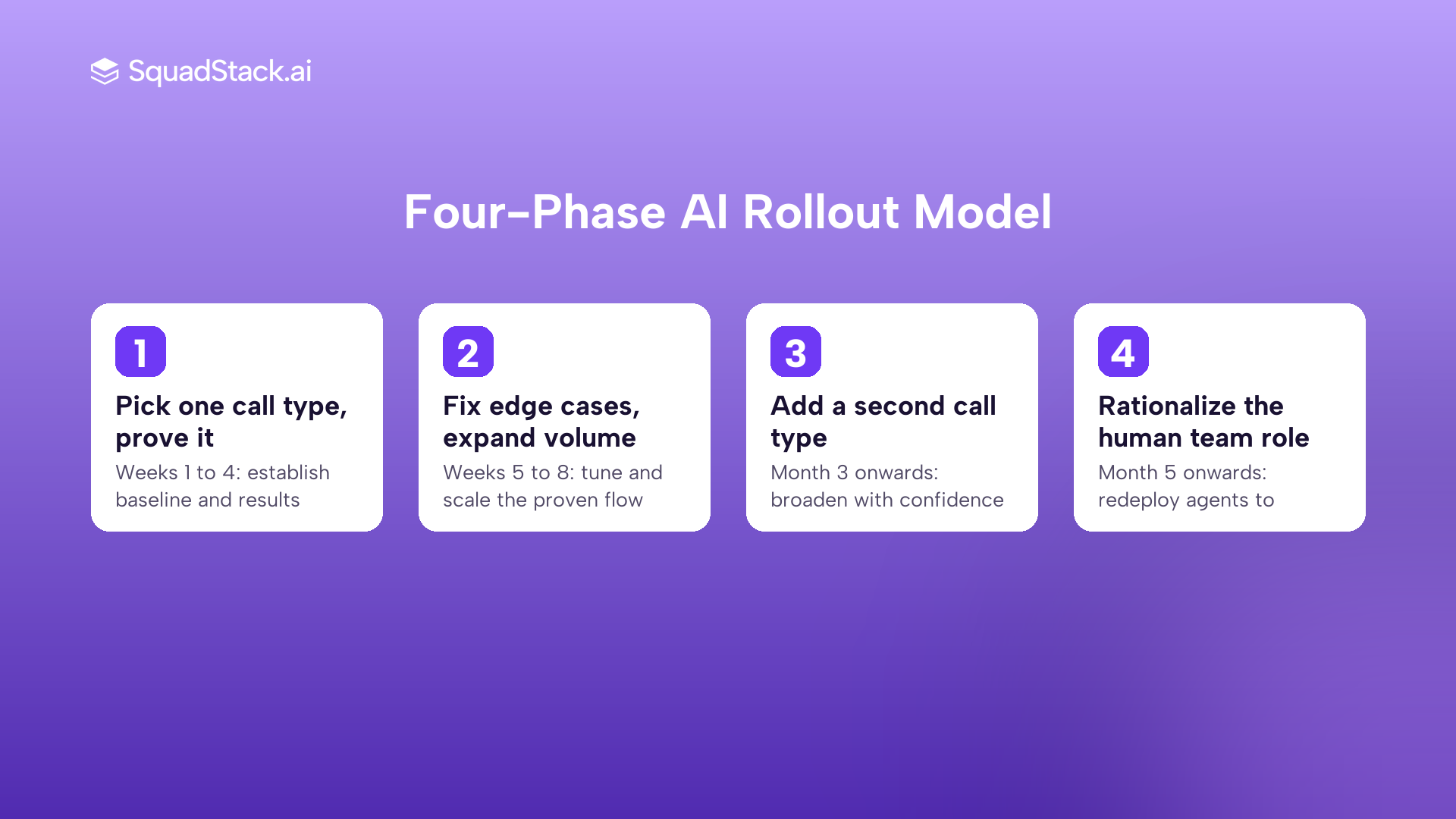
Phase 1 (Weeks 1 to 4): Pick one call type, prove it on real traffic
Run AI on one use case alongside your existing team. Lead qualification is usually the best entry point. Align on a single success metric before the pilot starts: connectivity rate, qualification rate, or cost per qualified lead. Do not declare success on volume alone.
Phase 2 (Weeks 5 to 8): Measure, fix, expand the same use case
The first few weeks surface edge cases your human team handled instinctively: unusual objections, dialect quirks, regulatory disclosures that need exact phrasing. Fix these in the script and re-test. Expand volume on the use case that proved out.
Phase 3 (Month 3 onwards): Add a second call type
With one use case proven, add a second. Payment reminders or re-engagement calls are natural next steps. By this point you also have data to decide which leads should always go straight to a human closer.
Phase 4 (Month 5 onwards): Rationalize the human team's role
With AI handling qualification, follow-ups, and reminders, your human agents should be spending most of their time on high-intent leads already warmed up. This is where cost savings appear without the risk of automating calls that need human judgment.
The phased model is not just about risk management. It builds the internal proof that earns buy-in from the team, the CFO, and the compliance function.
The biggest non-technical risk in any AI rollout is the people question. A few things that actually work:
Name the shift honestly. If your message to the team is "AI will do the boring 50 calls you hate making every morning so you can spend your time on warm leads," most agents respond well to that.
Retrain the human role before you need to. Agents moving from cold outreach to warm, pre-qualified leads need better objection handling and less dependence on a script. Start that training during the pilot, not after.
Do not cut headcount during the proof phase. Running AI on real leads while keeping the human team intact gives you a genuine benchmark and means you are not betting on AI before you have seen it work.
India-specific reality check. TRAI compliance is non-negotiable. Your AI dialing system must use 140-series numbers for cold outreach, enforce the 9:30 AM to 8:30 PM calling window as a hard system rule, and handle DND scrubbing before any dial goes out. These are not optional features to configure later. See the AI sales agent overview for how a compliant setup works.
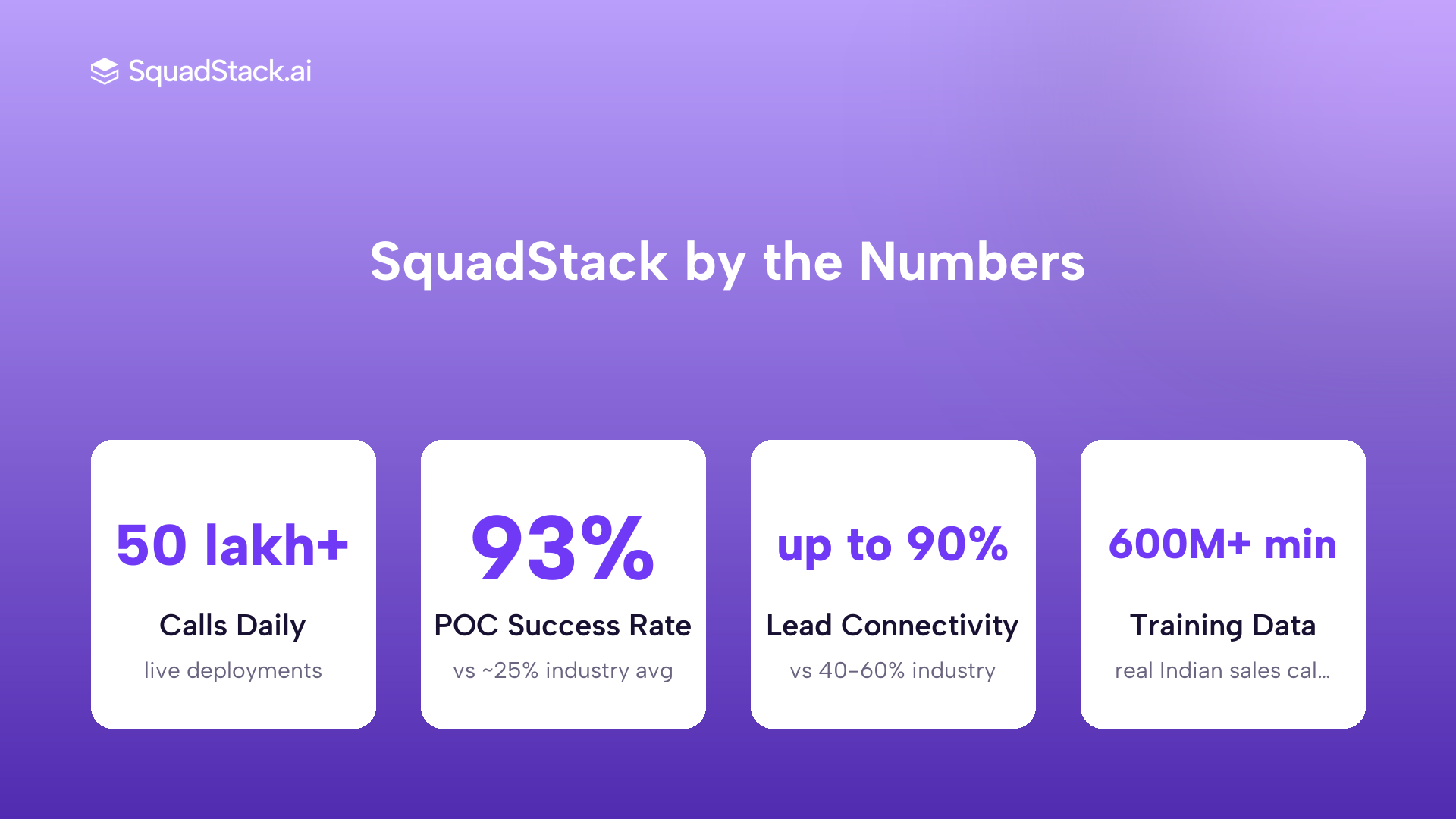
The speech model underneath, Arth, is trained on 600M+ minutes of real Indian contact-center conversations: code-switched, noisy, 8kHz telephonic audio from across 85%+ of Indian pincodes. That training data is why the agents handle the natural pauses, fillers, and backchannels of a real sales conversation rather than sounding like a newsreader.
The platform runs 50 lakh+ calls daily across 60+ large consumer brands including Kotak Mahindra Bank, AngelOne, PhonePe, TATA Digital, and IndiaMART. The pilot success rate is 93%, compared to a rough industry average of around 25%. That gap exists because every engagement starts with a dedicated squad: an AI Agent Product Manager, a Forward Deployed Engineer, a Conversational AI Designer, and a QA specialist, who build the agent on the client's own call recordings and knowledge base before it touches a single live lead.
Every call is evaluated on three levels via the Eval System: outcome (did it convert?), sentiment (how did the customer experience it?), and execution (did the agent follow the correct flow?).
For teams that want to see this before committing, the Delhivery case study shows how AI handled rider hiring at scale with a 4x lower cost-per-hire (read it here). For qualification use cases, Moneyview achieved 89% connectivity and 40% more loan applications (see the case study).
Augment first, on the right call types, with a clean phased rollout. Replace is not the right frame for most teams at this stage. The better frame is: what does my human team do best, and how do I get AI to handle everything else so they can do more of it?
Talk to the SquadStack team about a pilot aligned to a single success metric. Ninety-three percent of pilots prove out. The ones that do not tend to share one root cause: the success metric was not fixed before go-live.
Also worth reading: AI agents for sales operations and AI cold calling for Indian sales teams.
Should I replace a 100-seat collections team in an NBFC with AI voice agents, or augment?
Start by augmenting, not replacing. Run AI on high-volume, pre-due reminder calls and early-bucket reachout where the conversation is structured. Keep your experienced human collectors on calls that require negotiation, settlement discussions, or emotionally sensitive handling. A hybrid model built this way typically costs far less than a full human team while preserving conversion quality where it matters most.
Which call types in Indian consumer sales are best suited to AI voice agents right now?
Lead qualification, follow-up and re-engagement, payment reminders, appointment booking, and abandoned-form recovery are the strongest starting points. These share a common profile: high volume, structured conversation, binary outcome, and low penalty for being slightly imperfect on any individual call.
How does an AI voice agent compare to a traditional calling team on connectivity and conversion?
SquadStack's AI achieves up to 90% lead connectivity versus a 40 to 60% industry norm for human teams, because it dials at the right time per individual lead and rotates numbers automatically to avoid spam flags. In the Moneyview personal loan sales deployment, the platform achieved 89% connectivity and 40% more loan applications.
What are the TRAI compliance requirements for AI calling in India?
AI dialing in India must use 140-series numbers for cold outreach, restrict calls to the 9:30 AM to 8:30 PM window (enforced at the system level), scrub lists against the DND registry before dialing, and honor opt-outs in the conversation itself. These rules apply to AI-driven calls the same way they apply to human agents.
How long does it take to go live with AI calling for an Indian sales team?
Most enterprise pilots go live in two to three weeks. The setup covers building the agent on the client's real call recordings and knowledge base, configuring the workflow, and completing integrations and UAT. The long pole is usually approvals and data readiness on the client side, not the build itself.
Can an AI voice agent handle multiple Indian languages and regional accents?
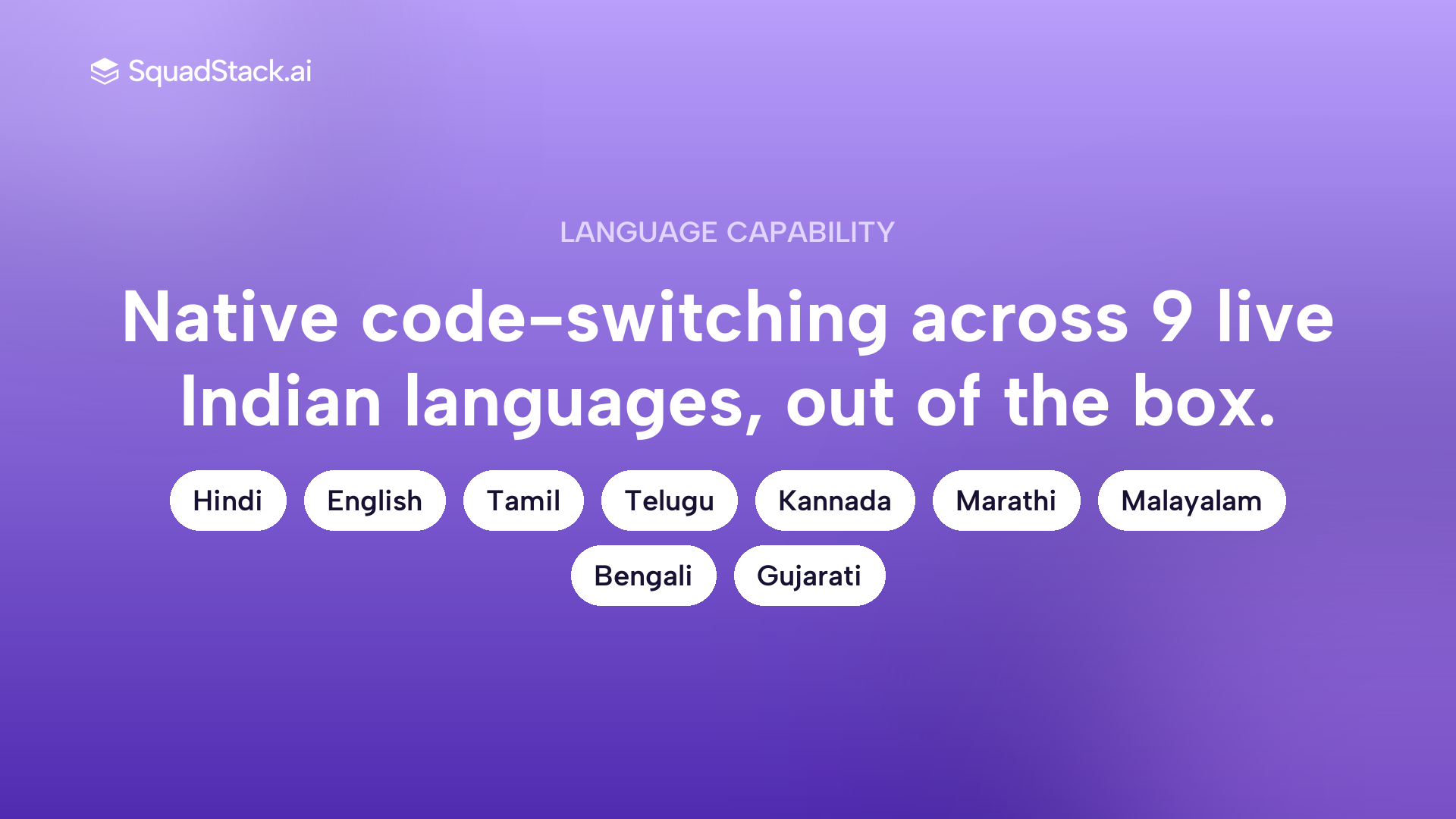
Yes. Hindi, English, Tamil, Telugu, Kannada, Marathi, Malayalam, Bengali, and Gujarati are live today with native code-switching, meaning the agent can switch languages mid-sentence the way a bilingual human agent would. More regional languages are available on demand. The speech model is trained on real Indian telephony audio, not public datasets, which is why regional accent handling and code-switched speech work in production.
What happens when an AI call goes wrong or the customer gets frustrated?
The agent can detect when a call is not going well and either work the objection across multiple turns or trigger a warm transfer to a human agent, passing full conversation context so the customer does not have to repeat themselves. Transfer triggers are configurable: customer request, loop detection, or keyword-based escalation.
How do I measure whether my AI voice pilot is actually working?
Fix one success metric before go-live, typically qualification rate, cost per qualified lead, or connectivity rate on a specific lead cohort. Run the AI alongside your existing human team on the same lead source for at least four weeks. The comparison needs to be like-for-like on lead quality and campaign parameters; without that, the data is not meaningful.
Does the AI improve over time, or does it stay static after setup?
The platform runs continuous A/B testing across voice, script framing, call timing, and channel cadence on live traffic. The ROI Optimizer feeds outcomes back into the system so the agent gets sharper on each campaign. The Lift component specifically reads near-misses and early drop-offs to propose precise instruction edits, each of which goes through a human review gate before running on production traffic.
What is the risk of going all-in on AI calling too early?
The main risks are losing deals on call types that needed human judgment, creating compliance exposure if the AI dialing setup is not TRAI-compliant from day one, and damaging team morale if the rollout is framed as replacement rather than augmentation. A phased approach on a single call type, with a pre-aligned success metric and a dedicated squad running the pilot, is the standard way to manage all three.