AI Voice Agent for Microfinance: Grameen Model at Scale
November 7, 2026
|

13 min read
A guide to how lead response delay drives revenue loss in Indian B2C sales, and what faster outreach changes for conversion and CAC.
Lead response speed revenue impact in India is one of the most underquantified problems in B2C sales. Indian sales teams across lending, insurance, EdTech, and e-commerce routinely lose a large share of their best leads simply by calling too late. This report draws on patterns from SquadStack's call operations across 60+ large consumer brands to explain how response delay maps to revenue loss, and what a sub-minute AI voice response changes.
Most sales leaders in India know that slow follow-up hurts conversion. Few have quantified it precisely for Indian consumer funnels, because the data has been scattered across disconnected CRMs, manual call logs, and shift-based dialers.
The benchmarks that circulate in Indian sales teams are almost entirely borrowed from US research. Studies from MIT Sloan and InsideSales.com get cited constantly, but those figures come from B2B SaaS funnels in North America. They do not reflect a personal loan applicant in Pune who filled a form at 8:45 PM, or an EdTech lead in Hyderabad who enquired between two classes on a Monday afternoon.
This report presents what lead response speed actually looks like in Indian B2C sales, what delays cost, and what changes when you close the gap structurally.
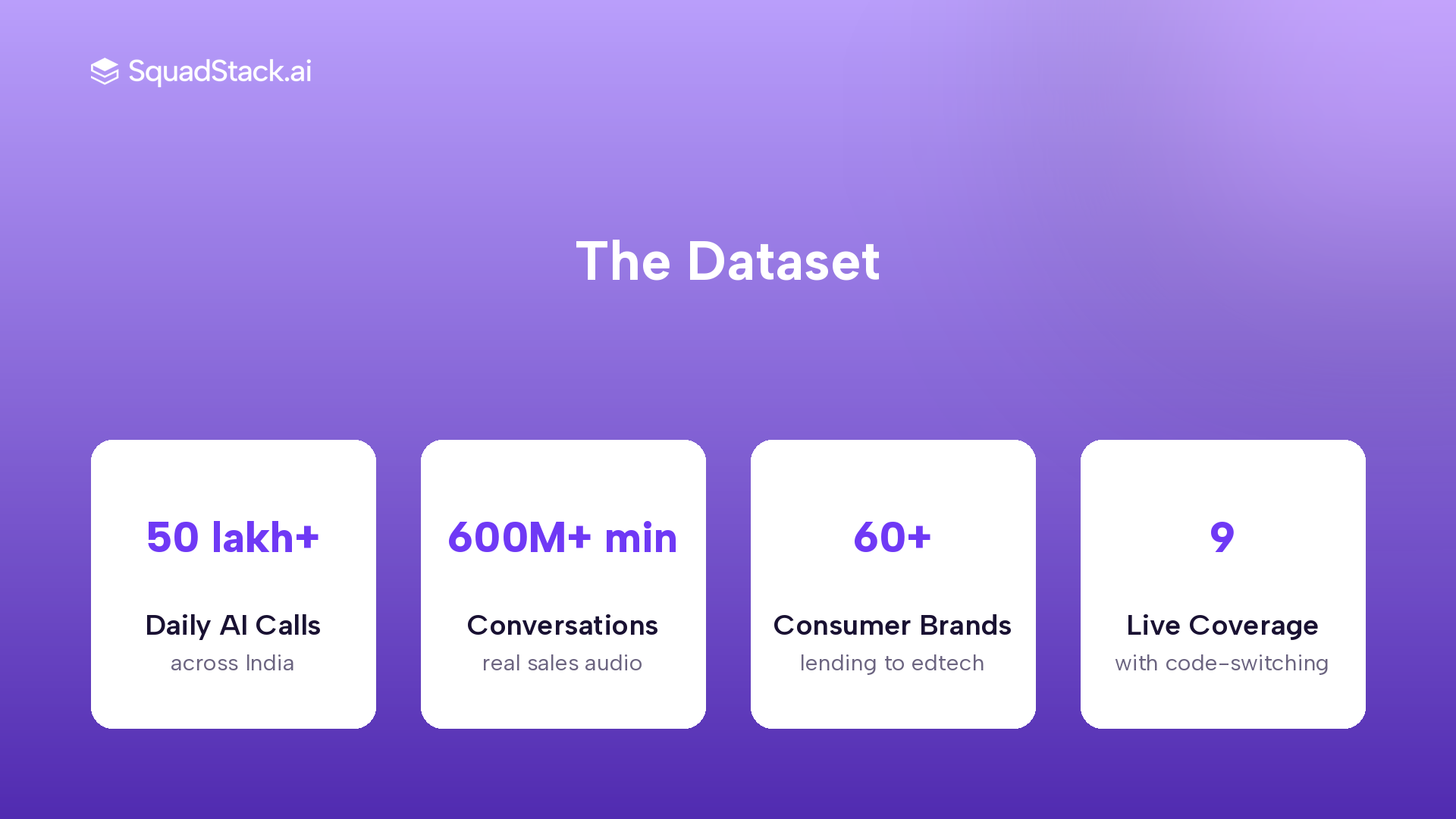
Scope and method: The findings are based on observed patterns across SquadStack's call operations. SquadStack has processed 50 lakh+ AI calls daily across 60+ large consumer brands in India, building a corpus of 600M+ minutes of real Indian sales conversations. The industries covered are lending, insurance, EdTech, and e-commerce, all high-volume B2C contexts where lead response speed directly gates revenue.
This is not a controlled academic study with randomised hold-out groups. It is an operational analysis drawn from first-party call data at scale. Where findings are directional rather than precisely quantified, we say so plainly.
In Indian B2C consumer sales, the response window that determines whether a lead converts is extremely narrow. Across lending, insurance, EdTech, and e-commerce, leads contacted within five minutes of submitting an enquiry convert at dramatically higher rates than leads contacted even thirty minutes later.
This is not a small gap. It is the difference between a lead who is still at the device, still in the purchase frame, and still weighing options, versus one who has moved on, been contacted by a competitor, or simply gone cold. Every hour of additional delay compounds the problem.
The average Indian B2C sales team does not respond to most inbound leads within five minutes. The reasons are structural, not motivational.
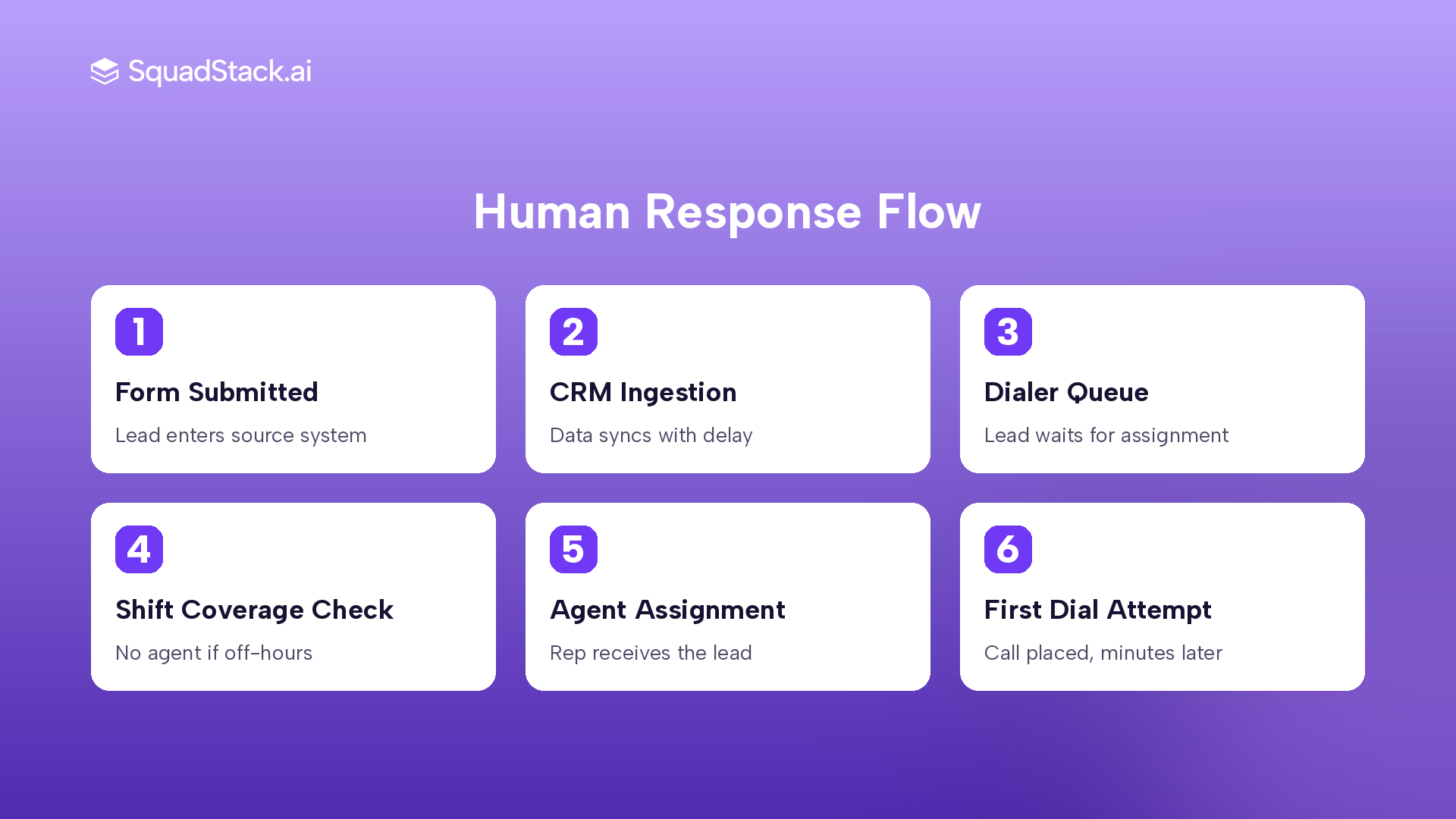
Shift coverage gaps. Most contact centers run on fixed shifts. Lead volume does not follow shift schedules. A large share of loan enquiries, EdTech searches, and insurance quote requests happen evenings and weekends, when agent availability is lowest.
CRM and dialer lag. Leads flow from a landing page into a CRM, then get routed to a dialer, then assigned to an agent. Each handoff adds minutes. By the time an agent dials, a significant portion of the response window is already gone.
Agent capacity constraints. During high-demand periods, agents are on existing calls. New leads queue. A lead arriving in a busy window may wait considerably longer than the nominal response target.
No weekend or night coverage. For many lenders and insurers, an evening or weekend lead is simply not called until the next business morning, a gap of eight to twelve hours or more.
The result is that actual median response time is far longer than the aspirational target, and most leads are never called within the five-minute window where conversion is highest.
| Industry | Typical Lead Volume | Why Speed Matters | Cost of Delay |
|---|---|---|---|
| Lending (personal, home, gold loans) | Very high; multiple aggregators competing | Borrower often enquires on 3 to 5 platforms simultaneously | First caller wins; every hour of delay hands the deal to a competitor |
| Insurance | High; peaks at renewal and tax-saving season | Intent is high but cools quickly; buyer moves to agent or aggregator | First credible contact drives policy binding; late calls face "already done" objection |
| EdTech | Very high; leads from ads convert on same-session intent | Student or parent is in research mode for minutes, not days | Courses with same-day callbacks report far higher enrollment than those with next-day follow-up |
| E-commerce / D2C | Very high; abandoned cart intent decays fast | Cart abandonment intent is strongest in the first hour | A recovery call within an hour recovers far more carts than one the next day |
Each industry shares a common mechanic: the lead's intent at the moment of enquiry is the highest it will ever be. Every hour that passes allows competing priorities, competing vendors, and buyer inertia to erode it.
For a lender processing a large volume of personal loan leads per month, even a modest improvement in same-session contact rate produces a material lift in applications. For most Indian lending operations, the share of leads falling outside the five-minute window is large, which means the revenue left on the table is large.
Two structural reasons make the Indian B2C context more response-sensitive than US benchmarks indicate.
The first is competition density. For personal loans, credit cards, and online courses, a single consumer action on an aggregator simultaneously triggers outreach from multiple vendors. Whoever calls first and frames the offer best wins the attention.
The second is device context. A large share of Indian B2C lead generation happens on mobile during commutes or short breaks. The window when the user is still engaged with the product is often minutes, not hours. An evening lead from a user browsing loan options on their commute may already be watching television by the time a morning-shift agent dials.
These factors make the five-minute window not just a conversion best practice but the structural definition of the lead's useful life in many Indian funnels.
The fix for slow lead response is not hiring more agents or extending shift hours. Both approaches hit diminishing returns quickly and drive CAC upward.
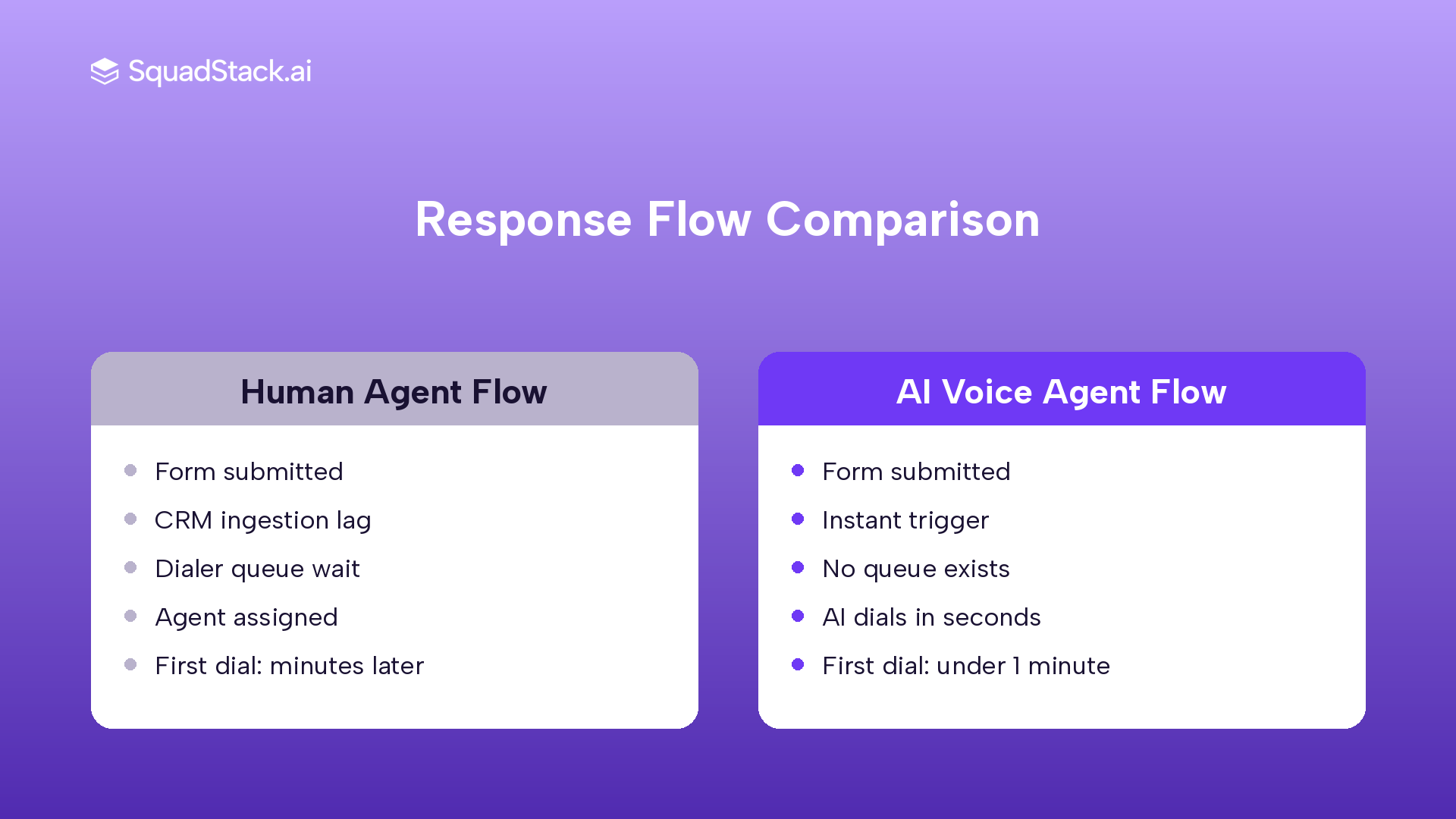
The structural fix is removing the human dependency from the initial response entirely.
An AI voice agent for lead qualification can respond to a new lead in seconds regardless of time of day, day of week, or current agent load. It holds a full qualification conversation, captures structured data, and either books a callback for a human closer or progresses the lead directly.
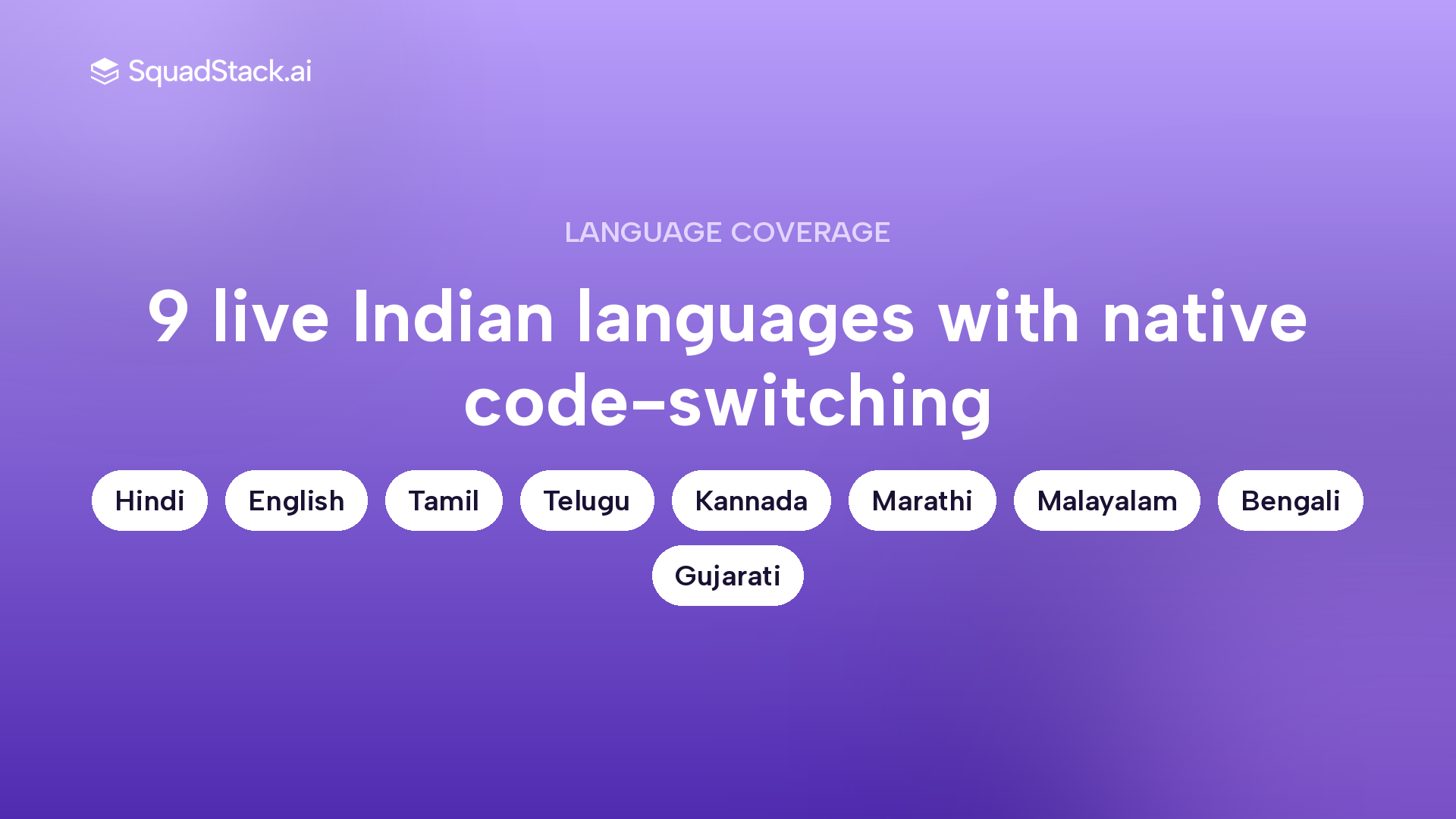
SquadStack's AI voice agents operate at a median response latency of 0.8 seconds or less, across 9 live Indian languages including Hindi, English, Tamil, Telugu, Kannada, Marathi, Malayalam, Bengali, and Gujarati, with native code-switching. A borrower in Tamil Nadu who enquires in English and switches to Tamil mid-call is handled without friction. Additional regional languages are available on demand.
This matters because the coverage problem is not only about timing. It is about whether the agent can hold a genuine conversation in the lead's preferred language at any hour. A rigid IVR in English at 9 PM serves a Hindi-speaking lead poorly regardless of response speed.
For omnichannel lead management, the platform can send a WhatsApp message or SMS within seconds of lead generation, then follow with a call, so the lead receives a signal of responsiveness before any voice conversation begins.
The case study numbers bear this out. A leading quick commerce platform achieved 90% lead connectivity and 40% lower cost-per-hire with AI voice outreach. WheelsEye saw 87% higher rate card collection at 50% lower cost. A leading general insurer achieved 85% connectivity and 60% lower renewal cost.
SquadStack's AI-based lead qualification software and conversational AI lead scoring capabilities extend the same logic to scoring and prioritisation, so high-intent leads get called first even at high volume.
For teams evaluating vendors, the 93% POC success rate SquadStack has achieved versus an industry average of roughly 25% is a reasonable proxy for whether a platform will deliver on speed-to-lead at production scale or stall in a pilot.
The business case for speed-to-lead investment is straightforward once you have the right framing.
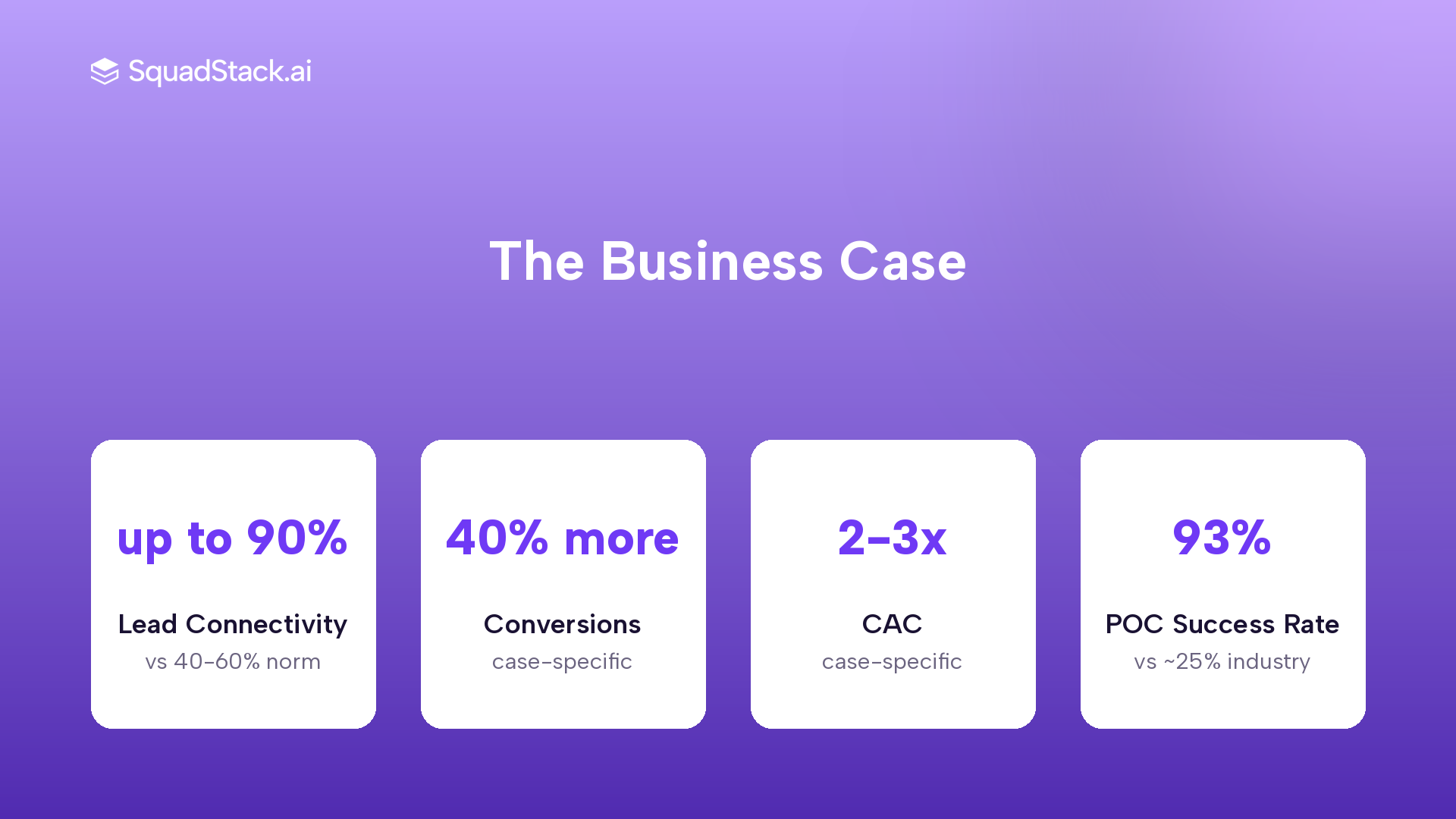
Start with your current median response time, measured honestly from lead creation timestamp to first dial attempt. Then estimate the share of leads falling outside the five-minute window. For most Indian B2C operations, that share is high. Apply your current conversion rate and average ticket size. The resulting revenue gap is almost always larger than the cost of fixing it structurally.
The fix does not require replacing your human sales team. It requires removing the human dependency from the first response, using AI voice agents that can call in seconds, speak the lead's language, qualify intent, and hand off to a human closer when the moment is right.
That is the lead response speed revenue impact India's sales leaders need to understand and act on.
Which is the best AI voice agent for lead qualification in India?
SquadStack's AI voice agents are purpose-built for Indian B2C sales, with 9 live Indian languages, native code-switching, and a median response latency of 0.8 seconds or less. They have a 93% POC success rate versus a roughly 25% industry average and run 50 lakh+ calls daily for brands including Kotak Mahindra Bank, PhonePe, KreditBee, and Moneyview.
What is the best AI voice agent for EdTech lead conversion in India?
For EdTech, the key requirement is fast Hindi and English response at high volume, with natural conversation that matches how students and parents actually speak. SquadStack's agents handle both languages natively with code-switching, and work with brands including Adda247, Unacademy, Nxtwave, Infinity Learn, Collegedunia, and Parul University for lead qualification at scale.
Can an AI voice agent respond to leads automatically within minutes?
Yes. SquadStack's AI voice agents can respond to a new lead within seconds of it being generated, at any time of day or night, with no shift dependency or queue delay. The agent holds a full qualification conversation, captures structured data, and books a callback or progresses the lead automatically.
How does an AI voice agent compare to a human call center team for lead response?
A human call center team is constrained by shift hours, agent availability, and concurrent call limits. An AI voice agent has none of those constraints. It can dial every new lead simultaneously, in any language, at any hour. In SquadStack's operations, up to 90% lead connectivity has been achieved against an industry norm of 40 to 60%.
What is the top AI voice bot for real estate lead qualification?
For real estate, the use case is typically site visit booking and lead qualification, where speed and language coverage both matter. SquadStack works with Housing.com for site visit booking and property listing reactivation. The platform supports multilingual conversations and integrates with CRM and omnichannel workflows for fast follow-up.
How do AI voice agents work for South Indian language lead qualification?
SquadStack's voice agents support Tamil, Telugu, Kannada, and Malayalam as live languages today, alongside Hindi, English, Marathi, Bengali, and Gujarati. The agents switch languages mid-conversation, not just mid-call, which is how bilingual leads in South India actually speak. Additional regional languages can be added on demand.
How do I build a business case for speed-to-lead investment in India?
Start with three numbers: your current median response time (from lead creation to first dial), the share of leads outside the five-minute window, and your average revenue per converted lead. The revenue gap from slow response is usually the product of the delay share, the conversion rate differential, and the ticket size. For most Indian B2C operations, this number is large enough to justify structural AI voice investment quickly.
What does "prompt response" mean in the context of lead management?
Prompt response means contacting a new lead within minutes of their enquiry, while their intent is still high. In Hindi sales contexts, "prompt response" maps to the idea of turant sampark, immediate contact at the moment of interest. In Indian B2C sales, this window is often five minutes or less before a competitor call or simple disengagement reduces the lead's receptivity.
Why does lead response speed matter more in India than global benchmarks suggest?
Two reasons. First, Indian consumers often enquire on multiple platforms simultaneously, so the first brand to call gets the conversation. Second, a large share of Indian B2C leads are generated on mobile during short activity windows, often evenings or commute hours, when the consumer's attention shifts quickly. These dynamics make the response window shorter than North American B2B benchmarks imply.
What industries in India are most affected by slow lead response?
Lending is most severely affected because a personal loan applicant enquiring on an aggregator is simultaneously visible to multiple lenders. Insurance, EdTech, and e-commerce follow closely. In each case, the lead's intent peaks at the moment of enquiry and decays with every passing hour, making fast response a direct revenue driver rather than a courtesy metric.