Voice AI Onboarding Failures: What Goes Wrong and Why
November 2, 2026
|

13 min read
What to know about why slow lead response leaks revenue in India and how AI voice agents fix the speed-to-lead gap at scale.
Lead response time revenue leakage in India is a more compressed problem than global benchmarks suggest. In high-velocity Indian consumer sectors like lending, insurance, and edtech, a lead's likelihood to convert drops sharply within the first few minutes of showing intent, not hours. AI voice agents are the only operationally viable fix because they call instantly, at any scale, in the lead's own language.
A lead fills in a form for a personal loan at 8:47 PM. The nearest available sales agent comes in the next morning at 9:30 AM. By then, the lead has already spoken to two competitors who called back within minutes.
This is not a hypothetical. It describes the structural reality of consumer sales in India, where a large portion of lead volume arrives outside calling hours, at the edges of shifts, or in volumes that outpace human capacity. The result is revenue leakage from slow lead response time, and in India the decay happens far faster than most global benchmarks account for.
Most resources on this topic cite a 30-minute or 5-minute response window. Those figures come from Western B2B SaaS research. India's consumer lending, insurance, and edtech funnels behave differently. Intent is expressed in a form click, a missed call, or a WhatsApp tap. The moment passes quickly.
Lead response time revenue leakage is the revenue a business loses when the gap between a prospect expressing interest and a salesperson making first contact is long enough for that prospect to disengage, convert elsewhere, or simply forget.
The leakage is not always visible in a CRM. It shows up as a lead never contacted within a useful window, marked "not connected" after five failed attempts days later, and written off as low-quality data.
In Indian consumer sales, a lead for a pre-approved loan, an online course, or a term insurance policy typically comes from a digital ad or aggregator. The prospect filled in the form because something caught their attention at that exact moment. That attention fades fast, especially when the next three apps on their phone are surfacing competing offers.
There are four structural reasons Indian teams struggle with first-response speed.
Shift-hour gaps. A large share of digital leads arrive in the evening and on weekends, when outbound calling teams are at reduced capacity or off entirely. A lead that arrives at 9 PM is typically not called until the next working morning.
Agent availability limits. Human agents can only handle a fixed number of calls at a time. During peak lead-generation periods, such as after a large ad spend or a flash sale, call queues back up. Leads at the end of that queue wait far longer.
Vernacular friction. Many Indian consumers are more comfortable in their regional language than in English or Hindi. When a lead from Tamil Nadu is called by a Hindi-speaking agent, the conversation often fails within the first 30 seconds. The lead is marked "not interested" when the real problem was language mismatch.
Channel confusion. Many leads expect a call back but get a WhatsApp message first, or vice versa. Without a system that tracks channel preferences and cross-channel history, the first outreach lands wrong and the lead goes cold.
These causes compound each other. A team working through a backlog of last night's leads, calling in the wrong language, on the wrong channel, compresses conversion rates far more than any single variable would suggest.
A pre-approved loan lead has already cleared an eligibility filter. Their intent is high and specific. But lending is moment-sensitive: borrowers apply to multiple lenders simultaneously and take the first offer where someone actually reaches them and speaks their language. A slow call-back means the deal goes to whoever was faster.
Insurance leads in India depend on timing. A lead from a comparison site is actively evaluating. Call within a few minutes and they are still in decision mode. Call the next day and they have either bought elsewhere or filed the decision away for later.
Online course enquiries, especially for competitive exam preparation, arrive in spikes: after board results, after exam notifications, after a free webinar. These spikes overwhelm human dialing capacity. A lead not called for 24 hours is almost impossible to convert. The emotional trigger that made them fill in the form has passed.
In all three sectors, the lead's intent has a short active window, and human response capacity cannot match the volume or speed that window demands.
When teams look for a speed-to-lead fix, many consider IVR. It is worth being precise about why IVR does not solve this problem.
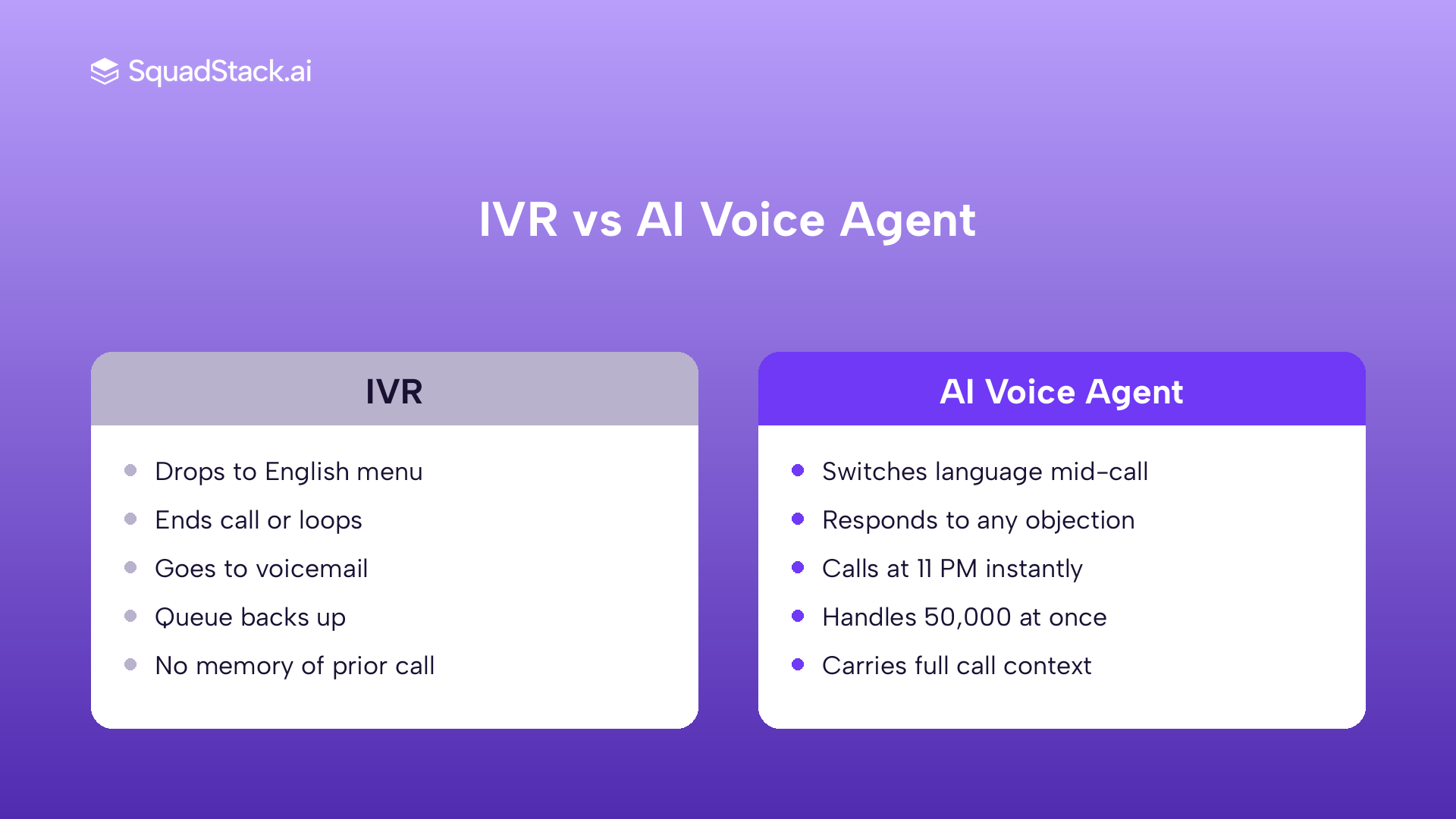
| Dimension | Legacy IVR | AI Voice Agent |
|---|---|---|
| Response to off-script input | Loops back to the menu or disconnects | Understands and responds in natural conversation |
| Language handling | Fixed language, no switching | 9 Indian languages with native mid-sentence code-switching |
| Lead memory | Every call starts cold | Persistent memory across calls and channels |
| Vernacular objection handling | Not possible | Multi-step objection handling in the lead's own language |
| Time to call after form submit | Depends on human queue | Seconds, at any volume, any time of day |
An IVR can route a call. It cannot have a conversation. When a lead says "mujhe thoda time chahiye" or switches from English to Tamil mid-sentence, an IVR either misroutes or hangs up. An AI voice agent responds to what was actually said.
The AI voice agent for lead qualification does more than place a fast call: it carries the full conversation, captures structured data, and hands off only the highest-intent leads to human closers.
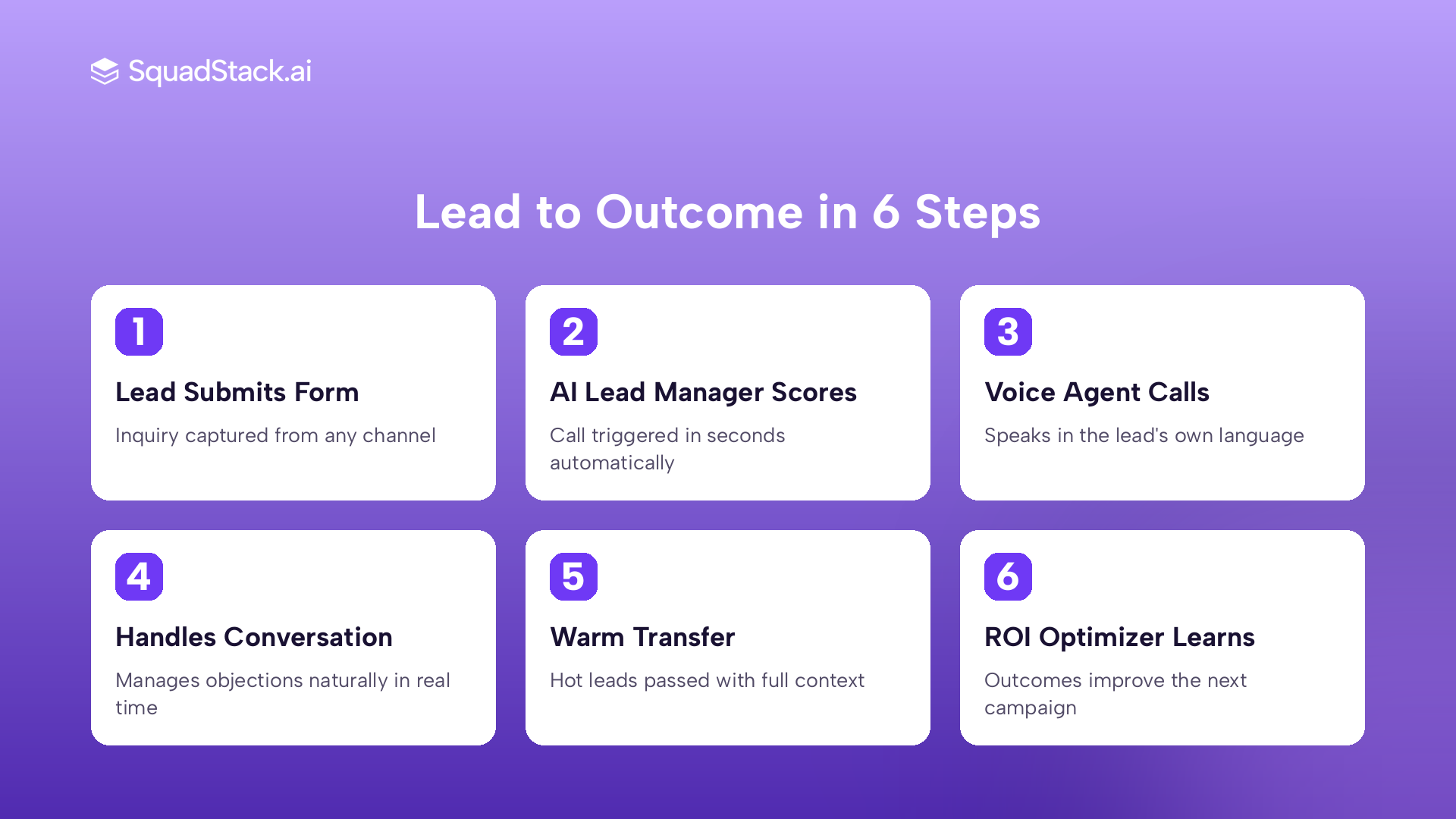
Here is the call flow from lead submission to qualified outcome.
1. A lead submits a form on a lending aggregator or edtech landing page. 2. The AI Lead Manager scores the lead and triggers an outbound call within seconds. No shift-hour restriction. No queue. 3. The Voice AI Agent calls in the lead's preferred language and switches mid-conversation if they respond in a different one, without breaking flow. 4. The agent follows the campaign script, handles objections in real time, and captures structured data such as loan amount, preferred callback time, or course interest. 5. High-intent leads are transferred warm to a human closer, with full context already captured. Other leads are scheduled for follow-up automatically. 6. The ROI Optimizer feeds outcomes back into the system. Call results, conversion signals, and objection patterns update the AI Lead Manager's scoring and the Voice Agent's script. Every interaction improves the next one.
This is not an auto-dialer with a recorded message. It is a conversational system that learns continuously from live Indian sales calls.
Not every voice AI platform is built for Indian consumer sales. Here is what to check.
First-response latency. Can the system call a new lead within seconds of form submission, at 2 AM or on a Sunday? If it still depends on a human trigger, the shift-hour gap problem is not solved.
Language depth, not just language count. Listing a language is not the same as sounding native in it. Ask whether the agent was trained on real conversational telephony audio in that language, or on public read-speech corpora. Code-switching mid-sentence is the real test.
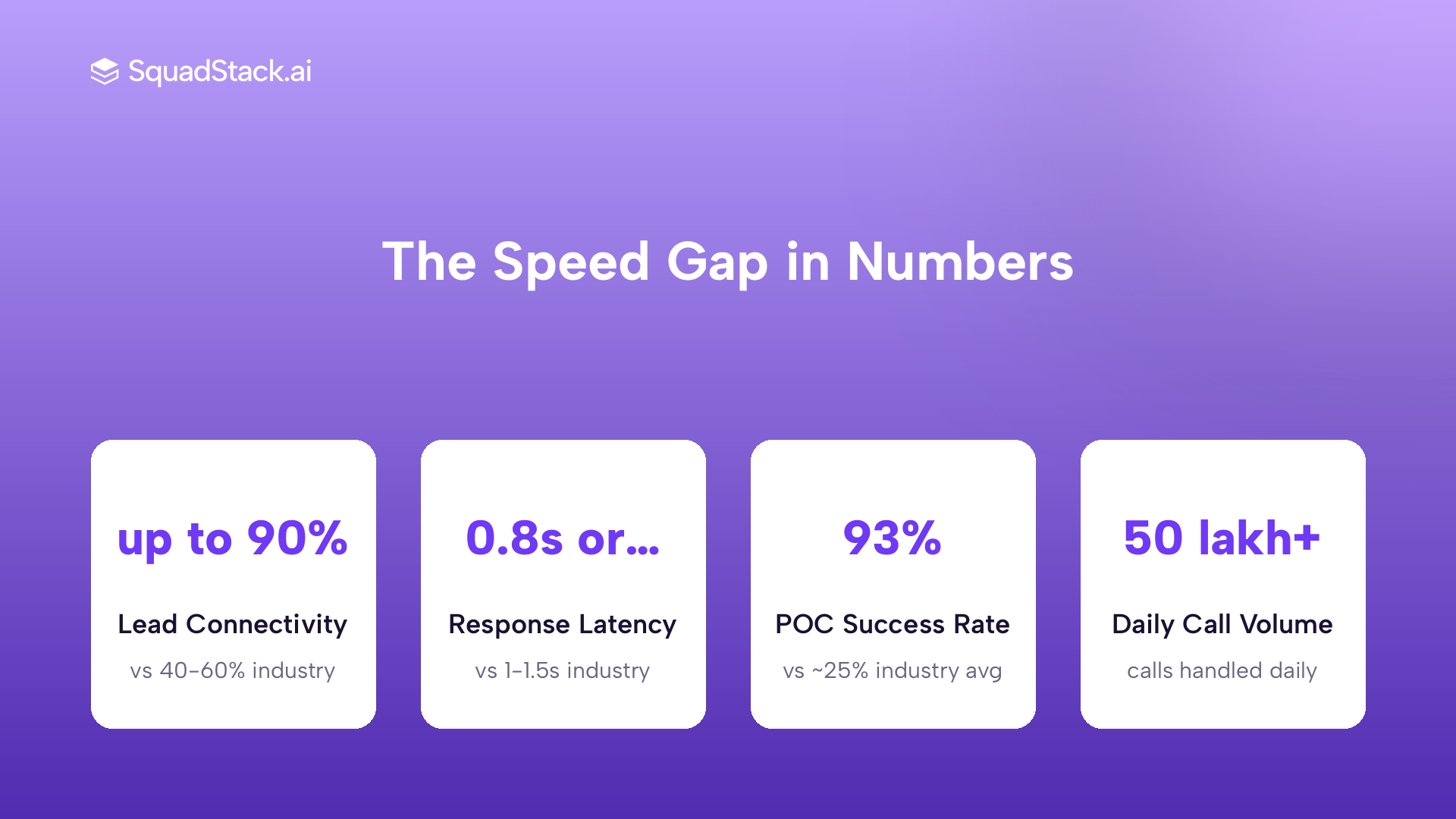
Connectivity rate. The platform-level lead connectivity rate tells you how many leads are actually reached over a full campaign attempt cycle, not just on the first attempt. A 40 to 60% industry norm leaves a large share of paid leads uncontacted.
Call quality under scale. A system that works on 500 leads a day may degrade at 50,000. Ask for live campaign references in your sector and lead volume range.
Compliance. For BFSI and insurance, the platform must be TRAI-compliant, use only 140-series numbers for cold outreach, and respect DND registries automatically.
A broader comparison of what to look for across AI contact center dimensions is at SquadStack's AI contact center ROI page.
SquadStack's proprietary speech model, Arth, was trained on 600M+ minutes of real Indian sales conversations spanning more than 85% of Indian pincodes. That training corpus includes Hinglish, Taminglish, and noisy 8kHz telephony audio, the exact conditions of a real outbound call. Generic speech models trained on public datasets cannot replicate this.
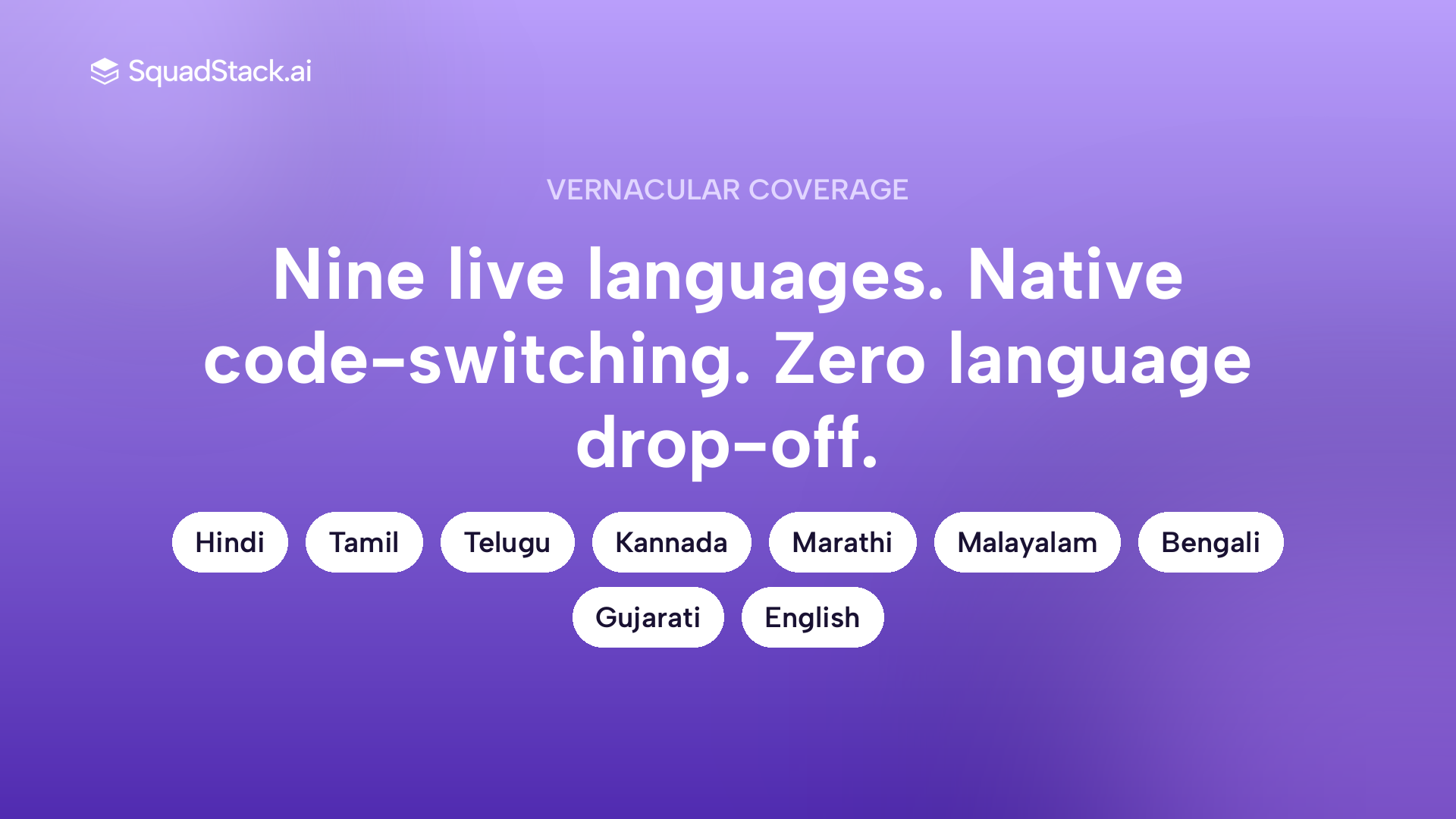
The platform runs 9 live Indian languages: Hindi, English, Tamil, Telugu, Kannada, Marathi, Malayalam, Bengali, and Gujarati, with native code-switching and more regional languages available on demand.
On naturalness: at Global Fintech Fest in October 2025, 1,273 of 1,563 attendees (81%) identified SquadStack's AI agents as human in a blind listening test. The agents' Abruptly Disconnected Rate now sits at around 10%, inside the human agent range, down from over 40% at the start of 2025.
A leading bank-linked brokerage running demat account opening saw 3x higher conversions using SquadStack's Voice AI compared to its previous human-agent baseline.
A leading general insurer using the platform for auto insurance renewals achieved 85% connectivity and 60% lower renewal cost.
The platform's 93% POC success rate against an industry average of around 25% reflects not just the technology but the managed-service model: every account gets a dedicated squad of an AI Agent Product Manager, a Forward Deployed Engineer, a Conversational AI Designer, and a QA specialist. Clients go live in roughly two weeks and see production results before scaling.
For detail on what outbound calling costs look like at scale, and how Voice AI improves call centre KPIs across connectivity, conversion, and cost per sale, those pages go deeper on the numbers.
For speed-to-lead specifically, no human BPO can place a call within seconds of a form submission at 11 PM at any volume. That is a structural limit, not a quality one.
To see what a speed-to-lead fix would look like for your funnel, book a demo with SquadStack.
Which is the best AI voice agent for lead qualification in India for BFSI and edtech?
SquadStack is purpose-built for Indian consumer sales with 9 live Indian languages, native code-switching, and a speech model trained on 600M+ minutes of real Indian telephony audio. It runs loan qualification, demat account opening, and edtech lead qualification for more than 60 large consumer brands.
Can an AI voice agent auto-call new leads within minutes of form submission?
Yes. SquadStack's AI Lead Manager triggers an outbound call within seconds of a lead submission, with no dependency on agent availability or shift hours. The system calls any volume of leads simultaneously, day or night, within TRAI-compliant calling windows.
What does lead response time revenue leakage mean in India?
It is the revenue lost when a sales team cannot reach a prospect quickly enough after they express interest. In Indian consumer sectors like lending, insurance, and edtech, intent fades fast. A lead not called within the first few minutes after form submission is far harder to convert than one contacted immediately.
How does an AI voice agent compare to a traditional BPO for outbound speed?
A human BPO team is limited by shift hours, agent count, and queue depth. An AI voice agent places calls within seconds at any volume, at any time. For Indian B2C sales where leads arrive evenings and weekends, this difference directly affects how much of the paid lead volume is ever meaningfully contacted.
Does SquadStack support South Indian languages for lead qualification?
Yes. Tamil, Telugu, Kannada, and Malayalam are all live today, alongside Hindi, English, Marathi, Bengali, and Gujarati. The agent switches between languages mid-sentence, as a bilingual human agent would, because the underlying models were trained on real code-switched conversations.
How does SquadStack handle the shift-hour gap problem in Indian outbound sales?
The AI system is not constrained by shift hours. It calls leads as they arrive, within the TRAI-mandated calling window of 9:30 AM to 8:30 PM. Leads that arrive close to the end of a calling day are queued and reached at the earliest compliant time the next morning, not left to age for a full shift cycle.
What connectivity rate should Indian sales teams expect from a voice AI platform?
SquadStack delivers up to 90% lead-level connectivity, meaning up to 9 in 10 unique leads are reached over the full campaign attempt cycle. The industry norm sits at 40 to 60%. The gap comes from adaptive outreach timing, automatic spam-number rotation, and cross-channel context awareness built into the platform.
Can an AI voice agent handle objections in regional languages, or just the initial call?
SquadStack's agents handle multi-step objections in the lead's own language throughout the conversation, not just the opening. Objection responses are trained on real Indian sales call data and are tested per language on actual 8kHz telephone lines, not synthetic audio.
Is SquadStack compliant with TRAI and DPDP rules for Indian outbound calling?
Yes. The platform uses only 140-series numbers for cold outreach, scrubs leads against the TRAI DND registry before every dial, enforces calling-window restrictions as a hard system block, and holds ISO 27001, ISO 27701, SOC 2 Type II, and DPDP certifications. TRAI compliance rules are pre-configured and enforced by the platform, not by agent convention.
How long does it take to go live with SquadStack for a new lead qualification campaign?
Most enterprise campaigns go live in two to three weeks. The setup period covers solutioning, agent build, integrations, and testing. The go-live timeline is often gated by client-side dependencies such as data feeds and compliance approvals, rather than the platform build itself.