.svg)




Hyper-Personalised Outbound Call Scripts Using Customer Lifecycle Data
October 6, 2026
|

13 min read
Most voice AI vendors list Tamil as a supported language and stop there. Listing a language is not the same as sounding native in it.
TL;DR: A Tamil voice AI agent India businesses deploy today must do far more than translate scripts into Tamil. It needs to recognise dialect variation, switch registers mid-call, and handle the code-switching patterns native to real Tamil sales conversations. SquadStack's voice AI agents are trained on 600M+ minutes of real Indian sales calls, Tamil included, which is why they convert rather than just connect.
Most voice AI vendors list Tamil as a supported language and stop there. Listing a language is not the same as sounding native in it.
Tamil has a long history of diglossia: the written standard and the spoken vernacular differ enough that a model trained on text or broadcast audio will sound like a newsreader, not a person. Add wide dialect variation across Tamil Nadu and a large urban population that naturally mixes English into everyday speech, and the gap between "supports Tamil" and "converts Tamil-speaking customers" becomes significant.
This matters directly for revenue. BFSI and healthcare brands running loan advisory, insurance renewal, and appointment booking at scale lose every call where the agent sounds unnatural. The AI voice agent handling these conversations has to earn trust in the first few seconds, and that trust is linguistic before it is anything else.
A Tamil voice AI agent India brands need must handle three specific challenges that generic multilingual models routinely fail on.
Register switching. Tamil has a clear formal-informal distinction. A formal opening sets a respectful tone for an insurance call, but if the agent stays formal after a customer relaxes into casual speech, the conversation feels stiff. A well-trained agent reads the customer's register and adjusts. This comes from training on real sales calls, not a settings panel.
Dialect variation. Chennai, Coimbatore, and Madurai Tamil differ in vocabulary, intonation, and pace. A customer from Tirunelveli phrases "not interested right now" differently from a customer in Erode. An agent trained only on the Chennai variant will misidentify objections from other regions as unclear speech. Dialect coverage is an accuracy problem, not just a cultural nicety.
Code-switching with English. Urban Tamil speakers, especially in BFSI conversations, naturally mix English terms into Tamil sentences. "Enna interest rate?" or "EMI ku monthly kattanum" are not edge cases. They are the normal pattern for a loan inquiry from a Tamil-speaking professional in Bengaluru or Chennai. An agent that treats English words as noise, or pauses on them, breaks the conversational flow at exactly the moment a sales question is being raised.
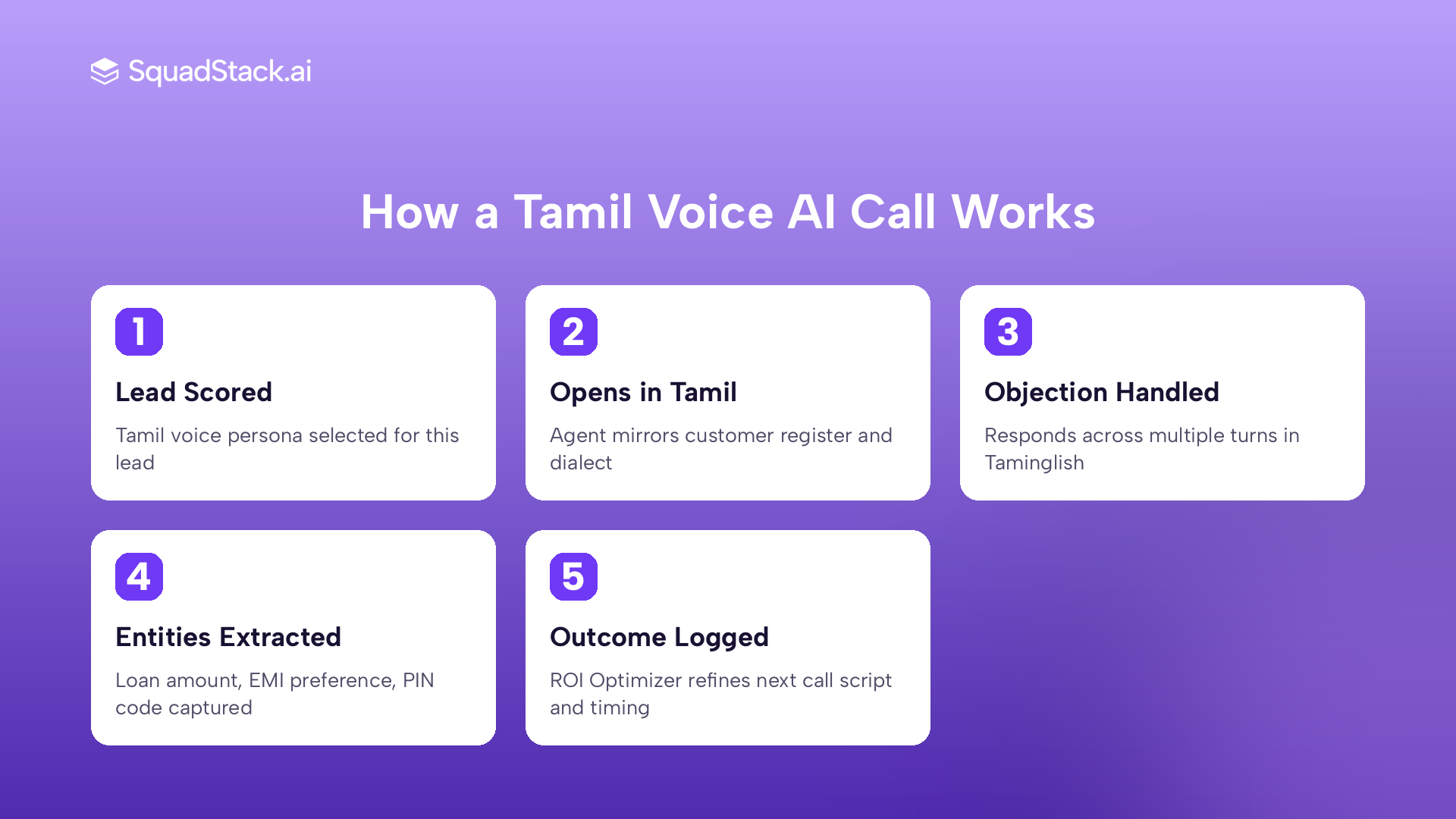
1. Pre-call preparation. The AI Lead Manager scores each lead, predicts the best call time, and selects a voice from a library of 1,000+ human-like voices cloned from top-performing Indian sales agents. For a Tamil-speaking lead, this means selecting a voice with the right accent and cadence for the region.
2. Opening and trust building. The agent opens in Tamil. If the customer responds in Tamil mixed with English, the agent follows. This is native code-switching: not a background translation step, but a model that handles Taminglish as a natural speech pattern.
3. Objection handling. Tamil-speaking customers have culturally specific ways of raising objections. "Konjam dipichutu pesalam" is not a flat refusal. "Vera company la kuzhiya premium irukku" is a price comparison objection. The agent catches these, responds to what was actually said, and works the objection across several turns.
4. Entity capture. Names, policy numbers, dates, PIN codes, and loan amounts in Tamil and English are extracted accurately. Arth, SquadStack's proprietary speech recognition model, is tuned for Indian entity handling on noisy 8kHz lines. When transcription confidence is low, the agent asks for confirmation rather than guessing.
5. Continuous learning. Every call outcome feeds back into the ROI Optimizer: calls that converted, calls that ended early, objections handled well, phrases that caused confusion. The agent running week four of a Tamil loan outreach campaign is measurably better than the one that ran week one.
For a deeper look at how the AI voice agent for sales automation works end-to-end, the platform page covers the full stack.
BFSI. Loan advisory, insurance renewal, and credit card activation calls require a customer to stay on the line long enough to hear the offer. A robotic-sounding agent produces early disconnections. SquadStack's Abruptly Disconnected Rate now runs at roughly 10%, inside the human-agent range, because naturalness is treated as a conversion variable.
For a Tamil-speaking customer being called about a personal loan, the difference between a formal corporate register and a natural conversational one can determine whether they stay on long enough to hear the interest rate. The AI voice agent for lead qualification page covers how qualification flows handle complex multi-turn conversations.
Healthcare. Appointment booking for a Tamil-speaking patient involves clinic names, doctor specialisations, timing preferences, and medical terms that mix Tamil and English. An agent that stumbles on these terms breaks the booking flow. Medibuddy uses SquadStack for doctor-appointment booking, and the platform handles exactly this kind of entity-dense conversation.
For healthcare-specific detail, see AI voice agent for healthcare.
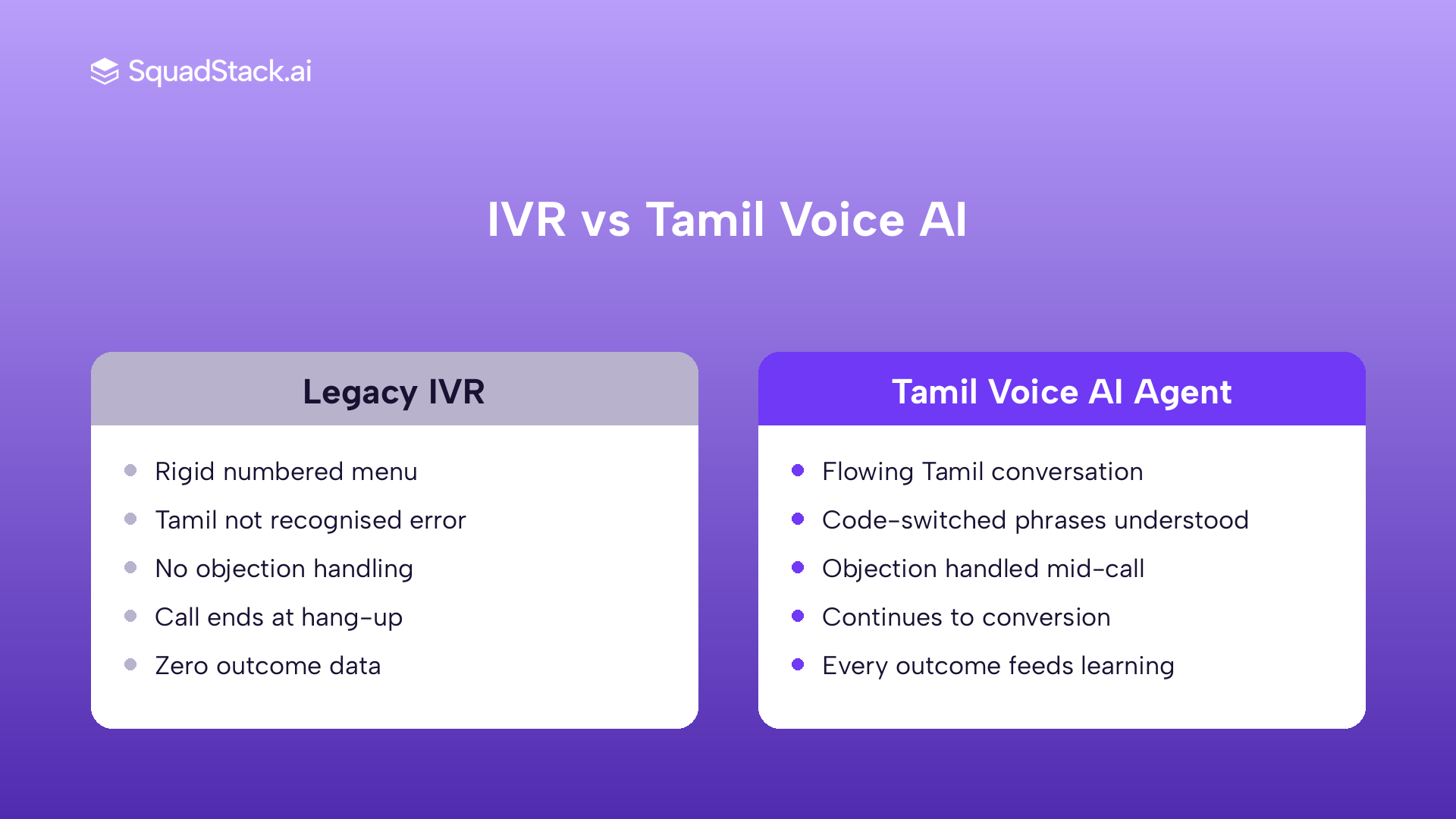
| Dimension | Legacy IVR | Tamil Voice AI Agent |
|---|---|---|
| Language handling | Pre-recorded Tamil audio clips; breaks on any input outside the menu | Full Tamil conversation with native code-switching; handles Taminglish naturally |
| Dialect coverage | Recorded in one accent, typically Chennai | Trained on conversations spanning Tamil Nadu regions; handles Madurai, Coimbatore, and other dialect patterns |
| Objection response | Routes to a hold queue or repeats the menu | Catches and handles objections live, across multiple turns |
| Register adaptation | Fixed formal script throughout | Matches the customer's register, formal or casual, as the call progresses |
| Long-call coherence | Resets after a menu timeout | Maintains context across a 20-minute insurance advisory call; no drift, no looping |
| Outcome learning | Static; same script forever | Every call outcome feeds the improvement loop; the agent gets sharper each week |
An IVR fails the moment a Tamil-speaking customer says something off-script. A voice AI agent treats that moment as the start of a real conversation.
1. What is the training data source for Tamil? Generic models train on text corpora or broadcast audio. Neither sounds like a real sales call. Ask whether the model was trained on actual telephony conversations in Tamil, at 8kHz, with background noise, interruptions, and code-switching.
2. How does the model handle dialect variation? Ask for demos with audio from Madurai, Coimbatore, and Chennai. Differences in performance across regions will be visible immediately.
3. What is the actual word error rate on Tamil telephony audio? A WER number on clean studio audio means nothing for a contact centre. Ask for the benchmark on real noisy call-centre recordings.
4. How does the platform handle TRAI and DPDP compliance? Outbound Tamil calling is subject to DND scrubbing, 140-series number requirements, and the 9:30 AM to 8:30 PM calling window. The platform should enforce these at the system level.
5. Can the vendor show conversion outcomes, not just connectivity? Connectivity tells you calls are being made. Conversion tells you they are working. Ask for outcome data from comparable industry verticals.
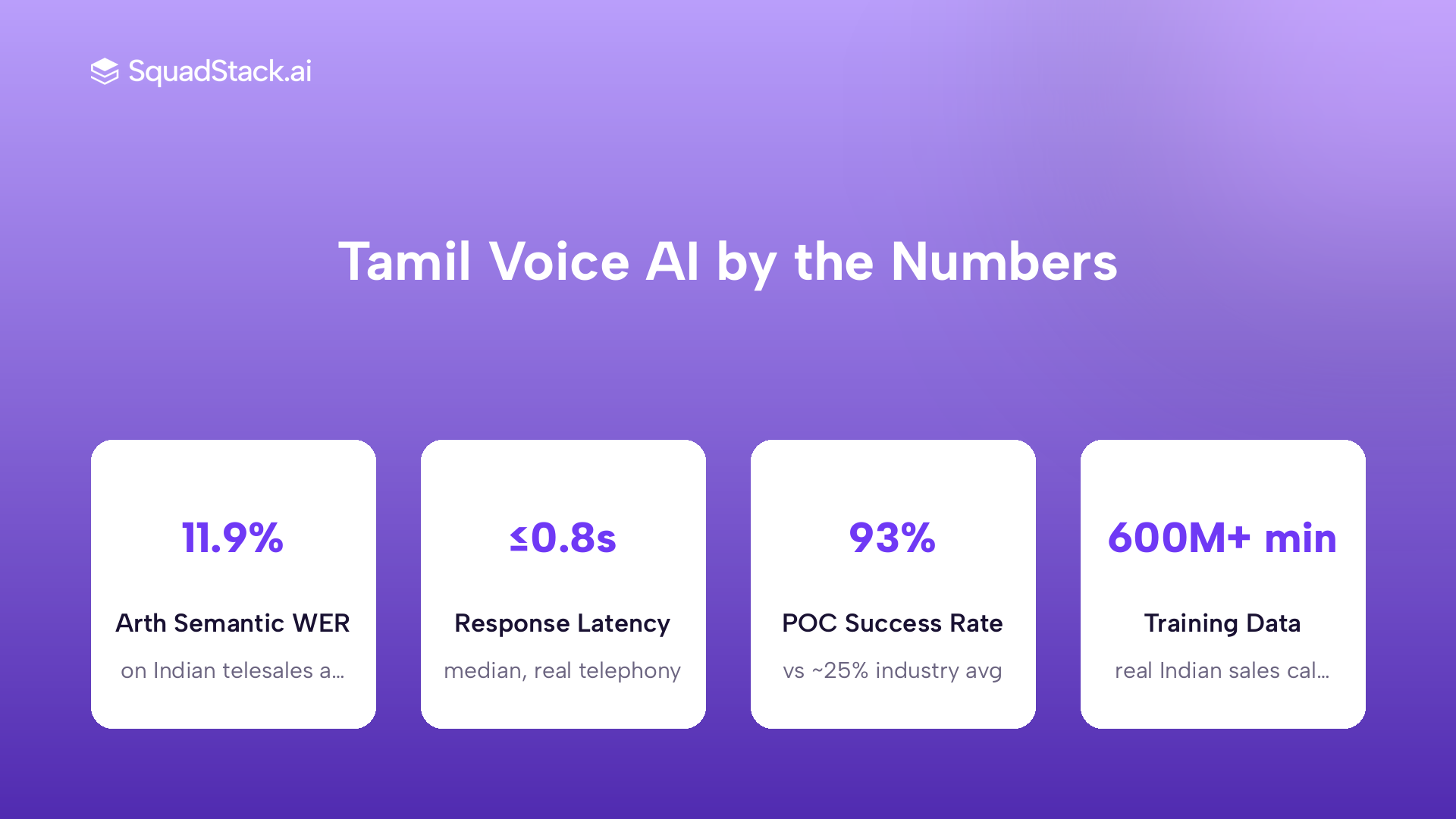
SquadStack's edge on Tamil comes from one source: real data.
Arth is trained on 600M+ minutes of actual Indian contact centre conversations, including Tamil in its real form: noisy telephone lines, code-switching, regional dialects, and the vocabulary of BFSI and healthcare sales. Public datasets and YouTube audio do not capture what a Coimbatore customer sounds like asking about a gold loan on a 2G connection.
The Arth benchmark on real Indian telesales audio shows a semantic WER of 11.9%, within 0.9 points of the best commercial streaming STT, measured on the same noisy telephony conditions Tamil campaigns actually run in.
Dialogue for Tamil campaigns is hand-built by native speakers, not generated by a language model. Every filler word, reformulator, and backchannel phrase is sourced from transcripts of top-performing Tamil sales agents and tested against actual 8kHz telephone lines.
The redBus multilingual campaign shows the external proof: engagement ran 75% to 85% above the human baseline, feedback captured was 2 to 4 times the human baseline, and cost per outcome came in 50% to 79% lower than human agents on vernacular campaigns.
A leading general insurer running renewal outreach achieved 85% connectivity and 60% lower renewal cost on vernacular campaigns. (https://www.squadstack.ai/case-study/success-story-with-leading-general-insurer)
The platform runs at 50 lakh+ calls daily across 60+ large consumer brands, fully TRAI and DPDP compliant, with ISO 27001, ISO 27701, and SOC 2 Type II certification.
For a broader picture of how hyper-personalisation drives sales outcomes, the linked piece covers the full framework.
Tamil is not a small market. The Tamil-speaking consumer base across BFSI and healthcare represents a large share of India's most active borrowers, policyholders, and patients. Calling them with a generic multilingual agent is not neutral. It actively signals that they are an afterthought.
A voice AI built on real Tamil sales data, with dialect coverage and native code-switching, closes that gap. It connects more leads, keeps them on the line longer, and converts more of them.
Book a demo with SquadStack to see a live Tamil campaign and the Arth benchmark results for your specific use case.
Which is the best Tamil voice AI agent for Indian BFSI and healthcare businesses?
SquadStack offers a Tamil voice AI agent India businesses in BFSI and healthcare can deploy at scale, trained on 600M+ minutes of real Indian sales conversations including Tamil telephony audio. It handles dialect variation, native code-switching with English, and formal-to-casual register shifts that generic multilingual models miss.
How does a Tamil voice AI agent handle code-switching between Tamil and English?
SquadStack's models handle Taminglish natively, not as a translation step. When a customer says "Enna interest rate?" mid-conversation, the agent processes and responds to the full sentence without pausing or misrecognising the English words. This is trained behaviour from real code-switched sales calls, not a rule-based overlay.
What is the difference between Chennai Tamil and Coimbatore Tamil for a voice AI model?
The two dialects differ in vocabulary, intonation, and the phrasing of common objections and confirmations. An agent trained only on Chennai-variant audio will misread or miss objections from customers in other regions. SquadStack's training corpus covers Tamil sales conversations from across Tamil Nadu, giving the model exposure to these regional patterns.
Can a Tamil voice AI agent handle long advisory calls, like a 20-minute insurance or loan call?
Yes. SquadStack's state management layer keeps the context payload roughly constant across a long call, so the agent does not drift, loop, or forget details the customer shared early in the conversation. This is specifically tested on the multi-turn advisory calls that insurance and lending use cases require.
How does SquadStack ensure TRAI and DPDP compliance for Tamil outbound calling?
The platform enforces the 9:30 AM to 8:30 PM calling window as a system-level hard block, scrubs lead lists against the TRAI DND registry, and uses only 140-series numbers for cold outbound. All models are hosted in India, compliant with the DPDP Act. Consent gating and opt-out handling run in the conversation layer itself.
What accuracy does SquadStack's speech model achieve on Tamil telephony audio?
Arth v1 achieves a semantic WER of 11.9% on real Indian telesales audio measured on noisy 8kHz telephone lines, within 0.9 points of the best commercial streaming STT available. This benchmark is on production telephony conditions, not clean studio recordings.
How does a Tamil voice AI agent compare to a traditional BPO for outbound sales?
A Tamil-trained voice AI agent reaches up to 90% of leads at a lead-level contact rate, versus a 40% to 60% norm for traditional outbound. It runs continuously, handles interruptions and objections in real time, and improves with every call. Cost per outcome has come in 50% to 79% lower than human agents on comparable vernacular campaigns.
Can SquadStack add more Tamil dialect coverage or a specific regional voice on demand?
Yes. The voice library contains 1,000+ human-like voices cloned from real Indian sales agents. Specific accent profiles and dialect variants can be configured per campaign. SquadStack's conversational AI designers hand-build Tamil dialogue sourced and validated by native speakers for each deployment.
How long does it take to go live with a Tamil voice AI campaign?
Most enterprise campaigns go live in two to three weeks. The build includes training the agent on the client's real call recordings, knowledge base, and FAQs, followed by UAT before the first live call. The dedicated squad handles the build end to end. No client-side AI engineers are needed.
Is Tamil voice AI suitable for healthcare appointment booking, or only for BFSI?
Tamil voice AI works well for healthcare appointment booking, which is entity-heavy (doctor names, clinic locations, available slots) and requires the agent to stay coherent across rescheduling and confirmation turns. Medibuddy uses SquadStack for doctor-appointment booking. See AI voice agent for healthcare for vertical-specific detail.