.svg)





Hyper-Personalised Outbound Call Scripts Using Customer Lifecycle Data
October 6, 2026
|

13 min read
Telugu is India's fourth-most spoken language, with tens of millions of native speakers across Andhra Pradesh and Telangana. Yet most businesses calling...
TL;DR: A Telugu voice AI agent customer calls solution lets businesses reach Andhra Pradesh and Telangana customers in their own language, with the right dialect, vocabulary, and tone. Generic AI bots trained on Hindi or English data fail in Telugu because they sound foreign to native speakers. Getting it right means training on real Telugu conversational audio, not just adding a translation layer on top.
Key Takeaways:
Telugu is India's fourth-most spoken language, with tens of millions of native speakers across Andhra Pradesh and Telangana. Yet most businesses calling these customers still use Hindi-heavy IVR systems or generic English bots loosely translated. The result is predictable: customers hang up within seconds, call containment drops, and conversion suffers.
The problem is not a lack of Telugu text-to-speech. Many platforms can produce words in Telugu. The real challenge is sounding native, not just correct. A customer in Nellore and one in Hyderabad speak differently. An elderly policyholder expects different respect markers than a 25-year-old salaried professional. And when someone asks a live question mid-call, the AI has to handle it naturally, not fall back to a menu.
This post covers what it takes to deploy Telugu voice AI agents that actually work at scale for customer calls across both states.
A Telugu voice AI agent for customer calls is a software-based voice agent that conducts outbound or inbound phone calls in Telugu, handling the full conversation without a human on the other end. It listens in real time, understands what the customer said, decides the right response, and speaks back, all within under a second.
This is not a prerecorded IVR. The agent responds to what the customer actually says. It can answer questions, handle objections, capture structured data like an EMI preference or a preferred appointment slot, and book follow-up actions.
For it to work in Telugu, three things have to be right at once: speech recognition must understand Telugu-accented speech on a noisy phone line; the language model must know the right response in context; and the voice output must sound like a real Telugu speaker, not a newsreader.
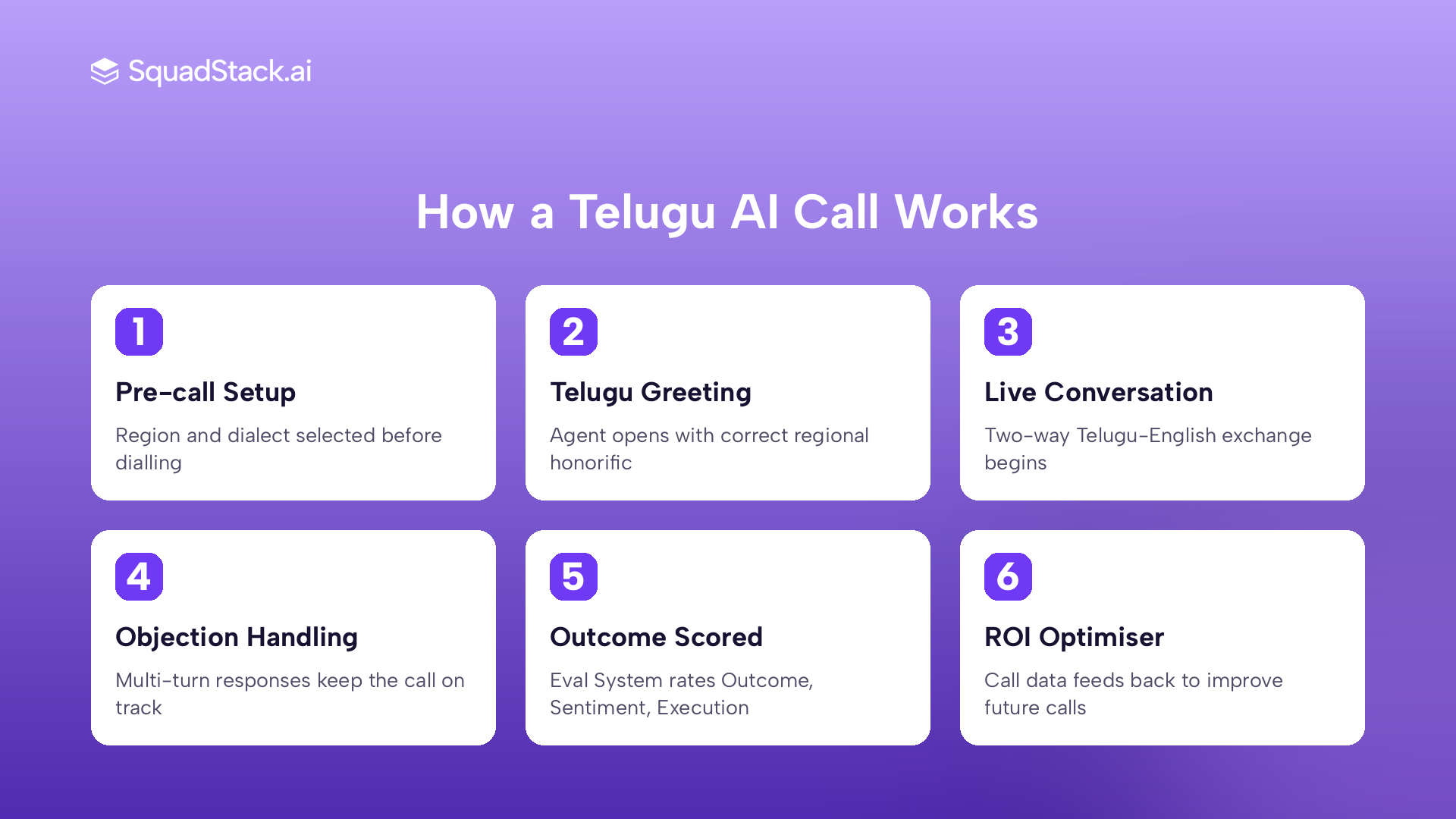
The call flow has five stages:
1. Pre-call personalisation. Before the call dials out, the system pulls the lead's language preference, region (Andhra or Telangana), prior interaction history, and product context. This determines the agent persona, dialect register, and opening line.
2. Greeting and identification. The agent opens in Telugu using the appropriate honorific: a respectful suffix for older customers, a more casual but polite register for younger urban ones. The greeting also includes TRAI-required AI disclosure, configurable per campaign.
3. Two-way conversation. The customer responds freely. The Arth STT layer transcribes Telugu speech, including code-switched English terms like "EMI", "policy", "premium", and "doctor". The sales LLM processes the intent and generates the correct next response. The voice output uses one of SquadStack's 1,000+ human-like voices, cloned from real top-performing Indian sales agents.
4. Objection and question handling. If the customer pushes back on a premium amount or asks about coverage, the agent responds across multiple turns, not with a single canned line. In collections use cases, it handles payment-timing objections with contextual responses.
5. Continuous learning. Every call feeds back into the ROI Optimizer. Outcomes, sentiment, and execution quality are scored via the Eval System. Script variants and voice choices improve with every campaign. Over time, the system learns which openings work better in Vijayawada versus Karimnagar, and adjusts accordingly.
For a deeper look at how the underlying AI voice agent platform works, including lead scoring and campaign orchestration, the pillar page covers the full stack.
Insurance renewal calls are high-value and time-sensitive. A customer who misses a renewal window because a bot sounded robotic is a lost premium. In Telugu-speaking markets, the issue is compounded by vocabulary mismatches: terms like "policy navikarana" or "claim settlement" need to land naturally, not as direct transliterations.
A voice AI agent trained on real Telugu insurance call audio can handle the renewal pitch, address objections about premium increases, and confirm payment intent in one call. The auto insurance renewal case study from a leading general insurer shows what this delivers in practice: 85% connectivity and 60% lower renewal cost.
Collections calls in Telugu require precision. A call that sounds accusatory or robotic leads to an immediate hang-up or escalation. The right voice, register (firm but respectful), and ability to respond to the customer's stated reason for delay all require a conversational model, not a scripted one.
Early-delinquency buckets respond far better to natural, empathetic conversation than to rigid automated messages. Voice AI in this context can handle EMI rescheduling discussions, capture payment commitment dates, and trigger a follow-up call at exactly the agreed time.
Healthcare calls are short but critical. A missed reminder or failed booking has direct revenue and health impact. For patients in Andhra Pradesh and Telangana, receiving a reminder in Telugu from an agent that sounds local significantly increases callback and confirmation rates.
The agent can confirm appointment details, handle rescheduling on the spot, and capture updated contact information without routing to a human. For AI voice agents in healthcare, language-native conversations are the single biggest driver of patient response rates.
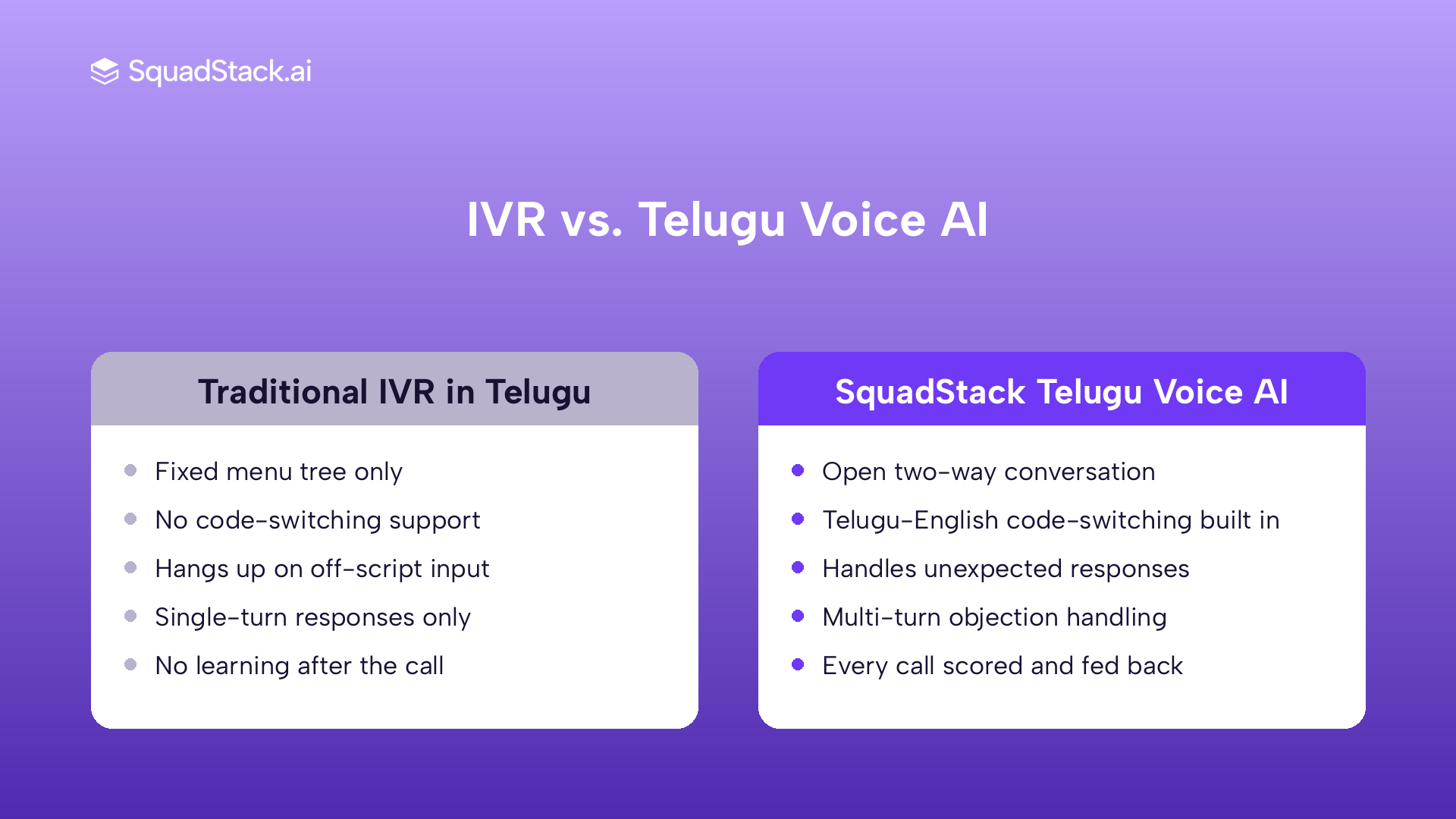
| Dimension | Traditional IVR | Telugu Voice AI Agent |
|---|---|---|
| Language handling | Pre-recorded Telugu prompts, no understanding | Live speech recognition and generation in Telugu |
| Dialect sensitivity | None: same recording for Andhra and Telangana | Configurable by region, honorific, and vocabulary register |
| Customer who speaks off-script | "I didn't understand. Press 1 for..." | Understands the actual intent and responds |
| Code-switching | Breaks when English terms like "EMI" appear mid-sentence | Handles mixed Telugu-English natively |
| Collections call with a reason objection | Can only accept or reject payment; cannot discuss | Captures the reason, offers a callback date, logs the commitment |
| Memory across calls | None; every call starts from zero | Persistent memory: knows the customer's prior interaction, skips repeated questions |
| Response latency | Instant (pre-recorded) | Median 0.8 seconds or less; sub-second, conversational |
The IVR's fundamental problem in complex outbound use cases is not audio quality. It is the inability to have a real exchange. A customer in Guntur who says "nenu ee nalugatariki chesukovadam kuda kaadu" ("I cannot even do it by the 4th") is giving the collections agent an opening to offer a solution. An IVR just hears an unexpected input and loops.
Real Telugu training data. Ask whether the STT model was trained on actual Telugu telephony audio: 8kHz, noisy, code-switched, live call conditions. Models trained on clean studio recordings or YouTube audio will fail on a real call from a village in East Godavari.
Dialect and register control. Can the agent use different vocabulary or honorifics for different customer segments? Andhra and Telangana Telugu are genuinely different in idiom and phrasing. A platform that treats them as one language will have lower engagement in at least one state.
Native code-switching. Ask for a live demo where the customer switches mid-sentence from Telugu to English. If the agent stumbles, that is a product gap, not a configuration issue.
Sub-second latency. Anything above 1.5 seconds of silence before the agent responds will feel broken. Aim for verified median latency under 1 second.
TRAI and DPDP compliance. All automated outbound calling must comply with TRAI calling-window rules (9:30 AM to 8:30 PM), DND scrubbing, and AI disclosure. For healthcare and collections, DPDP Act data residency requirements apply.
Continuous improvement loop. A platform that does not learn from call outcomes will plateau. Look for native A/B testing, outcome labelling, and a closed feedback loop between QA and script improvement.
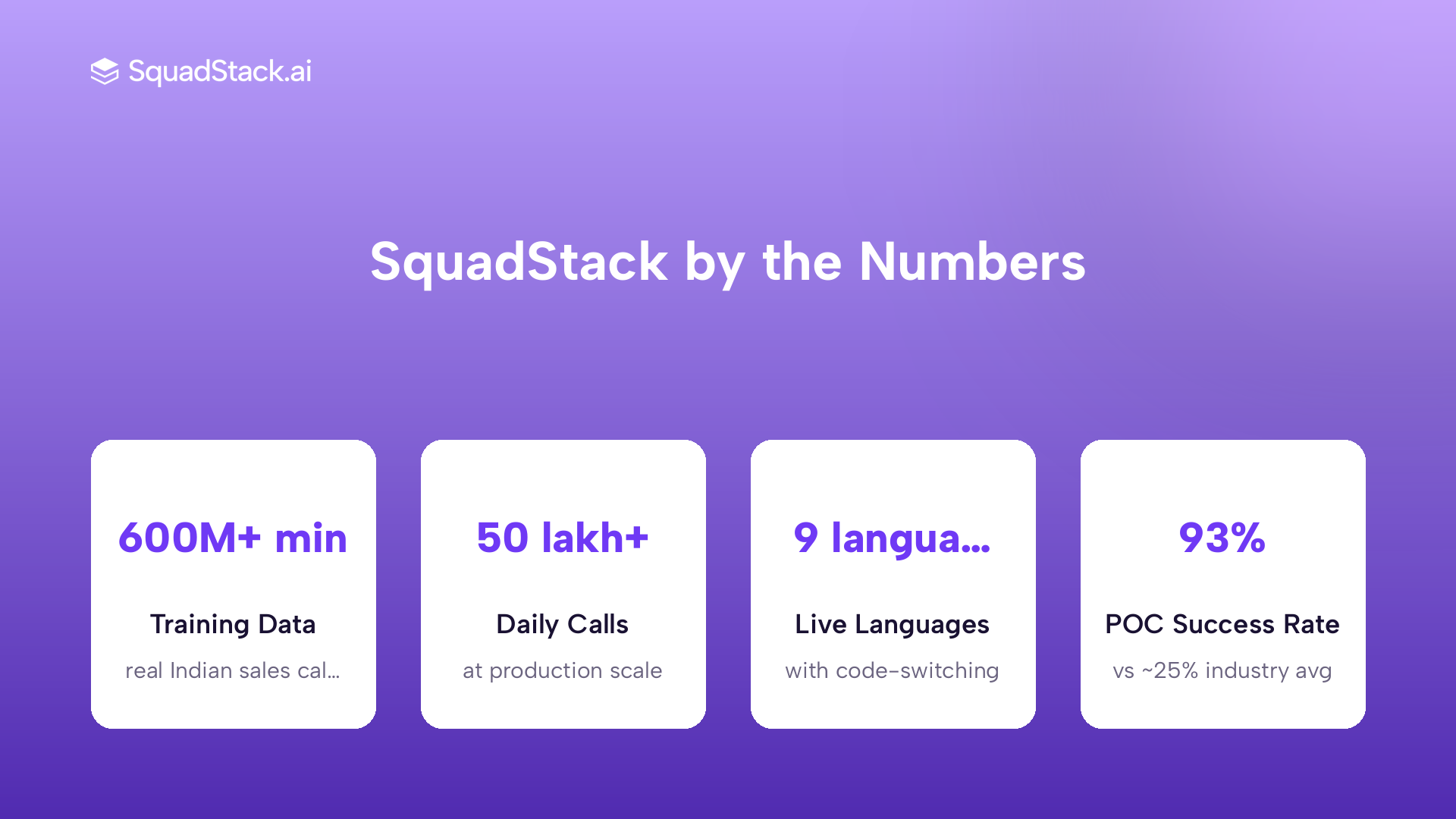
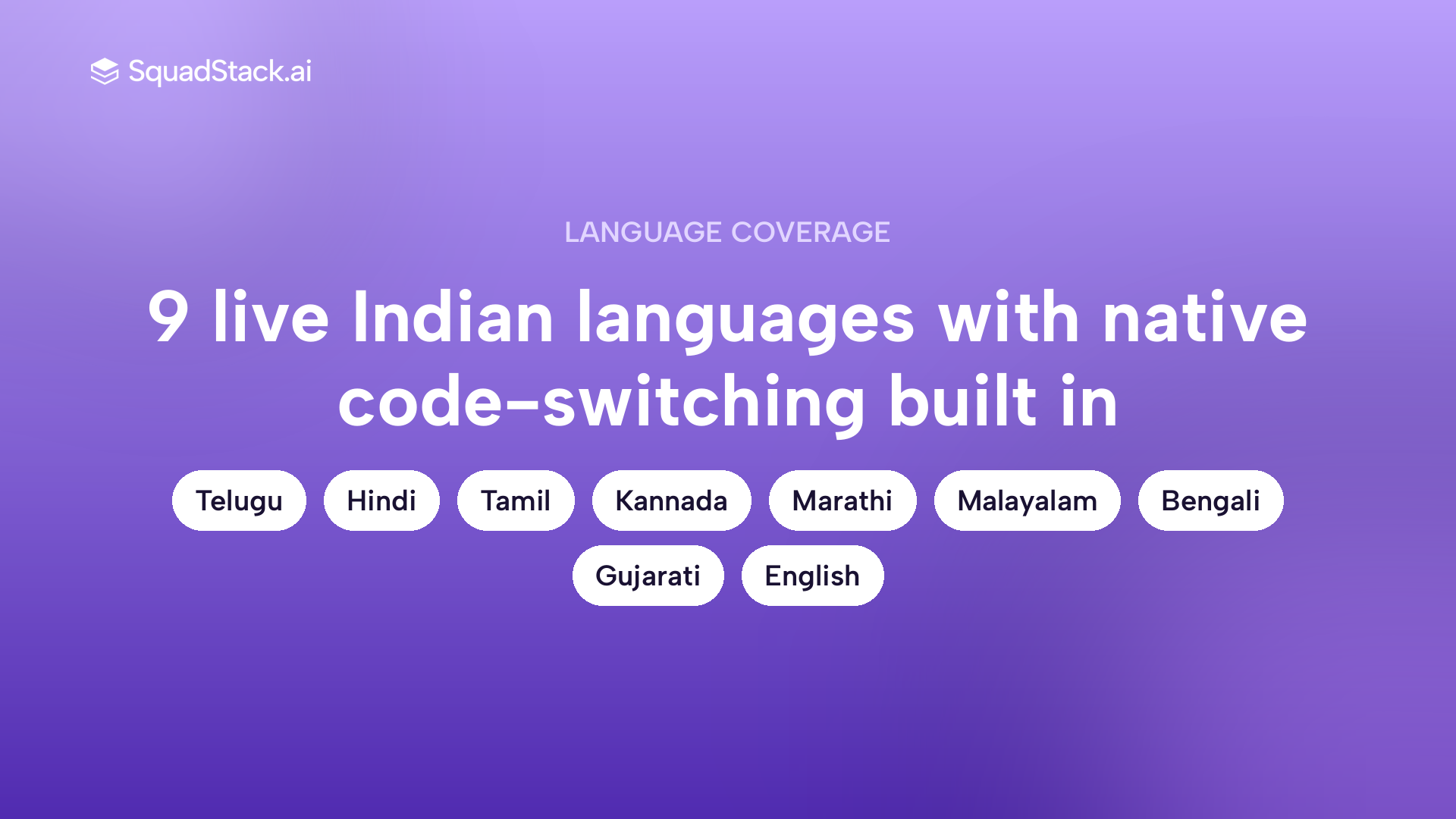
SquadStack's proprietary speech model, Arth, is trained on 600M+ minutes of real Indian sales conversations spanning 85%+ of Indian PIN codes. Telugu is one of nine live languages with native code-switching built directly into the models, not added as a translation layer. The model handles Tenglish (Telugu-English code-switching) the same way Hinglish is handled: because that is how people actually speak on sales calls.
On a hard benchmark of real Indian telesales audio, Arth v1 achieves a semantic word error rate of 11.9%, within 0.9 points of the best commercial streaming STT available. Unlike third-party models trained on public datasets, Arth is tuned for noisy 8kHz telephone lines with crosstalk and packet loss, the exact conditions of a real call to a customer in Tirupati or Warangal.
Every voice in the library was cloned from real, top-performing Indian sales agents, not read-speech. Each voice is validated per language, since a filler phrase that sounds natural on one voice can sound robotic on another.
The Eval System scores every Telugu call on three levels: Outcome (did the renewal get confirmed?), Sentiment (how did the conversation land?), and Execution (did the agent follow the compliance flow?). This is dual-layer QA, with both AI audit and human review, running on every campaign.
SquadStack currently runs 50 lakh+ calls daily across 60+ large consumer brands in India across insurance, lending, healthcare, and e-commerce. The leading general insurer case study is the closest published proof in this cluster: 85% connectivity and 60% lower renewal cost.
For teams evaluating how to improve AI-driven lead scoring alongside voice quality, or how hyper-personalisation at the campaign level drives conversion, SquadStack's platform handles both as part of the same stack.
If your teams are running outbound renewal, collections, or healthcare reminder campaigns in Andhra Pradesh or Telangana with generic Hindi or English bots, the drop-off you are seeing is a language and dialect problem, not a dialing problem. A properly trained Telugu voice AI agent customer calls solution will close that gap directly.
Book a demo to see a live Telugu call, including code-switching and objection handling, against your own use case.
Which is the best Telugu voice AI agent for customer calls in India?
The best options are those with STT models trained specifically on real Telugu telephony audio, not clean-room recordings, and with native support for Telugu-English code-switching. SquadStack's Arth model is trained on 600M+ minutes of real Indian sales conversations and supports Telugu as one of nine live languages with native code-switching.
Can a Telugu voice AI agent handle both Andhra and Telangana dialects?
Yes, if the platform is configured for dialect sensitivity. Andhra and Telangana Telugu differ in vocabulary, idiom, and preferred honorifics. A good platform allows the agent persona, register, and vocabulary to be tuned per customer segment, not just per language.
What is the difference between an AI voice bot in Telugu and an IVR in Telugu?
An IVR plays pre-recorded Telugu prompts and routes calls through menus. A Telugu voice AI agent understands free-form speech, responds to what the customer actually says, handles objections, and holds a multi-turn conversation. It can adjust tone, capture data mid-call, and remember context from prior calls.
How does a Telugu voice AI agent handle EMI and insurance terms mid-conversation?
Native code-switching is key. Telugu speakers frequently mix English financial terms like "EMI", "premium", "policy", and "due date" into otherwise Telugu sentences. A well-trained model recognises these mid-sentence without treating them as errors and responds in the same natural register.
Is automated Telugu voice AI calling compliant with TRAI and the DPDP Act?
It can be, if the platform is built for compliance. SquadStack enforces TRAI calling windows as a hard system block (9:30 AM to 8:30 PM), scrubs DND lists before every campaign, and handles AI disclosure within the conversation. All models are hosted in India to satisfy DPDP Act data residency requirements.
What forms of address should a Telugu AI agent use for older versus younger customers?
For older customers, respectful address forms using "garu" as a suffix and formal second-person pronouns are the norm. For younger, urban customers, the register can be more direct while remaining polite. Getting this wrong, for example using an overly casual form with a 60-year-old policyholder, signals that the agent does not know the customer.
How does SquadStack's AI voice agent for sales calls learn and improve over Telugu campaigns?
Every call outcome is scored via the Eval System (Outcome, Sentiment, Execution). The ROI Optimizer runs A/B tests on voice, script, and cadence in the background, and the Lift layer proposes precise script edits based on what near-misses and early drop-offs reveal. Changes go through human review before they reach live traffic.
Can Telugu voice AI agents handle collections calls without sounding aggressive?
Yes, and tone control is one of the most important capabilities for collections. The agent can be configured for a firm but respectful register, respond contextually to customer reasons for delay (medical expense, pending salary), and offer structured next steps like a rescheduled payment date. AI voice agents for sales calls in sensitive use cases like collections are designed to match tone to context, not apply a uniform script.
Does a Telugu voice AI agent work for inbound calls too?
Yes. The same conversational stack handles inbound and outbound. For healthcare appointment booking and insurance claim intake, inbound Telugu calls are a natural fit, since the customer initiates and the agent needs to understand free-form queries from the start.
How long does it take to go live with a Telugu voice AI campaign?
Most enterprise campaigns go live in two to three weeks. The setup involves training the agent on the client's real call recordings, knowledge base, and FAQs, not a generic template. SquadStack's 93% POC success rate against an industry average of around 25% reflects that the build time is used to validate quality before launch, not after.