Customers no longer accept being placed on hold while an agent searches through a static knowledge base. They expect instant answers, zero repetition between channels, and service that recognises their call history. This change in expectations is the main reason why AI contact centre-as-a-service platforms are being adopted so quickly by companies in India.
According to Salesforce research, nearly 90 percent of customers rate the experience a company provides as equally important as its products or services. For Indian businesses managing customer interactions at scale, that number represents a massive operational challenge. The AI contact centre-as-a-service platform that India businesses are deploying in 2026, however, is built for exactly this purpose. India hosts the world's largest business process outsourcing industry and serves as the customer support backbone for hundreds of global brands. Rising labour costs, low employee turnover, and the need to show clear returns have pushed Indian BPOs and contact centres to adopt AI.
This guide covers every dimension of the AI contact centre-as-a-service platform in India in 2026. You will find detailed explanations of how these platforms work, which capabilities matter most for Indian operations, how leading vendors compare, and exactly what criteria to use when evaluating platforms for your specific context.
What's New in AI CCaaS for 2026
The AI contact centre-as-a-service platform market has moved faster this year than in any previous year. Here are the most significant developments shaping the space right now.
- Leading platforms now offer AI agents that autonomously complete end-to-end customer requests without human handoff.
- The Digital Personal Data Protection Act (DPDP) in India is actively improving vendor compliance requirements.
- Multilingual NLP now covers all 22 scheduled Indian languages on at least three major platforms, compared to just Hindi and English support two years ago.
- CMP Research evaluated 22 automated QA and quality management solution providers in its Q1 2026 Prism Report.
- SquadStack AI contact center voice agent became the first to pass the Turing test in the world. Link
What Is an AI Contact Centre as a Service Platform?
An AI contact centre-as-a-service platform is a cloud-native software solution that embeds artificial intelligence directly into the operational core of a contact center. It includes call routing, self-service, agent support, quality management, workforce optimisation, and analytics. The "as a service" model means the software runs on vendor-managed cloud infrastructure.
It is accessed through a browser or API, and no on-premise servers are required. The "AI" layer is what makes modern CCaaS fundamentally different from older cloud contact center software. The second function gives agents access to generative AI tools for faster, more accurate responses during live conversations. Together, these functions transform a contact center from a reactive cost center into a proactive customer experience engine.
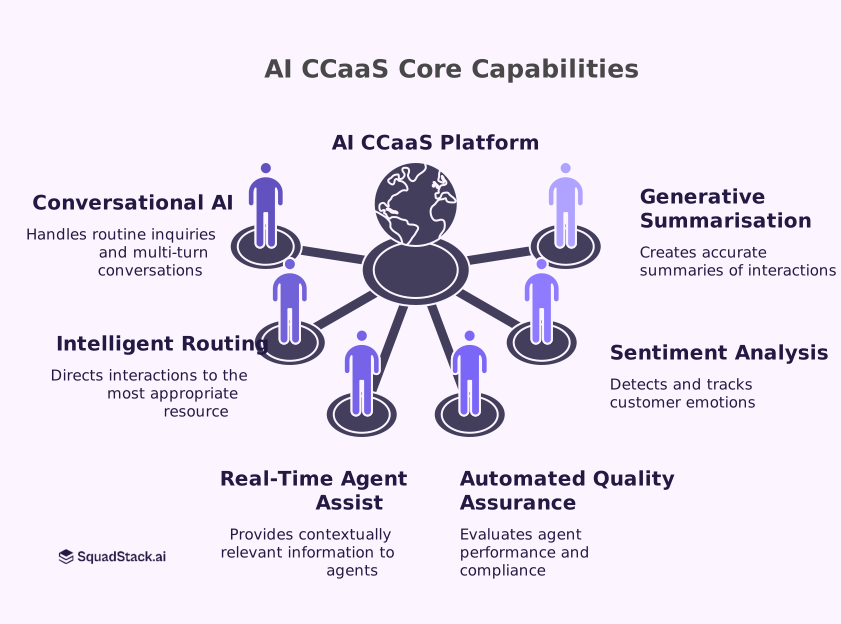
At its foundation, an AI contact center as a service platform in 2026 typically includes these components:
- Conversational AI for voice and digital self-service
- Intelligent interaction routing based on intent and context
- Real-time agent assistance with live suggestions and knowledge surfacing
- Automated quality assurance scoring across 100% of interactions
- Sentiment analysis and emotion detection throughout conversations
- Generative AI for automatic call summarisation and categorisation
- Workforce management with AI-driven scheduling and forecasting
- Analytics and reporting with customizable dashboards
- Integration with CRM, ERP, and workforce management systems

How AI CCaaS Differs from Traditional Contact Center Software
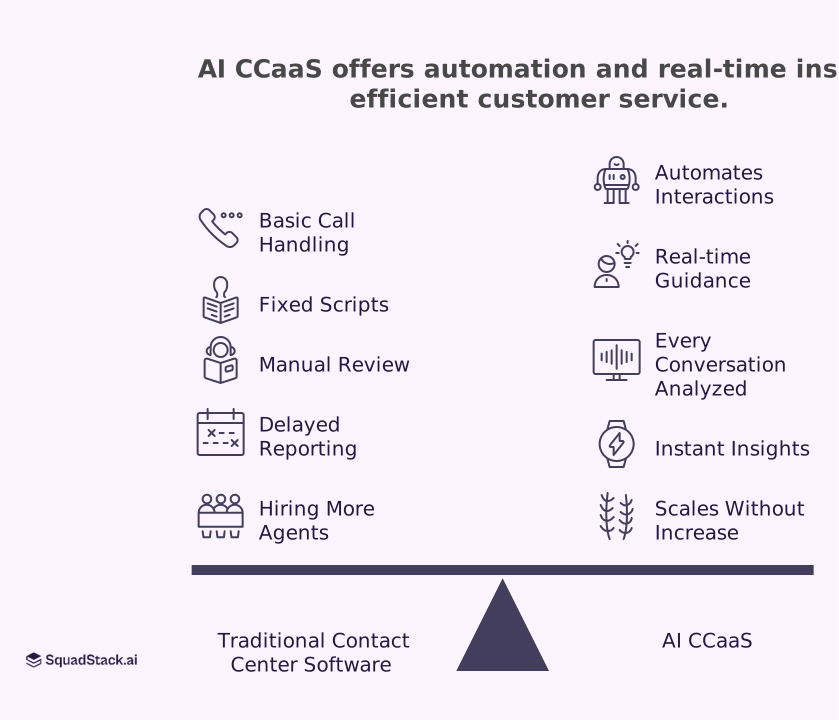
The difference between traditional contact center software and AI CCaaS is clear when you compare how they operate day to day. While legacy systems focus on basic call handling and rely heavily on manual effort, AI CCaaS brings automation, real-time insights, and scalable operations. The table below highlights these key differences.
What AI CCaaS Is Built For
The AI contact centre-as-a-service platform is built for intelligent, continuous service delivery. Every interaction feeds the AI learning loop. Decisions about routing, agent support, and escalation are made in real time based on intent detection, sentiment signals, and interaction history. Scaling happens through cloud capacity, not headcount.
Here is a clear comparison across five key dimensions:
Quality Assurance: Traditional contact centres manually review 1-2% of interactions. AI CCaaS platforms automatically evaluate 100% of interactions, flagging compliance risks and coaching opportunities in real time.
Agent Support: Traditional agents search knowledge bases manually and sometimes put customers on hold to find answers. AI CCaaS agents receive real-time prompts, suggested responses, and compliance reminders proactively on their screens.
Post-Call Work: Traditional agents spend 3 to 8 minutes after each call writing notes and updating CRM records. AI CCaaS platforms generate accurate summaries and categories within seconds, cutting after-call work to near zero.
Scalability: Traditional scaling requires hiring, training, and physical infrastructure. AI CCaaS scaling happens in hours through cloud capacity adjustments.
Customer Insights: Traditional systems extract insights from post-call surveys with low response rates. AI CCaaS platforms extract insights directly from 100% of conversation data in near real time.
Why the Indian Market Needs AI CCaaS in 2026
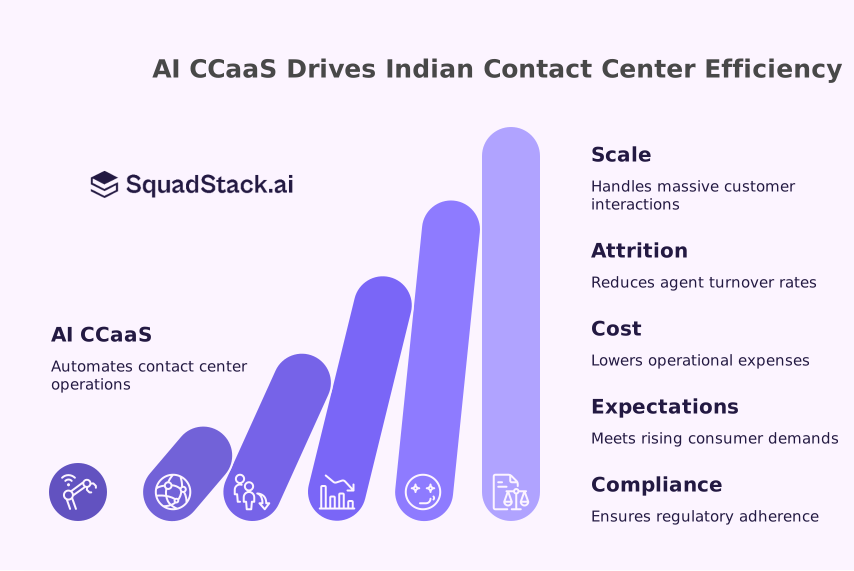
India’s contact center industry is facing a mix of challenges that are hard to solve with traditional systems. They are happening at the same time and affecting operations, costs, and customer experience. Because of this, adopting AI CCaaS is no longer optional. It is becoming necessary to run efficiently and stay competitive.
The Scale and Complexity of Indian Operations
India's BPO sector employs millions of agents and handles interactions for clients across North America, Europe, Southeast Asia, and domestic markets simultaneously. A single large BPO might process 500,000 customer interactions on a busy day. Manually reviewing even 5% of those interactions would require hundreds of QA staff working around the clock. An AI contact centre-as-a-service platform, India businesses deploy solutions that solve this through automation. It evaluates every single interaction.
Agent Attrition Remains a Critical Problem
India's contact centre industry has one of the highest agent attrition rates globally, often exceeding 30-40% annually in certain segments. The reasons are well documented: repetitive work, high stress from difficult calls, and limited visibility into career progression. AI CCaaS platforms address all three of these root causes. Automation handles the most repetitive tasks. Real-time AI assistance reduces stress by eliminating the panic of not knowing an answer during a live call. Gamification, recognition, and transparent performance dashboards give agents clearer visibility into their progress and achievements.
The Cost Pressure on Indian Contact Centers
IBM data indicates that every customer service call costs several dollars in labour and resources. For an Indian contact center handling five million calls per month, a 10% reduction in average handle time through AI assistance translates into millions of dollars in annual savings. The financial case for deploying an AI contact centre-as-a-service platform in India does not require complex modelling. The savings are direct and measurable.
Domestic Consumer Expectations Are Rising Fast
Indian consumers are among the most digitally active in the world. WhatsApp, Instagram, and mobile apps are primary service channels for millions of customers. They expect support on the channel they choose, with context preserved if they switch to a different channel. Meeting this expectation requires an AI CCaaS platform with genuine omnichannel architecture, not a collection of disconnected tools.
Regulatory and Compliance Pressure
India's Digital Personal Data Protection Act creates new obligations for the collection, storage, and processing of customer data. The banking, financial services, and healthcare sectors face additional sector-specific regulations from the RBI, SEBI, IRDAI, and the Ministry of Health. AI CCaaS platforms with built-in compliance monitoring and automated documentation are no longer optional for regulated Indian enterprises.
Core Capabilities Every AI CCaaS Platform Must Have
Evaluating platforms against a consistent capability framework is the most reliable way to objectively compare vendors. Here are the capabilities that matter most.
Conversational AI and Virtual Agents
Virtual agents which are powered by NLP handle routine inquiries without agent involvement. In 2026, leading virtual agents will understand multi-turn conversations, detect customer intent beyond simple keywords, and complete end-to-end transactions. For Indian deployments, multilingual support across Hindi, Tamil, Telugu, Marathi, Bengali, Kannada, and other regional languages is a non-negotiable requirement for consumer-facing operations.
Intelligent Routing
AI-powered routing directs every inbound interaction to the most appropriate resource in real time. Routing decisions consider customer intent, interaction history, urgency level, agent skill sets, and current availability. Intelligent routing is the difference between a customer reaching a skilled, prepared agent on the first attempt and getting transferred twice before finding the right person.
Real-Time Agent Assist
This capability delivers contextually relevant information to agents during live interactions. The AI monitors the conversation using NLP, detects the topics being discussed, and proactively surfaces relevant knowledge articles, answer suggestions, and compliance reminders on the agent's screen. Agents no longer search manually. Relevant information arrives before they need it.
Automated Quality Assurance
Traditional QA covers 1-2% of interactions. Automated QA covers 100 per cent. The AI evaluates agent performance against defined rubrics, detects compliance risks, identifies sentiment shifts, and flags interactions that need supervisor attention. For Indian BPOs managing quality across multiple client programs simultaneously, 100% automated QA coverage is the single most transformative capability available.
Sentiment Analysis
Advanced sentiment analysis goes beyond positive or negative labelling. Leading platforms detect specific emotions, including frustration, disappointment, appreciation, urgency, and confusion, at specific moments in a conversation. They track how sentiment evolves across the interaction and generate an overall satisfaction score. Supervisors receive real-time alerts when sentiment deteriorates during a live call, enabling immediate intervention.
Generative Summarisation and Categorisation
After each interaction, generative AI produces an accurate summary of topics discussed, actions taken, and follow-up requirements. The interaction is automatically categorised. CRM records are updated. After-call work drops from several minutes to seconds. For high-volume contact centres, this capability alone generates measurable cost savings within weeks of deployment.
Voice of the Customer Intelligence
AI CCaaS platforms extract customer satisfaction and experience insights directly from conversation data. This eliminates reliance on low-response-rate post-call surveys. Patterns in call drivers, emerging complaints, product feedback, and missed upsell opportunities become visible across 100% of interactions, rather than the 2-5% captured in surveys.
Workforce Management and Optimisation
AI-driven workforce management forecasts demand using historical patterns and real-time signals. It generates optimised agent schedules, monitors schedule adherence, and automatically makes intraday adjustments when demand deviates from the forecast. For Indian contact centers serving global clients across multiple time zones, precise WFM directly impacts service levels and client satisfaction.
Omnichannel Architecture
A genuine omnichannel architecture preserves full conversation context as customers move between channels. A customer who starts on WhatsApp and escalates to voice should not need to repeat any information. Context transfers completely and instantly. This requires a unified data model across channels, not separate modules that share data through periodic syncs.
Analytics, Reporting, and Dashboards
Real-time analytics give supervisors and managers actionable visibility into contact center performance as it happens. Custom dashboards allow different roles to see the metrics most relevant to their responsibilities. Flexible reporting combines interaction data with external sources, including CRM systems, sales databases, and customer feedback platforms, to deliver holistic business intelligence.
Top 12 AI Contact Center as a Service Platforms in India (2026)
India’s AI contact center market is growing rapidly, expected to reach $2.1B by 2029 with 34% CAGR, as enterprises shift toward agentic AI platforms that automate conversations and workflows at scale. Below are the top AI CCaaS platforms in India, powering sales, support, and customer engagement in 2026. The list includes full-stack CCaaS platforms as well as AI layers that enhance existing contact center systems.
SquadStack AI (Best for AI-Led Sales & Revenue Operations)
SquadStack AI is built for AI-led telesales and customer engagement at scale. Its core strength lies in combining human agents with AI systems like the Humanoid Agent, which handles conversations, qualifies leads, and drives conversions across inbound and outbound workflows. SquadStack is an Agentic AI contact center as a service platform built for high-volume outbound and inbound customer conversations across sales, support, onboarding, and debt collections.
Key Metrics & Capabilities
- 4M+ daily calls powered by AI
- 90%+ lead connectivity at enterprise scale
- 40% higher conversions with AI-driven conversations
- 2–3× lower CAC vs traditional call centers
- AI trained on hundreds of millions of interaction signals
- Omnichannel orchestration across Voice, WhatsApp, SMS, and Web
- Enterprise compliance: ISO 27001, SOC 2 Type II
SquadStack is widely used across BFSI, lending, insurance, ecommerce, and edtech for revenue-generating workflows like lead qualification, collections, onboarding, and renewals. The platform focuses heavily on revenue outcomes rather than just support metrics. It offers automated call handling, real-time agent assistance, lead prioritisation, multilingual voice AI, and deep analytics. SquadStack is widely used in BFSI, edtech, and consumer businesses where outbound calling and conversion rates matter.
Best for: Enterprises and high-growth companies focused on sales, lead conversion, and AI-powered outbound/inbound calling in India.
Consideration: Best suited for use cases where voice-led engagement and revenue generation are priorities.
Osno.ai
Osno.ai is an AI-first CCaaS platform designed for automation-heavy customer engagement. It provides AI voice agents, lead qualification, automated follow-ups, and real-time conversation intelligence with strong CRM integrations. The platform is built for speed and scalability, allowing businesses to deploy AI agents quickly across inbound and outbound workflows. It supports multilingual interactions and is well-suited for industries like real estate, healthcare, and services.
Best for: Businesses looking to automate large volumes of calls, lead qualification, and follow-ups with minimal manual intervention.
Consideration: Requires clear workflow design to fully leverage automation capabilities.
Genesys Cloud CX
Genesys Cloud is a cloud-native platform offering omnichannel routing, AI copilots, and workforce engagement tools.
Best for: Mid-to-large enterprises prioritising journey orchestration and omnichannel engagement.
Consideration: Integration outside its ecosystem can require effort.
Kore.ai
Kore.ai delivers strong conversational AI with multilingual support, making it highly relevant for Indian deployments.
Best for: Enterprises needing AI-driven self-service across multiple Indian languages.
Consideration: Requires proper configuration for regional language variations.
Sprinklr Service
Sprinklr Service supports voice, chat, and social channels with strong AI capabilities in analytics, QA, and agent assistance.
Best for: Enterprises handling large volumes of social and digital customer interactions.
Consideration: Broad feature set can increase implementation complexity.
Google Contact Center AI (CCAI)
Google CCAI provides modular AI tools like Dialogflow and Agent Assist that integrate with existing CCaaS platforms.
Best for: Companies adding AI capabilities without replacing existing infrastructure.
Consideration: Requires setup and tuning for full QA and coaching workflows.
Observe.AI
Observe.AI focuses on conversation intelligence, automated QA, and evidence-based coaching.
Best for: Teams scaling QA and coaching using AI insights.
Consideration: Not a CCaaS platform.
Dialpad
Dialpad combines unified communications with AI-powered contact center features like transcription and sentiment analysis.
Best for: Growing companies needing fast deployment and simple pricing.
Consideration: Limited advanced workforce and gamification features.
Verint
Verint specialises in workforce engagement, QA automation, and performance optimisation.
Best for: Enterprises focused on workforce management and compliance.
Consideration: Requires integration with existing CCaaS platforms.
Industry-Specific Use Cases of AI Contact Center as a Service Platforms in India
Contact Center as a Service (CCaaS) platforms in India are improving how Indian businesses manage customer interactions across industries. Instead of generic automation, modern AI voice agents in contact center are made to handle industry-specific workflows, compliance needs, and multilingual customer journeys at scale. From high-volume sales in BFSI to logistics coordination and healthcare follow-ups, these platforms enable businesses to automate conversations across the entire lifecycle.
Banking, Financial Services, and Insurance
BFSI is the largest and most advanced adopter of AI CCaaS in India. Virtual agents handle balance inquiries, EMI calculations, claim status checks, policy renewal reminders, and KYC document verification. Real-time compliance monitoring during agent calls ensures adherence to RBI and IRDAI guidelines.
E-commerce and Retail
India's e-commerce sector handles enormous volumes of customer contacts around order status, return initiation, refund processing, and delivery exceptions. AI virtual agents resolve the majority of these routine inquiries without human involvement. Sentiment analysis identifies frustrated customers early, triggering priority routing to experienced agents before situations escalate to social media complaints. Proactive outbound campaigns automatically notify customers of order delays or delivery exceptions before they call to inquire. This shift from reactive to proactive service significantly reduces inbound call volumes during peak periods.
Telecommunications
Indian telecom operators manage millions of customer contacts monthly around billing disputes, plan changes, service outages, and device support. AI self-service handles routine requests, including balance inquiries, plan comparisons, and basic troubleshooting. Intelligent routing sends complex technical issues directly to specialists.
Outbound campaigns proactively notify customers about planned outages, new plan benefits, or upcoming bill due dates. This proactive communication style reduces both complaint call volumes and customer churn.
Healthcare and Insurance
Healthcare providers and insurance companies in India use AI CCaaS for appointment scheduling, medication reminders, support for claim processing, and post-discharge follow-up programs. Multilingual virtual agents are particularly important in healthcare, given India's linguistic diversity. Patients in Tamil Nadu, West Bengal, and Gujarat all need support in their native languages for comfortable healthcare conversations.
Data security requirements in healthcare are stringent. Platforms must demonstrate compliance with applicable personal health data protection standards and maintain detailed audit trails for all interactions involving health information.
Travel, Hospitality, and Airlines
Airlines, hotels, and online travel aggregators in India manage high volumes of booking modifications, cancellation requests, and refund inquiries. AI virtual agents handle these requests across voice, chat, and messaging apps simultaneously. During peak periods such as festival seasons and summer school holidays, AI CCaaS enables elastic scaling without proportional increases in agent headcount.
Real-time agent assist helps human agents navigate complex fare rules, cancellation policies, and upgrade eligibility accurately during live interactions, reducing errors and repeat calls.
Logistics & Supply Chain
Handles delivery confirmations, rescheduling, rider coordination, and address verification. Improves delivery success rates and reduces operational load in high-volume logistics environments.
Government and Public Services
Several Indian state governments and central government agencies have deployed AI CCaaS to handle citizen service inquiries. Virtual agents provide information about government schemes, application status, document requirements, and eligibility criteria. Multilingual support across regional languages is essential for citizen-facing deployments serving populations across diverse linguistic geographies.
Hidden Challenges and Honest Limitations
Any evaluation that presents only the benefits of AI CCaaS would be doing Indian buyers a disservice. Here are the challenges that experienced practitioners encounter most often.
Integration Complexity Is Real
Connecting AI to all your existing data sources is the hardest part of any AI CCaaS deployment. Indian contact centres frequently operate a mix of legacy telephony systems, cloud CRM platforms, workforce management tools, and client-specific applications. Each integration requires testing, maintenance, and periodic updates. Implementation timelines and budgets almost always underestimate this work.
Ask vendors to demonstrate live integrations with the specific systems in your stack, not generic API documentation. Request references from clients who were running a similar mixed-system environment before deploying.
Language Model Accuracy Varies Significantly
Vendors claiming multilingual support do not all deliver the same quality of language understanding. Indian English spoken with a Tamil, Bengali, or Punjabi accent presents different challenges than standard British or American English. Native Hindi, Tamil, and Telugu language understanding quality varies significantly between vendors.
Conduct your own accuracy testing using recordings of real customer interactions in your specific language contexts. Do not accept vendor-provided demo recordings as representative of production performance.
Change Management Is Consistently Underestimated
Technology deployment is the smaller half of the implementation challenge. Agents need to trust real-time AI suggestions before they will use them consistently. Supervisors need to understand how to interpret AI performance data before it changes their coaching behavior. QA teams need to understand how automated scoring differs from their manual processes.
Organisations that invest heavily in change management, training, and incentive alignment consistently report faster adoption and higher ROI than those that treat AI CCaaS as a purely technical project.
Smaller Operations May Not Need Full Platform Breadth
AmplifAI has publicly noted that contact centres with fewer than 20 agents may not require the full breadth of unified AI capabilities and cross-system integrations at launch. The same logic applies broadly: a 15-seat inbound support team for a startup needs a different solution than a 3,000-seat BPO managing multiple global client programs.
Avoid paying for capabilities you will not use within 12 months. Start with the specific problems you need to solve today and select a platform that solves them well, with a credible roadmap for expansion.
AI Accuracy Requires Ongoing Calibration
AI models are not set-and-forget systems. Sentiment analysis models need to be calibrated to your specific customer vocabulary and interaction patterns. Virtual agents need regular updates as products, policies, and customer questions evolve. QA scoring rubrics need periodic review as business priorities change.
Budget for ongoing calibration and optimisation work as a permanent operational expense, not a one-time implementation cost.
ROI Benchmarks and Business Case Data
Indian enterprises evaluating AI CCaaS investments benefit from concrete benchmark data when building internal business cases.
Average Handle Time Reduction
Contact centres that deploy real-time agent assist consistently report average handle time reductions of 10 to 25 per cent within the first six months. At a fully loaded agent cost of $12 to $20 per hour for an Indian contact center, a 15% reduction in handle time across a 500-seat operation represents significant annual savings.
After-Call Work Reduction
Generative AI summarisation and automated CRM updates eliminate 3-8 minutes of after-call work per interaction. For a 500-seat centre handling 1,000 interactions per agent per month, this produces a reduction of 25,000 to 66,000 agent-hours per month. These hours can be redeployed to handle additional interactions or to reduce headcount requirements.
First Contact Resolution Improvement
Intelligent routing and real-time agent assistance typically improve first-contact resolution rates by 8 to 15 percentage points. Higher first-contact resolution directly reduces repeat calls, further reducing total interaction volume and cost.
QA Cost Reduction
Replacing manual sampling of 1 to 2 percent of calls with automated 100% coverage eliminates a significant portion of QA team costs. Large contact centres with dedicated QA teams of 10 to 30 people often redeploy QA staff to higher-value coaching and process improvement activities rather than reducing headcount outright.
Self-Service Containment Rate
Effective conversational AI virtual agents account for 30 to 60 per cent of inbound interaction volume, depending on industry and query complexity. For an Indian contact centre handling 500,000 monthly inbound contacts, a 40% containment rate eliminates 200,000 agent interactions monthly. At even a modest cost per interaction, the financial impact is substantial.
Customer Satisfaction Improvement
Sprinklr client Jumia reported a 76% improvement in average CSAT after deploying AI CCaaS. Gulf Bank reduced the first response time from 58 minutes to under 6 minutes. These are exceptional results, but even more modest improvements of 10 to 20 CSAT points have a meaningful impact on customer retention and lifetime value.
The Future of AI CCaaS in India
Several clear trajectories define where the AI contact centre-as-a-service market in India is heading over the next three to five years.
Agentic AI Will Become the Standard
The industry is moving decisively from AI that assists humans to AI that autonomously resolves complete customer journeys. Agentic AI systems make multi-step decisions, interact with multiple backend systems, and complete end-to-end transactions without human involvement. In 2026, early agentic deployments are proving measurably higher containment rates than first-generation chatbot technology. By 2028, agentic AI will be standard for resolving complex multi-step requests in leading Indian contact centres.
Regional Language NLP Will Reach Native Quality
Current multilingual NLP for Indian regional languages is good and improving. Within three years, native-quality understanding of Tamil, Telugu, Kannada, Bengali, Marathi, and other major Indian languages will be achievable on leading platforms. This capability will unlock AI CCaaS adoption in industries and customer segments currently underserved by English-centric technology.
Predictive and Proactive Service Will Replace Reactive Support
Future AI CCaaS platforms will proactively identify customers likely to need assistance based on behavioural signals and reach out through preferred channels before problems arise. A customer whose internet speeds have been degrading for three days should receive a proactive service call before they call to complain. This shift from reactive to proactive will fundamentally change the economics of customer retention.
Compliance AI Will Become Central
As AI is increasingly embedded in customer interactions, regulators in India and globally are intensifying scrutiny of AI transparency, fairness, and data protection. Future AI CCaaS platforms will include built-in compliance AI that monitors every interaction for regulatory compliance and automatically generates documentation. DPDP compliance tools will be standard features, not optional add-ons.
BPO Industry Transformation
India's BPO sector will undergo a significant transformation as AI handles increasingly complex tasks. The industry will not disappear, but the work profile will shift toward higher-value, more complex interactions that genuinely require human judgment, empathy, and creativity. Indian BPOs that lead this transition by deploying unified AI CCaaS platforms will strengthen their competitive position. Those that resist will face increasing pressure from clients seeking more AI-driven service models.
Why Choose SquadStack as Your AI Contact Center as a Service Platform in India?
Most contact centers today are built for throughput, not outcomes. More calls, more agents, more tools, yet customer experience keeps getting worse. Conversations feel repetitive, context gets lost across channels, and high-intent customers drop off before decisions are made.
SquadStack is built to change this. It replaces fragmented calling operations with a unified, AI-led system designed to deliver fewer, higher-quality conversations that actually move customers forward, from discovery to decision to support.
Built for Outcomes, Not Just Automation
Traditional chatbots and voice bots are designed to respond. SquadStack is designed to resolve, convert, and complete workflows.
Every AI Voice Agent is trained around specific business outcomes — whether it’s qualifying a lead, completing onboarding, collecting payments, or resolving support queries. Conversations are structured to guide users toward decisions, not just provide information.
- 40% higher conversions across sales and onboarding journey.
- Strong performance across lending, insurance, brokerage, and support workflows
- Designed for end-to-end execution, not just intent detection
Proven at Real Enterprise Scale
This is not experimental AI. SquadStack powers large-scale customer operations where performance, reliability, and consistency matter every day.
- 4M+ daily customer interactions handled at scale
- 5M+ hours of outcome-tagged conversations used for continuous training
- Supports ₹500 Cr+ monthly loan disbursals
- Enables 50K+ brokerage account openings every month
The platform is built to operate reliably across high-volume outbound and inbound use cases without degrading conversation quality.
Real-Time, Human-Like Voice Conversations
Voice is still the most critical channel in India — but most automation systems sound robotic, slow, or rigid. SquadStack is engineered for natural, interruption-friendly conversations that feel close to human interaction.
- ≤ 0.8s median latency, enabling real-time responses
- 4.23 MOS voice quality, benchmarked against top voice systems
- Handles interruptions, follow-ups, and multi-turn conversations seamlessly
Built for India’s Multilingual Reality
Customer communication in India is rarely single-language. People switch between Hindi and English mid-sentence, or prefer regional languages based on comfort and context.
SquadStack is designed for this reality:
- Supports Hindi, English, Tamil, Telugu, Kannada, Marathi
- Understands Hinglish and natural code-switching
- Enables businesses to reach customers across Tier 1, Tier 2, and Tier 3 markets
This significantly improves both connect rates and conversion rates.
Deep Integrations That Enable Real Actions
Most AI tools stop at answering questions. SquadStack goes further by connecting directly to your systems, enabling the AI to take action during the conversation itself.
- Integrates with CRMs, dialers, lending systems, ERPs, and internal tools
- Captures and updates customer data in real time
- Triggers workflows like approvals, scheduling, or follow-ups instantly
AI + Human Collaboration for Complex Scenarios
Full automation sounds ideal, but real-world conversations often require judgment, empathy, or compliance checks. SquadStack combines AI with human expertise where needed.
- Seamless handoff to human agents with full conversation context
- No repetition for the customer
- Better handling of edge cases, escalations, and sensitive conversations
This ensures consistency without sacrificing quality.
Significant Cost and Efficiency Gains
By replacing repetitive manual calling with intelligent automation, SquadStack helps businesses operate more efficiently without compromising outcomes.
- 2–3× lower customer acquisition cost (CAC)
- Up to 70% reduction in operational costs
- Higher agent productivity with fewer manual interventions
The result is a system that scales without proportionally increasing cost.
Built for High-Impact Use Cases Across Industries
SquadStack is already deployed across industries where voice interactions directly impact revenue and customer experience:
- BFSI: Loan qualification, collections, insurance renewals
- Brokerage: Account opening and KYC follow-ups
- E-commerce: Order confirmation, COD verification, NDR resolution
- EdTech: Lead qualification and admission counseling
- Healthcare: Appointment booking and reminders
Each use case is optimized for conversion, completion, and compliance.
Conclusion
The decision to deploy an AI contact centre as a service platform is no longer a question of whether, but when and which one. Indian enterprises that move decisively in 2026 will compound the benefits of early adoption across customer satisfaction, operational efficiency, and agent experience. Those who wait face ga rowing competitive disadvantage as early adopters demonstrate measurable results.
Selecting the right platform requires an honest assessment of your current data architecture, specific language requirements, compliance obligations, budget constraints, and operational maturity. No single platform is the right answer for every Indian contact center. However, every serious AI CCaaS platform on this list represents a meaningful improvement over traditional contact centre software for any organisation managing meaningful customer interaction volumes.