.svg)

AI intent detection technology uses natural language processing (NLP) and real-time speech analysis to interpret the purpose behind a caller's words, rather than just the words themselves. Globally, NLP tools are integrated into more than 70% of customer support systems by 2025, enabling intent understanding even in informal or fragmented speech patterns. Such intent-driven interpretation significantly enhances the accuracy of AI responses.
Intent detection enables systems like SquadStack AI Voicebot to adapt flows mid-conversation by recognising when a caller’s goal changes, ensuring responses feel natural rather than robotic. As AI continues to scale across industries, intent detection is now central to both voice and text conversational interfaces, reducing friction and misunderstandings in automated interactions.
Role of AI Intent Detection in Conversational AI
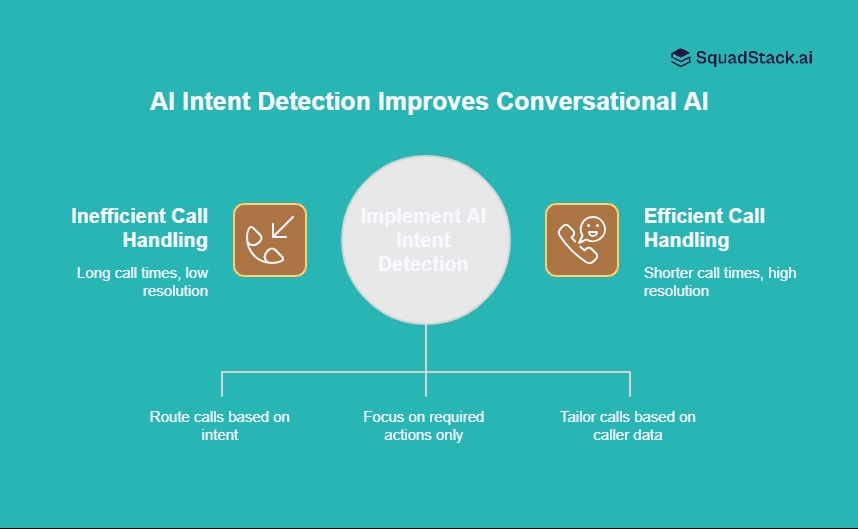
AI intent detection plays a critical role in conversational AI conversations in contact centers, shaping how systems respond, escalate, and personalize every interaction. Contact centres that deploy AI tools report up to a 30% reduction in average call handle time and higher first-call resolution rates than traditional models, showing practical impact beyond theory.
Smart Call Routing Decisions
Intelligent call routing systems use intent signals to decide whether a call should continue with an AI workflow or be transferred to a human agent. SquadStack identifies intent early in the conversation, reducing unnecessary transfers and wait times. This ensures customers are connected to the right resource quickly, improving both efficiency and caller satisfaction.
Faster Call Resolution
When AI accurately detects intent, calls are resolved faster by avoiding irrelevant questions. SquadStack’s AI focuses only on the required action, confirmation, clarification, or escalation, based on the caller’s intent. This shortens call duration, reduces repetition, and helps businesses handle higher call volumes without compromising conversation quality.
Scalable Personalization
AI intent detection can help contact centers have personalized conversations even at a large scale. SquadStack tailors call flows based on each caller’s intent, history, and responses, without manual intervention. Whether handling hundreds or thousands of calls, every interaction feels context-aware and relevant, allowing businesses to deliver consistent experiences while maintaining operational efficiency.
How Intent Detection Works in AI Voice Agents?
AI intent detection in voice calls is a multi-stage process that enables systems to interpret real spoken language and convert it into meaningful actions. It begins with capturing what the caller says, followed by understanding the why behind their message. This layered approach allows voice agents to respond accurately, even when customers use informal language or indirect phrasing.
Capture Caller Speech in Real Time
Capturing caller speech in real time is the foundation of intent detection. SquadStack’s AI voice agents use advanced speech recognition to transcribe conversations instantly, even in noisy environments or with diverse accents. Beyond words, the system also picks up pauses, tone shifts, and hesitations, which often signal changes in intent or urgency during a call.
Detect Intent Using NLP and LLMs
Once speech is transcribed, natural language processing and large language models analyze the text to understand meaning, context, and intent. SquadStack’s AI looks beyond keywords to interpret how callers express themselves, whether directly or indirectly. This allows the system to accurately identify intents like objections, confirmations, or information requests in natural, conversational language.
Execute Intent-Driven Call Actions
After identifying intent, SquadStack’s AI immediately triggers the relevant action within the call flow. This may include continuing the conversation, switching scripts, sharing information, initiating a payment process, or escalating to a human agent. Intent-driven execution ensures calls stay focused, efficient, and aligned with predefined business and compliance rules.
Continuously Improve with Feedback Loops
Intent detection improves through continuous learning from real call data. SquadStack uses feedback from call outcomes, agent reviews, and performance metrics to refine intent accuracy over time. These feedback loops help the system adapt to new language patterns, edge cases, and customer behaviors, making future interactions more reliable and context-aware.
AI Intent Detection in Real-World Use
In real-world calling scenarios, intent detection helps businesses manage high volumes without sacrificing quality. SquadStack applies intent recognition to route calls correctly, reduce repeat interactions, and improve resolution rates across collections, support, and sales workflows. By understanding why customers call, businesses can deliver faster, more consistent, and more human-like voice experiences at scale.
How AI-Based Call Intent Determines the Purpose Behind Each Customer Call?
AI-based call intent determines the purpose of a customer call by analyzing spoken language, context, and conversation flow in real time. Instead of relying on fixed options or keywords, SquadStack’s AI voice agents interpret what the caller is trying to achieve, such as making a payment, asking for information, or requesting a callback. By evaluating phrasing, tone, and prior interactions, the system accurately identifies intent, even when callers speak indirectly or change topics mid-conversation. This ensures every call follows the most relevant and efficient path from the very beginning.
Automatically Directing Calls to the Right AI or Human Agent
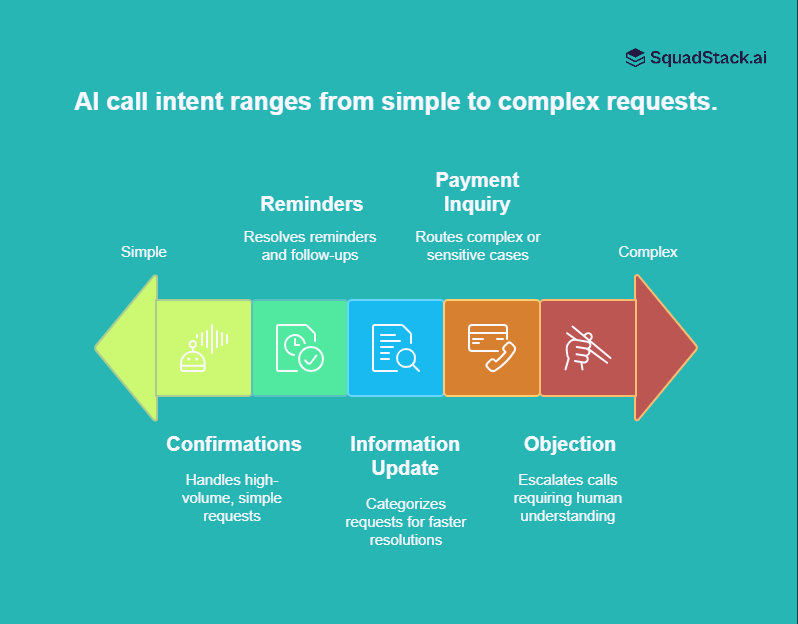
SquadStack’s AI uses call intent detection to decide whether a conversation should be handled by an AI voice agent or escalated to a human agent. AI resolves simple, high-volume requests such as confirmations, reminders, or follow-ups, while complex or sensitive cases are routed to trained agents. This intelligent routing reduces wait times, prevents unnecessary transfers, and ensures customers receive the right level of support at the right moment.
Categorizing Customer Requests for Faster Resolutions
AI intent detection allows SquadStack to categorize customer requests during live calls automatically. Each interaction is tagged based on purpose, such as payment inquiry, objection, callback request, or information update, so the system knows how to respond instantly. This categorization streamlines call flows, reduces repetitive questioning, and helps teams resolve issues faster while also improving reporting, compliance tracking, and operational insights.
How AI Understands and Interprets Human Language
Human conversations are rarely structured, and SquadStack’s AI is designed to handle that complexity. By using NLP and large language models, the system understands variations in phrasing, regional expressions, incomplete sentences, and emotional cues. It interprets meaning rather than exact words, allowing callers to speak naturally while ensuring the AI responds accurately and contextually throughout the conversation.
Top Use Cases of AI Intent Recognition on Calls
Modern contact centers and voice platforms like SquadStack are revolutionizing customer engagement by applying AI intent recognition across diverse calling scenarios. With AI now handling up to 65% of customer interactions in contact centers and driving 70% of interactions to involve AI by 2025, intent recognition is no longer optional; it’s foundational to modern voice operations.
Intelligent Lead Qualification and Sales Conversion
AI intent recognition helps SquadStack qualify leads automatically during outbound dialing campaigns by detecting purchase intent and interest signals in live speech. This reduces manual screening and surfaces ready-to-buy prospects for sales teams, improving conversion rates while lowering operational costs.
Automated Customer Support Resolution
By identifying the purpose of inbound calls, such as billing inquiries, service disruptions, or product questions, SquadStack’s AI routes or resolves queries instantly. This shortens average handle times and increases customer satisfaction by delivering relevant responses without unnecessary transfers.
Dynamic Appointment and Follow-Up Scheduling
AI intent models can detect when callers express scheduling or follow-up preferences, such as “call me tomorrow” or “reschedule my visit,” and automatically update calendars or trigger reminders. This saves time for both callers and operational teams and ensures timely engagement.
Proactive Outbound Customer Engagement
SquadStack uses intent detection to determine the best possible upstream action during automated outbound calls, whether it’s payment reminders, policy updates, or proactive issue resolution. By reading early speech patterns and intent cues, the system adjusts scripts in real time to be more relevant and efficient.
Real-Time Sentiment and Escalation Triggers
Intent recognition doesn’t just detect what is being said; it also helps identify how it’s being said. Emotional or frustration cues can trigger immediate escalation, routing the call to a human agent when empathy, negotiation, or deeper judgment is necessary, enhancing overall experience.
Some Examples of How AI Intent Recognition Works in Real Calls
AI intent recognition comes to life during real phone conversations, where callers speak naturally and often without a clear structure. Instead of relying on fixed scripts, SquadStack’s AI listens, interprets meaning, and adjusts the conversation in real time. These real-call examples show how intent detection helps guide calls efficiently, reduce friction, and deliver better outcomes for both customers and businesses.
Payment Confirmation During a Reminder Call
When a caller responds with “I already paid yesterday,” SquadStack’s AI instantly recognizes a payment confirmation intent. Instead of repeating reminders, the system switches to a verification flow, confirms transaction details, and closes the call smoothly. This avoids frustration and reduces unnecessary follow-ups, improving trust and operational efficiency.
Callback Request in a Busy Moment
If a customer says, “I’m in a meeting right now, call me later,” the AI detects a callback request intent. SquadStack automatically schedules a follow-up at a suitable time and ends the call politely. This prevents drop-offs and ensures customers are contacted when they are more receptive.
Objection or Confusion About the Call Purpose
When a caller asks, “Why are you calling me again?” the system identifies an objection or clarification intent. The AI shifts to an explanatory flow, clearly stating the reason for the call and next steps. This helps de-escalate confusion and keeps the conversation constructive.
Information Request During an Outbound Call
If a customer says, “Can you tell me my outstanding balance?” the AI detects an information-seeking intent. SquadStack responds with relevant details pulled from integrated systems, without transferring the call to a human agent, saving time for both parties.
Escalation to a Human Agent Based on Tone
When a caller’s language or tone indicates frustration or repeated disagreement, the AI identifies a human-assistance intent. SquadStack immediately routes the call to a trained agent, ensuring sensitive situations are handled with empathy and better judgment.
How to Implement AI Intent Recognition on Your Contact Center Phone Calls?
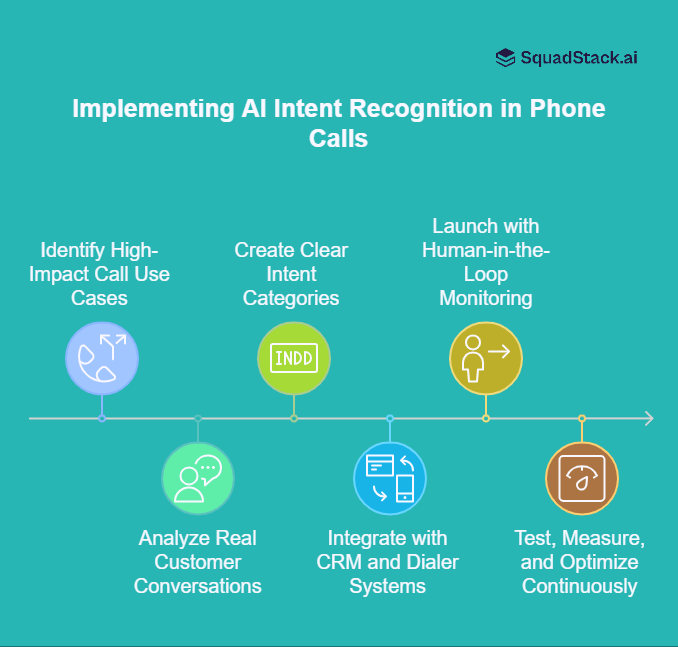
Implementing AI intent recognition in phone calls requires a structured, data-driven approach to ensure accuracy, compliance, and measurable results. The steps below outline how businesses can successfully deploy intent detection across high-volume calling workflows. Below we have shared the steps to implement AI Intent recognition on your contact center calls:
Step 1: Identify High-Impact Call Use Cases
Begin by selecting call scenarios where intent recognition adds the most value, such as debt collection, lead qualification, appointment reminders, or customer support. Focus on high-volume interactions to see faster results.
Step 2: Analyze Real Customer Conversations
Review call recordings and transcripts to understand how customers naturally express intent. Use real language patterns instead of scripted assumptions to define intent categories.
Step 3: Create Clear Intent Categories
Design intent labels such as payment intent, dispute intent, callback request, or escalation intent that align with business goals and operational workflows.
Step 4: Integrate with CRM and Dialer Systems
Connect AI intent recognition with your CRM, dialer, and backend systems so detected intents automatically trigger actions like payment links, follow-ups, or agent handoffs.
Step 5: Launch with Human-in-the-Loop Monitoring
During early deployment, involve human reviewers to validate intent accuracy, manage edge cases, and ensure compliance with calling regulations.
Step 6: Test, Measure, and Optimize Continuously
Track performance metrics like intent accuracy, call resolution rate, and average handle time. Use live call insights to continuously refine models and improve customer experience at scale.