.svg)

Nowadays, customers don’t want to wait on hold or struggle through frustrating phone call conversations with less skilled agents. They want quick, helpful support and a smooth experience from the very first call. AI call bots are helping change that. Whether it’s answering sales questions, following up on payments, or handling urgent support issues, these phone call bots help to respond faster and more effectively.
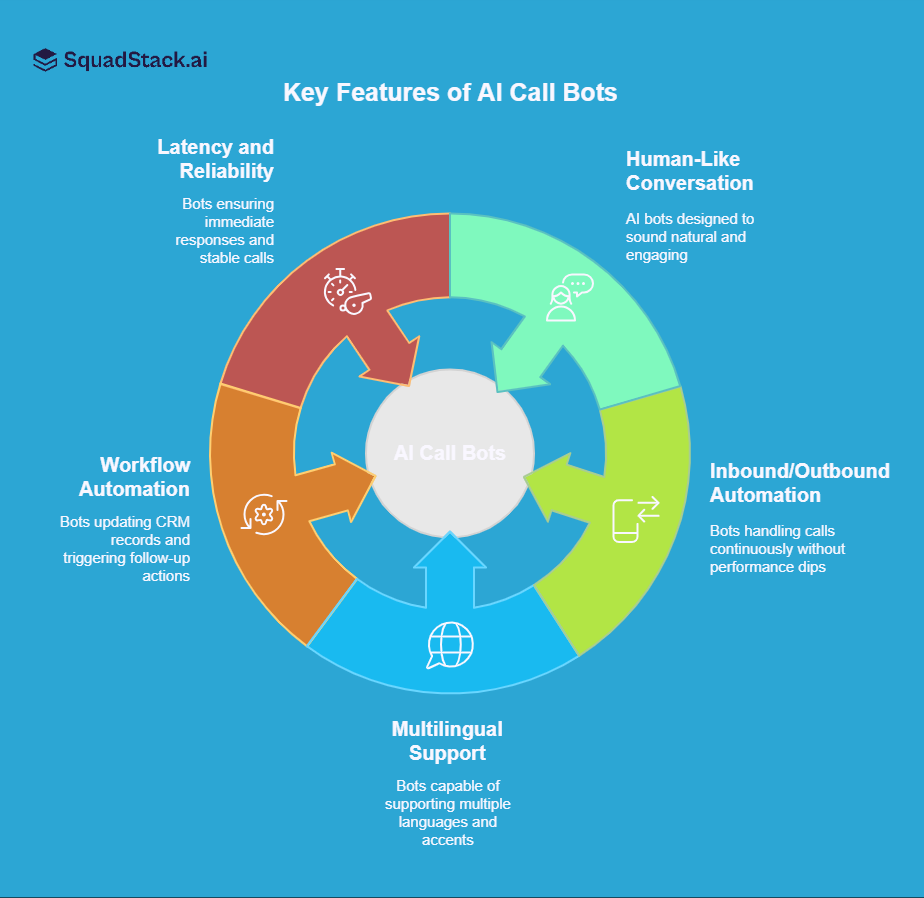
Businesses want voice Call bots to understand context, switch languages mid-call, and connect directly to CRMs and workflow tools. AI Phone call bots play a vital role in helping businesses manage high-volume customer interactions with a human touch. SquadStack's AI-powered contact center voice bot delivers instant, human-like responses to handle inquiries, qualify leads, and enhance customer support effortlessly.
From real estate and healthcare to eCommerce, BFSI, and logistics, businesses across every sector are adopting AI-powered voice automation. Below we have put the top AI calling bots to the test to see how well they handle real-world business conversations and workflow automation. Here are our picks for the 10 best tools for 2026, along with a guide to help you choose the right one for your business
What is an AI Call Bot?
An AI call bot is an autonomous voice software system that conducts real phone conversations using speech recognition, natural language processing, and dynamic response generation. It uses artificial Intelligence to make outbound calls or receive inbound calls, understand what callers wants to say, and respond intelligently without needing a human agent.
AI call bots can understand conversational language, detect customer intent, and deliver personalized responses, significantly improving customer satisfaction. Businesses use AI call bots for a wide range of tasks, including:
- Qualifying inbound leads instantly after a form submission
- Following up on unpaid invoices or abandoned carts
- Confirming appointments and sending reminders
- Handling frequently asked customer support questions
- Screening job applicants before a human interview
- Verifying cash-on-delivery orders in eCommerce
How does an AI Call Bot Work in a Contact Center?
Understanding the working of an AI call bot helps businesses to choose the right platform. An AI call bot works like a voice-based customer support or sales agent that can talk to people on the phone, understand what they say, and respond naturally. Based on the research by IAES International Journal of Artificial Intelligence (IJ-AI), it follows a clear step-by-step flow made of connected modules of various stages, shared below.
Stage 1: Call starts through the phone network (PBX)
First, a customer places a call using a normal phone line or VoIP. The call goes to a PBX server, which acts like the switchboard and routes the call into the company’s system
Stage 2: ASR converts voice into text
Next, the Automatic Speech Recognition (ASR) module listens to the caller and converts the spoken audio into written text. This is also called speech-to-text
Stage 3: NLP understands the caller’s intent
After the call is converted into text, the Natural Language Processing (NLP) module processes it to understand what the caller wants. Customers often ask the same thing in different ways, so the bot needs text normalization to avoid confusion. This helps the bot recognize the real meaning behind the words, even if people speak differently. The NLP module typically does:
- Sentence segmentation
- Removing special characters
- Tokenization (splitting into words)
- Removing stop words
- Stemming
- Lemmatization
Stage 4: The decision-making module selects the right answer
Once the intent is clear, the decision-making module decides what the best response should be using the following:
- A knowledge base (company scenarios and answers)
- Machine learning algorithms (like SVM, Random Forest, Logistic Regression, Naive Bayes, etc.)
Usually, SVM performed best overall among the tested algorithms, with an accuracy of 70.29% using n-gram.
Stage 6: TTS converts the text response into voice
Once an answer is chosen, the Text-to-Speech (TTS) module converts the bot’s response from text into a human-sounding voice, so the customer hears it like a normal conversation.
Stage 7: Escalation to a Human agent (This stage is required only if it is needed)
If the call bot cannot solve the issue or the request is too complex, the system can transfer the call to a human agent.

Which AI Call Bot Is Right for Your Business?
Choosing the “right” AI call bot isn’t mainly about which vendor delivers the best demo. The right AI calling bot vendor depends on the outcome you’re targeting, whether it’s support, collections, or sales. It also comes down to how much control you want over workflows (DIY vs fully managed) and whether the platform can scale at an enterprise level while delivering measurable impact on conversions and CAC. Below is a practical way to choose the best AI calling bot vendor based on your specific goals, preferred level of workflow control, and the platform’s ability to deliver scalable:
1) Start with the decision: What job are you hiring the call bot to do?
Start by clearly defining the goal you’re hiring the AI calling bot to do, whether it’s handling customer support, driving collections, or generating sales. This clarity ensures you evaluate vendors based on outcome alignment rather than just features.
- If your goal is consumer sales revenue outcomes (conversion lift, CAC reduction)
If you need a platform purpose-built for sales where zero error tolerance, high switching costs, and procurement decisions are driven by measurable revenue uplift. SquadStack fits this category as an AI native consumer sales platform with outcome ownership, not just a generic voicebot or call center tool.
These bots are best fit when:
- Your metric is conversion lift / CAC reduction.
- Your sales funnel is high volume and high value (lending, insurance, brokerage, marketplaces, etc.)
- You need omnichannel execution (voice + WhatsApp + SMS + email + in-app/web).
B) If your goal is support or collections automation
If your primary workflow is support/collections, a specialized outcome owner in those domains may be a better fit than a sales-focused platform
- Support optimizes for cost deflection and can tolerate some error (5–10%)
- Collections optimizes for recovery rates
2) Decide your operating model: DIY “tooling” vs outcome ownership
Option 1: DIY Orchestrators / Infrastructure vendors (APIs, tooling)
These bots are structurally suited to experimentation budgets, not enterprise revenue workflows. These vendors help you assemble a system (telephony + model APIs + routing + prompts), but you own:
- workflow design
- experimentation
- QA/compliance
- outcome accountability
Choose DIY if:
- You have a strong internal engineering + ops team
- You want maximum control
- You’re okay owning performance risk and iteration complexity
Option 2: Outcome-owned platforms (embedded, end-to-end)
These platforms are designed to be evaluated on business outcomes. Choose outcome ownership if you want a partner evaluated on conversion, CAC, and connectivity outcomes. You want the system to fit deeply into your workflows with clear responsibility, and you don’t want to build or manage testing, QA, and routing yourself.
3) Check the three enterprise-grade capabilities
A) Context quality, not just speech quality
Most AI voice agents start calls with no context and end up asking repetitive questions. The better approach is context before conversation. For use cases like marketplaces, ecommerce, or seller onboarding, a context-aware system such as the Humanoid Vision Agent can analyze product images, understand product details, and cross-check data before the call.
B) 100% quality monitoring and compliance
Instead of checking just 5 to 10 percent of calls, enterprise platforms move to full coverage with automated QA. This includes compliance checks, script adherence scoring, sentiment analysis, and coaching insights. For industries like BFSI and insurance, this becomes a critical factor when choosing a platform.
C) Built-in continuous experimentation
Performance improvement comes from constant testing. Without this, teams end up making changes based on guesswork, which becomes expensive at scale. If ROI matters, your call bot needs an experimentation engine, not just a calling capability.
4) Use measurable selection criteria (what to ask vendors in evaluation)
- POC win rate and head-to-head results
- Conversion lift (often 1.5–2x cited).
- CAC / cost per sale reduction (2–3x lower cited).
- Lead connectivity rate (80–90% cited vs 40–60% baseline)
- Time-to-value metrics like demo→live rate and sales cycle velocity.
9 Best AI Call Bot Platforms for Business in 2026
Selecting the right AI calling bot platform can impact how effectively you automate voice interactions for your business. Some solutions work well for inbound support, others for outbound outreach, while several offer full-stack automation with CRM integrated workflows. Below we have evaluated best AI call bot platforms in 2026, each with its strengths tailored to different business needs.
How We Evaluated the Best AI Call Bot Platforms
Not every AI calling tool is a genuine AI call bot. Many platforms still rely on scripted flows, basic IVR logic, or limited dialing automation. Each platform was assessed across six criteria that directly impact real-world performance.
Conversation Intelligence and Human-Like Speech
Platforms were assessed on their ability to handle dynamic conversations, follow up on ambiguous statements, and adapt tone based on context. Robotic or scripted-sounding responses scored lower regardless of feature count.
Call Quality, Latency, and Reliability
Response latency was a key factor. Poor latency creates awkward pauses that damage caller trust. Platforms were assessed on audio clarity, response speed, and consistency under high call volumes.
Supported Use Cases Beyond Demos
Platforms were evaluated on whether they perform well in real business workflows, not just controlled demonstrations. This included lead qualification, payment follow-ups, customer support, appointment scheduling, and recruitment screening.
Integration and Automation Capabilities
Strong preference was given to platforms that connect natively with CRMs, eCommerce tools, calendar systems, and automation frameworks.
SquadStack.ai
SquadStack.ai is an AI-powered voice AI bot and revenue orchestration platform built to help businesses drive higher conversions, improve lead connectivity, and reduce customer acquisition costs. While most platforms focus on handling queries, SquadStack is built to drive outcomes, conversions, collections, onboarding, and customer resolution. SquadStack is trained on millions of real customer interactions. These AI agents are designed to mirror how top-performing sales and support agents actually communicate.
%2520(4).jpeg)
Key features of SquadStack AI call bots:
Outcome-Driven AI Voice Agents
SquadStack’s AI agents are optimized for business results, not just conversations. Whether it’s qualifying a lead, completing KYC, or collecting a payment, every interaction is designed to move the customer forward.
- 40% higher conversions across key funnels
- Strong performance in lending, insurance, brokerage, and support workflows
Real-Time, Human-Like Conversations
Unlike robotic voice bots, SquadStack delivers natural, interruption-friendly conversations that feel close to human interactions.
- ≤ 0.8s median latency for real-time responsiveness
- 4.23 MOS voice quality, ensuring clarity and engagement
- Handles multi-turn conversations, interruptions, and follow-ups seamlessly
Proven at Enterprise Scale
SquadStack is built for companies that operate at scale and cannot afford inconsistent customer experiences.
- 4M+ minutes daily customer interactions handled
- 5M+ hours of outcome-tagged conversations powering continuous learning
- Enables ₹500 Cr+ monthly loan disbursals
- Drives 50K+ brokerage account openings every month
Deep Integrations That Enable Action
Most AI tools stop at answering queries. SquadStack goes further by integrating deeply with business systems to execute actions within the conversation itself.
- Connects with CRMs, dialers, lending systems, and internal tools
- Captures and updates data in real time
- Triggers workflows like approvals, scheduling, and follow-ups instantly
Built for India’s Multilingual Reality
Customer conversations in India are dynamic, often involving multiple languages and accents within a single interaction. SquadStack is designed for this complexity.
- Supports Hindi, English, Tamil, Telugu, Kannada, Marathi
- Understands Hinglish and natural code-switching
- Improves engagement across Tier 1, 2, and 3 markets
AI + Human Collaboration
Instead of forcing full automation, SquadStack enables a hybrid model where AI handles scale, and humans handle complexity.
- Seamless handoff with full context
- Better handling of edge cases and sensitive conversations
- Ensures quality, compliance, and trust
Strong ROI and Cost Efficiency
SquadStack helps businesses scale operations without scaling costs.
- 2–3× lower customer acquisition cost (CAC)
- Up to 70% reduction in operational costs
- Higher efficiency with fewer manual interventions
Best for: Enterprises that want to go beyond support automation and use AI to drive conversions, improve efficiency, and scale customer engagement intelligently.
Why Businesses Should Choose SquadStack AI Calling Bot:
- Teams report 30–40% higher contact rates in outbound campaigns.
- Reduced dependency on large calling teams.
- Predictable performance at scale, even during peak volumes.
Osno.ai
Osno.ai is a growing AI call bot platform focused on quick deployment, multilingual calling, and scalable automation. It is often used by businesses looking to automate inbound support calls, reminders, and simple outbound notifications without heavy setup. Osno positions itself as a practical solution for teams that want fast time-to-value rather than deep customization.
Key features of Osno AI call bots:
- Fast setup and deployment.
- Multilingual and regional language support.
- Inbound and outbound call automation.
- Simple workflow configuration.
- Integration with basic CRM systems.
Business impact:
- Reduced wait times for inbound calls.
- Improved customer reach in regional markets.
- Lower operational costs for routine calling.
Osno.ai is well-suited for businesses that need straightforward, reliable AI calling without complexity.
Verloop.io
Verloop.io is widely recognized for conversational automation across both chat and voice channels, making it a strong choice for businesses aiming to unify customer communication. Its AI call bot capabilities are primarily used for inbound customer support, including FAQs, order status queries, account assistance, and basic service requests.
Verloop’s strength lies in its intent recognition and conversational routing, which helps AI call bots understand varied customer phrasing and direct calls appropriately. This reduces call transfers and shortens resolution times, especially for repetitive Tier-1 queries.
Key features of Verloop AI call bots:
- Unified chat and voice automation.
- Intent-based call routing.
- Knowledge-base-driven responses.
- Multilingual support.
- Easy integration with helpdesk tools.
Business impact:
- Up to 50–60% reduction in Tier-1 support call load.
- Faster first-response times.
- More consistent customer experience across channels.
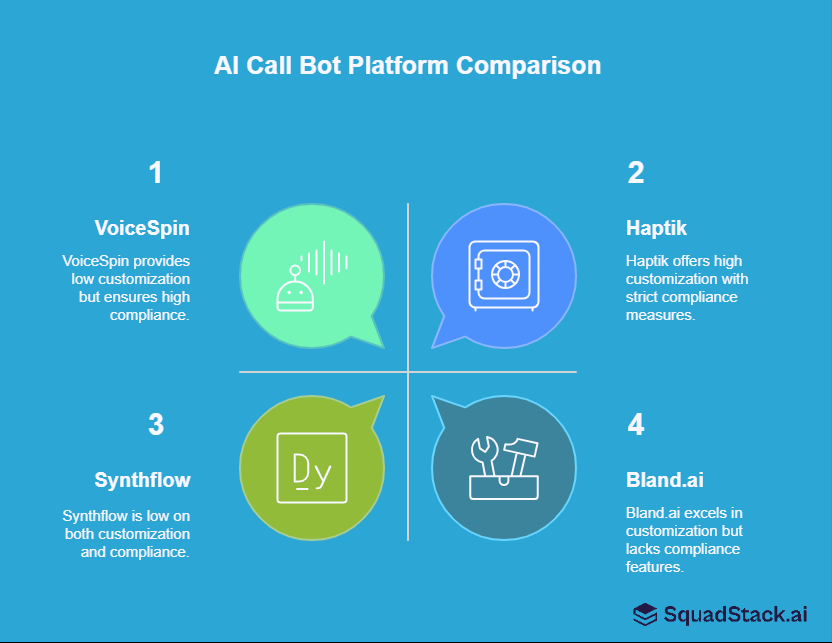
Haptik
Haptik focuses on enterprise-grade AI virtual agents, with strong adoption among large organizations in banking, telecom, retail, and travel. Its AI call bots are designed to handle high volumes of customer interactions while meeting strict compliance and data security requirements.
Key features of Haptik AI call bots:
- Enterprise-level security and compliance.
- Omnichannel AI agents (voice + chat + messaging).
- Transactional and notification-based calling.
- Intent detection tuned for complex customer journeys.
- Detailed analytics and compliance reporting.
Business impact:
- Improved call containment rates.
- Reduced manual agent dependency.
- Better regulatory alignment for large brands.
Haptik is ideal for enterprises that need scale, structure, and compliance over experimentation.
Lindy.ai
Lindy.ai combines AI call bots with workflow and task automation, positioning itself as a voice-first operations assistant. It’s commonly used for internal processes, appointment scheduling, follow-ups, and task-driven calls where conversations must result in immediate action. Lindy’s AI call bots are designed to trigger backend workflows automatically, such as updating records, or scheduling meetings, immediately after or during a call.
Key features of Lindy AI call bots:
- Voice-driven workflow automation.
- CRM, calendar, and task integrations.
- Multilingual calling support.
- Post-call action execution.
- Conversation analytics and optimization.
Business impact:
- Reduced manual coordination work
- Faster turnaround for operational tasks.
- Improved accuracy in follow-ups.
Lindy works well for teams focused on internal efficiency and operational automation.
Synthflow
Synthflow offers no-code AI call bot creation, making it accessible to marketing, operations, and growth teams without engineering support. It is commonly used for outbound campaigns such as reminders, confirmations, feedback collection, and basic sales outreach. The platform emphasizes speed of setup and ease of iteration, allowing teams to launch and refine campaigns quickly.
Key features of Synthflow:
- Drag-and-drop call flow builder.
- Outbound campaign automation.
- Retry logic and follow-up triggers.
- Multilingual voice options.
- Real-time campaign analytics.
Business impact:
- Faster campaign launches.
- Lower technical dependency.
- Improved outreach consistency.
VoiceSpin
VoiceSpin blends AI call bots with traditional dialer infrastructure, making it particularly suitable for outbound-heavy teams transitioning from human-only call centers. It allows businesses to introduce AI gradually without disrupting existing processes.VoiceSpin’s AI bots can handle routine calls, pre-qualify leads, or assist agents during live calls, creating a hybrid AI-human calling model.
Key features of VoiceSpin:
- Predictive dialing + AI call bots.
- Hybrid AI and human workflows.
- CRM integration.
- Call analytics and performance tracking.
- Gradual automation rollout.
Business impact:
- Higher agent productivity.
- Reduced idle dialing time.
- Smoother transition to AI-assisted calling.
Convin.ai
Convin.ai is widely recognized for AI-driven call analytics, making it a strong choice for businesses that want to improve performance of their existing sales and support teams. Its capabilities are focused on analyzing calls, identifying gaps, and driving better outcomes through coaching, QA automation, and insights rather than replacing agents entirely.
Key features of Convin.ai:
- AI-powered call analysis and insights.
- Automated quality monitoring and scoring.
- Agent coaching and performance tracking.
- Compliance and script adherence checks.
- Conversation intelligence dashboards.
Business impact:
- Improved agent productivity and performance.
- Reduced manual QA effort.
- Better compliance and risk management.
- Higher conversion rates through data-driven coaching.
Yellow.ai
Yellow.ai is widely recognized for enterprise-grade conversational AI across voice and chat, making it a strong choice for businesses looking to automate customer engagement at scale. Its AI call bot capabilities are primarily used for customer support, lead engagement, and service automation across multiple channels.
Key features of Yellow.ai call bots:
- Omnichannel automation across voice, chat, and messaging.
- Advanced NLP for intent detection.
- Multilingual support for global use cases.
- Workflow automation and integrations.
- Enterprise-grade scalability and deployment.
Business impact:
- Reduced customer support workload.
- Faster response and resolution times.
- Improved customer experience across channels.
- Scalable automation for large enterprises.
Key Benefits of AI Call Bots For Call Centers
AI call bots have improved how businesses handle customer interactions, offering automation and personalized support. Companies looking to scale their customer service and sales operations can leverage AI-powered voice bots to enhance efficiency, reduce costs, and deliver a superior customer experience. Key benefits include:
24/7 Availability: Round-the-Clock Customer Support
AI call bots operate continuously, providing uninterrupted customer service 24/7. Unlike human agents who require breaks and shifts, AI bots ensure that customer inquiries are addressed instantly, even outside business hours. This mainly benefits global businesses catering to customers across different time zones, eliminating long hold times and improving overall customer satisfaction.
Cost Savings: Reducing Operational Expenses
AI call bots significantly lower operational costs by automating routine queries and handling repetitive customer interactions. Businesses no longer need to maintain large support teams for simple inquiries, as AI-driven voice software can efficiently manage high call volumes. This allows organizations to allocate resources more effectively, ensuring human agents focus on complex or high-value interactions while reducing staffing and training expenses.
Scalability: Handling High Call Volumes with Ease
AI call bots allow businesses to effortlessly scale their customer service. Whether handling thousands of inquiries during a peak shopping season or managing unexpected spikes in call volume, AI-powered bots can respond to multiple customers simultaneously without compromising efficiency. This ensures businesses can meet growing customer demands without hiring additional staff or investing in costly infrastructure.
Faster Resolutions: Minimizing Customer Wait Time
One key advantage of AI call bots is their ability to process customer queries instantly. These bots can quickly understand customer intent and provide accurate responses by leveraging speech recognition and natural language processing (NLP). This drastically reduces average handling time, helping customers get the needed assistance without delays. Faster issue resolution leads to increased customer satisfaction and improved brand loyalty.
Personalized Interactions: AI-Driven Customer Engagement
AI call bots are not just about automation; they also deliver a personalized customer experience. By analyzing past interactions, customer history, and preferences, these bots provide tailored responses that feel human-like and relevant. Whether recommending products, addressing specific concerns, or recalling previous conversations, AI bots enhance engagement, making interactions more meaningful and effective for businesses and customers.
Why do Businesses Need AI Call Bots?
Customer expectations are higher than ever, and businesses must provide instant, accurate, personalized support to stay ahead. SquadStack's AI-powered call bots help companies streamline operations, reduce response times, and improve engagement—ensuring seamless interactions without overwhelming human agents.
With 24/7 availability, these bots effortlessly handle customer inquiries, qualify leads, and resolve issues. Their advanced NLP and machine learning capabilities allow them to understand intent, provide relevant solutions, and escalate complex queries when needed.
SquadStack's AI call bots automate routine tasks to cut operational costs, enhance efficiency, and drive business growth. Whether for customer support, sales, or lead generation, they ensure faster, smarter, and more effective communication at every touchpoint.
Contact Center Automation Through Powerful Deep-Tech Voice AI Agents
SquadStack’s cutting-edge AI voice agents are setting a new standard in contact center operations by combining the power of intelligent automation with the reliability of human support. Designed with scalability, precision, and customer experience at the core, these AI-powered solutions are not just tools—they’re strategic assets for businesses looking to streamline workflows and deliver exceptional service.
Optimized Customer Support
With SquadStack’s AI agents, businesses can automate up to 80% of inbound queries, enabling instant resolutions to common customer issues. From account information to order tracking and FAQs, these bots handle it all—drastically reducing average handling time and cutting resolution cycles from days to just a few minutes. The result? Lower workload on support staff and significantly improved customer satisfaction.
Smart Lead Qualification
AI voice agents proactively manage outbound calling tasks, including lead verification, appointment scheduling, and collecting feedback. These calls are guided by intelligent scripts that adapt to customer responses, ensuring accurate data capture and qualification without manual effort. Businesses can scale their sales and marketing outreach while maintaining consistency and personalization.
Human-AI Collaboration
For complex or sensitive queries, SquadStack’s AI voice agents seamlessly transfer conversations to live human agents without any disruption. This smooth handoff ensures that customers always receive the right level of support, blending the speed of AI with the empathy and judgment of human representatives. It’s a collaborative model that drives both efficiency and trust.
Cost Efficiency & Scalability
AI-powered voice agents significantly reduce operational costs by minimizing the need for large support teams and cutting down on repetitive workload. Unlike traditional models that require hiring and training for every growth phase, SquadStack’s solution can scale effortlessly to handle surges in call volume—delivering consistent, 24/7 support without compromising quality.
Advanced Workflow Automation
Beyond handling calls, SquadStack’s AI agents are equipped to automate backend operations. They can process refunds, track orders, verify customer data, and update records in real time—integrating directly with CRM systems and internal databases. This end-to-end automation reduces human error, accelerates business processes, and allows agents to focus on higher-value tasks.
By integrating deep-tech AI voice solutions, SquadStack empowers businesses to scale operations, improve customer satisfaction, and maximize ROI—all while staying ahead in a competitive market.

How to Implement an AI Call Bot in Your Contact Center
Implementing an AI call bot requires a well-thought-out strategy to ensure seamless integration, enhanced customer experience, and maximum efficiency. Here’s a step-by-step guide to successfully integrating AI voice solutions into your business operations.
Identify Business Needs
The first step in implementing an AI call bot is clearly defining your business objectives and using clear criteria to assess where AI can provide the most value—whether it is customer support, handling appointment scheduling, managing lead qualification, or conducting post-call surveys.
Businesses can pinpoint repetitive and time-consuming tasks that AI can manage efficiently by analyzing pain points in current workflows. The goal is to ensure that automation aligns with business objectives while enhancing the overall customer experience.
Choose the Right AI Solution
Selecting the right AI call bot is crucial for achieving seamless automation and superior performance. Businesses should opt for solutions that offer advanced natural language processing (NLP) capabilities, enabling the AI to understand and respond naturally to customer queries.
Integration with CRM and backend systems is essential to provide personalized responses and maintain continuity in customer interactions. Additionally, omnichannel support ensures that AI can handle phone calls, chat, email, and messaging platforms to deliver a unified customer experience. A customizable AI workflow is also necessary so businesses can tailor responses, automate decision-making, and enhance overall efficiency.
Train the AI Model
AI bots are only as good as the data they learn from. To maximize efficiency, businesses must train the AI model by feeding it real customer interactions, such as chat logs, call transcripts, and FAQs.
Implementing machine learning algorithms helps the AI refine its real-time responses and real-time interactions. Training should also account for customer intents, accents, languages, and industry-specific terminologies to improve accuracy. Regular testing and refinement are crucial to reducing errors and ensuring that AI interactions feel natural.
Integrate with Existing Systems
For a smooth transition to AI-driven automation, businesses should integrate their AI call bots with existing systems. Seamless integration with CRM platforms like Salesforce, HubSpot, or Zoho allows the bot to access real-time customer data and deliver highly contextual, personalized responses.
Connecting the bot with ticketing systems enhances support workflows by enabling the AI to assist in issue resolution, status updates, and ticket tracking. To handle billing-related queries, order tracking, and refund requests, AI call bots should also be linked with payment gateways and order management systems.
Monitor & Optimize Performance
AI automation is an ongoing process that requires continuous monitoring, analysis, and refinement. To measure efficiency, businesses should track key performance metrics such as response time, call resolution rate, customer satisfaction (CSAT), and fir first-call solution (FCR) scores.
Analyzing customer interactions helps identify areas for improvement, enabling businesses to adjust AI responses accordingly. Workflow optimization ensures that the AI continues evolving, adapting to customer needs while improving efficiency and accuracy.