Conversational AI Voicebots are improving customer communication by delivering human-like AI Voice calls, improving how businesses engage with consumers through telephone conversations. As customer call volume increases, consumer demand for human-like conversations from Voicebots is rising. It is not feasible to rely on IVRs or manually handle all these consumer calls. All this has led to an increased adoption of Chatbots for Voice Conversations.
According to Research and Markets, the global conversational AI market is forecasted to reach $43.7 billion by 2030, growing at a 23.9% CAGR. As a result, conversational AI voice bots are seeing rapid adoption in contact centers as businesses seek faster, more scalable, and more human-like customer interactions.
From lead qualification and customer service to collection processes, Conversational AI Voicebots are increasingly a crucial call center solution. They can deliver faster resolutions, improved experiences, and stronger business outcomes through a mashup of speech recognition technology, natural language understanding, and AI-driven decisioning.
What Is a Conversational Voice AI?
Conversational Voice AI comprises artificial intelligence systems that can have two-way spoken conversations with humans in real time. Unsimple voice response systems, which depend on rigid scripts or keypad inputs, are contrasted with the development of Conversational Voice AI, which understands natural speech, context, and intent. In a nutshell, Conversational Voice AI uses technologies such as ASR, NLP, NLU, and Text-to-Speech to enable intelligent listening, thinking, and responding during a call.
What is a Conversational AI Voicebot
Conversational AI Voicebot is an AI-powered calling agent that can handle phone conversations autonomously from start to finish. It can greet callers, ask follow-up questions, interpret responses, take action, and close conversations without human intervention, unless escalation is required.
How Conversational AI Voice Technology Works
The Conversational AI Voice solution is designed and developed to replicate and improve human-like conversational interactions over voice communication channels. The solution differs from typical IVR technology by using strict menus and keypad inputs to process responses. It will be designed to listen and respond accordingly, as skilled customer service personnel do.
Essentially, Conversational AI Voice is about processing natural human speech, decoding caller intent, retaining context for multi-turn dialogue, and generating optimal responses using natural-sounding voices. Essentially, this system can adapt to different inputs, accents, speech patterns, and dialects in conversations and is also effective at handling complex customer interactions, including support, sales, scheduling, and follow-up. Of course, this is an intelligent voice experience. Conversational AI software operates via a feedback loop: capture input, transcribe/analyze with NLP and LLMs, generate responses, and learn from interactions.
For Example, when a user asks, "Track my order," the software identifies intent ("order tracking"), extracts entities ("my order"), queries a backend database, and responds naturally: "Your order #12345 ships tomorrow."
How Conversational AI Software Works?
Understanding how conversational AI software functions helps businesses deploy it more effectively.
1. Speech or Text Input
The conversation begins when a user sends a message via chat or voice.
2. Natural Language Understanding (NLU)
The AI analyzes intent, entities, sentiment, and context. For example, it understands whether a user wants support, pricing information, or to make a purchase.
3. Dialogue Management
This component determines the most appropriate response based on context, past interactions, and business rules.
4. Response Generation
The system generates a human-like response using natural language generation (NLG).
5. Learning Loop
Every interaction helps the conversational AI software improve accuracy and relevance over time.
Key Components of Conversational AI Voice Architecture
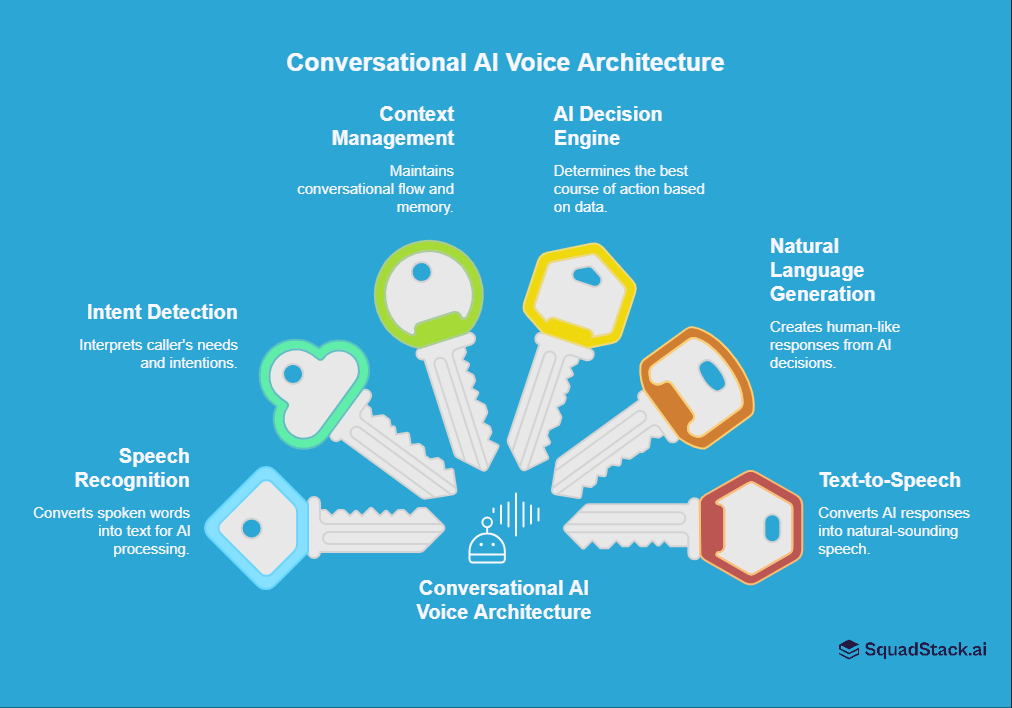
Conversational AI Voice systems have multiple AI-driven components to work in harmony. Each component plays a critical role in enabling the system to understand human speech, interpret intent, maintain conversational context, and respond naturally in real time. Together, these building blocks form the backbone of an intelligent voice experience, one that goes far beyond traditional IVR systems to deliver fluid, human-like conversations at scale.
1. Speech Recognition (Automatic Speech Recognition – ASR)
Speech Recognition is considered to be the backbone of every Conversational AI Voice solution. This technology converts the caller's spoken words into text. Advanced Speech Recognition models are trained on diverse corpora to recognise accents, speech rates, ambient noise levels, and regional variations. This ensures high transcription precision.
2. Intent Detection and Natural Language Understanding (NLU)
This text analysis enables the system to apply Natural Language Understanding to assess the input and determine exactly what the caller needs or means. The caller might have intended to schedule an appointment, file a complaint, or speak with a customer service representative. This requires an intent analysis to determine exactly what they need.
3. Context Management and Conversation Memory
Context Management enables voice AI to track conversation history and maintain a logical flow across multiple turns. The system remembers previous responses, user preferences, and unresolved queries to enable more natural back-and-forth. There are no capabilities for repetitive questioning, while the AI is trained to handle follow-up queries and requests for clarification and correction with the same grace a human agent would.
4. AI Decision Engine and Business Logic
The AI Decision Engine calculates the best course of action/response based on the intent, context, business rules, and real-time data analysis. Functions could involve invoking backend integrations, such as CRMs, ticketing systems, and payments, hand off the call to a live agent, or continue the conversation autonomously. This level is responsible for ensuring that responses are more conversational and aligned with business needs.
5. Natural Language Generation (NLG)
Natural Language Generation is responsible for turning the system's decisions into human-sounding responses. Rather than giving generic, repetitive answers to customer questions, NLenables the creation of messages that vary and adapt to the customer's tone and the moment of communication.
6. Text-to-Speech (TTS) with Human-Like Voice Output
Finally, such a response is delivered through sophisticated Text-to-Speech technology, offering a very natural, expressive voice appropriate for communication. Modern Text-to-Speech systems support various voices, languages, and speaking styles, making communication appear natural and human-like.
Why Are Modern Call Centers Adopting Conversational AI Voicebots?
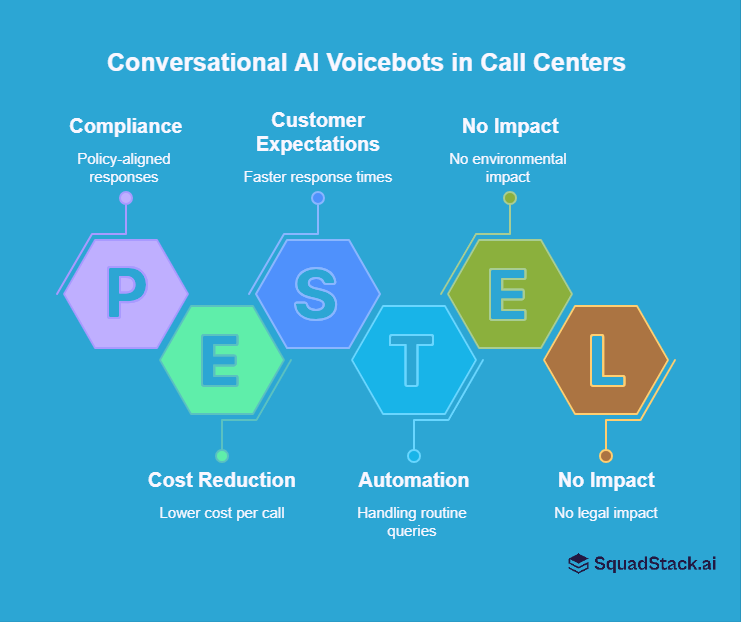
Modern-day call centers are under increasing pressure to reduce costs, minimise response times, and ensure consistent treatment. Conversational AI Voicebots offer the solution to this. The major drivers for adopting this technology include increased call volume, attrition among customer service representatives, the need for 24/7 availability, and the requirement for faster turnaround time without impacting customer satisfaction.
Rising Call Volumes Are Hard to Manage Manually
Customer calls have increased across industries, especially during peak hours, campaigns, and seasonal demand. Hiring and training agents fast enough to handle these spikes is difficult and expensive. Voicebots help manage large call volumes by handling routine queries and outbound calls without overwhelming human teams.
Customers Expect Faster Responses, Not Long Wait Times
Today’s customers expect immediate answers. Long IVR menus and wait queues lead to frustration and call drop-offs. Voicebots respond instantly, acknowledge customers, and resolve common requests without delay, improving the overall calling experience.
Agent Attrition Is Impacting Service Quality
High attrition in call centers leads to constant hiring and training cycles. New agents take time to become effective, which affects consistency and service quality. Voicebots ensure stable performance for repetitive tasks, allowing human agents to focus on complex conversations.
24/7 Support Is Becoming a Basic Expectation
Customers now expect support beyond business hours. Maintaining round-the-clock human teams significantly increases costs. Voicebots enable call centers to offer reliable 24/7 support without expanding headcount or compromising service standards.
Consistency and Compliance Matter More Than Ever
In industries like banking, lending, and healthcare, every customer conversation must follow strict policies. Voicebots deliver standardised, policy-aligned responses on every call, reducing errors and compliance risks associated with manual handling.
Operational Costs Need Better Control
Call center costs grow quickly with volume, more agents, more shifts, and more infrastructure. Voicebots reduce the cost per call by automating high-frequency tasks, helping businesses scale operations without incurring proportional costs.
Key Features of Conversational AI Voicebots
The Conversational AI Voicebot is designed to handle real-life voice conversations efficiently, accurately, and intelligently. They enable companies to automate high-volume conversations efficiently while providing a human-like experience. Below are key features that make the Conversational AI Voicebot efficient, effective, and reliable in the current context of customer engagement.
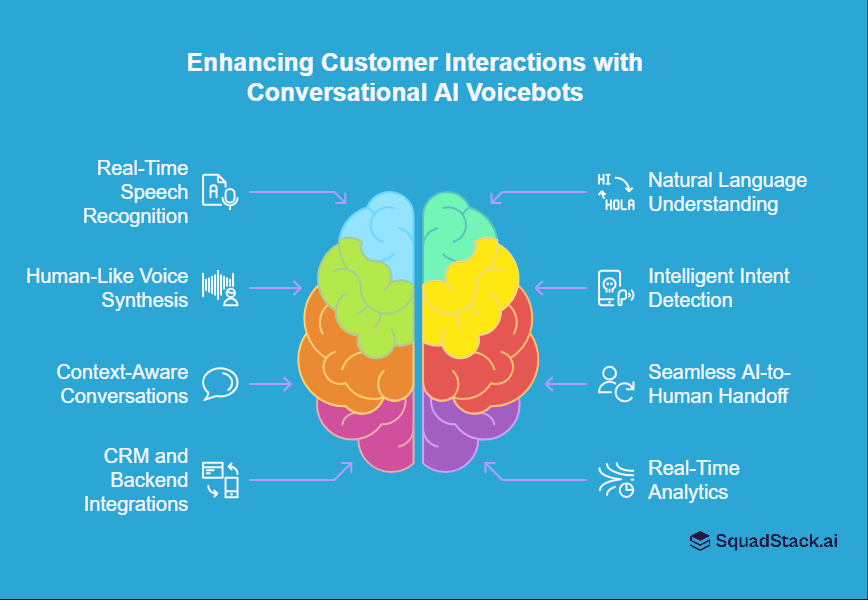
1. Real-Time Speech Recognition and Natural Language Understanding
The Conversational AI Voicebot leverages sophisticated Automatic Speech Recognition that converts spoken words to text instantaneously, even in the presence of background noise or within different accents. Along with that, it uses Natural Language Understanding that deciphers the meaning behind the words, not necessarily the phrases. Bote aspects combine tenableow the Voicebot to decode customer inquiries instantaneously.
2. Human-Like Voice Synthesis
Using neural text-to-speech technology, modern Voicebots generate responses that sound natural, expressive, and emotionally appropriate. The voices are designed to sound more conversational than robotic, with a realistic tone, pacing, and intonation. This greatly enhances caller comfort, engagement, and confidence during their interactions with the voice.
3. Intelligent Intent Detection and Call Routing
It allows the voice bot to recognize the caller's purpose. For example, they could be looking to book an appointment or simply seeking a status update. The voice bot will be able to route callers to the relevant solution based on the purpose they are seeking. In some cases, it can offer a solution directly.
4. Context-Aware, Multi-Turn Conversations
Unlike conventional IVR systems, the Conversational AI Voicebots can retain the context even in multi-turn conversations. Conversational AI Voicebots can recall previous questions and answers, as well as the user's inputs during the conversation.
5. Seamless AI-to-Human Handoff
If the conversation becomes too complex or requires human judgment, the Voicebot smoothly transfers the call to the live agent. More importantly, the full history of the conversation and context about the customer will be transferred, so the human agent can pick up where the conversation left off without asking the caller to repeat information. A frictionless experience that enhances resolution quality will be delivered.
6. CRM and Backend System Integrations
Conversational AI Voicebots also integrate easily with CRM solutions, ticketing systems, payment gateways, and other backend services. This allows them to fetch, update, perform actions, and process transactions during a call. All of these make the Voicebot a fully functional assistant, not just a chat tool.
7. Real-Time Analytics and Call Insights
With Voicebots, detailed analytics are provided on call volumes, intent distribution, resolution rates, conversation outcomes, and customer behavior. These insights help businesses track performance, identify bottlenecks, and continuously optimize conversation flows. Real-time dashboards and reports facilitate data-driven decision-making for both operations and customer experience teams.
Key Benefits of Conversational AI Voicebots for Call Centers
Conversational AI Voicebots are modernizing call centers by improving scalability, efficiency, and the overall experience. Today, call centers are increasingly burdened by rising customer call volumes for support, sales, and service. It is no longer efficient to rely exclusively on human agents to handle calls. This is where Conversational AI Voicebots help call centers automate conversational calls, allocate resources efficiently, and deliver rapid, high-quality voice interactions.
Below, we outline the key benefits of conversational AI voicebots for call centers, highlighting how they ensure human agents are focused on high-impact interactions where empathy and judgment truly matter.
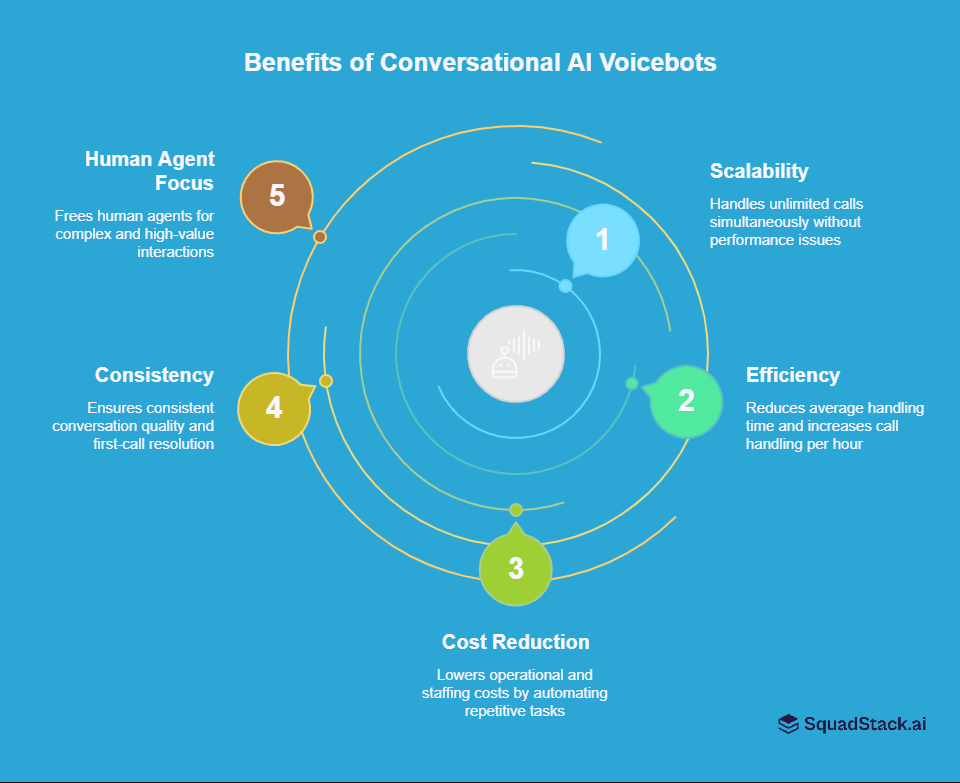
Handle Thousands of Calls Simultaneously
Conversational AI Voicebots can process an unlimited number of call connections simultaneously without performance issues. This enables the system to eliminate long wait times and call abandonment while ensuring callers have access to assistance as quickly as possible.
Reduce Average Handling Time (AHT)
Because they immediately understand caller intent and provide precise answers, Voicebots reduce the time spent on each call. They do not require unnecessary questions and answers, and effectively route incoming calls when necessary. This impacts overall efficiency and increases call handling per hour.
Lower Operational and Staffing Costs
Automating high-volume, repetitive customer interactions reduces the need for large teams of customer service agents. Call centers can achieve greater efficiency with fewer resources, without incurring the cost of additional staff. The Conversational AI Voicebots enable companies to grow without increasing their expenses.
Ensure Consistent Conversation Quality
Voicebots will use intent identification, context-awareness, and backend integrations to resolve customer issues on the first call. Performing tasks such as providing information, updating status, or taking transactional actions in real time reduces follow-up calls and improves customer satisfaction.
Free Human Agents for Complex, High-Value Interactions
Voicebots handle mundane tasks, such as answering FAQs, confirming, sending reminders, and handling simple troubleshooting. In this way, they allow human assistants to focus only on complex, emotional, or revenue-generating conversations.
How Conversational AI Voicebots Improve Customer Experience
With Conversational AI Voicebot solutions, long wait times and IVR menu routing are eliminated, ensuring a smooth customer experience. Customers can speak freely, receive instant responses, and accomplish their goals.
Voicebots also ensure consistency in the level of information, tone, and service each caller receives, regardless of time or call volume.
Multilingual & Regional Language Support at Scale
Among many advantages, one of the most critical is that Conversational AI Voicebots can support multiple languages and regional dialects at scale. This is most important for businesses that operate across different geographies.
It can dynamically switch languages, understand accents, and deliver conversations in localized languages, which, no doubt, is difficult and expensive to maintain with just human call centers.
High-Impact Use Cases for AI Voicebots
SquadStack’s Conversational AI Voicebots have been designed specifically to handle high-volume, outcome-oriented conversations, with a focus on speedy processing, precision, conversion quality, and the pace of interactions. The following points highlight the most influential applications that directly drive the creation of maximum value through SquadStack’s AI Voicebots.
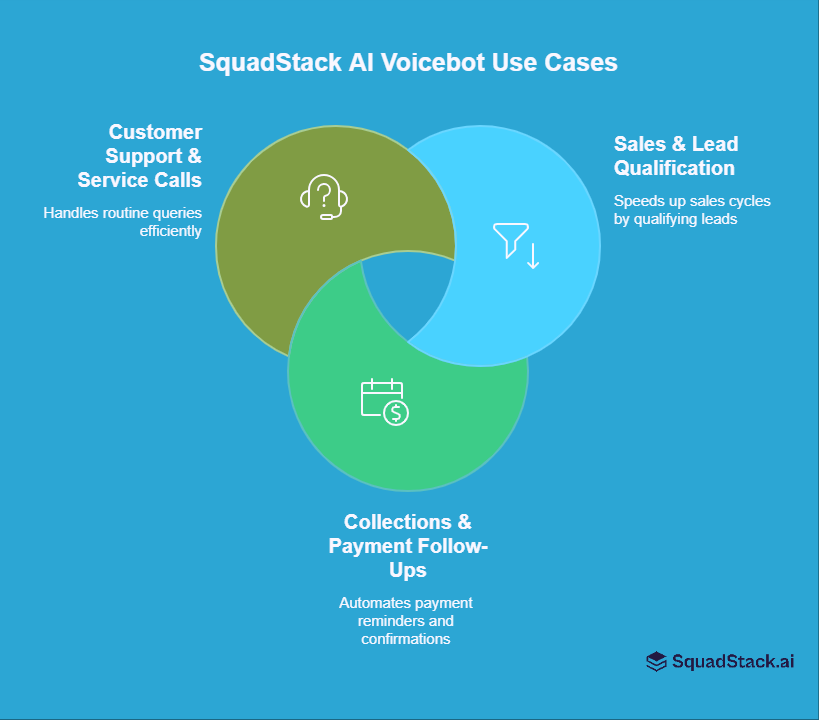
Sales & Lead Qualification
The Conversational AI Voicebots from SquadStack are a critical part of speeding up sales cycles by engaging inbound and outbound leads. The Voicebot initiates conversations with leads, qualifying them through a series of questions, and also assesses buyer intent against predefined criteria.
The system addresses the problem of human sales agents being routed to low-intent leads, as it avoids routing such leads to them. This results in less agent time being spent on unqualified calls, in turn improving connect rates, productivity, and conversion rates. This results in shorter deal cycles, a higher closing ratio, and a streamlined sales force.
Collections & Payment Follow-Ups
In the context of collections and payments, consistency, timing, and tone are important. AI Voicebots from SquadStack automate payment reminder, overdue, and confirmation calls, strictly adhering to compliance and regulatory requirements.
The Voicebot maintains a polite, professional, and non-intrusive tone during conversations, resulting in a frictionless solution that increases the customer's willingness to comply with the process. It can deal with objections, send reminders, lock payment commitments, and escalate complex cases to human representatives if necessary.
Customer Support & Service Calls
The Conversational AI Voicebots of SquadStack efficiently handle large volumes of customer service queries by handling routine queries end-to-end. This includes checking the status of orders, service requests, appointment confirmations, troubleshooting, and FAQ.
How Is SquadStack’s Conversational AI Voicebot Different ?
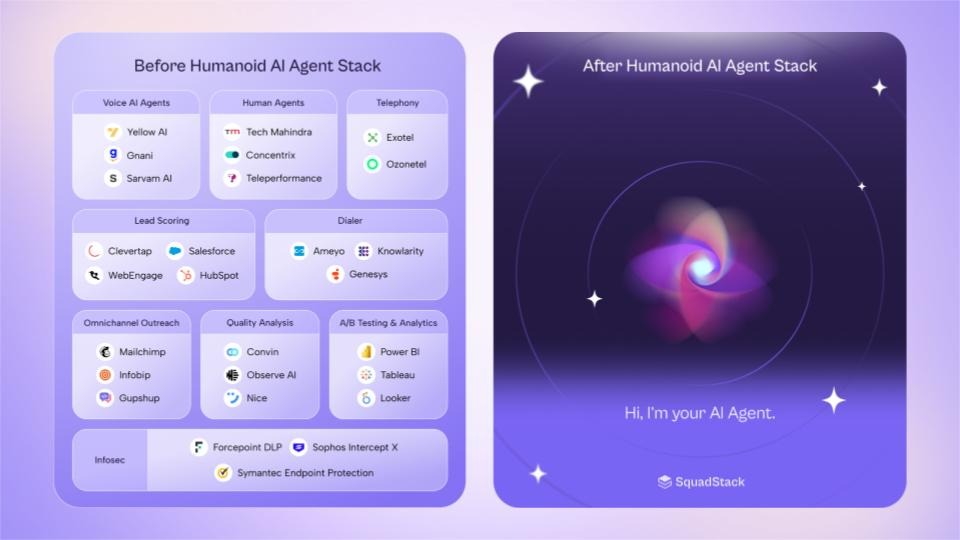
Most conversational AI voicebots are built to sound accurate or automate calls. SquadStack’s Conversational AI Voicebot is built for something far more important: delivering measurable business outcomes. SquadStack AI voicebot can be directly implemented to real-world calling workflows ie. sales, onboarding, renewals, collections, and customer engagement.
Deep Domain-Trained Conversation Models (Not Generic AI)
SquadStack’s Conversational AI Voicebot is trained on 600M+ minutes of real enterprise call data across industries such as BFSI, insurance, education, healthcare, e-commerce, and logistics. This allows the conversational AI Voicebot to understand how real customers respond.
Unlike scripted or rule-based systems, Voicebot dynamically adapts mid-conversation based on customer intent, hesitation, tone, and past outcomes. It follows conversation paths that have historically driven higher conversions or resolutions, rather than rigid scripts.
Voice-First Architecture Built for High-Volume Calling
Many AI platforms start with chat and later “add voice.” SquadStack is fundamentally voice-first.
This architecture delivers:
- Sub-second median latency (≤ 0.8s)
- High speech recognition accuracy across accents
- Stable performance at 400K–750K+ calls per day
- Natural, interruption-aware conversations
This makes the platform especially effective for continuous, high-volume calling environments such as sales campaigns, onboarding drives, renewal reminders, and services.
Built-In Compliance, Quality & Control by Design
In regulated and high-risk industries, compliance cannot be an afterthought. SquadStack embeds compliance and quality controls directly into the Conversational AI Voicebot.
The platform enforces:
- Pre-approved conversation flows and disclosures
- Tone, duration, and retry logic controls
- Regulatory adherence (TRAI, BFSI norms, data residency)
- Enterprise-grade security (ISO 27001, SOC 2 Type II)
Every call operates within a governed framework—ensuring consistency, auditability, and zero deviation from approved standards.
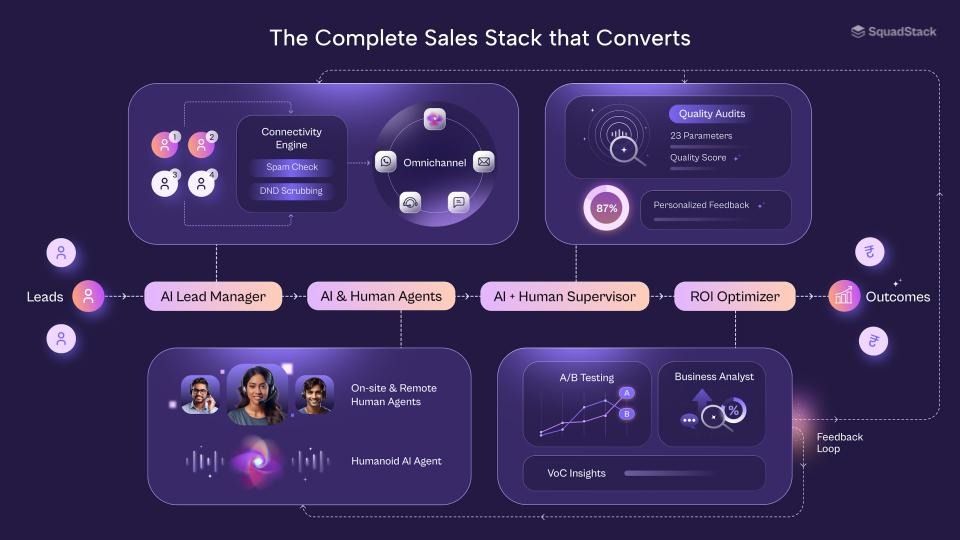
A True Hybrid AI + Human Execution Model
SquadStack does not position AI as a replacement for humans—it treats AI and humans as coordinated execution layers.
- High-frequency, repetitive, and early-stage conversations are handled by the AI Voicebot.
- High-intent, emotionally sensitive, or complex conversations are routed to trained human agents.
- Full conversation context, CRM data, and intent signals are passed instantly—no repetition, no loss of continuity.
This hybrid orchestration ensures customers get speed where they want it and empathy where they need it.
Real-Time Performance, Conversion & Outcome Tracking
Every conversation handled by SquadStack’s Conversational AI Voicebot is tracked and analyzed in real time.
Businesses gain visibility into:
- Intent distribution
- Connectivity and retry effectiveness
- Conversion and resolution rates
- Funnel leakage points
- Agent and AI performance comparisons
These insights power continuous optimization—helping teams refine scripts, timing, workflows, and targeting based on what actually converts.
Customer Stories: Real Impact with SquadStack’s Conversational AI Voicebots
1. Higher Contact and Connectivity Rates
Customer Story: Digital Lending Platform (BFSI)
A fast-growing digital lending company was struggling with low contact rates due to spam tagging, limited agent availability, and poor retry strategies. Despite a large lead pool, more than half the prospects were never reached.
After deploying SquadStack’s Conversational AI Voicebot, the platform used intelligent call timing, automated retries, and spam-aware number rotation to reach customers when they were most likely to answer.
Impact:
- ~90% lead connectivity achieved
- Significant reduction in missed and unanswered calls
- Higher engagement across first-time and repeat outreach
The AI Voicebot ensured every lead was pursued consistently, without being constrained by agent shifts or availability.
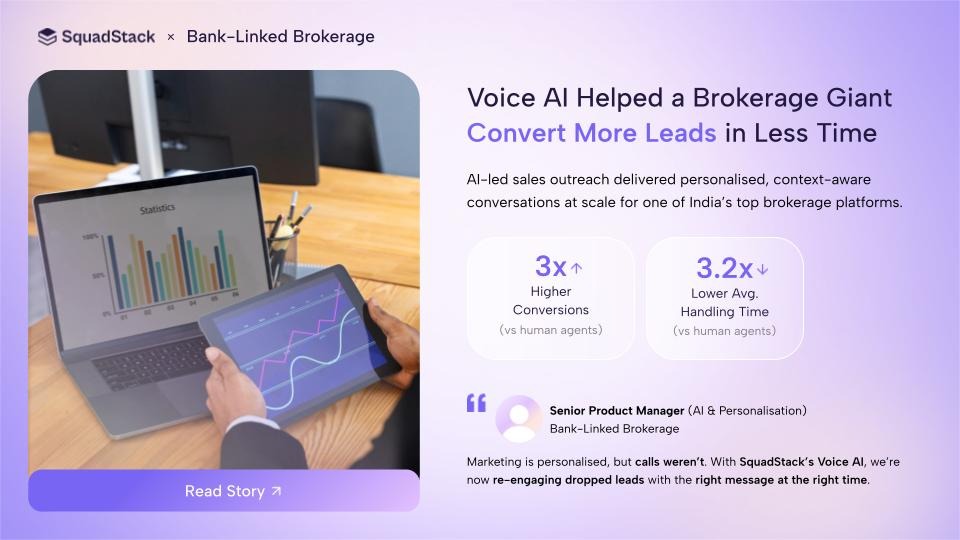
2. Improved Lead-to-Conversion Ratios
Customer Story: Online Education & EdTech Platform
An education company offering professional courses received thousands of daily inquiries but struggled to convert them. Sales agents spent time calling low-intent leads, leaving high-potential prospects unattended.
With SquadStack’s Conversational AI Voicebot, the intent, eligibility, and readiness were assessed during the first interaction. Only high-intent learners were passed to human counselors.
Impact:
- 2× increase in conversion rates
- Faster lead qualification
- Sales teams focused only on serious prospects
The result was a cleaner funnel, higher productivity, and better enrollment outcomes.
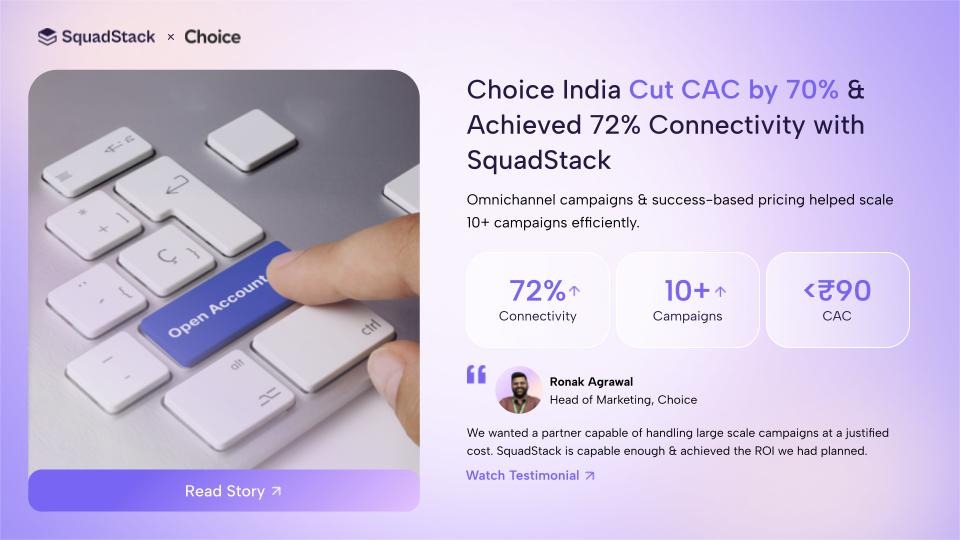
3. Faster Turnaround Times for Support and Collections
Customer Story: Consumer Finance & Collections Team
A consumer finance company faced delays in collections follow-ups and customer callbacks due to limited agent bandwidth. Routine conversations, such as payment reminders and confirmations, were slowing recovery cycles.
By introducing SquadStack’s Conversational AI Voicebot, routine collection conversations were handled instantly and at scale—without waiting for agent availability.
Impact:
- Faster resolution and follow-up cycles
- Improved payment confirmations
- Reduced backlog for human agents
The collections team was able to close loops faster while agents focused on complex recovery cases.
4. Reduced Dependency on Large Agent Teams
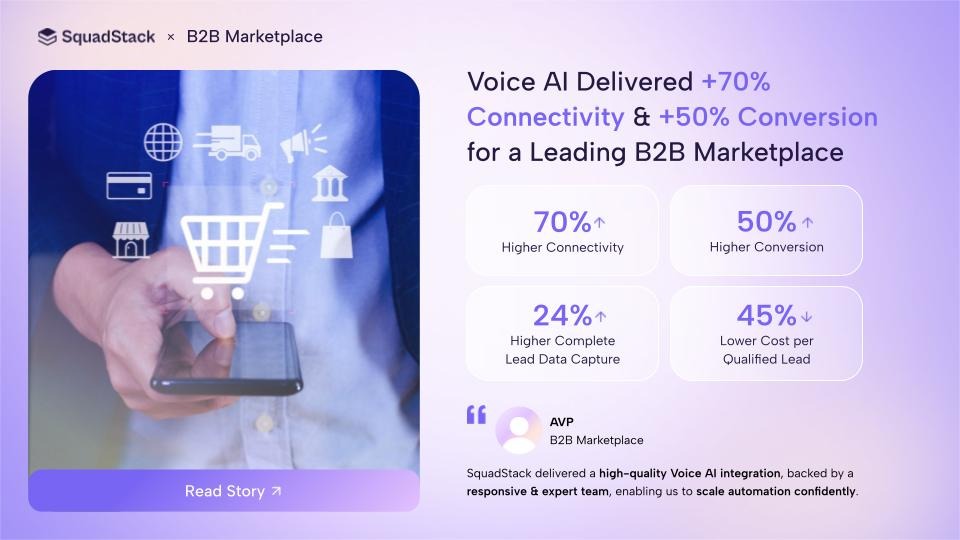
Customer Story: E-commerce & Logistics Company
During seasonal spikes, an e-commerce logistics company had to rapidly hire and train temporary calling agents for onboarding, feedback, and support calls. Attrition and ramp-up time caused inconsistent performance.
SquadStack’s AI Voicebot automated high-volume, repetitive calls such as seller onboarding and feedback collection, drastically reducing dependency on temporary hiring.
Impact:
- 70% lower cost per qualified interaction
- Minimal hiring during peak periods
- Stable performance without retraining cycles
5. Consistent Performance at Scale
Customer Story: Enterprise Consumer Brand
A large consumer brand ran multiple campaigns simultaneously across regions and languages. Human-led calling resulted in inconsistent messaging, variable quality, and compliance risks.
With SquadStack’s Conversational AI Voicebot enforcing standardized conversation flows, tone, and compliance rules, every customer received the same high-quality experience—regardless of volume.
Impact:
- Uniform customer experience across millions of calls
- Improved QA scores and compliance adherence
- Predictable, measurable campaign outcomes
The Future of Call Centers Is Voice + AI + Humans.
The transformation of call centers is not about AI supplanting human work; rather, it is about complementing them to make operations wiser, more productive, and customer-oriented. As businesses scale up and customers' expectations for quicker, more personalized experiences increase, the nexus of voice technology, AI, and human experience will define the shape of modern contact centers.
Industry statistics support the hypothesis that AI is already mainstreamed and increasing in call centers. An estimated 65% of contact centers have implemented some form of AI to enhance customer engagement, and by 2025, 70% of all customer interactions will involve AI of one sort or another. But human agents will remain essential when the calls are complex and require empathetic discussions, let alone judgment, emotional intelligence, or strategic problem-solving.
Conclusion: Why Now Is the Time to Adopt Conversational AI Voicebots
Conversational AI Voicebots have moved well beyond experimentation and pilots; they are now a proven, enterprise-ready solution driving real results across sales, collections, and customer support operations. As noted in both BFSI and non-BFSI implementations of SquadStack, companies using AI-led voice automation have already begun experiencing better contact efficiency, faster turnaround times, and higher conversion rates, while adhering to strict compliance and quality standards.
As evident from data patterns across SquadStack-led programs, a substantial share of routine calling workflows for lead qualification, reminders, confirmations, and follow-ups can be handled by AI Voicebots. This would free human agents to focus on complex and empathy-driven conversations that are critical to generating revenue. Indeed, this hybrid Voice + AI + Human model is increasingly emerging as the most viable and efficient operating model for modern call centers.