Search got solved. Coding is getting eaten by models.
Now we’re entering the next interface shift: Voice as the primary interface for the world.
If you’re a CX, growth, or tech leader at a consumer brand, your inbox probably looks like this:
Every week: a new “Voice AI market map.”
Every day: 5 new pitches from Indore to Israel about “the next generation voice agent”
It’s impressive. It’s also overwhelming.
We felt the same. So, instead of adding yet another vendor comparison, we built a simple evaluation framework you can use to separate demos that wow from systems that compound.
This piece is not about any one company. It’s about how to think.
Created with inputs from Blume Ventures, this framework distills what actually matters when evaluating Voice AI today.
Start With the Job To Be Done (JTBD), Not the Vendor
Before you touch a deck or a demo, ask: What exact job are we hiring Voice AI to do?
Every tool is leveraged for a specific job. For Voice AI, the jobs usually sound like:
“Increase our sales conversions without increasing CAC.”
“Improve collections efficiency without burning users or regulators.”
“Deliver faster, friendlier support without adding 3 new vendor contracts.”
“Handle spikes in volume without breaking SLAs.”
Make it painfully concrete:
Are we replacing something (e.g., a part of a process that humans do today)?
Are we augmenting humans (AI does first pass, humans handle edge cases)?
Are we doing something we couldn’t do before (e.g., proactive outbound at real scale)?
Without a clear JTBD, every pitch sounds good, and every pilot looks “promising,” but nothing scales.
Once you know the job to be done, map the jobs that are coming next.
Ask: Will this platform scale across future use cases, more languages, and new channels, or will I end up buying separate point solutions?
Define How You’ll Know It Worked
The second question: How will we know this is working — in numbers, not adjectives?
Success definitions:
“Increase activation rate by 30% at 40% lower cost per outcome in 90 days.”
“Maintain ≥95 CSAT while handling 2–3× more inbound calls with the same headcount.”
“Reduce cost to collect per ₹ recovered by 25% while staying within RBI/TRAI guardrails.”
You can break this down by use case:
1. Outbound Sales
Connectivity rate (how many target users actually pick up)
If a vendor can’t talk in these terms, you’re not looking at a platform. You’re looking at a demo.
Naturalness Is More Than “Does It Sound Human?”
Most teams over-index on “does it sound human?” in the first 10 seconds of a call.
That’s important. But naturalness is much more:
What to Listen for (Qualitative)
Conversational fluency: Can it handle interruptions, pauses, “hello…hello?”, people talking in the background, or language switching (Hinglish, regional accents)?
Prosody and pacing: Does it have natural rhythm, emphasis, and pauses? Too fast feels robotic; too slow feels dumb.
Emotional intelligence: Can it change tone for a frustrated user vs. a curious one vs. a high-intent buyer?
Overlaps & barge-in: Humans interrupt. Good Voice AI can detect that, stop talking, listen, and respond, not steamroll.
Speech clarity: Is it still clear and understandable in noisy environments and on cheap devices?
These are best evaluated through blind listening tests: mix human + AI calls and see if your team can reliably spot the AI.
What to Measure (Quantitative)
A few under-rated metrics:
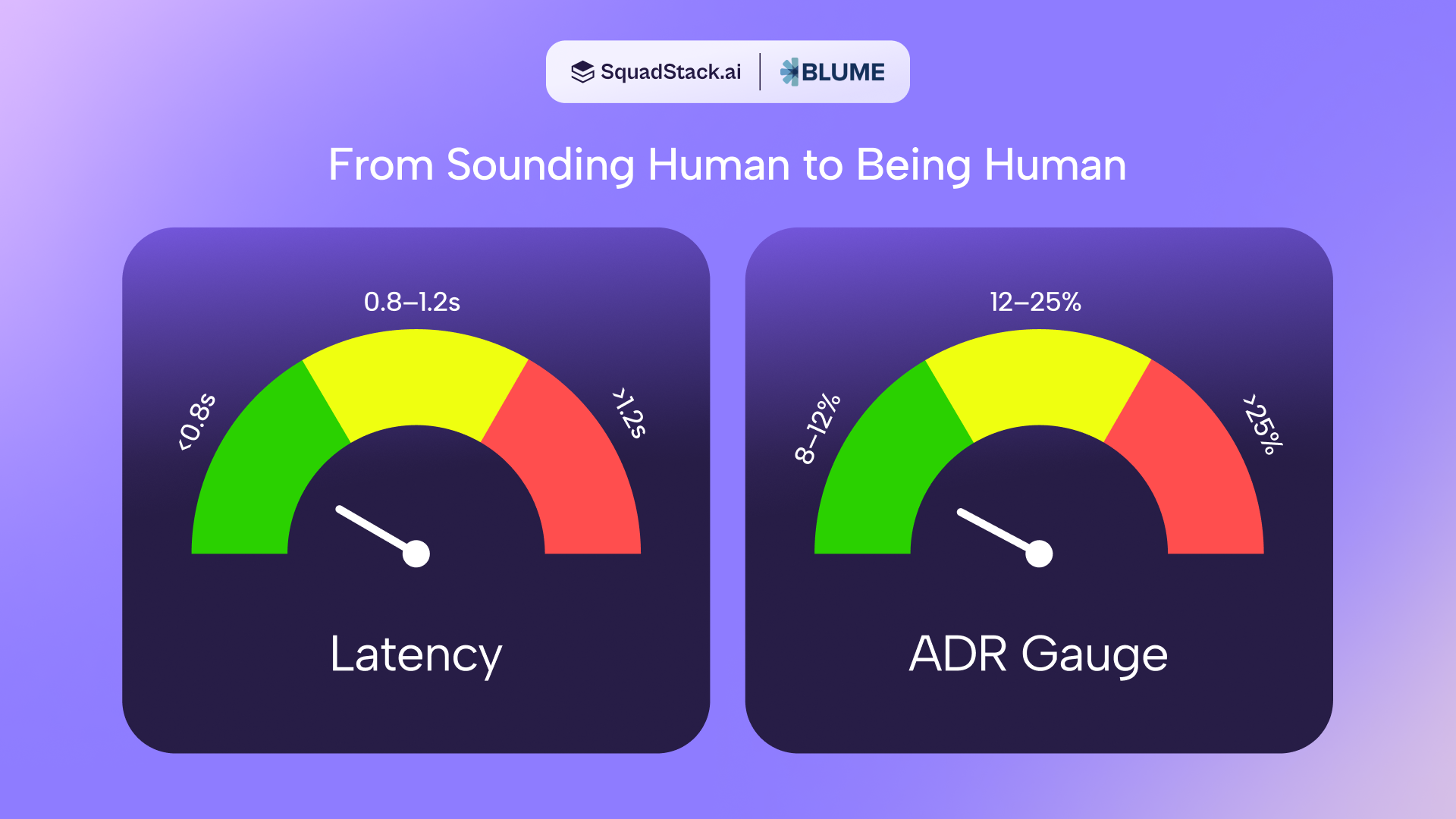
1. Latency
Target: < 0.8 seconds round-trip for most responses.
Anything slower breaks conversational flow and feels “botty.”
2. ADR (Abruptly Disconnected Rate)
Calls ending within the first 10 seconds.
Early systems saw ADRs of 60–70%.
Today, strong systems can get close to or better than human benchmarks (~8–12% ADR).
If a vendor can’t share their latency numbers, ADR, and how they measure naturalness across accents and languages, you’re flying blind.
Evaluate the Whole System, Not Just the Model
This is where many evaluations go wrong.
You’re not buying a model. You’re buying a system.
The Platform Spine
Look at:
1. Routing & orchestration
When does AI handle it?
When does it escalate to a human?
When does it switch channels (voice → WhatsApp → email)?
2. Human-in-the-loop
How easy is it to transfer mid-call to a person?
Can humans see the full context instantly?
Can they feed learnings back into the system?
3. Omnichannel capability
Does it only do calls?
Or does it unify your IVR, chat, WhatsApp, and email with a single brain?
4. Error & edge-case handling
How are “I didn’t get that” moments handled?
Is there a feedback loop to fix those at the platform level?
Integration, Data, and Security (the boring but critical bits)
Ask very specific questions:
1. Integrations & data connectivity
Can it plug into your CRM (Salesforce, HubSpot, homegrown)?
Can it read/write into your core systems in real time?
Does it support real-time data sync across channels?
2. Security & compliance
Encryption at rest and in transit?
Certifications (e.g., ISO 27001, SOC 2 Type II)?
Alignment with DPDP and, where relevant, TRAI/RBI/SEBI/IRDAI guidelines?
Granular audit logs of conversations and actions taken?
Regulated categories (BFSI, health, telecom, marketplaces) don’t just need smart AI. They need defensible AI.
Ask for Their Operational Playbook, Not Just the Product Roadmap
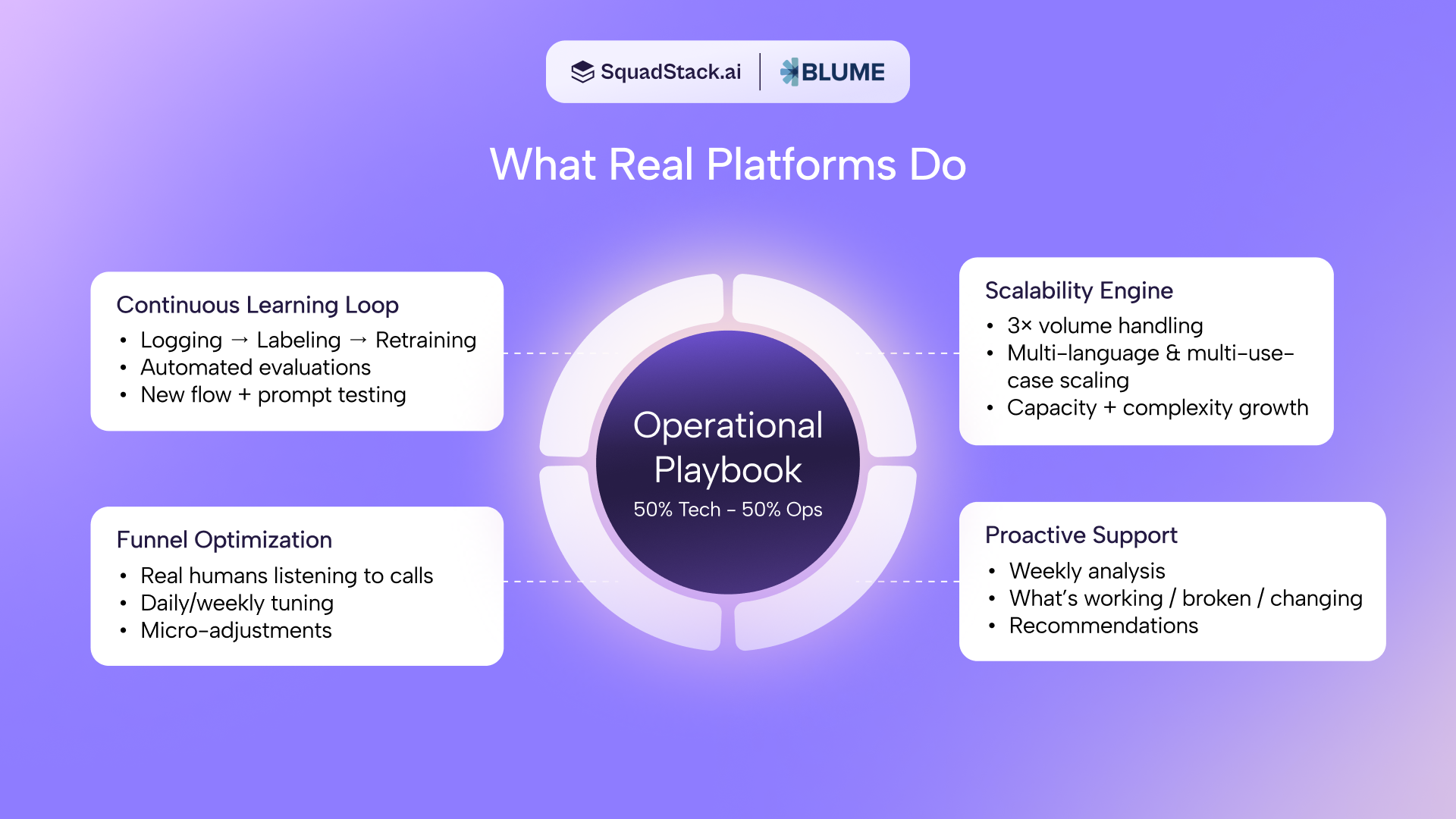
Voice AI that works at scale is 50% tech, 50% operational muscle.
Great vendors should be able to show:
1. Continuous learning loop
How are calls logged, labeled, and fed back into training?
Is there automated evaluation on new flows, new prompts, new model versions?
Funnel optimization & micro-adjustments
Who is listening to calls and tweaking flows?
How often do they ship improvements — monthly, weekly, daily?
2. Scalability
What happens when volume jumps 3×?
Can they scale both capacity (more calls) and complexity (more use cases, more languages)?
3. Proactive support
Will they show up every week with:
“Here’s what’s working.”
“Here’s what’s broken.”
“Here’s what we’re changing and why.”
If the answer is “you get a dashboard and a CSM,” that’s not an operational playbook. That’s an account manager.
Check the Team Behind the Tech
You’re not just evaluating a platform; you’re evaluating who’s in the room building and running it.
Look for a mix of:
ML / ASR / TTS / LLM engineers – deep speech + language chops
Data scientists – performance analysis, experimentation, routing logic
Conversation designers – how the agent actually speaks and handles nuance
Domain experts – people who’ve lived sales, collections, or support
QA & Compliance – people who lose sleep over audits and edge cases
Ask to meet the people who will be on your account: not just sales, but the builders and operators. You’ll learn more in 30 minutes with them than in 300 slides.
The One Question That Cuts Through the Noise
After all this, one final filter: “Can you show me one live use case where you’re beating a human baseline on the metric that matters — with numbers?”
Not a recorded demo.
Not a prototype.
A live, in-production funnel:
Here was the human baseline.
Here’s what the AI or AI+human blend is doing now.
Here’s the time frame.
Here’s the sample size.
Here’s what we changed to get there.
If they can’t show this anywhere, they might be early, which is fine for experiments, but risky for core business flows.
Closing: Voice Won’t Just Be How Machines Talk, It’ll Be How Brands Compete
We’ve already lived through two big shifts:
Search changed how we find information.
AI code assistants are changing how we build products.
Voice will change how we sell, support, and serve, especially in countries and segments where typing is a tax and talking is second nature.
As you evaluate platforms, remember:
Don’t get hypnotized by how human it sounds in the first 30 seconds.
Anchor on jobs to be done and hard metrics.
Evaluate the whole system: tech, ops, compliance, and team.
Bet on platforms that self-improve and beat human baselines over time.
Because in a few years, “Do you use Voice AI?” won’t be an interesting question.
The only question that will matter is: “Is your Voice AI actually moving your P&L?”