AI Voice Agent for Microfinance: Grameen Model at Scale
November 7, 2026
|

13 min read
A closer look at the calling analytics metrics Indian RevOps teams must track to separate qualified pipeline from wasted budget across AI voice campaigns.
The AI calling analytics metrics RevOps teams in India need to track go far beyond total dials. Connect rate, conversation completion rate, intent detection accuracy, sentiment score, and cost per outcome tell you whether your AI voice campaigns are building qualified pipeline or just burning budget. This post breaks down each metric, explains what good looks like in Indian B2C outbound, and shows you how to build a calling performance dashboard that drives decisions.
Indian RevOps teams running outbound at scale face a specific problem. They generate enormous call volumes daily across lending, insurance, edtech, and e-commerce, but most analytics dashboards were designed for Western SaaS inside sales, not high-volume Hindi, Tamil, and Hinglish consumer conversations. The result: teams track what is easy to measure (dials, talk time, IVR completion) rather than what actually predicts revenue.
AI voice calling changes the data available to you. A modern AI voice platform captures intent, sentiment, objection patterns, and outcome classifications at the conversation level across every single call. The question is which numbers to act on.
This is the RevOps team's practical guide to AI calling analytics in the Indian market.
AI calling analytics metrics are structured, conversation-level measurements extracted automatically from AI voice agent interactions. Unlike traditional call center reporting, which captures call duration, disposition codes, and agent handle time, AI calling analytics extract intent signals, sentiment, objection types, and outcome classifications from the conversation itself.
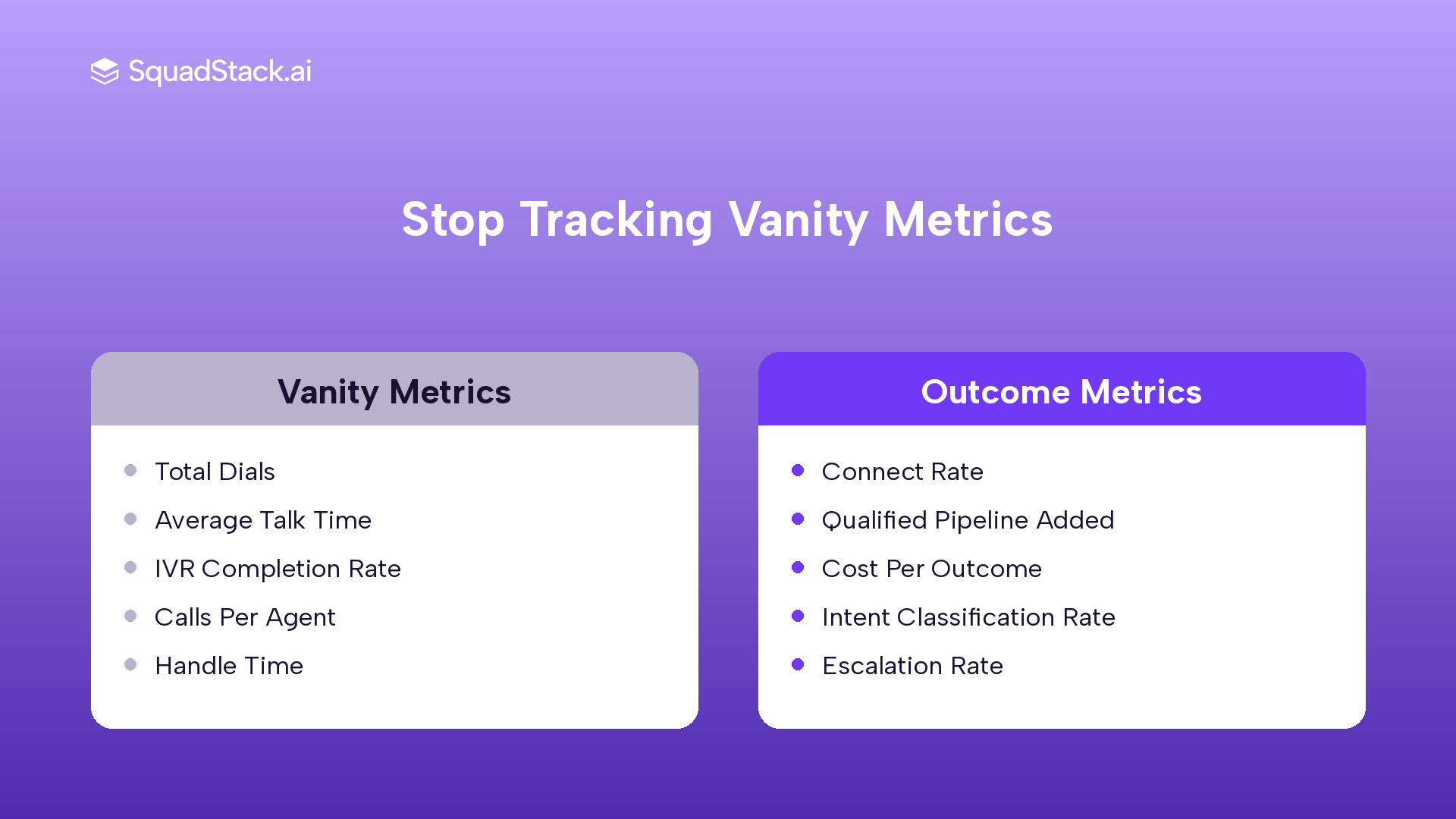
This shifts the data layer from what an agent typed into a CRM after a call to what actually happened during it. For Indian B2C outbound sales, this is especially powerful: campaigns run across multiple languages, lead quality varies widely by source, and the same script performs differently in Hinglish versus Tamil. Conversation-level analytics let RevOps teams see exactly where pipeline is leaking and why.
A full-stack AI calling analytics system runs in four stages.
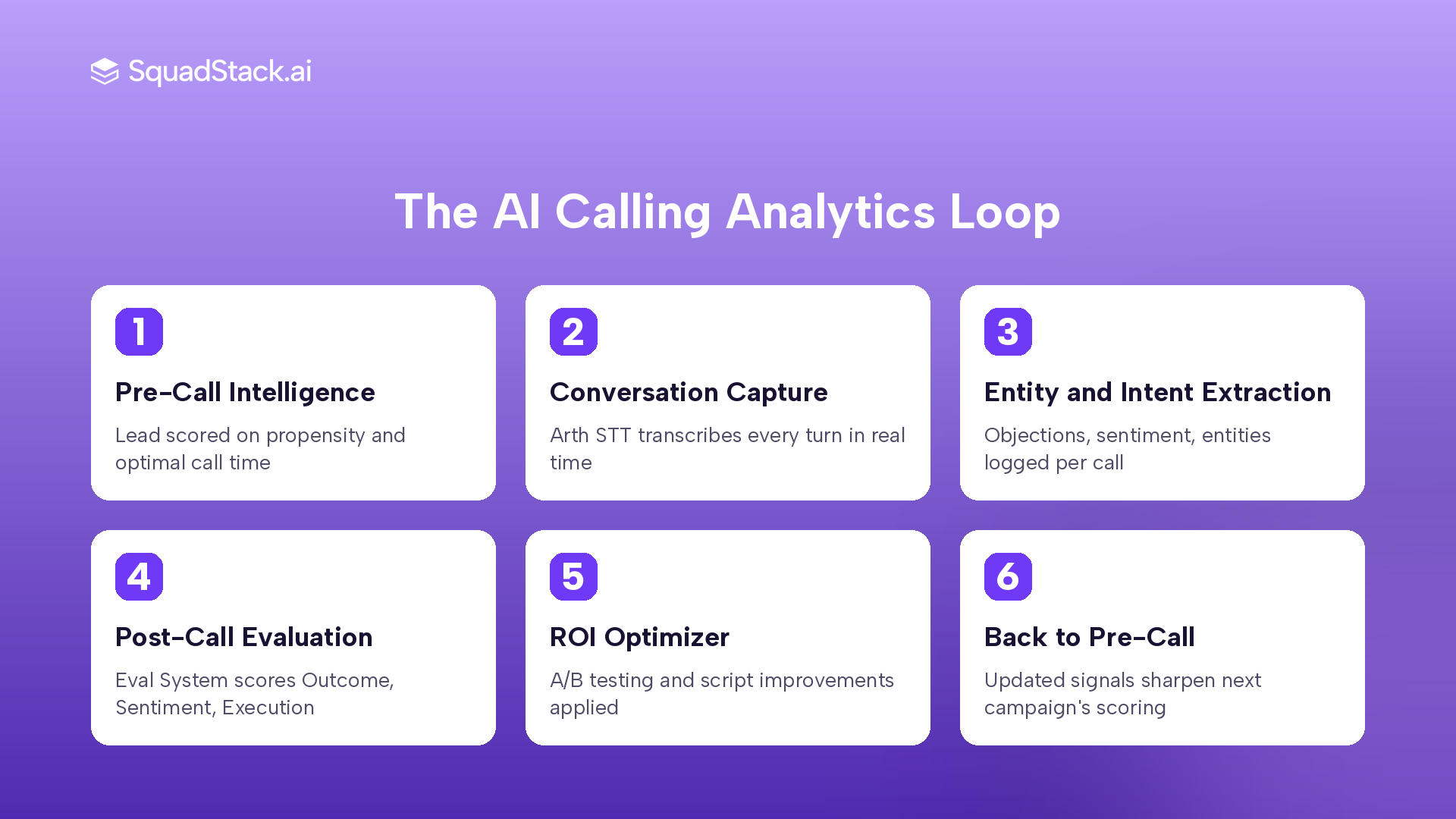
Stage 1: Pre-call intelligence. The AI Lead Manager scores every lead on propensity to convert and assigns an optimal call time. You cannot correctly interpret connect rate data without knowing the quality of the lead list going in.
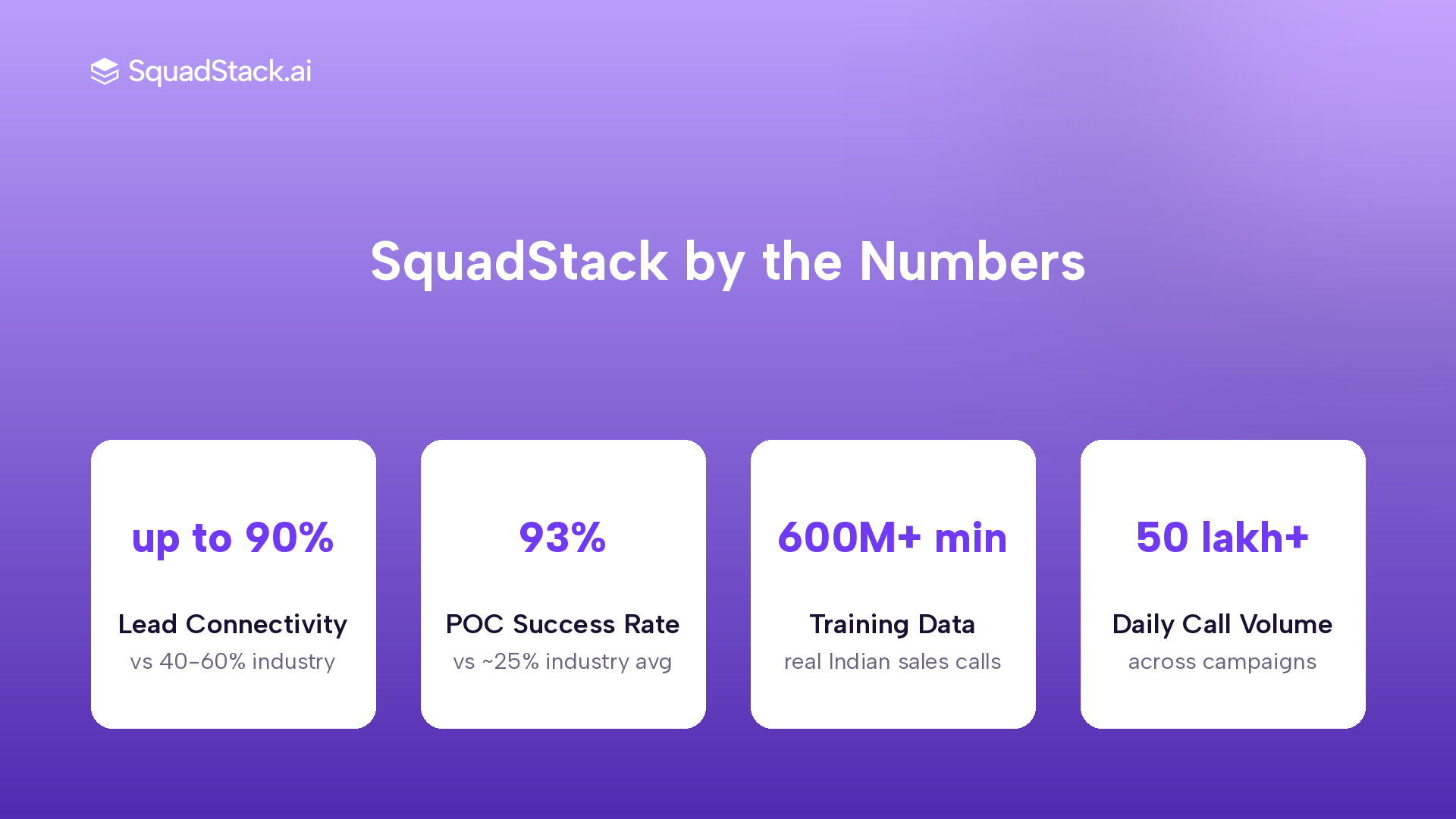
Stage 2: Conversation capture. The AI voice agent holds the call. Every turn is transcribed in real time by a speech recognition layer tuned for Indian telephony conditions. For SquadStack, this is Arth, a proprietary model trained on 600M+ minutes of real Indian sales conversations across noisy 8kHz telephone lines. Named entities such as loan amounts, PAN details, and city names are extracted mid-conversation into structured fields.
Stage 3: Post-call evaluation. The Eval System scores each conversation on three levels: Outcome (did the call achieve its objective?), Sentiment (how did the call land with the buyer?), and Execution (did the agent run the conversation correctly?). This uses both AI scoring and human review. Disposition, entity extractions, and quality scores are written back to the CRM automatically.
Stage 4: Campaign-level learning. Every outcome feeds the ROI Optimizer. The system identifies which scripts, voices, timings, and cadences drove conversions, updates scoring models, and adjusts future calls. The loop is continuous: calls generate insights, insights improve the agent, the improved agent runs better conversations.
RevOps teams tracking AI calling analytics metrics in their RevOps operations in India commonly ask: which numbers should I put on the dashboard? Most teams track the wrong ones.
Connect rate. The share of unique leads actually reached over a campaign's full attempt cadence. This is a lead-level figure, not a per-attempt rate. The industry norm for outbound consumer sales in India sits between 40% and 60%. This is your first health check: if connect rate is low, everything downstream is starved.
Conversation completion rate. Of calls that connected, what share ran through the full intended conversation flow? Early drop-offs signal a robotic voice or a wrong opener. SquadStack tracks this as Abruptly Disconnected Rate (ADR): a caller who identifies they are talking to an AI and hangs up immediately. Getting ADR down to human-agent levels is a naturalness engineering problem, not a dialing problem.
Intent detection accuracy. Did the AI correctly classify what the caller wanted to do? A lead who says "send me the details on WhatsApp first" has a different intent from one who says "I am not interested." Misclassifying these produces wrong follow-up actions and corrupts pipeline data.
Sentiment score. Post-call sentiment extraction identifies how the conversation landed. A loan sales campaign in Tamil where sentiment scores are consistently negative in the first two minutes indicates an opener problem. Segment sentiment by language and lead source to find actionable fixes.
Qualified pipeline added. Of calls completed, how many resulted in a qualified lead, a booked appointment, or a confirmed application step? This is the metric that connects your calling campaign to revenue.
Cost per outcome. Total campaign cost divided by the number of achieved outcomes. For reference, SquadStack has achieved up to 2 to 3x lower customer acquisition cost compared to human agents in specific campaigns.
The table below puts the full stack in one view.
| Metric | What it measures | Vanity or outcome? | India-specific consideration |
|---|---|---|---|
| Total dials | Dialing volume | Vanity | High volumes mask low connect rates |
| Connect rate | Leads actually reached | Outcome (leading) | Target up to 90% with adaptive timing; industry norm is 40 to 60% |
| Conversation completion rate / ADR | Naturalness, early hang-up | Outcome (leading) | Vernacular ADR is higher without native-language voice models |
| Intent detection accuracy | Correct classification of caller intent | Outcome | Critical for code-switched calls (Hinglish, Taminglish) |
| Sentiment score | Buyer experience quality | Outcome | Segment by language and geography |
| Qualified pipeline added | Revenue-relevant conversions | Outcome (lagging) | The core RevOps number |
| Cost per outcome | Campaign ROI | Outcome (lagging) | Use to benchmark AI vs BPO and human agent costs |
| Dimension | Traditional IVR | AI Voice Agent |
|---|---|---|
| Data captured | Call duration, key press, drop point | Intent, sentiment, objection type, entity (loan amount, location, preference), outcome classification |
| Objection handling | Cannot detect or respond to objections | Detects objections live and responds across multiple turns; logged for post-campaign analysis |
| Language handling | Fixed language menu; drops call if caller responds in unscripted language | Native code-switching; conversation continues in the caller's language; analytics segment by language |
| Insight from a failed call | "Call abandoned at menu step 2" | "Caller expressed price objection, cited a competitor rate, sentiment negative from turn 3 onwards" |
| Learning loop | None | Every outcome feeds back into script, timing, and voice optimization |
For a RevOps team running a personal loan campaign across five Indian states, an IVR gives you a drop-off count. An AI voice agent gives you the specific objection, the language it was expressed in, the call stage it appeared at, and the frequency across the campaign. That is the data layer RevOps teams need to improve conversion, not just report on it.
A practical calling performance dashboard for Indian B2C outbound should have three layers.
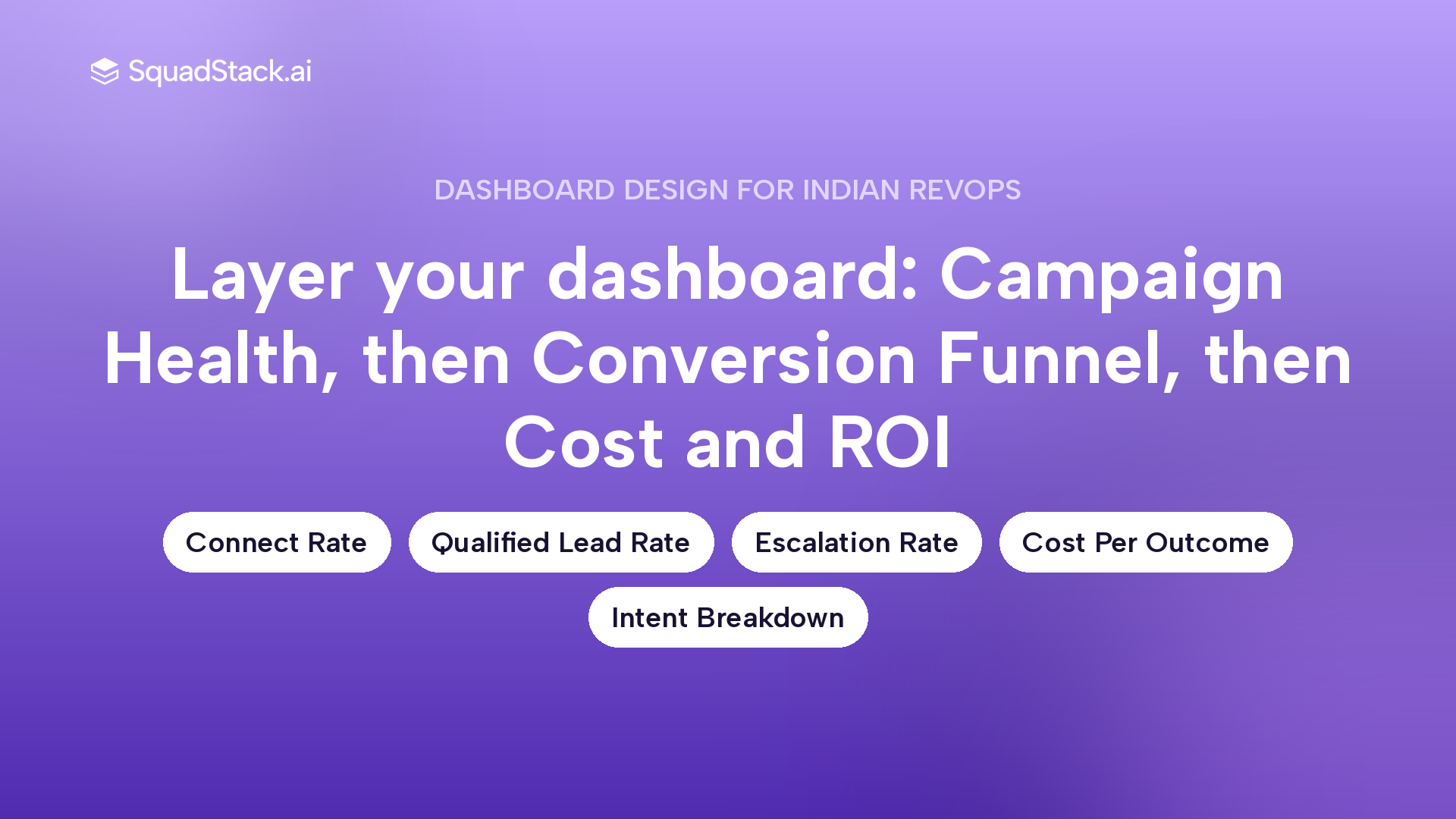
Campaign health layer. Connect rate, ADR, conversation completion rate, and daily call volume. These tell you whether the campaign is running correctly before you look at outcomes.
Conversion funnel layer. Qualified lead rate, intent classification breakdown, escalation rate, and qualified pipeline added. These show where leads are converting or dropping.
Cost and ROI layer. Cost per connected conversation, cost per qualified lead, and cost per closed outcome. These are the numbers RevOps takes to the leadership team.
For high-volume campaigns in India, segment every metric by language. A campaign running in Bengali and Gujarati will show different performance curves in each language. Treating them as one cohort hides both the problem and the opportunity.
SquadStack's platform writes all of these back to the CRM automatically after each call. The AI contact center ROI framework explains how to structure that measurement architecture.
Most analytics debates start with the dashboard. SquadStack starts with the data quality underneath it.
Arth, the platform's speech recognition model, is trained on 600M+ minutes of real Indian sales conversations spanning noisy 8kHz telephone lines, code-switched speech, and 9 live Indian languages. On SquadStack's own benchmark of real Indian telesales audio, Arth v1 achieves a semantic word error rate of 11.9%, within 0.9 points of the best commercial streaming STT available. Accurate transcription is the foundation of accurate analytics: entity extraction, intent classification, and sentiment scoring all depend on getting the words right first.
The Eval System scores every call on Outcome, Sentiment, and Execution using both AI and human review. Campaign teams see quality scores per call, not just aggregate numbers.
The ROI Optimizer closes the loop. Optimize, SquadStack's native A/B testing layer, runs simultaneous experiments on voice, prompt, workflow, and channel cadence across live campaigns. When a prompt change improves qualification rate, it is confirmed on live traffic through a progressive ramp before scaling.
Across 60+ large consumer brands running 50 lakh+ calls daily, including Kotak Mahindra Bank, AngelOne, and Moneyview, SquadStack has delivered up to 90% lead connectivity against the 40 to 60% industry norm. The Moneyview case study shows 89% connectivity and 40% more loan applications. The IndiaMART case study shows 20% higher conversions and 15% lower CAC.
RevOps teams evaluating how AI improves call centre KPIs or looking to reduce outbound calling costs will find the analytics layer is not a reporting add-on; it is the mechanism that compounds performance over time.
If your team runs 50,000+ calls a month and wants to see what a calling analytics dashboard looks like on live Indian campaigns, book a demo to see the numbers from your own lead set.
Which AI calling analytics metrics should a RevOps team in India track first?
Start with connect rate and conversation completion rate. These two leading indicators tell you whether your campaign is reaching leads and whether those conversations are progressing. Only then look at qualified pipeline and cost per outcome as the lagging measures of revenue impact.
Evaluating AI voice bot versus traditional BPO for outbound sales — which platforms show clear analytics on connectivity, conversion, and cost per sale?
AI voice platforms built natively for Indian telephony, like SquadStack, report connect rate at the lead level, intent classification per call, sentiment score, and cost per outcome automatically. A traditional BPO typically gives you disposition codes and handle time. The difference is structured conversation data versus manual logging.
What is a good connect rate benchmark for outbound AI calling in India?
The industry norm for outbound consumer sales in India sits between 40% and 60% of unique leads reached across a campaign. Platforms with adaptive outreach timing, spam-aware number rotation, and verified caller ID can reach up to 90% in specific campaigns. Use 40 to 60% as your baseline for comparing BPO or legacy dialers.
How is cost per outcome calculated for an AI voice calling campaign?
Divide total campaign cost (including platform fees and telephony costs) by the number of completed outcomes, such as qualified leads, booked appointments, or confirmed application steps. This is the RevOps metric that directly compares AI calling costs to BPO costs on the same denominator.
Can AI calling analytics detect why a lead did not convert?
Yes. Post-call analysis extracts the specific objections raised, the stage at which the lead dropped off, and the sentiment trend across the conversation. VoC Insights on the SquadStack platform breaks down non-conversion reasons by percentage across a campaign, including price objections, documentation hesitation, and competitor mentions.
How do AI calling analytics handle multilingual campaigns in India?
A platform trained on Indian sales conversations handles code-switched speech natively. Analytics should be segmented by language to show performance differences across Hindi, Tamil, Gujarati, and other languages. Generic Western analytics tools that aggregate all languages into one cohort hide the real performance variation.
What is intent detection accuracy and why does it matter for RevOps?
Intent detection accuracy measures how correctly the AI classifies what a caller wants to do: convert, reschedule, object, or drop. High accuracy means downstream CRM data and follow-up actions are correct. Low accuracy corrupts your qualified pipeline count and triggers the wrong follow-up, wasting both budget and leads.
How does the AI calling analytics loop improve future campaigns?
Every call outcome feeds back into the platform's optimization layer. The system identifies which scripts, voices, and timings drove conversions, runs A/B experiments on live traffic to confirm the finding, and then scales the winning variant. Each campaign cycle starts from a higher baseline than the last.
We do high-volume edtech lead qualification in Hindi and English. Can an AI voice agent with analytics scale this?
Yes. High-volume edtech lead qualification in Hindi and English is one of the most common use cases on the SquadStack platform, with customers including Adda247, Unacademy, Infinity Learn, and Nxtwave. The platform handles native code-switching between Hindi and English mid-conversation, and qualification outcomes are classified and written back to the CRM per call. See how AI voice agents handle lead qualification at scale.
Is a 93% POC success rate realistic for AI calling deployments in India?
SquadStack's POC success rate is 93% against an industry average of around 25%. The gap comes from the build process: the agent is trained on the client's own call recordings, knowledge base, and FAQs before going live, so it performs close to the client's best human rep from day one rather than requiring months of post-launch tuning.