.svg)





Top AI Outbound Calling Tools in India: Features Compared
October 23, 2026
|

13 min read
AI voice agents recover abandoned carts for Indian D2C brands by calling shoppers in their own language to fix what stopped them. See how it works.
An AI voice agent for abandoned cart recovery in India calls shoppers who left without buying, handles real objections in their language, and books the order before the window closes. Unlike email or WhatsApp nudges, voice gets a response when shoppers have a COD hesitation, an EMI question, or a trust concern that a message cannot resolve. A D2C brand running this well can measure real uplift using a holdout control group and scale it without adding headcount.
India's cart abandonment problem looks the same on paper as anywhere else. A shopper adds items, reaches checkout, and leaves. But the reasons are different here.
COD is the default payment preference for a large share of Indian shoppers, especially in tier-2 and tier-3 cities. A shopper choosing COD has not failed to pay. Their abandonment is almost always about something else: a question about the return policy, uncertainty about delivery timelines, a price objection they did not want to type, or distraction.
Prepaid drop-offs are a different problem. These buyers tried to pay and something stopped them: a payment failure, EMI option confusion, or a trust deficit with an unfamiliar brand.
Neither shopper is well-served by a follow-up email or a WhatsApp discount code. The COD shopper has a question. The prepaid drop-off shopper has a blocker. Both need a two-way conversation. That is exactly what a voice AI agent does.
An AI voice agent for abandoned cart recovery calls a shopper who left your checkout, holds a real conversation, answers their objections, and either completes the order or routes a warm handoff to a human agent for high-value carts.
It is not an IVR. It is not a robocall. It listens, responds to what the shopper actually says, and adapts. A shopper who says "mujhe EMI mein chahiye" gets an EMI explanation, not a scripted repeat of the original offer.
The agent connects to your e-commerce stack through a webhook or API, triggers when a cart is abandoned, and begins the outreach cadence within minutes.
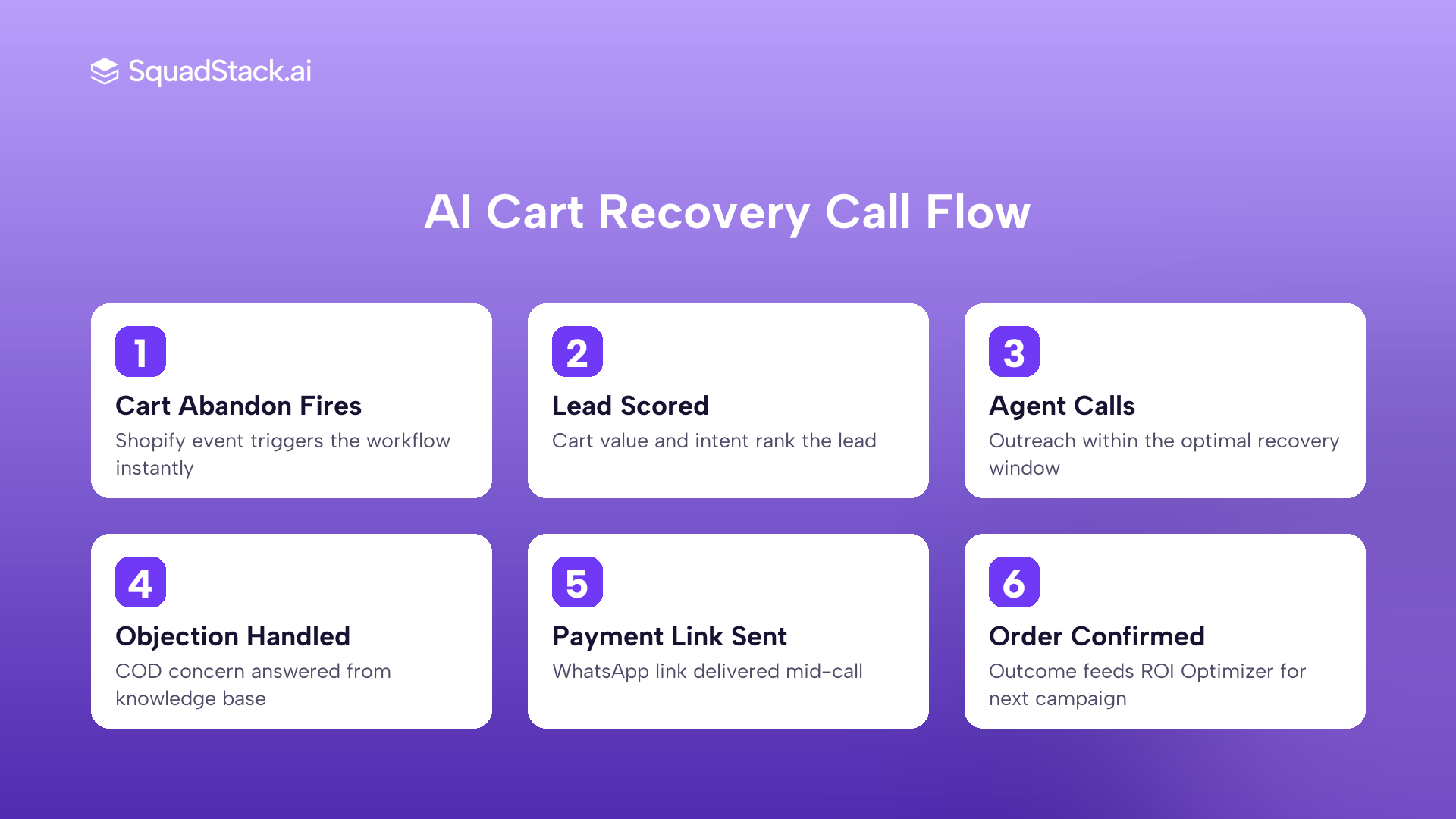
1. Trigger and lead scoring. A cart abandon event fires from your store (Shopify, Unicommerce, or a custom backend) and the platform scores the lead by intent signal, cart value, payment method, and prior interaction history. High-intent, high-value carts move to the front of the queue.
2. Outreach timing. The agent calls within the optimal window, which the platform learns over time. Calling too fast feels intrusive. Calling the next day misses the intent window.
3. The conversation. The agent opens with a warm greeting in the shopper's language, references the cart item by name, and invites a conversation. If the shopper raises a COD concern, EMI question, or delivery worry, the agent addresses it from your product knowledge base. It does not guess or improvise product facts.
4. Resolution. The agent confirms the order, sends a payment link via WhatsApp mid-call if the shopper wants to switch to prepaid, books a callback, or flags a warm transfer for complex queries.
5. Continuous learning. Every call outcome feeds back into the platform's ROI Optimizer. Script phrasing, call timing, and objection responses improve with each campaign without anyone rewriting a script manually.
Abandoned cart recovery is the headline use case, but voice AI attaches to several other points in the D2C order lifecycle.
COD confirmation. Before dispatch, the agent calls to confirm a COD order is real and offers a prepaid switch with an incentive. This directly reduces the RTO rate, one of the biggest margin drains in Indian D2C.
Order and address verification. Delivery failures in tier-2 and tier-3 cities often come from incomplete addresses. An outbound call that confirms the address and captures a landmark before dispatch cuts NDR volume significantly.
NDR resolution. When a delivery attempt fails, the agent calls immediately, corrects the address or slot, and triggers a reattempt. A conversation within 24 hours of the first failed attempt saves most deliveries.
NPS and post-purchase feedback. After delivery, the agent captures a rating and flags dissatisfied customers for human follow-up before they become a return or chargeback.
Win-back calls. For customers past their natural repurchase window, a voice call with a specific reason to return outperforms email and push for lapsed users who no longer open messages.
For a full picture of how voice AI fits the e-commerce lifecycle, see SquadStack's e-commerce industry page and the conversational AI in retail guide.
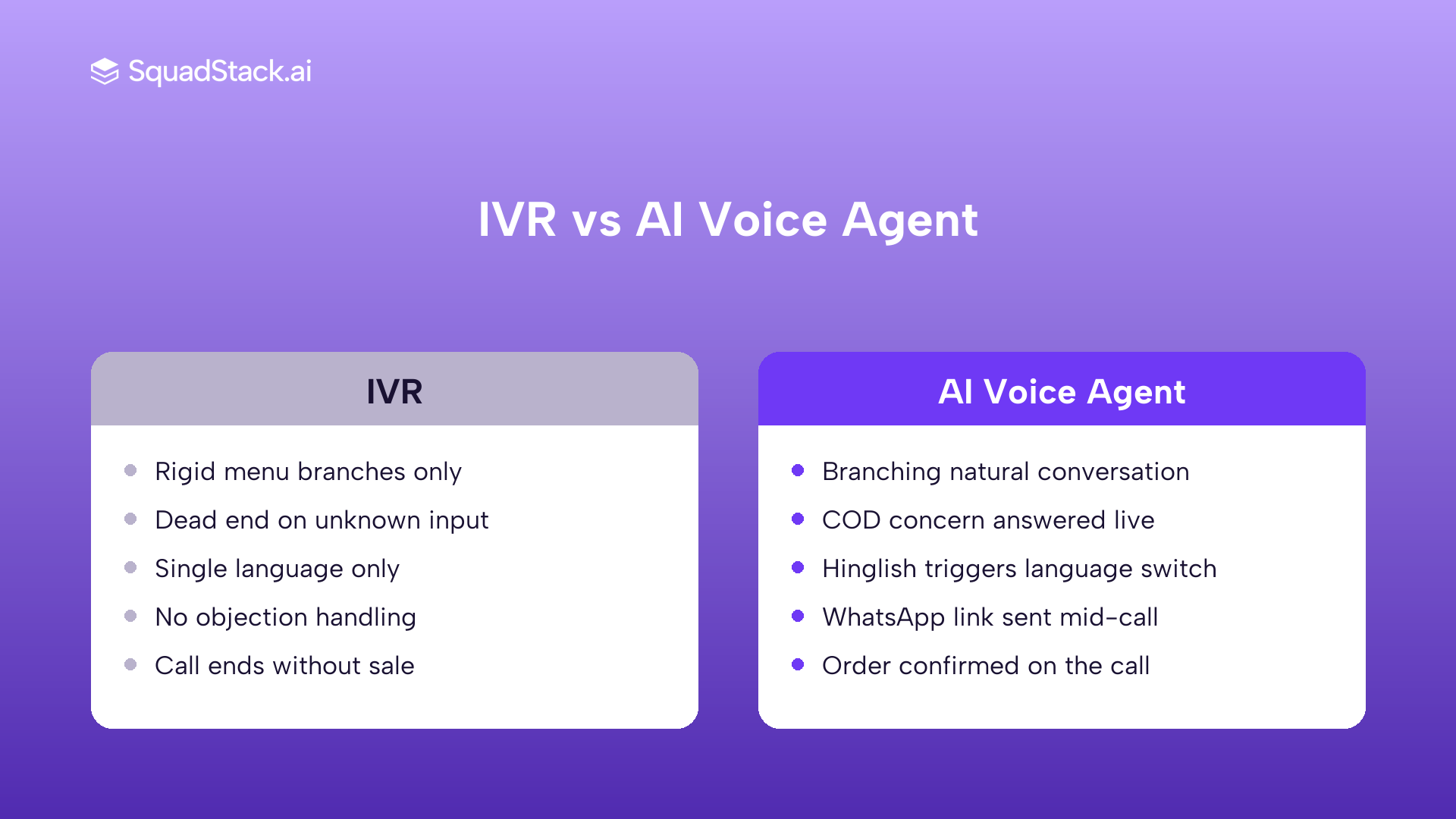
| Dimension | IVR | AI Voice Agent |
|---|---|---|
| COD objection ("I'll pay at delivery but I'm worried about return policy") | Reads a fixed message or drops the call | Answers the specific policy question from your knowledge base, then confirms the order |
| Language switching | Configured for one language; cannot adapt mid-call | Switches languages mid-sentence based on how the shopper responds |
| Payment link mid-call | Cannot send anything | Sends a WhatsApp payment link while the shopper is still on the line |
| Off-script question | Loops, repeats the menu, or says "I didn't understand" | Handles the deviation, answers or flags a transfer, keeps the conversation moving |
| Response time | Pre-recorded; plays at fixed pace | Median response latency of 0.8 seconds or less |
| Learning between campaigns | None; someone must manually rewrite the script | Outcomes feed back automatically; script and timing improve with each run |
The practical difference: a shopper with a real question about EMI tenure will hang up on an IVR within ten seconds. The same shopper will stay on a natural voice conversation and often convert.
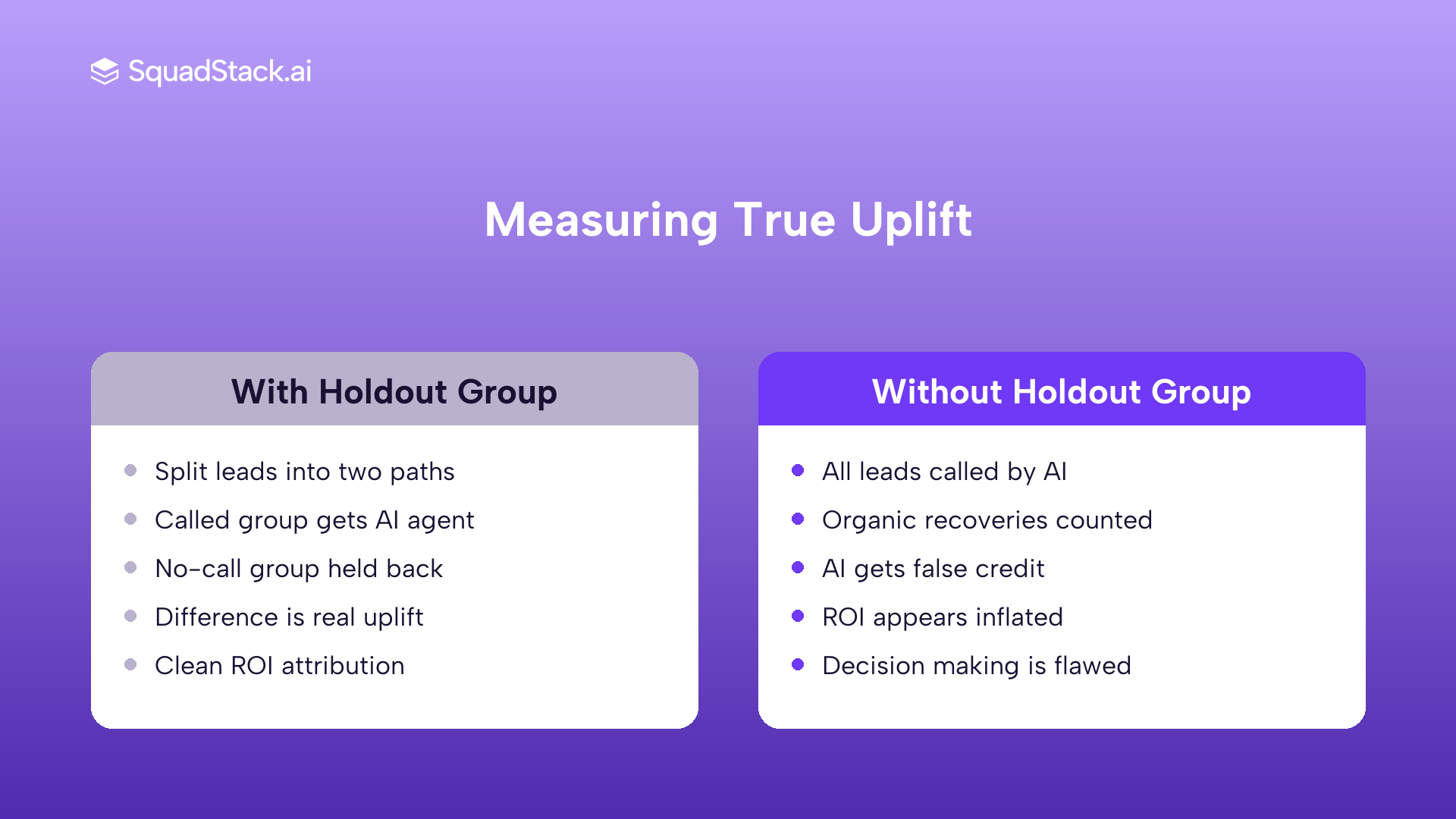
Most D2C operators get the ROI calculation wrong. If you call all abandoned cart shoppers and track how many buy, you are measuring organic recovery plus the agent's contribution combined. You cannot separate them.
The right method is a holdout control group. Before the campaign starts, randomly assign a share of abandoned cart leads to a no-call group. Run the agent on the rest. Compare conversion rates. The difference is the true incremental lift from the voice AI.
This also prevents inflated CAC calculations. Some shoppers would have bought anyway from a retargeting ad or email. Crediting the voice call for those conversions overstates the agent's value.
Ask any vendor whether their reporting separates incremental from organic. If they only show overall recovery rate, the number is not comparable to anything.
| Criteria | What to ask |
|---|---|
| Indian language support | Are Hindi, Tamil, Telugu, Kannada live today, or listed but not in production? |
| Speech model | Is the STT trained on real Indian telephony audio? Code-switching requires training data that reflects how people actually speak. |
| TRAI compliance | Are calling hours hard-enforced by the system? Is DND scrubbing automatic before every dial? |
| Integration | Can it trigger directly from Shopify or your webhook on cart abandon events? How long does setup take? |
| Holdout testing | Does the platform support a control group to measure true incremental uplift? |
| Latency | What is the median response time? Above 1 second, conversations feel unnatural and shoppers disengage. |
| QA | How does the vendor audit call quality? AI-only, human-only, or both? |
| Managed vs self-serve | Who builds and tunes the script? Self-serve platforms push that onto your team; managed platforms own the outcome. |
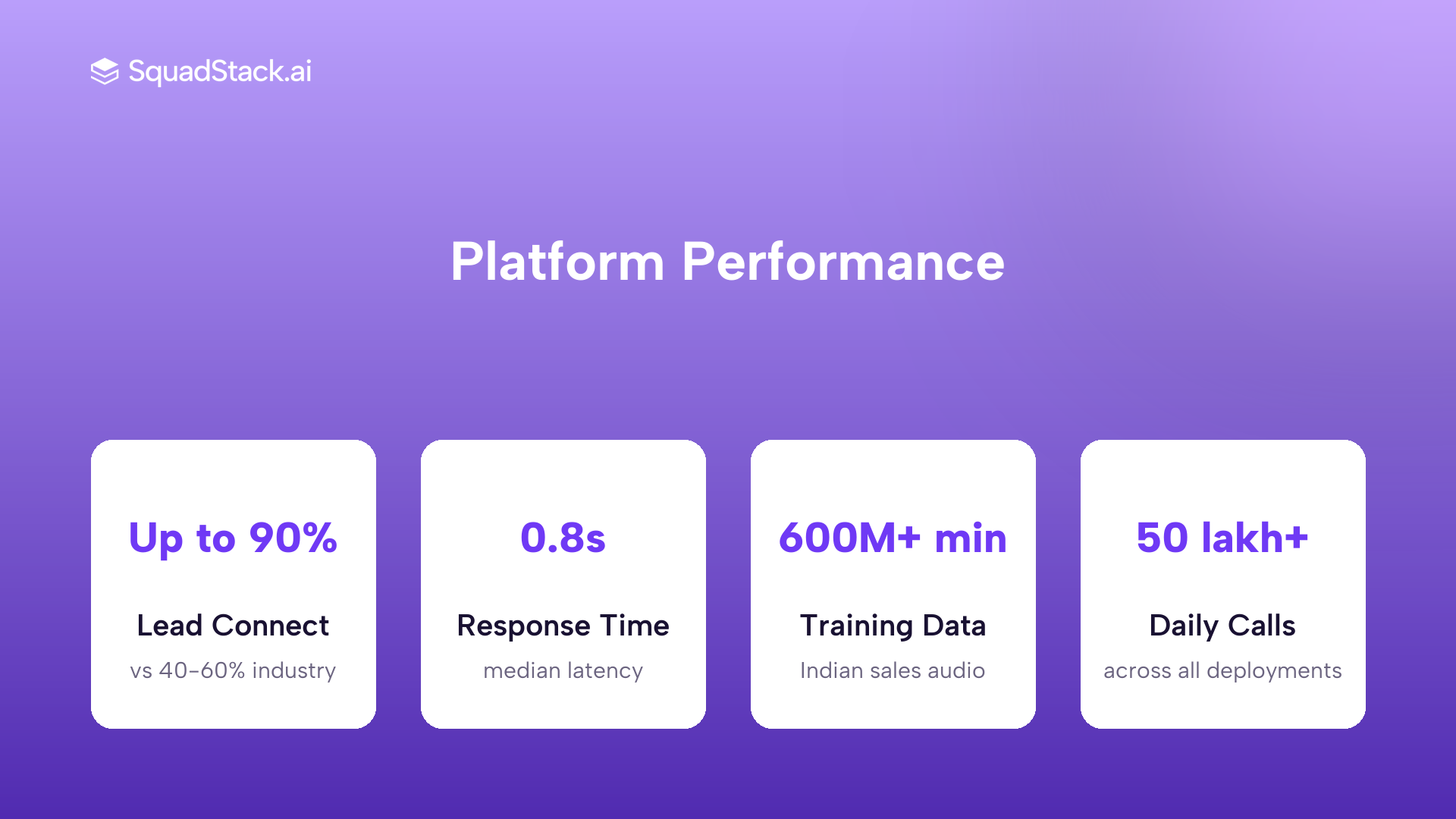
SquadStack's proprietary speech model, Arth, is trained on 600M+ minutes of real Indian contact center conversations, including code-switched speech like Hinglish and Taminglish, on actual 8kHz telephone lines with background noise and packet loss. Most competitors train on public datasets. The gap shows up the moment an agent hears a Tamil speaker switch mid-sentence into English.
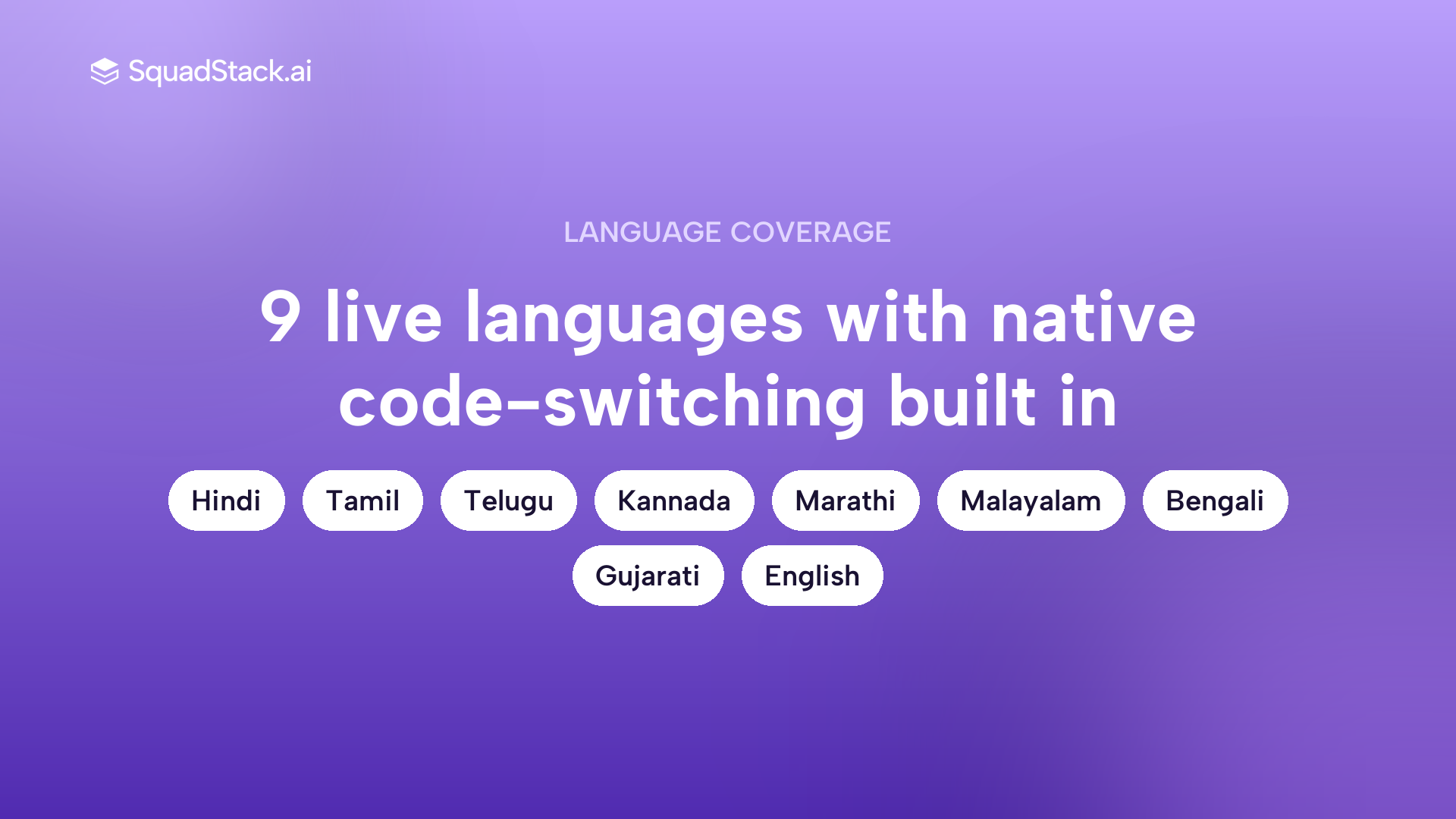
SquadStack runs 9+ Indian languages with native code-switching. Hindi, English, Tamil, Telugu, Kannada, Marathi, Malayalam, Bengali, and Gujarati are live today. More regional languages are available on demand.
Calling hours between 9:30 AM and 8:30 PM are hard-enforced at the system level. DND scrubbing runs automatically before every dial. Consent-aware dialogue is built into the conversation layer.
A leading D2C personal care brand achieved 8x ROI using SquadStack's voice AI for cart recovery. The full story is in the case study. Shiprocket and Bellavita are also active customers on the platform.
The platform handles the full funnel: lead scoring, outreach timing, multilingual conversation, WhatsApp mid-call actions, QA via the Eval System (Outcome, Sentiment, Execution), and continuous optimization through the ROI Optimizer. Every engagement includes a dedicated squad: an AI Agent Product Manager, a Forward Deployed Engineer, a Conversational AI Designer, and a QA specialist.
Across all campaigns, SquadStack delivers up to 90% lead connectivity against a 40 to 60% industry norm, and runs 50 lakh+ calls daily for 60+ large consumer brands. The POC success rate is 93%, compared to roughly 25% industry average.
For more on how the AI voice agent platform works and how it powers e-commerce support more broadly, those pages cover the platform in depth.
Every outbound AI calling programme in India runs under TRAI's telecom regulations. Key requirements: calls restricted to 9:30 AM to 8:30 PM; cold outreach must use 140-series numbers; numbers must be scrubbed against the TRAI DND registry before dialing; leads who opt out during a call must be honored immediately.
These are not optional courtesies. Non-compliance creates regulatory exposure and destroys caller ID reputation, which kills connectivity rates. SquadStack enforces all of these at the platform level. Calling-hour restrictions are a hard system block. DND scrubbing runs automatically. Numbers are monitored for spam flags on Truecaller and rotated out when flagged.
If a vendor cannot explain exactly how they enforce TRAI compliance, that is a risk you are absorbing.
If your D2C brand is losing revenue to cart abandonment and you want to measure real incremental uplift, book a demo or talk to the SquadStack ecommerce team. The typical pilot goes live within two weeks and runs against a pre-aligned success metric.
Which is the best AI voice agent for abandoned cart recovery in India?
The best fit depends on whether the vendor has real production deployment in Indian languages, not just a language list on their website. Look for live Hindi, Tamil, Telugu, and Kannada campaigns, TRAI-compliant dialing infrastructure, and a managed-service model that owns outcomes. SquadStack runs verified abandoned cart recovery for D2C brands in India, trained on 600M+ minutes of real Indian sales conversations.
Can an AI voice agent for abandoned cart recovery integrate with Shopify?
Yes. The agent connects to Shopify (or any e-commerce backend) via webhook or API. When a cart abandon event fires, it triggers the outreach cadence automatically. Integration typically takes days, not weeks, and includes CRM write-back so every call outcome syncs to your records.
How do I track real uplift from a cart recovery AI voice program?
Use a holdout control group. Randomly assign a portion of abandoned cart leads to a no-call group before the campaign starts. Compare conversion rates between called and uncalled groups. The difference is your true incremental recovery rate. Without this, you are measuring organic recovery alongside the agent's contribution and cannot separate them.
Is AI calling for cart recovery legal in India under TRAI rules?
Yes, provided the campaign follows TRAI rules: calls only between 9:30 AM and 8:30 PM, use of 140-series numbers, DND registry scrubbing before every dial, and immediate opt-out honoring. A platform that hard-enforces these at the system level eliminates compliance risk.
How is voice better than WhatsApp or email for cart recovery in India?
Email and WhatsApp work for shoppers who got distracted. They do not work for shoppers with a real objection, a COD concern, or an EMI question. A voice call handles those objections in real time, in the shopper's language, and can send a payment link mid-call if the shopper wants to switch to prepaid. Conversion rates on voice are higher for high-intent carts where the shopper stopped because of a question, not disinterest.
What languages does SquadStack's voice AI agent support for cart recovery calls?
Hindi, English, Tamil, Telugu, Kannada, Marathi, Malayalam, Bengali, and Gujarati are live today, with native code-switching so the agent switches languages mid-sentence the way a bilingual human does. More regional languages are available on demand.
How long does it take to go live with a cart recovery AI voice campaign?
Most campaigns go live within two weeks. The build includes training the agent on your product knowledge base, call recordings, and FAQs. Pilot duration is typically four to eight weeks, running against a pre-aligned success metric before scaling.
How does the AI handle a shopper who wants to pay on delivery but has concerns?
The agent answers the specific concern from your product knowledge base, whether it is about the return policy, delivery timeline, or cancellation process. If the concern is complex or the cart value is high, the agent can transfer the call live to a human agent with full conversation context already passed.
What happens when a shopper asks an off-script question?
The agent retrieves the answer from your knowledge base in under 100 milliseconds. If the answer is not in the knowledge base, the agent can book a callback or trigger a warm transfer. It does not guess or improvise facts.
Can the AI send a payment link or WhatsApp message during the call?
Yes. The agent can send a WhatsApp message or payment link mid-conversation while the shopper is still on the line. This is useful for converting a COD shopper to prepaid in the same call, with an incentive communicated verbally and the link delivered simultaneously.
Sources: SquadStack Product Knowledgebase (2026-08-24); SquadStack ABM Knowledge Base (2026-08-25); SquadStack case study: A Leading D2C Personal Care Brand; Industry cart abandonment and COD data

