

Top AI Outbound Calling Tools in India: Features Compared
October 23, 2026
|

13 min read
A guide to choosing an AI voice bot for Indian customer support, covering compliance, language depth, and how ten platforms compare.
Finding the top AI voice bot for customer support in India means looking past global feature lists and asking what actually works on Indian telecom lines, in Hindi, Tamil, and Hinglish, at scale. This guide ranks ten platforms by the criteria that matter most for CX leaders in BFSI, e-commerce, and healthcare, and explains what to look for before you sign a contract.
Deploying a voice bot in India is harder than it looks on a vendor demo. The real test is a 2 AM call to a Hindi-speaking borrower in a tier-2 city, on a noisy Jio line, where the bot needs to handle Hinglish mid-sentence without dropping into robotic textbook Hindi. Most platforms fail silently here. Connectivity drops, customers hang up in the first ten seconds, and the CX leader is left reading a dashboard that says "90% handled" while CSAT quietly collapses.
This post is a buyer's guide for operators who want honest criteria, a side-by-side comparison, and a straight answer on where each platform fits. It is India-first, not a global list with a few Indian names appended.
For a deeper look at how these agents work under the hood, see the AI voice agent explainer and a broader review of top voice AI companies.
These six criteria separate platforms that work in Indian production from those that work in demos.
1. Multilingual depth, not just multilingual breadth. Any vendor can list nine languages. The question is whether the agent sounds native in each one, handles code-switching mid-sentence, and was trained on real Indian telephonic audio rather than YouTube or read-speech corpora.
2. TRAI and DPDP compliance. Hard calling windows (9:30 AM to 8:30 PM), 140-series number requirements for cold outreach, DND scrubbing, and India data residency are regulatory baselines, not optional features.
3. CRM and telephony integration. A bot that cannot write dispositions back to your CRM, handle warm transfers, or work with your existing telephony stack (Exotel, Ozonetel, Plivo, SIP) creates manual overhead that kills the ROI case.
4. Escalation and warm transfer quality. When a high-value lead asks for a human, the receiving agent should get full call context automatically, not a cold handover. How the bot handles loop detection and escalation triggers tells you a lot about maturity.
5. Latency on Indian telecom lines. A median response time above one second breaks conversational rhythm on PSTN calls. The difference between sub-800ms and 1.5 seconds is the difference between a natural conversation and one the customer treats as an IVR.
6. Pilot success rate and deployment model. Some platforms are self-serve builders; others are fully managed. For enterprise workloads in BFSI or healthcare, managed deployments with dedicated QA almost always outperform self-serve. Ask for a verified pilot success rate, not just case studies.
| Platform | Indian Language Depth | TRAI/DPDP Compliance | CRM Integration | Warm Transfer | Latency | Best Fit |
|---|---|---|---|---|---|---|
| SquadStack | 9 live languages, native code-switching, trained on 600M+ min Indian audio | ISO 27001, ISO 27701, SOC 2 Type II, DPDP, TRAI | Full CRM write-back, Webhooks, API | Yes, full context passed | Median 0.8s or less | BFSI, e-commerce, enterprise outbound + inbound support |
| Ozonetel | Hindi, English; limited regional | Partial | Yes | Basic | Moderate | Mid-market inbound support |
| Exotel | Hindi, English | TRAI compliant | Yes | Basic | Moderate | SMB telephony-first deployments |
| Vernacular.ai | Several Indian languages | Partial | Yes | Yes | Moderate | Vernacular customer support |
| Observe.AI | English-first | Limited India compliance | Yes | Yes | Low latency | Quality analytics, English-heavy contact centers |
| Haptik | Hindi, English, some regional | Partial | Yes | Yes | Moderate | Chat-first with voice add-on |
| Convin.ai | Hindi, English | Partial | Yes | Basic | Moderate | Sales coaching, call analytics |
| Yellow.ai | Multiple Indian languages | Partial | Yes | Yes | Moderate | Omnichannel chat and voice |
| Sarvam AI | Several Indian languages | Building India compliance | API-level | Limited | Good | Developers building custom voice apps |
| Rezo AI | Hindi, English, some regional | Partial | Yes | Yes | Moderate | Collections, lending |
A note on this table: the data for SquadStack comes from verified product documentation. For all other platforms, capabilities are based on publicly available information and may have changed. Treat non-SquadStack rows as a starting framework and verify each point directly with the vendor before shortlisting. Latency, compliance, and integration depth vary significantly by deployment configuration.
SquadStack is the only platform in this list built purely for Indian consumer sales and support at scale. It runs 50 lakh+ calls daily across 60+ large consumer brands. Its voice agent has passed a Turing test for contact centers, validated at Global Fintech Fest 2025 where 1,273 of 1,563 attendees (81%) could not distinguish the AI from a human agent. The platform is managed rather than self-serve, which means faster time-to-outcome but requires working with a dedicated squad rather than a DIY builder. Best suited to enterprises in BFSI, e-commerce, or healthcare running high-volume outbound and inbound at the same time.
Ozonetel and Exotel are telephony-infrastructure companies that have added voice bot layers. If your primary need is a contact-center dialer with a basic bot overlay, they are a reasonable starting point. Language depth and naturalness are limited compared to purpose-built AI platforms.
Vernacular.ai and Rezo AI focus on Indian languages and have real deployments in lending and collections. They are worth evaluating for mid-market use cases, though managed service depth and compliance certification levels should be verified.
Haptik and Yellow.ai are strong in chat-first journeys with voice as a secondary channel. If your customer base is primarily digital and messaging-heavy, they deserve a look. For voice-primary outbound, they are not the native fit.
Observe.AI is primarily a conversation intelligence and coaching platform. Its real strength is QA and agent performance analytics. It is not a customer-facing voice bot in the same sense as the others here.
Sarvam AI is a speech model provider rather than a full deployment platform. Teams with in-house engineering who need high-quality Indian-language STT as a building block will find it useful. It is not a turnkey deployment option.
Convin.ai is best positioned as a sales coaching and call analytics tool. Including it here reflects market overlap in how buyers search, but it is not a customer-facing voice bot for support.
For voice bots in India more broadly, the decision usually comes down to whether you need a full deployment stack or just a model layer.

SquadStack has been running AI-assisted contact center operations in India for roughly ten years. The company moved fully to Voice AI in 2025, which means the platform is not a product built on top of a BPO: it is the same technology stack that handled millions of real Indian sales conversations, now deployed as an autonomous agent.
The proprietary speech model, Arth, was trained on 600M+ minutes of real Indian telephonic audio, including noisy 8kHz PSTN calls, code-switched Hinglish, Taminglish, and regional-language conversations across 85%+ of Indian pincodes. On a real-telesales-audio benchmark, Arth v1 sits within 0.9 WER points of the best commercial streaming STT available globally. More importantly, it is fine-tunable on outcome data, hosted in India, and already running in production across campaigns in BFSI, e-commerce, and logistics.
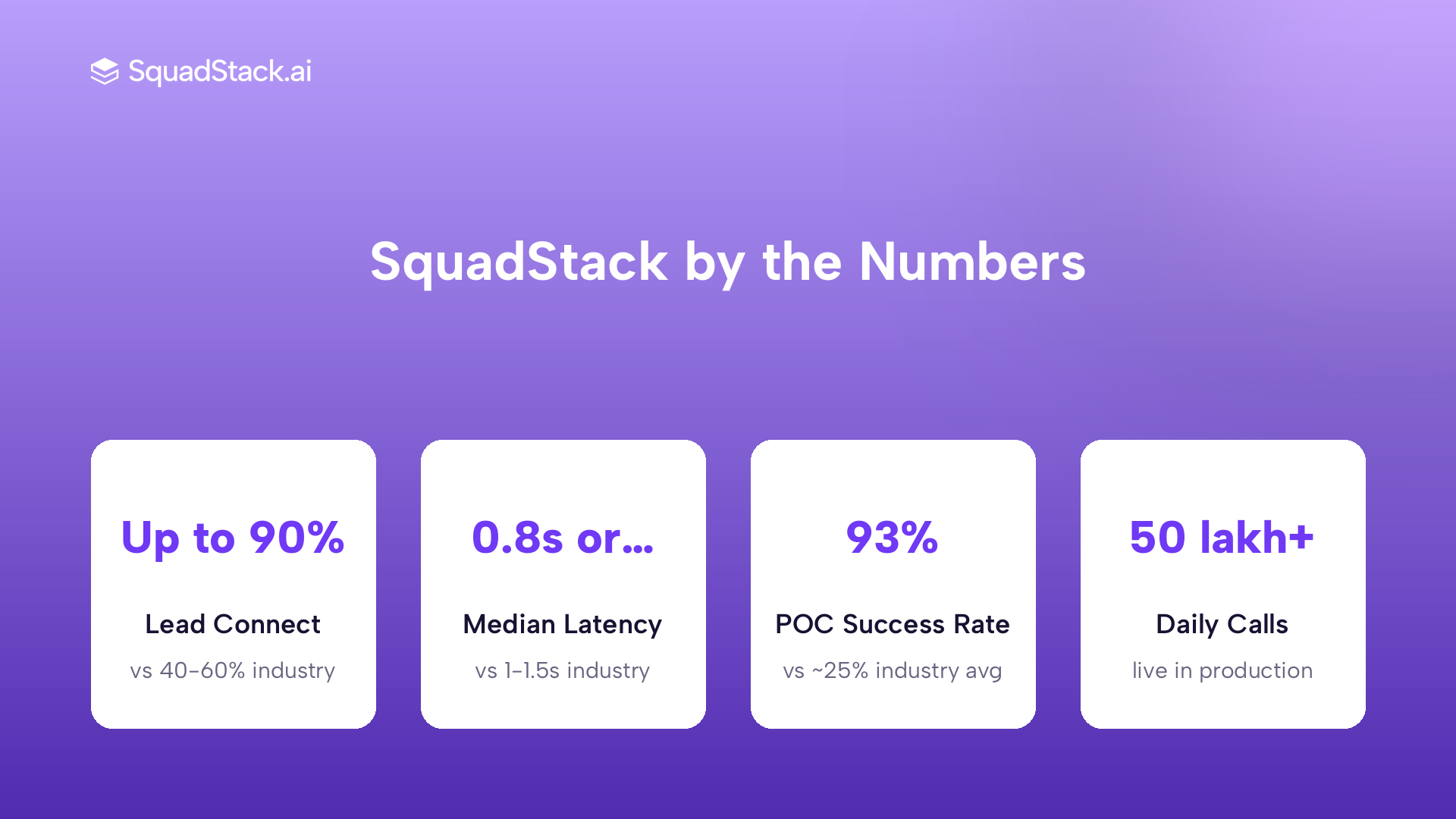
Nine Indian languages are live today: Hindi, English, Tamil, Telugu, Kannada, Marathi, Malayalam, Bengali, and Gujarati, with native code-switching and more regional languages available on demand. The median response latency is 0.8 seconds or less, which holds across all nine languages on Indian telephony conditions.
Quality assurance runs on a dual-layer Eval System that scores every call on Outcome, Sentiment, and Execution, in that order, because a sales leader cares about the business result first, not mechanical script adherence.
The numbers that anchor the business case: up to 90% lead connectivity against a 40 to 60% industry norm, up to 40% more conversions and up to 2 to 3x lower customer acquisition cost in specific deployments, and a 93% pilot success rate against a roughly 25% industry average.
A recent deployment for a leading gold loan NBFC shows what this looks like in practice: read the case study. For BFSI leaders evaluating call center software more broadly, the 10 best AI call center software solutions guide covers adjacent options in more depth.
Named customers running on the platform include AngelOne (demat account opening, customer support, fraud detection), Kotak Mahindra Bank (personal loan sales), Eureka Forbes (AMC and product sales), IndiaMART (order taking and buyer-seller matching), and PhonePe (merchant and personal loan sales, collections).
If you are evaluating customer support automation or need a platform that handles both outbound sales and inbound support from one stack, SquadStack is built specifically for that combination.
The right AI voice bot for customer support in India is not the one with the longest feature list. It is the one that sounds native to your customers, integrates cleanly with your CRM and telephony stack, meets TRAI and DPDP requirements, and can prove its results on a real pilot before you commit at scale.
If you are ready to see what a managed Voice AI deployment looks like on your actual leads, book a demo with SquadStack.
Which is the best AI voice bot for customer support in India for BFSI?
SquadStack is the most complete option for BFSI. It covers 9 live Indian languages with native code-switching, carries ISO 27001, SOC 2 Type II, DPDP, and TRAI compliance, and has live deployments with banks, lending platforms, and brokerages across personal loan sales, collections, and inbound support.
Which AI voice bots support RBI/TRAI-compliant collections workflows in India?
Collections workflows in India require strict calling windows, DND scrubbing, 140-series number compliance, and auditable call records. SquadStack enforces calling windows as a system-level hard block (not a convention), scrubs against the TRAI DND registry, and logs every call with full transcripts and QA scores. Rezo AI is also specifically positioned for collections in lending. Always confirm the full compliance stack with any vendor before deploying collections workloads.
What are the best AI voice bots that handle Hinglish and Indian accents naturally?
The key question is training data. SquadStack's Arth STT was trained on over 600 million minutes of real Indian telephonic conversations, including Hinglish and Taminglish, rather than read-speech or YouTube audio. Sarvam AI also focuses on Indian language speech. For most production deployments, how the model handles code-switching mid-sentence and low-quality 8kHz audio matters more than which languages are listed on the website.
What should a CXO look for when evaluating AI voice bots in India?
Six things: native multilingual depth (not just language names), TRAI and DPDP compliance built into the platform, CRM integration with automatic disposition write-back, warm transfer with full context handoff, latency under one second on Indian PSTN, and a verified pilot success rate. Ask every vendor for a pilot on your real leads before committing.
Can AI voice bots handle both inbound customer support and outbound sales from one platform?
Yes, but few platforms do it well from a single stack. SquadStack runs both inbound and outbound from the same voice agent and persistent memory layer, so a customer who called inbound last week is recognised when the outbound agent calls next week. Platforms that started as chat-first or telephony-infrastructure tools often treat inbound and outbound as separate products.
Are there AI voice bots that support omnichannel outreach (voice, WhatsApp, SMS, email, IVR) from one workflow?
SquadStack's Workflow Builder runs voice, WhatsApp, SMS, email, IVR, and in-app channels from a single campaign workflow, with cross-channel persistent memory. WhatsApp is delivered through Gupshup, SMS through Infobip, and the orchestration layer decides per-lead which channel fires at which point. Most voice-only platforms require separate tools for each channel.
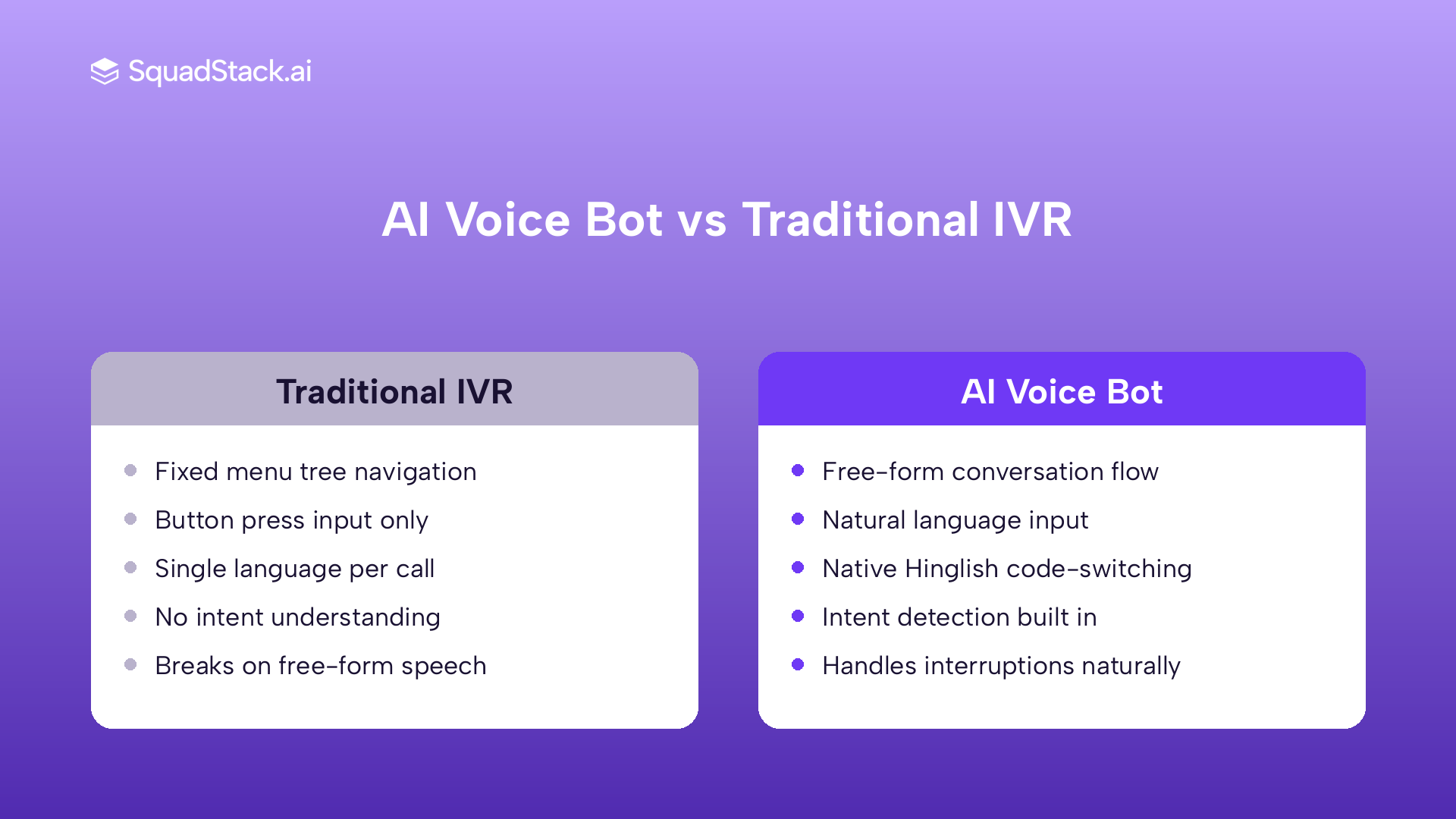
How does an AI voice bot compare to a traditional IVR for customer support?
A traditional IVR follows a fixed decision tree and cannot understand free-form speech. An AI voice bot holds a real two-way conversation, handles objections across multiple turns, switches languages mid-sentence, and routes based on what the customer actually said, not which number they pressed. The operational difference shows up in CSAT and first-call resolution, because customers are far less likely to drop an AI conversation that feels natural than an IVR tree they are trying to escape.
How long does it take to deploy an AI voice bot in India?
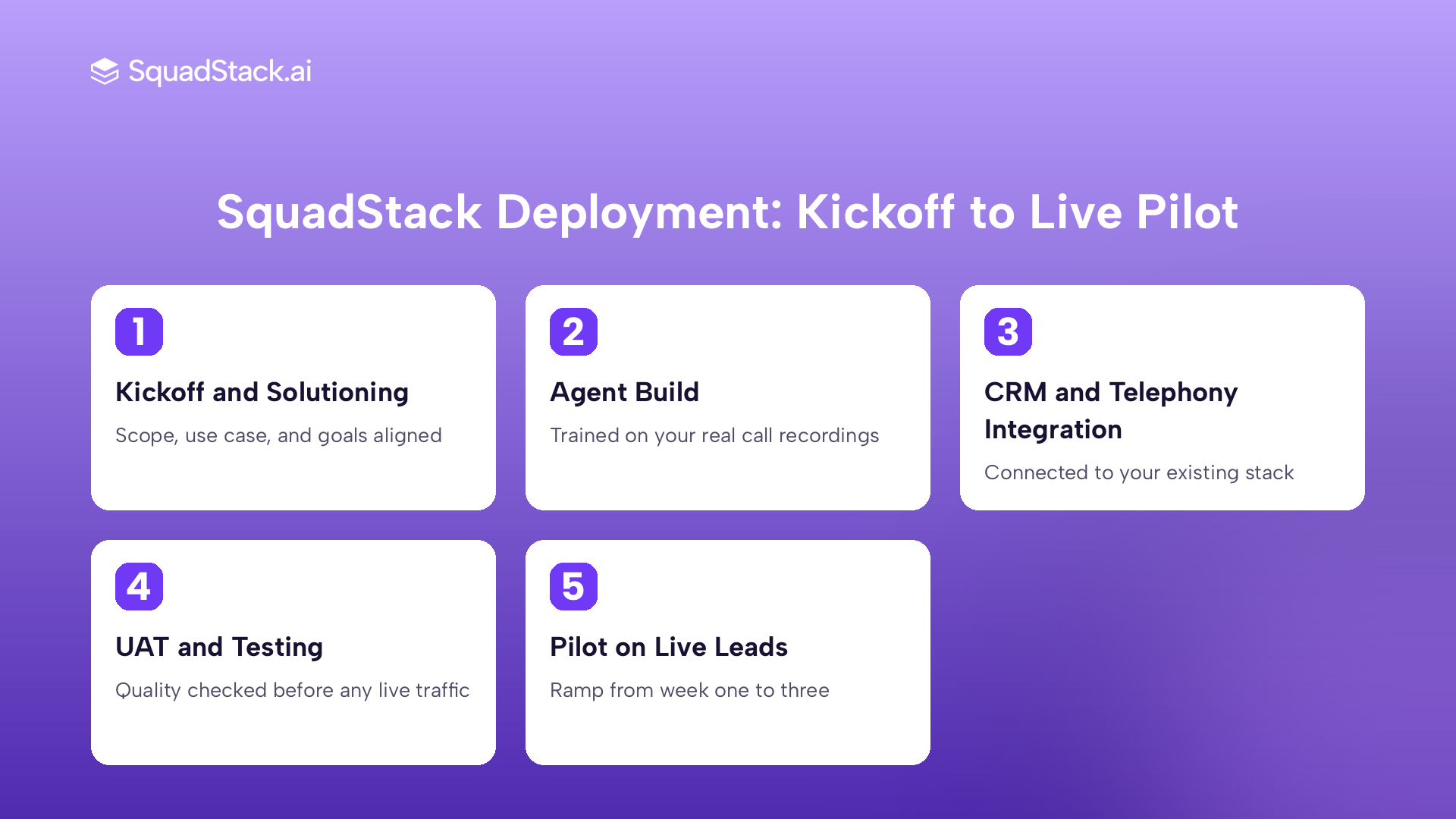
For a managed platform like SquadStack, setup typically takes around two weeks, covering solutioning, agent build, integrations, and testing, followed by a four to eight week pilot on real leads. Self-serve platforms can deploy faster but usually require more internal engineering to reach production quality on Indian languages. The two-week setup reflects the time needed to train the agent on real call recordings and knowledge bases so it performs from day one.
What failure modes should Indian enterprises watch for with AI voice bots?
The most common ones are accent and code-switching failures (the agent misreads a word and goes off-track), latency spikes on low-bandwidth lines that break conversational rhythm, CRM integration gaps that cause dispositions to fall off, and compliance blind spots like calling outside TRAI windows or dialing DND numbers. A dual-layer QA process that scores every call for outcome, sentiment, and execution catches these issues before they scale.
Which AI voice bots support multilingual customer support with Indian regional languages?
SquadStack has nine Indian languages live in production: Hindi, English, Tamil, Telugu, Kannada, Marathi, Malayalam, Bengali, and Gujarati, with additional regional languages available on demand. Vernacular.ai and Yellow.ai also cover several Indian languages. The critical distinction is whether the platform trained on real Indian telephonic audio in each language or simply passed text through a multilingual LLM. The former sounds native; the latter usually does not. See also the multilingual voicebot guide for a deeper comparison.