AI Voice Agents for Inbound Support with Complex Query Escalation
September 21, 2026
|

12 min read
AI voice agent pricing in India follows three main structures: per-minute billing, per-seat licensing, and pay-per-outcome. For high-volume outbound...
AI voice agent pricing in India follows three main structures: per-minute billing, per-seat licensing, and pay-per-outcome. For high-volume outbound sales, per-minute and pay-per-outcome models tend to fit better than fixed seats. The right model depends on your call volume, conversion goals, and how much billing risk you want to absorb versus share with your vendor.
A headline rate of a few rupees per minute sounds straightforward. Then the bill arrives.
Indian outbound sales campaigns run into failed attempts, DND-scrubbed numbers, low connect rates, and calls that drop in the first ten seconds. Depending on how your contract is written, you may be paying for all of those. Add GST, telephony surcharges, and any extra charges for Hindi or Tamil language support, and the effective cost per useful conversation can be several times the headline rate.
This guide breaks down each pricing model, explains what drives real cost, and gives you a checklist to compare vendor quotes on the same basis. If you are also evaluating the broader ROI question, start with SquadStack's AI contact center ROI guide and then come back here for the pricing specifics.
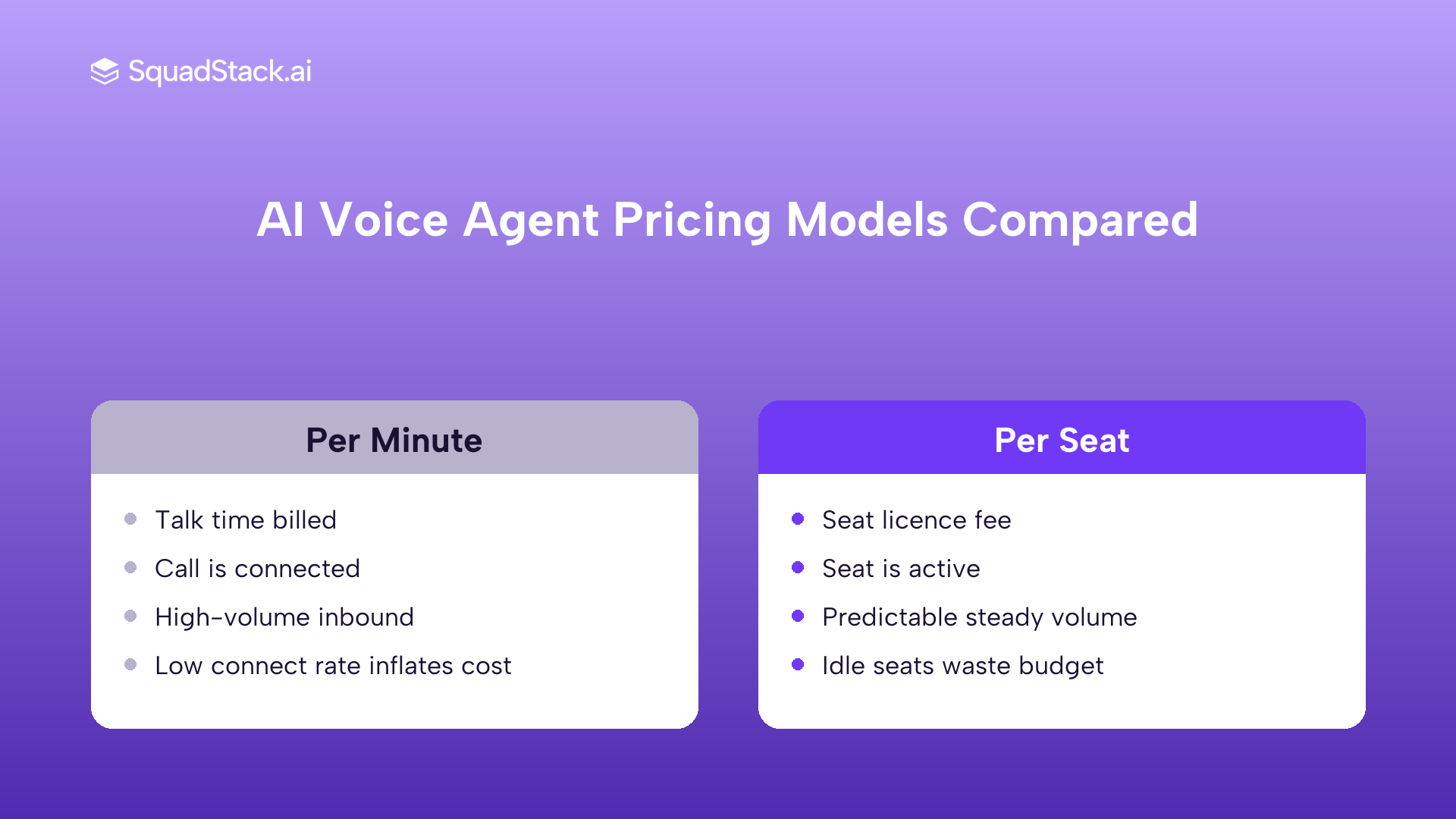
Each model fits a different situation. Per-minute billing transfers call volume risk to the buyer. Per-seat licensing is a fixed overhead that works well only when seat utilisation is consistently high. Pay-per-outcome transfers performance risk to the vendor, which is only viable when the vendor is confident in their conversion capabilities.
| Pricing Model | How You Pay | Best Fit | Watch Out For |
|---|---|---|---|
| Per minute (all calls) | Every second the line is open | High-volume outbound with known handle times | Paying for failed attempts, silence, IVR trees |
| Per connected minute | Only when a human answers | Outbound with variable connect rates | Still includes low-quality connects and short-duration drops |
| Per seat | Monthly flat fee per concurrent agent | Inbound support, predictable volumes | Idle capacity during off-peak hours |
| Pay per outcome | Per qualified lead, conversion, or defined result | Sales-driven campaigns where success is measurable | Narrower vendor availability; requires clear outcome definition |
Per-minute billing is the default for most AI voice platforms in India. You pay for call duration, often rounded up to the nearest six or thirty seconds.
The problem is what counts as a minute. If your dialer attempts 1,000 calls and only 400 connect, you may still pay for ring time, IVR traversal, and the seconds before a human says hello. On an outbound lending or edtech campaign running a 1+4 retry cadence, a large share of billed minutes can come from calls that never reached a real conversation.
Per-minute pricing also gives vendors no reason to optimise your connect rate. Their revenue goes up when calls are longer, not when leads convert.
There is also the language question. A voice AI agent supporting English only costs less to run than one handling Hindi, Tamil, or Hinglish code-switching. Some vendors charge extra for Indic language support, or their models perform noticeably worse in regional languages, driving up call duration and re-attempts. That cost lands on you either way.
For more on what AI-driven outbound calling actually costs in practice, that page goes deeper.
Per-connected-minute billing starts the clock only when a human answers, removing the cost of ring time and failed dials. That is a genuine improvement for campaigns with low connect rates.
But a call that connects, plays two seconds of audio, and gets hung up still counts. If your voice agent sounds robotic in regional languages, short-duration connects will quietly inflate your bill without producing useful conversations.
The practical test: ask vendors what their abruptly disconnected rate looks like. That is the share of calls ended within the first ten seconds after the caller identifies they are talking to an AI. A high rate means you are paying for worthless connects. SquadStack's voice agents run an abruptly disconnected rate of roughly 10%, inside the range you would see with skilled human agents, the result of naturalness engineering specific to Indian telephonic conditions.
Per-seat pricing is borrowed from traditional contact centre software. You pay a monthly fee per concurrent agent. For inbound support teams with predictable call volumes, this works fine. The seats are almost always occupied, so you pay for capacity you actually use.
For outbound sales in lending, edtech, or D2C, it rarely makes sense. Outbound calling is not evenly distributed across the day. You might run three to four times as many calls in the morning window as in the evening. A seat model forces you to buy for peak capacity while paying for idle capacity the rest of the time.
There is also a scaling mismatch. AI voice agents do not have the hiring and training constraints of human agents. Locking capacity into seats reintroduces the headcount arithmetic that AI is supposed to eliminate.
Pay-per-outcome means you pay when the AI agent achieves a defined result: a qualified conversation, a booked appointment, a completed application step, a verified lead. You do not pay for failed dials or short connects.
This model exists because some vendors are confident enough in their conversion performance to absorb the cost of bad calls. That confidence is not equally distributed. A vendor running at pilot scale cannot price this way sustainably. A vendor running 50 lakh+ calls daily across dozens of campaigns has the data to price by outcome and still make the economics work.
The important thing is defining the outcome precisely before signing. A "qualified conversation" means different things to a personal loan lender, an edtech company, and a logistics firm. The contract needs to specify exactly what triggers a billable event, what happens with borderline calls, and how disputes are resolved.
For use cases such as lead qualification or sales automation, pay-per-outcome pricing is often the most defensible model to take to a CFO.
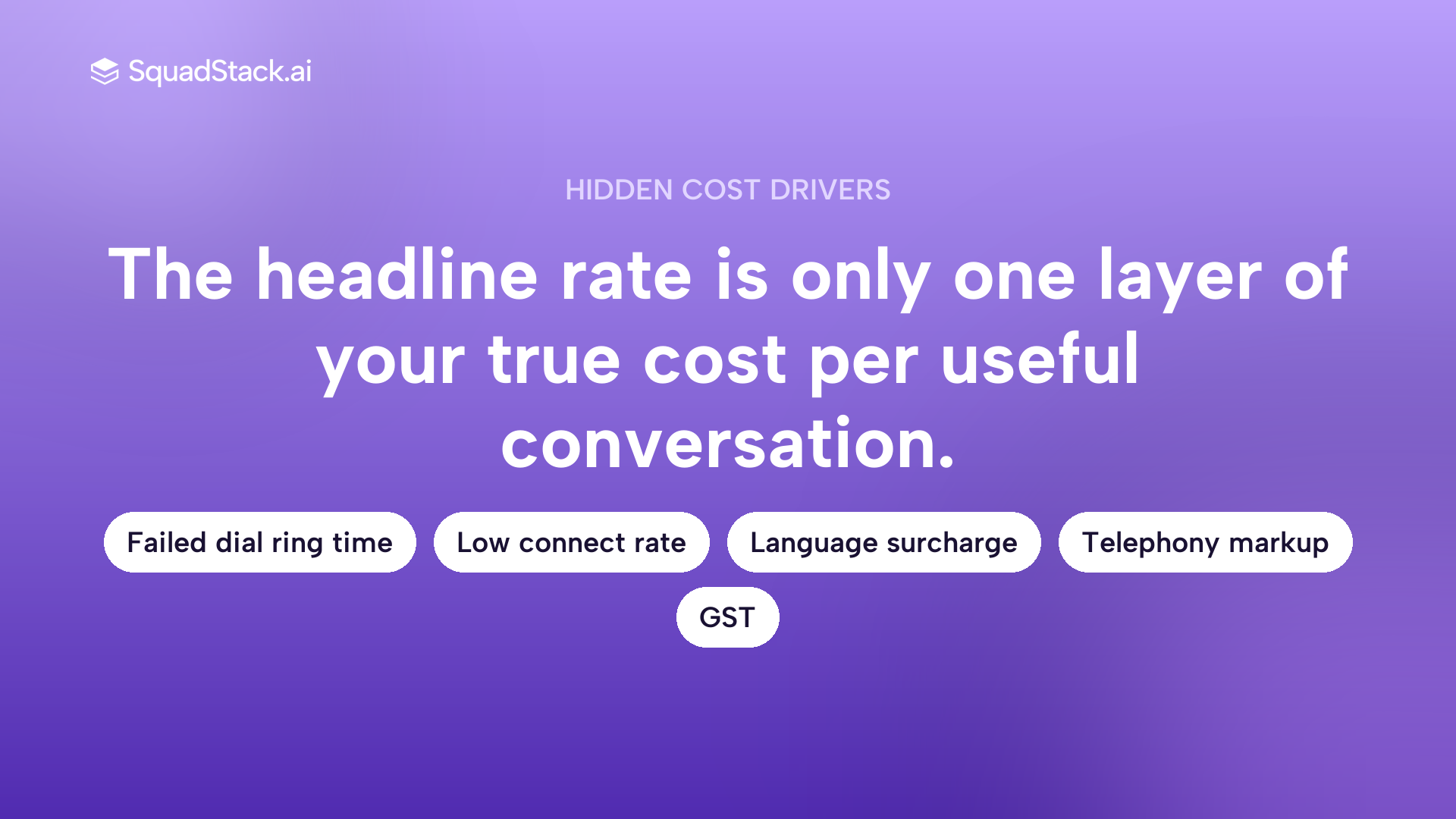
Beyond the headline model, several factors determine what you actually spend per useful conversation.
Connect rate. Industry norm for outbound campaigns in India sits at 40 to 60% lead connectivity. A vendor delivering up to 90% connectivity means far fewer total dials to reach the same number of leads, changing your effective cost per conversation regardless of the per-minute rate.
Telephony and number management. Indian regulations require 140-series numbers for cold outbound calling. Numbers flagged as spam on Truecaller see connect rates fall sharply. A platform that monitors number health and rotates flagged numbers protects your campaign economics and your compliance posture.
TRAI compliance overhead. DND scrubbing, calling window enforcement, and opt-out handling are not optional in India. Vendors who do not build this in will either cut corners or charge separately for it.
Language model quality. An agent that handles Hindi, Hinglish, Tamil, and Telugu natively, with code-switching mid-sentence, completes more conversations without re-attempts. A stilted agent drives up call duration, increases disconnects, and raises attempts needed per conversion.
GST and telephony surcharges. These add to every model. Get vendors to quote total landed cost, not just the platform rate.
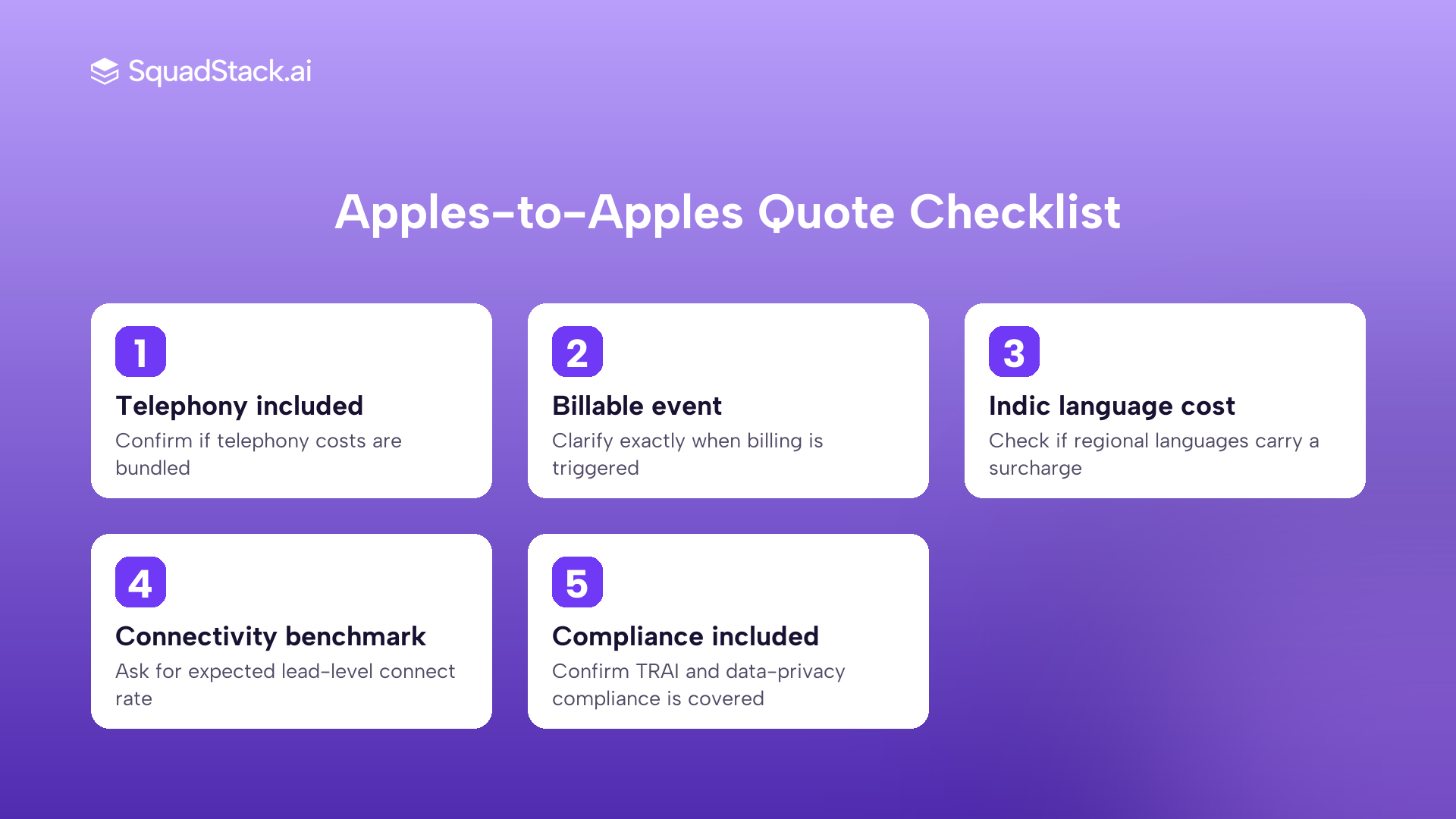
When evaluating AI voice agent pricing in India, use this checklist to standardise what vendors are actually offering.
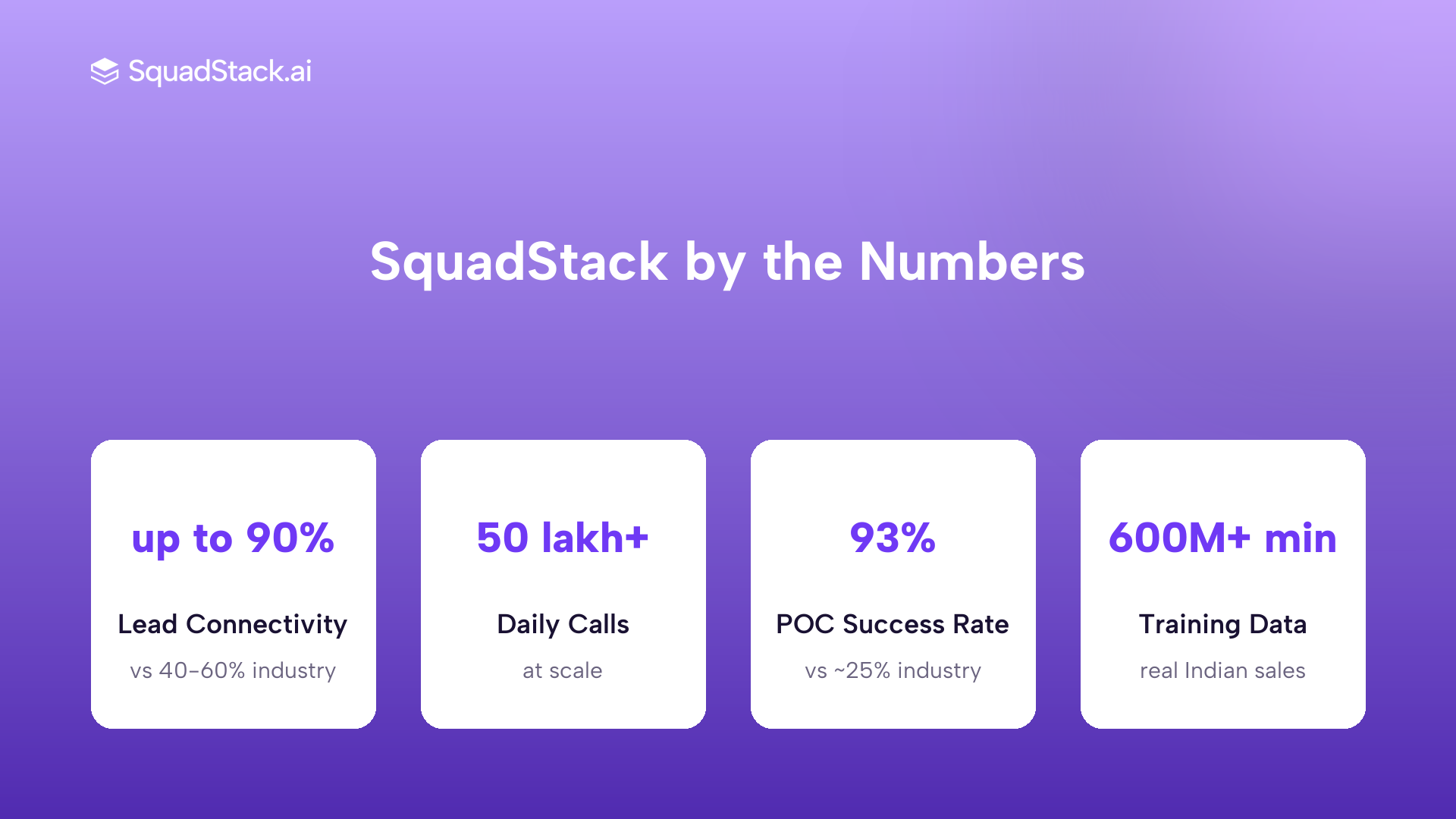
SquadStack's pricing is outcome-driven by design. Every engagement ships as a managed stack: voice AI engine, telephony with automated number health monitoring, dual-layer QA via the Eval System (Outcome, Sentiment, and Execution), and a dedicated squad per account.
The proprietary advantage that generic vendors cannot replicate is training data. SquadStack's in-house speech model, Arth, is trained on 600 million+ minutes of real Indian sales conversations spanning 85%+ of Indian pincodes, across noisy 8kHz telephony conditions, and across code-switched speech patterns like Hinglish and Taminglish. That is not a public dataset. It is the reason the platform's abruptly disconnected rate runs inside the human agent range, directly reducing wasted call spend.
The connectivity engine delivers up to 90% lead-level connectivity versus a 40 to 60% industry norm. On a campaign of 100,000 leads, that difference changes the total call volume and cost structure substantially.
Across four live campaigns where SquadStack's AI agents ran head-to-head against established human benchmarks, cost per outcome came in 2x to 3.3x better than the human agent baseline. Those are measured results from live production traffic, not projections.
The platform is ISO 27001, ISO 27701, SOC 2 Type II, DPDP, and TRAI compliant, with India data residency. All compliance infrastructure, DND scrubbing, 140-series number management, and calling window enforcement, is included in the engagement, not billed separately.
SquadStack's 93% POC success rate, compared to roughly 25% industry average, reflects a defined pilot with an agreed success metric, typically four to eight weeks, with scaling gated on proving that metric first. That structure protects buyers moving from per-minute or per-seat contracts to a performance model for the first time.
Ready to see what this looks like for your campaign? Schedule a demo with SquadStack.
What is the typical AI voice agent pricing per minute in India?
Headline per-minute rates in India vary across vendors, but the published rate is rarely what you end up paying. Once you account for failed dials, low connect rates, language model charges, and telephony surcharges, effective cost per useful conversation is usually several times the per-minute figure. The more useful metric is cost per qualified conversation or cost per outcome, which normalises for connect rate and call quality.
Which AI voice agent pricing model is best for outbound sales campaigns in India?
Pay-per-outcome or per-connected-minute models are generally better than all-calls per-minute billing for outbound sales, because they reduce your exposure to wasted dials. Pay-per-outcome aligns vendor incentives most tightly with your revenue goals, but requires a clear outcome definition and a vendor with the scale to price that way sustainably.
Can AI voice agents replace a 100-seat collections or outbound sales team in India?
AI voice agents can handle the full first-touch and qualification layer across very large call volumes, which means a scaled outbound team is not the right comparison. The relevant question is cost per outcome, not headcount. SquadStack's platform runs 50 lakh+ calls daily for large Indian consumer brands, with cost per outcome measured at 2x to 3.3x better than human agent benchmarks in head-to-head live campaign tests.
How does TRAI compliance affect AI voice agent pricing in India?
TRAI compliance adds real operational costs: DND registry scrubbing, calling window enforcement (9:30 AM to 8:30 PM), 140-series number requirements for cold outbound, and opt-out handling. Vendors who build this in are more expensive up front but protect you from regulatory exposure. Vendors who treat it as optional or charge extra are creating hidden cost and risk. Always confirm whether compliance infrastructure is included in the quoted price.
What is pay-per-outcome AI voice agent pricing and how does it work?
Pay-per-outcome pricing means you pay only when the AI agent achieves a predefined result, such as a qualified lead, a booked appointment, or a completed application step. You do not pay for failed dials or short connects. The model only works when the vendor has enough data and scale to price sustainably, and when the outcome is defined precisely in the contract before the campaign starts.
We do 50,000 calls a month for edtech lead conversion. Which AI voice agent works best for Hindi and English?
You need a platform with native Hindi and English support, not translated or bolted-on multilingual. SquadStack's voice agents handle Hindi, Hinglish, and English with native code-switching mid-sentence, trained on hundreds of millions of real Indian sales conversations. The voice AI agent for Indian languages page covers how the language stack works in practice.
How do I compare AI voice agent quotes from different vendors in India on an apples-to-apples basis?
Ask every vendor to quote total landed cost including telephony, GST, and language model charges. Confirm what counts as a billable event. Ask for expected lead-level connectivity across the full dial cadence, not per-attempt connect rates. Ask whether DND scrubbing and TRAI compliance are included. And ask for a structured pilot with a defined success metric before committing to scale.
What is the difference between per-minute and per-connected-minute AI voice agent pricing?
Per-minute billing starts the clock when the call is placed, so you pay for ring time and failed dials. Per-connected-minute billing starts only when a human answers. Per-connected-minute is better for campaigns with variable connect rates, but still includes short-duration connects where the lead hangs up immediately. The abruptly disconnected rate of the agent is a better indicator of how much of your connected-minute spend is wasted.
Does SquadStack offer pay-per-outcome pricing for Indian enterprise clients?
SquadStack structures engagements around defined outcomes and runs a pilot gated on an agreed success metric before scaling. The specific commercial model is discussed during solutioning. To explore what an outcome-based structure looks like for your use case, schedule a demo.
What hidden costs should I look for in AI voice agent pricing in India?
The main hidden costs are: billing for failed dials and ring time under a per-minute model; premium charges for Indic language support; telephony surcharges billed separately from the platform rate; GST; and costs from low connect rates that are not visible in the headline rate. A vendor with a high lead connectivity rate, active number health management, and all-in pricing removes most of these variables. Ask vendors to show you the effective cost per qualified conversation on a real campaign, not just the per-minute rate card.