AI Voice Agents for Inbound Support with Complex Query Escalation
September 20, 2026
|

12 min read
A loan officer in Chennai speaks Tamil and English together, sometimes inside the same sentence. A borrower in Lucknow drops into Bhojpuri when...
TL;DR: Voice AI trained on Indian sales calls outperforms generic voice models because it learns the exact accents, objection patterns, and code-switching behaviour that real Indian buyers use. SquadStack's proprietary speech model, Arth, is built on 600M+ minutes of real Indian sales conversations, covering 85%+ of Indian pincodes, and delivers up to 90% lead connectivity where the industry norm sits at 40 to 60%. Generic models trained on public datasets simply cannot replicate this.
A loan officer in Chennai speaks Tamil and English together, sometimes inside the same sentence. A borrower in Lucknow drops into Bhojpuri when frustrated. A first-time demat account opener in Pune asks questions that almost no English-language training set has ever seen.
Generic voice AI models were not built for any of this. They were trained on clean, studio-recorded speech or public internet audio. Their word-error rates on noisy 8kHz Indian telephony calls are significantly higher, their objection-handling logic does not reflect how Indian buyers push back, and their dialogue sounds like a newsreader rather than a human sales agent.
The result is predictable: high early call drop rates, poor intent detection, and conversion numbers that fall short of what human agents achieve. The fix is not a bigger model. It is the right training data.
Voice AI trained on Indian sales calls is a speech and dialogue system built on real, full-duplex telephone conversations between Indian sales agents and Indian buyers, labelled with outcomes, covering the range of accents, languages, objection types, and call scenarios that appear in live Indian consumer sales.
This is distinct from a general-purpose voice AI that has been pointed at an Indian use case. The difference shows up in three specific places.
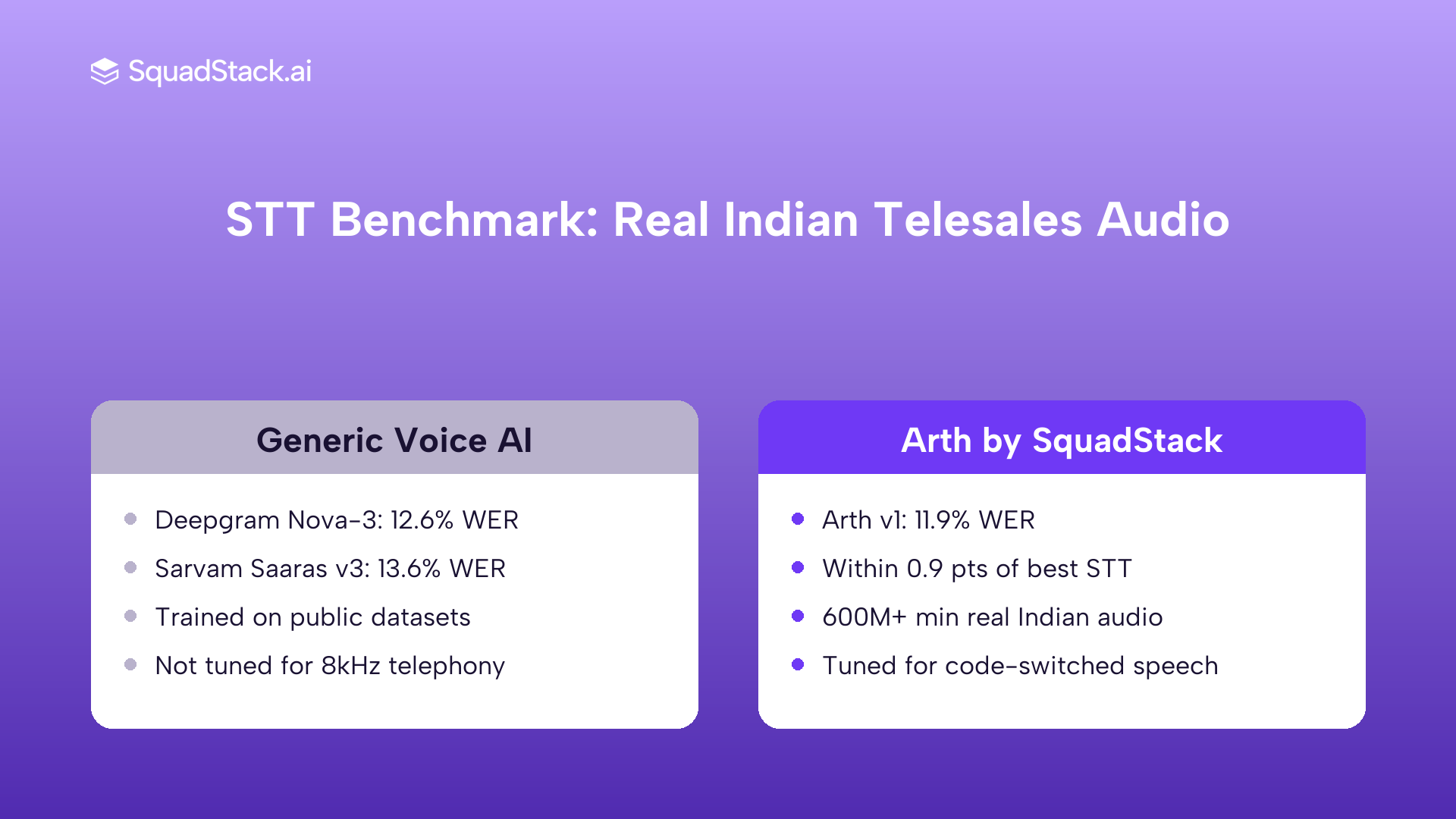
Accent and telephony noise handling. Indian telephony runs at 8kHz with significant background noise, crosstalk, and packet loss. A model trained on clean audio degrades badly in these conditions. Arth, SquadStack's proprietary speech recognition model, was trained specifically on this kind of audio and benchmarks at a semantic word-error rate of 11.9% on real Indian telesales calls. That puts it within 0.9 percentage points of the best commercial streaming STT on this task, and ahead of both Deepgram Nova-3 (12.6%) and Sarvam's Saaras v3 (13.6%).
Code-switching. Indian buyers do not stay in one language. Hinglish is not a dialect; it is a real communication style where Hindi and English blend sentence by sentence. Taminglish does the same for Tamil speakers. A model trained on this code-switched speech handles it natively. A model that treats code-switching as an edge case will misrecognise words, lose intent, and sound foreign. Arth was trained on exactly this kind of conversation, which is why it handles Hinglish and Taminglish without a translation step.
Objection patterns. Indian buyers object differently than the Western scripts that most voice AI training sets reflect. Price objections arrive wrapped in politeness. "Main sochta hoon" (I'll think about it) is a soft refusal that needs a different follow-up than a direct no. "Abhi busy hoon" is often a trust signal, not a real time constraint. A dialogue model trained on millions of real Indian sales calls learns these patterns; a generic model does not.
For a closer look at how this plays out in specific sales flows, the AI voice agent platform overview covers the full stack.
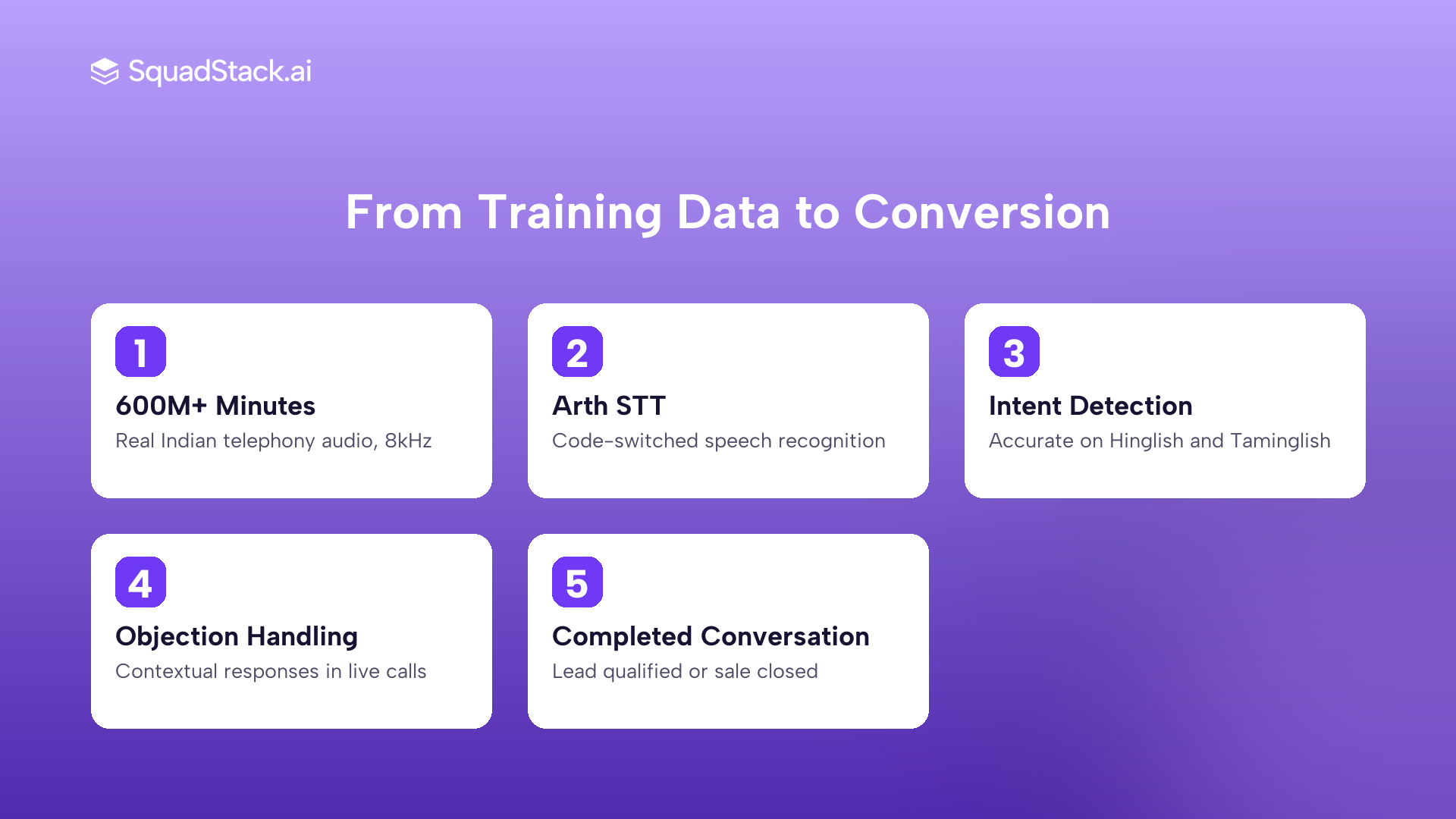
The connection between training data and conversion is not abstract. It runs through a specific chain: better speech recognition leads to better intent detection, which leads to better objection handling, which leads to more completed conversations, which leads to higher conversion.
Where this chain breaks in generic voice AI is usually at intent detection. If the STT layer mishears a code-switched phrase or misses an entity like a PIN code or a product name, the dialogue model is working from a flawed transcript. The agent's response is off, the buyer loses confidence, and the call drops.
SquadStack tracks a metric called Abruptly Disconnected Rate (ADR): the share of calls cut short in the first ten seconds after the caller identifies they are speaking to an AI. Early-generation IVR systems run ADR above 70%. Human agents run 8 to 12%. SquadStack's voice agents now run around 10%, inside the human range. That drop was engineered through 2025 by improving every layer of the stack, starting with the speech model.
At Global Fintech Fest in October 2025, 1,273 of 1,563 attendees (81%) could not tell SquadStack's AI agents from human agents in a blind listening test. That level of naturalness does not come from a good TTS engine. It comes from dialogue built on what real Indian sales conversations actually sound like.
The hyper-personalisation and the future of sales post covers how this training feeds the broader personalisation system.
Lending and BFSI. A personal loan call in India involves a buyer who may be cautious about sharing financial details with an AI, has specific questions about EMI and FOIR, and may switch from English to Hindi when discussing amounts. SquadStack runs personal loan sales for brands including Kotak Mahindra Bank, KreditBee, and DMI Finance. The AI voice agent for sales automation page covers the mechanics in BFSI contexts.
Rider and candidate hiring. Conversations with prospective delivery riders or candidates are often in regional languages, filled with local idioms, and involve back-and-forth on shift timings and location. Delhivery achieved a 4x lower cost-per-hire using SquadStack's voice AI. A leading quick commerce platform reached 90% connectivity and 40% lower cost-per-hire. These results depend on the agent being understood and understood correctly by people whose primary language may not be English or Hindi.
EdTech lead qualification. A student enquiring about a course in Tamil Nadu may start in English, shift to Tamil, and ask about fee structures in both. Agents for Adda247, Unacademy, Collegedunia, and other EdTech brands handle exactly this kind of bilingual qualification. The AI voice agent for lead qualification page explains the qualification flow in detail.
Marketplace buyer-seller matching. IndiaMART's deployment shows what 20% higher conversions and 15% lower CAC look like when a voice AI handles order taking and buyer-seller matching in the language the buyer actually uses. Read the IndiaMART case study.
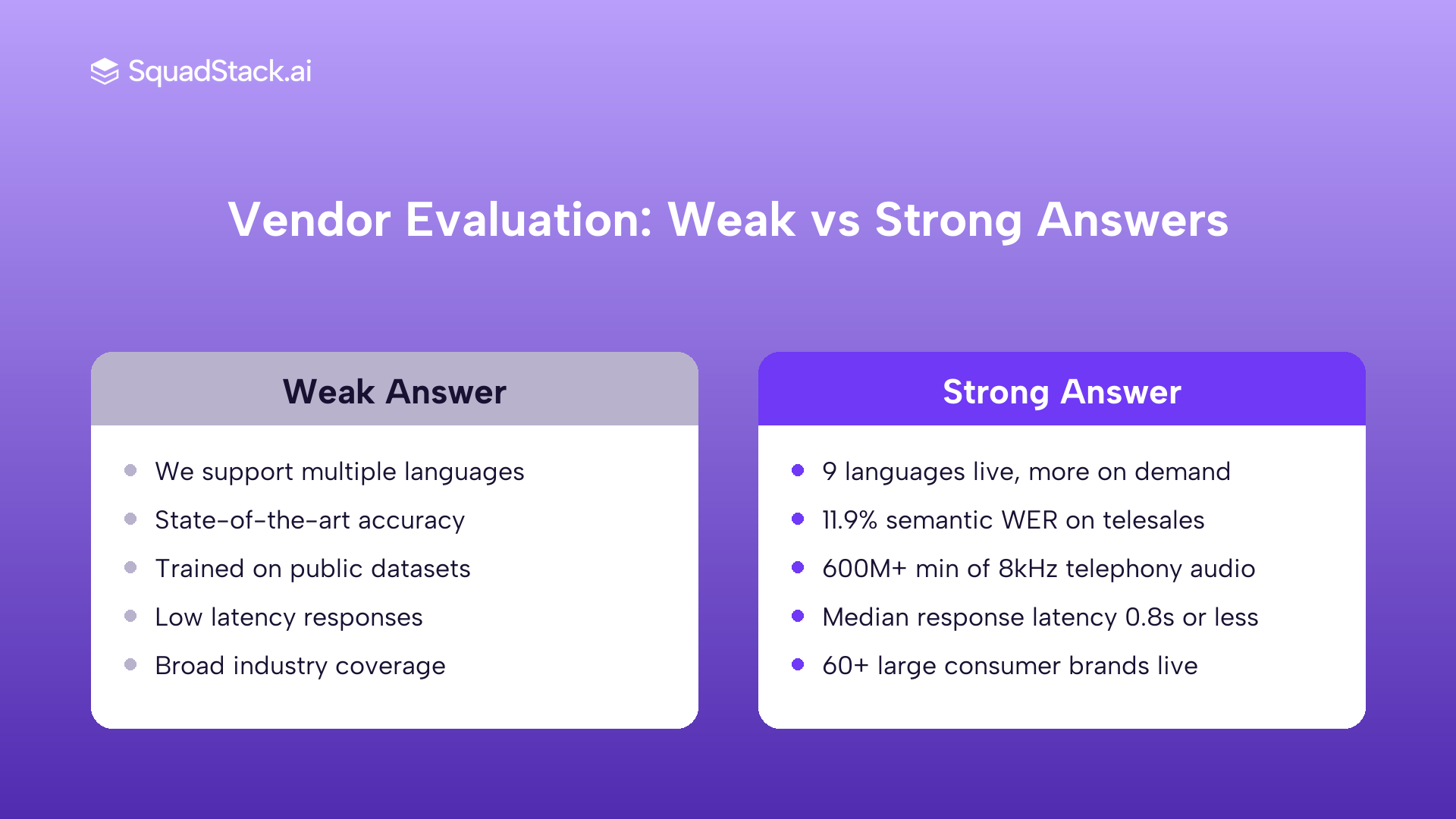
Many voice AI vendors claim Indian-language support. Very few have trained on the kind of real telephonic data that production performance requires. Here is a practical checklist for evaluating the claim.
| Question to ask | What a strong answer looks like | Red flag |
|---|---|---|
| What is your training corpus? | Real, outcome-labelled telephonic audio at 8kHz | Studio recordings, YouTube audio, or public datasets |
| What languages are live in production? | Specific languages live today, others clearly "on demand" | A long list with no production evidence |
| Can you share a WER benchmark on real Indian telesales audio? | A named benchmark with a methodology | Generic "state of the art" claims without numbers |
| How does your agent handle code-switching? | Mid-sentence switching, natively | "We support multiple languages" without a mechanism |
| What is your ADR on live campaigns? | In or near the human agent range | No ADR data, or only "naturalness" claims |
| How do you handle objection patterns specific to Indian buyers? | Named objection types and multi-turn handling | Generic objection-handling with no India-specific examples |
| Is your model hosted in India? | Yes, India data residency, DPDP compliant | Hosted abroad or ambiguous |
The AI for sales calls page covers what production-grade call handling looks like across industries.
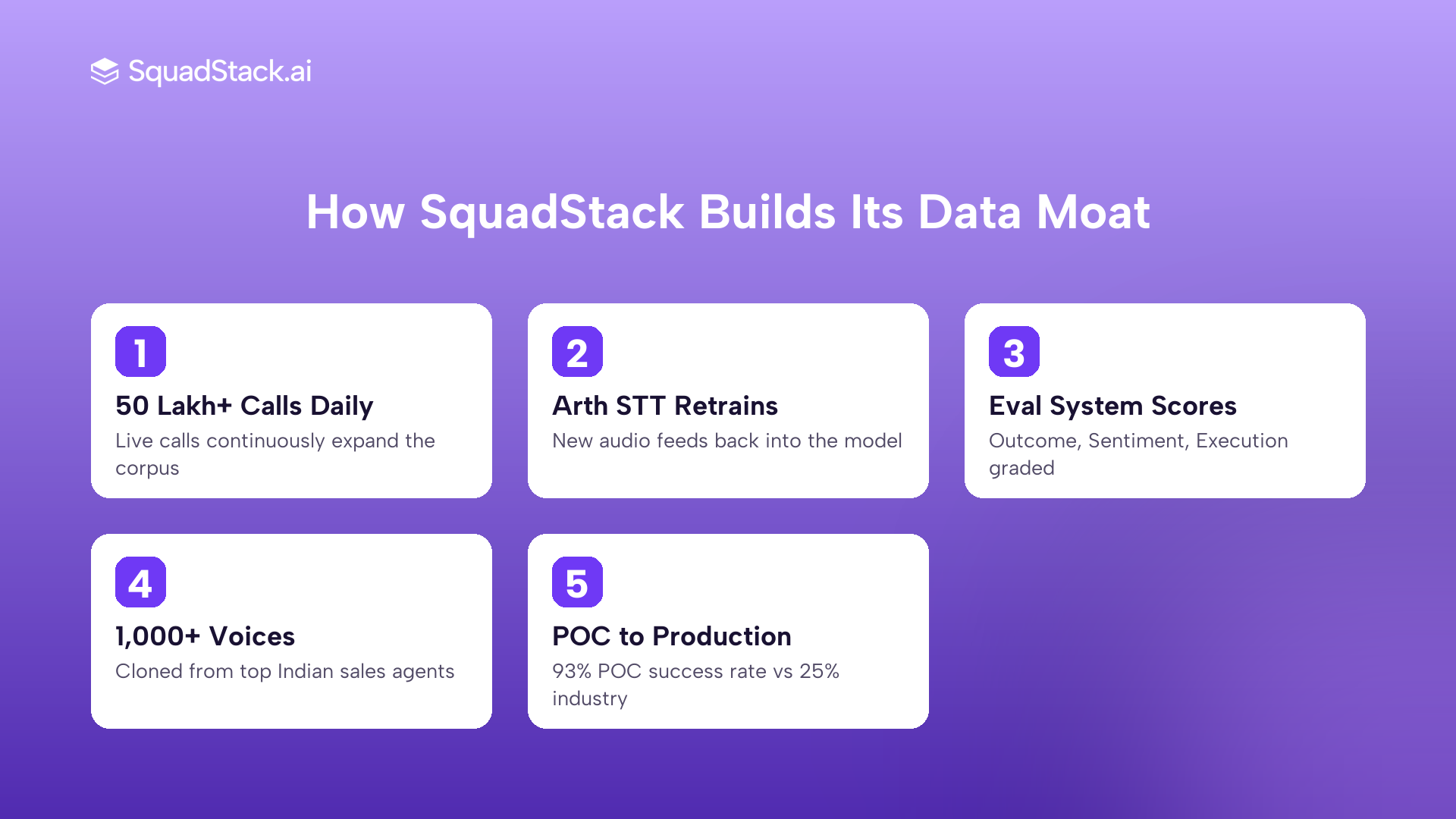
The claim that SquadStack is different starts with a fact no competitor can replicate today: 600M+ minutes of real, full-duplex, outcome-labelled Indian sales conversations covering 85%+ of Indian pincodes. This corpus is what Arth was trained on, and it is the single biggest reason the agent sounds and performs like a native.
Production-quality 8kHz Indian telephonic data does not exist publicly. Other vendors train on what is available, which means read-speech corpora, YouTube clips, or general multilingual datasets. The acoustic conditions are different, the vocabulary is different, and the conversational patterns are nothing like a real sales call. That gap shows up every time a caller says something slightly unexpected.
SquadStack has been operating AI-assisted contact centers in India for roughly ten years, running over 10,000 human agents for some of the largest consumer brands in the country before transitioning fully to Voice AI in 2025. Every human call that ran through the platform was a potential training signal. The corpus built over that period is the foundation Arth sits on.
The quality of what comes out is audited through a dual-layer system. The Eval System scores every call on three levels in sequence: Outcome (did the call achieve its objective?), Sentiment (how did the conversation land with the buyer?), and Execution (did the agent run the conversation correctly?). Both AI and human reviewers contribute to this process. That feedback loop keeps the agents improving on live traffic rather than drifting.
Today, 50 lakh+ calls run daily across 60+ large consumer brands, including names like PhonePe, Amazon, Kotak Mahindra Bank, AngelOne, and Swiggy. Each call adds signal. The agents that run tomorrow are measurably better than the ones that ran last month.
The 93% POC success rate, against an industry average of around 25%, is the business translation of all of the above.
For a deeper look at how the platform personalises every interaction, the conversational AI lead scoring page and AI intent detection page cover the decision engine in detail.
Ready to see what a voice AI trained on real Indian sales calls does on your leads? Book a demo with SquadStack.
Which voice AI platforms are actually trained on millions of Indian sales calls?
SquadStack's Arth speech model is trained on 600M+ minutes of real Indian sales conversations, covering 85%+ of Indian pincodes, at 8kHz telephony quality with native code-switching. Most other vendors use public datasets or studio-recorded audio, which behaves differently on live Indian calls.
What is the best voice AI for outbound sales in India?
A strong answer requires production evidence, not feature lists. Look for a platform with real Indian telephony training data, a low ADR on live campaigns, named enterprise customers in your vertical, and a managed-service model with outcome-aligned SLAs. SquadStack runs 50 lakh+ calls daily for 60+ large consumer brands across BFSI, EdTech, e-commerce, and logistics.
Can voice AI handle Hinglish and code-switching automatically?
Yes, if the underlying model was trained on code-switched Indian speech. Arth handles Hinglish and Taminglish natively because the training corpus contains exactly these conversation types. Models trained on monolingual or clean-audio datasets will misrecognise code-switched phrases and lose intent mid-conversation.
How does voice AI trained on Indian calls improve conversion rates?
Better speech recognition reduces transcription errors, which improves intent detection, which allows the agent to respond correctly to objections and questions in real time. The result is more completed conversations and fewer early drop-offs. In one deployment, a leading quick commerce platform achieved 90% connectivity and 40% lower cost-per-hire using SquadStack's voice AI.
What is Abruptly Disconnected Rate (ADR) and why does it matter?
ADR is the share of calls where the caller hangs up within the first ten seconds after identifying they are speaking to an AI. It is a direct measure of perceived naturalness. Human agents run 8 to 12%; generic voice AI often runs much higher. SquadStack's agents reached around 10% ADR by late 2025, inside the human range, validated by blind listening tests at Global Fintech Fest.
Is voice AI for Indian sales calls TRAI-compliant?
SquadStack's platform is TRAI-compliant: it uses 140-series numbers for cold calling, scrubs lead lists against the DND registry, enforces calling windows (9:30 AM to 8:30 PM as a hard system block), and handles consent gating in the dialogue layer itself. The platform also holds ISO 27001, ISO 27701, SOC 2 Type II, and DPDP certifications.
How many Indian languages does SquadStack's voice AI support?
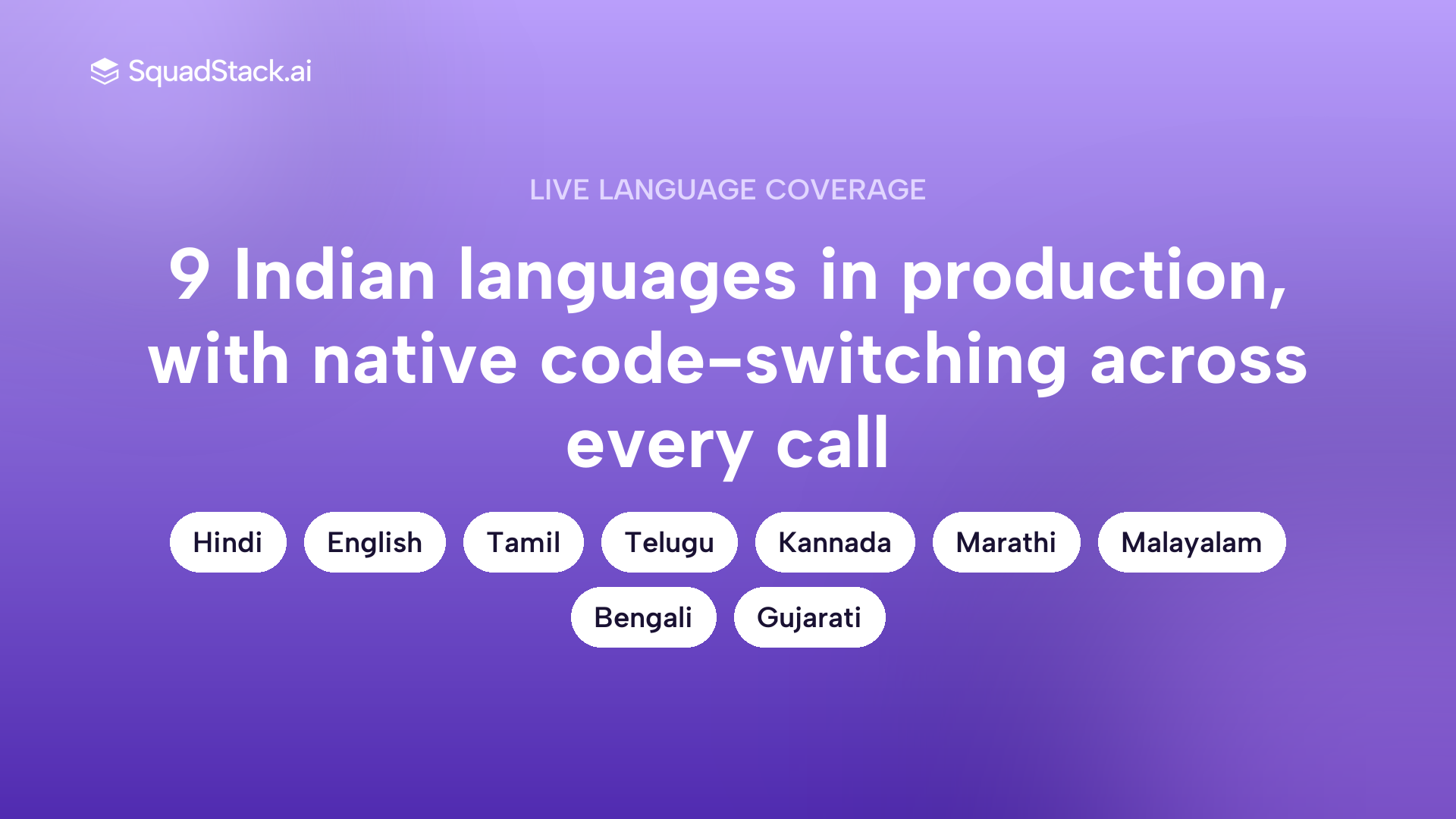
Nine languages are live in production today: Hindi, English, Tamil, Telugu, Kannada, Marathi, Malayalam, Bengali, and Gujarati, all with native mid-sentence code-switching. More regional languages are available on demand, and additional regional languages can be added based on business requirements. See the voice AI agent for Indian languages page for details.
How long does it take to go live with a voice AI sales agent in India?
Most enterprise deployments go live within two to three weeks. The build involves training the agent on the client's real call recordings, knowledge base, and FAQs, plus integration, QA, and a UAT sign-off before any live traffic runs. The pilot then runs for four to eight weeks against a pre-agreed success metric before scaling.
Does voice AI replace human sales agents entirely?
Not necessarily, and SquadStack does not require a choice. High-intent leads can be transferred live to a human team with full conversation context passed across. The AI handles volume; humans close the most complex conversations. Transfer triggers are configurable per campaign, and some campaigns run fully AI-handled with no transfers at all.
How do I know if a vendor's "trained on Indian calls" claim is real?
Ask for the corpus size in minutes of real telephonic audio (not conversations or tokens), the languages live in production today, a semantic WER benchmark on 8kHz Indian telesales audio, and the ADR on live campaigns. A vendor with a real data moat will answer all four specifically. Vague answers about "multilingual support" or "state-of-the-art models" are a signal the claim is thin.