Why Voice AI Trained on Millions of Indian Sales Calls Wins
September 20, 2026
|

12 min read
A customer calls about a disputed transaction. The IVR plays four menu options. None match the problem. The customer presses zero. The call drops. They...
TL;DR: An AI voice agent inbound support escalation system handles routine caller queries end-to-end, authenticates the caller, and routes complex or sensitive issues to a human agent with full context already transferred. Done well, it cuts handle time on simple queries while protecting CSAT on the hard ones. Done poorly, the escalation itself becomes the failure point.
A customer calls about a disputed transaction. The IVR plays four menu options. None match the problem. The customer presses zero. The call drops. They try again, reach a human after eight minutes on hold, and re-explain everything from scratch.
This is the inbound support failure that AI voice agents are built to fix. But the promise only holds if the agent knows when to handle a query itself and when to hand the call to a person, with everything the caller already said intact.
An AI voice agent inbound support escalation system combines a conversational voice AI with a structured handoff protocol. The agent answers incoming calls, resolves queries it can handle, and escalates the rest by routing the caller to a human with a pre-loaded context packet.
The two functions are inseparable. Containment without good escalation produces a churned customer. Escalation without containment wastes human capacity on questions the AI could have answered in thirty seconds. The goal is calibrated containment: the AI handles what it genuinely can, and the human enters a call that is already halfway done.
This is distinct from inbound lead qualification, where the intent is to progress a sales conversation. Support calls start with a problem, and the system's first job is to understand that problem before deciding anything else.
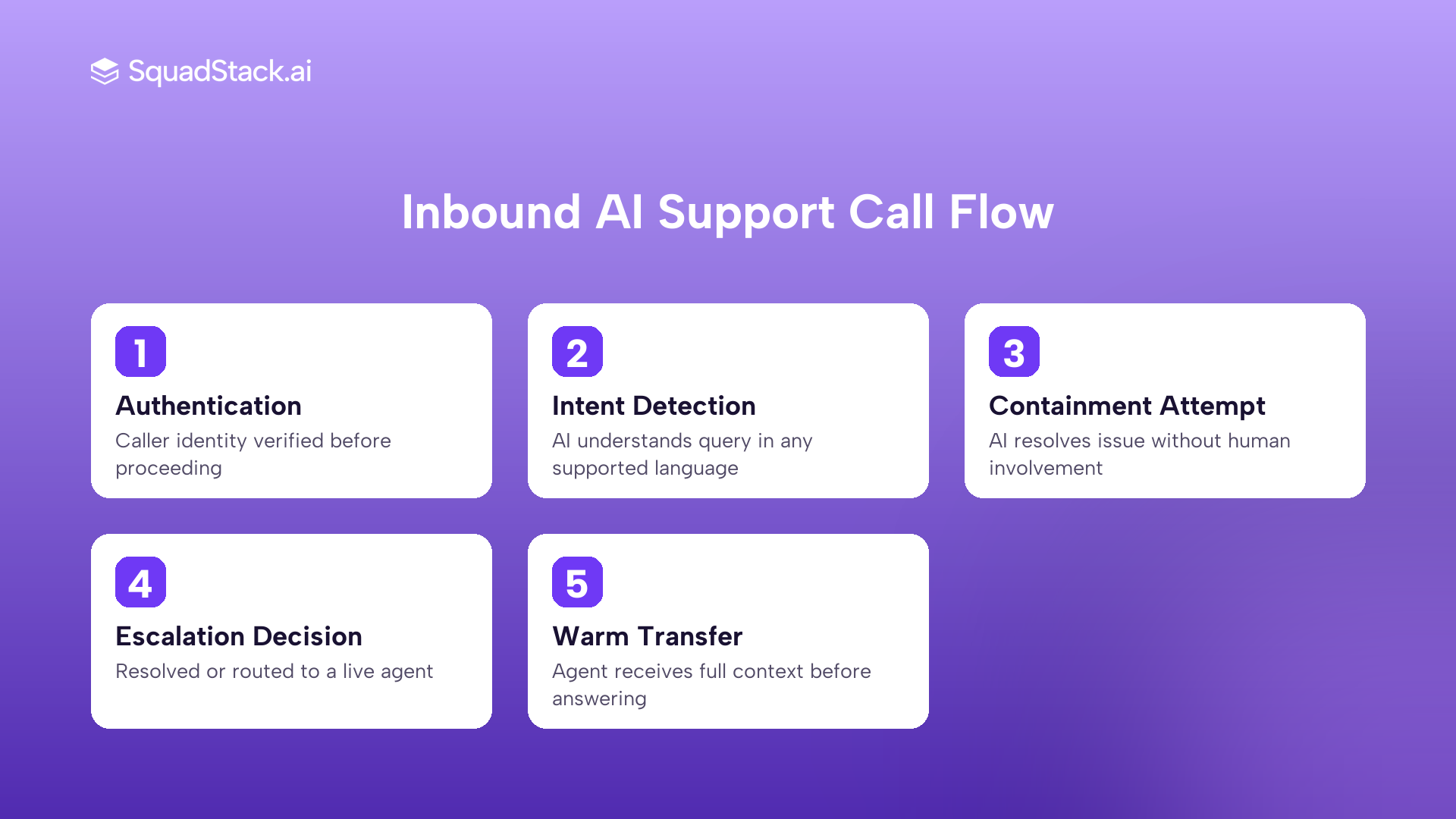
A well-structured inbound AI support call moves through five stages.
1. Authentication. The agent confirms who is calling before any account information is shared, verifying a registered mobile number, date of birth, or PIN in natural conversation.
2. Intent detection. The agent identifies what the caller needs. In Indian-market deployments this gets complicated. A caller might start in Hindi, switch to English to describe a technical issue, then shift back when frustrated. The agent must follow that without losing the original intent. SquadStack's models are trained on 600M+ minutes of real Indian telephony conversations, including code-switched speech like Hinglish and Taminglish, specifically because this failure mode is common on real calls.
3. Containment attempt. For queries the agent can resolve, it retrieves information from the client's knowledge base via RAG and answers directly. Account balances, order statuses, appointment confirmations, and FAQ-level queries typically resolve here. The RAG layer retrieves answers in under 100 milliseconds.
4. Escalation decision. The agent escalates when a query is complex, sensitive (a fraud complaint, a collections dispute, a complaint about a previous interaction), when the caller explicitly requests a human, or when the conversation has looped twice without resolution. Escalation triggers are configured per campaign.
5. Warm transfer with context. The human agent receives a context packet before they speak: verified caller identity, the question asked, what the AI tried, and the current sentiment reading. The caller does not repeat themselves.
After each call, outcomes feed into the ROI Optimizer. Every resolved query and escalation becomes a data point. The system identifies which query types are unnecessarily escalated, which scripts cause confusion, and which phrasings improve containment. Containment rates improve over a campaign's lifetime without manual intervention.
BFSI inbound support. AngelOne uses SquadStack for customer support and fraud detection. Inbound calls fall into two buckets: routine queries like balance checks and statement requests, and complex ones like disputed transactions or KYC failures. The AI contains the first bucket and escalates the second with authentication already complete, which matters in regulated contexts where a human agent cannot act until identity is verified.
Consumer electronics and durables. Eureka Forbes runs AMC and product sales with SquadStack. Inbound support covers warranty queries, service scheduling, and complaint intake. The AI books service calls and confirms warranty status, but a repeat failure or complaint about a technician needs a human. The escalation carries complaint history and the customer's tone data.
Automotive inbound support. TVS Motors runs inbound support through SquadStack. Post-purchase queries range from simple (service rescheduling) to complex (a recurring issue already flagged twice). The AI handles simple ones and escalates repeat-complaint patterns with full call history attached.
E-commerce and logistics support. Most inbound queries are transactional: order status, delayed delivery, returns. These contain at very high rates. Damaged goods claims or payment disputes are the exception: the AI takes complaint details, confirms order information, and transfers to a human with everything documented.
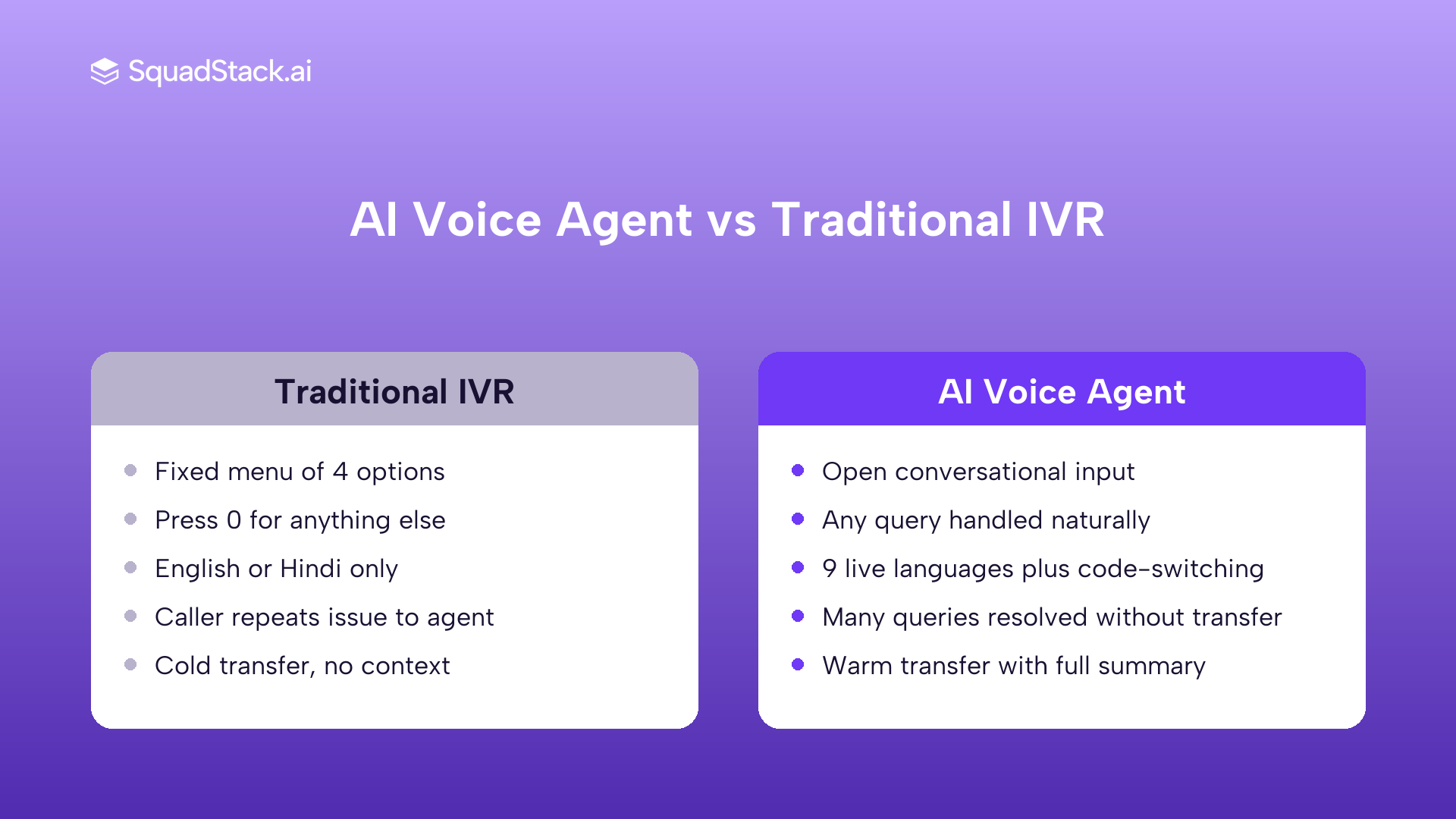
The core difference is not cosmetic. An IVR presents a menu. An AI voice agent holds a conversation.
| Dimension | Traditional IVR | AI Voice Agent |
|---|---|---|
| Query handling | Caller navigates a fixed menu; unmapped queries go to a generic queue | Agent understands the question in natural language and resolves or routes it correctly |
| Language flexibility | Single language, no code-switching; a caller who switches to Hindi on an English IVR gets stuck | Follows the caller across languages mid-sentence, without losing conversational context |
| Authentication | DTMF entry of PIN or date of birth; fails on mis-key, drops call | Conversational verification: agent asks, listens, confirms |
| Escalation quality | Caller is transferred cold; human agent starts from scratch | Warm transfer: human receives call summary, verified fields, and detected intent before speaking |
| Complex query handling | Fails immediately; routes to hold queue | Attempts resolution via knowledge base; escalates only when genuinely needed |
| After-call learning | No feedback loop; IVR menu never changes from call data | Every call outcome trains the next call; containment rates improve over time |
See the best AI call center software breakdown for a broader comparison across platforms.
Most buyers compare features. The sharper comparison is on failure modes.
Code-switching and accent handling. In India, a single support call can move through three language registers. If the speech model is trained on read-speech rather than real telephony data, it will misfire on exactly these calls. Ask the vendor where their training data came from and whether it includes real 8kHz telephonic audio in code-switched Indian languages.
Context handoff quality. Ask what data passes to the human agent at escalation. The minimum viable handoff is verified caller identity, conversation summary, and reason for escalation. A system that only passes the caller's phone number is not doing warm transfer.
Containment vs CSAT measurement. These metrics can trade off against each other. A vendor who only reports deflection rate may be hiding a CSAT problem on escalated calls. Look for a system that measures both together, with call-level sentiment data.
Compliance for Indian telephony. Inbound support in BFSI, lending, and insurance operates under TRAI and DPDP requirements. The AI must enforce consent gating and data handling rules in the conversation layer itself.
Latency on Indian networks. A response time above 1.5 seconds on an 8kHz telephony line breaks conversational rhythm. On support calls, where the caller is already tense, dead air accelerates frustration.
For a broader comparison of agentic AI contact centre platforms, that page covers architecture differences in more depth.
SquadStack's inbound support capability runs on the same infrastructure handling 50 lakh+ calls daily across 60+ large consumer brands, using the same speech stack, context management layer, and QA system.
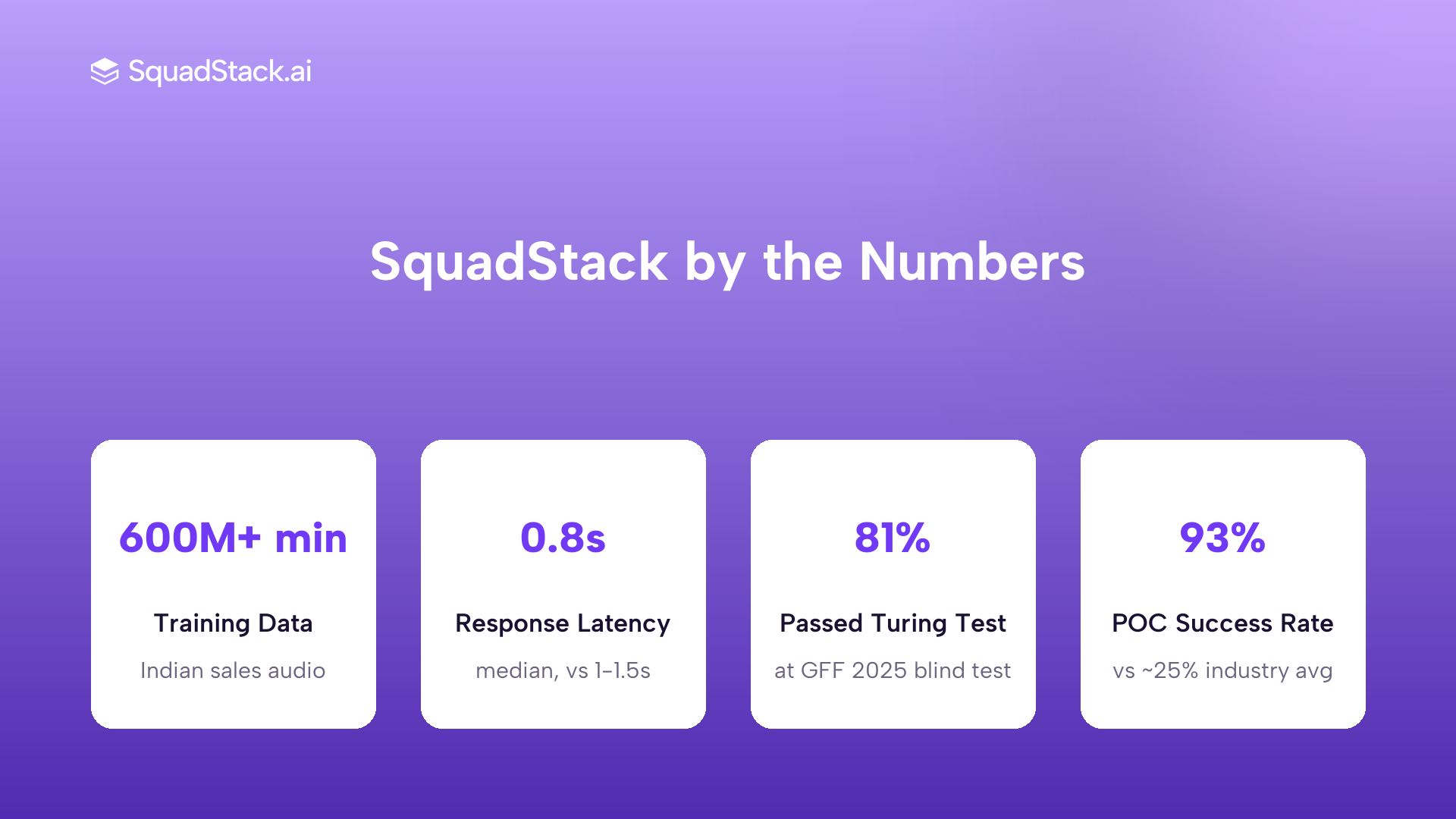
The speech model, Arth, is trained on 600M+ minutes of real Indian contact centre conversations including high-noise 8kHz telephonic audio with code-switching across Hinglish, Taminglish, and other regional patterns. On SquadStack's own benchmark of real Indian telesales audio, Arth v1 sits within 0.9 WER points of the best commercial streaming STT available. Accent and dialect handling failures are the most common cause of unnecessary escalations on Indian calls.
The warm transfer mechanism passes structured context to the receiving human: extracted entities (account numbers, complaint type, verification status), a conversation summary, and sentiment data from the Eval System. The human does not start cold.
Every call is scored by the Eval System on Outcome (was the issue resolved?), Sentiment (how did the caller feel?), and Execution (did the agent follow the flow correctly?). A campaign where containment rises but sentiment falls is flagged, not celebrated.
SquadStack is ISO 27001, ISO 27701, SOC 2 Type II, DPDP, and TRAI compliant. Consent gating and opt-out honoring are enforced in the dialogue layer itself.
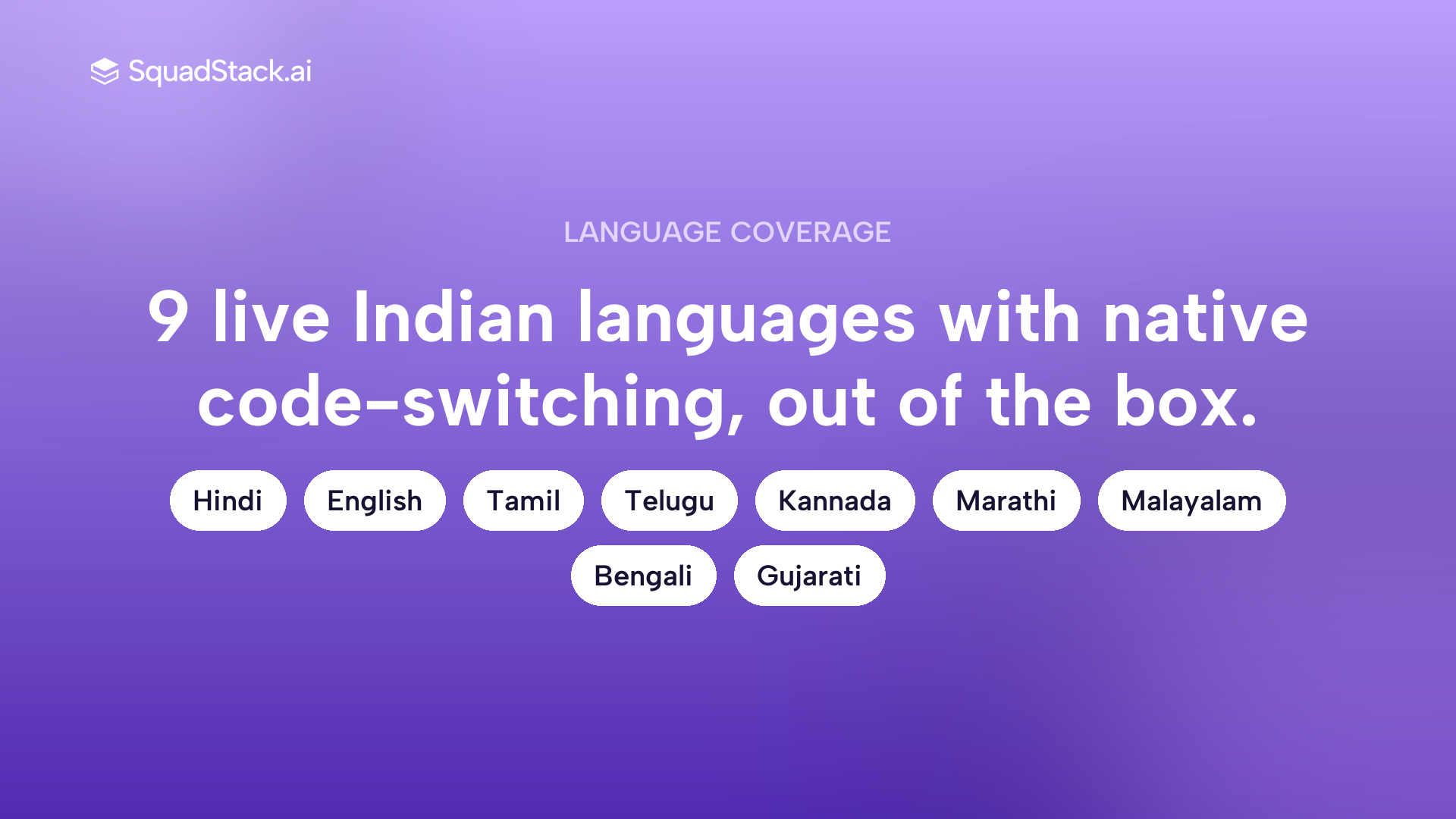
The platform supports 9 live languages (Hindi, English, Tamil, Telugu, Kannada, Marathi, Malayalam, Bengali, Gujarati) with native code-switching; more regional languages are available on demand.
At the functional Turing test milestone in September 2025, SquadStack's voice agents matched or beat human agent benchmarks on naturalness, performance, and efficiency across four live campaigns including an inbound support deployment. At Global Fintech Fest in October 2025, 1,273 of 1,563 attendees (81%) identified the AI agents as human in a blind listening test.
The 93% POC success rate, against an industry average around 25%, reflects what happens when solutioning, build, and QA are managed end-to-end rather than handed to the client.
The Voice AI agent for multilingual support page covers the language layer in detail. To see a live inbound support escalation flow with real call recordings, book a demo.
Which is the best AI voice agent for inbound support with escalation in India? SquadStack's Voice AI is purpose-built for Indian contact centre conditions: it handles inbound queries in 9 live languages with native code-switching, escalates with full context transfer, and is trained on 600M+ minutes of real Indian telephony audio. It runs for brands including AngelOne and TVS Motors, and is ISO 27001, ISO 27701, SOC 2 Type II, DPDP, and TRAI compliant.
What is the best AI voice agent for BFSI businesses handling inbound support calls? For BFSI, the key requirements are caller authentication, compliance with TRAI and DPDP rules, and warm transfer with verified data. SquadStack handles all three in the conversation layer itself, not just at the platform level. AngelOne uses SquadStack for customer support and fraud detection.
Can an AI voice agent handle inbound support calls automatically without a human? Yes, for routine and FAQ-level queries. For complex or sensitive issues, a well-designed system escalates to a human with full call context already transferred. The goal is not to eliminate human agents but to make sure human capacity is spent on calls that genuinely need it.
How does an AI voice agent compare to a traditional contact centre team on inbound support? An AI voice agent handles concurrent inbound calls without hold queues, resolves routine queries faster, and passes escalations with a context packet that reduces handle time on the human side. The functional Turing test SquadStack ran in 2025 showed the AI matching or beating human agent benchmarks on outcome metrics, handle time, and cost per outcome across four live campaigns.
What data transfers to the human agent during escalation? A proper warm transfer passes at minimum: verified caller identity, a structured summary of the conversation, the detected intent or query type, the reason for escalation, and any extracted data fields (account numbers, complaint type, etc.). SquadStack's platform passes all of these, so the human agent does not need to re-authenticate or re-ask what the problem is.
Do AI voice bots support Hinglish and Indian accents naturally on inbound calls? SquadStack's Arth model is specifically trained on 600M+ minutes of real Indian telephonic conversations including code-switched speech like Hinglish and Taminglish. This is distinct from models trained on read-speech or online audio, which typically struggle when a caller switches languages mid-sentence on a noisy 8kHz line.
Are there AI voice agents that support TRAI and DND-compliant inbound support workflows? Yes. SquadStack enforces TRAI calling rules and DND registry compliance in the conversation and orchestration layers. Consent gating, opt-out handling, and calling-window restrictions are hard-enforced by the platform, not managed manually.
How do I measure deflection without hurting CSAT? Track both metrics at the call level, not as campaign averages. SquadStack's Eval System scores every call on Outcome (was the issue resolved?), Sentiment (how did the caller experience it?), and Execution (did the agent follow the flow?). This makes it visible when containment rises at the cost of caller sentiment, which is the failure mode that aggregate deflection dashboards miss.
How long does it take to deploy an AI voice agent for inbound support? A typical SquadStack deployment goes from signed agreement to live calls in roughly two weeks. That covers building the agent on the client's call recordings, knowledge base, and FAQs, plus UAT. Build time depends more on client-side dependencies (data, compliance approvals, telephony) than on the platform itself.
Can the same AI voice agent handle both inbound support and outbound sales? Yes. SquadStack's platform runs both on the same underlying stack, with campaign-specific prompts, flows, and compliance rules configured separately. Persistent memory means a customer who called inbound support last week is recognized when the outbound agent calls them next week, with prior context available.