AI Voice Agents for Inbound Support with Complex Query Escalation
September 21, 2026
|

12 min read
The admissions funnel in Indian education has a structural mismatch at its core. Institutions spend heavily on lead generation through performance ads...
TL;DR: An AI voice agent for admissions handles the enquiry-to-enrollment journey automatically: it qualifies leads the moment they arrive, follows up with counsellors, chases form completions, and sends fee-deadline nudges, all without adding headcount. Indian education teams using this approach reach far more leads at lower cost per enrollment, because the agent works every lead in the database, not just the ones counsellors have time for.
The admissions funnel in Indian education has a structural mismatch at its core. Institutions spend heavily on lead generation through performance ads, aggregators, and scholarship tests. Then, during the May-to-July crunch, counsellor floors drown in volume, a large share of paid leads never get called, and speed-to-lead collapses exactly when lead value is highest.
The answer most institutions reach for is hiring more telecallers. But that cycle breaks: seasonal ramp-up takes weeks, attrition runs high, and a new caller needs time before they sound like your best counsellor. An AI voice agent for admissions solves a different problem than a larger floor. It makes sure every lead gets a call, immediately, every time, in their language.
An AI voice agent for admissions is a conversational calling system that handles student enquiries, qualifies them, books next steps, and follows up across the enrollment funnel, automatically, at any volume. It is not an IVR menu. The student speaks naturally, the agent listens, asks relevant follow-up questions, code-switches between languages mid-call if needed, and acts on what it hears: booking a counselling slot, sending a WhatsApp link, or flagging a high-intent lead for a human counsellor.
The outcome it targets is measurable: more leads contacted, more qualified leads passed to your floor, lower cost per enrollment.
For a fuller picture of how education teams use voice AI across the funnel, see SquadStack's education industry hub.
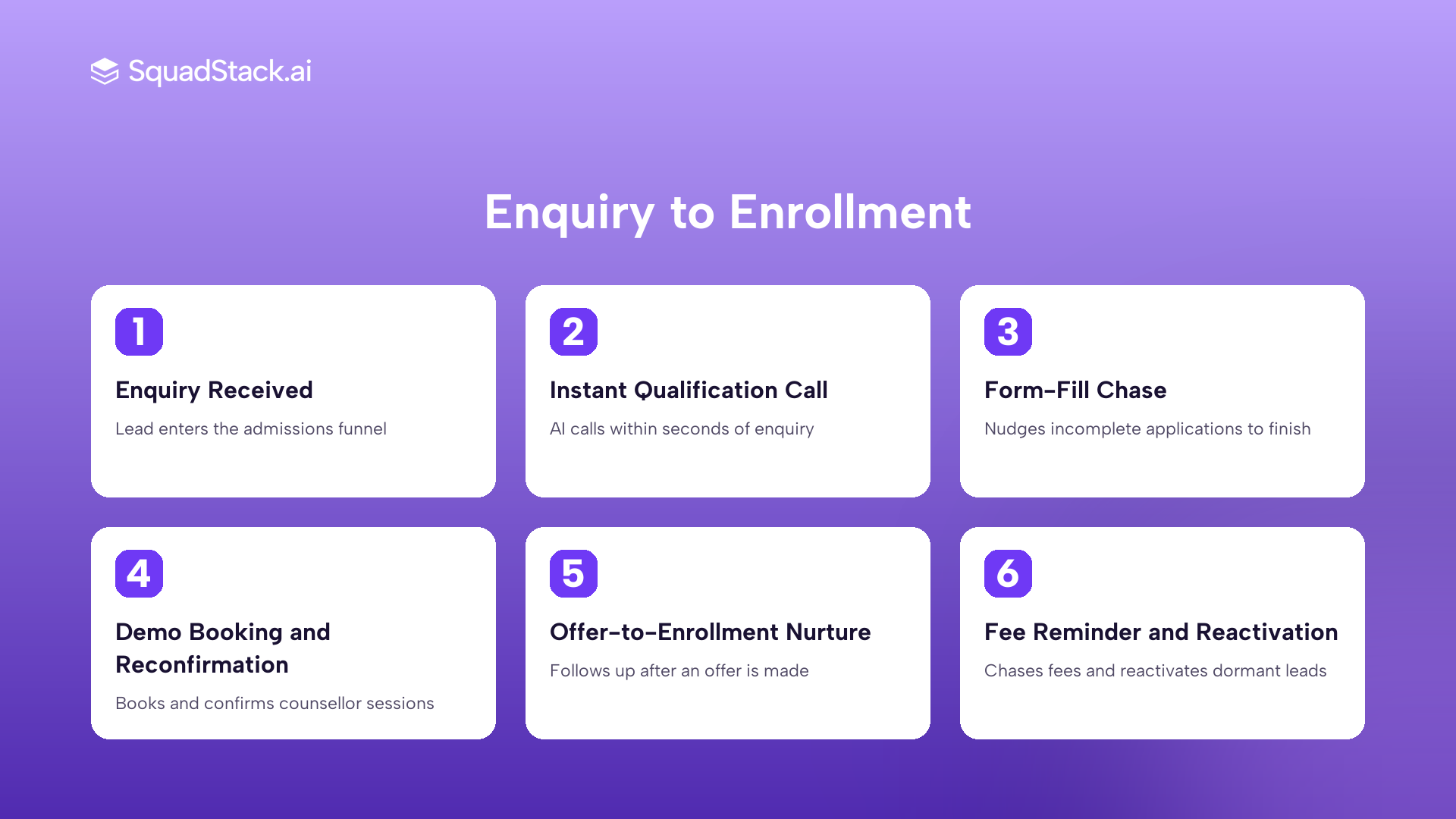
The flow covers eight moments where leads are typically lost.
Step 1: Instant lead qualification. A lead arrives from an ad, a marketplace, or a scholarship test. The agent calls within minutes, before a rival does. It captures stream, eligibility, city, budget, and parent involvement, then routes qualified leads to a counsellor with full context, or books the next milestone directly.
Step 2: Form-fill and application chase. Started-but-stalled applications are a named CRM segment at every institution. The agent calls the student, resumes from the exact stopping point, resolves the specific friction (payment failure, missing document, unclear step), and sends the link mid-call.
Step 3: Demo and campus-visit booking. The agent books the counselling session or campus visit, then sends a WhatsApp confirmation. At T-24 hours and T-2 hours it reconfirms. If the student cannot make it, the agent reschedules on the spot.
Step 4: Offer-to-fee nurture. An accepted offer is not a closed enrollment. Students routinely block seats at multiple institutions while waiting on CUET and state counselling rounds. Weekly warm check-ins from offer to orientation keep your institution the preferred option, chase document completion, and flag a student drifting toward a competitor seat.
Step 5: Fee deadline and re-registration reminders. The agent calls ahead of installment deadlines, offers the payment link mid-call, and surfaces the EMI option. For online-degree programs, semester re-registration is a recurring, calendar-driven campaign, and the agent runs it automatically.
Step 6: Dormant lead reactivation. Last cycle's unconverted leads are near-free pipeline. The agent re-opens with new-cycle context, a fresh intake window or a new scholarship slab, and re-qualifies for this season.
Step 7: Inbound admissions queries. At peak season, inbound call volumes spike sharply and IVR overflow simply rings out. The agent answers end to end from the institution's knowledge base, then hands off to a human with full context if needed.
Step 8: Continuous learning. Every call outcome feeds back into the system. The ROI Optimizer tracks which script, voice, timing, and follow-up sequence is converting, and the agent improves with each round. Calls produce insights, insights sharpen the agent, and the next campaign starts better than the last.
The jobs below map to the real leaks in the Indian admissions funnel.
Private and deemed universities use voice agents for peak-season overflow: qualifying the lakhs of leads that arrive in May-July, chasing incomplete applications, and running anti-melt nurture between offer and orientation. Institutions working with SquadStack include Unacademy, Adda247, Classplus, Collegedunia, Nxtwave, and Parul University.
Online-degree arms run on rolling admissions with January and July batch anchors. The same aggregator lead gets sold to multiple universities, so first-to-connect wins. The agent calls the moment a lead arrives, explains EMI options mid-call, and drives semester re-registration campaigns on a recurring calendar.
High-ticket upskilling platforms (₹50,000 to ₹4 lakh tickets) need qualification triage before expensive human counsellors pick up. The agent filters webinar floods, books confirmed counselling sessions, and chases EMI document completion between booking and batch start.
Low-ticket test-prep platforms cannot put a human on every lead at their ticket size. The agent calls cart abandoners on higher-ticket batches, follows up with scholarship-test takers who never enrolled, and runs year-boundary renewal calls (Class 11 to 12, first attempt to dropper batch).
Coaching chains use the agent for scholarship-test registration drives, test no-show recovery, result callbacks with parents, and installment reminders before batch dates.
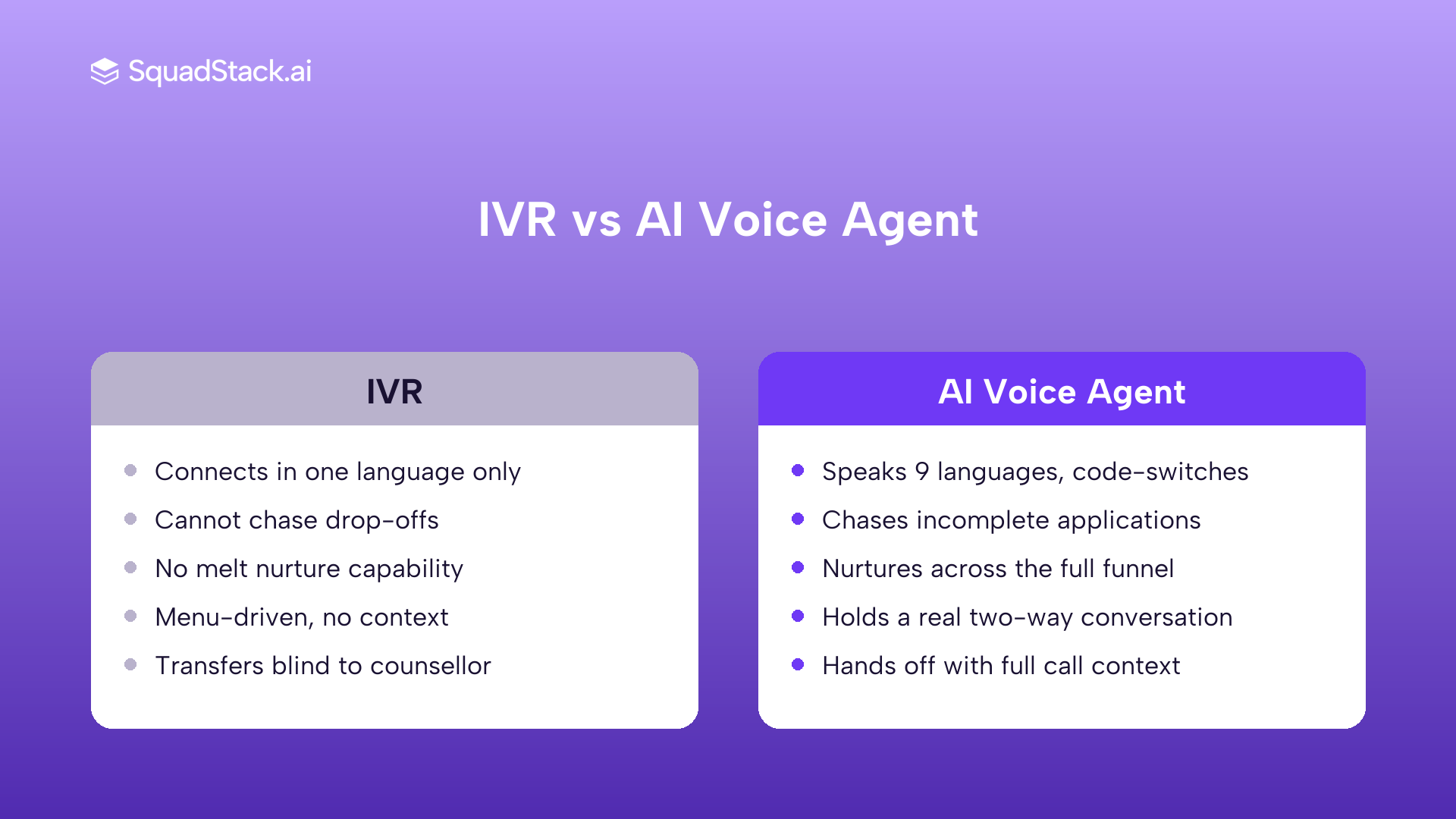
IVR systems were built to route calls, not hold conversations. In the admissions context, the gap matters in very specific ways.
| Dimension | IVR | AI Voice Agent |
|---|---|---|
| Lead response | Waits for the student to call in; cannot dial outbound proactively | Calls the student within minutes of enquiry, before a rival does |
| Language handling | Fixed language at setup; cannot switch mid-call | Switches naturally between Hindi, Tamil, Telugu, Kannada, and English mid-sentence, the way a bilingual counsellor does |
| Application drop-chase | Cannot identify where a form stalled or send a link mid-call | Resumes from the exact stopping point, resolves the friction, and sends the WhatsApp link while the student is still on the line |
| Offer-to-enrollment melt | No awareness of melt risk; cannot nurture an admitted student | Runs weekly warm check-ins from offer to orientation, detecting early warning signs |
| Counsellor handoff | Transfers cold, with no context passed | Passes qualification data, call summary, and confirmed entities to the counsellor before the call lands |
| Memory across calls | Every call starts from the beginning | Persistent memory means a student is never asked the same question twice across multiple touchpoints |
The shift is not just about automation. It is about covering the parts of the funnel that no one currently staffs: melt management, form-fill chase, dormant reactivation. IVRs do not touch these at all.
Four things separate platforms that work in Indian education from those that struggle.
1. Indian language depth, not just coverage. Listing a language is easy. Sounding native in it is hard. The agent needs to handle Hinglish, Taminglish, and parent-to-student code-switching mid-call. Check whether the vendor's models were trained on real Indian telephony audio or on generic datasets.
2. Lead connectivity, not just call volume. A large share of education leads go unconnected because numbers get spam-flagged during bulk campaigns. Ask the vendor how they handle Truecaller status, number rotation, and retry timing. A platform that cannot reach the lead cannot qualify it.
3. CRM and workflow integration. The agent must write dispositions, qualification fields, and callback schedules back to your Meritto or LeadSquared instance in real time. Without that, the counsellor floor operates blind.
4. Human escalation design. The best admissions conversations still end with a human counsellor for high-intent students. Look for warm transfer with full context passed, not a cold handover.
For a structured evaluation guide, see how to evaluate a voice agent.
SquadStack has spent roughly 10 years running AI-assisted contact center operations for large Indian consumer brands before moving fully to Voice AI in 2025. The training data behind the platform is 600 million-plus minutes of real Indian sales conversations, spanning most Indian PIN codes, including full-duplex, outcome-labelled education calls in multiple languages. That corpus is what trains Arth, SquadStack's proprietary speech model, tuned specifically for Indian telephony conditions: noisy 8kHz lines, code-switched speech, and Indian entity handling for names, PIN codes, and exam terminology.
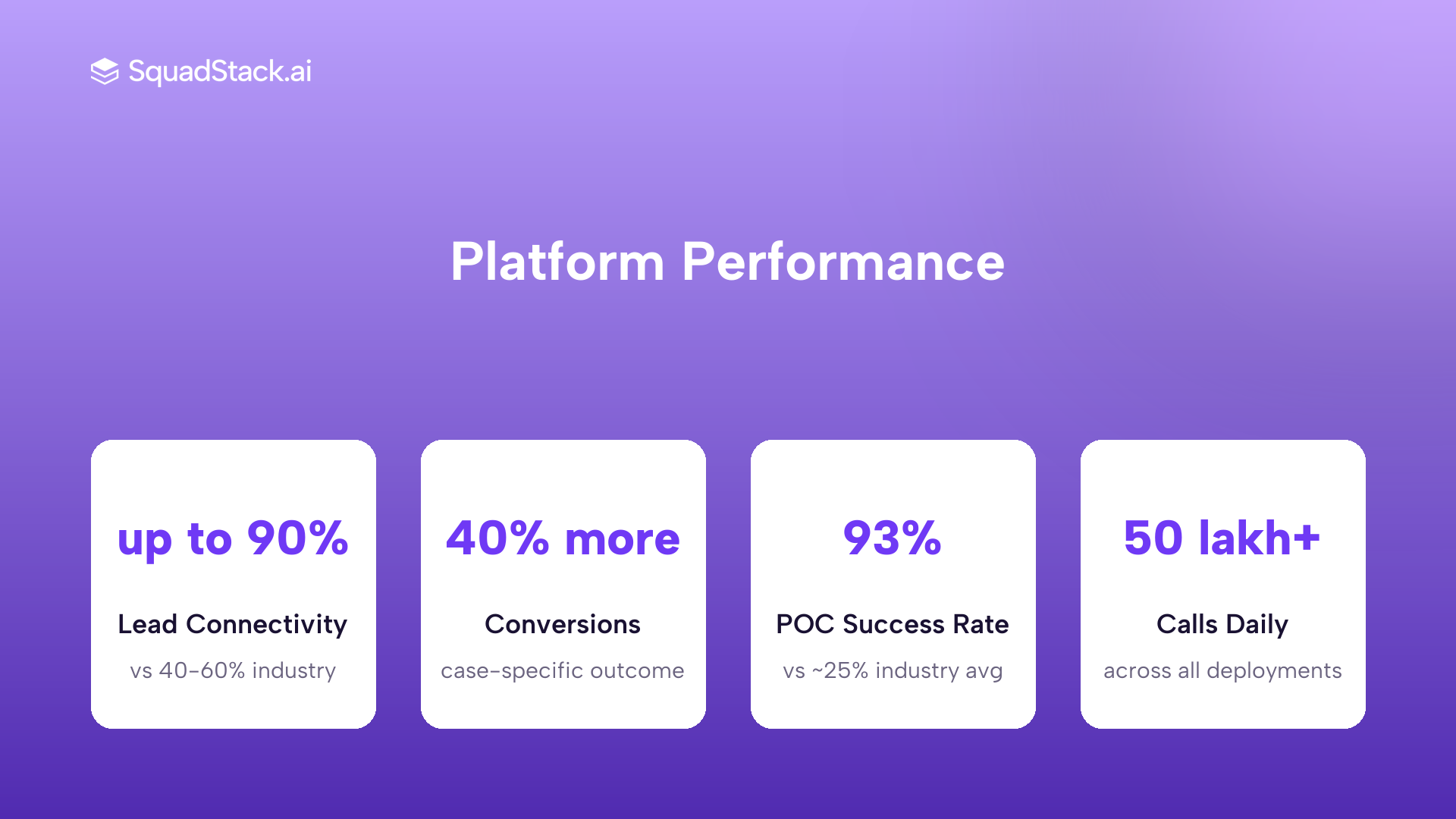
The platform runs 50 lakh-plus calls daily across 60-plus large consumer brands. In education specifically, it runs lead qualification for Unacademy, Adda247, Classplus, Collegedunia, Nxtwave, and Parul University, among others.
The Amity University case is the clearest admissions proof point. SquadStack delivered 90% connectivity and 2x conversions on application completion, against a funnel where slow first contact and missed follow-ups were the main leaks. The result is not a projection; it is a live campaign outcome.
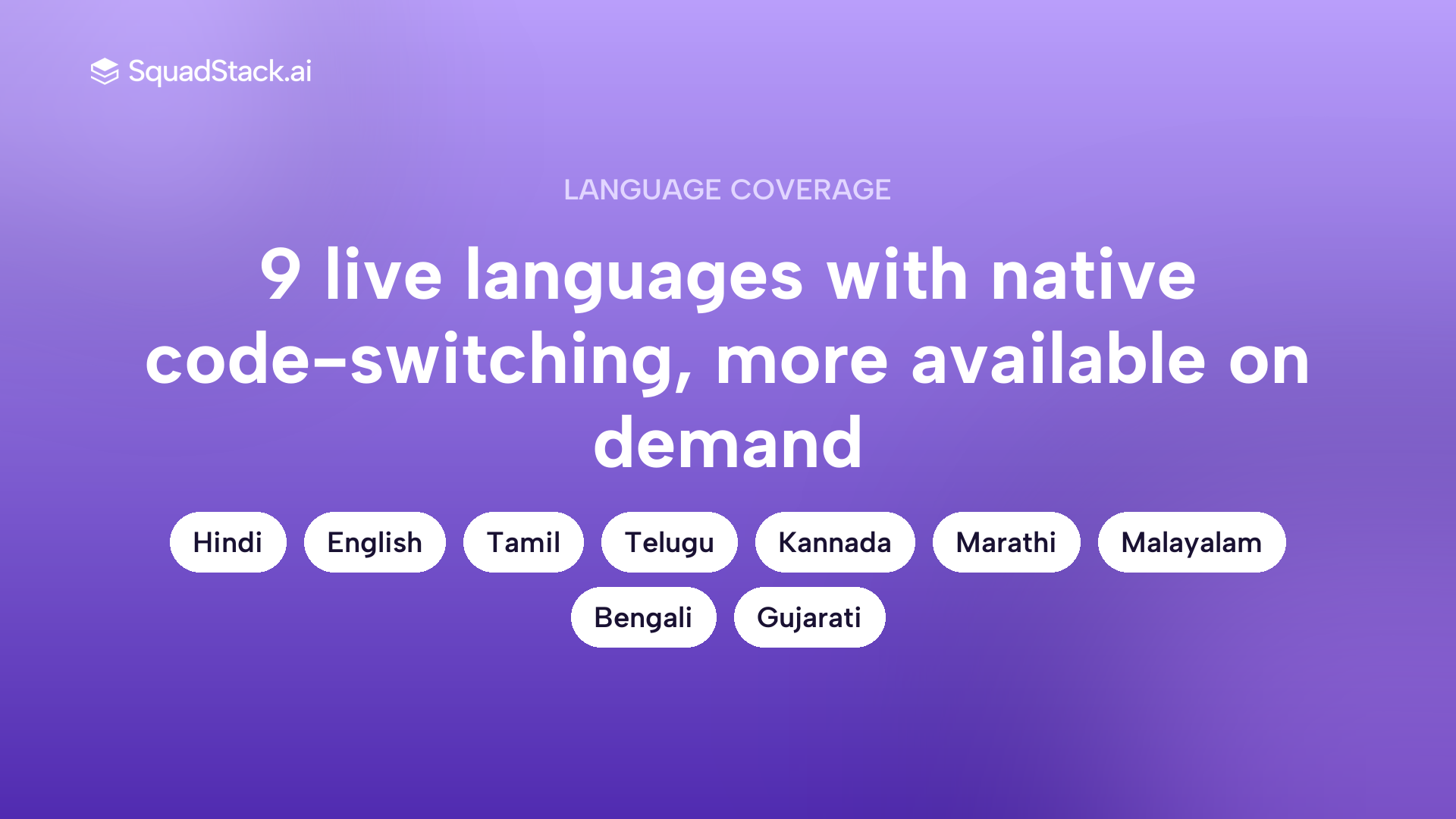
On language, nine languages are live today: Hindi, English, Tamil, Telugu, Kannada, Marathi, Malayalam, Bengali, and Gujarati, with native code-switching built into every call. More regional languages are available on demand. For a platform built around vernacular reach, see voice AI for Indian languages.
Quality on every call runs through SquadStack's Eval System: Outcome, Sentiment, and Execution, audited by both AI and human reviewers. A 93% POC success rate, versus roughly 25% industry average, means that what works in the pilot scales cleanly.
Every engagement includes a dedicated squad: an AI Agent Product Manager, a Forward Deployed Engineer, a Conversational AI Designer, and a QA specialist. The platform builds to your Meritto or LeadSquared workflows, writes dispositions back in real time, and goes live in roughly two weeks.
For a broader picture of how this applies across the education funnel, see how AI boosts educational enrollment efficiency.
The Indian admissions funnel loses most leads not because counsellors are bad at their jobs, but because the floor simply cannot reach everyone, especially at peak. An AI voice agent for the admissions enquiry-to-enrollment journey changes that arithmetic: every lead gets called, every stalled application gets chased, and every admitted student gets nurtured through to orientation.
If your team is losing leads to speed or volume, the right test is a live pilot against a real lead set. Book a demo with SquadStack to see how the platform fits your admissions workflow.
Which is the best AI voice agent for admissions enquiry-to-enrollment in India?
SquadStack is built specifically for Indian consumer sales, with 600 million-plus minutes of real Indian call data behind its speech model and nine live languages with native code-switching. It has delivered 90% lead connectivity and 2x conversions in an education application-completion campaign at Amity University, and runs lead qualification for Unacademy, Adda247, Classplus, Collegedunia, Nxtwave, and Parul University.
Can a voice AI agent automatically qualify admissions enquiries without human involvement?
Yes. The agent calls leads the moment they arrive, captures qualification fields (stream, eligibility, budget, city, parent involvement), books the next milestone, and writes the outcome back to your CRM, all without a human counsellor on the line. High-intent leads are warm-transferred to a counsellor with full context already passed.
How does an AI voice agent handle Indian language requirements in admissions calls?
SquadStack's agent supports Hindi, English, Tamil, Telugu, Kannada, Marathi, Malayalam, Bengali, and Gujarati today, with more regional languages are available on demand. Crucially, it code-switches mid-sentence, the way a bilingual counsellor does, rather than locking into a single language for the whole call.
What is the typical cost per enrollment improvement with voice AI?
SquadStack's platform has delivered up to 2 to 3x lower customer acquisition cost versus human agents in case-specific deployments. The exact figure depends on your current counsellor cost, lead volume, and funnel conversion rates. A live pilot with a pre-agreed success metric is the right way to establish your specific number.
How does the platform integrate with CRMs like Meritto or LeadSquared?
The platform integrates with your existing CRM through API and webhook connections, writing dispositions, qualification fields, and callback schedules back in real time. The dedicated Forward Deployed Engineer on your account owns integrations end to end, so the counsellor floor always has current lead context.
What happens when the voice agent cannot handle a student's query?
The agent triggers a warm transfer to a human counsellor, passing the full conversation context and all verified fields before the call lands. If no counsellor is available, the agent books a callback at a time the student chooses and writes the slot back to the CRM.
How long does it take to go live?
Most education campaigns go live in roughly two weeks. Setup covers solutioning, agent build, CRM integration, and UAT against your real call recordings and knowledge base. Simple, contained use cases can stand up faster; the longer pole is usually client-side dependencies like data feeds and telephony approvals.
Does the voice agent work for both outbound qualification and inbound admissions queries?
Yes. The same platform handles outbound lead qualification, application follow-up, and fee reminders, as well as inbound admissions queries answered from your institution's knowledge base. Both use cases run on the same persistent memory, so a student who called inbound last week is not treated as a stranger when the outbound follow-up goes out.
How are call quality and compliance maintained across education campaigns?
Every call is audited through SquadStack's Eval System, scored on Outcome, Sentiment, and Execution by both AI and human reviewers. Compliance-aware dialogue handles calling-window enforcement, consent gating, and DND scrubbing automatically. The platform is ISO 27001, ISO 27701, SOC 2 Type II, DPDP, and TRAI compliant.
Can the platform handle the volume spike during the May-to-July admissions peak?
Scaling AI does not require hiring, training, or managing a temporary floor. The platform runs 50 lakh-plus calls daily and can ramp volume on a software-driven cadence. In one campaign documented by SquadStack, volume scaled approximately 100x over nine weeks while conversion continued to beat the human benchmark.