AI Voice Agents for Inbound Support with Complex Query Escalation
September 21, 2026
|

12 min read
An AI voice agent for brokerage account activation automates the three calls that move a new signup from a stalled KYC form to a funded, trading account...
An AI voice agent for brokerage account activation automates the three calls that move a new signup from a stalled KYC form to a funded, trading account: the drop-chase nudge, the funding prompt, and the first-trade hand-hold. Indian brokerages using SquadStack's voice agents have seen up to 3x higher conversions on account opening, within full SEBI and TRAI compliance guardrails.
Every brokerage in India faces the same problem. The account was opened. The KYC was started. The money never arrived. And somewhere between the e-sign screen and the trading app, the person simply moved on.
India now has more than 23 crore demat accounts and roughly 4.55 crore NSE-active clients. That gap, nearly 19 crore accounts sitting dark, represents acquisition spend that has not paid back. Most brokerages send a push notification and hope. The ones gaining ground are calling.
This article explains exactly how AI voice agents work inside a brokerage funnel, what calls they handle, and why the combination of speed, compliance guardrails, and persistent follow-up makes them effective where human floors and IVR systems fall short.
An AI voice agent for brokerage account activation is a conversational AI system that conducts outbound and inbound calls to move signups through the KYC-to-first-trade funnel, without a human caller on the line and without ever giving investment advice.
It handles the operational layer of activation: finding out where a signup stalled, walking the user through DigiLocker or e-sign, confirming a bank transfer, and staying on the line while the first order is placed. The agent does not recommend securities, does not name target prices, and does not make return promises. Those lines sit in locked compliance guardrails that no optimization loop can touch.
This is the boundary SEBI draws clearly. KYC and account-opening completion, funding prompts, feature education, transactional confirmations, and dormant account reactivation are all legitimate outbound use cases. Oral advice on specific securities is not. An AI voice agent designed for brokerage operations enforces that boundary at the system level, not in a training script that callers can deviate from.
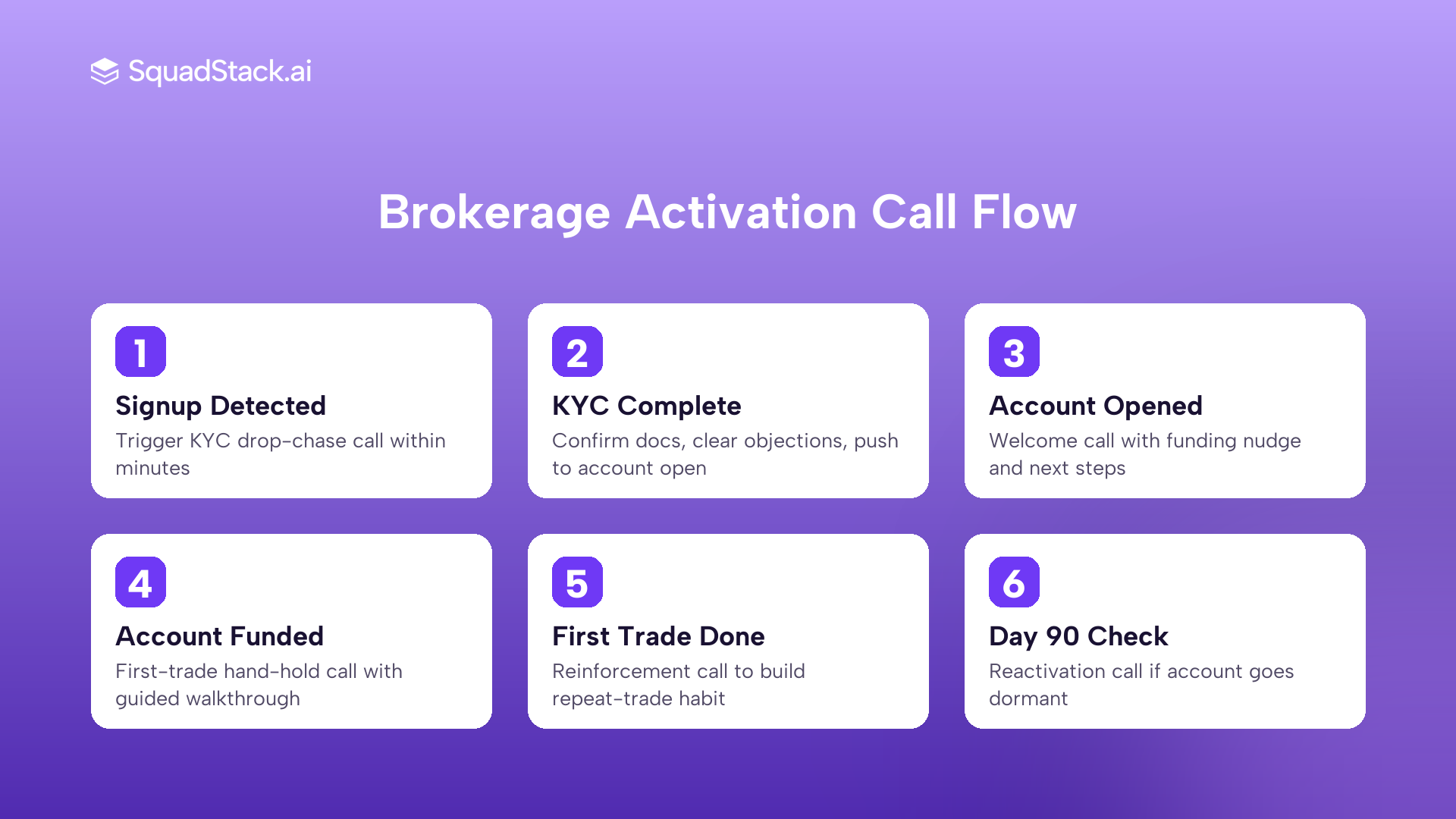
The call flow maps directly onto the activation funnel.
1. Trigger and prioritization. When a signup stalls, the AI Lead Manager scores it, assigns intent decay, and queues the call within the compliant 9:30 AM to 8:30 PM window, rotating numbers to avoid spam flags and scrubbing against the TRAI DND registry before dialing.
2. The KYC drop-chase call. The agent identifies exactly which step failed: PAN mismatch, forgotten Aadhaar-linked mobile, penny-drop name mismatch, or abandonment at e-sign. It then walks the user through the fix live, including the DigiLocker document pull and OTP-based Aadhaar e-sign.
3. Funding nudge. Once the account is open, the agent calls on a day 1, day 3, day 7 cadence. The conversation confirms the account is live, explains what funding does and does not commit the user to, and walks through the transfer. No securities recommendation, no market view.
4. Welcome call. The agent confirms brokerage plans, explains how charges work, and answers basic order-placement questions. This is both a regulatory best practice and an activation nudge.
5. First-trade hand-hold. The agent educates the user on how to place a delivery order or start a SIP, then stays on the line while they do it. This is the activation moment and where the industry leaks most: a large share of KYC-completed users never place their first trade, not because they lost interest but because nobody guided them through it.
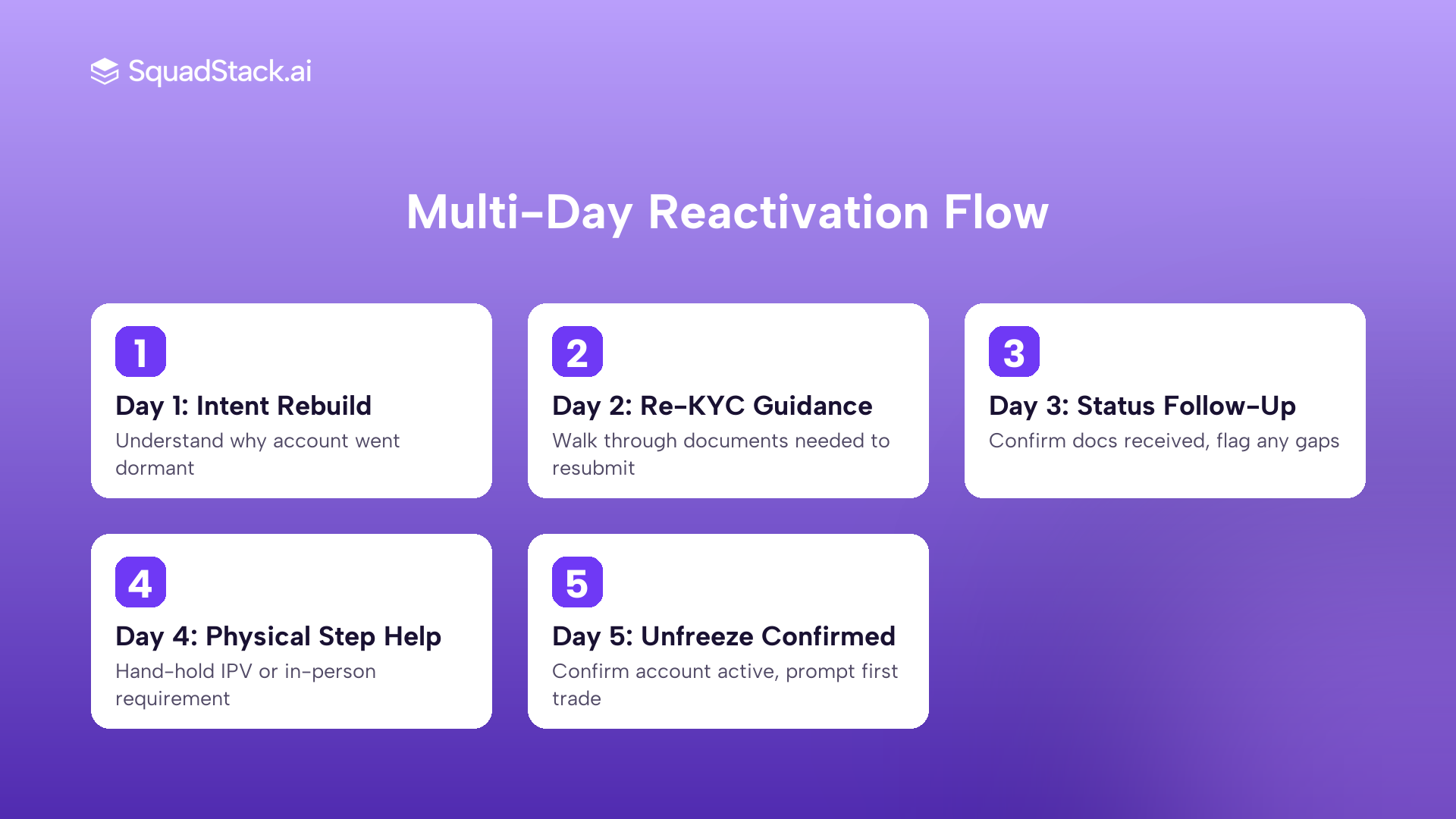
6. Dormant reactivation. For accounts dark under 24 months, the agent rebuilds intent and guides the unfreeze process across multiple calls. For accounts dormant beyond 24 months, it handles the re-KYC hand-hold, a process that takes two to five business days online and longer with physical steps. The agent picks up exactly where the last call ended, not from zero.
7. Continuous learning. Every call outcome feeds back into SquadStack's ROI Optimizer. Script framing, call timing, and objection responses run as live A/B experiments. The loop does not stop: calls generate insights, insights update the agent, and each future conversation benefits from what every previous one learned.
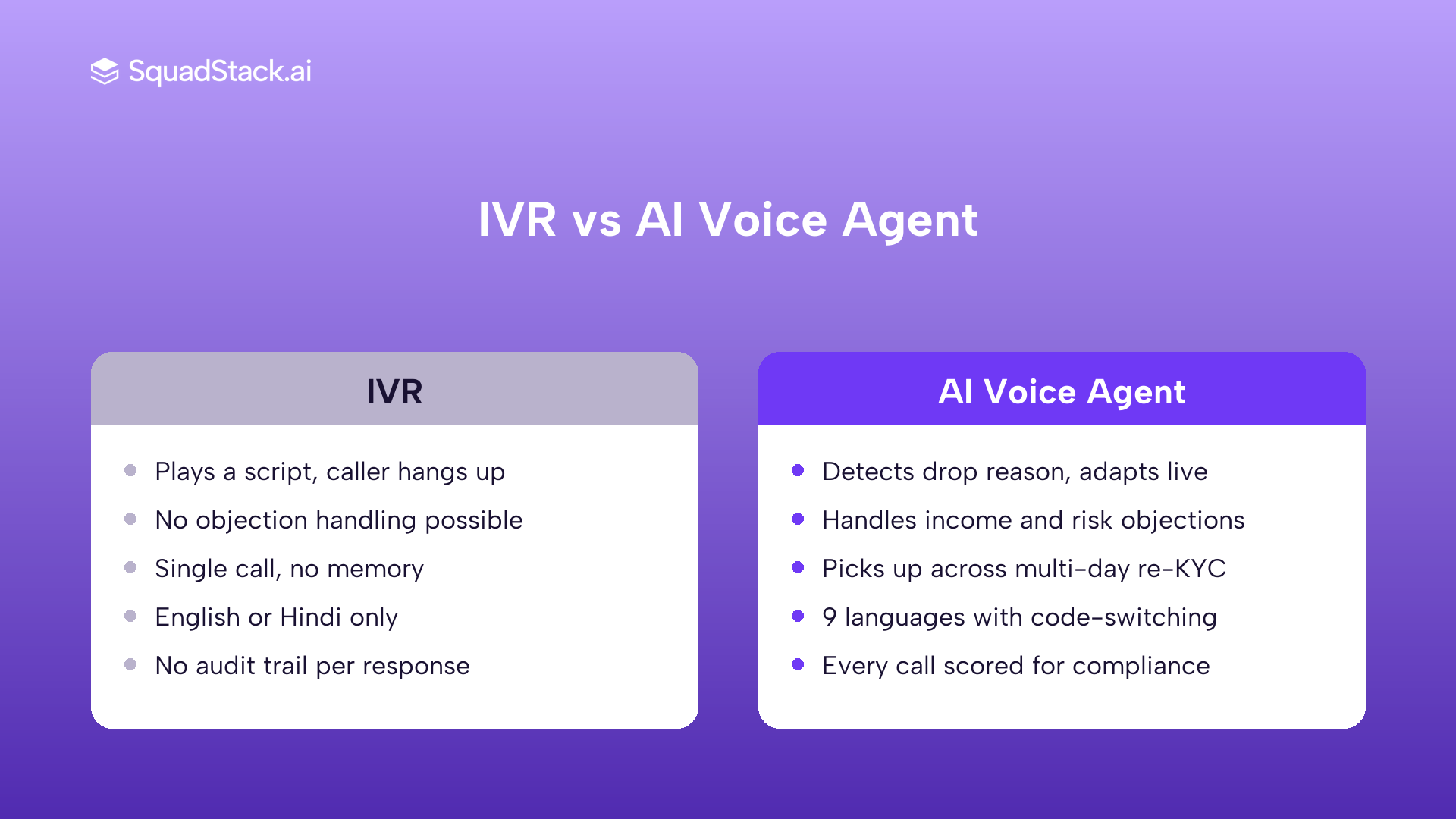
IVR systems work for routing and verification. They break for activation.
| Dimension | Traditional IVR | AI Voice Agent |
|---|---|---|
| KYC rescue | Plays a menu. Cannot identify which specific step failed or walk through a DigiLocker flow live. | Asks the user what went wrong, diagnoses the exact step, and guides them through the fix in real time. |
| Objection handling | Breaks on any off-menu response. "I'll fund it when markets dip" has no IVR path. | Handles multi-turn objections with responses calibrated to what the user actually said. |
| Multi-day re-KYC | Treats each call as a fresh interaction. No memory of what was confirmed yesterday. | Carries context across every call until re-KYC is complete. Knows which documents are submitted and which are pending. |
| Language | One language per IVR tree. Code-switching breaks it. | Switches mid-sentence between Hindi, English, Tamil, Telugu, or Kannada as the user shifts. |
| Compliance guardrails | Cannot be dynamically updated. Script drift is invisible until a complaint. | Compliance language and advice-line guardrails sit in locked sections that no optimization loop can alter. |
The practical version: a user who stalled at penny-drop presses nothing on an IVR because no menu option matches their problem. An AI voice agent asks "Where did the process stop for you?" and then solves it.
SEBI and TRAI compliance by design, not by policy. Guardrails for advice-line limits, DND scrubbing, calling-hour restrictions, and consent gating must be hard-coded at the system level, not in a training script.
Persistent memory across a multi-day funnel. KYC drop-chase is usually one call. Dormant reactivation takes days. A platform without cross-call memory forces users to repeat themselves, and most will not.
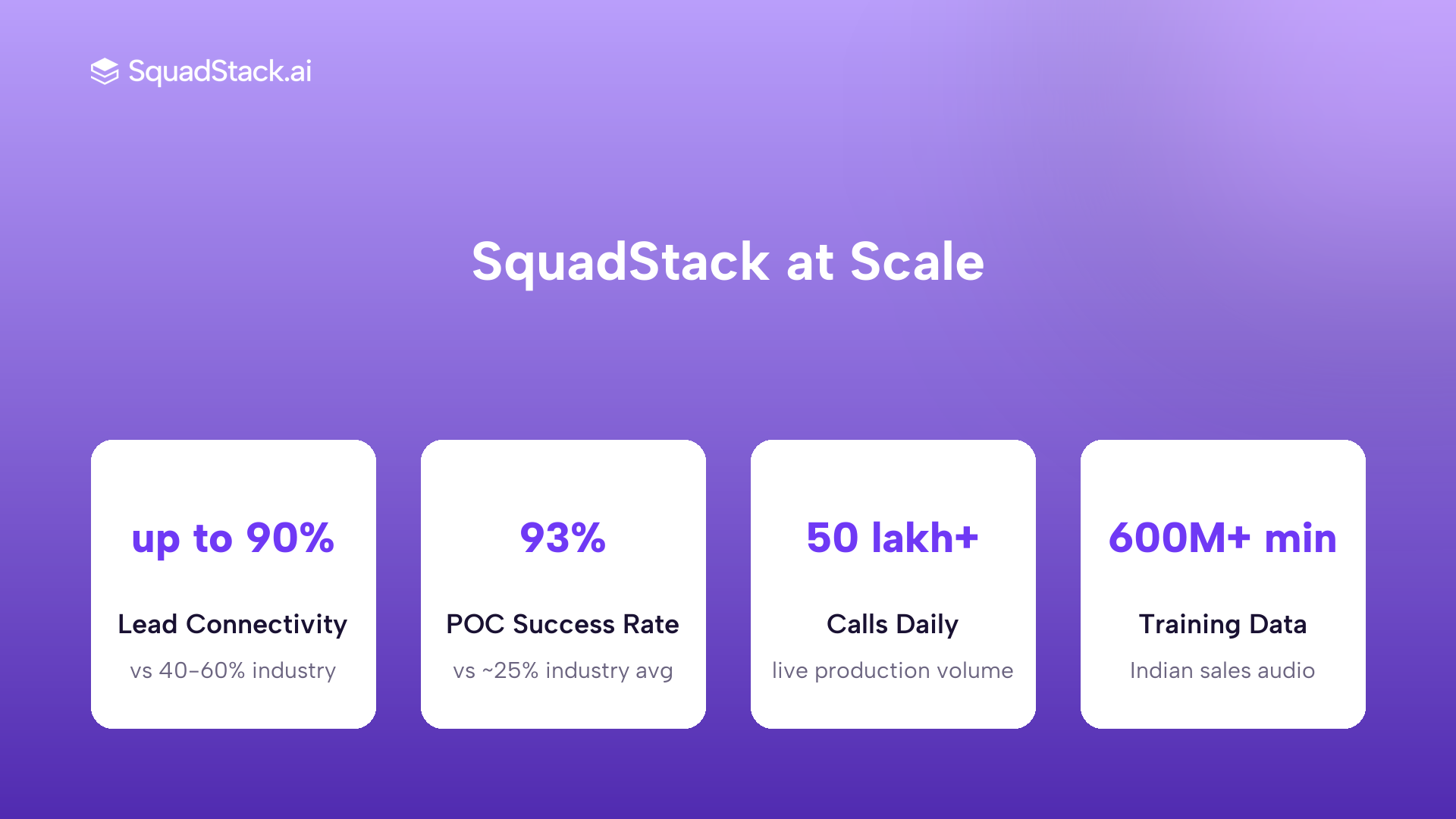
Indian telephony quality. A speech model trained on clean studio audio does not handle 8kHz telephone lines, crosstalk, or code-switched Hinglish. The gap between a model that transcribes cleanly on a demo and one that holds up on 50 lakh real calls a day is large.
A managed outcome model, not a self-serve script builder. Activation rate is a business outcome. The platform needs to own the conversion result: A/B testing, script tuning, quality audits, and a team accountable for the number.
Proven brokerage experience. A platform that has run account-opening campaigns for named Indian brokerages has solved the edge cases already: IPV queue handling, penny-drop mismatch scripts, e-sign abandonment rescue, and 1600-series vs 140-series consent routing.
For a full comparison of what to look for, the how-to-evaluate guide covers the key dimensions in detail.
A leading bank-linked brokerage running SquadStack's voice AI on demat account opening achieved 3x higher conversions compared to the prior human-agent baseline. The full story is at the brokerage account-opening case study.
Named clients currently running live campaigns include Kotak Securities and Bajaj Broking on demat account opening, and AngelOne across account opening, customer support, and fraud-detection calling. These are production campaigns running at the volumes Indian brokerages actually operate at.
SquadStack's proprietary STT model, Arth, was trained on 600M+ minutes of real Indian sales conversations, including noisy 8kHz telephone audio, code-switched Hinglish, and the full range of Indian accents and financial terminology. On a real Indian telesales audio benchmark, Arth v1 sits within 0.9 semantic WER points of the best commercial streaming STT available. That difference is audible when a user spells their PAN character by character over a crackly line.
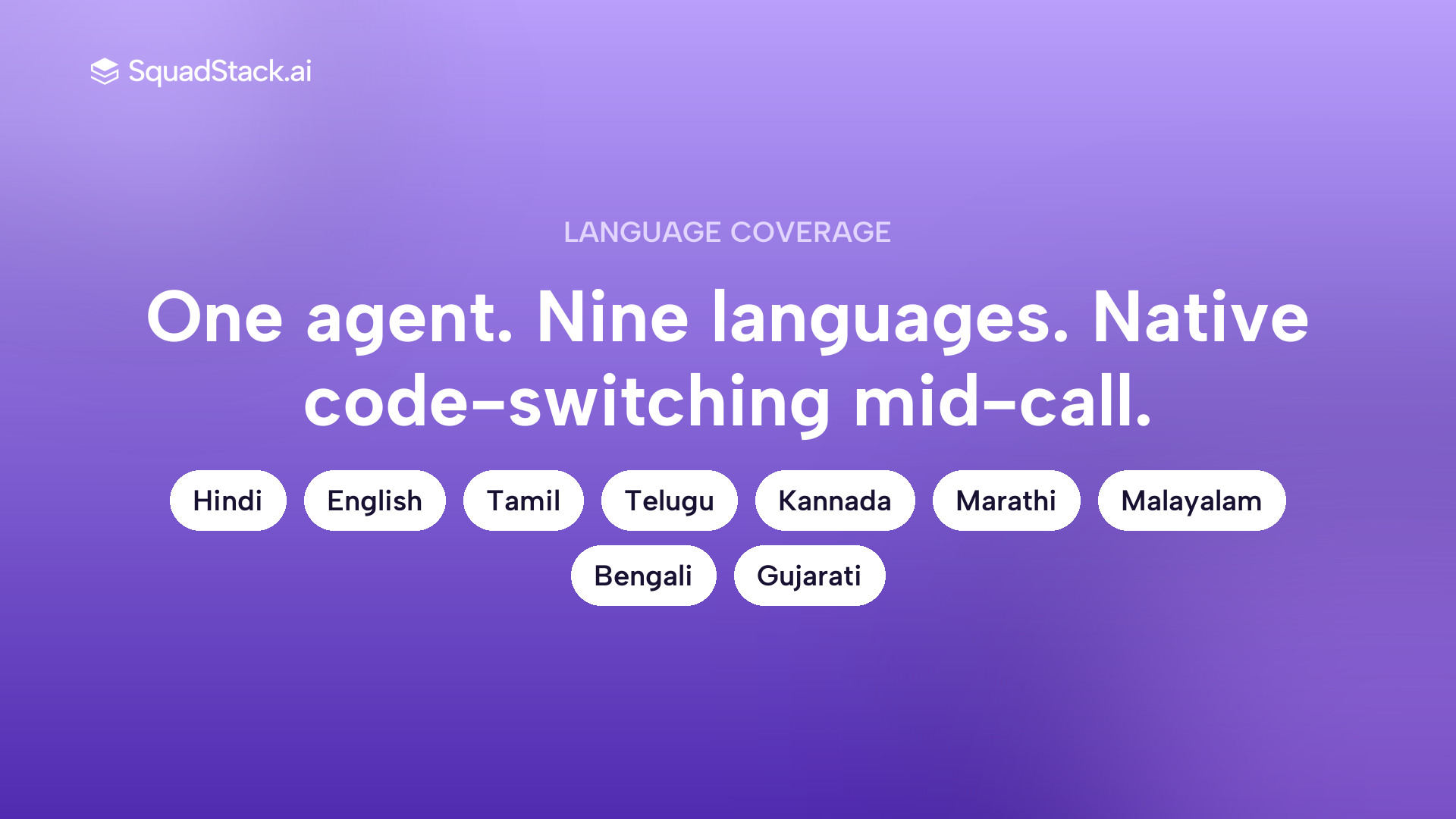
The platform runs 9+ Indian languages with native code-switching: Hindi, English, Tamil, Telugu, Kannada, Marathi, Malayalam, Bengali, and Gujarati are live today, with more regional languages are available on demand. For B30 acquisition, where more than 60% of new demat accounts now originate outside metros, a vernacular-native agent converts differently than one that sounds like a newsreader.
Every call is audited by SquadStack's dual-layer Eval System across outcome, sentiment, and execution. Brokerage-specific quality parameters cover script adherence, compliance guardrail enforcement, and KYC step identification. At Global Fintech Fest 2025, 1,273 of 1,563 attendees could not tell SquadStack's voice agents from human callers in a blind test.
The platform holds ISO 27001, ISO 27701, SOC 2 Type II, DPDP, and TRAI certifications. India data residency is standard.
Go-live takes roughly two weeks, followed by a 4 to 8 week pilot against a pre-aligned conversion metric. SquadStack's POC success rate is 93%, against an industry average of roughly 25%.
The brokerage activation problem is not a technology gap. It is a speed-and-persistence gap. A new signup needs to hear from someone in minutes. A dormant account needs a caller who remembers last Tuesday's conversation. A first-trade moment needs someone patient enough to stay on the line without making it a sales call.
AI voice agents do all three, at the volume Indian brokerages actually operate at, within the compliance boundary SEBI requires. More signups completing KYC, more opened accounts funding, more funded accounts placing that first trade.
If your brokerage is sitting on a dark book it paid to acquire, the calling motion that recovers it is ready to run. Book a demo with SquadStack to see the activation flow live.
Which is the best AI voice bot platform for an Indian brokerage that needs KYC nudges, account activation calls, and first-trade hand-holding?
SquadStack is purpose-built for this use case. It runs live campaigns for Kotak Securities, Bajaj Broking, and AngelOne on demat account opening, with speech models trained on 600M+ minutes of real Indian contact center calls and compliance guardrails that enforce SEBI's advice-line rules at the system level.
Can an AI voice agent handle KYC drop-chase calls automatically in India?
Yes. The agent identifies exactly which KYC step the user abandoned, whether PAN mismatch, penny-drop name error, forgotten Aadhaar OTP, or e-sign abandonment, and walks them through the fix live. It calls within the TRAI-compliant 9:30 AM to 8:30 PM window and uses DND-scrubbed, spam-monitored number rotation.
How does AI voice compare to a human calling floor for brokerage account activation?
A human floor is limited by headcount, attrition, and calling-window capacity. A voice AI agent scales instantly, reaches up to 90% of leads in a campaign, and maintains identical script adherence on every call. A leading brokerage using SquadStack achieved 3x higher conversions on account opening compared to its human baseline.
Is AI voice agent calling for brokerages compliant with SEBI and TRAI rules?
Yes, when the platform is built correctly. SquadStack's agents enforce SEBI's advice-line guardrails in locked prompt sections, route by consent state between 140-series and 1600-series numbers, scrub against the TRAI DND registry, and hold ISO 27001, SOC 2 Type II, DPDP, and TRAI certifications. Compliance controls are at the system level, not in a training script.
How does dormant demat account reactivation work with a voice AI agent?
It is a two-call-minimum process. The first call rebuilds intent. Subsequent calls guide the user through the unfreeze or re-KYC steps, which can take two to five business days online and longer with physical steps. SquadStack's persistent memory means each follow-up call resumes exactly where the last one ended, so users never repeat themselves.
Can a voice AI agent handle first-trade assistance without giving investment advice?
Yes. The agent explains how to place a delivery order or start a SIP, navigates the user through the app screens, and stays on the call while the order is submitted. It does not name securities, does not give market views, and does not make performance claims. That boundary is enforced in locked compliance sections of the system, not in caller discretion.
What languages can a brokerage voice AI agent speak in India?
SquadStack's agents are live in Hindi, English, Tamil, Telugu, Kannada, Marathi, Malayalam, Bengali, and Gujarati, with native code-switching mid-sentence. More regional languages are available on demand. For B30 acquisition, where a large and growing share of new demat accounts originate outside metros, vernacular-native capability is a real conversion driver.
How long does it take to go live with a voice AI agent for brokerage activation?
SquadStack's typical setup is roughly two weeks, after which a 4 to 8 week pilot runs against a pre-aligned success metric on real leads. The agent is trained on the broker's own call recordings, knowledge base, and compliance flows before going live. Simple, contained use cases can stand up faster; the longer pole is usually client-side dependencies like telephony approvals and compliance sign-off.
What is the AI voice agent for BFSI customer onboarding in India that handles both activation and compliance?
SquadStack's voice AI platform is designed specifically for BFSI customer onboarding in India. It handles KYC drop-chase, account funding nudges, welcome calls, and first-trade hand-holding while enforcing SEBI's non-advisory boundary, TRAI calling-hour rules, and DPDP data-residency requirements. It runs on Arth, a proprietary STT model trained on Indian telephony audio, and is currently live with named BFSI brands across banking, broking, and lending.
Can the same platform handle dormant account reactivation and new account activation?
Yes. The same platform runs both, and the two use cases often share the same agent infrastructure. New-account activation is a fast, high-volume, single-call-to-close motion, while reactivation requires multi-day follow-up with persistent memory. SquadStack configures both as separate campaign workflows on the same stack, with quality parameters and compliance guardrails appropriate to each.