AI Voice Agents for Inbound Support with Complex Query Escalation
September 21, 2026
|

12 min read
An AI voice agent for delivery rescheduling and coordination handles the full last-mile conversation loop: calling customers to rebook failed deliveries...
An AI voice agent for delivery rescheduling and coordination handles the full last-mile conversation loop: calling customers to rebook failed deliveries, confirming dispatch windows with riders, and escalating to a human when needed. Deployed properly, it cuts return-to-origin rates, saves manual dialing hours, and works across India's regional languages without adding headcount. SquadStack runs this at scale for logistics and quick commerce brands today.
India runs between 20% and 40% of shipments into at least one failed delivery attempt. In tier-2 and tier-3 cities, the rates are worse. The customer was unavailable, the address was ambiguous, the rider came and left. Now someone has to call, reschedule, and make sure the second attempt lands.
At any real scale, that "someone" cannot be a room full of agents dialing manually. The NDR desk fills up, calls go out late, the rescheduling window closes, and the parcel goes back. Each return costs the seller freight both ways and returns zero revenue.
AI voice agents built for logistics handle this coordination layer automatically, in multiple languages, with a call flow that adapts to what the customer actually says.
This post covers how that works, what good looks like operationally, and what to look for when choosing a platform. It is a companion to our broader logistics and quick commerce industry overview.
An AI voice agent for delivery rescheduling and coordination is a voice AI system that calls customers automatically after a failed delivery, confirms a new time slot, updates the rider, and writes the outcome back to the dispatch system. It is not an IVR. It holds a two-way conversation, handles objections and address corrections, switches languages mid-sentence, and escalates to a human when the situation is beyond its scope.
The core job is replacing the manual NDR callback desk. Every failed delivery raises a non-delivery report. That report needs a phone call within hours, not the next morning. The AI agent makes that call immediately, at any volume, day or night.
Beyond NDR, the same agent handles pre-dispatch confirmation calls for COD orders, inbound rescheduling requests, pickup validation, and rider coordination nudges for slot confirmation or ETA updates.
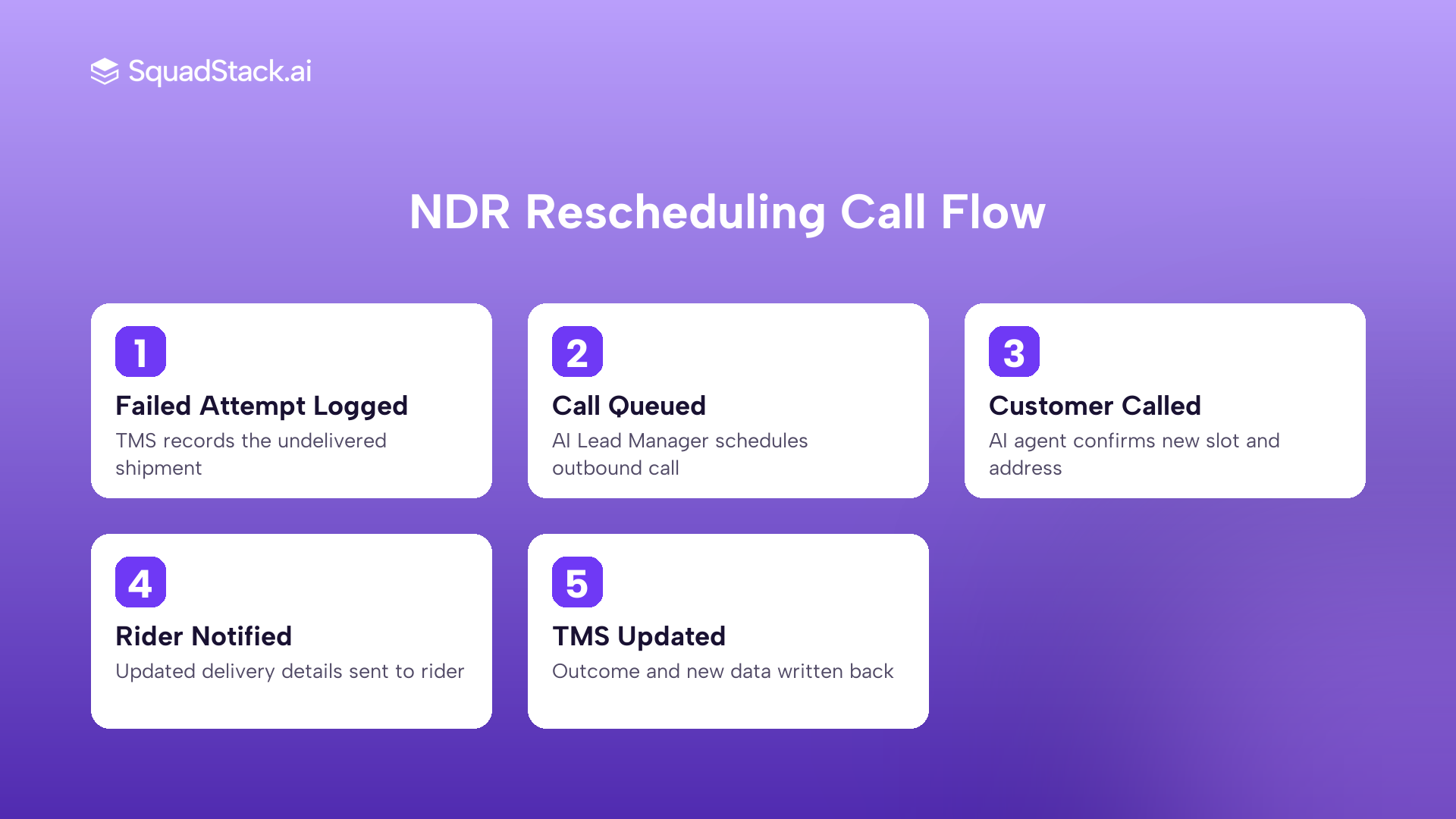
Step 1: Trigger on failure. The moment a failed attempt is logged in the dispatch or warehouse management system, the AI Lead Manager queues an outbound call. Reaching a customer within the first few hours converts at a much higher rate than calling the next day.
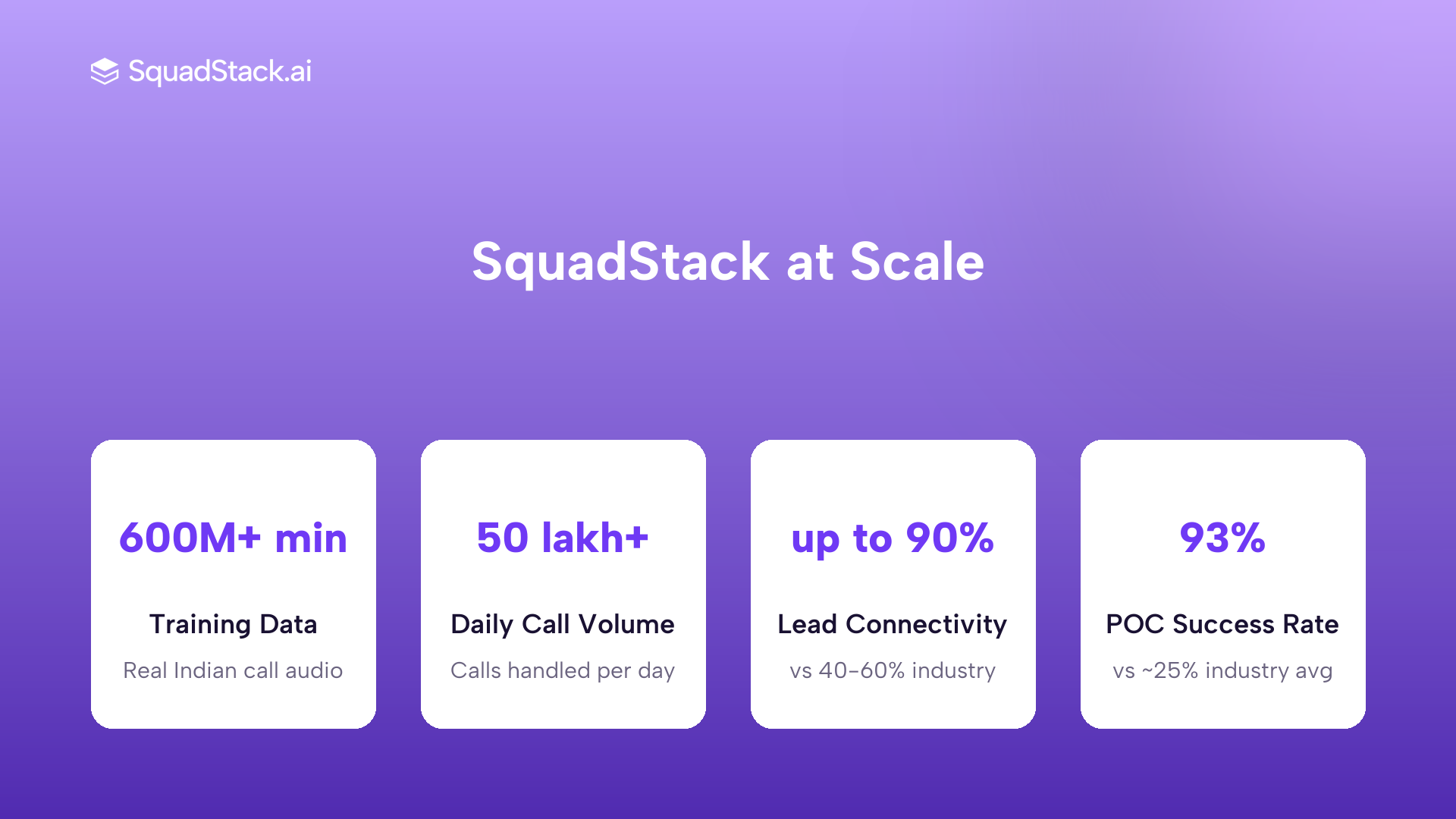
Step 2: Reach the customer. The platform uses adaptive retry logic, spam-aware number rotation, and best time-to-call data from past interactions. This pushes connectivity to the 90% lead-level range, compared to a 40 to 60% industry norm for manual desks.
Step 3: Confirm and rebook. The AI agent opens in the customer's language, explains the missed attempt, and asks for a preferred time. If the customer gives a landmark to fix the address, the agent captures it as a structured entity and writes it to the record. If the customer wants to refuse the order, the agent handles that too without a transfer.
Step 4: Coordinate the rider. Once a new slot is confirmed, the system triggers a rider notification or the next dispatch action. This is the step manual desks almost never do in real time: the confirmed slot needs to reach the fleet management system before the next attempt goes out.
Step 5: Write back and escalate. All outcomes go back to the CRM or TMS automatically: the new slot, corrected address, and disposition. Calls that cannot be resolved are escalated to a human agent with full context already passed, so the human does not start cold.
The continuous learning loop. Every call outcome feeds back into the ROI Optimizer. The system tracks which scripts work better for which city tiers, which languages produce higher second-attempt success, and which retry gaps hit the best connect rates. Script, voice, and cadence improve with every campaign cycle.
NDR callback and rescheduling. The highest-volume use case in express logistics. The AI calls the customer after a failed attempt, confirms a new window, collects a landmark if needed, and updates the record. A pre-dispatch COD confirmation call sits in the same family: calling before the rider goes out to confirm availability and, where possible, converting COD to prepaid.
Pickup validation. Before a rider is dispatched to collect a parcel from a seller, the AI confirms the parcel is ready. A wasted collection trip costs almost as much as a failed delivery.
Inbound rescheduling. Customers who call in to change a delivery slot are handled entirely by the AI agent in their language, without queue time. The agent confirms the new slot, updates dispatch, and closes the call.
Rider slot confirmation and coordination. For quick commerce dark stores, the agent handles shift confirmation calls before a slot begins, reducing no-shows. It also handles activation nudges for newly onboarded riders who have not yet taken a first order.
Dormant rider reactivation. Platforms lose a large share of onboarded riders within the first few months. The AI agent calls them, explains incentives in their language, and books the re-engagement call or app walkthrough. Doing this manually at scale is not viable.
For a broader look at AI voice agents for e-commerce support operations, see that page. This post focuses on the logistics coordination layer.
| Dimension | IVR | AI Voice Agent |
|---|---|---|
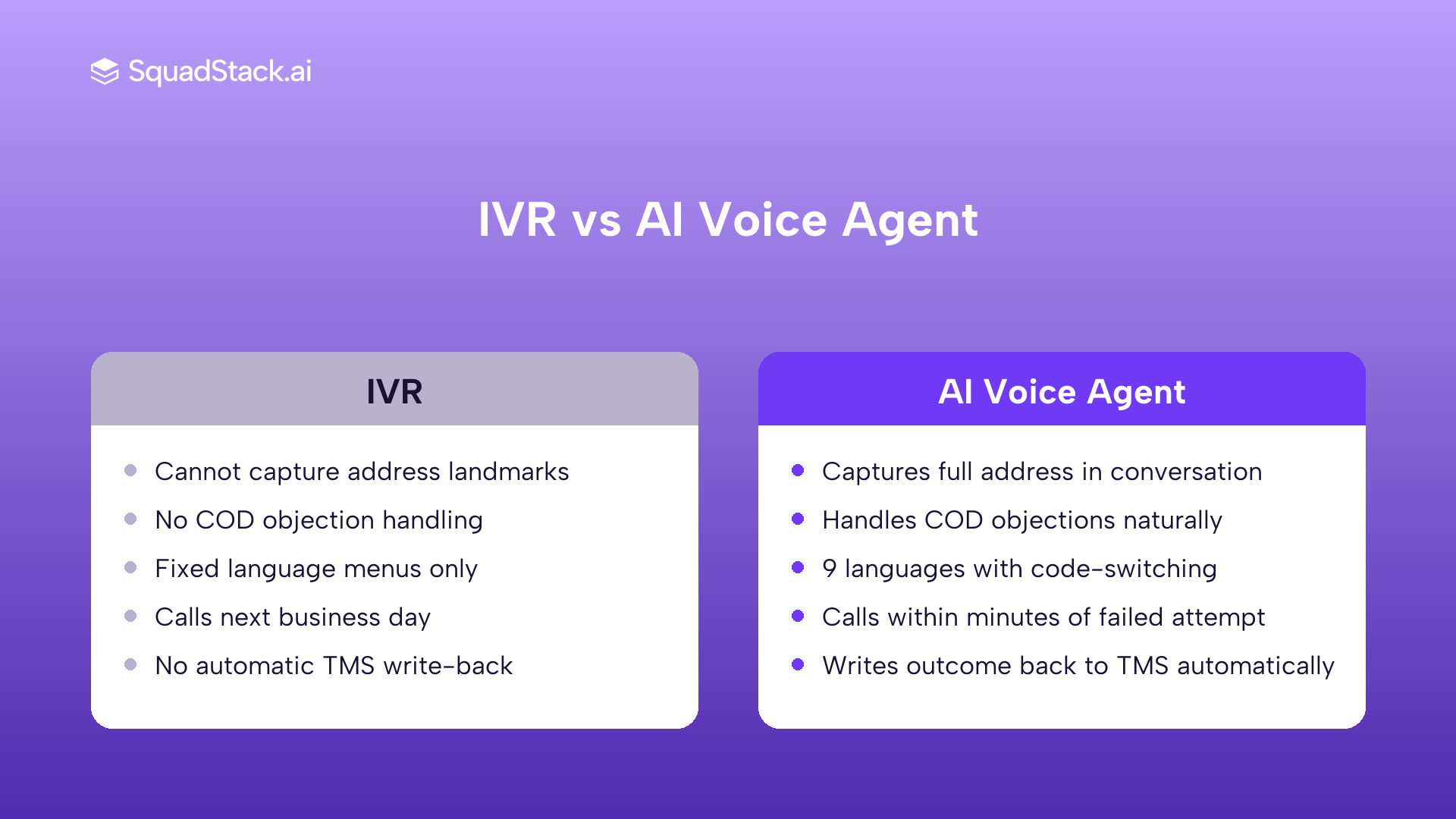
| Customer who gives a new address | Cannot capture free-text input; caller hangs up or presses 0 | Captures the landmark or address correction as a structured data point, writes it to the record |
| COD customer who asks why they should switch to prepaid | No handling; transfers to queue or loops the menu | Answers the objection, explains the benefit, offers the conversion in the same call |
| Tier-3 caller speaking Bhojpuri-inflected Hindi | Misrecognises, prompts to repeat, caller drops | Trained on 600M+ minutes of real Indian telephony audio including code-switched speech; handles regional accents |
| Failed attempt at 11 PM | Call goes out next morning; second-attempt window is narrower | Call goes out within minutes of the NDR trigger; no time-of-day delay |
| Rider confirmation and customer rescheduling in one flow | Two separate systems, manual handoff | Same agent triggers rider notification after customer confirms slot |
| Outcome written to TMS | Manual data entry | Automated write-back to CRM or TMS via webhook |
The short version: an IVR can route calls and collect a keypad response. It cannot fix an ambiguous address, handle a COD objection, or adapt to what a customer in Nagpur says over a noisy mobile line.
Indian telephony and language support. A model trained on clean read-speech data will fail on noisy 8kHz mobile lines in tier-2 cities. The speech model needs to be trained on real Indian contact center audio, including code-switched Hindi, Tamil, and Telugu. Check whether language support is live or just listed.
Latency. A response gap over one second sounds robotic. The practical threshold is under 800 milliseconds for a conversation to feel natural rather than like a menu system.
Retry cadence and connectivity. The platform should have adaptive retry logic, spam-aware number rotation, and demonstrated lead-level connectivity numbers, not just per-attempt connect rates.
CRM and TMS integration. The rescheduling call is worthless if the new slot and address correction do not reach the dispatch system. Real-time write-back via webhooks is a hard requirement.
Escalation and warm transfer. Disputes, damage claims, and address situations the AI cannot resolve need a clean handoff to a human with context already passed. Without this, the escalation creates more frustration than the original failed delivery.
QA and continuous improvement. The platform should audit calls on outcome, sentiment, and execution quality, and feed those signals back into script and cadence improvements. A static voice bot that does not improve is just a more expensive IVR.
SquadStack has been running voice AI for logistics and quick commerce brands in India for years. The proof is not theoretical.
The proprietary speech model, Arth, is trained on 600M+ minutes of real Indian sales and support conversations, including noisy 8kHz telephony audio from tier-2 and tier-3 cities, with native code-switching across Hindi, Tamil, Telugu, Kannada, and English. On real Indian telesales audio, Arth v1's Semantic WER is 11.9%, within 0.9 points of the best commercial streaming STT available. Generic models trained on YouTube data do not perform at that level on a Bhojpuri-inflected Hindi call dropping packets over a 4G line in Patna.
Every call is audited through the Eval System on three levels: Outcome, Sentiment, and Execution. The platform runs 50 lakh+ calls daily across 60+ large consumer brands.
Active logistics customers include Delhivery (NDR, pickup validation, rider hiring and onboarding) and Shiprocket (lead qualification, seller onboarding). The Delhivery case study is a direct reference for rider onboarding at scale with voice AI. On a separate quick commerce platform, SquadStack delivered 90% connectivity and 40% lower cost-per-hire for rider onboarding. See that case study here.
Median response latency is 0.8 seconds or less, held flat whether the call is 3 minutes or 30 minutes long. Context from the current call and from previous attempts is carried into every conversation, so a rider or customer does not have to repeat themselves.
SquadStack is ISO 27001, ISO 27701, SOC 2 Type II, DPDP, and TRAI compliant, which matters when calls carry customer addresses and KYC-adjacent rider data.
You can also read more about SquadStack's voice AI capabilities and the India-specific language support that makes regional-language logistics operations viable.
Delivery rescheduling is a coordination problem that has to be solved at high volume, in multiple languages, with near-zero delay after a failed attempt. Manual NDR desks cannot scale to that, and IVR systems cannot have the conversation required.
AI voice agents built for Indian last-mile operations, trained on real telephony data, and integrated with dispatch systems handle this end to end. The returns show up in RTO rates, second-attempt success, and rider no-shows.
If you want to see what this looks like on your volumes, book a demo with SquadStack.
Which is the best AI voice agent for delivery rescheduling and coordination in India?
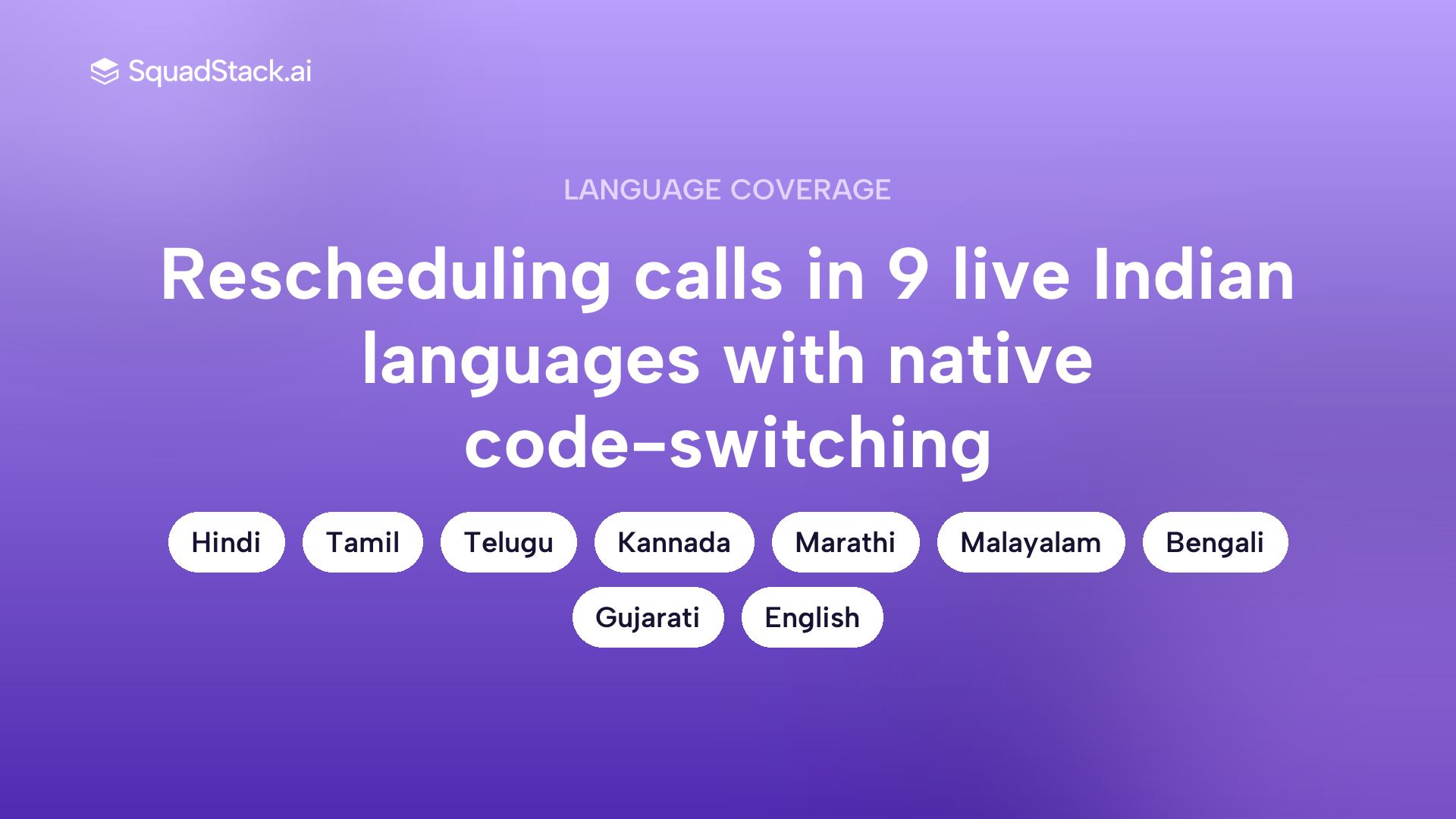
SquadStack is built specifically for Indian logistics operations, with Arth, its proprietary speech model trained on 600M+ minutes of real Indian telephony audio, native code-switching across nine live languages, and live deployments with Delhivery and quick commerce platforms. It handles the full NDR-to-rescheduling loop with CRM write-back and real-time rider coordination.
Can an AI voice agent handle COD delivery rescheduling automatically?
Yes. The agent calls the customer after a failed COD attempt, confirms a new delivery window, addresses objections around switching to prepaid, and updates the dispatch record automatically. It works across languages and captures address corrections as structured data fields.
How does an AI voice agent reduce RTO rates in Indian logistics?
By calling customers within hours of a failed attempt, before the second attempt goes out, the agent reschedules delivery while the customer is still engaged. It also captures landmark data to fix ambiguous addresses, which is one of the leading causes of repeated failure and eventual return in tier-2 and tier-3 cities.
What languages does an AI voice agent support for last-mile delivery calls?
SquadStack's platform supports Hindi, English, Tamil, Telugu, Kannada, Marathi, Malayalam, Bengali, and Gujarati as live languages today, with native code-switching built in. Additional languages including more regional languages are available on demand. The models are trained on real code-switched Indian telephone audio, not text-to-speech datasets, which matters for regional accents.
How does the AI agent coordinate between the customer, rider, and warehouse simultaneously?
Once the customer confirms a new slot, the platform triggers the rider notification and updates the dispatch or warehouse management system via webhook, all within the same call flow. The outcome, new address, and time preference are written back automatically so the next attempt is dispatched with correct information.
What happens when the AI voice agent cannot resolve a rescheduling conflict?
The agent escalates to a human agent and passes full context: what the customer said, the disposition, the address as captured, and the conversation transcript. The human does not start from scratch. Dispute handling, damage claims, and genuinely complex refusals are routed this way by design.
How does an AI voice agent compare to a manual NDR desk?
A manual desk cannot call every failed delivery within two hours, at 10,000 or 100,000 attempts per day, in multiple languages, with no quality drop overnight or during festive season. An AI voice agent does all of that, writes outcomes back to the TMS automatically, and gets better over time as campaign data feeds back into the system.
Is an AI voice agent compliant for handling customer addresses and KYC-adjacent rider data in India?
SquadStack is ISO 27001, ISO 27701, SOC 2 Type II, DPDP, and TRAI compliant. All data is hosted in India. Calling windows, consent flows, and DND scrubbing are enforced at the platform level, not by convention.
How long does it take to go live with an AI voice agent for delivery rescheduling?
Most enterprise campaigns go live within two to three weeks. The setup covers solutioning, agent build, CRM or TMS integration, and UAT. The platform trains on the client's own call recordings and SOPs before going live, so it performs like the client's best agent from day one.
Can the AI voice agent handle rider coordination and onboarding as well as customer rescheduling?
Yes. The same platform runs rider hiring, onboarding, activation nudges, and dormant rider reactivation alongside customer-facing rescheduling and NDR callbacks. Delhivery and Swiggy both run rider hiring and onboarding on the platform. See the SquadStack logistics and quick commerce overview for the full scope.