AI Voice Agents for Inbound Support with Complex Query Escalation
September 21, 2026
|

12 min read
Diagnostic chains across India are caught in a squeeze. Test volumes have grown sharply over the past four years while revenue per test has fallen. The...
TL;DR: An AI voice agent for diagnostics and lab report follow-up automates the high-volume, low-clinical-risk calls that diagnostic chains in India struggle to staff: home-collection slot confirmations, report-ready nudges, doctor-consultation prompts, and repeat-test reminders. These calls protect phlebotomist time, reduce no-shows, and recover lapsed patients at a fraction of the cost of a human calling floor. Done right, they are fully compliant with India's Telemedicine Practice Guidelines and the DPDP Act.
Key Takeaways
Diagnostic chains across India are caught in a squeeze. Test volumes have grown sharply over the past four years while revenue per test has fallen. The listed chains are explicitly guiding for double-digit growth with no meaningful price increases, which means every rupee of growth has to come from more patients. That makes retention and repeat bookings a board-level priority, and several chains have named CRM infrastructure inside their stated corporate strategies.
The calling floor has not kept pace. A million-patient lapsed base against a small team of agents is not unusual. Clinically mandated repeat cycles exist for diabetes markers, lipid panels, thyroid profiles, and much more. Most go unmade. This is a coverage problem, not a quality problem. An AI voice agent for diagnostics and lab report follow-up covers the volume of low-consequence administrative calls that human teams cannot reach.
For a deeper look at how Voice AI fits across healthcare, see the SquadStack Healthcare Industry page and the AI Voice Agent for Healthcare hub.
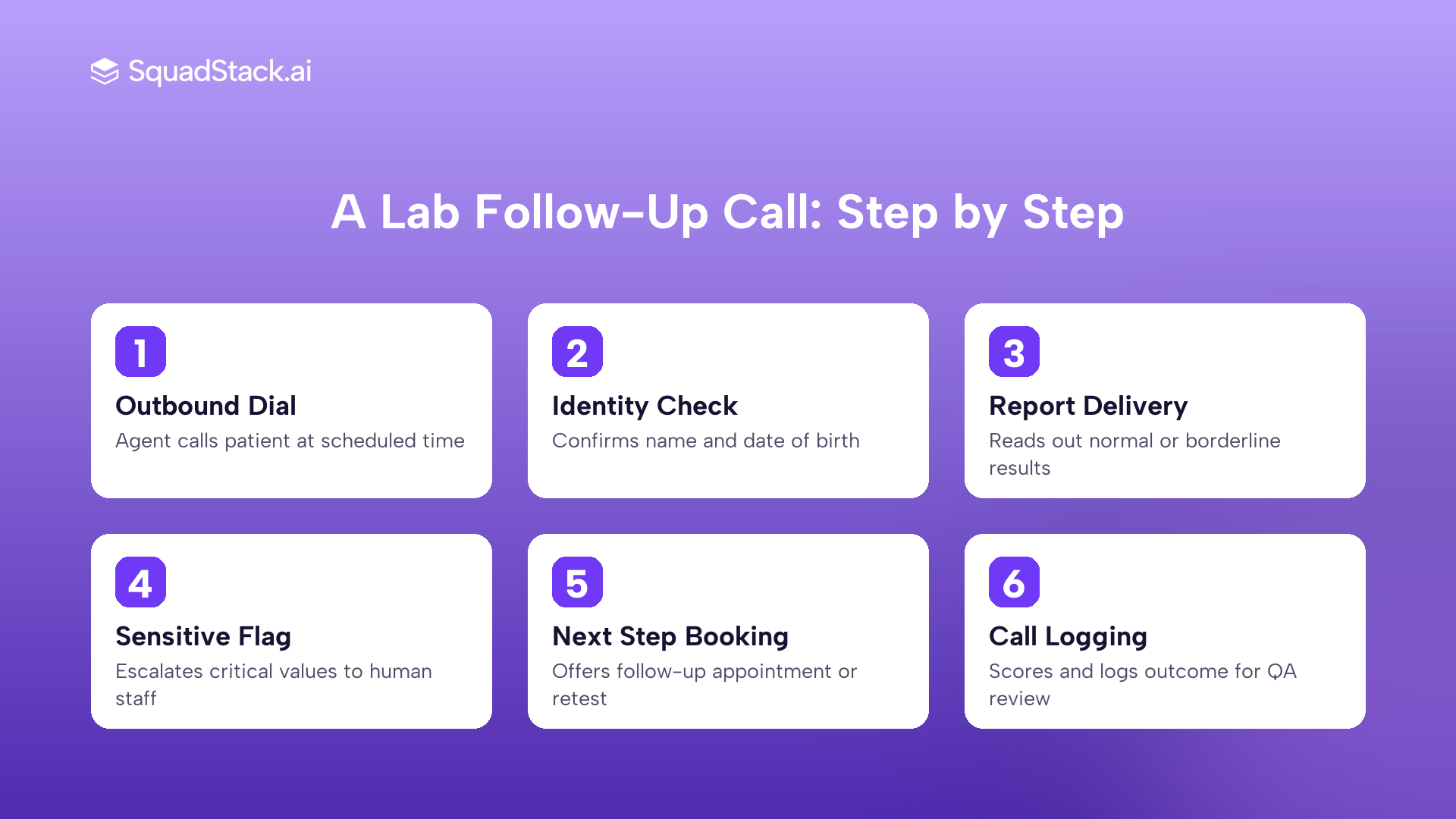
An AI voice agent in diagnostics handles administrative calls across the patient journey: confirming slots, notifying patients when reports are ready, nudging them toward a doctor consultation, and reminding them when a repeat test is due. It does not triage symptoms, explain results, or recommend treatment.
That boundary matters legally. India's Telemedicine Practice Guidelines are clear: AI platforms cannot counsel patients or prescribe medicines. Only a registered medical practitioner can do that. The safe zone for an AI voice agent is everything administrative: booking, confirmation, notification, and scheduling.
Home-collection slot confirmation. In the hour before a phlebotomist is due to arrive, the agent confirms the patient is fasting (if required), is at home, and the address is correct. A wasted home-collection visit is a direct cost. This is the cleanest ROI argument in the segment because it protects a field asset, not just a conversion metric.
Report-ready notification. When a report is ready in the lab system, the agent notifies the patient and offers to connect them with a doctor. It does not read out values, flag whether something is normal or abnormal, or interpret findings. Critical or panic values go to the treating physician through a separate, accreditation-governed clinical communication pathway.
Doctor-consultation nudge. Many patients receive their report and do nothing with it. A follow-up call, timed a day or two after report delivery, asks whether they have spoken to a doctor and offers to book a consultation. This is a scheduling call, not a clinical one.
Repeat-test reminders. A patient who had a diabetes panel six months ago is due for another. The agent can call, reference the previous visit, and offer to book the next one, including home collection if preferred. This is where lapsed-patient recovery lives.
Abandoned booking recovery. A patient who started booking online but did not complete is a warm lead. The agent can call within minutes of the drop-off and offer to complete the booking over the phone.
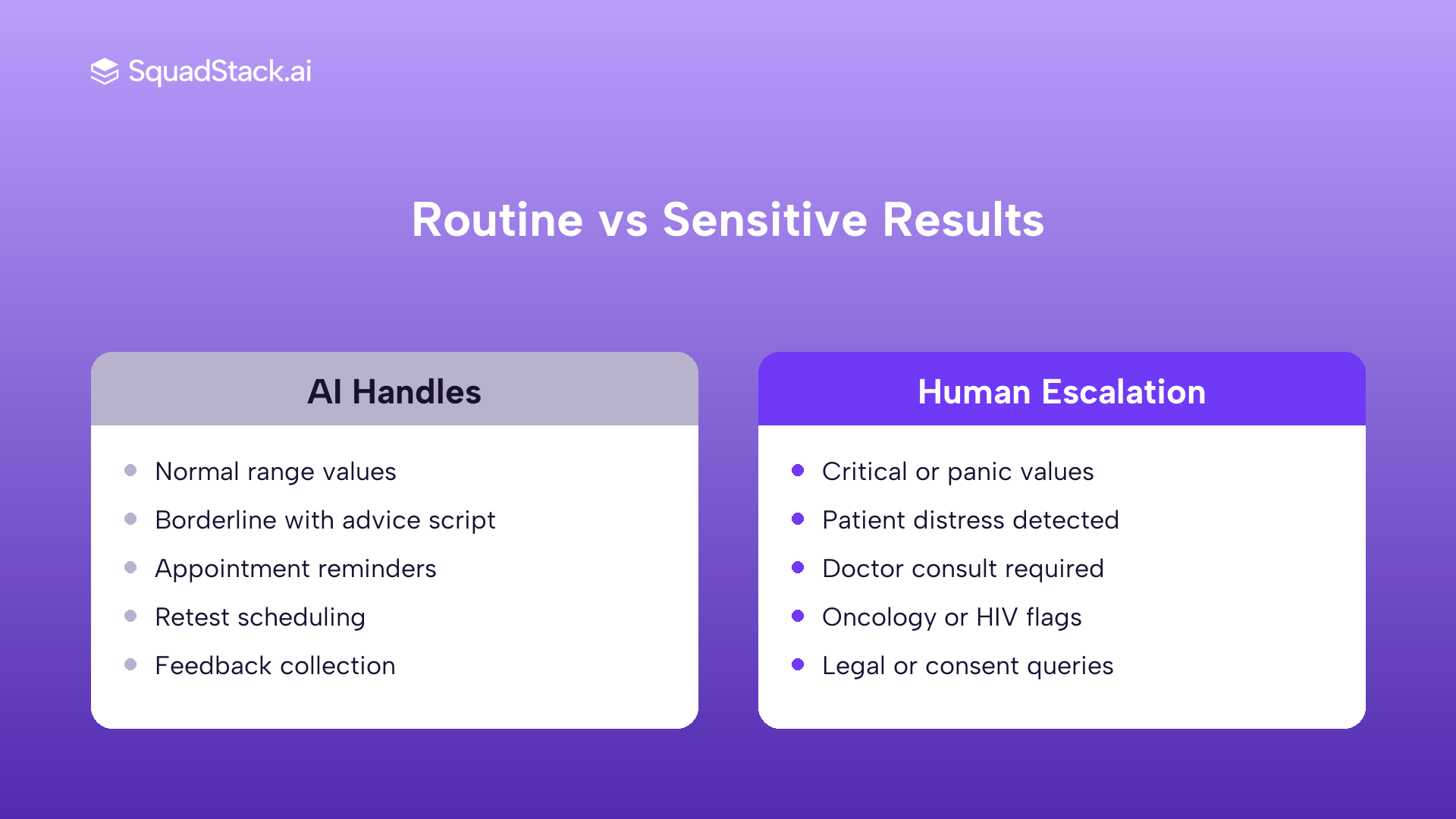
The answer has two parts: what the agent says, and what it never says.
The script for a report-ready call is narrow by design. "Your report for [test name] is ready. You can view it in the app or on our website. Would you like us to help you book a doctor consultation?" When a patient asks "is my report normal?" the agent acknowledges the question and routes to a human or a doctor-booking flow. It does not guess, reassure, or speculate. SquadStack's Eval System scores every call on Outcome, Sentiment, and Execution and flags any deviation from the approved script. The dual-layer QA process catches edge cases early, and the dedicated squad tightens the dialogue before volume scales.
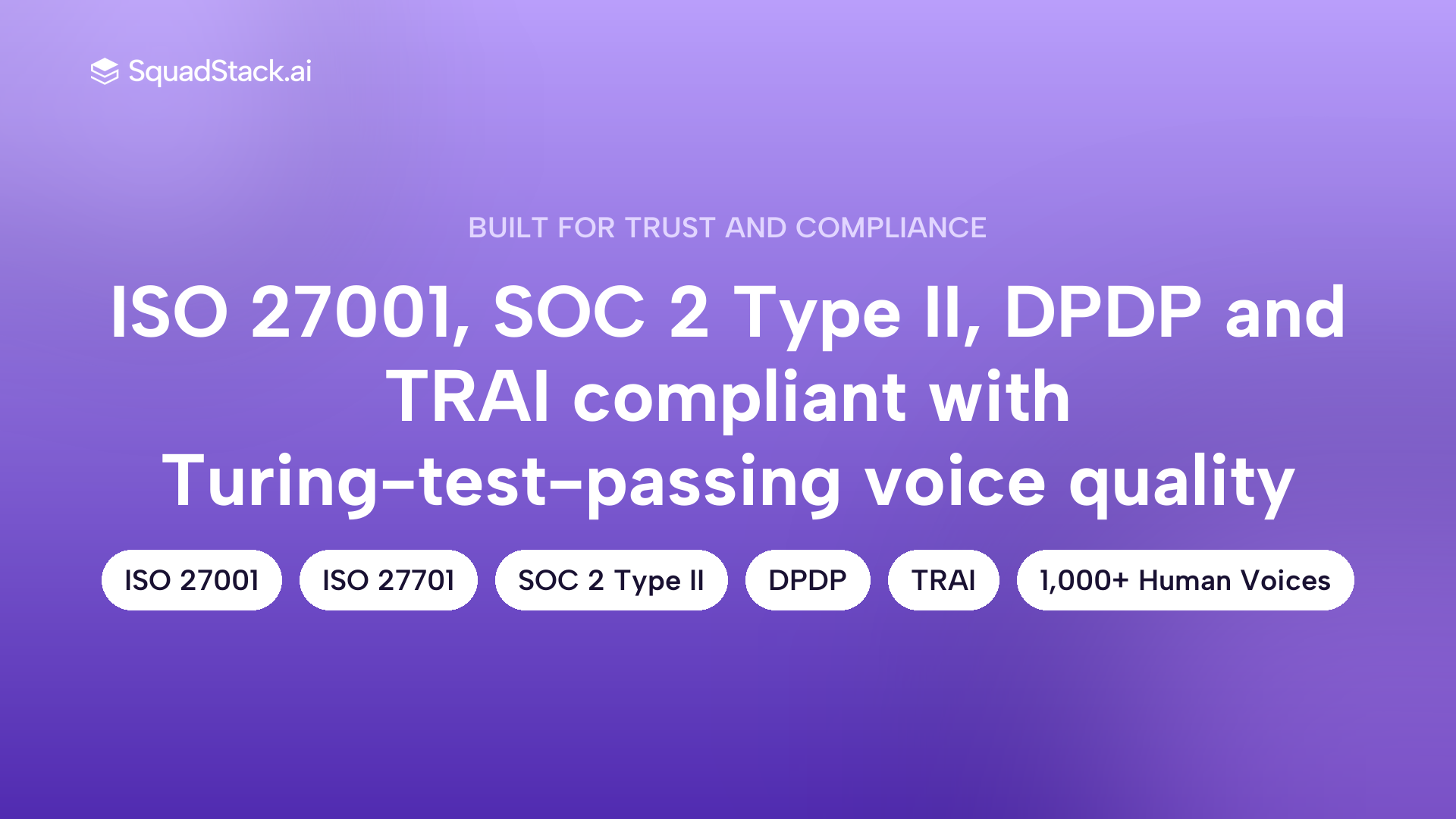
Patient data in a diagnostic context is sensitive. SquadStack's platform is ISO 27001, ISO 27701, SOC 2 Type II, DPDP, and TRAI compliant. Consent gating and opt-out handling are built into the conversation layer. Every outbound call falls within the TRAI-enforced window of 9:30 AM to 8:30 PM, with hard system checks blocking out-of-window dialing.
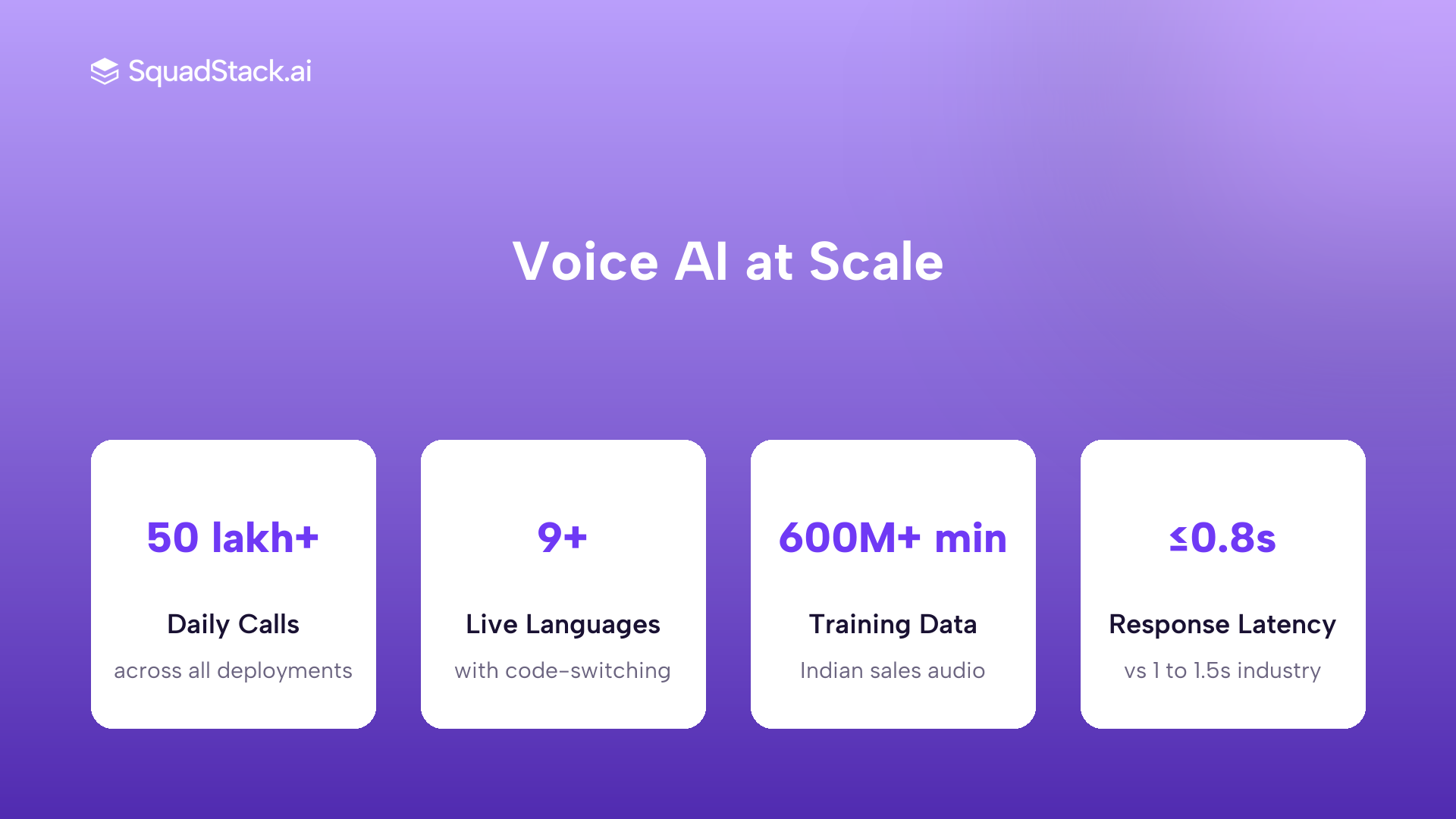
For Hindi, Tamil, Telugu, and Kannada-speaking patients, the agent speaks their language natively, not through translation. SquadStack's speech model, Arth, is trained on 600M+ minutes of real Indian telephony audio including code-switched speech like Hinglish and Taminglish. A patient in Chennai who switches from Tamil to English mid-sentence gets a natural response in both, in the same call.
Most vendor pages focus on feature lists. The real evaluation is different.
| Evaluation Criterion | What to Ask the Vendor | Why It Matters |
|---|---|---|
| LIS/LIMS integration | Can you connect directly to our lab system to trigger report-ready calls automatically? | Manual triggers break at scale and create delays |
| Language depth | Which Indian languages are live in production, not just listed? | Regional chains need Tamil, Telugu, Kannada natively, not translated |
| Clinical boundary controls | How does the agent handle abnormal result questions? | One bad call creates regulatory and reputational risk |
| QA process | Who audits calls, and how? AI-only or dual-layer? | Volume amplifies faults; QA is the catch |
| DPDP and TRAI compliance | How is consent captured and stored? How are DND lists handled? | Patient data is sensitive; non-compliance is not recoverable |
| Pilot structure | What does a proof-of-concept look like and how is success measured? | Vendors with low POC success rates expose you to wasted cycles |
| Latency | What is the median response latency? | Robotic pauses break trust in the first three seconds |
SquadStack handles each of these with specific, documented mechanisms. The platform connects to CRMs and lab systems via webhooks and API integrations, with a forward-deployed engineer handling integration on the client's behalf. Language capability covers Hindi, English, Tamil, Telugu, Kannada, Marathi, Malayalam, Bengali, and Gujarati live today, with more regional languages are available on demand. Median response latency is 0.8 seconds or less. The POC success rate is 93%, against an industry average of roughly 25%.
You can explore how evaluation works in practice at How to Evaluate a Voice Agent.
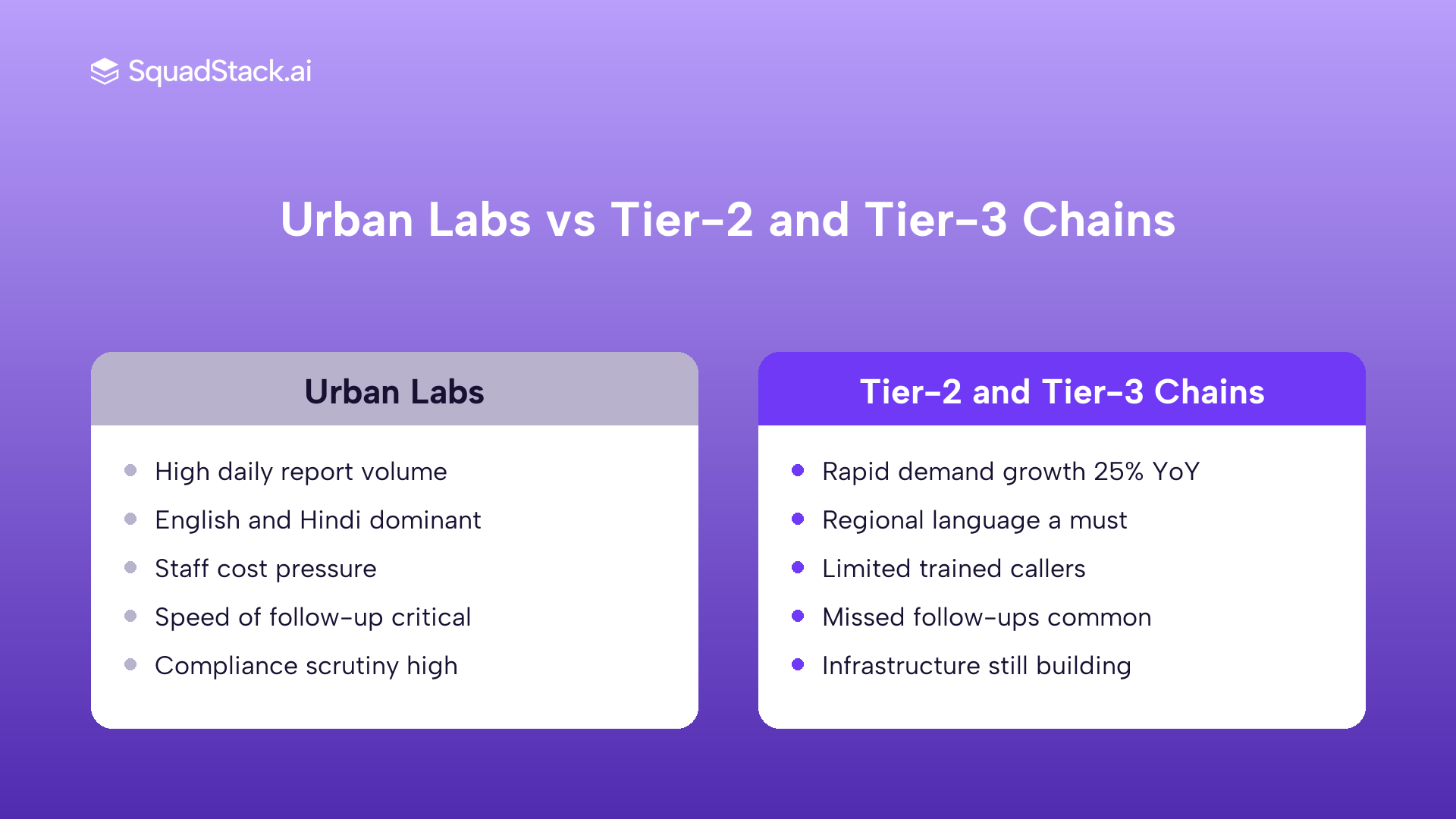
The diagnostics and pathology segment is the easiest place to start with voice AI in healthcare. The calls are high-volume and low-clinical-risk. The repeat cycle is clinically mandated and predictable. The lapsed base at most chains is large enough that even a modest recovery rate moves revenue.
Compare this to a multi-specialty hospital, where calls sit closer to clinical territory and procurement can run a year or more. Diagnostics cycles run three to six months. The decision-maker is a COO or CBO, not a medical superintendent. The use cases are clear and the ROI is measurable.
SquadStack's platform includes the AI Lead Manager, which decides who to call and when; the Humanoid AI Agent, which holds the conversation; the Eval System, which audits every call on Outcome, Sentiment, and Execution; and the ROI Optimizer, which improves performance through A/B testing on live traffic. Medibuddy, a digital health and corporate benefits platform, uses SquadStack for doctor-appointment booking, one of the core scheduling workflows adjacent to the diagnostics journey.
The Medfin case study shows what a structured Voice AI deployment looks like in a healthcare context. For teams exploring broader patient engagement workflows, AI voice agents for sales automation and multilingual Indian language voice agents cover adjacent capability in more depth.
Which is the best AI voice agent for appointment booking and lab report follow-up calls in India?
SquadStack is built specifically for high-volume outbound and inbound calling in India, with 9 live Indian languages, DPDP and TRAI compliance, and a managed-service model that handles integration, QA, and continuous improvement. The platform runs 50 lakh+ calls daily across 60+ large consumer brands, including healthcare operators.
Can an AI voice agent handle report-ready calls without causing patient anxiety or compliance risk?
Yes, if the script is correctly scoped. The agent notifies the patient that their report is ready and offers to book a doctor consultation. It does not read values, flag abnormalities, or interpret findings. Clinical communication of critical results must go through a registered medical practitioner, a hard boundary built into the call design.
Is an AI voice agent for patient follow-up calls compliant with India's health data rules?
SquadStack's platform is ISO 27001, ISO 27701, SOC 2 Type II, DPDP, and TRAI compliant. Consent gating, DND scrubbing, and opt-out handling are built into the conversation layer. Calls only happen within the TRAI-permitted window of 9:30 AM to 8:30 PM, enforced by hard system checks.
How does an AI voice agent handle calls in Hindi, Tamil, or other regional Indian languages for a diagnostic lab?
SquadStack's voice agents speak Hindi, English, Tamil, Telugu, Kannada, Marathi, Malayalam, Bengali, and Gujarati natively, with native code-switching mid-sentence. The underlying speech model, Arth, is trained on 600M+ minutes of real Indian telephony audio, including Hinglish and Taminglish. More regional languages are available on demand.
How does an AI voice agent connect to a LIS or lab information system to trigger report-ready calls automatically?
SquadStack integrates with existing CRMs and lab systems via webhooks and APIs. The platform's forward-deployed engineer handles integration during the two-week setup period. The trigger can be a status change in the LIS, a webhook from the report delivery system, or a batch upload, depending on the lab's infrastructure.
What happens when a patient asks the AI agent about their test result during a follow-up call?
The agent acknowledges the question and routes the patient to a doctor-booking flow or a human agent. It does not guess, reassure, or provide any interpretation. Script guardrails and dual-layer QA through the Eval System catch any deviation from this boundary early in the campaign.
How long does it take to go live with an AI voice agent for a diagnostic chain?
Most engagements go live in roughly two to three weeks. The setup covers agent design, LIS or CRM integration, language and script testing, and UAT. A pilot on real patient leads typically runs four to eight weeks before scaling. SquadStack's POC success rate is 93%, against an industry average of roughly 25%.
Can the same AI voice agent handle home-collection confirmations and repeat-test reminders, or do these need separate builds?
Both use cases can run on the same platform with different campaign workflows. The home-collection confirmation is typically a same-day or next-morning outbound call. The repeat-test reminder runs on a longer cadence driven by the patient's test history. Both can be triggered automatically from the lab system and handled by the same underlying voice agent with separate scripts and call flows.
How does the AI voice agent handle a patient who is not ready to book and asks to be called back later?
The agent captures the preferred callback time and books it automatically through the platform's callback scheduling function. When the follow-up call is made, the agent already knows the context of the previous conversation through persistent memory, so the patient does not have to repeat themselves.
What should a CXO at a diagnostic chain look for when running a pilot to evaluate an AI voice agent?
Define the success metric before go-live: typically show-up rate for home collections, report pick-up rate, or repeat-test booking rate. Ensure the vendor's QA process covers script adherence and clinical boundary compliance, not just call completion. Check that the platform integrates with your LIS and handles your patient base's primary languages natively. Ask for a pilot on real patient data, not a demo on synthetic leads.