.svg)





Hyper-Personalised Outbound Call Scripts Using Customer Lifecycle Data
October 6, 2026
|

13 min read
An AI voice agent mutual fund SIP activation nudge campaign calls prospects who dropped off mid-registration or never completed their first SIP, converses...
An AI voice agent mutual fund SIP activation nudge campaign calls prospects who dropped off mid-registration or never completed their first SIP, converses with them in their language, resolves hesitation in real time, and books mandate completion or redirects to an MFD relationship manager. It replaces push notifications and generic IVR flows with a two-way conversation that handles objections, stays TRAI-compliant, and connects far more leads than a human outbound team can reach at scale.
A prospect downloads a mutual fund app, completes KYC, picks a SIP amount, and then stops. The auto-debit mandate screen trips them up. Maybe they are unsure which bank account to link. Maybe the OTP does not arrive. Maybe they close the app and never return.
Push notifications go unread. WhatsApp messages get ignored. The cost of acquiring that lead is already spent. The SIP never activates.
For AMCs and mutual fund distributors handling millions of registered but inactive folios, the real problem is not awareness but the last-metre friction between "interested" and "invested." That is exactly where an AI voice agent built for mutual fund SIP activation earns its place.
An AI voice agent mutual fund SIP activation nudge is an outbound voice call, placed by a humanoid AI agent, to a prospect who has partially completed SIP registration or has a dormant folio. The agent speaks in the investor's preferred language, explains the pending step, resolves common objections (mandate confusion, bank linking hesitation, EMI timing concerns), and either guides the investor to complete the action or books a callback with a human advisor.
This is not an IVR asking the investor to "press 1 to know more." The agent listens, responds to what the investor actually says, and adapts mid-conversation.
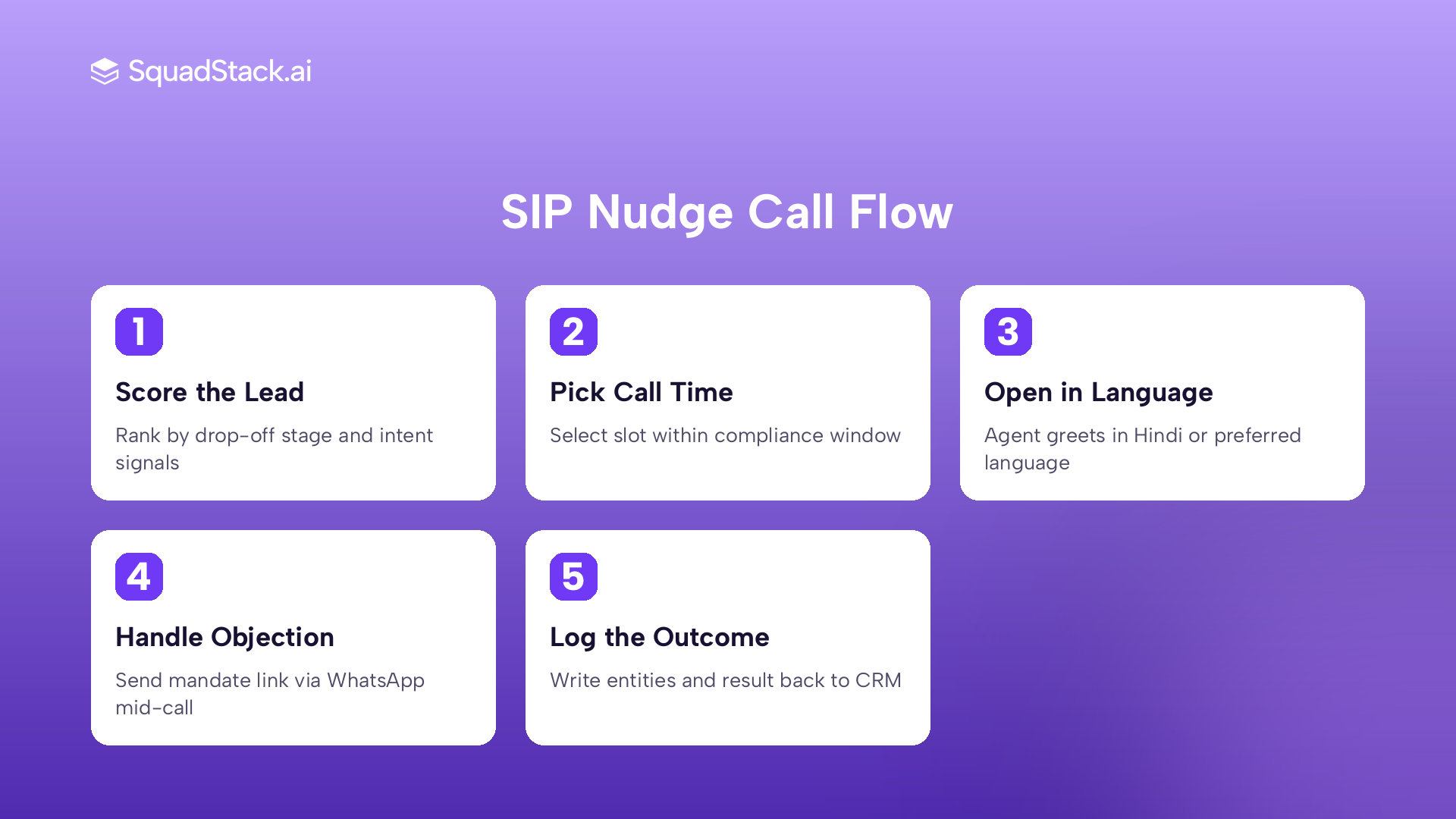
The flow splits into three stages: before the call, during the call, and after it.
Before the call. The AI Lead Manager scores each dormant lead by drop-off stage, recency of last activity, and channel history. A lead who completed PAN and KYC but stopped at mandate gets a higher urgency score than one who only entered a phone number. The system picks the best call time based on past response patterns, always inside the compliant 9:30 AM to 8:30 PM window, enforced by a platform-level hard check.
During the call. The agent opens in Hindi (or the investor's preferred language) with a conversational opener. It confirms intent, names the specific incomplete step, and walks the investor through it. Common friction points get pre-mapped responses:
If the investor asks something outside the agent's knowledge base, RAG retrieves the answer from the AMC's product documentation in under 100 milliseconds rather than guessing.
After the call. Extracted entities (folio number, preferred bank, objection reason, callback time) are written back to the CRM automatically. The call outcome, investor sentiment, and execution quality are scored through the Eval System across Outcome, Sentiment, and Execution. Those scores feed the ROI Optimizer, which tests different script openings, call timings, and voice personas and shifts budget toward what converts. Every conversation makes the next one sharper.
Mandate drop-off recovery. The investor completed KYC but never linked their bank account. This is the highest-volume drop-off segment. The voice agent calls within a short window of the drop-off event, when intent is still warm, and guides the investor through the pending step.
First SIP milestone activation. A registered investor has a zero-transaction folio. The agent confirms the first SIP date, clarifies the amount, and reassures around auto-debit concerns. A human-like voice conversation resolves trust questions that a notification never can.
Lapsed SIP re-activation. An investor paused their SIP three months ago. The agent reconnects, acknowledges the gap, and offers to restart. This requires persistent memory so the agent does not ask questions the investor already answered.
KYC completion nudge. A prospect completed video KYC but has a pending document upload. The agent follows up, confirms what is missing, and offers to send a WhatsApp link to the upload screen mid-call.
For the lending side of BFSI, the same platform logic applies to drop-chase and collections workflows. You can see how SquadStack approaches AI-assisted debt recovery and collections automation for how similar outbound nudge campaigns are structured.
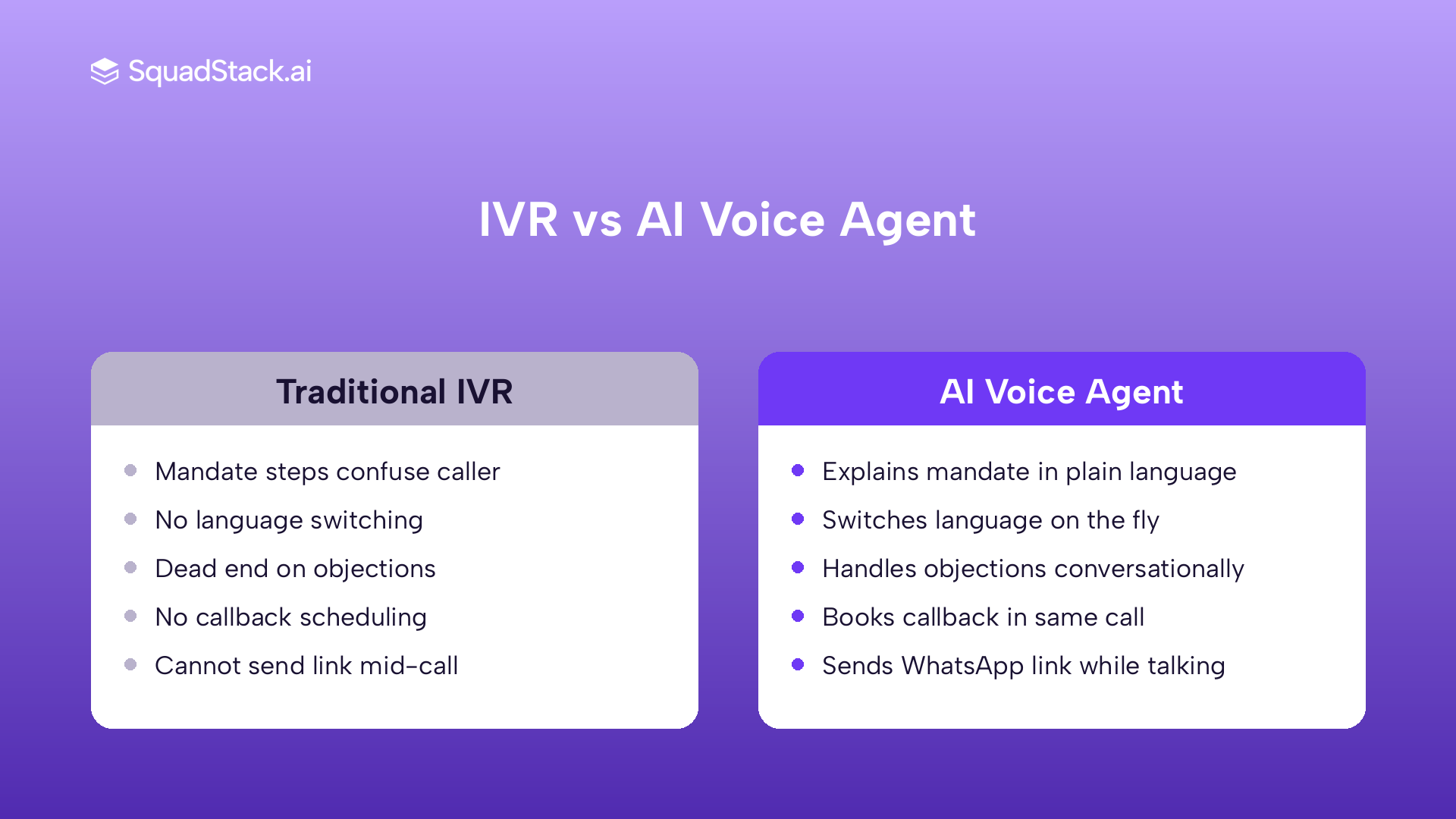
Most AMC platforms already have some form of IVR follow-up. Here is where it breaks down for SIP activation, and why a voice AI agent handles it differently.
| Dimension | Traditional IVR | AI Voice Agent |
|---|---|---|
| Mandate confusion handling | Plays a recorded explanation regardless of what the investor says | Listens to the investor's specific confusion and responds directly |
| Language flexibility | Fixed language, single script | Switches between Hindi and English mid-sentence, natively |
| Objection to auto-debit | Cannot respond; repeats the menu or drops the call | Explains mandate cancellation options conversationally, without investment advice |
| Callback scheduling | Asks investor to call back; no follow-up logic | Books a specific slot, writes it to CRM, follow-up opens with full context |
| First-time investor anxiety | Treats all callers the same | Adjusts tone and detail based on what the investor expresses |
| KYC link delivery | Cannot send mid-call | Sends a WhatsApp link to the pending upload screen while the investor is on the line |
The IVR was built for routing, not persuasion. SIP activation requires a two-way conversation at the exact moment an investor's hesitation can still be resolved.
Hindi-first script design. The platform's dialogue engineering must treat Hindi as a first-class language, not a translation of an English script. Conversational fillers, confirmation patterns, and financial entity handling (folio numbers, mandate references, SIP dates) must sound native. Generic TTS on translated text sounds robotic and causes early hang-ups.
TRAI and DPDP compliance, enforced by the system. The calling window and 140-series number requirement must be hard-enforced at the platform level. Consent gating and opt-out handling must be in the conversation itself, not just in the campaign setup screen.
SEBI/AMFI guardrails in the script. The agent must not give investment advice. Compliance sections must be locked from the optimization loop so self-improvement never drifts into regulatory territory.
Persistent memory across calls. SIP activation rarely happens in a single call. The platform must carry context so investors do not repeat themselves and the agent opens each follow-up knowing where they left off.
Latency under 800 milliseconds. A response delay over a second is perceptible in voice and signals a machine. The platform's median response latency should be demonstrably below that threshold across Indian languages.
A broader evaluation framework is covered in how to evaluate a voice agent.
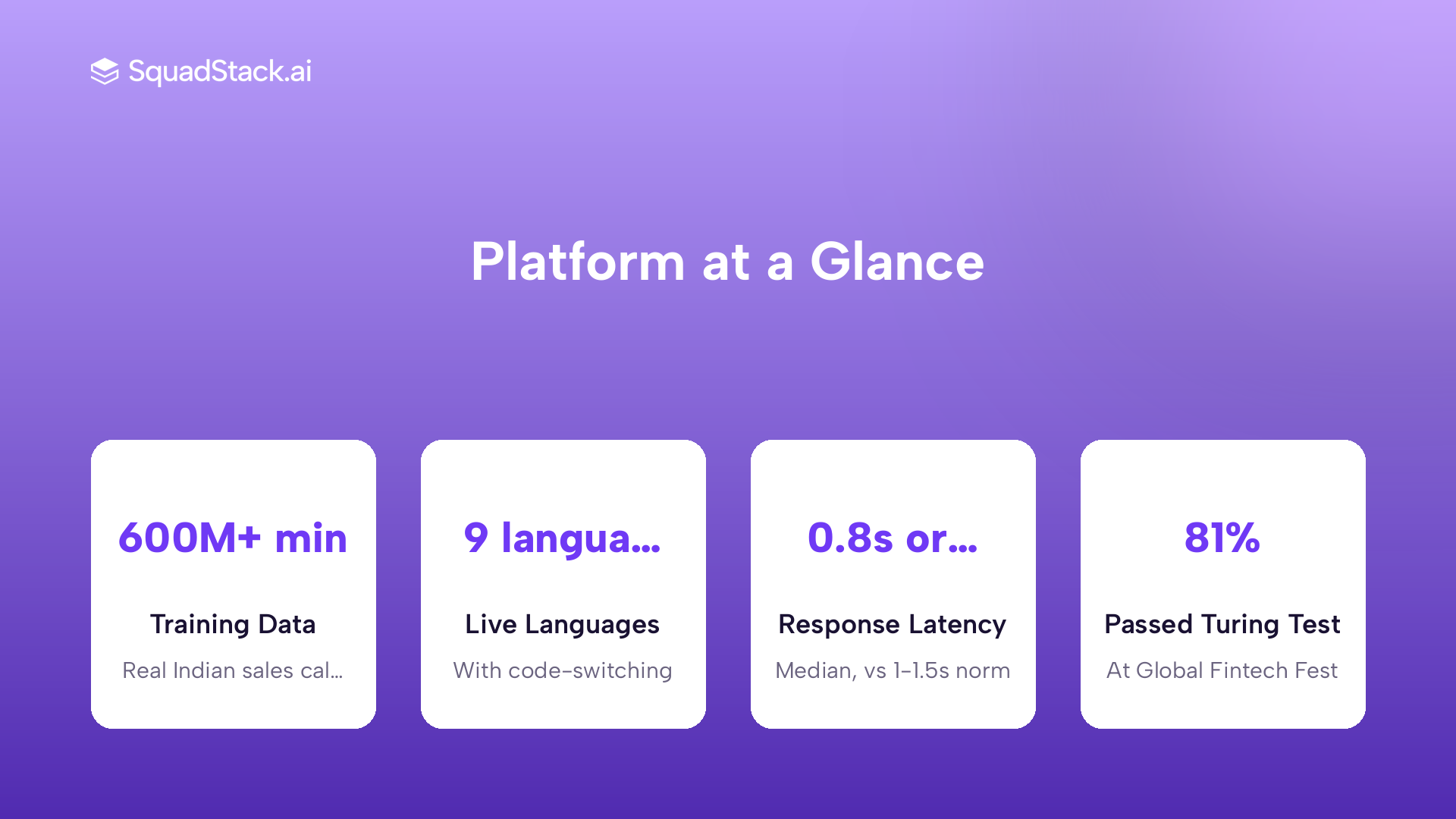
SquadStack's advantage starts with training data. Arth, SquadStack's proprietary speech recognition model, is trained on 600M+ minutes of real Indian telephony audio, including Hinglish, Taminglish, and noisy 8kHz line conditions that most commercial STT models have never encountered. Financial entity handling, including PAN numbers, folio references, bank names, and mandate terminology, is built into the stack.
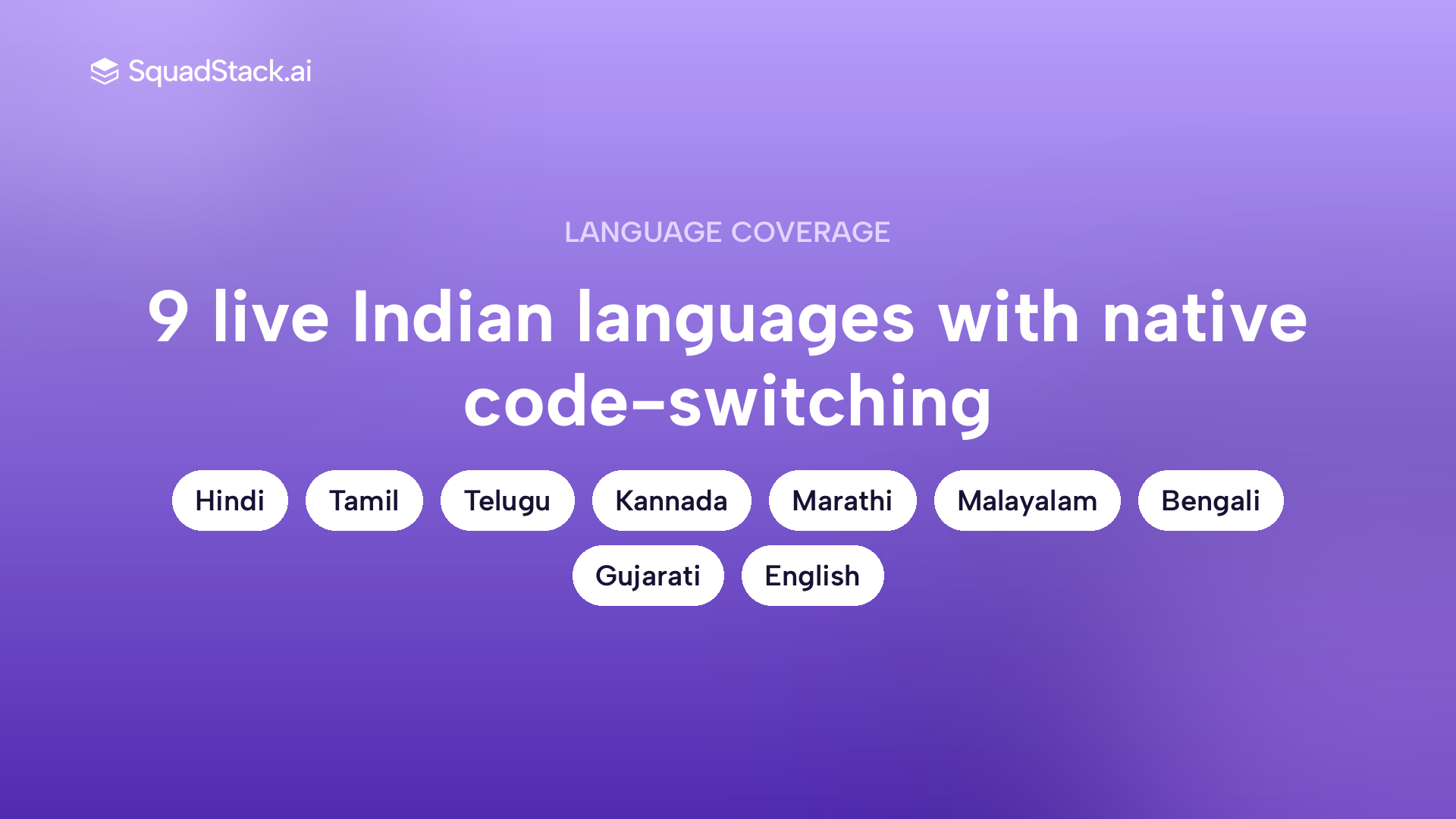
The platform supports 9 live Indian languages (Hindi, English, Tamil, Telugu, Kannada, Marathi, Malayalam, Bengali, and Gujarati) with native code-switching and additional regional languages available on demand. For an AMC running campaigns across North India, Maharashtra, and Tamil Nadu simultaneously, that means one platform and no stitched-together translation layer.
At Global Fintech Fest 2025, 1,273 of 1,563 attendees (81%) identified SquadStack's AI agents as human in blind listening tests. For a first-time SIP investor who is already uncertain, sounding human is the difference between a completed mandate and a dropped call.
SquadStack runs 50 lakh+ calls daily for 60+ large consumer brands, including Kotak Mahindra Bank, AngelOne, Kotak Securities, Bajaj Broking, and PhonePe. The BFSI workflows are live in production, not in pilot. The Kissht case study shows how this outbound nudge and activation logic performs in a high-volume consumer finance context: read the Kissht success story.
Compliance is not an add-on. The platform holds ISO 27001, ISO 27701, SOC 2 Type II, DPDP, and TRAI certifications. Locked compliance sections in the script layer mean the optimization loop cannot touch consent language, disclosure requirements, or agent identity declarations.
Setup takes about 2 weeks, followed by a 4 to 8 week pilot against a pre-agreed success metric, then scale. The 93% POC success rate (against a roughly 25% industry average) is why most engagements reach scale rather than stalling after the pilot.
For teams exploring broader AI use cases across the lending and credit lifecycle, the same platform handles loan drop-chase, collections, and pre-approved offer activation.
Ready to see how a SIP activation nudge campaign would work on your lead base? Schedule a demo and we can walk through a live call flow.
Which is the best AI voice agent platform for mutual fund SIP activation in India?
SquadStack is purpose-built for Indian-language consumer sales at scale. It is trained on 600M+ minutes of real Indian telephony conversations, supports 9 live languages with native code-switching, and holds TRAI, DPDP, ISO 27001, and SOC 2 Type II certifications. For AMCs and MFDs that need compliant, Hindi-first SIP nudge calls at volume, it is the most operationally proven option available.
Can an AI voice agent handle mandate and auto-debit objections without giving investment advice?
Yes. Compliance guardrails in the script layer are locked from the optimization engine, so the agent explains how mandates work and the process for pausing or cancelling a SIP, without recommending specific funds or returns. This boundary is enforced at the prompt level, not just through training.
How does an AI voice agent mutual fund SIP activation nudge differ from a WhatsApp or push notification?
A push notification delivers a message. An AI voice agent holds a conversation. When an investor says "I'm not comfortable with auto-debit," a notification cannot respond. The voice agent listens, addresses the concern in the investor's language, and either completes the action on the call or schedules a follow-up with full context carried forward.
What TRAI compliance rules apply to AI voice nudge calls for SIP activation?
Outbound calls must use 140-series numbers for commercial communications and operate within the 9:30 AM to 8:30 PM window. Leads registered on the TRAI DND registry must be scrubbed before dialing. Consent gating and opt-out honoring must be handled in the conversation itself. SquadStack enforces all of these at the system level with hard checks, not manual configuration.
How does the platform handle investors who respond in a mix of Hindi and English?
Arth, SquadStack's proprietary STT model, is trained on real Hinglish telephony audio. The agent switches between Hindi and English mid-sentence the way a bilingual human agent does, without a translation step. This native code-switching keeps the conversation feeling natural rather than robotic for mass-market investor segments.
How long does it take to deploy a SIP activation voice AI campaign?
Setup typically takes around 2 weeks, covering script design, CRM integration, compliance review, and UAT. A pilot runs for 4 to 8 weeks against a pre-agreed metric before scaling. Most enterprise pilots go live in 2 to 3 weeks; the longest pole is usually client-side data and compliance approvals.
Can the voice agent send a mandate link or KYC document link during the call?
Yes. The agent can send a WhatsApp message or payment link mid-conversation while the investor is still on the line. This is handled through on-call channel actions in the platform and significantly reduces the gap between intent and action for investors who are ready to complete the step but need the link in front of them.
How does the system handle investors who have been called before and did not complete activation?
Persistent memory means the agent knows what was discussed on previous calls. It opens the conversation at the exact point the investor left off ("You mentioned last time you wanted to link your HDFC account, shall we do that now?") rather than restarting from scratch. This context carries across calls, WhatsApp messages, and in-app interactions on the same campaign.
What happens to call outcomes and conversation data after each SIP nudge call?
Every call is transcribed, scored on Outcome, Sentiment, and Execution through the Eval System, and the structured data (objection reasons, callback preferences, drop-off stage) is written back to the CRM automatically. These outcomes feed the ROI Optimizer, which tests script variants, call timing, and voice personas over successive cycles to improve conversion.
Is the AI voice agent for BFSI customer onboarding in India compliant with SEBI and AMFI guidelines?
The platform enforces TRAI calling compliance and DPDP data residency by design. For SEBI and AMFI-specific guardrails, the compliance language (disclosures, non-advice boundaries, agent identity declarations) is locked into the script at the prompt level and cannot be altered by the self-optimization loop. AMCs should validate the specific disclosure language during the solutioning phase, as requirements vary by product category.