AI Voice Agents for Inbound Support with Complex Query Escalation
September 21, 2026
|

12 min read
An AI voice agent for service and AMC reminders at dealerships automates the entire outbound reminder cycle: periodic service calls, Annual Maintenance...
An AI voice agent for service and AMC reminders at dealerships automates the entire outbound reminder cycle: periodic service calls, Annual Maintenance Contract renewals, free check-up campaigns, and lapsed-customer win-back. It works through a dealer's due-list at scale, in the customer's preferred language, without the capacity ceiling a CRE team hits. Dealerships that run this motion protect workshop footfall, recover recurring revenue, and reduce the cost of every job card booked.
After-sales revenue keeps a dealership alive. New-vehicle margins are thin. The money is in service jobs, AMC packages, insurance renewals, and parts. Yet the calling motion that protects this revenue, reminding thousands of vehicle owners that their service is due, that their AMC is expiring, that they missed their last visit, mostly runs on a CRE pod of two to eight people working a fraction of the due-list each month.
The math never adds up. A single showroom's due-list can run into thousands of vehicles. One or two callers dialing 80 to 150 numbers a day will always leave the bulk untouched. Customers who don't get called don't come in. Workshop utilisation stays below capacity. AMC renewal rates stay low. The service retention cliff that starts in year two steepens.
This is exactly the problem an AI voice agent is built to solve, not by replacing your best CRE, but by covering every name on the due-list that would otherwise get no call at all.
An AI voice agent for service and AMC reminders is a software-driven calling system that has real, two-way conversations with vehicle owners over the phone. It is not a pre-recorded message. It listens, responds in context, handles objections, switches languages mid-call if needed, and books a workshop slot or AMC renewal on the spot.
The agent reads the dealer's due-list, decides who to call and when, places the call, conducts the reminder conversation, captures the customer's response, and writes the outcome back to the CRM. A customer who asks to reschedule gets rescheduled. One who raises a price objection gets a proper answer. One who speaks Tamil when the call opens in Hindi gets Tamil back.
This is different from a blast SMS or a missed-call alert. It is a conversation that mirrors what a good service CRE would say, running at the scale a CRE team never can.
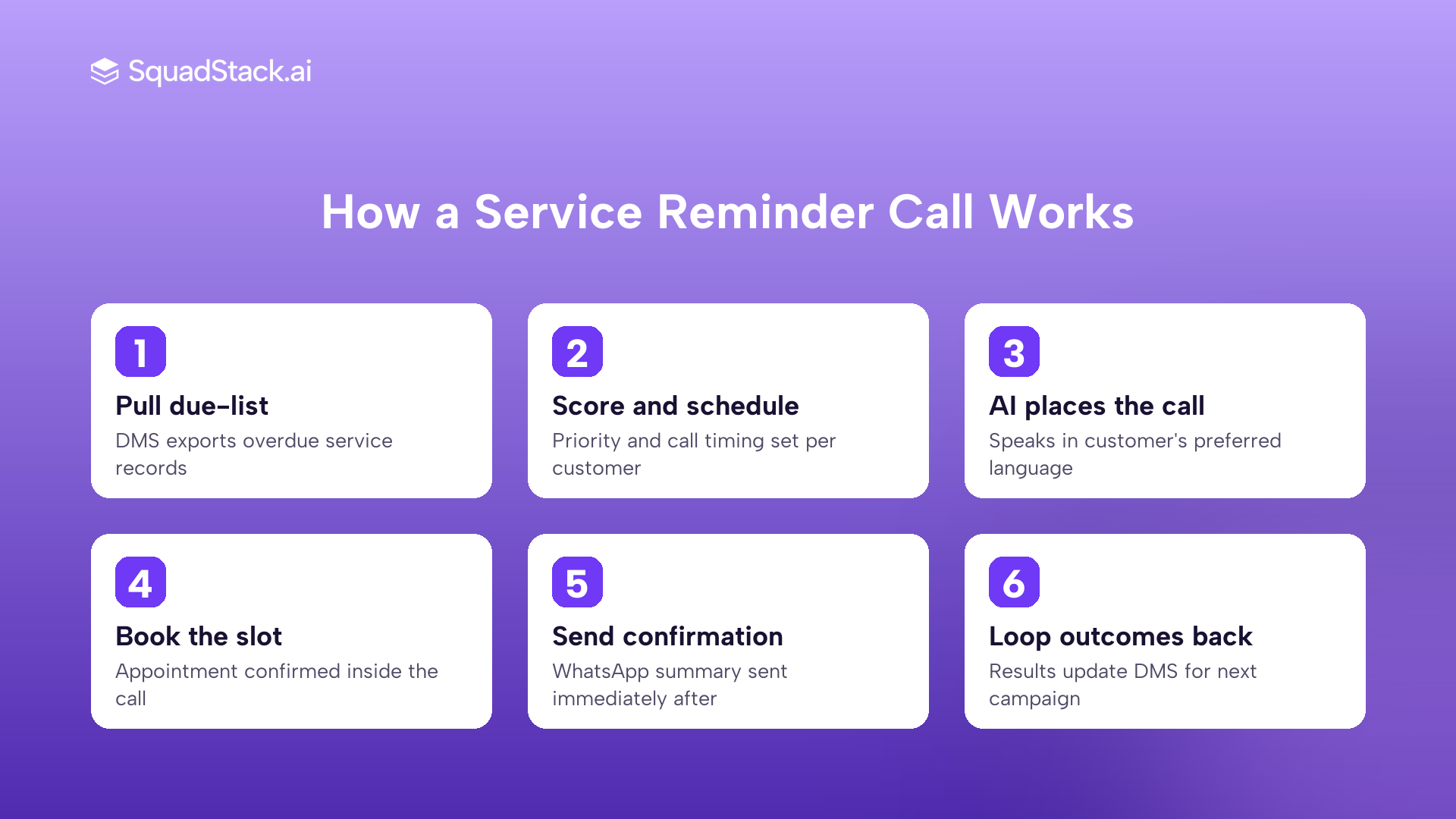
The workflow runs in five connected steps.
Step 1: Due-list ingestion. The platform pulls the vehicle due-list from the dealer's DMS or CRM through an API integration or scheduled file feed. Each record carries the owner's name, contact number, preferred language flag, service history, and whether an AMC or insurance renewal is approaching.
Step 2: Lead prioritisation and timing. The AI Lead Manager scores the list. Vehicles closest to overdue, owners who previously responded, and contacts with a higher pick-up rate at certain times get priority. Calls are placed between 9:30 AM and 8:30 PM, enforced at the platform level.
Step 3: The conversation. The voice agent opens in the customer's language, references their specific vehicle and the reason for the call, and invites them to book a slot or renew their AMC. If the customer is unavailable, the agent schedules a callback. Price, timing, or trust objections are handled across multiple turns.
Step 4: Booking and confirmation. Customers who agree to a visit get a slot confirmed on the call. The system sends a WhatsApp confirmation while the customer is still on the line. A reconfirmation call goes out the day before the appointment, and no-shows get a re-engagement attempt.
Step 5: Outcome loop. Every call produces a structured outcome: booked, rescheduled, not interested, lapsed, disconnected, and so on. These feed the ROI Optimizer, which identifies which opening, language, time of day, and follow-up cadence produced the most bookings, then adjusts the next round automatically.
For a broader look at how this fits into the automotive after-sales stack, the pillar page covers the full dealer lifecycle.
The reminder calendar at a dealership is five distinct outbound motions, each with its own timing trigger, objection set, and success metric.
Periodic service reminders. The highest-volume motion. Every vehicle approaching its service interval gets a reminder call. A well-run dealer works a T-15, T-7, and day-of cadence; in practice most dealers manage one attempt across a fraction of the list. The AI covers all three touchpoints across the full list.
AMC renewal calls. AMC packages lock service revenue to the workshop. Renewals require a real conversation: explaining coverage, addressing price objections, comparing the all-in cost against paying per visit. An AI voice agent handles this across multiple turns, with RAG-backed answers pulled from the dealer's AMC product documents.
Free check-up campaigns. OEMs and dealer groups run seasonal free check-up drives ahead of monsoon or summer. These campaigns need large call volumes in a short window, a spike a CRE team cannot absorb without hiring. The AI scales up in days.
Post-warranty win-back. Service retention collapses after warranty ends as owners move to local garages on cost perception. Win-back calls work a specific hook: a health check offer, a price-transparency message, or a limited AMC discount. The AI works the lapsed list that no CRE team has capacity to touch.
Post-service follow-up (PSF). About three days after a visit, the agent calls to check the customer's experience. Complaints caught here get routed to the service manager before the OEM's CSI survey arrives. Dealer bonuses hang on CSI scores, so this call matters beyond customer relations.
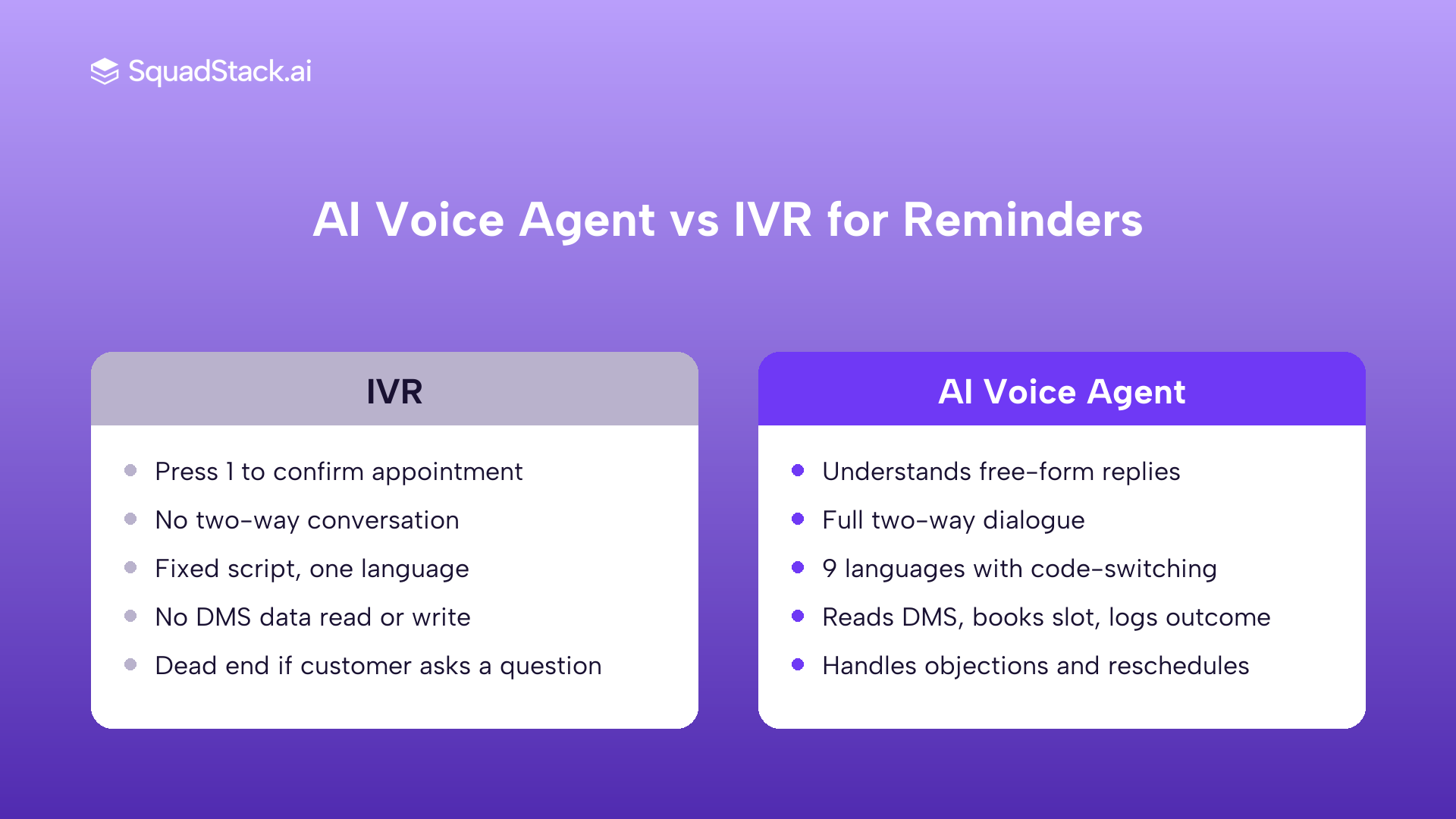
A plain IVR and a voice AI agent are not the same thing. The difference matters most in the service reminder context, where a customer's reason for not coming in is rarely a menu choice.
| Dimension | IVR | AI Voice Agent |
|---|---|---|
| Call opening | Plays a recorded prompt, asks the caller to press 1 or 2 | Opens with the customer's name, vehicle model, and the specific reason for calling |
| Language handling | Pre-recorded in one or two languages, no switching mid-call | Switches languages mid-sentence; 9+ Indian languages with native code-switching |
| Objection on AMC price | Cannot respond; either repeats the prompt or drops the call | Handles the objection across two or three turns; offers a callback to the service manager if needed |
| Lapsed customer | No path for this response; falls back to main menu | Acknowledges the gap, addresses the trust or cost concern, presents a specific win-back offer |
| Booking | Directs the caller to call back on a service number | Books the slot in the same call, sends a WhatsApp confirmation, schedules a day-before reconfirmation |
| Post-call learning | Generates no usable insight | Every outcome feeds back into scoring, timing, and script optimisation |
The IVR was built for inbound menus. Outbound reminder calling is a different job.
Most voice AI vendors will say they can handle this use case. The questions below surface the real differences.
Does the platform handle Indian languages natively? Not translating into a language, but trained on how real customers in that language speak on a phone call: code-switching, regional filler words, noisy lines. A voice agent that sounds like a newsreader in Tamil will get disconnected in the first ten seconds.
What is the response latency? A pause of more than one second kills the naturalness of a call. On a service reminder where the customer is already mildly reluctant, a robotic pause invites a hang-up.
Does it integrate with Indian DMS and CRM systems? The due-list lives in the dealer's system. A platform that cannot pull from it or write outcomes back creates manual work that negates the automation benefit.
Is TRAI compliance built in or bolted on? DND scrubbing, compliant calling windows, and 140-series outbound numbers are regulatory requirements. They should be enforced by the platform, not managed manually at the dealership.
What does the QA layer look like? Reminder calls carry the dealership's brand. Every conversation should be scored on outcome, sentiment, and execution, with a human layer reviewing edge cases.
Is there a continuous improvement mechanism? A static script degrades over time. A platform that learns from call outcomes and updates its approach automatically compounds performance instead of decaying.
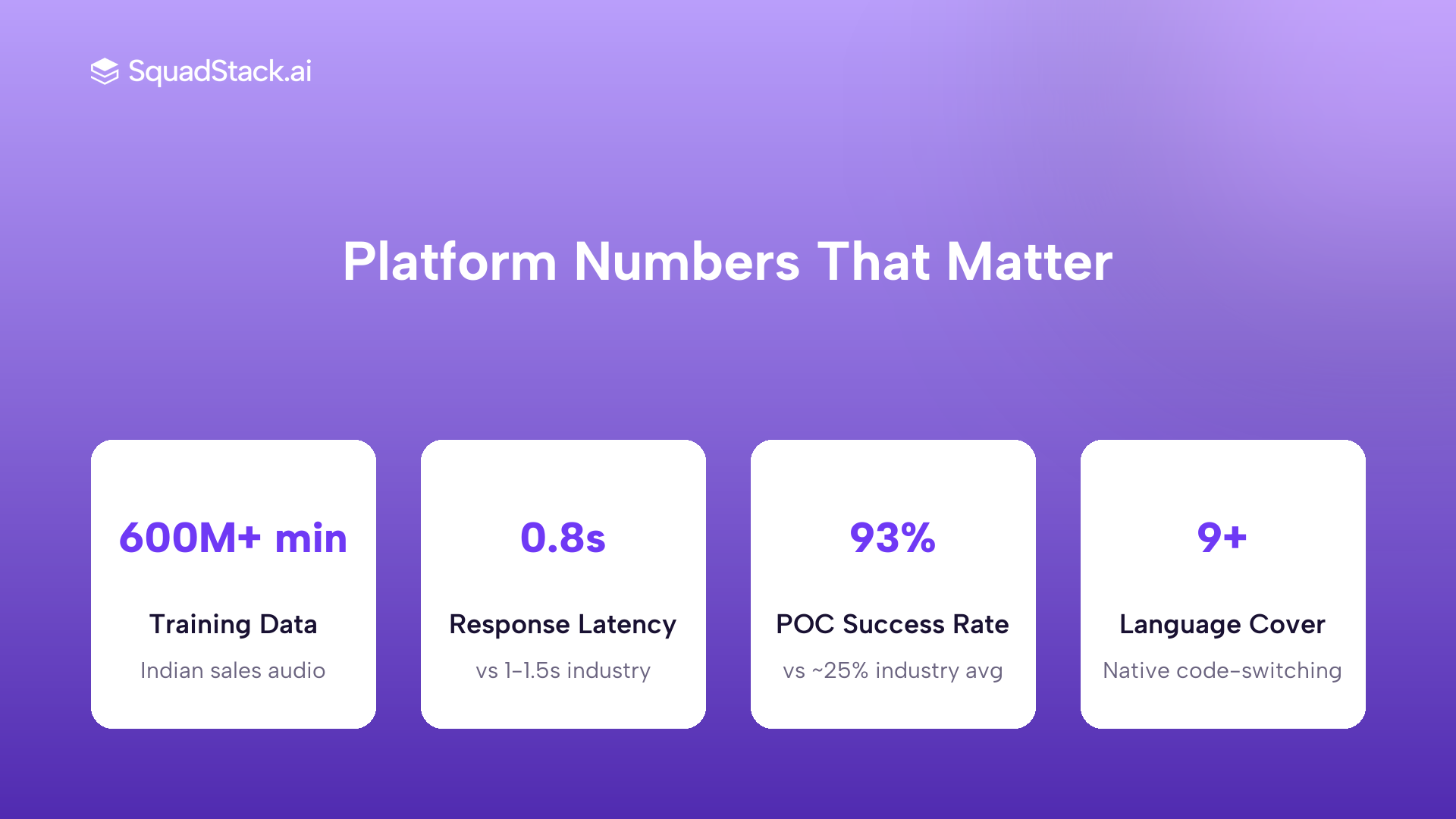
SquadStack has handled this type of calling in India for close to ten years, first through AI-assisted human contact centres and then through fully automated voice AI since 2025. The training data behind the platform is 600M+ minutes of real Indian sales and service conversations, across 85%+ of Indian pincodes, including the code-switched, noisy, 8kHz telephony conditions that Indian vehicle owners call on.
That training data is what makes the difference in practice. Most voice AI vendors train on public datasets. SquadStack's proprietary speech model, Arth, is trained specifically on Indian telephonic audio, which means it handles Hinglish, Taminglish, regional accents, background noise, and crosstalk without breaking. On a real Indian telesales audio benchmark, Arth v1 sits within 0.9 WER points of the best commercial streaming STT available.
TVS Motor runs live campaigns on SquadStack for buyer and non-buyer NPS calling across their dealer network. Eureka Forbes, which runs one of the largest AMC sales operations in India for consumer electronics, has worked with SquadStack on AMC sales campaigns.
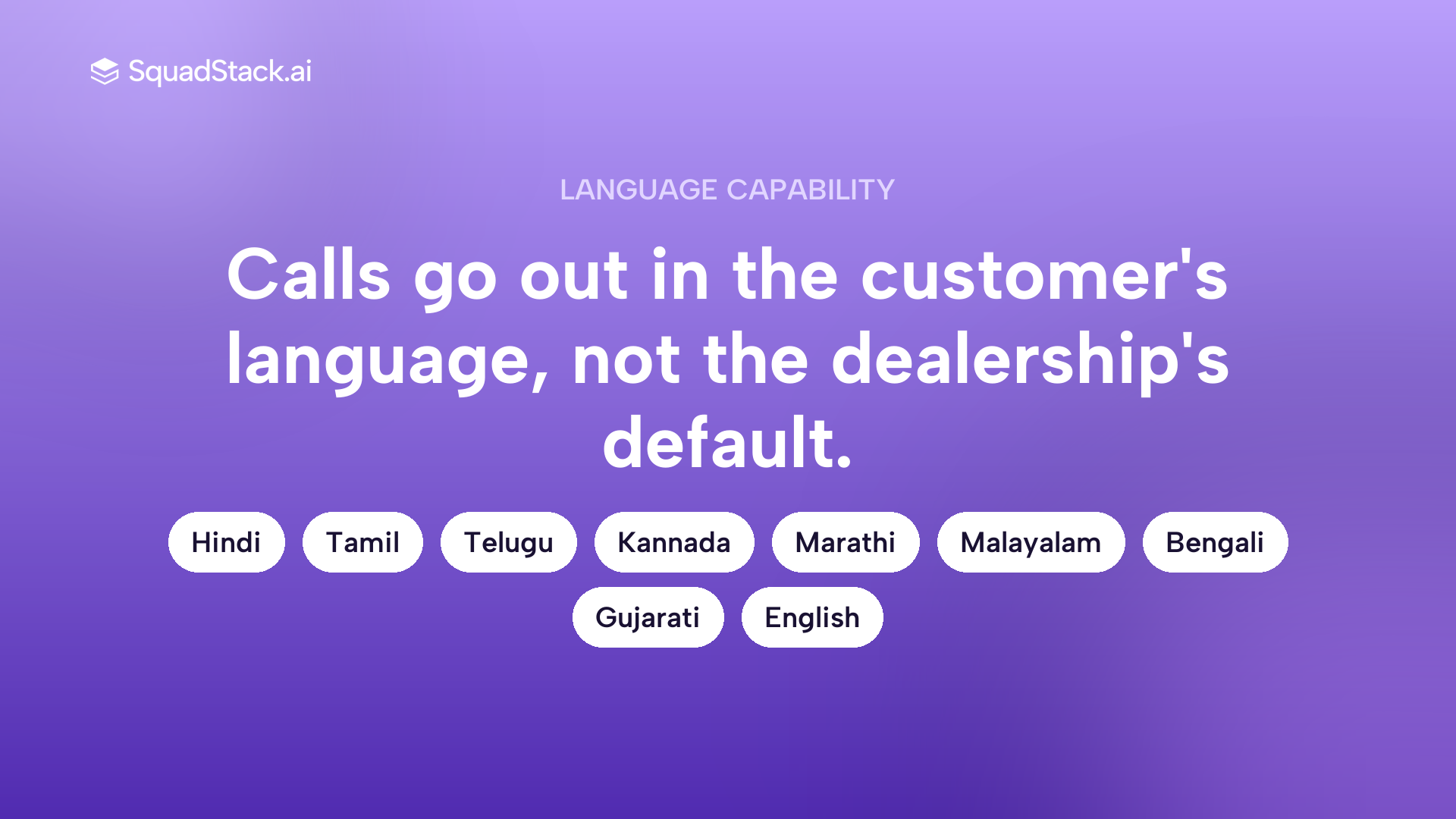
The platform supports 9+ Indian languages with native code-switching. Hindi, English, Tamil, Telugu, Kannada, Marathi, Malayalam, Bengali, and Gujarati are live today; more regional languages are available on demand.
Compliance is enforced at the platform level. The calling window (9:30 AM to 8:30 PM) is a hard system constraint. DND scrubbing runs before every campaign, dealer-uploaded internal DND lists are honoured the same way, and only 140-series numbers are used for outbound calls. The platform is ISO 27001, ISO 27701, SOC 2 Type II, DPDP, and TRAI compliant.
The POC success rate is 93%, against an industry average of around 25%. Setup takes roughly two weeks and runs on real leads with a success metric defined before go-live.
For teams evaluating this more broadly, the how to evaluate a voice agent guide covers the framework in detail. And if the goal extends to front-end lead qualification alongside service reminders, the AI voice agent for lead qualification page covers that motion.
Every dealership already knows which vehicles are overdue, which AMC packages are about to lapse, and which customers went quiet after year two. The problem is capacity: a CRE team of two to eight people cannot work thousands of records at the cadence it takes to move workshop footfall.
An AI voice agent for service and AMC reminders solves that capacity problem without adding headcount, without sacrificing conversation quality, and without the compliance exposure that manual calling creates. If the due-list is only partially covered each month, the gap is measurable and the fix is available. Schedule a demo with SquadStack to see the call flow on a live reminder campaign.
Which is the best AI voice agent for service and AMC reminders at Indian dealerships?
SquadStack is purpose-built for the Indian market, trained on 600M+ minutes of real Indian contact-centre conversations, and supports 9+ Indian languages with native code-switching. The platform has a 93% POC success rate and is live with large automotive brands including TVS Motor.
Can an AI voice agent handle AMC objections, or does it just read a script?
A well-built AI voice agent handles objections across multiple conversation turns, not with a single canned response. SquadStack's agents pull answers from the dealer's own AMC product documents in real time, so a customer who asks about coverage, compares cost, or pushes back on price gets a real answer, not a dead end.
How does AI calling for service reminders stay TRAI compliant?
SquadStack enforces the compliant calling window (9:30 AM to 8:30 PM) as a hard platform constraint. DND scrubbing runs against the TRAI registry before every campaign, and dealer-uploaded internal DND lists are honoured the same way. Only 140-series numbers are used for outbound campaigns. Consent gating and opt-out handling are built into the conversation layer itself.
What happens if the customer speaks Tamil when the agent opens in Hindi?
The agent switches to Tamil mid-conversation without prompting. SquadStack's models are trained on code-switched Indian telephony audio, so language switching is native to the model, not a translation step bolted on. Hindi, English, Tamil, Telugu, Kannada, Marathi, Malayalam, Bengali, and Gujarati are live today. More languages are available on demand.
How does the AI voice agent connect to a dealership's DMS or CRM?
The platform connects to dealer management systems and CRMs through API integrations or scheduled file feeds. The due-list comes in, calls go out, and outcomes write back automatically. SquadStack's forward-deployed engineers handle the integration as part of the two-week setup, so no client-side developers are needed.
What is a realistic timeline to go live with an AI reminder campaign?
Most campaigns go live in two to three weeks. The setup phase covers kickoff, solutioning, agent build, integrations, and testing against the dealer's own call recordings and knowledge base. The pilot then runs on real leads for four to eight weeks before volume scales.
How does the platform handle lapsed customers who haven't visited in over a year?
The AI identifies lapsed vehicle records from the due-list and routes them to a separate win-back flow with a different opening, a specific service offer or health-check hook, and a tone calibrated for re-engagement rather than routine reminder. These are contacts the CRE team never reaches because the active due-list already exceeds capacity.
Does the AI agent confirm bookings and send follow-up reminders?
Yes. The agent books the workshop slot during the same call, sends a WhatsApp confirmation while the customer is still on the line, and places a reconfirmation call the day before the appointment. Cancellations and reschedules are handled within the same workflow.
What does the quality assurance process look like for reminder calls?
Every call is scored by SquadStack's Eval System on three levels: Outcome (did the call achieve its objective), Sentiment (how the conversation landed with the customer), and Execution (did the agent follow the script and handle the flow correctly). A human QA layer reviews edge cases, and quality parameters are defined per campaign with the client before go-live.
How is performance tracked across the full AMC renewal and service reminder cycle?
Real-time dashboards show job cards booked, AMC renewals confirmed, show rates, and reconnect rates by segment, down to the individual call. Outcome classifications write back to the CRM automatically. The ROI Optimizer uses these outcomes to adjust script, voice, timing, and follow-up cadence across each campaign cycle, so performance compounds rather than plateaus.