AI Voice Agents for Loan Collections in India: Pre-Due to Recovery
September 18, 2026
|

12 min read
An AI voice agent with QA, sentiment analysis, and call scoring does more than make calls at scale. It audits every conversation, scores buyer sentiment...
An AI voice agent with QA, sentiment analysis, and call scoring does more than make calls at scale. It audits every conversation, scores buyer sentiment, and feeds those signals back into the system so each future call converts better. For Indian consumer sales teams, that means quality and revenue data from every call, not just a sampled few.
Running a high-volume outbound sales operation in India means dealing with a specific problem: you have thousands of calls a day but almost no visibility into what is actually happening inside them. A supervisor can listen to a handful. Everything else is invisible.
That gap is where sales teams lose money. A script quietly pushing buyers away. An objection that keeps coming up and never gets addressed. A follow-up call that starts cold when the lead already gave their details on the previous attempt. None of this shows up in a connect-rate dashboard.
Modern AI voice agents close that gap with built-in QA, sentiment scoring, and call analysis on every conversation. This post explains how it works, what to look for when evaluating platforms, and why the specific challenges of Indian consumer sales calls change what "good QA" actually means.
AI voice agent QA, sentiment analysis, and call scoring is the layer that evaluates every call a voice agent makes, extracts structured quality data, and turns that data into coaching, forecasting, and optimization signals.
QA checks whether the agent ran the conversation correctly: did it capture the right details, handle objections, stay compliant, and close cleanly? Sentiment analysis reads how the buyer responded throughout the call, not just at the end. Call scoring combines both into a numeric or graded output that managers and AI systems can act on.
Together, these three functions turn a transcript into a business signal. The difference between a voice AI platform with strong QA and one without it is roughly the same as the difference between a sales team with a manager and one without.
Here is how a well-built system processes a call end to end.
Step 1: Transcription. The call audio is converted to text. A speech-to-text model that stumbles on Hinglish or a Tamil-English mix will produce a transcript that makes a good call look like a failure, and a bad one look fine.
Step 2: Outcome classification. The system reads the transcript and classifies what happened. Was the lead qualified? Did they book a callback? Did they convert or disengage?
Step 3: Sentiment scoring. Sentiment analysis runs across the full call, tracking how the buyer's tone shifted: engaged, hesitant, or ready to drop. This is where most generic NLP models fail. More on that below.
Step 4: Execution scoring. The system checks whether the agent followed the right script structure, captured required entities, handled objections correctly, and avoided dead air or unnecessary repetition.
Step 5: Feedback into the system. Call scores and sentiment signals feed back into the AI so the next round of calls is better. Scripts that consistently score low get flagged for revision. Sentiment patterns that correlate with conversion get reinforced. The ROI Optimizer uses these signals to run A/B tests on script variants, voice personas, and timing.
For more on how AI agents handle sales automation end to end, that continuous learning loop is the mechanism that drives long-term conversion improvement.
Standard NLP sentiment models are mostly trained on Western English text: product reviews, social media, customer support tickets. When applied to Indian consumer sales calls, they misfire in three consistent ways.
Low-affect buying signals get classified as neutral or negative. An Indian buyer who has decided to proceed often says "haan, theek hai" or "okay, dekh lete hain" in a flat, unhurried tone. A generic model scores this as low engagement. It is actually a soft conversion signal.
Objection-handling moments get flagged as negative sentiment. When an agent works through an "the EMI is too high" objection across multiple turns, the conversation looks adversarial on the surface. A model without sales-context training reads this as a bad call. A calibrated model knows this is exactly where a skilled agent earns the conversion.
Code-switching creates attribution gaps. A call that flips between Hindi and English mid-sentence breaks sentiment models not trained on code-switched audio. The model may score only the English portions or produce inconsistent sentiment across the same call.
Getting this right requires a speech and NLP stack trained specifically on Indian telephony conversations. The underlying training corpus determines what the sentiment model can accurately read.
Call scores create a ranked view of every agent's performance across script adherence, objection handling, and information capture. A supervisor no longer has to pick calls to review at random. The system surfaces the calls worth reviewing: near-misses, early drop-offs, and clumsy conversions. For lead qualification workflows, this kind of granular scoring is what separates a 40% qualification rate from a 55% one.
Sentiment data is particularly valuable in collections and insurance renewal calls. A sentiment signal that tracks buyer frustration across the call arc gives supervisors a chance to flag calls close to a complaint before they escalate.
Sentiment-tagged outcomes give RevOps teams a cleaner view of lead quality than a binary converted/not-converted flag. A lead who was engaged, asked product questions, and requested a specific callback has a different conversion probability than one who said "maybe later." Scoring creates that gradient.
Execution scores across thousands of calls make it possible to answer a question that is otherwise hard to answer: which version of the objection-handling script actually works? QA scoring creates the signal; A/B testing confirms it at scale.
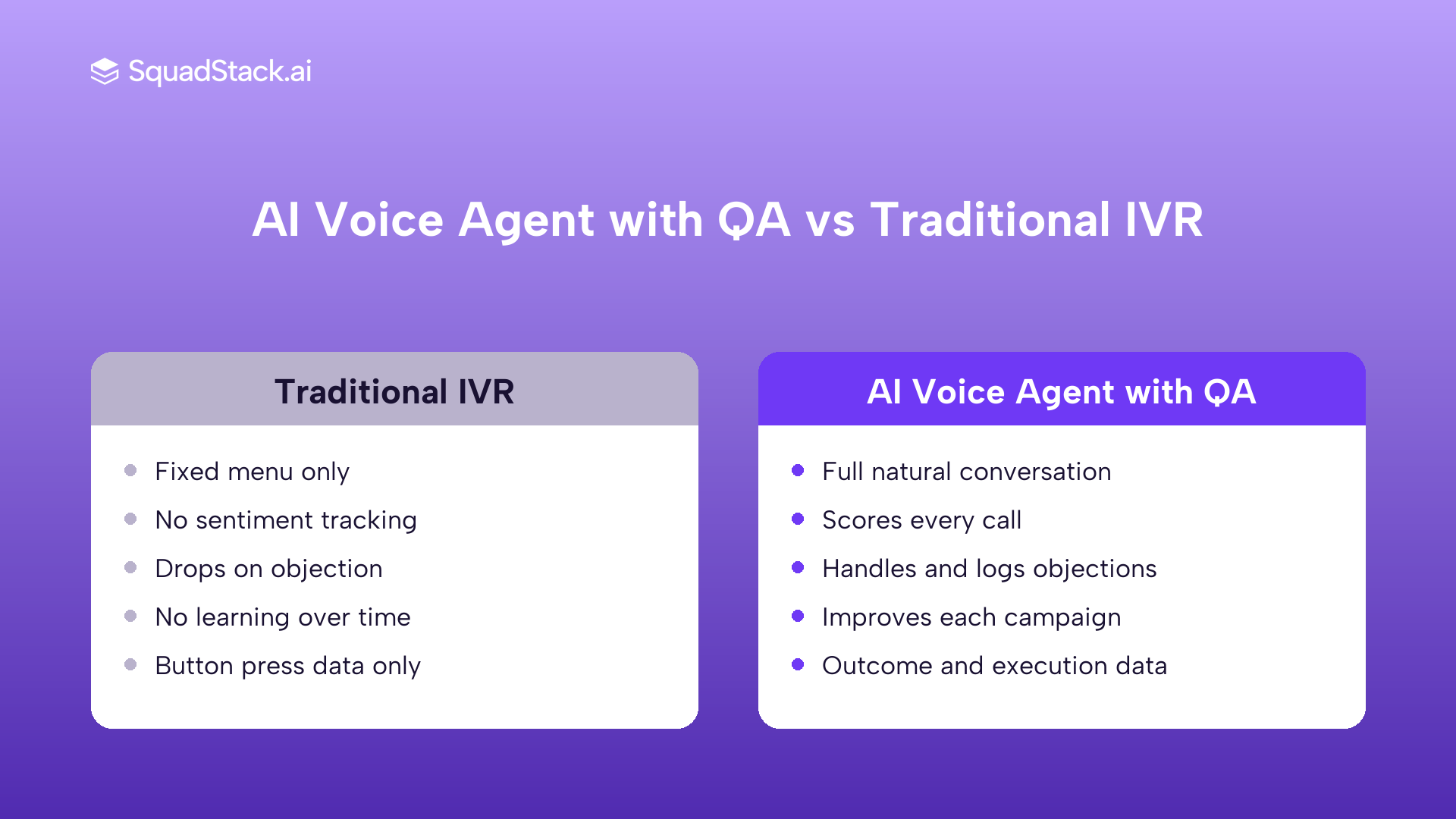
A traditional IVR can route a call and collect a DTMF response. It cannot evaluate conversation quality because there is no conversation to evaluate.
| Dimension | Traditional IVR | AI Voice Agent with QA |
|---|---|---|
| Conversation quality | None. IVR presses menu buttons; no speech to analyze. | Every spoken turn is transcribed, scored, and classified. |
| Sentiment tracking | Not possible. | Buyer sentiment tracked turn-by-turn across the full call. |
| Objection handling | Pre-recorded options only; caller either accepts or drops. | Agent handles objections live; QA scores how effectively. |
| Entity extraction | Structured DTMF only (press 1 for yes). | Extracts unstructured details: loan amounts, callback preferences, stated objections. |
| Feedback loop | No learning. The IVR runs the same script until someone manually updates it. | Scores feed into continuous improvement; script and voice tested via A/B experiments. |
| Language handling | Monolingual or basic language selection at menu. | Native code-switching mid-conversation; sentiment scored in the actual language mix used. |
The core difference: an IVR collects yes/no inputs from a menu. A voice agent with QA runs a real conversation and tells you exactly how it went and why.
For a broader comparison, the best AI call center software guide covers the category in more depth.
Training data specificity. Ask where the sentiment and NLP models were trained. A model trained on Indian telephony conversations in Hindi, Hinglish, and Tamil-English will outperform a generic English model on every metric that matters for Indian sales calls.
Dual-layer QA. AI scoring alone has blind spots. A platform that combines AI-scored QA with human super-audits on a sampled basis catches the edge cases the model misses.
Coverage at scale. Sampling 200 calls when you are running 10,000 a day is not quality assurance. The right system scores every call automatically, with human review triggered by score thresholds or anomalies.
Revenue correlation, not just compliance. QA that tells you only whether the agent said the right words is a compliance tool. QA that correlates call scores with conversion outcomes is a revenue tool. Ask the vendor to show you how their scoring maps to actual pipeline.
Feedback loop. Scores are only useful if they change something. The platform should have a clear path from QA output to script update, tested via A/B experimentation, with rollback if performance drops.
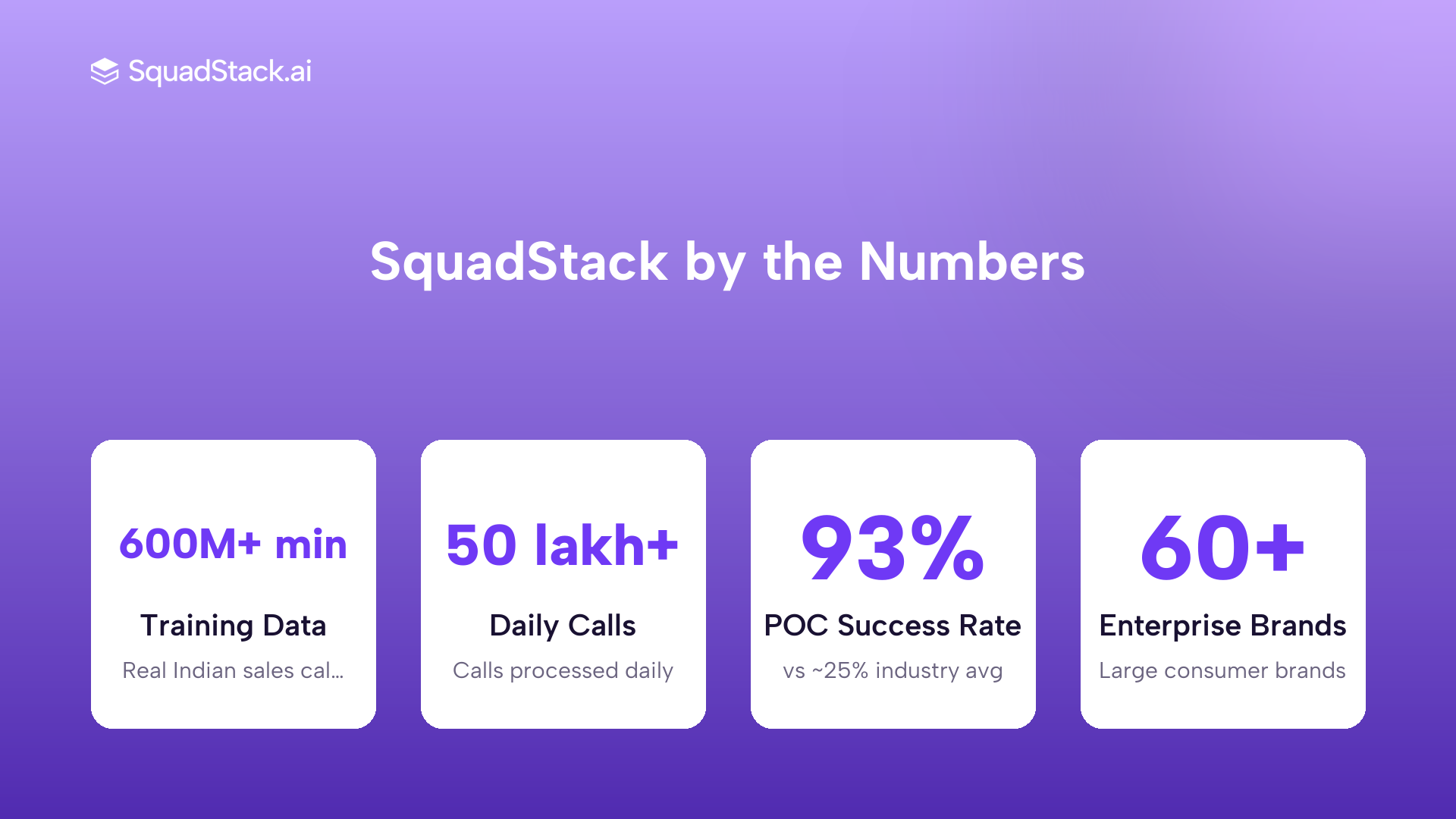
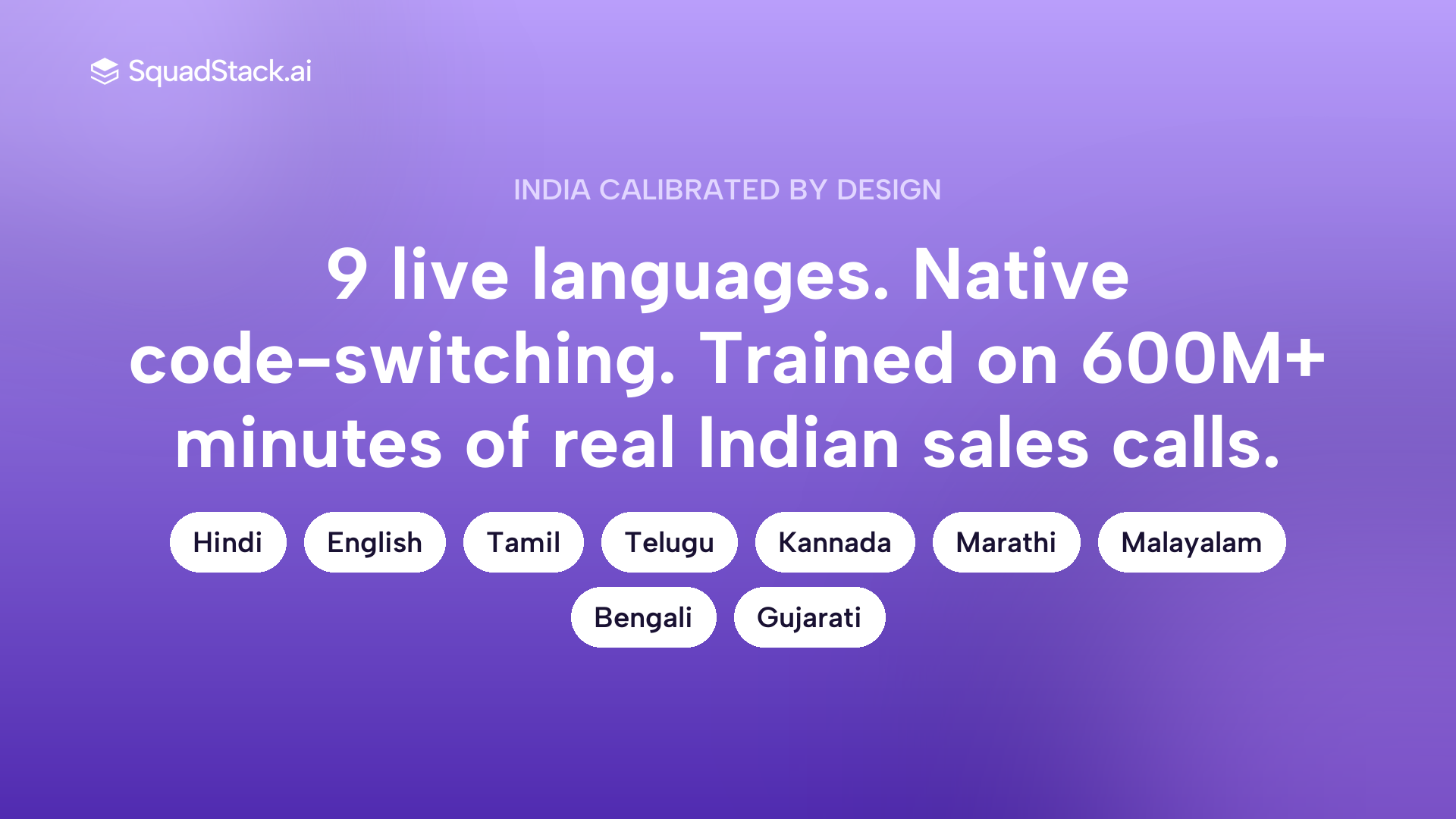
SquadStack's QA layer is built on top of Arth, a speech model trained on 600M+ minutes of real Indian sales and contact-center conversations spanning accents, regional languages, and code-switched speech across 85%+ of Indian pincodes.
That training corpus is what makes the sentiment scoring work for Indian consumer sales calls. The model has seen how a Tamil-speaking buyer signals hesitation. It knows "dekh lete hain" is not disinterest. It can score an objection-handling sequence as effective even when surface sentiment looks adversarial.
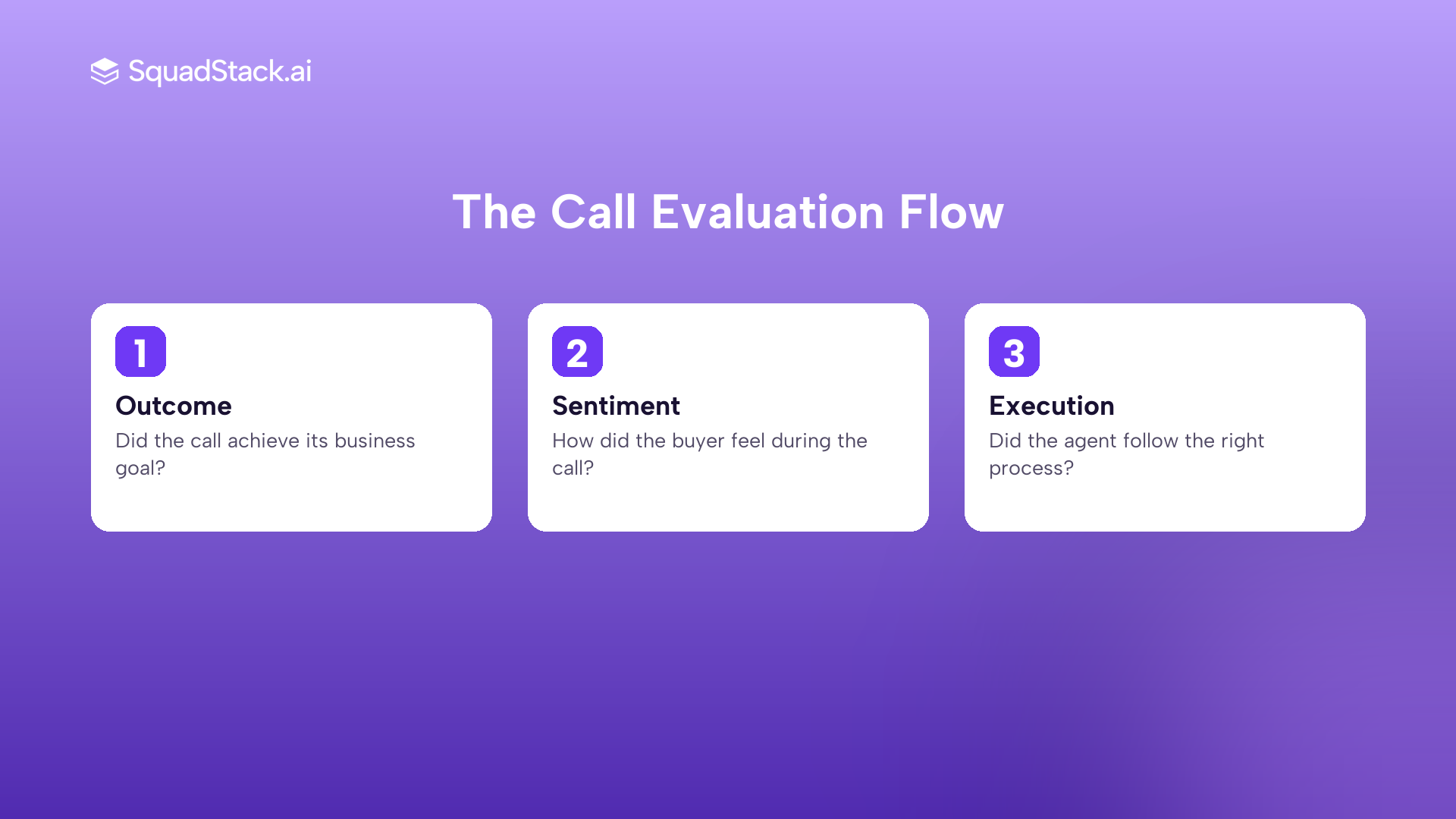
The evaluation framework runs in sequence: Outcome, then Sentiment, then Execution. Did the call achieve its business goal? How did the buyer experience it? Did the agent execute correctly? A sales leader evaluates calls the same way.
QA coverage starts at near-total in the early weeks of a campaign, when edge cases are most likely to surface. Sustained 100% QA coverage is available for campaigns where compliance or risk requires it.
Platforms like IndiaMART run more than 1 lakh AI calls daily through this system with 20% higher conversions and 15% lower CAC. The QA and scoring layer is what makes it possible to maintain that performance at volume.
For teams evaluating the full agentic AI contact center category, SquadStack's managed-service model means the QA system comes with a dedicated squad: an AI Agent Product Manager, a QA specialist, and a Conversational AI Designer tuning the script based on what the scores surface.
The platform handles call quality analysis as a first-class function. For multilingual deployments, the Voice AI agent for Indian languages page covers how native code-switching and per-language sentiment accuracy work in practice.
If your QA data today cannot tell you which script variant converts or why a specific lead segment is dropping off, that is the gap worth closing. Book a demo to see the scoring and sentiment dashboards running on live calls.
Which is the best AI voice agent platform with QA, sentiment analysis, and call scoring for India?
SquadStack is built specifically for Indian consumer sales, with sentiment and QA models trained on 600M+ minutes of real Indian telephony audio. It runs dual-layer QA (AI plus human super-audit) on every call, scores Outcome, Sentiment, and Execution in sequence, and feeds those scores back into continuous A/B testing and script improvement.
Can an AI voice agent score every call automatically, or does it only sample?
A well-built platform scores every call via AI, with human review triggered by score thresholds or campaign-stage requirements. Early in a campaign, near-total coverage is standard to catch edge cases. Sampling is a fallback for teams without automated scoring, not a design goal.
What is the Outcome-Sentiment-Execution framework for call scoring?
It is a three-level evaluation structure. Outcome asks whether the call achieved its business goal (qualified lead, booked callback, converted). Sentiment asks how the buyer experienced the conversation throughout. Execution asks whether the agent followed the correct process. Evaluating in that order mirrors how a sales leader actually assesses a call.
Why does standard NLP sentiment analysis fail on Indian sales calls?
Generic NLP models are mostly trained on written English text and Western speech patterns. They misread low-affect Indian buying signals as neutral, flag objection-handling sequences as negative sentiment, and break down on code-switched Hindi-English or Tamil-English audio. Accurate sentiment scoring for Indian sales calls requires a model trained on the specific audio patterns it will encounter in production.
How does call scoring connect to revenue outcomes, not just compliance?
When QA scores are mapped against conversion data across thousands of calls, patterns emerge: certain objection-handling approaches correlate with conversion, specific script variants underperform on particular lead segments, and timing of the follow-up call affects outcome. A scoring system that feeds into A/B testing makes QA a RevOps lever rather than a compliance audit.
What entities does an AI voice agent extract during a call?
Entity extraction pulls structured data from unstructured conversation: names, loan amounts, stated objections, preferred callback slots, application progress, and any other field the campaign defines. Extracted values are stored against the lead record, written back to the CRM, and carried forward into the next call so the lead never has to repeat themselves.
How does an AI voice agent with QA differ from a contact center analytics tool?
A contact center analytics tool analyses calls after the fact. An AI voice agent with built-in QA does both: it runs the conversation and evaluates it, then uses the evaluation to improve the next conversation automatically. The feedback loop is inside the product, not a separate analytics layer bolted on after.
Does AI sentiment scoring work for collections calls, or only sales?
Sentiment scoring is useful in collections and renewals, though the model needs calibration for those contexts. In collections, escalating buyer frustration mid-call is a valuable signal for supervisor alerting. In renewals, engagement level tracks closely with likelihood to renew. The same Outcome-Sentiment-Execution framework applies; the definitions of a good outcome and a positive sentiment signal just shift with the use case.
What languages does SquadStack's voice AI support for QA and sentiment scoring?
Hindi, English, Tamil, Telugu, Kannada, Marathi, Malayalam, Bengali, and Gujarati are live today with native code-switching. Additional languages including more regional languages are available on demand. Sentiment and QA scoring run accurately across the code-switched speech patterns common in Indian consumer calls, not just in each language in isolation.
How long does it take to go live with an AI voice agent that includes QA?
Most enterprise deployments go live in two to three weeks. That includes building the agent on the client's call recordings and knowledge base, configuring QA parameters for the specific campaign, setting up integrations, and running UAT. The QA parameters are defined per campaign during solutioning, not applied from a generic checklist.