.svg)





Top AI Outbound Calling Tools in India: Features Compared
October 23, 2026
|

13 min read
Why AI voice agents in India now match human telecallers on connectivity, conversion, and cost across live campaign data.
In a controlled comparison across live Indian consumer sales campaigns, SquadStack's Voice AI agents matched or beat human telecallers on connectivity, conversion, and cost per outcome. AI reached up to 90% of leads versus a 40 to 60% industry norm for human teams, and delivered up to 2 to 3x lower customer acquisition cost. This is not a generic vendor claim: it comes from head-to-head campaign data with identical lead sources, scripts, and compliance guardrails.
The question most RevOps and CX leaders in India are asking right now is simple: does an AI voice agent actually outperform a trained human telecaller, or is that just a vendor claim? Cost tables are everywhere. Real conversion data from the Indian market is not.
This post presents SquadStack's first-hand findings from controlled comparisons across live consumer sales campaigns in India. The goal is a straight answer, backed by data, for operators who need to make a build-vs-buy decision and want proof rather than promises.
For a broader look at how AI agents beat human benchmarks in practice, the Magic Playbook for Beating Human Numbers covers the tactical levers in depth.
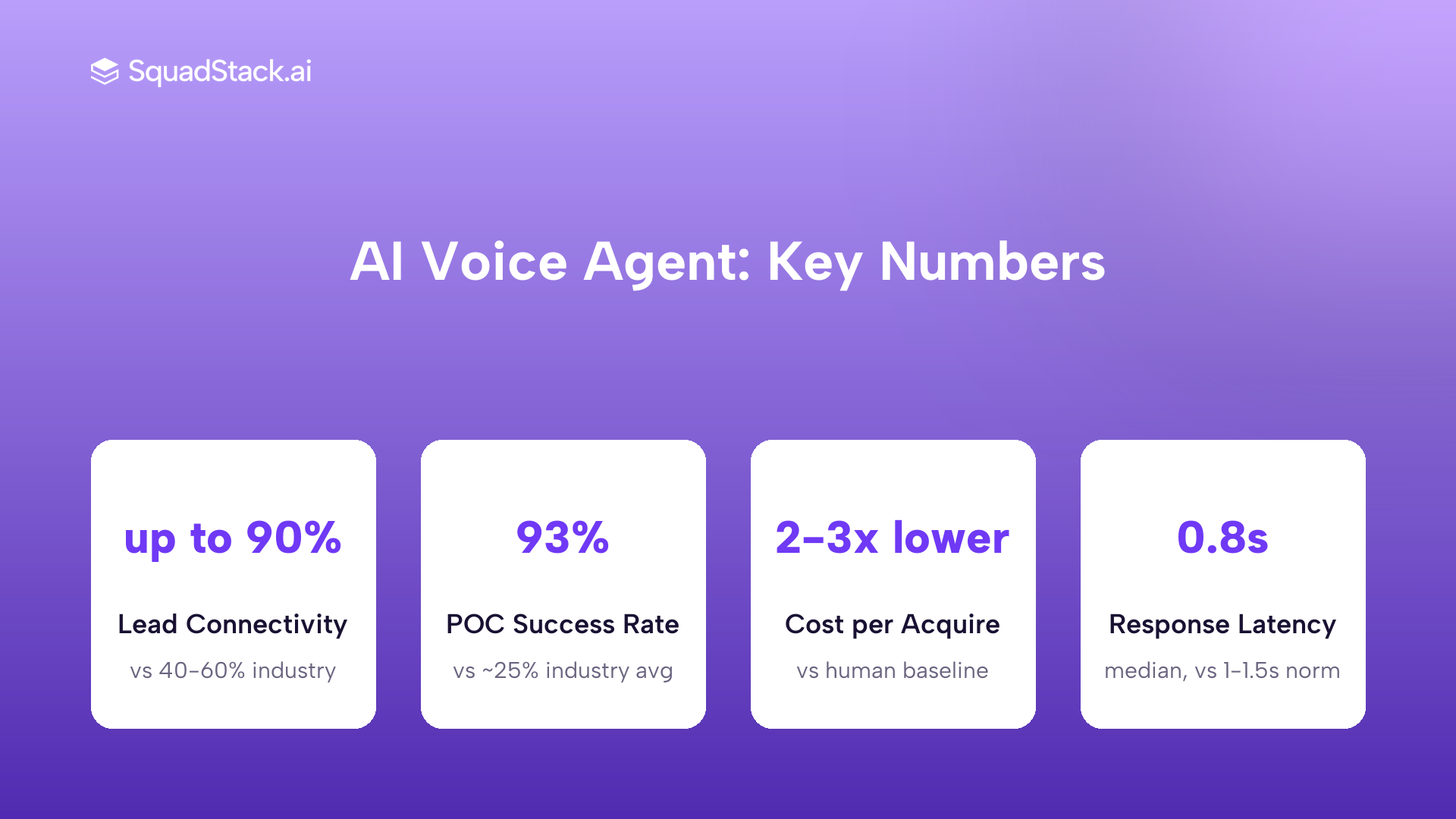
Across four live campaigns with pre-existing human benchmarks, SquadStack's Voice AI agents matched or exceeded human performance on all three dimensions measured: outcome metrics, average handle time, and cost per outcome. Outcome metrics ran 1x to 2.5x better than the human baseline. Average handle time improved 1.5x to 2.5x. Cost per outcome came in 2x to 3.3x better.
These were not lab tests. Campaigns used identical lead sources, scripts, and compliance guardrails. The human benchmarks were stable, real-world figures from the same campaigns before AI deployment.
The comparison ran across four live Indian consumer sales campaigns: buyer qualification for a large B2B marketplace, demat account opening for a top bank-linked brokerage, rider hiring for a leading logistics company, and inbound support for a regional entertainment platform.
Each campaign had three things in common. First, a stable human performance baseline from prior operation. Second, identical lead sources: the same pool, split between AI and human, so differences in lead quality could not explain the results. Third, identical compliance guardrails: same calling window (9:30 AM to 8:30 PM), same scripts, same DND scrubbing.
Three dimensions were measured per campaign:
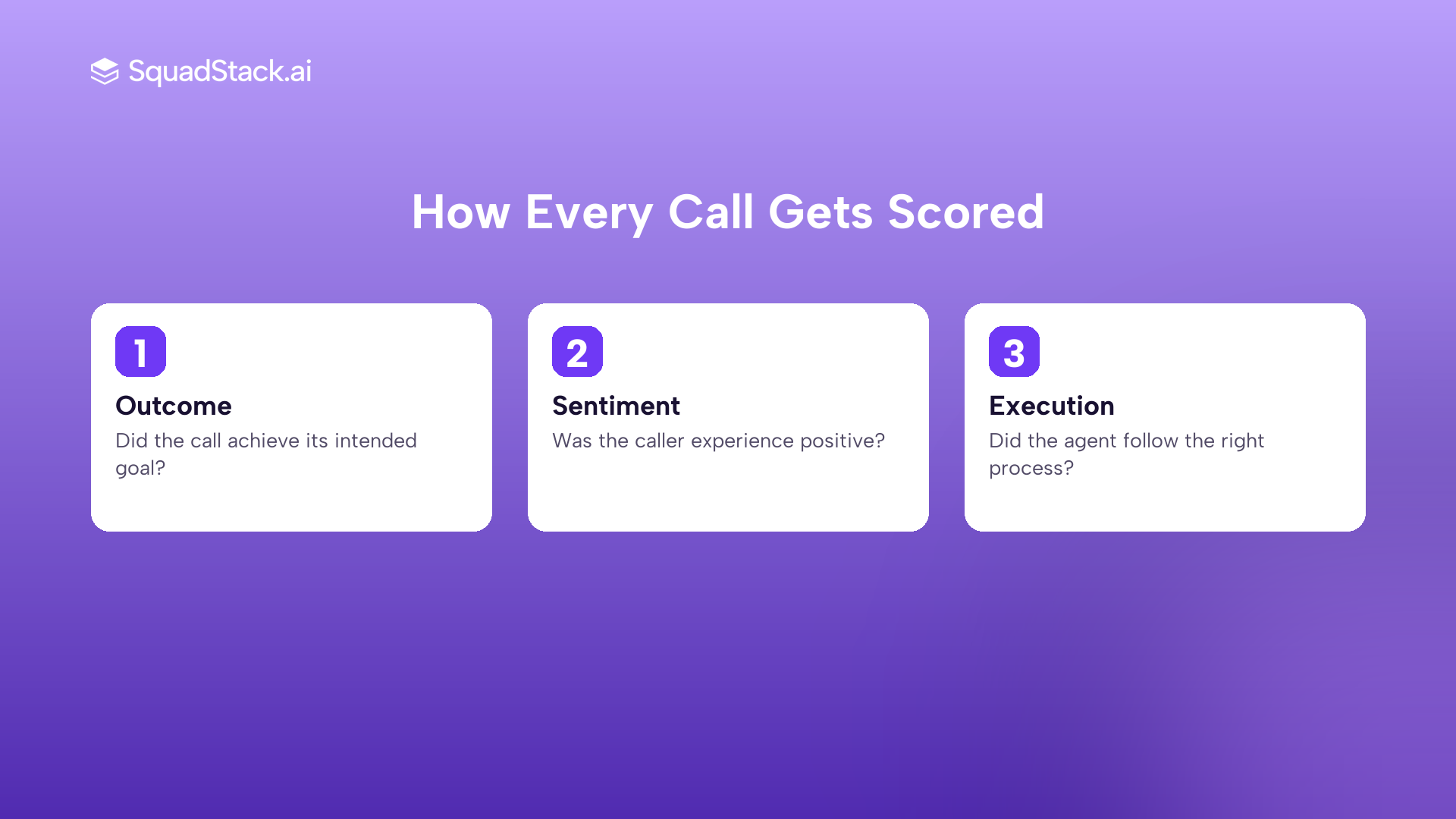
1. Connectivity: the share of unique leads actually reached over the full campaign cadence, not just first-attempt connect rates. 2. Conversion and outcome metrics: qualified leads, booked appointments, opened accounts, or hired riders, depending on the campaign. 3. Efficiency: average handle time and cost per outcome.
It is worth being clear about what this data does not cover. The study reflects specific Indian consumer verticals, specific lead profiles, and a managed deployment model where SquadStack's squad configures, monitors, and optimises every campaign. Results in unmanaged deployments or entirely different verticals may vary.
Human telecaller teams in India typically reach 40 to 60% of leads over a campaign's full attempt cadence. SquadStack's AI agents consistently reached up to 90% in these campaigns.
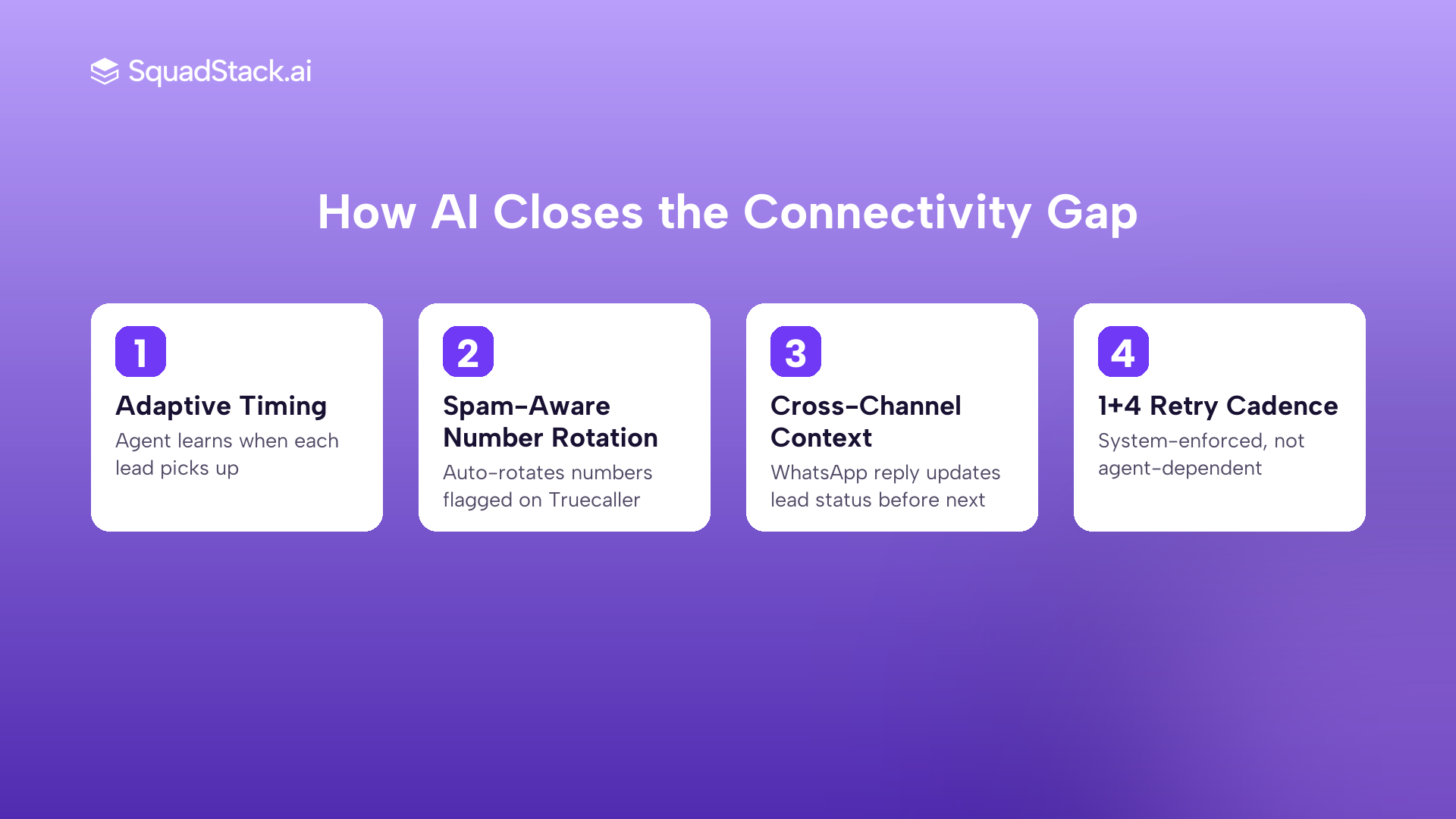
The gap is not explained by effort volume alone. The AI Lead Manager runs adaptive outreach: it learns the best time to reach each lead rather than following a fixed schedule, rotates numbers automatically when Truecaller flags them as spam, and uses cross-channel context to avoid treating a lead who just replied on WhatsApp as a cold contact.
Human telecallers face number-spam fatigue, fixed shift windows, and unavoidable downtime. Those constraints compound over a multi-day campaign. The AI's 1+4 retry cadence, spread across two days with 180-minute gaps, is enforced by the system, not by individual agent discipline.
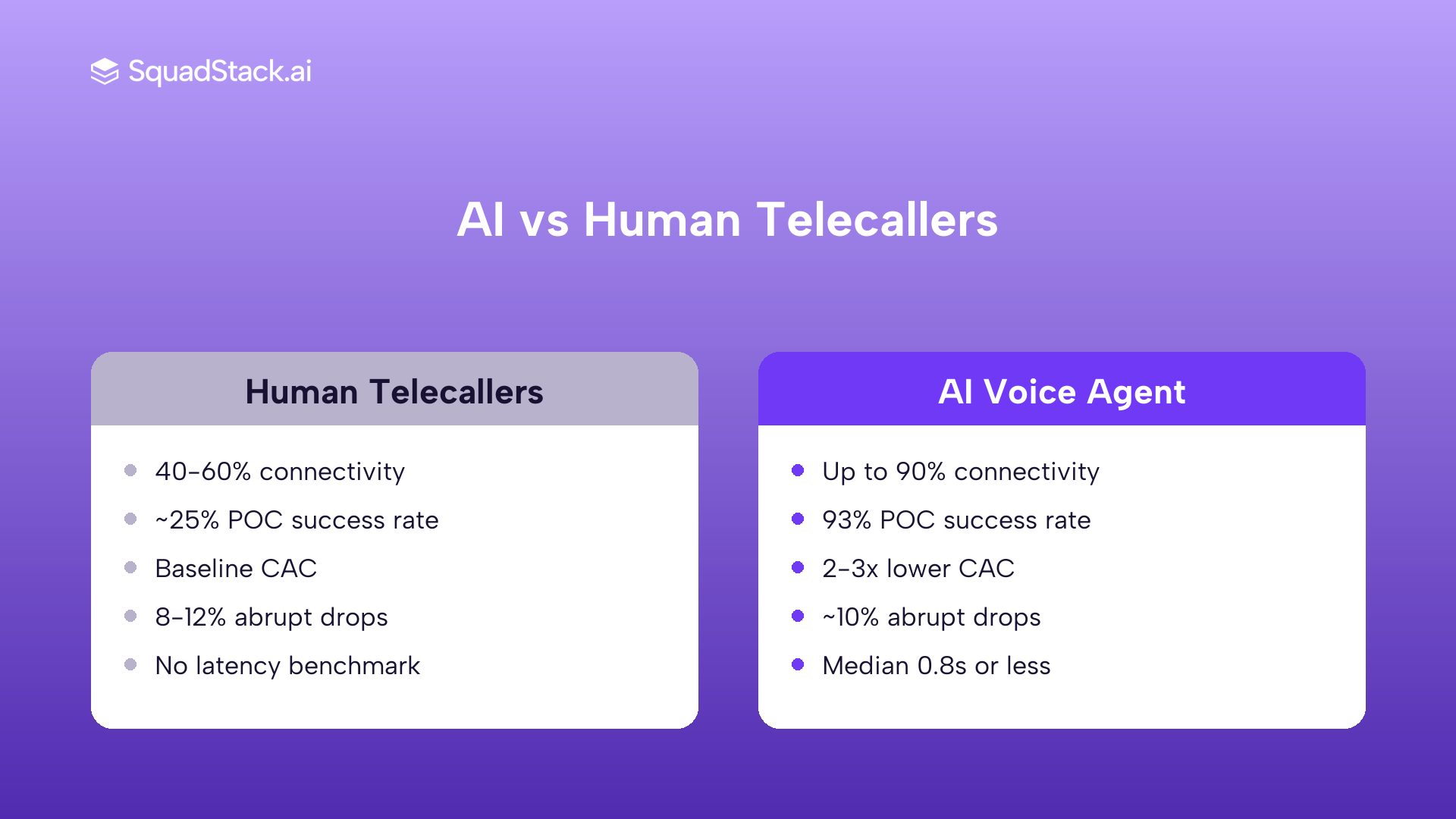
| Metric | Human Telecallers (Industry Norm) | AI Voice Agent (SquadStack) |
|---|---|---|
| Lead connectivity | 40 to 60% | Up to 90% |
| POC success rate | ~25% industry average | 93% |
| CAC vs human agents | Baseline | 2 to 3x lower |
| Conversion uplift | Baseline | Up to 40% more |
| Abruptly Disconnected Rate | 8 to 12% | ~10% (within human range) |
| Median response latency | N/A (human) | 0.8 seconds or less |
Connectivity is the easier win. Conversion is where the comparison gets more instructive.
On conversion outcomes, the AI ran 1x to 2.5x above the human baseline depending on the campaign. The accounts-opening and buyer-qualification campaigns showed the strongest uplift. The rider-hiring campaign was tighter, which fits: structured, high-frequency outreach favours AI more than nuanced persuasion tasks.
The reason AI outperforms on conversion in most Indian consumer sales contexts comes down to consistency. A human caller delivers a slightly different pitch on every call. Energy, mood, and experience vary. The AI runs the same optimised script every time, adjusted per lead using the Sales Decision System: voice, language, framing, and cadence are all chosen per individual rather than per shift.
Native code-switching also matters in India more than most vendors acknowledge. SquadStack's agents switch languages mid-sentence, the way a bilingual agent naturally does, because the underlying model was trained on 600M+ minutes of real Indian sales conversations, including Hinglish and Taminglish. A generic voice AI that pauses or stumbles at a language switch loses the caller in those first three seconds.
Cost per outcome ran 2x to 3.3x lower for AI across the four campaigns, consistent with the broader 2 to 3x lower CAC that SquadStack reports across its live deployments.
Two caveats are worth naming plainly. First, this is managed-service deployment: the squad that configures, monitors, and optimises the campaign is included in SquadStack's model. A raw infrastructure comparison with a self-serve tool would look different. Second, cost advantage compounds over time as the AI optimises itself through Lift, SquadStack's self-improvement layer. A human team's cost is relatively flat; the AI's cost per outcome tends to fall as conversion rates improve.
The data supports AI for most high-volume Indian consumer sales and qualification flows. But it would be dishonest to present this as a universal result.
Three scenarios show a different picture:
High-ticket, high-emotion products. Life insurance, home loans, and equity advisory involve significant life decisions. Some Indian consumers, particularly in tier-2 and tier-3 markets, build trust with a person before committing. A human who can pause, acknowledge, and go off-script in ways the AI cannot always closes the last 10% faster.
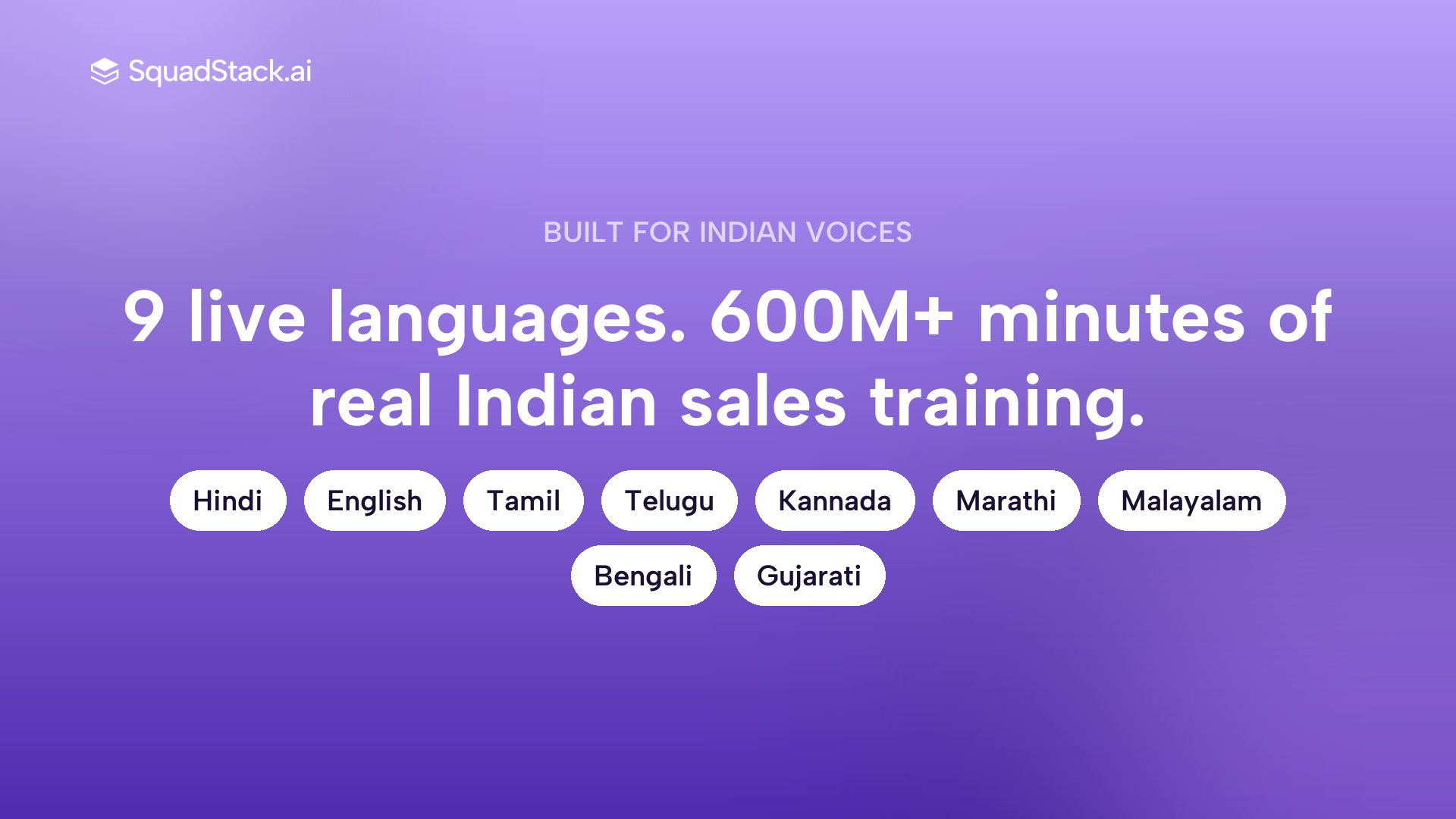
Unfamiliar dialects and deep-rural vernacular. SquadStack's agents support 9 live languages with native code-switching, and additional languages are available on demand. But a regional dialect that sits outside the training distribution will produce more errors and more abrupt disconnects. A local human agent with the right dialect still outperforms in those micro-markets.
Complex objection chains on regulated products. BFSI products with multi-step compliance requirements, where a customer raises several linked objections in sequence, can occasionally exhaust the AI's objection-handling depth. Warm transfer to a human closer at that point, which SquadStack supports natively, recovers the call. But a pure-AI flow without transfer capability loses those leads.
The right framing for most operators is not AI versus human. It is AI handling the volume, with human closers taking the warm transfers on high-intent, high-complexity leads. That hybrid model is how SquadStack's highest-performing campaigns are structured.
The ai vs human telecallers study india evidence points to a few practical decisions:
Start with lead connectivity, not conversion. Most operators underestimate how much revenue leaks before the conversation even happens. Reaching 40 to 60% of leads means 40 to 60% of qualified leads never hear the pitch at all. Closing that gap with AI often produces more total conversions even if per-call conversion rates are similar.
Use verified outcome data, not cost tables. Every vendor can build a cost-per-minute comparison that favours AI. Ask specifically for lead-level connectivity rates, conversion rates against a stable human benchmark, and cost per outcome including QA, telephony, and optimisation overhead. SquadStack's 93% POC success rate against an industry average of roughly 25% reflects that most vendors cannot produce these numbers under scrutiny.
Insist on evaluation campaigns with matching lead sources. If a vendor tests AI on fresher or better-qualified leads than the human baseline used, the comparison is meaningless. Identical lead pools, same compliance guardrails, and a pre-agreed success metric are the minimum conditions for a credible pilot.
Plan the human layer before you deploy. Decide in advance which conversations should transfer to a human closer, what the trigger is, and what context the human receives. SquadStack's warm transfer passes full conversation context to the receiving agent. Campaigns that plan this from the start consistently outperform campaigns that treat transfer as a fallback.
Relevant case studies that show these dynamics in action: the bank-linked brokerage account opening campaign (3x higher conversions) and the leading quick commerce platform rider hiring campaign (90% connectivity, 40% lower cost-per-hire) both illustrate what a well-structured AI deployment produces against a real human baseline.
Which is better for outbound sales in India: AI voice agents or human telecallers?
For high-volume qualification and connectivity, AI voice agents consistently outperform human telecallers on lead reach, cost per outcome, and consistency of delivery. For high-ticket or emotionally complex sales, a hybrid model where AI handles volume and human closers take warm transfers performs best.
What is the cost difference between AI voice agents and human telecallers in India?
In SquadStack's live campaigns, AI delivered up to 2 to 3x lower customer acquisition cost compared to human telecaller teams. This includes QA, telephony, and optimisation costs within a managed-service model, not just the raw cost per minute.
How does AI lead connectivity compare to human telecaller connectivity in India?
Human telecaller teams typically reach 40 to 60% of leads over a campaign's full cadence. SquadStack's AI agents have achieved up to 90% lead-level connectivity using adaptive timing, spam-aware number rotation, and omnichannel nudges between dial attempts.
Can AI voice agents handle Hindi and regional languages for Indian telecalling?
SquadStack's agents support 9 live languages (Hindi, English, Tamil, Telugu, Kannada, Marathi, Malayalam, Bengali, Gujarati) with native code-switching, meaning the agent switches mid-sentence the way a bilingual human agent does. Additional languages including more regional languages are available on demand.
How do I evaluate an AI voice agent vendor's claims on conversion vs human agents?
Ask for lead-level connectivity rates and conversion rates measured against a stable human baseline, using identical lead sources and compliance guardrails. Check the POC success rate: SquadStack's is 93%, compared to an industry average of roughly 25%. Cost-per-minute tables without conversion data are not sufficient for a real comparison.
Are AI telecallers TRAI-compliant for outbound calling in India?
SquadStack's platform is TRAI-compliant. Calling windows are hard-enforced by the system (9:30 AM to 8:30 PM), lead lists are scrubbed against the DND registry before dialing, and consent gating runs inside the conversation layer. Only 140-series numbers are used for cold outreach.
When does a hybrid AI plus human model outperform pure AI telecalling?
Hybrid models work best for high-ticket products like insurance or home loans, where some customers build trust with a person before committing, and for complex multi-objection conversations on regulated products. AI handles volume and qualification, and warm transfers the high-intent leads to a human closer with full context already passed.
What is the typical ramp time before AI telecalling matches human performance?
In SquadStack's model, the AI is trained on the client's real call recordings, knowledge base, and FAQs before going live, so it performs at a high level from the first week of the pilot. The standard pilot is 4 to 8 weeks, with a pre-aligned success metric agreed before go-live.
How does AI handle objections in Indian consumer sales compared to human agents?
SquadStack's agents detect objections in real time and handle them across multiple turns, not with a single canned response. The underlying Sales LLM is fine-tuned on 400M+ real Indian sales interactions, so common objections on loans, insurance, and demat accounts are trained responses rather than generic rebuttals.
Is there real Indian-market data comparing AI and human telecaller conversion rates?
SquadStack's functional Turing test compared AI and human performance across four live Indian consumer campaigns with matching lead sources and human benchmarks. AI matched or beat human metrics on outcome, handle time, and cost per outcome in all four. That data, along with specific case results, is available in the case studies linked throughout this post.

