

Top AI Outbound Calling Tools in India: Features Compared
October 23, 2026
|

13 min read
See how Bengali and Odia AI voice agents help sales teams in Eastern India close the trust gap in microfinance, insurance, and edtech outreach.
TL;DR: A Bengali Odia AI voice agent for Eastern India does far more than translate text into speech. It handles dialect variation, code-switching, and the specific buying hesitations common in West Bengal, Jharkhand, and Odisha. SquadStack's agents are live in Bengali today, with native code-switching, trained on 600M+ minutes of real Indian sales conversations.
Outbound sales teams working West Bengal, Jharkhand, and Odisha run into a specific problem. The product is good, the lead list is qualified, but connectivity is low and conversions are worse. Often, the agent is calling in Hindi or English to someone who thinks, negotiates, and objects entirely in Bengali or Odia. The mismatch is not a language barrier in the dictionary sense. It is a trust barrier. A voice that sounds foreign triggers immediate suspicion, especially in financial services and education.
This playbook covers what a Bengali Odia AI voice agent for Eastern India actually needs to do to close that trust gap, and how to build or choose one that works.

A Bengali Odia AI voice agent for Eastern India is a conversational Voice AI system that conducts outbound and inbound sales calls in Bengali or Odia, with the naturalness, pacing, and cultural register those languages require in a sales context. It is not a text-to-speech reader overlaid on a Hindi script.
Eastern India covers three major language communities with distinct registers:
This is what separates a genuine regional-language voice agent from a platform that lists languages in its feature table.
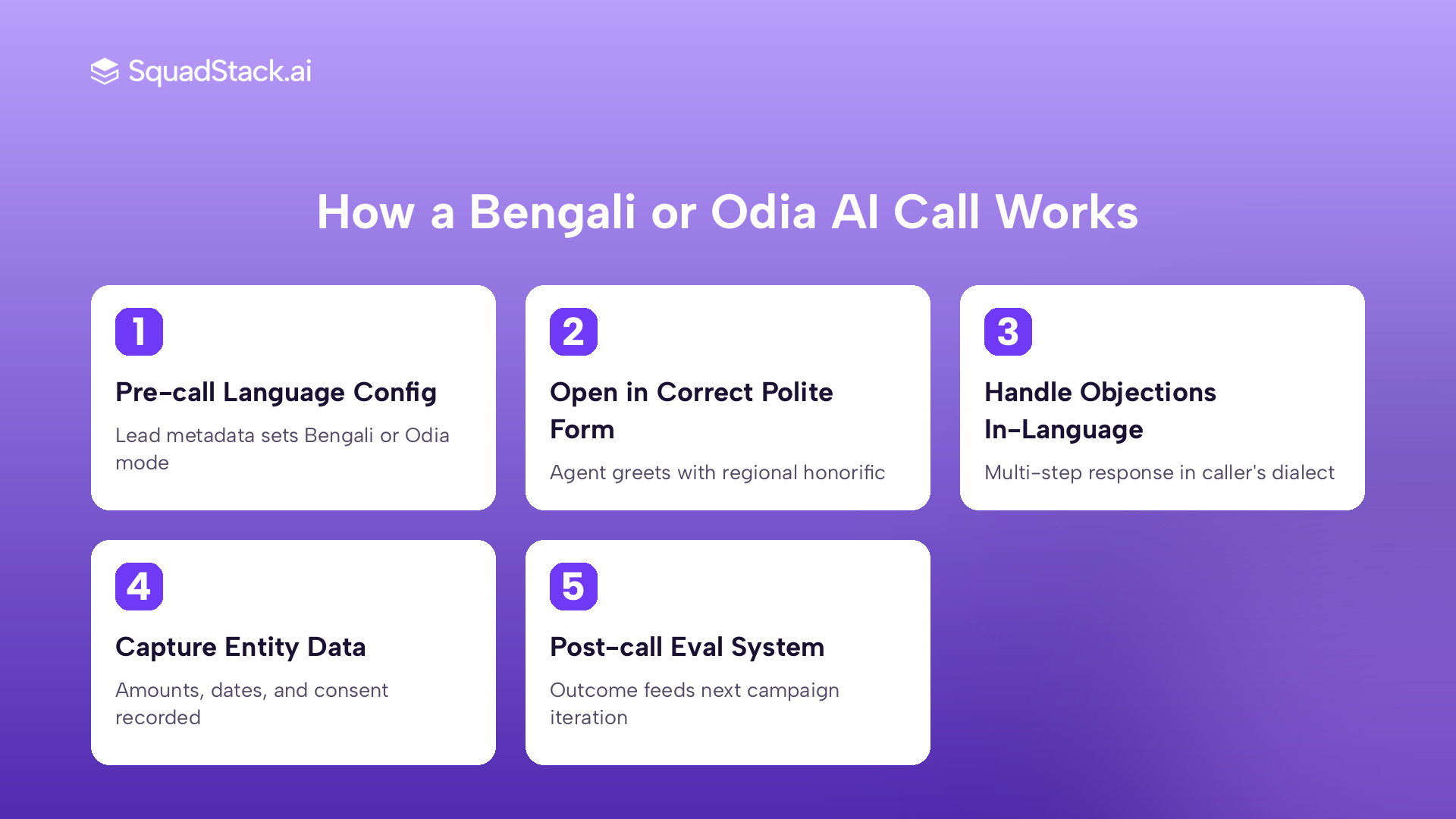
The core call flow has five stages, each with Eastern India-specific considerations.
1. Pre-call configuration. The platform sets the starting language from lead metadata: pin code, preferred language flag, or prior interaction history. For a lead from Cuttack, the agent opens in Odia. For Siliguri, Bengali. Code-switching takes over once the caller responds.
2. Opening and trust-building. The first three seconds decide whether the call continues. In Eastern India, abrupt openers perform poorly. An effective opening uses a polite form of address, states the purpose without pressure, and gives the caller a moment to settle. For Odia callers, vowel sounds and intonation must feel local, not approximated.
3. Needs discovery and objection handling. This is where regional cultural buying signals matter most. In microfinance and lending campaigns across Odisha and West Bengal, common objections include concerns about hidden charges ("ekta likhit document deben?"), distrust of automated systems, and deference to a spouse or household elder before committing. A good script anticipates these with multi-step responses rather than a single canned rebuttal.
4. Entity capture and action. The agent extracts structured data: loan amount, preferred callback time, consent confirmation. In Bengali and Odia, numbers and dates are spoken differently, and the speech model must handle both Bangla numerals and code-switched numerals (a caller might say "paanch hajar" or "five thousand" in the same sentence). SquadStack's Arth speech model is tuned for this kind of Indian telephony audio, including code-switched speech on noisy 8kHz lines.
5. Continuous learning. Every call feeds back into SquadStack's ROI Optimizer. The Eval System analyzes outcomes, sentiment scores, and execution quality, identifies near-misses and high-converting paths, then proposes precise script edits. Each campaign gets sharper over time. This loop is what separates a static voice bot from an AI voice agent built for sales automation.
West Bengal and Odisha have large microfinance markets. Borrowers are often first-time loan customers, sometimes unfamiliar with formal financial processes. An AI voice agent handling pre-approved loan outreach in Bengali needs to explain EMI structure in plain Bangla, answer the "what happens if I miss a payment?" question without creating panic, and capture income and purpose details accurately before passing a warm lead to a human closer.
The leading gold loan NBFC case study is the closest published proof of this kind of deployment. Gold loan customers often come from exactly the demographic that dominates Eastern India: vernacular-first, cautious, and highly sensitive to how the agent sounds.
Insurance renewals and new policy sales in Odisha and Jharkhand rely heavily on trust. An Odia-speaking agent that uses the right polite forms, explains the renewal benefit clearly, and handles the "I'll call you back" deflection without aggression consistently outperforms a generic Hindi agent on the same leads. The leading general insurer case study shows 85% connectivity and 60% lower renewal cost, achieved by getting language and tone right.
Edtech lead qualification in Eastern India is a volume game. Platforms run thousands of daily calls to students and parents across West Bengal and Odisha. A parent in Kolkata wants to hear about a course's value in Bengali. A parent in Bhubaneswar wants the same in Odia. The agent must qualify intent, handle price objections, and book a counselor callback without sounding like a robot reading a slide deck. SquadStack works with several edtech platforms on lead qualification at this scale.
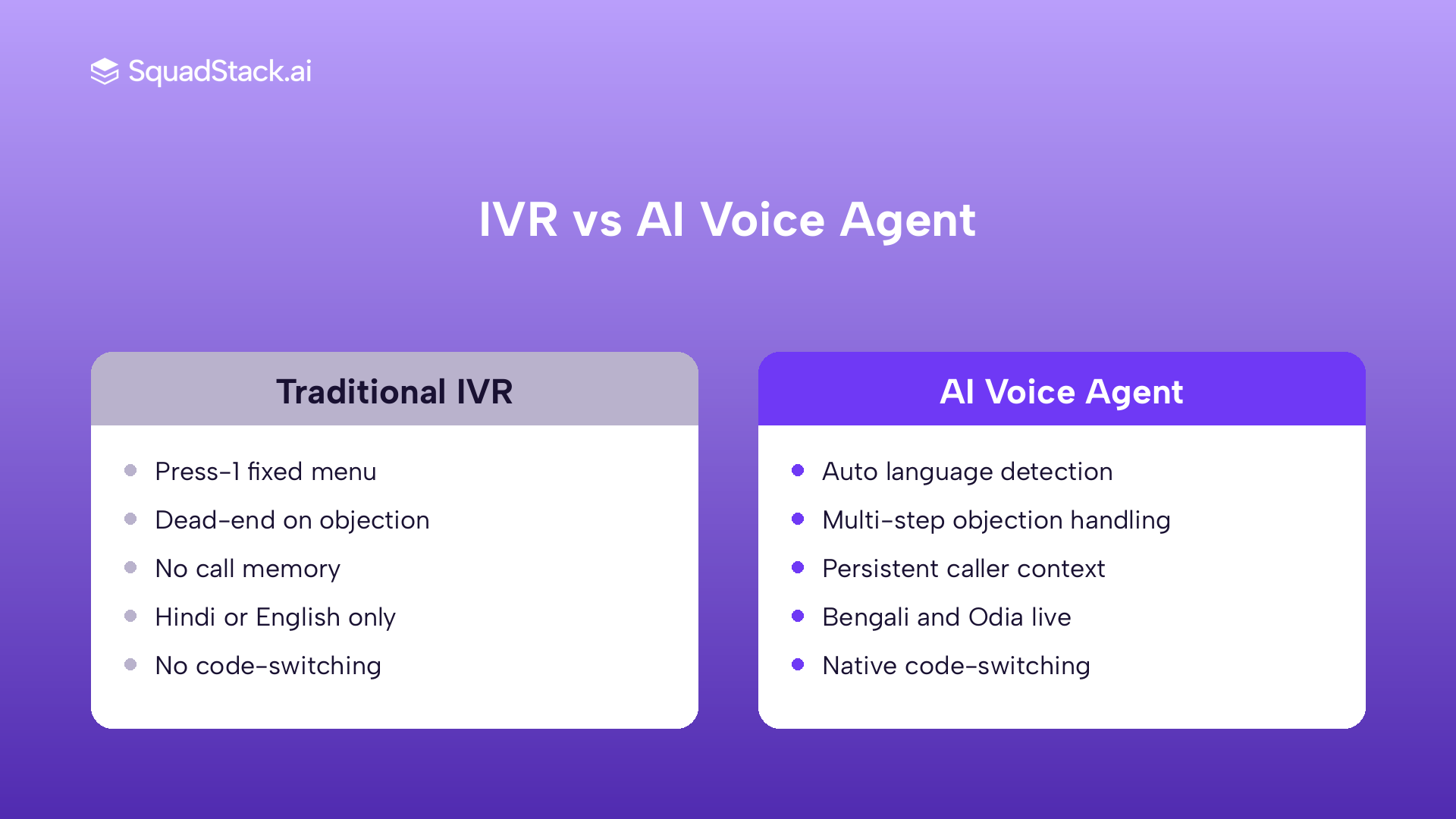
IVR systems were built for routing, not selling. In Eastern India markets, this gap is especially sharp.
| Dimension | Traditional IVR | AI Voice Agent |
|---|---|---|
| Language handling | Fixed language menus: press 1 for Hindi, press 2 for Bengali | Opens in Bengali or Odia automatically, follows code-switching mid-call |
| Script flexibility | Pre-recorded prompts, no deviation | Adapts response based on what the caller actually says |
| Objection response | No capability; caller either navigates or drops | Multi-step objection handling in the caller's own language |
| Cultural register | One generic tone for all callers | Polite forms of address configured per language and use case |
| Response speed | Menu wait times of several seconds | Median response latency of 0.8 seconds or less |
| Memory across calls | None, every call starts cold | Persistent memory carries prior context into the next call |
For a microfinance borrower in rural Odisha who has never used an IVR, a menu with numbered options is a dead end. An agent that speaks Odia, answers questions, and books a callback is a different experience entirely.
Go beyond the language feature list. Here is what actually determines whether a regional-language agent converts in Eastern India:
Dialogue engineering, not just TTS. Any platform can route text to a Bengali TTS engine. The question is whether someone has engineered the dialogue: the openers, polite forms, filler phrases, and objection responses. Poor dialogue in a regional language is instantly detectable. Callers hang up within seconds.
Code-switching at the word level. The agent must switch languages mid-sentence, not just at the start of a turn. This requires models trained on real code-switched Indian telephony audio, not public datasets.
Latency under 800ms. A pause of more than a second after a question breaks conversational rhythm and signals "machine." SquadStack's median response latency is 0.8 seconds or less across supported languages.
QA built for regional campaigns. A platform that applies a generic checklist to Bengali campaigns will miss the errors that matter. SquadStack's Eval System scores every call on Outcome, Sentiment, and Execution with campaign-specific quality parameters.
Compliance and data handling. All data should reside in India. SquadStack is ISO 27001, ISO 27701, SOC 2 Type II, DPDP, and TRAI compliant, with all models hosted in India. For regulated industries like microfinance and insurance, this is not optional.
For a broader platform comparison, see 10 best AI call center software solutions.
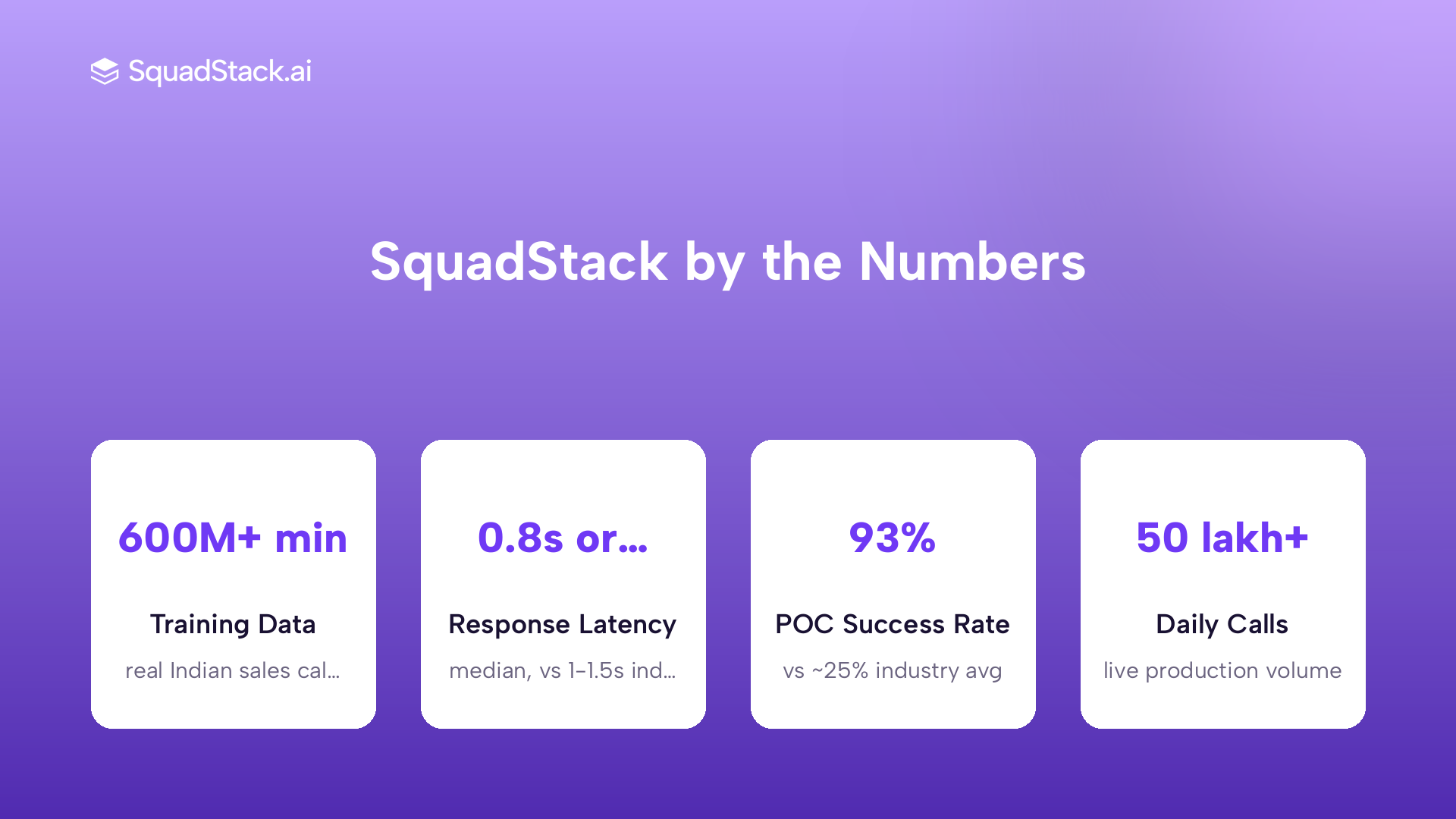
SquadStack's proprietary speech model, Arth, is trained on 600M+ minutes of real Indian sales conversations covering more than 85% of Indian pin codes. That corpus includes Bengali and Hinglish code-switching from actual outbound campaigns, not studio recordings. Arth v1 benchmarks within 0.9 WER points of the best commercial streaming STT on real Indian telesales audio and handles Indian entity recognition: names, amounts, pin codes, and product terms in Bengali and Odia as actually spoken on phone calls.
Bengali is one of nine live languages on the platform today: Hindi, English, Tamil, Telugu, Kannada, Marathi, Malayalam, Bengali, and Gujarati, all with native code-switching. Odia and other regional languages are available on demand.
The platform runs 50 lakh+ calls daily across 60+ large consumer brands, including AngelOne, Kotak Mahindra Bank, Eureka Forbes, IndiaMART, and PhonePe. The 93% POC success rate versus roughly 25% industry average means Eastern India pilots are far more likely to prove the metric and scale.
Every engagement includes a dedicated squad: an AI Agent Product Manager, a Forward Deployed Engineer, a Conversational AI Designer, and a QA specialist. The Conversational AI Designer handles the dialogue engineering specific to Bengali and Odia, the part most platforms skip.
For context on how SquadStack approaches AI voice agents more broadly, the pillar page covers the full platform.
Eastern India is a large, underserved market for voice AI. The brands that deploy Bengali and Odia agents now, and get the dialogue right, will have a real advantage before the market catches up.
If you are running outbound campaigns in West Bengal, Jharkhand, or Odisha and want to see what a properly engineered Bengali or Odia agent looks like on real leads, book a demo with SquadStack.
Which is the best AI voice agent for Bengali customer calls in India?
SquadStack is the strongest option for Bengali outbound sales calls in India. Bengali is one of nine live languages on the platform, with native code-switching, dialogue engineered from real call transcripts, and speech recognition trained on actual Indian telephony audio rather than public datasets.
Can an AI voice agent handle Odia-speaking customers automatically?
Yes. SquadStack can deploy Odia-language agents on demand, configured and tuned for Odia-speaking customers in Odisha and neighboring states. The agent handles polite forms of address, regional objection patterns, and code-switching between Odia and Hindi or English mid-call.
What is code-switching and why does it matter for Eastern India voice AI?
Code-switching is when a caller moves between two languages in a single sentence or turn, for example starting in Bengali and finishing a question in English. Eastern India callers do this constantly. An agent that cannot follow the switch will misunderstand the question or respond in the wrong language, and the call drops. SquadStack's models are trained on real code-switched Indian telephony audio, so switching mid-sentence is handled natively.
How does a Bengali AI voice agent compare to a human agent for BFSI sales?
A well-deployed Bengali AI voice agent delivers consistent tone, accurate entity capture, and reliable compliance adherence across every call. SquadStack's platform has achieved up to 90% lead connectivity versus a 40 to 60% industry norm, and up to 40% more conversions in specific case contexts. Human agents still handle complex escalations via warm transfer.
What are the compliance requirements for running AI voice calls in West Bengal and Odisha?
The same national rules apply: TRAI calling windows (9:30 AM to 8:30 PM), DND registry scrubbing, 140-series numbers for cold outreach, and AI disclosure where required. SquadStack enforces calling windows as hard system blocks, scrubs against the TRAI DND registry before each campaign, and handles all consent and opt-out mechanics within the dialogue. The platform is DPDP and TRAI compliant, with India data residency.
How long does it take to deploy a Bengali or Odia voice agent?
Most enterprise campaigns go live in two to three weeks. The setup covers script build from real call recordings, CRM integration, telephony configuration, and UAT before any leads are touched. Odia campaigns take slightly longer on first deployment as the dialogue is built from scratch, but the timeline is similar.
What industries in Eastern India benefit most from AI voice agents?
Microfinance and lending, insurance, edtech, and consumer goods distribution all have large outbound sales operations in West Bengal, Jharkhand, and Odisha. Each has specific trust barriers that a properly engineered Bengali or Odia agent addresses better than a Hindi or English agent on the same leads.
Does SquadStack's AI voice agent support dialects within Bengali?
The platform's dialogue engineering accounts for register differences, including more formal address forms used in rural West Bengal versus urban Kolkata. Specific dialect tuning is configured per campaign by the Conversational AI Designer, who builds from real call transcripts sourced from the target geography.
How is call quality measured on regional-language campaigns?
SquadStack's Eval System scores every call on three levels: Outcome (did the call hit its objective), Sentiment (how the conversation landed with the caller), and Execution (did the agent follow the script, capture entities accurately, and handle objections correctly). Quality parameters are set per campaign, not applied from a generic checklist.
Can the AI agent hand off a warm lead to a human in Eastern India campaigns?
Yes. High-intent leads can be transferred live to a human agent, with full conversation context passed at the point of transfer. The human receives a summary of what was discussed, confirmed entities like loan amount or product interest, and the reason for transfer, so the lead never has to repeat themselves. If no human is available, the agent books a callback.