.svg)





Top AI Outbound Calling Tools in India: Features Compared
October 23, 2026
|

13 min read

Discover how to evaluate AI voice agents in India across lead connectivity, code-switching, compliance, and persistent memory to choose the right vendor.
The best AI voice agents in India combine native-language handling, high lead connectivity, and outcome-based pricing built for Indian consumer sales. This guide covers every evaluation criterion that matters, a side-by-side comparison of approaches, and a clear framework for shortlisting the right vendor for your business.
Indian consumer sales is a high-volume, high-stakes contact sport. A lending company running outbound calls on 50,000 leads a day cannot afford a voice agent that sounds robotic in Hindi, drops calls in noisy 8kHz conditions, or starts every follow-up from scratch. The wrong choice here costs revenue, not just time.
This guide is written for RevOps leads, CX heads, and business owners evaluating AI voice agents for large-scale Indian consumer sales. It covers what to look for, how the main approaches compare, and where SquadStack fits.
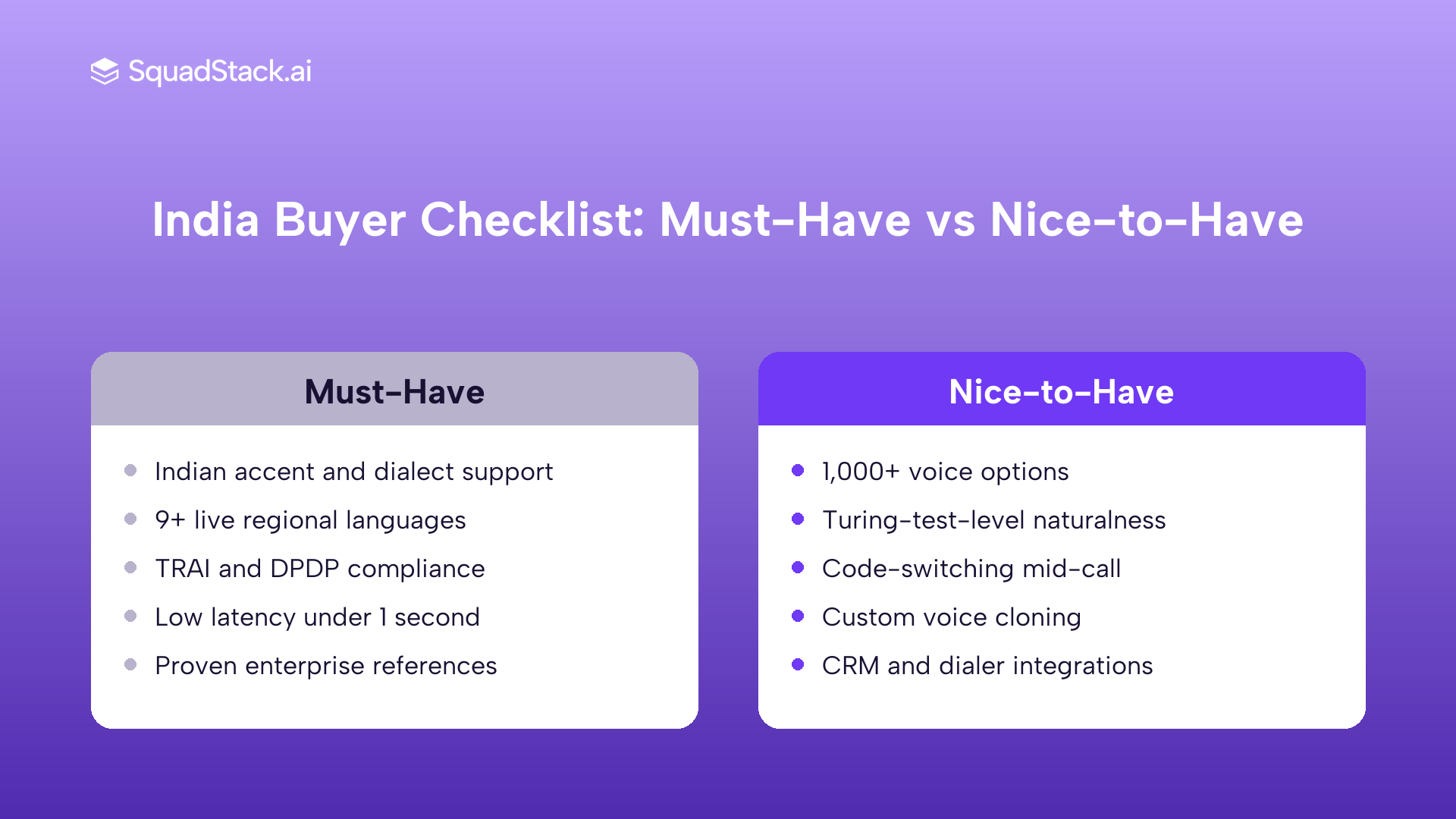
Most generic buyer guides list features. This one starts with the criteria that actually decide outcomes in the Indian market.
1. Native language and code-switching quality. Every vendor lists a language. Almost none sounds genuinely native in it. The test is not whether the agent can speak Hindi, it is whether it sounds like a real Hindi-speaking sales agent, including Hinglish mid-sentence. Ask to hear a live outbound call, recorded in production, on a real 8kHz telephone line. Naturalness drives whether a caller stays on the line.
2. Lead connectivity. What share of your list actually gets reached, over a full attempt cadence? The industry norm runs 40 to 60%. Demand a lead-level figure, not a per-attempt connect rate. Spam number detection and intelligent retry timing both matter here.
3. TRAI and DND compliance. Calling outside the 9:30 AM to 8:30 PM window, or reaching a DND-registered number, creates regulatory exposure. Hard-enforce these at the platform level, not by convention.
4. Human handoff quality. Some calls must reach a human. A warm transfer that gives the receiving agent full context (what was said, what was confirmed, what the lead's intent is) converts better than a cold drop. Check whether context actually travels with the transfer.
5. Persistent memory across calls. A lead who confirmed their PAN and loan amount on Monday should not be asked again on Wednesday. If the platform starts every call cold, you are burning trust and wasting attempts.
6. Pricing model. Outcome-based or per-conversation pricing aligns vendor incentives with yours. Per-minute pricing incentivizes long calls, not conversions.
7. Analytics and QA. Can you see why calls failed, not just that they did? A structured QA framework that scores Outcome, Sentiment, and Execution separately gives you actionable signal, not just a call recording.
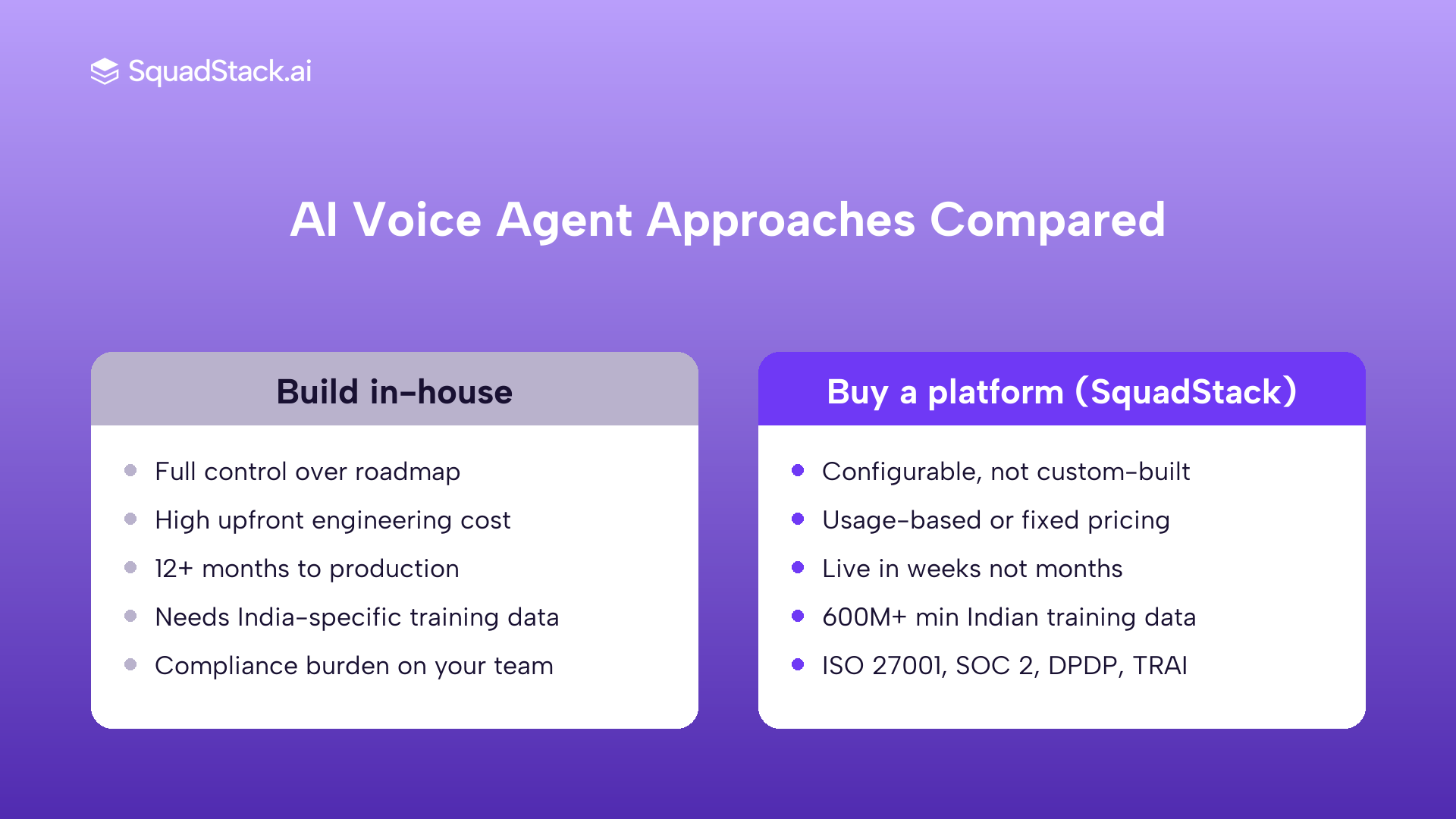
The market for AI voice agents in India breaks into four broad approaches. The table below is honest about the tradeoffs.
| Criterion | Full-stack managed platform | Self-serve voice AI builder | In-house build | Generic cloud CCaaS |
|---|---|---|---|---|
| Indian language quality | Native, trained on Indian telephony data | Variable; usually third-party models on public datasets | High cost to build; most teams never get there | Passable English; weak on vernacular |
| Lead connectivity | Up to 90% with adaptive retry and spam rotation | Depends on telephony integration | Depends on team investment | Moderate; no adaptive logic |
| TRAI/DND compliance | Hard-enforced at platform level | Buyer's responsibility | Buyer's responsibility | Partial |
| Warm human handoff | Context passed; callback fallback | Usually cold drop | Custom build required | Available but often cold |
| Persistent memory | Cross-call, cross-channel | Per-call only, typically | Custom build required | Rare |
| QA and observability | Dual-layer AI plus human audit | Limited or none | Custom | Dashboard only |
| Time to live | 2 to 3 weeks | Hours to days | 6 to 12+ months | Weeks to months |
| Pricing model | Outcome-based | Per minute or per agent | Capex plus ongoing | Per seat or per minute |
| Best suited for | High-volume enterprise sales (BFSI, e-commerce, education) | Developers, low-volume, experimentation | Large tech teams with AI/ML depth | Inbound support at scale |
A few honest notes on in-house builds: the speech model is roughly 10% of the problem. The rest is lead prioritization, telephony, QA, compliance, and a continuous optimization loop. Most consumer brands underestimate this and surface the cost six to twelve months in.
Self-serve builders work well for experimentation and low-volume flows. They hand responsibility for compliance, QA, and language quality back to the buyer. At enterprise scale in Indian sales, that responsibility is heavy.
SquadStack is built for one thing: high-volume outbound consumer sales in India. If your business runs lakhs of leads a month across BFSI, e-commerce, education, or logistics, and you need a platform that owns outcomes rather than just delivering calls, this is where SquadStack is at its strongest.
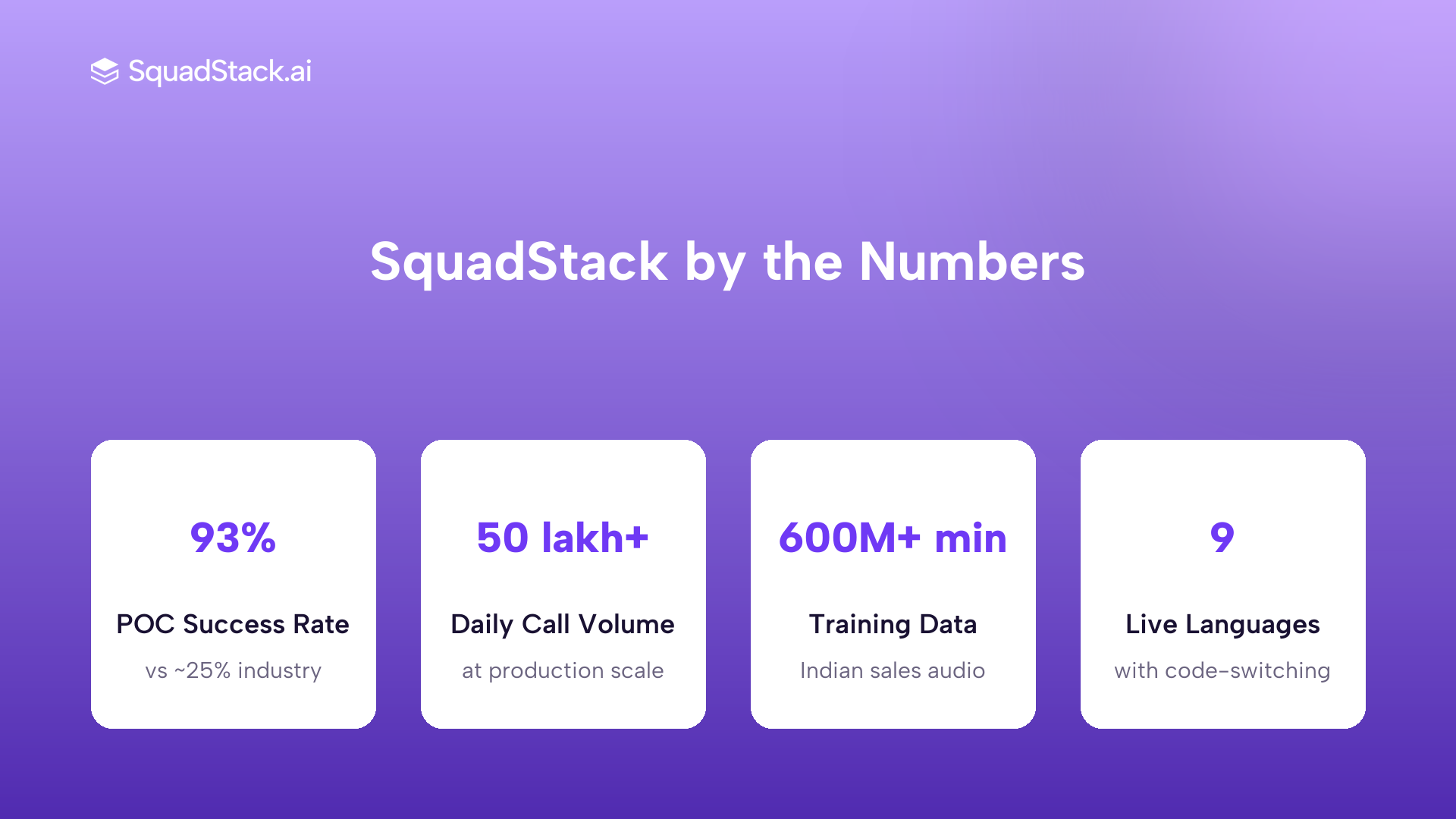
The proof starts with training data. Arth, SquadStack's proprietary speech recognition model, is trained on 600M+ minutes of real Indian contact center conversations, including code-switched speech like Hinglish and Taminglish, on noisy 8kHz telephone lines. That is not a public dataset scraped from YouTube. It is full-duplex, outcome-labelled audio from real sales calls across 85%+ of Indian pin codes. The result is a Semantic WER of 11.9% on real Indian telesales audio, within 0.9 points of the best commercial streaming STT available today, and ahead of widely used alternatives on number-category errors.
Naturalness is not just a feature claim. In a blind test at Global Fintech Fest 2025, 1,273 of 1,563 attendees (81%) identified SquadStack's AI agents as human when asked to pick the human caller from a mixed set of recordings. The platform's Abruptly Disconnected Rate, the share of calls dropped within 10 seconds of the caller detecting AI, sits around 10%, inside the human agent range.
The platform runs 50 lakh+ calls daily across 60+ large consumer brands. Named customers include Kotak Mahindra Bank, AngelOne, PhonePe, IndiaMART, and Eureka Forbes. The IndiaMART deployment achieved 20% higher conversions and 15% lower CAC on buyer-seller matching at 1 lakh+ AI calls daily. See the IndiaMART case study.
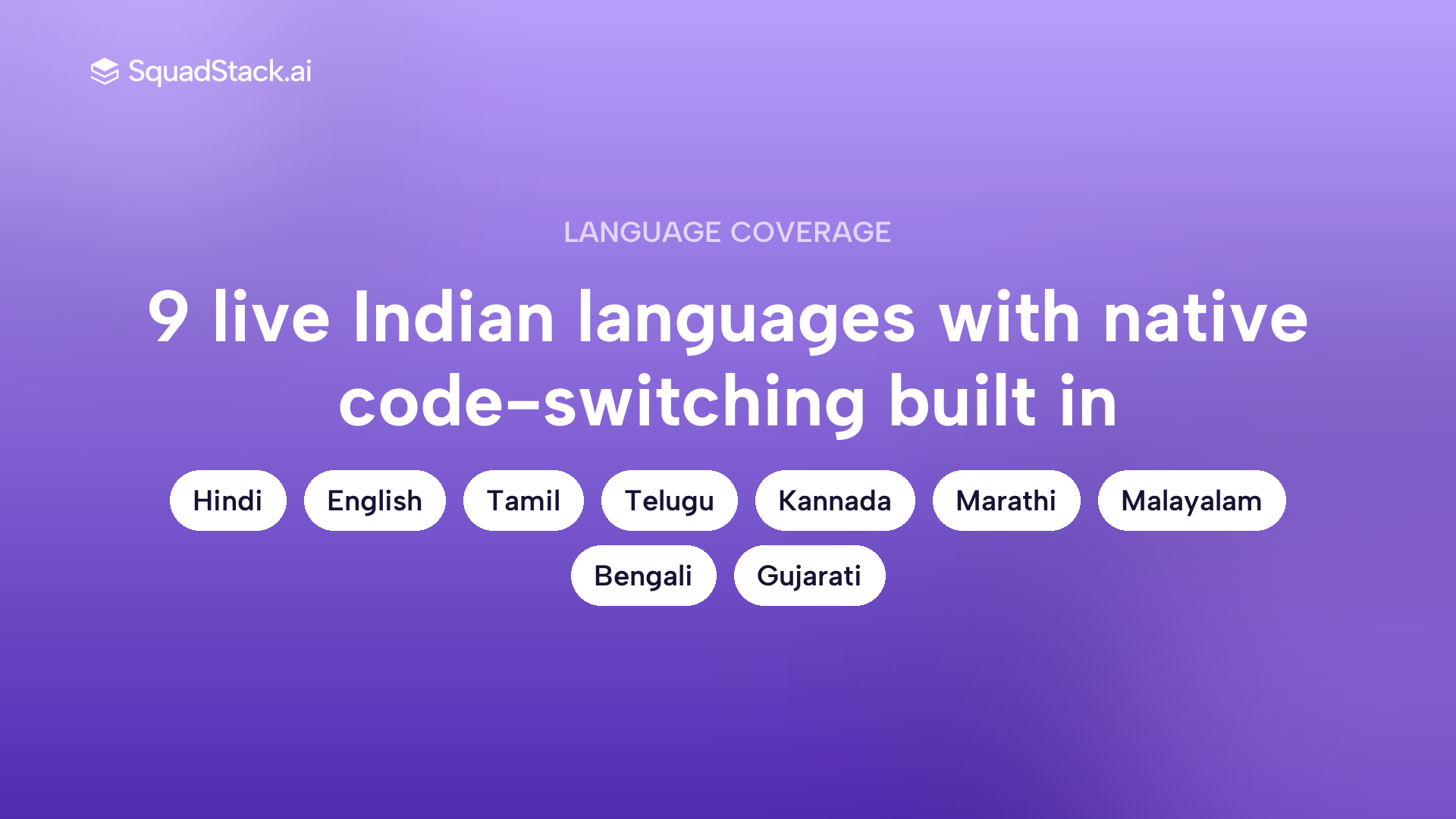
SquadStack supports Hindi, English, Tamil, Telugu, Kannada, Marathi, Malayalam, Bengali, and Gujarati as live languages with native code-switching, and additional languages (more regional languages are available on demand.
The platform is ISO 27001, ISO 27701, SOC 2 Type II, DPDP, and TRAI compliant, with all models hosted in India.
SquadStack is not the right fit for every buyer. If you need a self-serve tool for a small team to experiment quickly, the managed-service model may feel heavyweight. If your call volume is low or your use case is simple inbound support, there are lighter options. But for enterprises that need to convert large lead pools in multiple Indian languages, with compliance built in and outcomes guaranteed, SquadStack's 93% POC success rate against an industry average of roughly 25% is a real signal.
For further reading on how the platform fits specific sales workflows, see AI voice agents for sales automation and AI agents for sales operations. If you are evaluating a broader set of tools, the best AI call center software comparison and best AI tools for contact centers cover adjacent options.
For Indian startups specifically, voice AI agents for Indian startups and best voicebot platforms for business in India are worth reviewing alongside this guide.
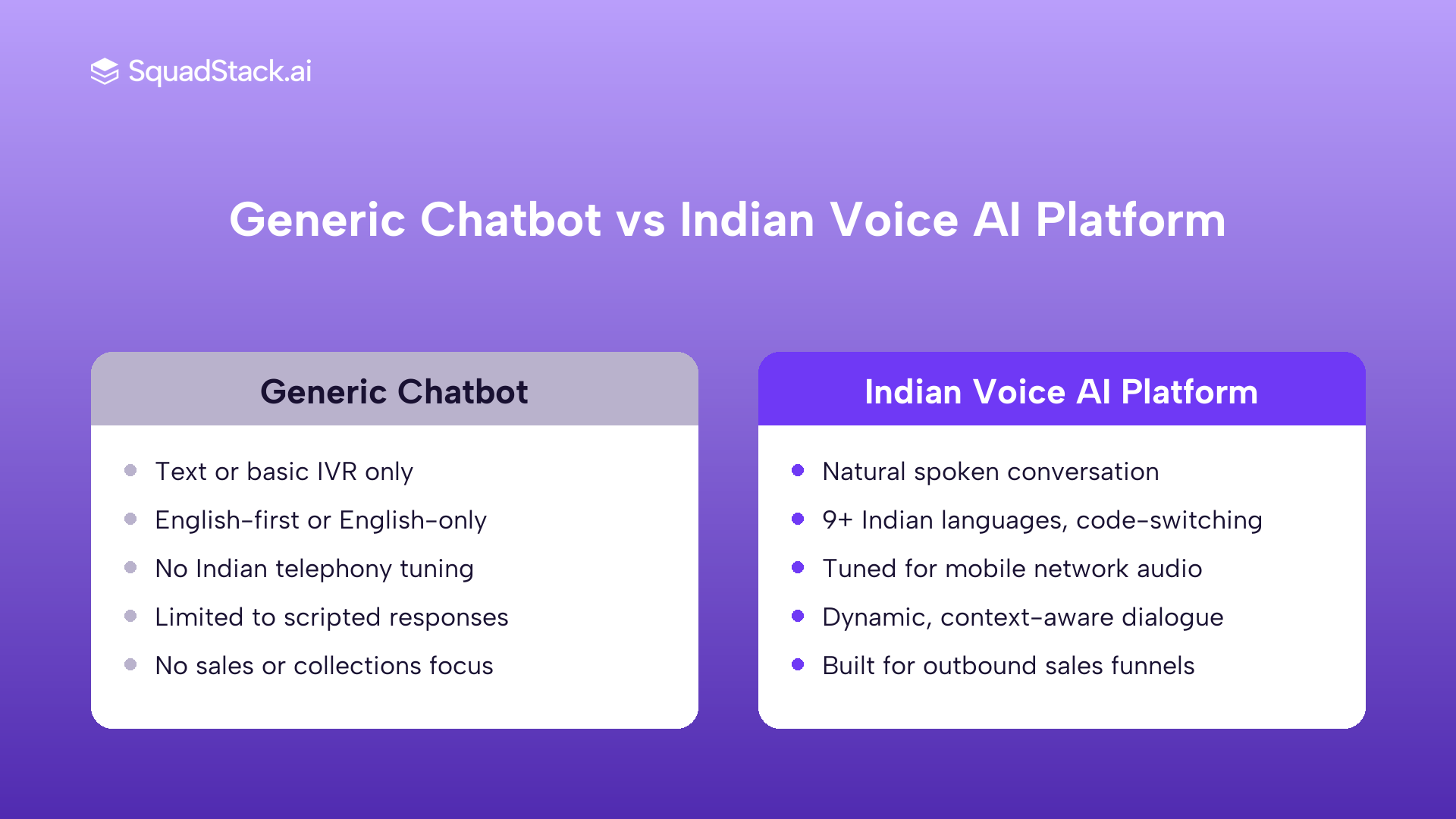
Start with three questions to ask any vendor: Can I hear a live production call in my target language? What is your lead-level connectivity rate over a full campaign? What happens to context when you transfer to a human agent?
The answers will tell you more than any feature comparison table.
Schedule a demo with SquadStack to see a live outbound call in your language and use case before committing to a pilot.
Which is the best AI voice agent for outbound sales in India?
The best AI voice agents in India for outbound sales combine high lead connectivity, native-language quality in Hindi and regional languages, and outcome-based pricing. SquadStack is purpose-built for this use case, with 50 lakh+ calls daily across 60+ enterprise brands, and a 93% POC success rate versus an industry average of roughly 25%.
What is a good lead connectivity rate for AI voice agents in India?
The industry norm for lead connectivity runs 40 to 60%. Platforms with adaptive retry logic, spam number rotation, and best-time-to-call modelling can reach up to 90% at the lead level over a full attempt cadence. Always ask for lead-level figures, not per-attempt connect rates.
Can AI voice agents handle Hindi and regional Indian languages properly?
Yes, but quality varies significantly. The key is whether the platform trained its speech models on real Indian telephony audio, including code-switched speech like Hinglish, rather than public datasets. Ask to hear a production call in your target language before committing to a pilot.
How long does it take to go live with an AI voice agent in India?
A full enterprise deployment with custom scripts, integrations, and compliance setup typically takes two to three weeks. Simple, contained use cases can produce a testable prototype faster, but the main variable is usually client-side dependencies like data feeds, telephony approvals, and compliance sign-off.
Are free AI calling agents available in India?
Some self-serve voice AI builders offer free tiers for low-volume experimentation. At enterprise scale, free options generally do not include managed compliance, QA, or outcome optimization. The total cost of a free tool includes the engineering, compliance, and operational overhead the buyer takes on.
What compliance rules apply to AI voice agents making calls in India?
TRAI regulations restrict outbound calls to the 9:30 AM to 8:30 PM window. DND-registered numbers must be scrubbed from lead lists before dialing. Cold calls must use 140-series numbers. DPDP requires data residency and processing within India. Platforms should hard-enforce these at the system level, not rely on manual controls.
How does a warm transfer work in an AI voice agent?
In a well-designed warm transfer, the AI agent hands off a high-intent caller to a human agent and passes full context: what was discussed, what the caller confirmed, and what their intent is. This is different from a cold transfer, where the human starts from scratch. If no human is available, the agent books a callback instead.
What is the difference between a voicebot and a Voice AI agent?
A voicebot typically follows a fixed script or menu tree and cannot handle open-ended conversation. A Voice AI agent uses a trained language model to hold dynamic, multi-turn conversations, handle objections, switch languages mid-call, and take actions like sending a WhatsApp link during the call. The distinction matters for sales use cases, where conversations rarely follow a fixed path. See voicebots vs voice AI agents for a detailed comparison.
How do AI voice agents handle calls where the customer speaks in a mix of Hindi and English?
Native code-switching is trained into the speech and language models, not added as a translation layer. Platforms trained on real Hinglish conversations handle mid-sentence language switches naturally. Platforms using generic multilingual models often struggle, producing robotic or mismatched responses when the caller shifts language unexpectedly.
What should I look for in a POC before scaling an AI voice agent deployment?
Align on a specific success metric before the pilot starts, typically lead connectivity or qualified pipeline. Run the pilot on real production leads, not a curated test set. Review call recordings in your target language to assess naturalness. And compare against a stable human baseline on the same lead source, so you know the delta is real.

