Voice AI Onboarding Failures: What Goes Wrong and Why
November 2, 2026
|

13 min read

A guide to choosing between India's leading voice AI platforms by deployment model, language naturalness, and outcome accountability.
TL;DR: This is a practical look at how the main Indian voice AI companies compare for outbound sales and contact-center use cases. Bolna, Gnani, Nurix, and Rezo each take a distinct approach: developer platform, sovereign AI stack, enterprise agent builder, and CX automation respectively. For Indian consumer brands running high-volume outbound sales, the differences in language depth, deployment model, and outcome accountability matter more than headline feature lists.
India's voice AI market has grown fast enough that a buying team can easily waste months evaluating platforms that look similar on a features spreadsheet but behave very differently in production. This post maps the four names that come up most in Indian enterprise shortlists: Bolna, Gnani, Nurix, and Rezo. It also includes SquadStack, because any honest comparison for outbound consumer sales should include the platform with the largest volume of live Indian sales calls.
Each platform has a real use case it serves well. The question is whether that use case matches yours.
For a deeper look at what separates the best AI voice agents from each other, or to compare top AI call center software, those resources cover the broader market.
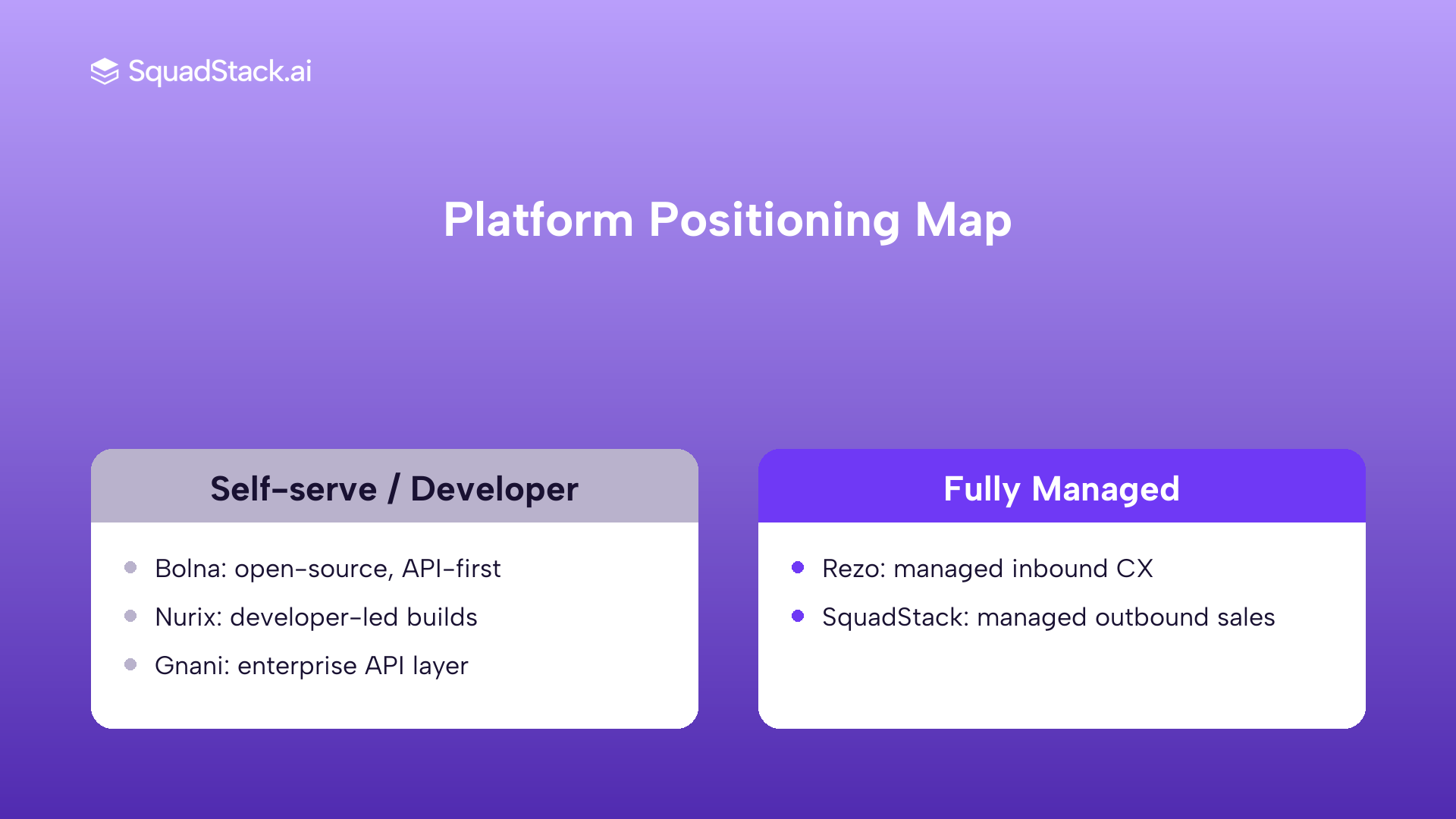
Indian voice AI companies build software that lets businesses have automated spoken conversations with customers over phone, WhatsApp, or in-app channels. The category splits into three broad types:
Infrastructure/platform: The vendor gives developers APIs and tooling to build their own agents. Speed-to-prototype is high; production quality depends almost entirely on the buyer's engineering.
Enterprise agent builder: The vendor provides a configurable agent platform. The buyer still owns tuning, QA, and optimization.
Fully managed outcome service: The vendor builds, runs, and continuously optimizes the agent on behalf of the client. The buyer defines the business goal; the vendor is accountable for hitting it.
The four players discussed here sit in different parts of this map, which is why a flat feature comparison misses the point.
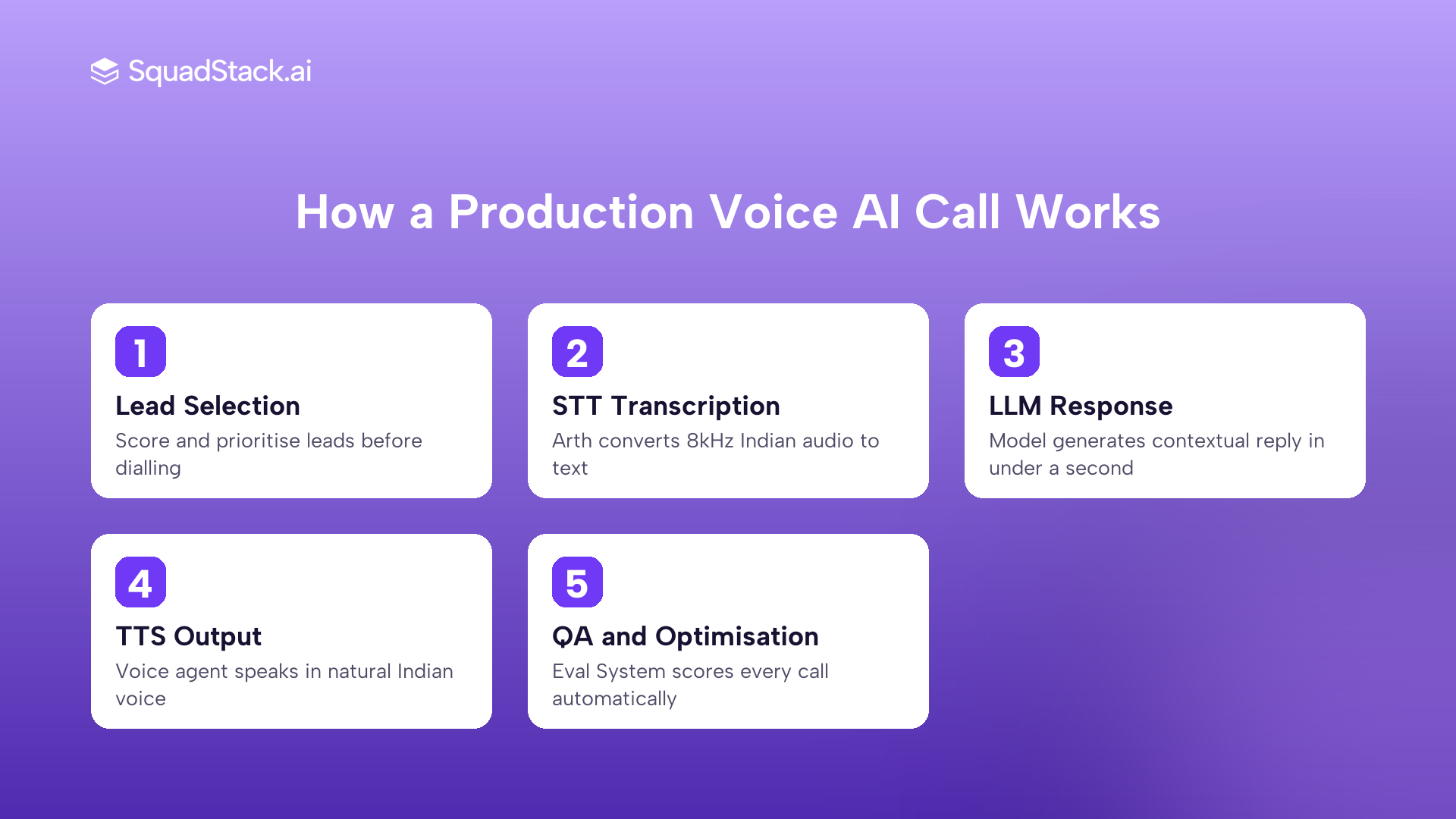
Understanding this matters because each layer is where platforms diverge.
1. Lead selection: The system decides which lead to call, when, and on which channel. 2. Speech recognition (STT): The caller speaks; the model transcribes speech to text. On Indian telephony, this means handling 8kHz audio, background noise, code-switching, and regional accents. 3. Language model (LLM): The transcript is fed to an LLM, which decides the next response based on the script, the lead's history, and the conversation so far. 4. Text to speech (TTS): The response is converted back to voice and played to the caller. 5. QA and optimization: After the call, the system audits outcome, sentiment, and execution to improve future calls.
Most platforms handle steps 2 to 4 adequately in clean demo conditions. Gaps appear at step 1 (lead prioritization), step 2 under real Indian telephony noise, and step 5 (whether anyone closes the improvement loop).
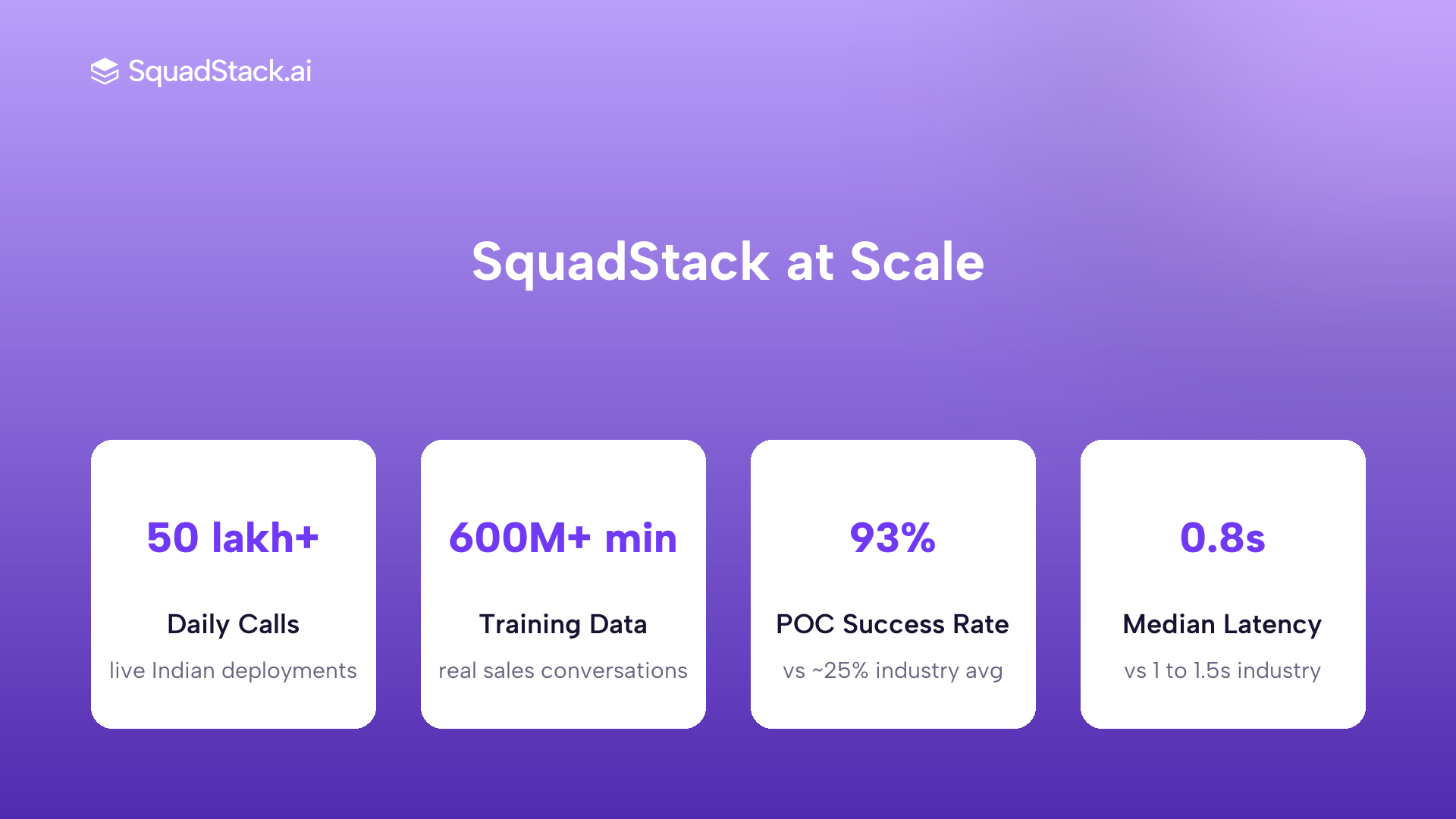
Bolna and Nurix are primarily developer-oriented platforms. Gnani has repositioned as a broader AI stack play. Rezo focuses on CX automation including service and support. SquadStack is the only platform in this list built and measured exclusively on Indian consumer sales outcomes at scale.
| Dimension | Bolna | Gnani | Nurix | Rezo | SquadStack |
|---|---|---|---|---|---|
| Primary model | Developer platform / infrastructure | Enterprise AI + sovereign stack | Enterprise agent builder | CX automation (support, feedback) | Fully managed sales outcome service |
| Best-fit use case | Custom agent builds, prototyping | Large enterprise, government, diverse AI use cases | Enterprise contact-center deployments | Inbound support, service bookings, feedback | High-volume outbound consumer sales, collections, qualification |
| Indian language depth | Listed multilingual coverage; live performance on noisy calls not independently benchmarked | Regional language support, including government/enterprise contexts | Enterprise-grade; depth on low-bandwidth Indian audio not publicly benchmarked | Indian languages supported; service/support-oriented | 9 live languages (Hindi, English, Tamil, Telugu, Kannada, Marathi, Malayalam, Bengali, Gujarati) with native code-switching; more on demand; trained on 600M+ minutes of real Indian calls |
| Deployment model | Self-serve/developer | Managed + on-prem options | Managed/enterprise | Managed/SaaS | Fully managed; go-live in roughly 2 weeks |
| Outcome accountability | Platform access; outcomes owned by buyer | Varies by engagement | Varies by engagement | Varies by engagement | Business metrics aligned at solutioning; 93% POC success rate |
| Enterprise customer proof | Thin public logos | Named public deployments; government references | Public case studies recently reduced | Service/support customers; auto-dealer push visible | 60+ large consumer brands including AngelOne, Kotak Mahindra Bank, PhonePe, Eureka Forbes, IndiaMART |
| Compliance | Not publicly detailed | On-prem/sovereign options; India-focused | Enterprise compliance; specifics vary | CX-platform compliance | ISO 27001, ISO 27701, SOC 2 Type II, DPDP, TRAI |
| A/B testing and optimization loop | Not built in | Not prominently featured | Not prominently featured | Not prominently featured | Native; voice, prompt, cadence, channel all testable live |
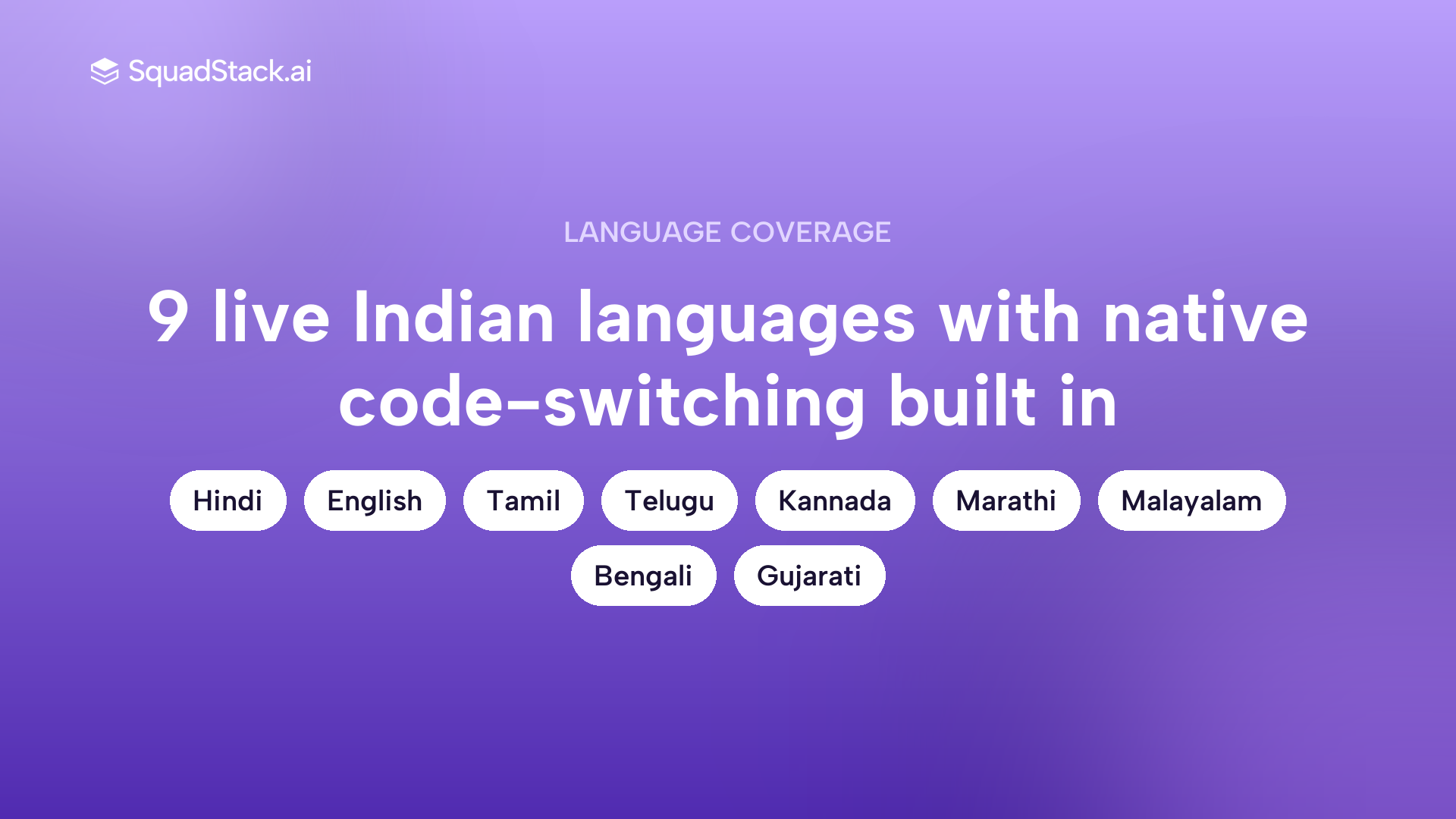
Almost every Indian voice AI platform claims multilingual support. The more useful question is what happens on a real 8kHz telephony line with a caller switching between Hindi and English mid-sentence, or asking for a loan amount in a regional dialect with background traffic noise.
Bolna emphasizes India-first architecture and lists broad language coverage. How that holds up on live outbound sales calls at high volume is not publicly benchmarked against a neutral test set.
Gnani has credible regional-language work, particularly in enterprise and government contexts, but public claims skew toward breadth of AI capability rather than specific telephony accuracy data on consumer sales audio.
Nurix and Rezo both claim enterprise-grade language support. Rezo's focus on automotive and service-booking scenarios means the language and conversation patterns differ from high-pressure lending or brokerage sales calls.
SquadStack's speech model, Arth, is trained on 600M+ minutes of real Indian contact-center audio: noisy, code-switched, live 8kHz telephony across Hindi, Hinglish, Tamil, Telugu, Kannada, and more. On SquadStack's own benchmark of real Indian telesales audio, Arth v1 reaches a semantic word error rate of 11.9%, within 0.9 points of the best commercial streaming STT and ahead of both Deepgram and Sarvam on the same test set.
This is the most consequential difference and the least visible in feature comparisons.
Bolna's platform model means a developer or technical team builds the agent. For a startup wanting a quick prototype, that works. For an enterprise sales team that needs production-quality outbound campaigns live in weeks, it usually does not.
Gnani offers managed and on-prem options, which suits large enterprises or government buyers with data residency requirements. The broader AI stack ambition means voice-for-sales is one of many product lines.
Nurix is positioned as enterprise-grade, but their engagement model for ongoing optimization is not prominent in public materials.
Rezo is clearly oriented toward service-side automation: CX support, feedback collection, and automotive service bookings. That makes them a strong fit for inbound support but a less obvious choice for outbound loan sales or demat account opening.
SquadStack ships every engagement with a dedicated squad: an AI Agent Product Manager, a Forward Deployed Engineer, a Conversational AI Designer, and a QA specialist. The client does not need to tune prompts, monitor STT quality, or manage retry logic. That matters when a misconfigured retry cadence or a drifting script eats real revenue across 50 lakh+ daily calls.
Most platforms define success as the agent going live. Actual business outcomes, connectivity rates, conversion lift, and cost per acquisition are the client's problem to track.
SquadStack aligns a specific success metric at solutioning before any build starts, then gates the move from pilot to scale on proving it. The 93% POC success rate against a roughly 25% industry average reflects that accountability structure.
The Eval System scores every call on three levels: Outcome (did the call achieve its objective?), Sentiment (how did the conversation land?), and Execution (did the agent run the flow correctly?). That audit runs on every call, with both AI and human reviewers, and feeds directly into the optimization loop.
See how this plays out in practice: IndiaMART runs more than 1 lakh AI calls daily through SquadStack, with 20% higher conversions and 15% lower CAC compared to prior benchmarks.
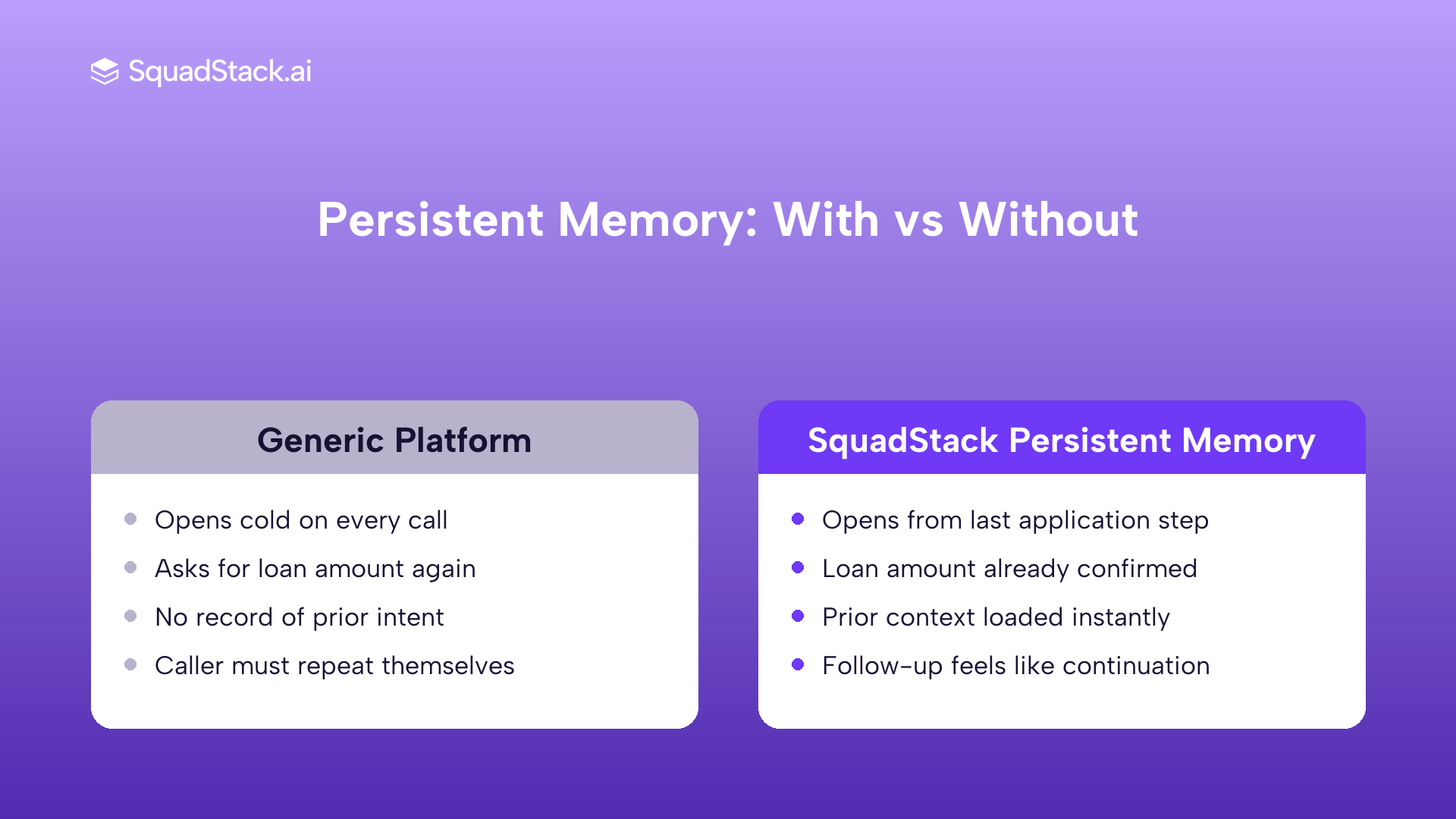
Choose Bolna if you have a strong engineering team and want to build a custom voice agent from the infrastructure up. Good for prototyping and developer-led products.
Choose Gnani if you are a large enterprise or government body that needs sovereign AI, on-prem deployment, or a broader conversational AI platform beyond outbound sales.
Choose Nurix if your primary need is enterprise contact-center automation and you have internal technical resources to manage and tune the deployment.
Choose Rezo if your primary use case is inbound customer support, service-booking automation, or automotive after-sales.
Choose SquadStack if your goal is measurable revenue from outbound consumer sales at Indian enterprise scale, with managed deployment, proprietary Indian-language speech models, and a team accountable for the outcome.
SquadStack's edge is not a feature list. It is the only platform in this comparison whose speech model is trained on real Indian sales conversations, whose agents have passed a Turing test on Indian telephony audio (81% of 1,563 attendees at Global Fintech Fest 2025 could not distinguish the AI from a human agent), and whose optimization loop runs A/B tests across voice, prompt, cadence, and channel simultaneously on live campaigns.
For BFSI specifically: Kotak Mahindra Bank uses SquadStack for personal loan sales, AngelOne for demat account opening and fraud detection, and PhonePe for merchant and personal loan sales and collections. All are production deployments, not pilots.
Full head-to-head pages: SquadStack vs Gnani, SquadStack vs Nurix, and SquadStack vs Bolna.
For outbound sales at scale, see how SquadStack drives sales automation or the voice AI agent for Indian languages page.
Ready to see the platform on your own leads? Schedule a demo.
Which is the best Indian voice AI company for outbound sales?
For high-volume outbound consumer sales in India, SquadStack is the only platform in this comparison with a fully managed service model, proprietary Indian-telephony speech models, and published outcome accountability across BFSI, e-commerce, and lending use cases. The 93% POC success rate and 50 lakh+ daily AI calls reflect production scale, not pilot conditions.
What is the difference between Bolna and SquadStack?
Bolna is primarily a developer platform: it gives technical teams the building blocks to construct voice agents. SquadStack is a fully managed outcome service: it builds, runs, QAs, and continuously optimizes the agent on the client's behalf, with a dedicated squad and a business metric agreed at solutioning. The right choice depends on whether you have engineering bandwidth to own the agent or need production-quality results without that overhead.
Is Gnani AI suitable for BFSI outbound sales in India?
Gnani has credible language AI and enterprise credentials, and has positioned toward a broader sovereign AI stack including government use cases. For BFSI outbound sales specifically (personal loans, demat opening, collections), SquadStack has more named production customers in that vertical and a deeper training corpus on Indian telephony sales audio.
How does Nurix AI compare to SquadStack for enterprise contact centers?
Nurix is enterprise-focused but has recently reduced the number of public case studies visible on its website. SquadStack maintains 60+ named enterprise customers with verified use-case pairings and published case study metrics. Both serve enterprise, but SquadStack's optimization loop (A/B testing, Lift's self-improvement layer, dual-layer QA) is more explicitly outcome-driven.
What should I look for when comparing Indian voice AI companies?
The four dimensions that matter most for outbound sales are: language accuracy on real Indian telephony audio (not studio demos), deployment model (who owns tuning and optimization), outcome accountability (how success is defined and measured), and compliance (TRAI, DPDP, ISO certifications). A feature comparison misses these entirely.
Can Indian voice AI handle Hinglish and regional code-switching in production?
Most platforms list it as a capability. SquadStack's agents handle it natively because the underlying speech model, Arth, was trained on 600M+ minutes of real code-switched Indian calls, including Hinglish and Taminglish. At Global Fintech Fest 2025, 81% of 1,563 attendees could not tell SquadStack's agents from human agents in blind listening tests.
How long does it take to go live with a voice AI agent in India?
With SquadStack, most enterprise campaigns go live in roughly two weeks. That build period includes training the agent on the client's real call recordings, knowledge base, and FAQs, plus integrations, testing, and UAT. Simple campaigns can stand up faster; the longer pole is usually client-side dependencies like telephony approvals and compliance sign-off.
What is the typical cost model for Indian voice AI platforms?
Pricing models vary: per-minute, per-outcome, or platform license. The important figure is not the per-minute rate in isolation but the total cost per qualified outcome, which depends on connectivity rate, conversion rate, and how much internal engineering the model requires. SquadStack case studies show up to 2 to 3x lower customer acquisition cost versus human agent benchmarks in specific campaigns, which reframes the per-minute cost question.
Does Rezo AI work for outbound sales in India?
Rezo's public positioning and recent content focus is clearly toward inbound CX, customer support, and automotive service bookings. For outbound consumer sales at scale (loans, brokerage, e-commerce), SquadStack's use-case depth and production track record is more relevant.
Where can I see a comparison of the top voice AI companies globally?
For a broader market view, the top voice AI companies page covers the global category. For India-specific contact-center software, the best AI call center software in India list is a useful reference alongside this post.