.svg)





Hyper-Personalised Outbound Call Scripts Using Customer Lifecycle Data
October 6, 2026
|

13 min read
An AI voice agent insurance cross-sell after policy issuance places personalised calls to new policyholders within 7 to 30 days of issuance, introducing...
An AI voice agent insurance cross-sell after policy issuance places personalised calls to new policyholders within 7 to 30 days of issuance, introducing riders, top-ups, or complementary covers at the moment when customer intent is highest. It runs without adding headcount, stays inside IRDAI compliance boundaries, and uses policy metadata to make every conversation relevant from the first sentence.
Most insurers celebrate policy issuance and then go quiet for eleven months. The renewal reminder drops on schedule, the upsell never comes, and lifetime value stays flat. Yet the new policyholder is, at that moment, the warmest prospect in the entire book. They have just trusted the brand with a financial decision. Their risk appetite is established. Their family situation and coverage gaps are on record in the proposal form.
The cross-sell window is not theoretical. A customer who adds a rider or complementary cover within 30 days of the base policy is far more likely to renew, less likely to lapse, and meaningfully more valuable over a three-to-five-year horizon. The challenge has always been execution at scale without burning the relationship through irrelevant calls or consuming licensed-agent time on routine outreach.
That is exactly the job an AI voice agent is built for.
A post-issuance cross-sell AI voice agent is an automated outbound calling system that contacts new policyholders in the days after their base policy is issued, introduces relevant add-on products, and routes high-intent conversations to a certified human agent for closure.
It is not a renewal reminder. It is not a welcome call. It fills a gap most insurance operations do not even have a team for.
The agent draws on policy metadata captured during proposal: sum assured, nominee relationship, customer age, city, existing covers, and product category purchased. The conversation starts from context rather than a cold script.
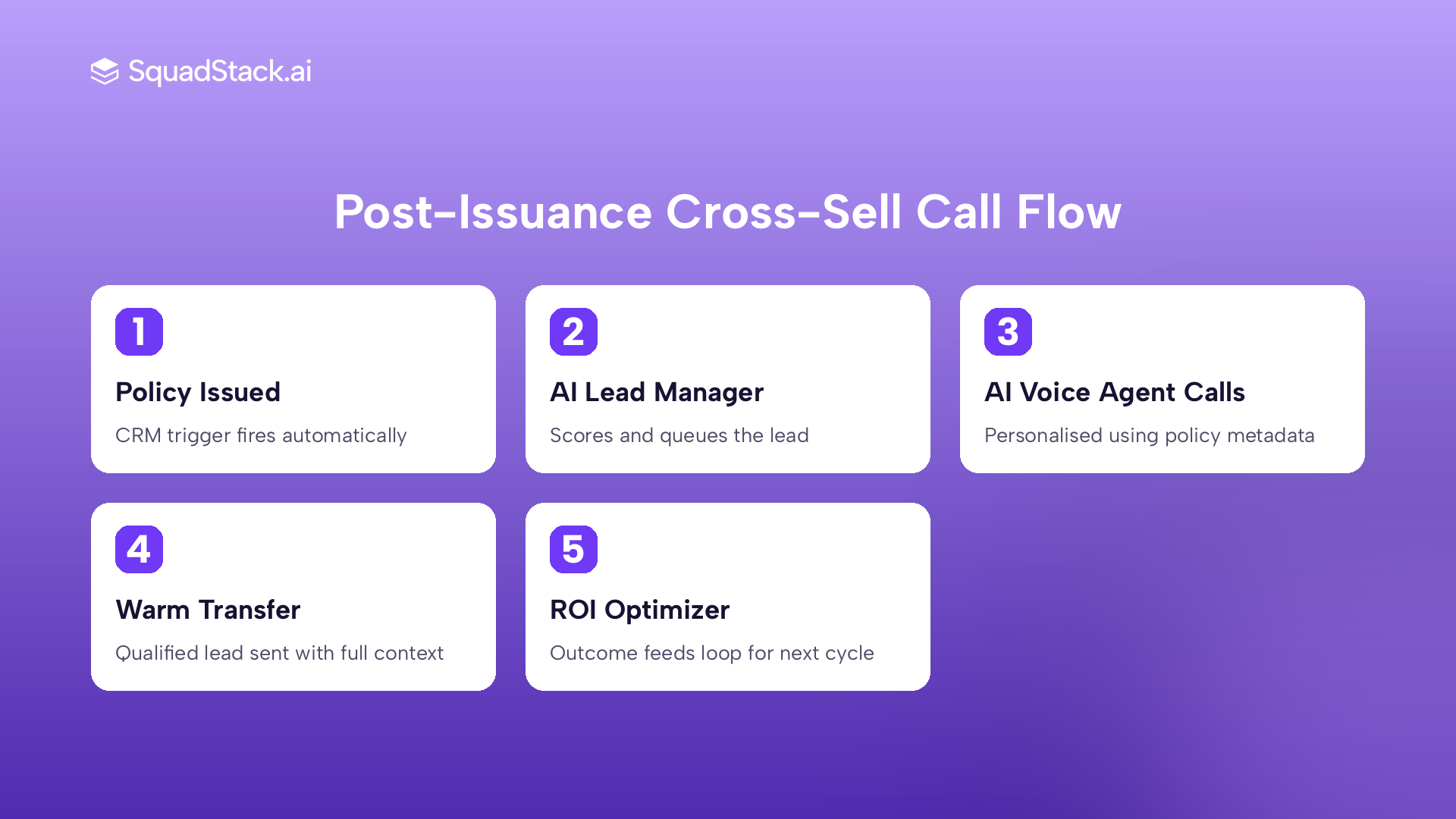
The call flow has five distinct steps, each driven by the platform rather than a human scheduler.
Step 1: Trigger and timing. When a policy status updates to "issued" in the insurer's CRM, the AI Lead Manager ingests the record, scores the lead for cross-sell propensity, and queues the call for the optimal window, typically within 7 to 30 days of issuance, during the compliant calling window of 9:30 AM to 8:30 PM.
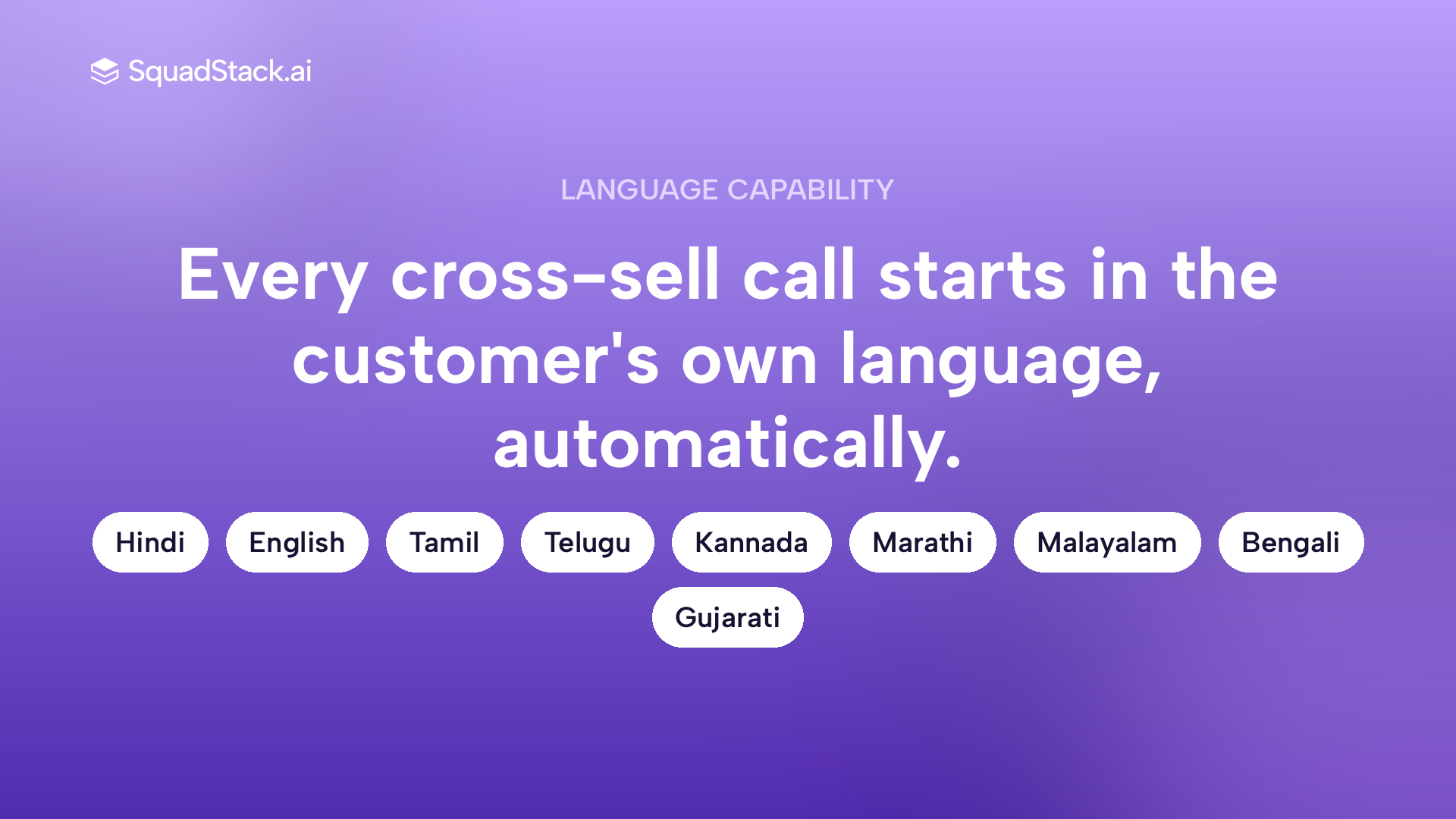
Step 2: Personalised opening. The voice agent opens with a reference to the specific policy, not a generic introduction. For a 35-year-old customer in Pune who just bought a term plan, the agent confirms the policy and moves immediately to the accidental death rider conversation. The agent speaks in the customer's preferred language, chosen from 9 live languages including Hindi, Tamil, Marathi, and Gujarati, with natural code-switching mid-sentence.
Step 3: Needs exploration and product introduction. The agent asks a few short questions to surface relevant gaps: existing health cover, dependents, liabilities. The response drives which product category is introduced. The agent does not solicit. It educates and qualifies, capturing the customer's interest level as a structured entity against the lead record.
Step 4: Warm transfer or callback. When a customer signals interest, the agent either transfers the call live to a certified licensed agent with full context, or schedules a callback with the confirmed time slot written back to the CRM. No information repeats. The licensed agent picks up knowing the product discussed, the objections raised, and the preferred call time.
Step 5: Continuous learning. Every call outcome feeds the ROI Optimizer. The system identifies which script framing, voice persona, and call timing produced the best attach rates. The next campaign cycle starts sharper.
Post-issuance cross-sell sits inside the broader insurance voice AI workflow as a distinct use case, separate from renewals, persistency calling, and PIVC.
Life insurance. A term plan customer is a natural candidate for a critical illness rider or accidental death benefit. A customer who bought an endowment plan may not have term cover for the full liability gap.
Health insurance. A family floater buyer is a candidate for a super top-up at a low incremental premium. A single-person policyholder in a high-cost city is a candidate for a sum-insured enhancement or maternity rider if the proposal data shows an appropriate age profile.
Motor insurance. A comprehensive motor policy customer is a natural candidate for zero-depreciation or engine-protection cover. The cross-sell conversation in the 30-day window primes the customer before the renewal cycle begins.
General and parametric covers. A home loan borrower who bought a term plan through a banca channel may have no home insurance. That gap is visible in the proposal data and addressable with a straightforward cross-sell call.
For a detailed look at how AI voicebots handle the full insurance call workflow, including renewals and welcome calls, see that dedicated resource.
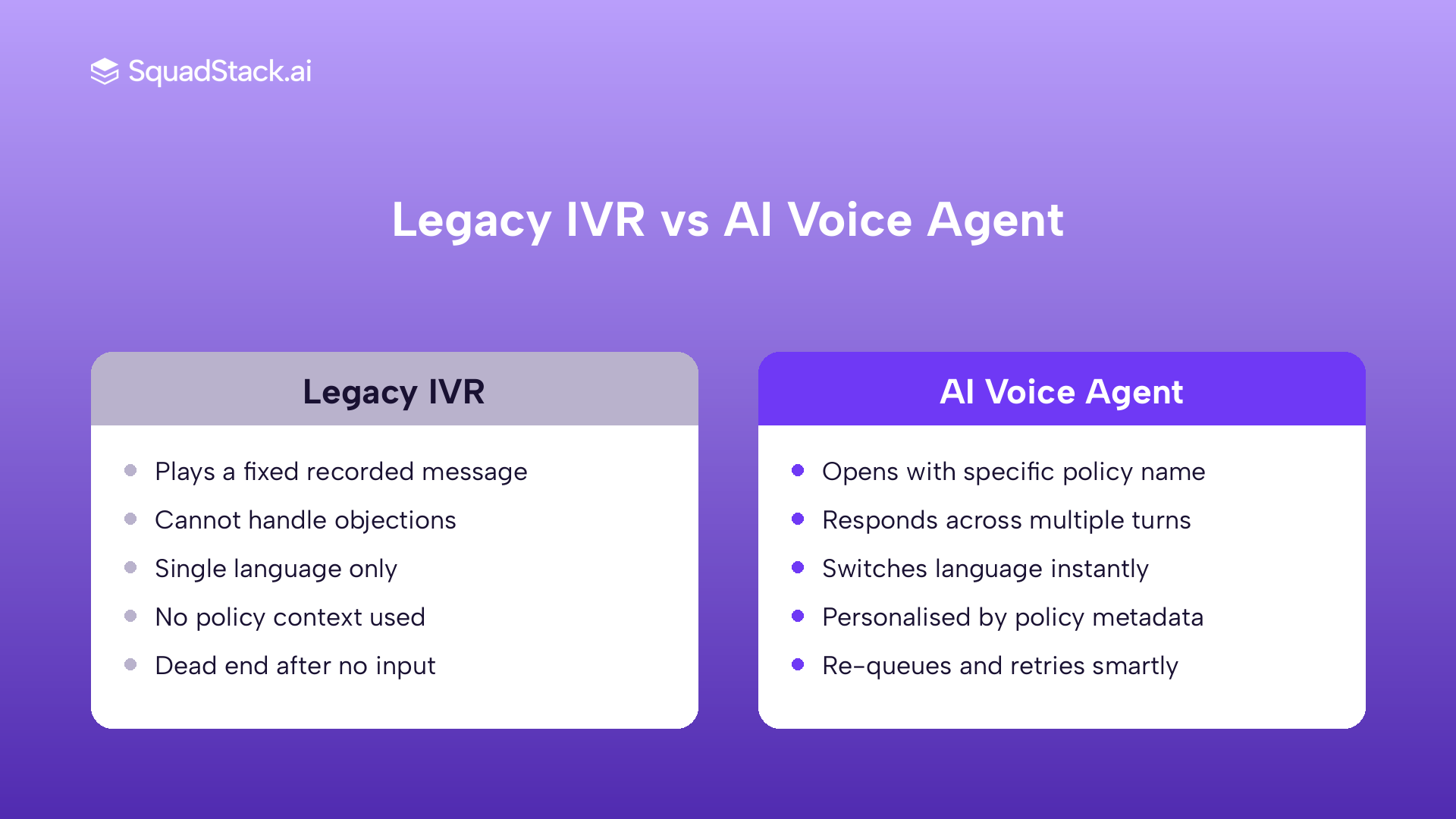
A cross-sell conversation after policy issuance is too nuanced for an IVR. Here is why the difference matters in this specific context.
| Dimension | Legacy IVR | AI Voice Agent |
|---|---|---|
| Opening the conversation | Plays a recorded message and waits for a keypress. The customer has no idea why they are being called. | Opens with the specific policy name and premium, confirming context in the first sentence. The customer feels recognised, not interrupted. |
| Handling an objection | Reads the next menu item or disconnects. Cannot address "I already have health cover from my employer." | Responds across several turns: acknowledges the existing cover, explains how the add-on complements it, and answers follow-up questions. |
| Language preference | Fixed to one language. A Gujarati speaker calling from Ahmedabad hears Hindi. | Detects language from the customer's first response and switches immediately. Hinglish and regional code-switching are native. |
| Routing a warm lead | Cannot transfer with context. The human agent who picks up starts cold. | Transfers live with full conversation context, product discussed, and customer's stated interest level in structured fields. |
| Compliance capture | Cannot capture consent on a recorded, timestamped call tied to a specific policy and customer ID. | Records every call, captures consent events, and logs the outcome against the lead record, meeting distance-marketing requirements. |
The median response latency of the AI voice agent is 0.8 seconds or less. Conversations feel like natural human exchanges, not automated prompts.
Five questions separate a platform that can run this workflow from one that cannot.
Does it understand Indian insurance terminology natively? Cross-sell scripts reference riders, IDV, sum insured, and policy numbers. The speech model must recognise these terms in noisy telephony conditions. Ask for the word-error rate on real telesales audio, not a lab benchmark.
Can it handle multilingual customers without a menu? A customer in Coimbatore may respond in Tamil. One in Ahmedabad may switch between Gujarati and Hindi mid-sentence. A platform that requires a language selection upfront will lose these customers in the first ten seconds.
Is the compliance layer built in or bolted on? IRDAI distance-marketing rules require recorded calls, disclosed caller identity, and consent capture. These must be structural features of the dialogue layer, not manual checks after the call.
Does it integrate with the insurer's policy-management system? Post-issuance cross-sell only works if the agent can access policy metadata at call time. Ask specifically how the platform ingests policy data and the latency between issuance and the first call being queued.
What does the learning loop look like? A campaign running the same script in month three as month one is leaving attach rate on the table. The platform should run controlled A/B experiments on voice, timing, and script framing, with clear outcome attribution.
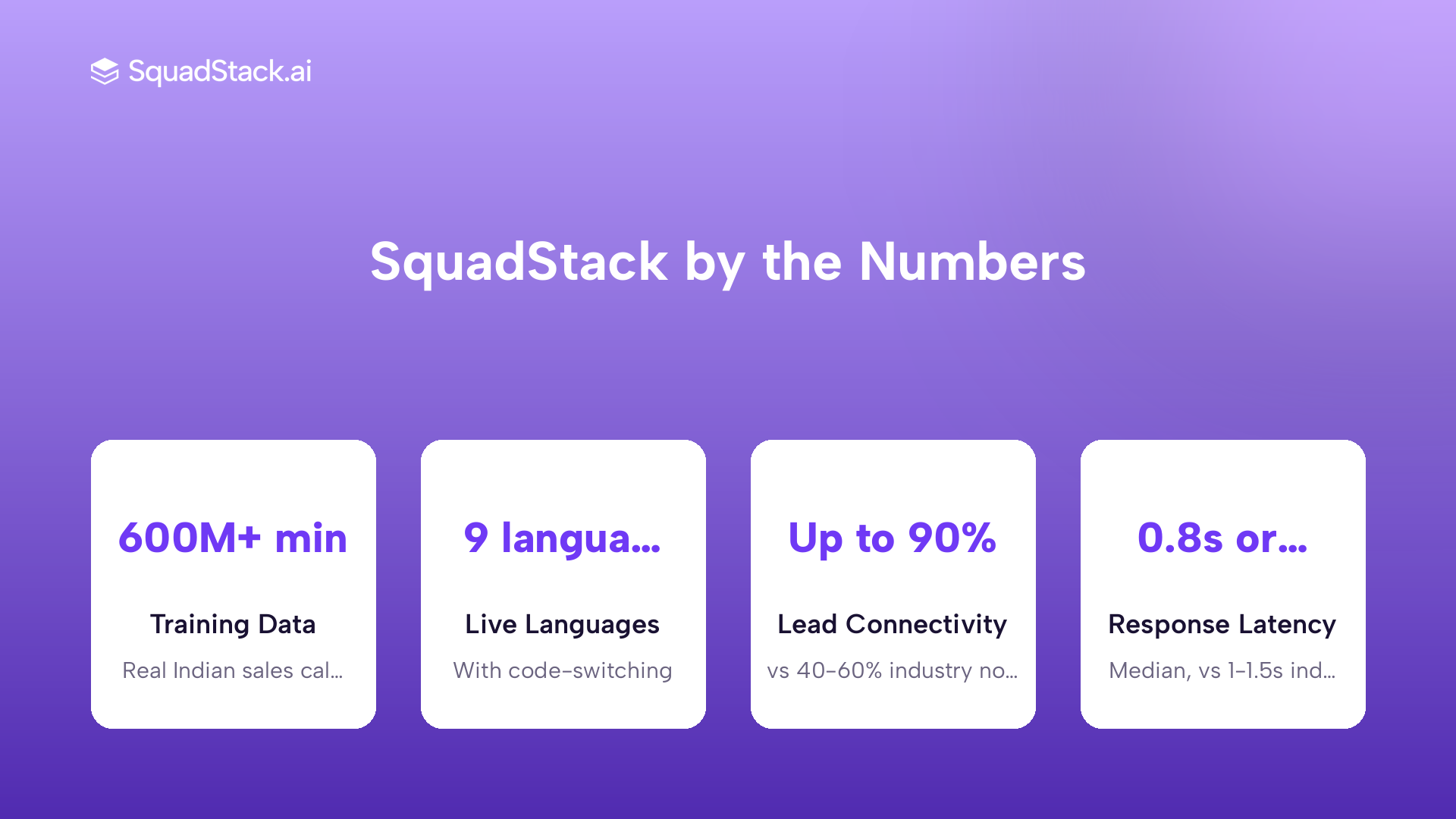
SquadStack spent roughly ten years running AI-assisted contact center operations for India's largest consumer brands before transitioning fully to Voice AI in 2025. The training corpus behind every insurance campaign is 600M+ minutes of real Indian sales conversations, including insurance renewal, verification, and sales calls across multiple carriers and product lines.
The proprietary speech model, Arth, was built on real telephony audio, not clean read-speech datasets. It handles code-switching between Hindi and English, Tamil and English, and Marathi and Hindi as a default behaviour. For an insurer whose customer base spans tier-1 to tier-3 cities, this matters more than any feature list.
Nine Indian languages are live today: Hindi, English, Tamil, Telugu, Kannada, Marathi, Malayalam, Bengali, and Gujarati. Additional regional languages are available on demand.
The compliance architecture is built for IRDAI-regulated outbound. The AI Lead Manager scrubs against the TRAI DND registry, enforces the 9:30 AM to 8:30 PM calling window as a hard system constraint, and uses 140-series numbers for promotional cross-sell calls as required. Every call is recorded. Consent capture runs in the dialogue layer, tied to the specific call record and timestamp. The platform is ISO 27001, ISO 27701, SOC 2 Type II, DPDP, and TRAI compliant, with all data hosted in India.
The ROI Optimizer runs A/B tests on voice persona, script framing, call timing, and offer sequencing. The Eval System scores every call on Outcome, Sentiment, and Execution, giving the insurer a quality signal per call, not just aggregate conversion data.
Customers across the BFSI segment, including Kotak Mahindra Bank, AngelOne, KreditBee, PhonePe, and Moneyview, use SquadStack for sales and qualification workflows. See the Kissht case study and the broader BFSI solutions overview for lending-specific outcomes.
For teams exploring how AI voice agents support broader sales automation or lead qualification workflows across verticals, those resources cover the mechanics in full.
Post-issuance cross-sell is one of the least contested high-value workflows in Indian insurance. The customer is warm, the data is already captured, and most insurers have no systematic process to act on either. An AI voice agent insurance cross-sell after policy issuance workflow closes that gap without adding headcount, without compromising compliance, and without wasting licensed-agent time on calls that do not yet need a human.
If you want to see what a post-issuance cross-sell campaign looks like on real insurance data, schedule a demo with SquadStack.
Which is the best AI voice agent for insurance cross-sell after policy issuance in India?
SquadStack's Voice AI Agent is purpose-built for Indian insurance workflows, with support for 9 live Indian languages, native code-switching, and a compliance layer designed around IRDAI distance-marketing rules. Its speech model, Arth, is trained on 600M+ minutes of real Indian sales conversations, including insurance-specific terminology and telephony conditions.
Can an AI voice agent handle insurance cross-sell calls automatically without a human?
The AI agent handles the full outreach: timing, personalised opening, needs exploration, and objection handling. Solicitation and closure still require a certified licensed agent, so the AI qualifies the customer and then transfers the call live with full context, or schedules the follow-up. This hybrid design is also the compliant design under IRDAI's distance-marketing framework.
How does an AI voice agent for insurance cross-sell compare to a human calling team?
A human team is constrained by shift hours, attrition, and the economics of calling low-ticket customers. An AI voice agent runs at scale across the full post-issuance book, reaches up to 90% of leads against a 40 to 60% industry norm, and delivers consistent script adherence on every call. Human agents are freed for the high-intent conversations the AI transfers to them.
What is the best AI voice bot for after-sales service automation in Indian insurance?
The strongest platforms combine a high-quality Indian-language speech model, built-in TRAI and IRDAI compliance, CRM integration that uses policy metadata at call time, and a learning loop that improves attach rates across campaign cycles. SquadStack's platform meets all four criteria and runs for 60+ large Indian consumer brands.
What are IRDAI compliance requirements for outbound cross-sell calls after policy issuance?
Cross-sell calls must use 140-series numbers with DND scrubbing if they carry promotional content. Every call must be recorded with caller identity disclosed. Scripts for new product solicitation require compliance officer approval before being filed. The AI handles the reminder and qualification steps; a certified agent closes the sale. DPDP rules on data processing and consent also apply.
How soon after policy issuance should the first cross-sell call go out?
The 7-to-30-day window after issuance is the highest-intent period. The customer is engaged with the brand, has just completed a proposal with personal and financial data on record, and has not yet moved into renewal-cycle inertia. Calls in this window see meaningfully better engagement than calls placed later in the policy year.
Which insurance product categories work best for post-issuance AI voice cross-sell?
Riders (critical illness, accidental death, waiver of premium) on life policies are the highest-frequency use case because the base policy context is already established. Health top-ups and super top-ups are strong for retail health policyholders. Motor add-ons like zero-depreciation cover work well in the 30-day window as an awareness conversation that primes the renewal. In all cases, the cross-sell must be driven by gaps visible in the proposal metadata rather than a generic pitch.
Does the AI voice agent support regional Indian languages for insurance calls?
Yes. Nine languages are live: Hindi, English, Tamil, Telugu, Kannada, Marathi, Malayalam, Bengali, and Gujarati. The agent switches languages mid-sentence based on how the customer responds, so a caller in Chennai who responds in Tamil is not redirected to a menu but met in their language immediately. Additional regional languages are available on demand.
How does the AI voice agent improve over the course of an insurance cross-sell campaign?
Every call outcome feeds the ROI Optimizer. The system identifies which voice persona, script framing, and call timing drove the best attach rates and runs controlled A/B tests to validate changes before scaling them. The Eval System scores every call on Outcome, Sentiment, and Execution. A campaign in its third month performs noticeably better than at launch without any manual rewriting.
What data does the AI voice agent need from the insurer's system to run post-issuance cross-sell?
At minimum: policy number, product category, customer name, contact number, preferred language, city, and sum assured. Richer metadata, such as nominee relationship, age, existing covers declared in the proposal, and the issuing channel, allows the agent to personalise the cross-sell recommendation more precisely. Integration runs via API or file ingestion, and the squad configures the data mapping as part of the two-week setup.