.svg)





Top AI Outbound Calling Tools in India: Features Compared
October 23, 2026
|

13 min read

See how AI voice agents cut patient no-shows for Indian hospitals by calling to confirm, reschedule, and answer prep questions in the patient's own language.
An AI voice agent for hospital appointment reminders India automatically confirms bookings, reschedules no-shows, and follows up on post-visit care, all in the patient's own language, around the clock. Hospitals and diagnostic chains using voice AI cut the gap between booked and attended appointments by reaching every patient before they slip away. The result is fewer empty slots, better phlebotomist utilization, and a lighter load on front-office staff.
No-shows are a coverage problem, not a quality problem. Most hospitals know which patients are likely to miss their appointment. The trouble is they do not have enough staff, working enough hours, speaking enough languages, to call every one of them in time. A Sunday enquiry sits unanswered until Monday. A Tamil-speaking patient in Coimbatore gets a Hindi reminder she ignores. A phlebotomist drives to an address where the patient forgot to fast. These are not failures of clinical care. They are failures of reach.
An AI voice agent for healthcare is built exactly for this gap: high-volume, low-clinical-risk conversations that need to happen consistently, in the right language, at the right time, every day.
An AI voice agent for hospital appointment reminders is a software system that places and receives phone calls, holds a natural conversation with a patient, and completes a defined administrative task: confirming a booking, rescheduling a missed slot, nudging a fasting check before home collection, or alerting a patient that their report is ready for pickup.
It is not an IVR. The patient is not navigating a menu. The agent listens, understands what the patient says, and responds in context, in the patient's preferred language, with a median response time of 0.8 seconds or less.
It is also not a clinical tool. Under India's Telemedicine Practice Guidelines 2020, only a Registered Medical Practitioner may counsel or prescribe. Voice agents stay on the administrative side of that line: booking logistics, reminders, rescheduling, and routing anything clinical to a human.
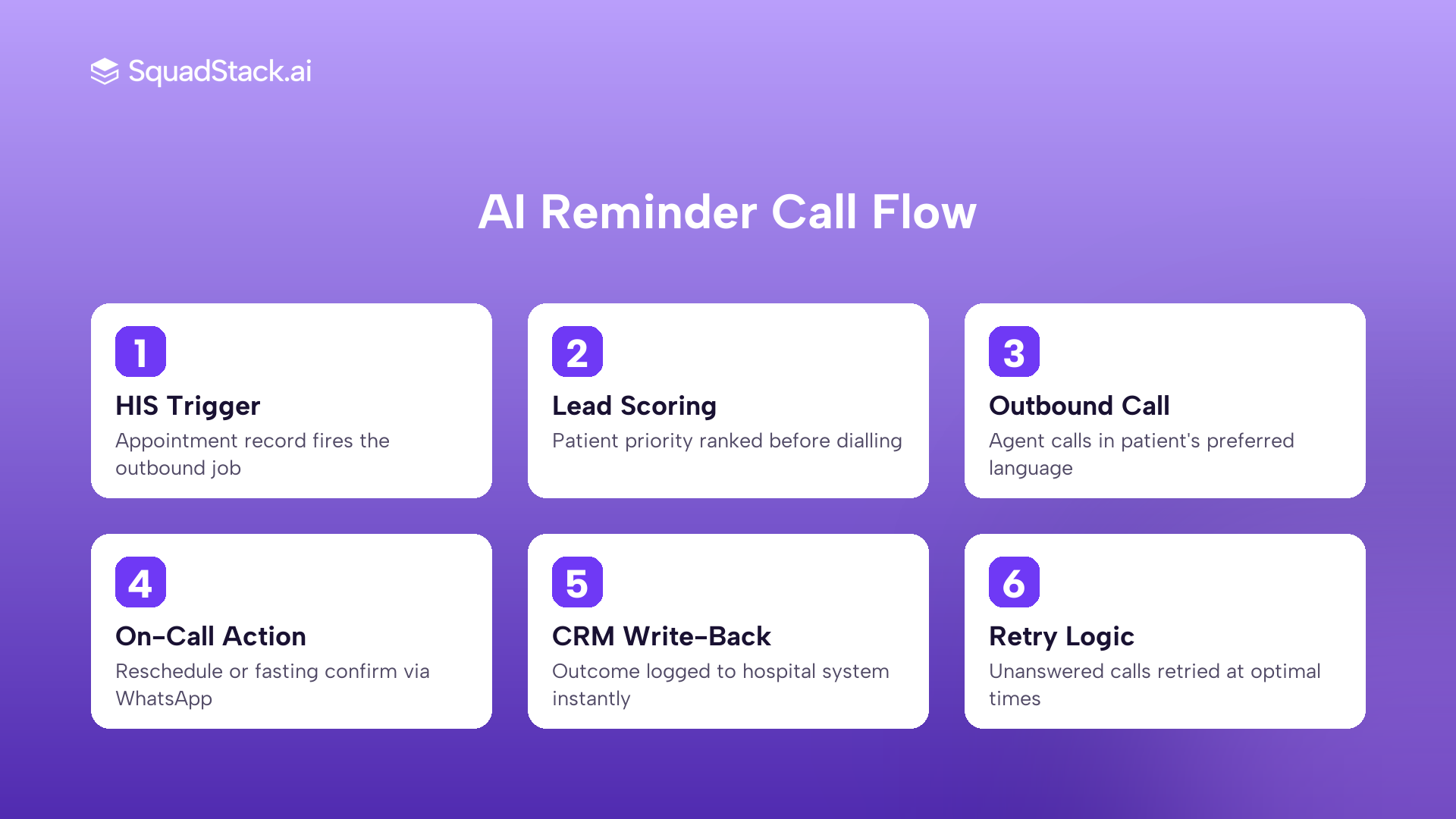
A typical appointment reminder sequence runs like this:
1. Trigger. The HIS or CRM sends a lead record to the platform. This could be a booking made 24 hours earlier, a home-collection slot the next morning, or a post-discharge flag from the day before.
2. Lead scoring and timing. The AI Lead Manager scores each patient record and picks the best time to call, based on past response data. It avoids calling outside the 9:30 AM to 8:30 PM window, enforced by a hard system check.
3. The call. The voice agent calls the patient. It confirms their appointment details, asks if the time still works, and handles a rescheduling request on the spot. If the patient has a question about the doctor's fee or the test prep, it answers from the hospital's knowledge base. If the question is clinical, it routes to a human.
4. On-call action. If the patient confirms, a WhatsApp message with directions or fasting instructions can be sent mid-call, while the patient is still on the line.
5. CRM write-back. The outcome, confirmed, rescheduled, or no-answer, is written back to the HIS or CRM automatically. No manual data entry.
6. Retry logic. For patients who did not pick up, the platform retries on a configured cadence, up to five attempts spread across two days, with gaps between attempts.
7. Continuous learning. Every completed call feeds outcome data into the ROI Optimizer. Which reminder timing gets the highest confirmation rate? Which language preference leads to the fewest rescheduled slots? The system tests, learns, and updates the approach for the next batch of calls. The script, timing, and voice improve with each campaign, not just at the start.
The most direct use case. Confirm the booking 24 hours before, remind again two hours before for high no-show patient cohorts, and if the patient misses, call within the hour to rebook. Every step runs without a human agent touching it.
A phlebotomist's visit costs lakhs a year in salary and logistics. A single wasted trip because the patient was not fasting or not home is avoidable. A voice agent calls the patient an hour before the slot, confirms they are home, confirms they have fasted, and flags a reschedule if they have not. This is the cleanest cost-reduction story in diagnostics.
"Your report is ready" calls are legitimate and low-risk. The agent notifies the patient, offers to share the report digitally, and asks if they would like to book a follow-up consultation with the doctor. What the agent does not do is interpret findings or explain an abnormal value. That boundary is absolute.
After a procedure or admission, a follow-up call within 48 hours is good clinical practice, and almost nobody does it at scale. The agent calls, asks if the patient is managing their medication schedule and next appointment, and routes anything clinical to a care coordinator. This improves adherence and generates feedback without adding to the floor team's workload.
Diabetes monitoring, annual lipid panels, post-operative reviews: clinically mandated recall intervals give diagnostics chains a natural outbound calendar. The lapsed patient base runs into millions at most chains, against handfuls of agents. Coverage is the whole problem here. For more on how voice AI agents handle lead qualification and reactivation, the same logic applies across industries.
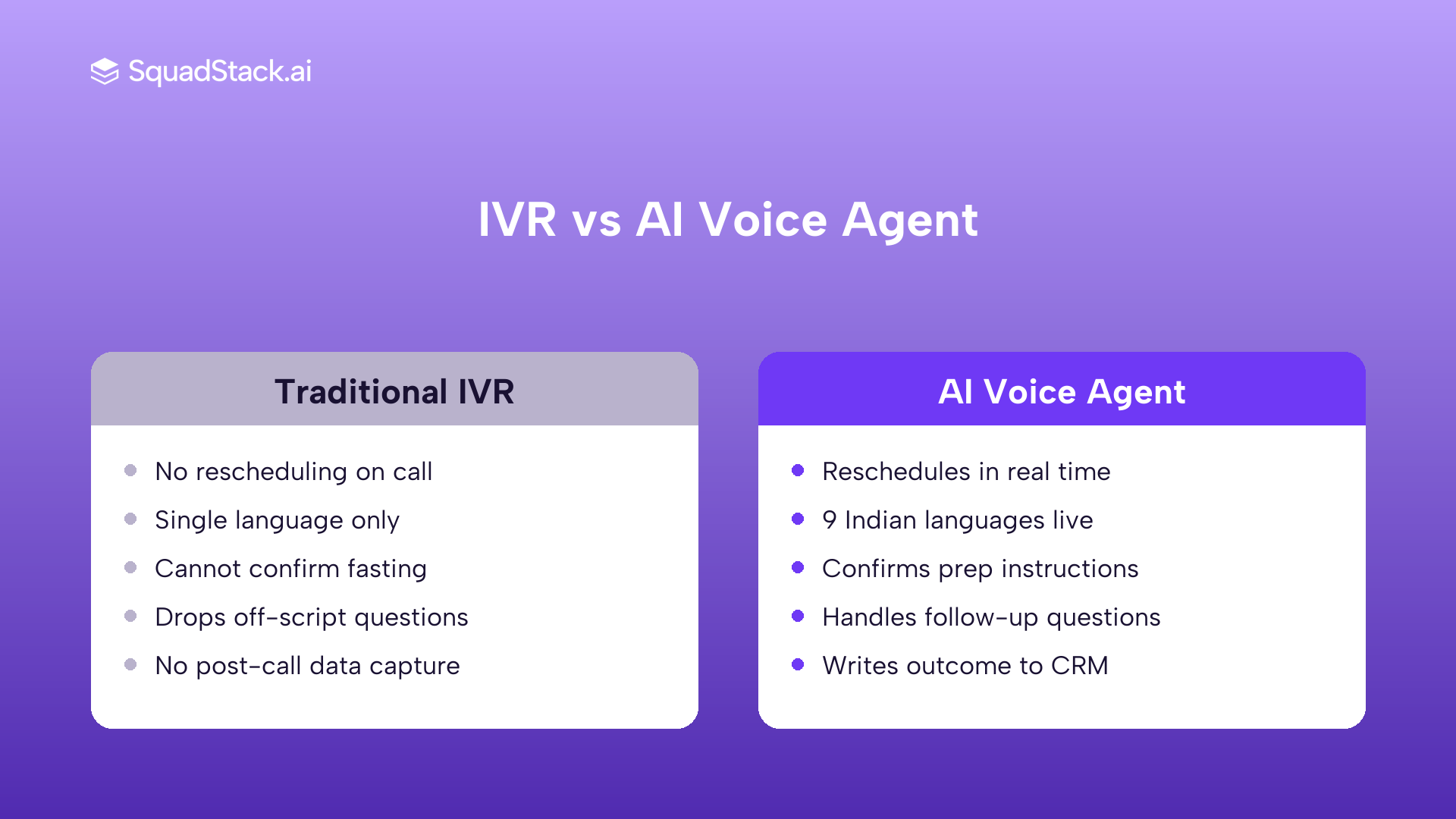
Traditional IVR systems were built for routing, not for conversations. That difference matters most in healthcare, where a patient may want to reschedule, ask about preparation instructions, or switch to a different doctor, all in the same call.
| Dimension | Traditional IVR | AI Voice Agent |
|---|---|---|
| Rescheduling | Patient presses a key to cancel. No new slot offered in the same call. | Agent finds the next available slot and confirms it on the spot. |
| Language handling | Fixed language menu. Patient selects at the start; no switching. | Native code-switching mid-call. A Hindi-English mix is handled naturally. |
| Fasting confirmation | Cannot ask or understand a free-text "yes, I have fasted" response. | Asks and understands. Flags a reschedule if the patient says they ate. |
| Off-script responses | Breaks. Patient is told to call the helpline. | Handles deviation. If the patient says "my husband is the one coming, not me," the agent updates the record and confirms. |
| Post-call data | Call log only. Outcome not captured. | Disposition, patient response, and extracted details written back to the CRM automatically. |
| Coverage hours | Tied to configured calling windows, with no learning over time. | Optimizes calling time per patient segment and runs every day within compliant windows. |
The practical gap is clearest at the moment a patient says "can we do it Thursday instead?" An IVR ends the call. A voice agent books Thursday.
For hospital and diagnostics buyers in India, these are the questions that actually separate good deployments from poor ones.
1. Does it handle Indian regional languages natively? Not just Hindi. Tamil, Telugu, Kannada, and Bengali are not optional if you operate in Tier 2 or Tier 3 cities. Ask specifically whether code-switching works mid-sentence, because patients do not switch cleanly at the start of a call.
2. What is the latency? A pause of more than a second in a phone conversation feels like a dropped call. Ask for median response latency in production, on Indian telephony. The benchmark to hold vendors to is under one second.
3. Where does data sit? DPDP compliance and India data residency are not negotiable for patient data. Confirm data does not leave India, and ask for the compliance certifications in writing.
4. Can it integrate with your HIS? A reminder system that requires manual file uploads will not run at the volumes that make it worthwhile. Ask about webhook and API support, and get a realistic integration timeline.
5. Who owns the build and the ongoing tuning? A self-serve voice AI platform puts the configuration burden on your team. A managed service puts a dedicated squad on your account. For healthcare, where scripts have compliance guardrails, the managed model is safer.
6. Does it stay on the right side of the Telemedicine Guidelines? Any vendor building you a symptom-triage or result-interpretation flow is putting you at legal risk. Ask how clinical escalation is handled, and make sure the demo shows it.
For a broader look at voice AI in Indian healthcare, including hospital chains, diagnostics, and health-tech platforms, see SquadStack's healthcare industry page.
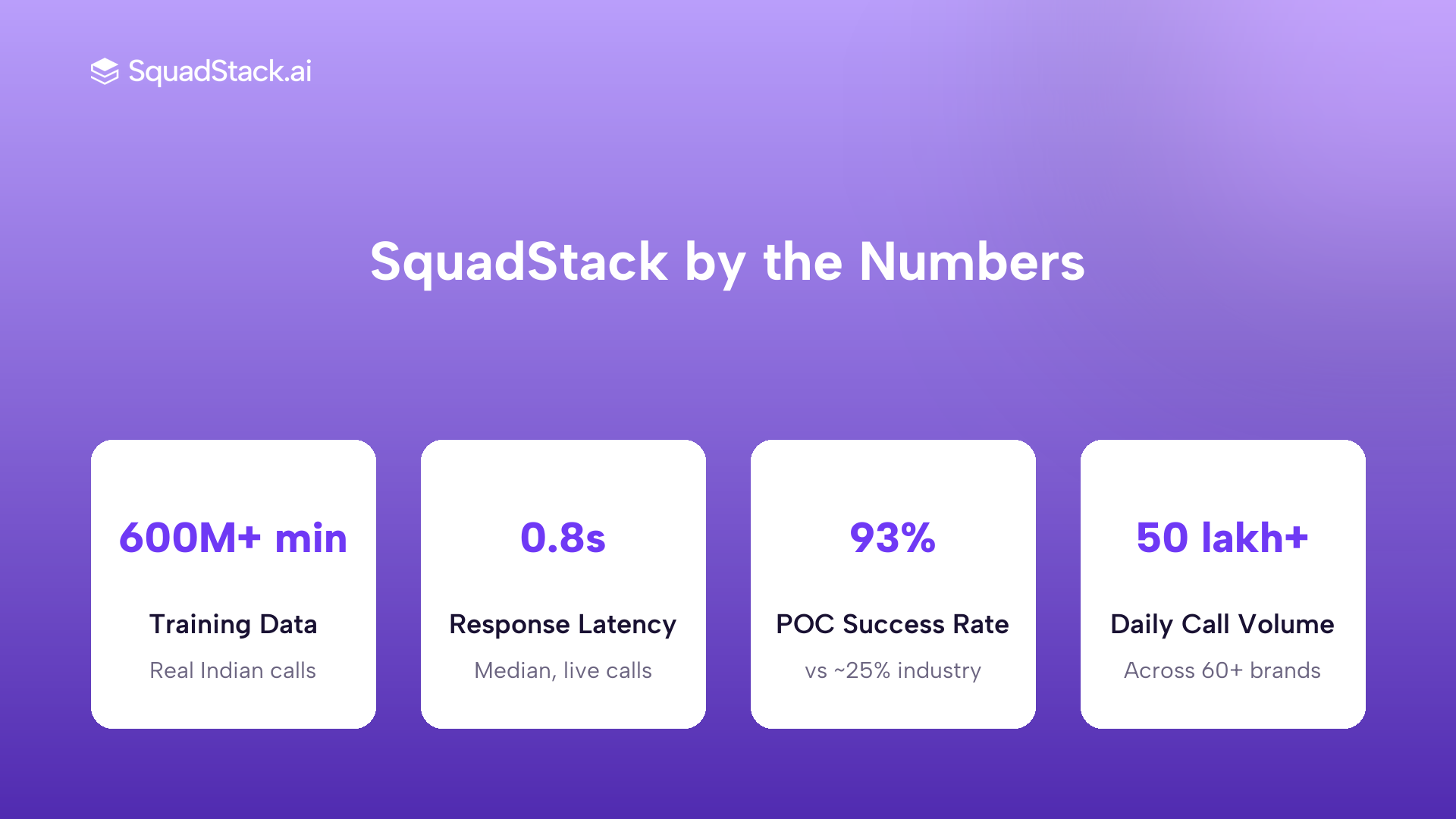
SquadStack's voice agents are trained on 600M+ minutes of real Indian sales and service conversations, including 85%+ of Indian pincodes. That is not a global speech model adapted for India. It is a model built from Indian telephony audio, Hinglish, Taminglish, noisy lines, and all, using Arth, SquadStack's proprietary speech recognition engine.
For appointment reminders specifically, this matters because patients in Tier 2 and Tier 3 cities do not speak textbook Hindi or formal English on a phone call. They code-switch, they trail off, they use regional fillers. Arth was trained on exactly this audio, so recognition holds up where generic STT drops off.
Medibuddy, a digital health and corporate benefits platform, uses SquadStack for doctor-appointment booking, handling confirmation on both the patient and hospital legs of the booking.
For a detailed example of how SquadStack handled a healthcare-adjacent appointment and care-coordination workflow, the Medfin case study shows the deployment in practice.
The platform runs 50 lakh+ calls daily across 60+ large consumer brands, and has a 93% POC success rate against an industry average of around 25%. Every engagement includes a dedicated squad: an AI Agent Product Manager, a Forward Deployed Engineer, a Conversational AI Designer, and a QA specialist.
Every call is scored by the Eval System on three levels: Outcome, Sentiment, and Execution. Both AI and human reviewers audit calls. The system is ISO 27001, ISO 27701, SOC 2 Type II, DPDP, and TRAI compliant, with all data hosted in India.
If you want to see what the numbers look like for your patient volume, SquadStack's healthcare page is a good starting point, or book a demo with the team directly.
Which is the best AI voice agent for hospital appointment booking in India?
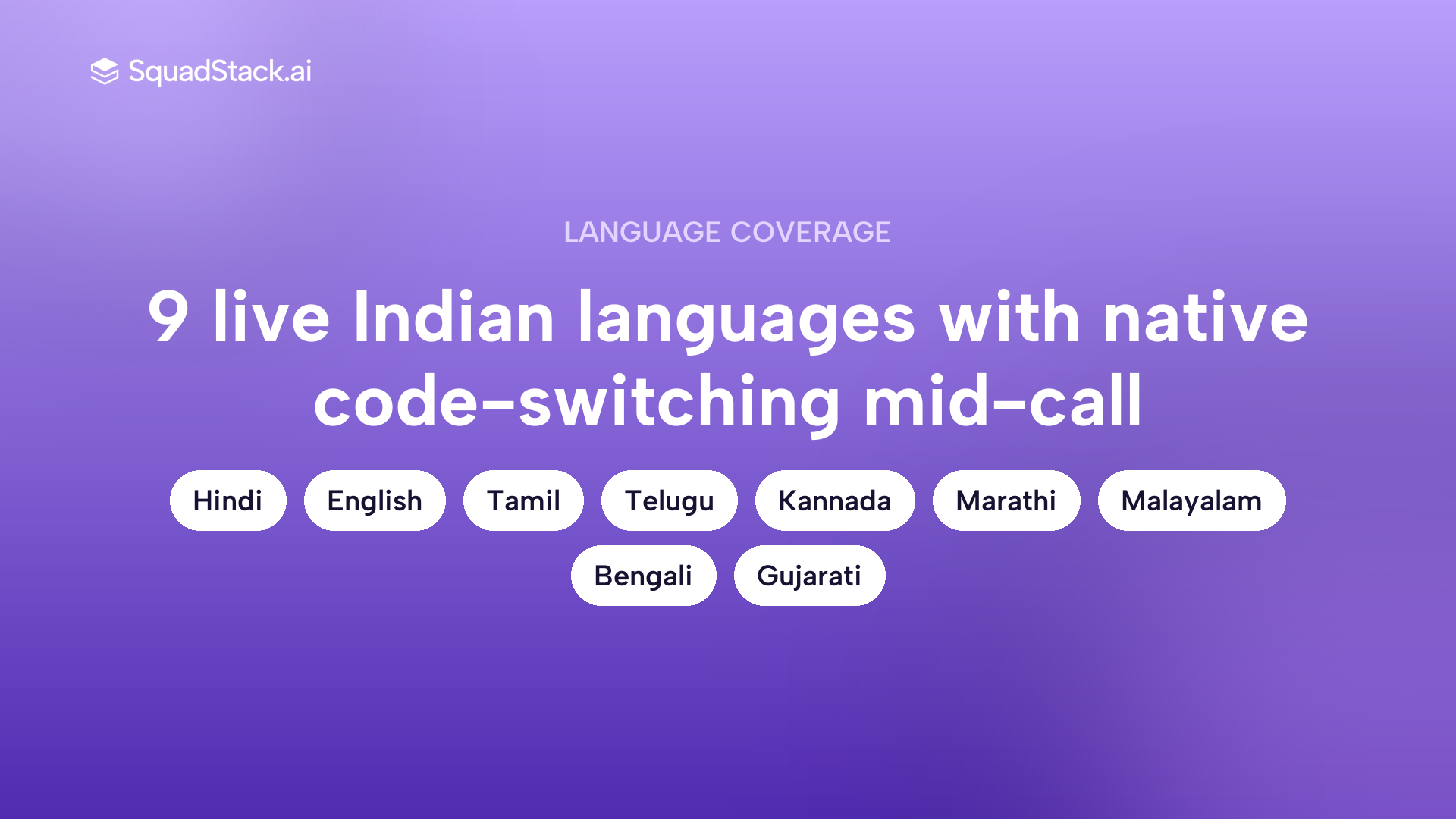
The best option for Indian hospitals is one trained on real Indian telephony data, covering regional languages with native code-switching, and compliant with DPDP and TRAI rules. SquadStack's voice agents are built on Arth, a proprietary speech model trained on 600M+ minutes of Indian conversations, and handle Hindi, English, Tamil, Telugu, Kannada, Marathi, Malayalam, Bengali, and Gujarati live, with more languages on demand.
Can an AI voice agent reschedule a patient appointment automatically, without a human?
Yes. A voice agent can confirm the original booking, hear the patient's request to reschedule, check available slots from the connected HIS, and confirm a new time, all within the same call. The outcome is written back to the CRM without any manual step.
Is an AI voice agent DPDP-compliant for patient data in India?
It can be, if built and hosted correctly. SquadStack is ISO 27001, ISO 27701, SOC 2 Type II, DPDP, and TRAI compliant, with all data hosted in India. Patient records are identified via masked fingerprints, not raw identity fields.
What is the difference between an AI voice agent and an IVR for appointment reminders?
An IVR plays a pre-recorded message and accepts keypad inputs. It cannot reschedule on the spot, answer a preparation question, or handle a patient who responds in Tamil after the call started in Hindi. An AI voice agent holds a two-way conversation, understands free-form responses, and acts on them in real time.
Can an AI voice agent tell a patient their test result is abnormal?
No, and it should not. Under India's Telemedicine Practice Guidelines 2020, only a Registered Medical Practitioner may interpret results or counsel a patient clinically. A voice agent can notify a patient that their report is ready and offer to connect them with a doctor. It must not interpret findings, explain abnormal values, or make any clinical recommendation.
How many Indian languages can a voice agent handle for appointment reminders?
SquadStack's agents support Hindi, English, Tamil, Telugu, Kannada, Marathi, Malayalam, Bengali, and Gujarati live today, with more regional languages are available on demand. The agents switch languages mid-conversation naturally, the way a bilingual human agent would, because the underlying model was trained on real code-switched Indian conversations.
How long does it take to go live with a voice agent for appointment reminders?
Most deployments take around two weeks from kickoff to live production. The build uses the hospital's own call recordings, knowledge base, and FAQs to train the agent. The longer timeline is usually client-side: data feeds, telephony approvals, and compliance sign-off, not the platform build.
What happens when a patient asks something the voice agent cannot handle?
The agent routes the call to a human team. Triggers are configured per campaign and can include a patient's explicit request, a detected clinical question, or a keyword that signals the conversation needs a practitioner. The human receiving the transfer sees the full conversation context, so the patient does not repeat themselves.
How does a voice agent improve over time for appointment reminders?
Every call outcome feeds back into the ROI Optimizer. The system runs A/B tests on reminder timing, language preference, and follow-up cadence. Winners are confirmed on live traffic before they replace the current approach. Over the course of a campaign, confirmation rates and reschedule rates improve as the system learns which strategy works for each patient segment.
Sources: Product Knowledgebase (SquadStack, 2026-08-24); Telemedicine Practice Guidelines 2020, Ministry of Health and Family Welfare, Government of India; Industry occupancy and diagnostics volume data

