.svg)






Subscriber Churn Prediction Calls: AI Voice for OTT and Streaming
October 10, 2026
|

12 min read
Learn how AI voice agents tackle India's unique FCR challenges across language, trust, and measurement to lift first-call resolution rates at scale.
First-call resolution rate measures whether a caller's issue or intent is fully addressed in a single call, without a callback or transfer. AI voice agents raise FCR in Indian contact centres by giving every caller an instant, accurate response in their own language, at any scale. Businesses using a strong first call resolution rate AI voice agent approach consistently outperform traditional IVR and human-agent setups on this metric.
Indian contact centres spend a lot of effort chasing a single number: did the customer get what they needed on the first call? For most teams, the honest answer is: not reliably. Calls get transferred, customers call back, and agents spend the first two minutes repeating context the last agent already gathered. The cost is real, in both operations and customer trust.
FCR is the metric that captures this problem. And for businesses deploying AI voice agents, it is also the metric that shows the clearest improvement, when measured correctly.
First-call resolution rate (FCR) is the percentage of calls in which a caller's question, request, or intent is fully resolved in a single interaction, without needing to transfer, escalate, or call back.
The standard formula: divide the number of calls resolved on the first attempt by the total number of calls, then multiply by one hundred. A call counts as resolved when the caller leaves with a clear outcome: a booked appointment, a confirmed loan application, an answered query, or a completed transaction.
FCR is tracked as both an inbound support metric and, in sales-oriented contact centres, as a measure of how efficiently agents move leads from first contact to commitment. In the Indian outbound sales context, a "resolved" call means the lead received a complete pitch, got their questions answered, and either converted or clearly opted out. Calls that end in vague follow-up promises or unanswered objections do not count.
When FCR is low, the cost compounds quickly. Each repeat call consumes agent time, adds to queue load, and erodes the caller's patience. In lending, insurance, and brokerage, a lead that calls back twice before converting costs far more per acquisition than one that commits on the first call.
FCR also signals CX quality. A caller who gets a complete answer the first time is more likely to trust the brand and follow through. In high-value categories like personal loans or demat account opening, that trust often separates a conversion from a drop.
Global benchmarks cluster around the mid-to-high seventies as a "good" baseline, but they are built on data from markets with different conditions. Applying them to Indian contact centres sets the wrong target.
Three structural factors depress FCR in India:
Language switching mid-call. A caller might start in Hindi, shift to a regional dialect, and close in English. Traditional IVR systems and even some human agents cannot follow this shift. The call either fails or requires a transfer, breaking resolution immediately.
Trust-building loops. Many Indian consumers, especially in tier-2 and tier-3 cities, ask the same question multiple times at different points in a conversation to verify consistency. An agent that cannot hold context across the full call loses their trust and triggers a callback.
Low digital literacy in the customer base. In categories like gold loans, insurance renewals, or merchant credit, many callers need a guided explanation, not just an answer to a direct question. If the agent cannot adjust based on what the caller already understands, the call ends without resolution.
The goal for Indian contact centres is not to copy a global benchmark. It is to remove the specific friction points that cause FCR to fail here.
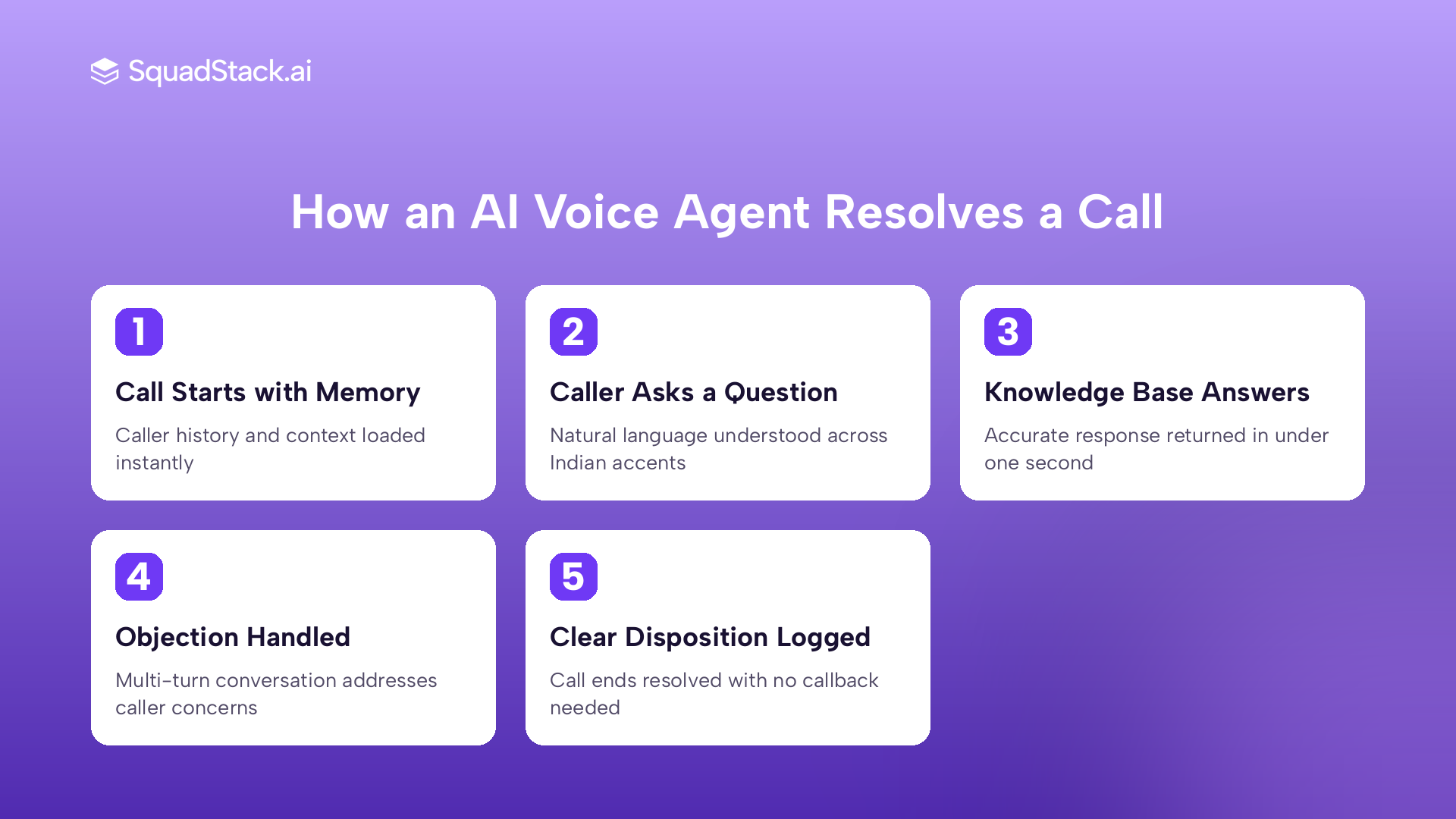
An AI voice agent for sales automation addresses each of these failure points directly.
Instant knowledge retrieval. When a caller asks a specific product question, the agent queries the client's knowledge base and returns an accurate answer in under 100 milliseconds. No hold music, no transfer, no invented answer.
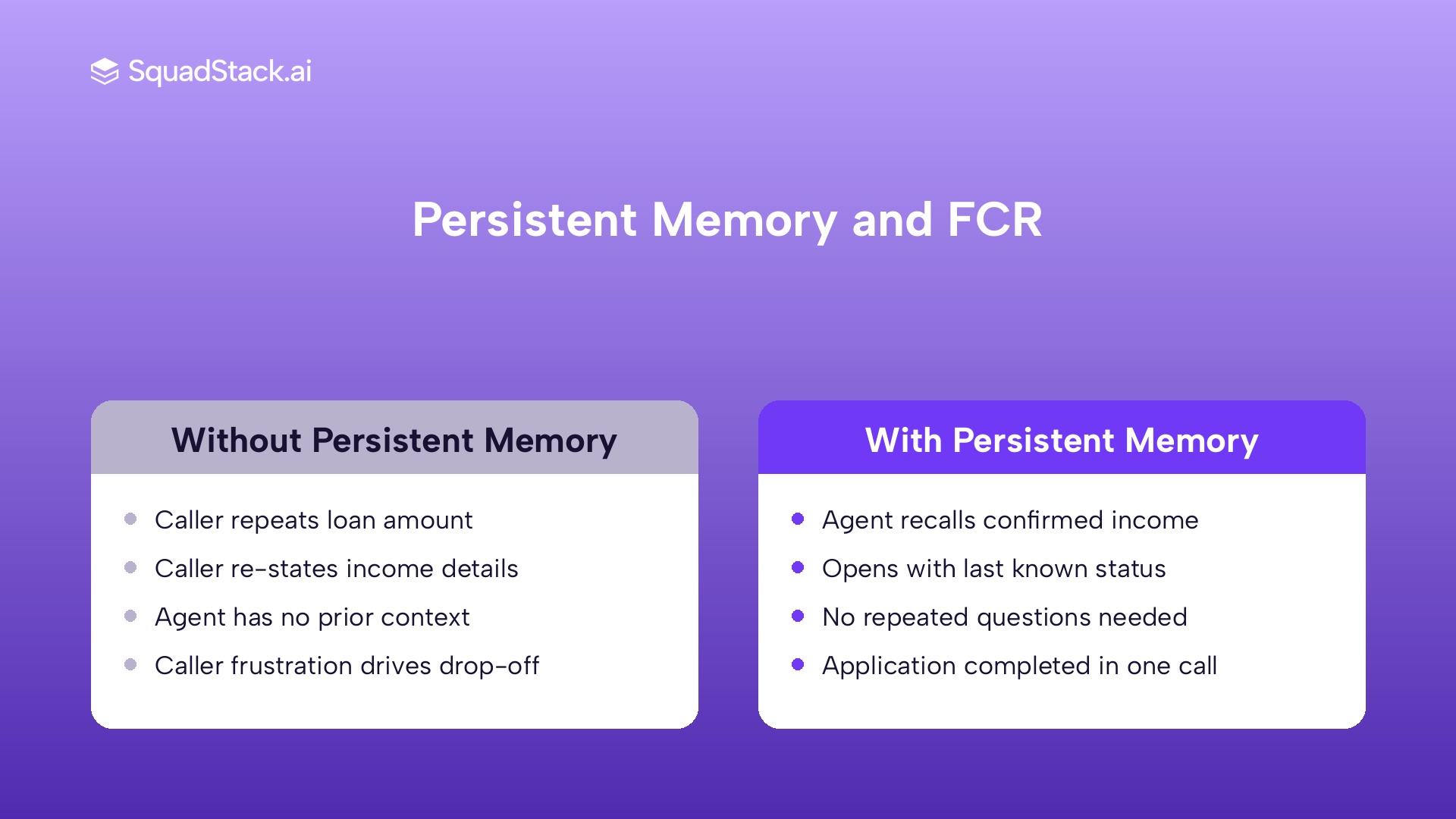
Persistent memory within and across calls. If a caller already discussed their income and PAN details on a previous call, the agent opens with what it already knows. This matters enormously for FCR in multi-touch outbound campaigns, where the "first call" to close is rarely the first call overall.
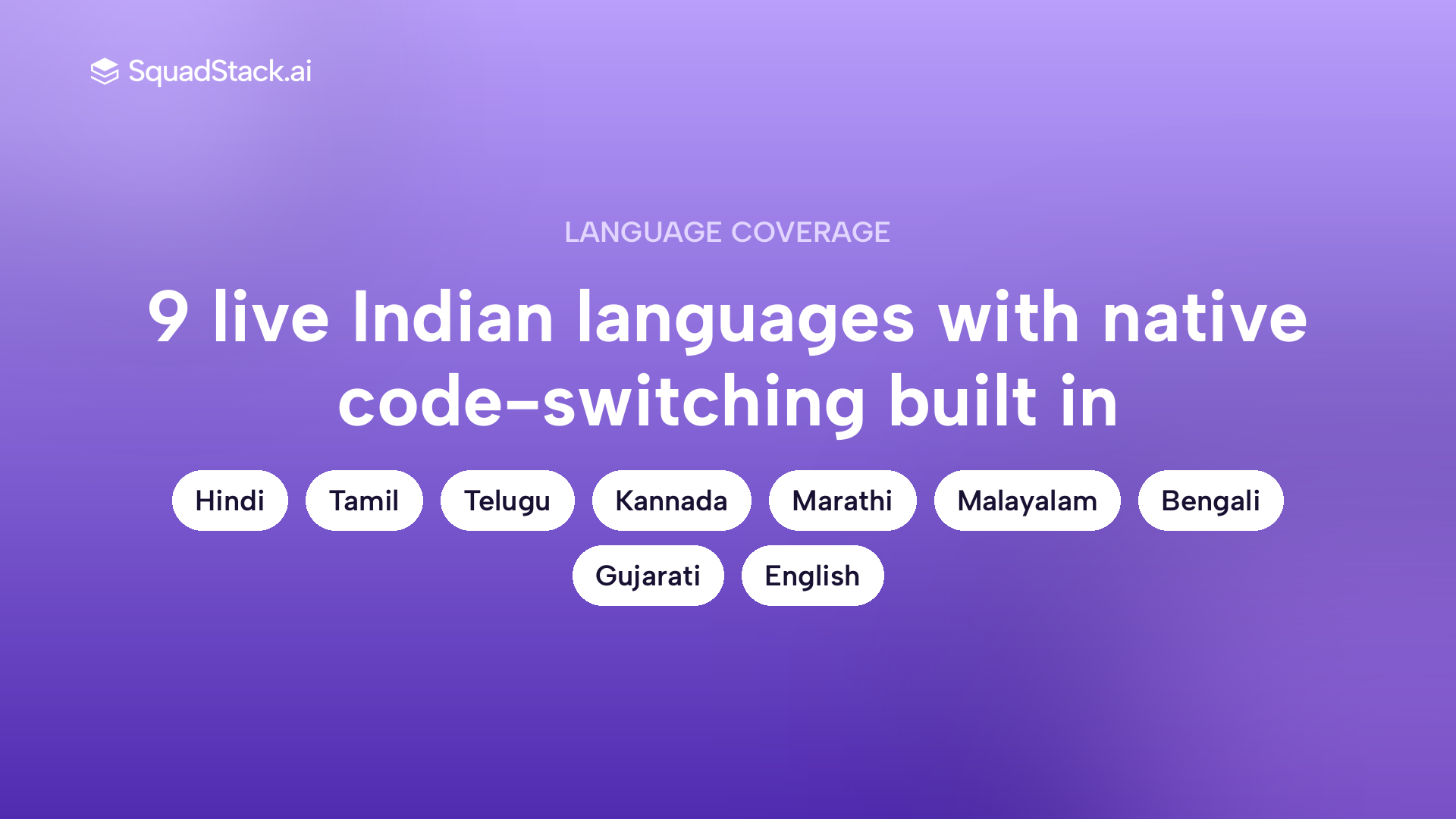
Native language switching. SquadStack's agents handle 9 live Indian languages, including Hindi, Tamil, Telugu, Kannada, Marathi, Malayalam, Bengali, and Gujarati alongside English, with native code-switching. A caller who switches from Hindi to Gujarati mid-explanation does not lose the thread of the conversation.
Real-time escalation with context. When a call genuinely needs a human, the agent hands off with the full conversation summary, confirmed details, and the escalation trigger point already transferred. The caller does not repeat themselves, so the escalation does not count against FCR.
Continuous learning after every call. Every call outcome feeds back into the platform's ROI Optimizer. The system identifies near-misses, spots recurring objections, and proposes script edits for the next campaign cycle. The agent running week six is measurably better at first-call resolution than the one that ran week one.
For a deeper look at how AI drives measurable improvements across contact centre KPIs, see how AI improves call centre KPIs.
Lending and BFSI. A personal loan call that ends in "I'll think about it" costs as much to run as one that converts. The FCR goal is to handle every objection, confirm eligibility, and reach a clear yes or no in a single conversation. Customers like KreditBee, DMI Finance, and Moneyview run outbound loan sales on SquadStack's platform where the agent handles qualification and objection resolution end to end.
Insurance renewals. A renewal call that cannot answer coverage questions forces a callback. In the auto insurance renewal case study from a leading general insurer, SquadStack's voice AI achieved 85% connectivity and a 60% lower renewal cost per outcome.
Brokerage account opening. Demat account opening calls involve identity questions, documentation steps, and compliance disclosures. Each unanswered question becomes a callback. A bank-linked brokerage using SquadStack's Voice AI agent saw 3x higher conversions compared to the prior approach.
Logistics and hiring. For rider onboarding, Delhivery achieved a 4x lower cost-per-hire with SquadStack's voice AI, partly because the agent fully qualified candidates and booked onboarding steps in a single call rather than across multiple touchpoints.
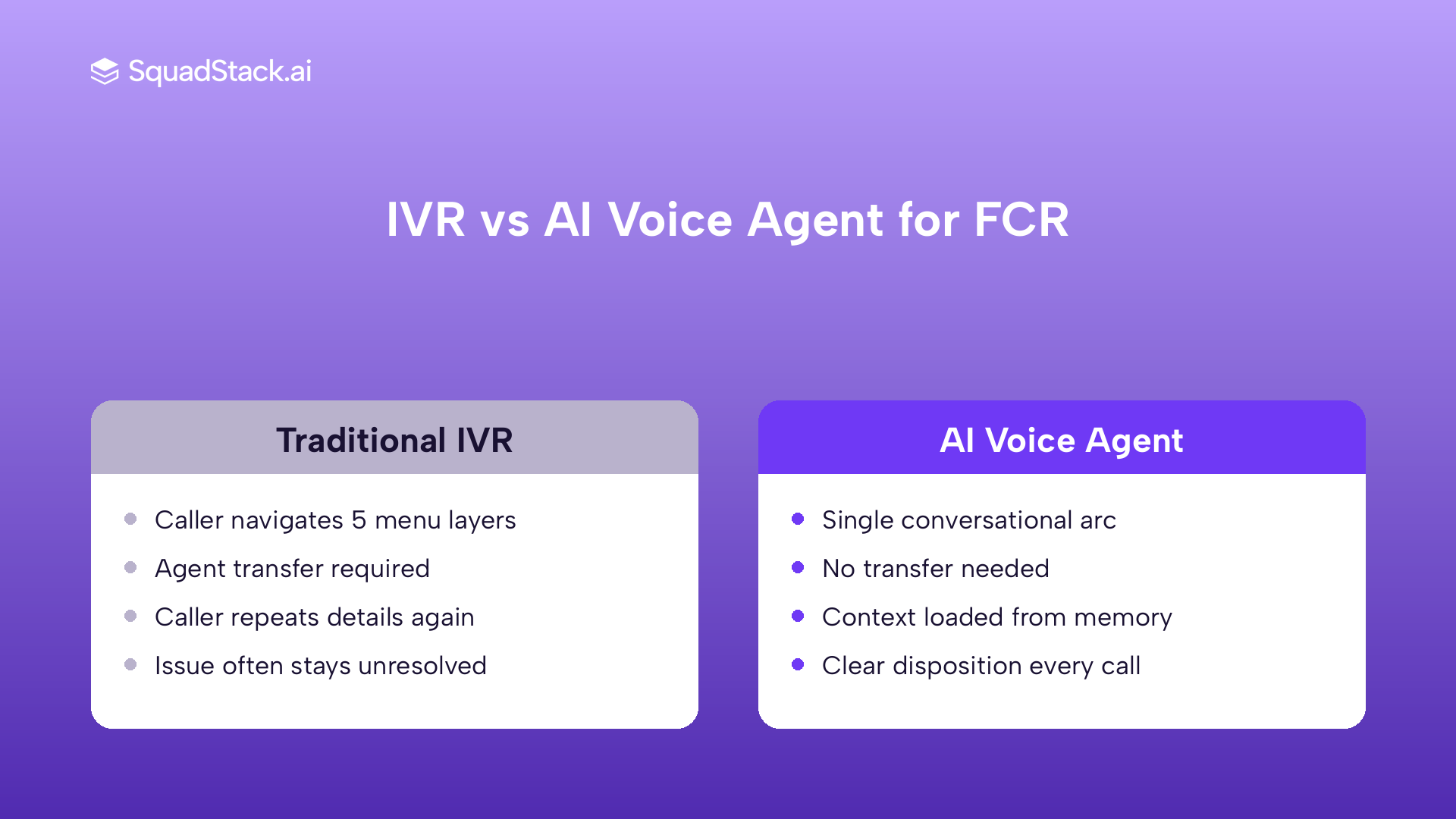
| Dimension | IVR | AI Voice Agent |
|---|---|---|
| Handling a mid-call language switch | Fails or routes to a hold queue | Continues in the caller's preferred language without interruption |
| Answering a specific product question | Reads a pre-recorded option or says "press 3 for more information" | Queries the knowledge base and answers in under 100 milliseconds |
| Caller repeats context from a previous call | No memory; every session starts cold | Loads prior conversation history before the call begins |
| Caller raises an objection not in the script | Call ends or drops into a default menu | Handles the objection across multiple turns with context |
| Escalation to a human | Cold transfer with no context passed | Warm transfer with full conversation summary and confirmed details |
An IVR resolves only what its menu anticipates. An AI voice agent resolves what the caller actually needs.
For a full comparison of AI-driven and traditional outbound calling costs, see AI outbound calling cost.
Define "resolved" for your use case. In inbound support, resolved means the issue is closed. In outbound sales, resolved means the lead received a complete pitch, had their questions answered, and reached a clear disposition: converted, scheduled, or explicitly not interested.
Account for persistent memory. A call that ends in a scheduled callback is not unresolved if the next call opens with full context and closes the sale. Track FCR across a campaign arc, not just per call.
Separate AI-handled calls from warm transfers. If the AI agent handles 85% of calls end to end and escalates 15% with full context, calculate FCR separately for each group. Blending them hides how each channel performs.
Track Abruptly Disconnected Rate alongside FCR. If callers hang up in the first ten seconds, the FCR calculation is distorted. SquadStack's agents currently run an Abruptly Disconnected Rate around 10%, inside the range of human agent campaigns, which means callers engage long enough for resolution to be possible.
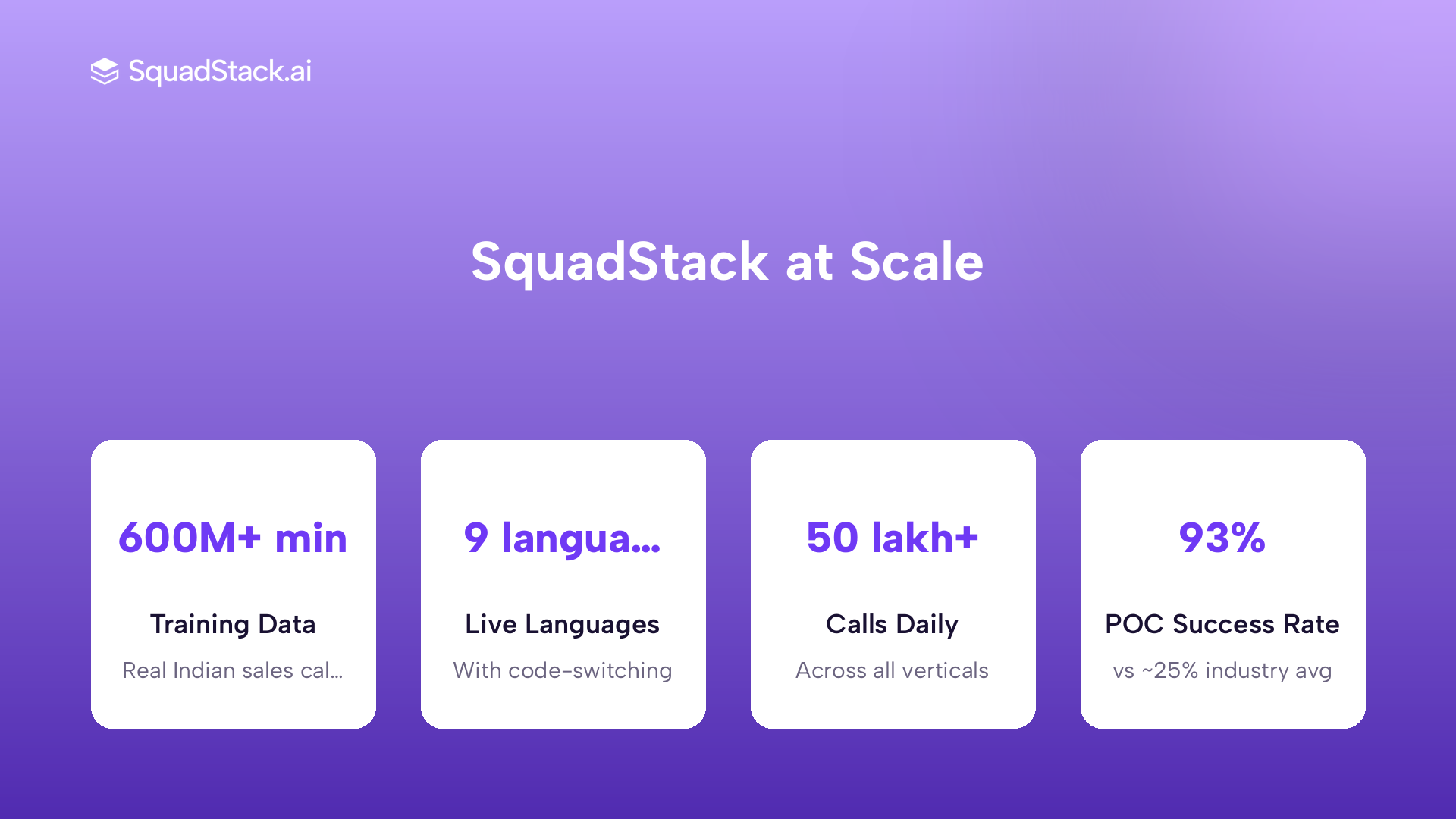
SquadStack built its speech model, Arth, on 600 million-plus minutes of real Indian contact centre conversations, including code-switched audio from actual sales calls across more than 85% of Indian pincodes. No publicly available training dataset covers this ground, which is why most voice AI systems still struggle with Hinglish, Taminglish, and noisy 8kHz telephone lines.
Every call is scored by the Eval System across three levels: Outcome (did the call achieve its objective?), Sentiment (how did the conversation land?), and Execution (did the agent follow the script and capture the right data?). This dual-layer QA, combining AI and human review, runs on every campaign. The platform has a 93% POC success rate, against an industry average around 25%.
The ROI Optimizer closes the loop. Near-misses, objection patterns, and drop-off points are analysed after every campaign run. Script changes and cadence improvements are proposed, reviewed by a human, and tested on live traffic before scaling.
SquadStack's platform delivers up to 90% lead connectivity against a 40 to 60% industry norm, up to 40% more conversions on a case-specific basis, and handles 50 lakh-plus calls daily for 60-plus large Indian consumer brands. For the ROI case in more detail, see AI contact centre ROI.
If you want to see what this looks like in practice for your category, book a demo and the team will show you a live campaign walkthrough.
Which is the best AI voice agent for improving FCR in India?
The best option for Indian contact centres is one built on Indian telephony data, with native language switching and persistent memory across calls. SquadStack's agents are trained on 600M+ minutes of real Indian sales conversations and support 9 live languages with native code-switching. They run 50 lakh-plus calls daily for 60-plus large consumer brands in India.
Can an AI voice agent resolve calls without transferring to a human agent?
Yes. AI voice agents handle the full conversation end to end for the majority of calls, including objection handling, product questions answered via knowledge-base lookup, and application steps. When a transfer is genuinely needed, the agent hands off with a full conversation summary so the caller does not repeat themselves.
What is a good FCR rate for an AI voice agent in India?
Global benchmarks of 70 to 80% are built on data from markets with different conditions. Indian contact centres face language switching, trust-building loops, and varying digital literacy that depress FCR below those levels with traditional systems. The right target depends on the use case and vertical. Measuring FCR across the full campaign arc, not just per call, gives a more accurate picture for outbound AI deployments.
How does an AI voice agent access real-time information to resolve a call?
The agent queries a client-supplied knowledge base during the conversation. Retrieval adds under 100 milliseconds of latency, so the answer is available before the caller notices any pause. When documents are updated, the agent's answers update automatically without any prompt rewriting or redeployment.
How does FCR measurement change when AI voice agents handle part of the call?
Calls fully handled by the AI agent should be tracked separately from those escalated to a human. For sales campaigns, define "resolved" as reaching a clear disposition: converted, booked, or definitively not interested. Track Abruptly Disconnected Rate alongside FCR to ensure callers are engaging long enough for resolution to be possible.
Does an AI voice agent handle callers who switch languages mid-call?
Yes. SquadStack's agents switch language mid-sentence, not just mid-conversation. The speech model is trained on real code-switched audio, including Hinglish and Taminglish, so the transition is handled naturally without routing the caller to a different agent or losing conversational context.
What happens when a caller asks a question the AI voice agent cannot answer?
If the answer is in the knowledge base, the agent retrieves it in real time. If the question falls outside the knowledge base and requires a human decision, the agent triggers a warm transfer, passing the full conversation context to the receiving agent. The caller does not start the conversation again.
How does an AI voice agent improve FCR over the course of a campaign?
Every call outcome feeds the ROI Optimizer. The system flags near-misses, recurring objections, and drop-off patterns, then proposes precise changes to the script or flow. Each change is reviewed by a human, tested on a small traffic slice, and rolled out only if it demonstrably improves outcomes. FCR typically improves as the campaign progresses.
Is it possible to reduce repeat callbacks using an AI voice agent?
Yes. Persistent memory means returning callers are greeted with context from their previous interaction. The agent knows where the last call ended, what the caller confirmed, and what is still pending. This removes the most common trigger for repeat calls: the caller needing to repeat information because the system forgot it.
How do I calculate FCR for an outbound sales AI voice agent campaign?
Count calls where the lead received a complete pitch, had their questions answered, and reached a clear disposition as resolved. Divide that number by the total calls attempted (or by total calls connected, depending on your operational definition). Track the figure by week across the campaign to see how FCR moves as the agent improves.