AI Voice Agents for Loan Collections in India: Pre-Due to Recovery
September 18, 2026
|

12 min read
A customer in Coimbatore gets a sales call in formal English. A borrower in Vizag hears Tamil when they speak Telugu. A loan applicant in Jaipur gets a...
TL;DR: Multilingual AI voice agents in India let businesses run outbound sales calls in Hindi, Tamil, Telugu, Kannada, and English, with native code-switching built in. The right language choice can be the difference between a lead picking up and hanging up, especially in Tier 2 and Tier 3 cities. This guide helps you map your customer base to the right language mix and pick a platform that actually sounds native.
A customer in Coimbatore gets a sales call in formal English. A borrower in Vizag hears Tamil when they speak Telugu. A loan applicant in Jaipur gets a bot that stumbles over "EMI" and "NACH mandate." None of these is a translation problem. Each is a conversion problem.
Tier 2 and Tier 3 buyers are more comfortable, more trusting, and more likely to convert when they hear their own language spoken naturally. Most search results about multilingual AI voice agents India count languages. Very few explain what it takes to sound native, or what a Tier 2 buyer actually needs from an AI caller. That is what this guide covers.
A multilingual AI voice agent is a conversational AI system that conducts full sales or support calls in more than one language, without a human operator switching it, without pre-recorded menus, and without the lead knowing they are not talking to a person.
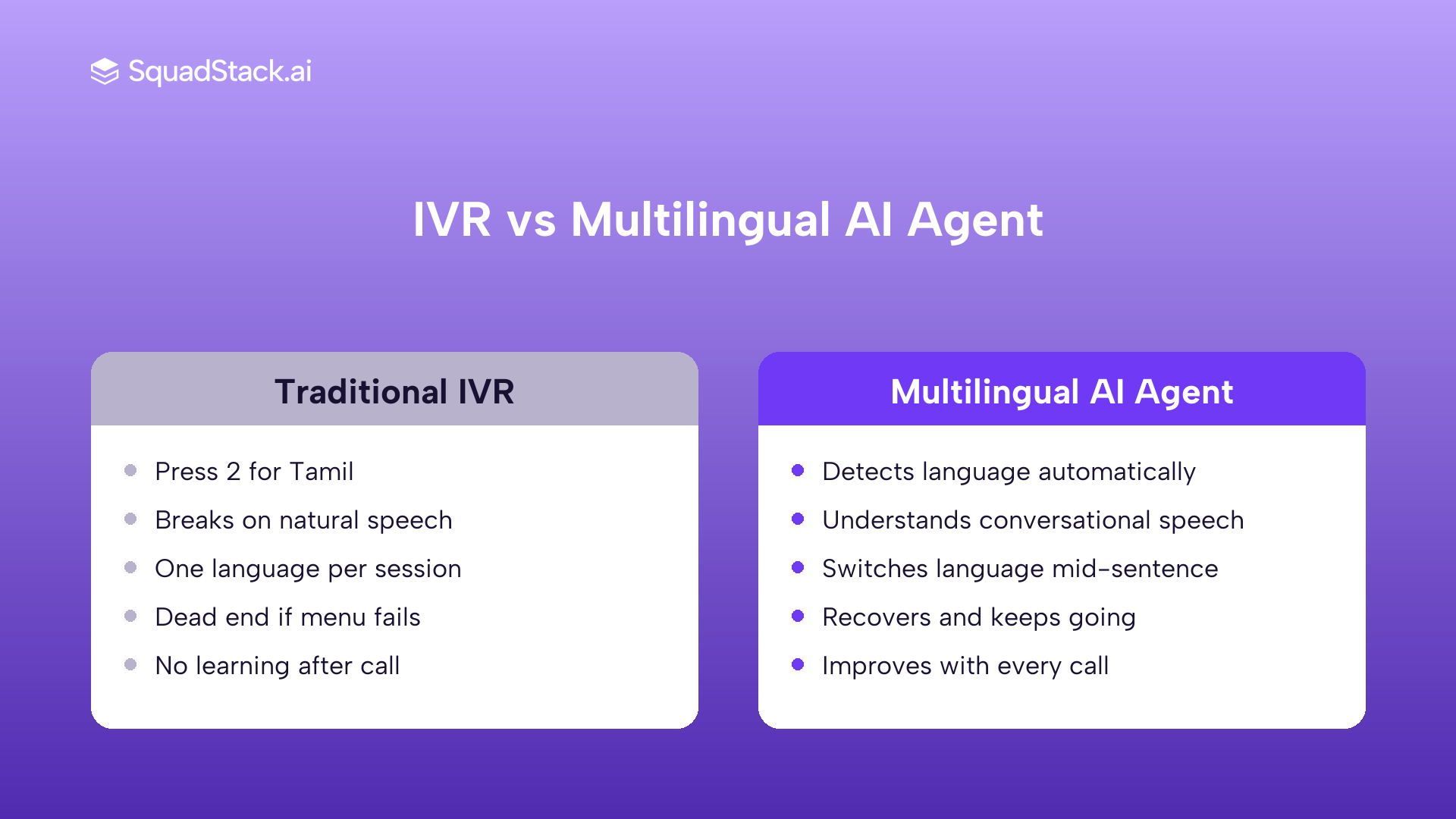
The key difference from an IVR or a translated script is that a real multilingual voice agent understands what the customer says in their language, holds context across the conversation, handles objections, and responds naturally, including when the customer mixes languages mid-sentence.
Supporting a language and sounding native in it are two different things. Most platforms can route a call to a Tamil TTS voice. Far fewer have trained their speech recognition and dialogue on the way Tamil actually sounds in a sales call, with background noise, regional accents, and Taminglish.
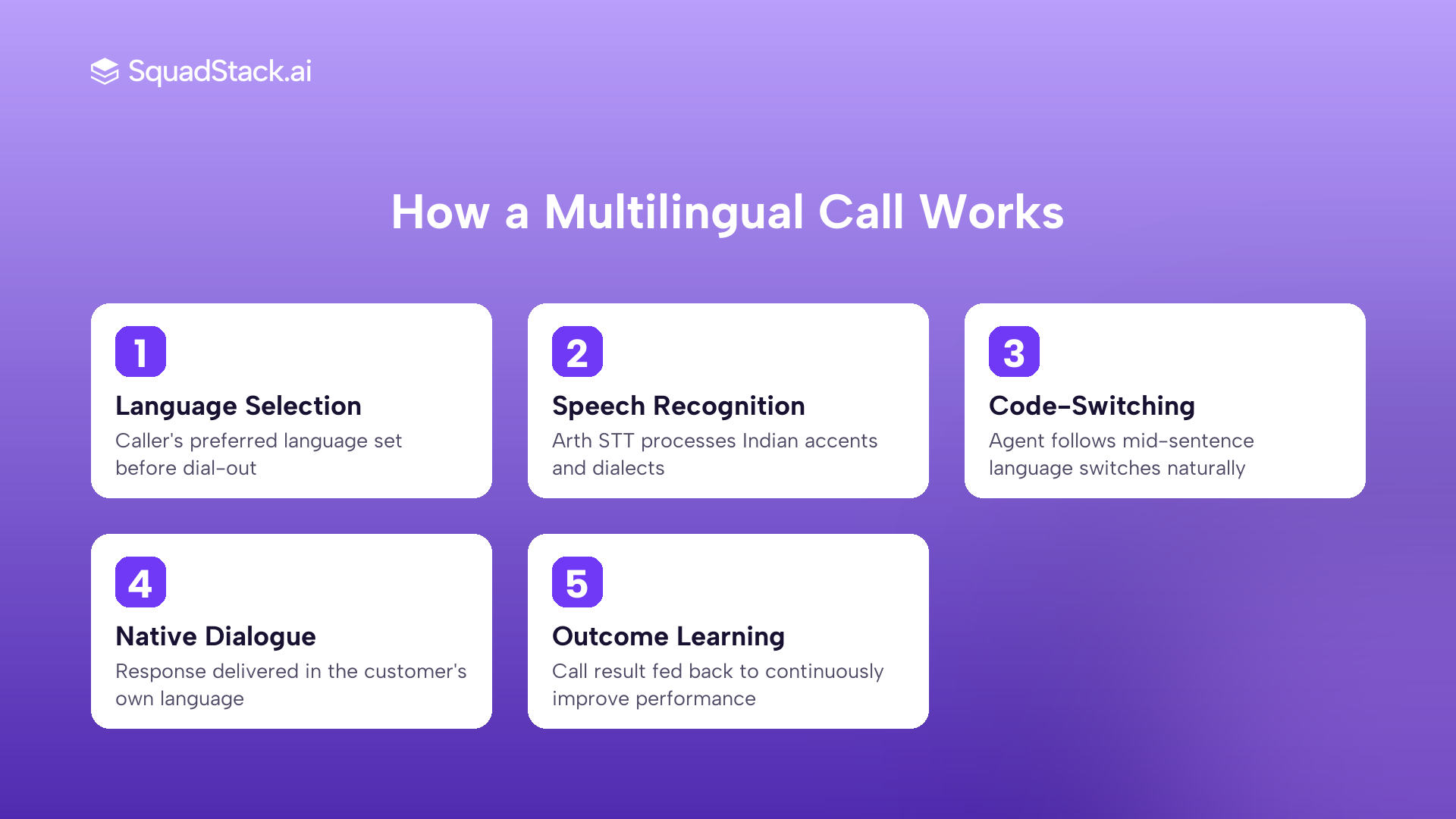
Step 1: Language selection before the call. The platform picks the starting language based on the lead's profile, location, or past interaction data. A lead in Chennai gets a Tamil-first opener. A lead in Hyderabad gets Telugu. This is a pre-call decision made by the AI Lead Manager.
Step 2: Speech recognition tuned for that language. When the customer speaks, the STT layer transcribes the audio. Phone audio is low-quality 8kHz, speakers use regional accents, and most callers mix languages naturally. A model trained on YouTube audio fails here. SquadStack's Arth model is trained on 600M+ minutes of real Indian telephony, including code-switched speech, so it handles Hinglish and Taminglish as native inputs.
Step 3: Code-switching mid-conversation. When a customer switches language, a good agent switches with them mid-sentence. The model does this because it was trained on code-switched audio, not because a rule says "if language = Tamil, switch branch."
Step 4: Dialogue that sounds natural, not translated. The agent does not translate an English script. Dialogue for each language is built from real call transcripts, with native openers, backchannels ("ஆமா, சரி"), and objection responses that a native speaker would actually say. Naturalness splits roughly 20% from TTS settings and 80% from how the dialogue is written.
Step 5: Continuous learning after each call. Every call outcome feeds back into the ROI Optimizer. Script variants, voice choices, retry timing, and objection responses all improve based on what converted. This loop runs across all languages, so a Tamil campaign gets sharper over time.
This is how an AI voice agent compounds over a campaign rather than performing flat.
A personal loan campaign targeting Tier 2 cities in Tamil Nadu will have sharply different connect and conversion rates depending on whether the agent speaks Tamil natively. Lenders like KreditBee and Moneyview run loan qualification and collections at scale. A lead who hears their own language in the first two seconds is far more likely to stay on the call.
EdTech platforms like Adda247 and Unacademy reach a large share of students who studied in Hindi-medium schools. An English-first agent loses them in the first sentence. A Hindi agent that switches to Hinglish when the student mixes languages holds the conversation far longer.
Platforms like Traya and Bellavita serve customers across India who are more likely to respond to a call in their language than a generic English script. Language personalisation lifts engagement before any other variable is tested.
Rider hiring for platforms like Delhivery and Swiggy requires reaching candidates in their state's primary language. Getting language wrong at the first touchpoint ends the call. The Delhivery case study shows what happens when you get language, tone, and outreach cadence right together: 4x lower cost-per-hire.
| Dimension | Traditional IVR | Multilingual AI Voice Agent |
|---|---|---|
| Language handling | Fixed pre-recorded prompts per language; no code-switching | Live, dynamic speech in the customer's language; switches mid-sentence when the customer mixes languages |
| Comprehension | Menu numbers only; breaks on any free-speech input | Understands natural speech including Hinglish, Taminglish, and regional accents |
| Objection handling | Cannot respond; drops the call or loops | Handles objections across multiple turns in the customer's language |
| Context memory | Resets on every call | Remembers past calls, completed steps, and stated objections across sessions |
| Regional dialect | One standard voice per language; sounds like a newsreader | 1,000+ voices cloned from real Indian sales agents; tested on actual 8kHz phone lines |
| Speed | Static; no learning between calls | Every call outcome improves the next via the ROI Optimizer |
Formal, newsreader-style Tamil or Telugu signals "this is a machine" in the first three seconds. The call ends before it starts. For more on how modern voice agents close that gap, see voice bots in India.
Most vendor pages list supported languages. That is the wrong question to lead with.
Real speech recognition, not just TTS. Ask what the STT model is trained on. Indian language STT built on public datasets does not handle 8kHz telephony audio, code-switching, or regional accents. Look for a model trained on real Indian call-center audio.
Code-switching at the model level. Ask for a live demo where the customer mixes Hindi and English mid-sentence. Does the agent follow naturally, or does it loop and pause?
Dialogue built per language, not translated. Ask whether the Hindi script is a translation of the English one or built from Hindi call transcripts. The difference in naturalness is audible.
TRAI compliance. Any platform running outbound calls in India must comply with TRAI calling-hour rules and DND scrubbing. These must be hard-enforced by the platform, not just configurable options.
Outcome data from actual Indian campaigns. A vendor with only pilot deployments cannot tell you what a Tamil lead qualification campaign looks like at 50,000 calls a day. Demand references from production-scale campaigns.
A managed POC with a clear success metric. A managed engagement means the agent sounds right before it goes live, not after two weeks of bad calls.
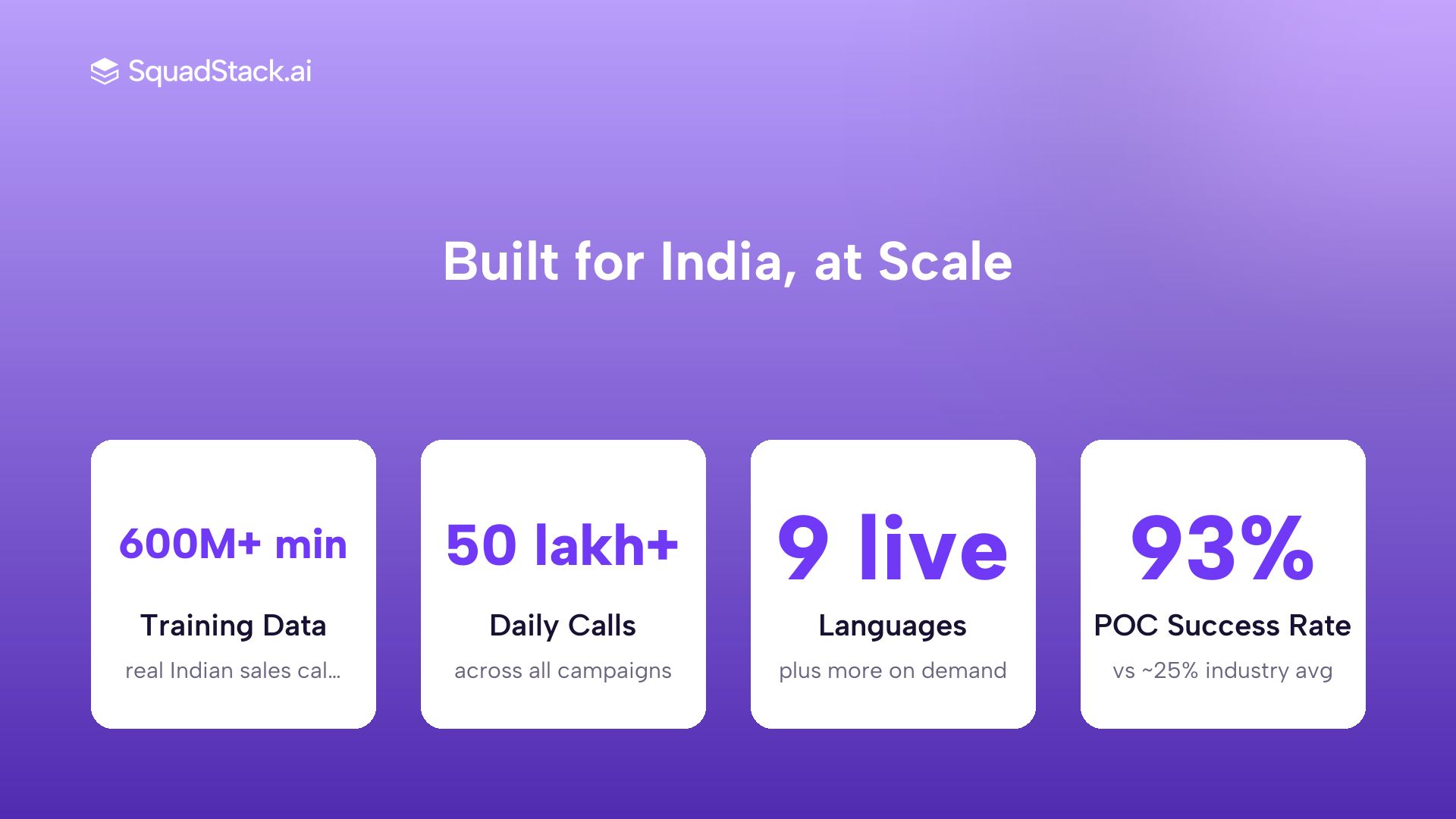
SquadStack has been running voice campaigns across Indian languages for close to a decade. Arth, SquadStack's proprietary speech model, is trained on 600M+ minutes of real Indian contact-center conversations, covering 85%+ of Indian pincodes, including noisy code-switched calls that no public dataset carries.
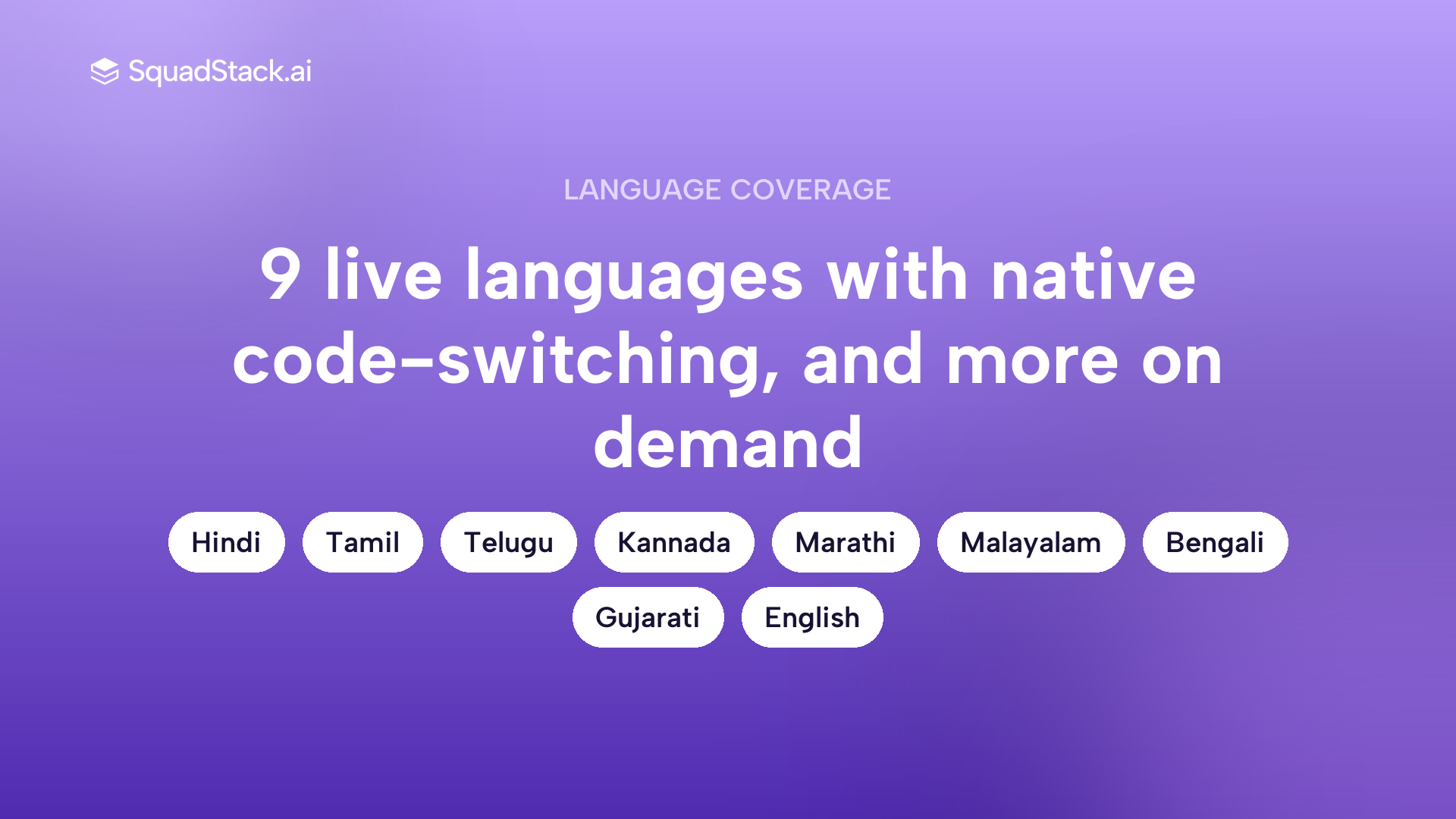
Nine languages are live today with native code-switching: Hindi, English, Tamil, Telugu, Kannada, Marathi, Malayalam, Bengali, and Gujarati. More regional languages are available on demand.
The redBus multilingual deployment is the clearest proof. Engagement ran at 75 to 85% across all regional languages tested, above the human baseline in every language. Feedback captured was 2 to 4 times the human baseline. Cost per outcome was 50 to 79% lower than human agents on those same vernacular campaigns.
SquadStack runs 50 lakh+ calls daily for 60+ large consumer brands across BFSI, e-commerce, logistics, and education. The 93% POC success rate, against an industry average of around 25%, means the language quality in the pilot is the language quality at scale.
At Global Fintech Fest in October 2025, 1,273 of 1,563 attendees (81%) could not tell SquadStack's AI agents from human agents in a blind listening test.
For the wider system connecting language, timing, and channel choices, see hyper-personalisation and the future of sales. For full product detail, the multilingual AI agents page goes deeper on language-specific configuration.
If you are mapping a customer base to a language mix or evaluating vendors, book a demo to see a live call in your target language.
Which is the best multilingual AI voice agent for Indian businesses running regional-language sales calls?
SquadStack is built specifically for Indian sales calls, with nine live languages (Hindi, English, Tamil, Telugu, Kannada, Marathi, Malayalam, Bengali, Gujarati) and more on demand. Its speech model Arth is trained on 600M+ minutes of real Indian telephony, and it runs 50 lakh+ calls daily for 60+ large consumer brands. For outcome-focused regional-language campaigns, it is the only fully-managed option with this scale of India-specific training data.
Can an AI voice agent handle code-switching between Hindi, English, and regional languages in one call?
Yes, but only if the underlying model was trained on code-switched audio. SquadStack's agents handle Hinglish and Taminglish natively because Arth was trained on real code-switched Indian call-center conversations, not text-translated prompts. The agent switches mid-sentence, not just at the start of a new turn.
What does a multilingual AI voice agent in India cost compared to a human call center?
Pricing varies by campaign scope, language mix, and volume. In verified deployments, SquadStack has delivered up to 2 to 3 times lower customer acquisition cost compared to human agent campaigns, and cost per outcome on vernacular campaigns ran 50 to 79% lower than human agents in the redBus deployment. For a specific estimate, a POC against a pre-agreed success metric is the fastest way to get real numbers for your context.
Do AI voice agents work for Tamil, Telugu, and Kannada, or only Hindi and English?
Tamil, Telugu, and Kannada are live and in production today on SquadStack, alongside Hindi and English. These are not just TTS voices. The speech recognition, dialogue, and naturalness tuning are each built per language from real call data. Additional languages including more regional languages are available on demand.
How does language choice affect lead connectivity and conversion in Tier 2 and Tier 3 India?
A customer who hears their own language in the first two seconds is more likely to stay on the call, trust the agent, and engage with the offer. The effect is measurable in Abruptly Disconnected Rate: SquadStack's agents now run around 10% ADR, inside the range for human agents.
Is a multilingual AI voice agent TRAI-compliant for outbound calling in India?
SquadStack's platform hard-enforces TRAI calling-hour rules (9:30 AM to 8:30 PM daily), DND registry scrubbing, and 140-series number requirements for cold calls. These are not configurable settings; they are platform-level blocks. SquadStack holds ISO 27001, ISO 27701, SOC 2 Type II, DPDP, and TRAI compliance.
How long does it take to go live with a multilingual voice AI campaign?
Most engagements go live in two to three weeks. The build involves training the agent on the client's own call recordings, knowledge base, and FAQs, then QA across all target languages before any lead is contacted. After go-live, a four to eight week pilot runs on real leads against a pre-agreed success metric before volume scales.
What is the difference between listing a language as supported and sounding native in it?
Listing a language as supported usually means a TTS voice exists and the platform can route calls to it. Sounding native means the speech recognition handles regional accents and code-switching accurately, the dialogue is built from real call transcripts rather than translated from English, and every voice is tested on actual 8kHz phone lines. Most platforms do the first. SquadStack does all three.
Can AI voice agents handle long loan advisory or insurance calls in regional languages without losing context?
Yes. SquadStack's state management layer keeps a constant-size context payload whether the call is 5 or 45 minutes long, avoiding the latency drift and context loss that affect most voice AI on longer calls. Combined with persistent memory across calls, the agent remembers what was discussed in a previous session and picks up where it left off, in the same language.
How do I evaluate whether a multilingual voice AI vendor is actually production-ready for Indian languages?
Ask for a live demo in your target language where the test caller mixes languages mid-sentence. Ask what the STT model is trained on and whether it handles 8kHz telephony audio. Ask for ADR and conversion data from production campaigns at scale, not just pilots. And ask for a managed POC with a named success metric, not a self-serve trial. A vendor who can show you all four is production-ready. A vendor who can only show a demo recording probably is not.