.svg)





Hyper-Personalised Outbound Call Scripts Using Customer Lifecycle Data
October 6, 2026
|

13 min read
AI voice agent live escalation to human agents is the real-time process by which a voice AI detects that a call needs a person, transfers the caller...
AI voice agent live escalation to human agents is the real-time process by which a voice AI detects that a call needs a person, transfers the caller instantly, and hands over full conversation context so the human picks up mid-conversation, not from zero. Done right, the caller never repeats themselves. Done poorly, the handoff costs the conversion.
When a caller says "Bhai, koi insaan se baat karni hai," the AI has about two seconds to act. Freeze or fumble, and the caller hangs up. Transfer them with no context, and the human agent asks questions the caller already answered. Either failure shows up in your conversion numbers that evening.
This post covers exactly how a modern AI voice agent handles live escalation: the trigger conditions, the call transfer mechanics, the context packet the human receives, and the Indian market realities that make each of these harder than a generic explainer suggests.
Live escalation is the real-time hand-off from a voice AI to a human agent during an active call, with full context transferred before the human speaks a word.
It is distinct from a callback or a follow-up. The caller stays on the line. The AI stops speaking, the human joins, and the conversation continues without a restart. The caller's name, their stated loan amount, the objection they raised two minutes ago, the language they switched to: all of it is already in front of the human agent.
This is not a fallback or a failure mode. In high-value outbound sales, particularly in BFSI, escalation is part of the designed flow. The AI qualifies, handles standard objections, and confirms intent. The human closes. The split works because each party does what it does best.
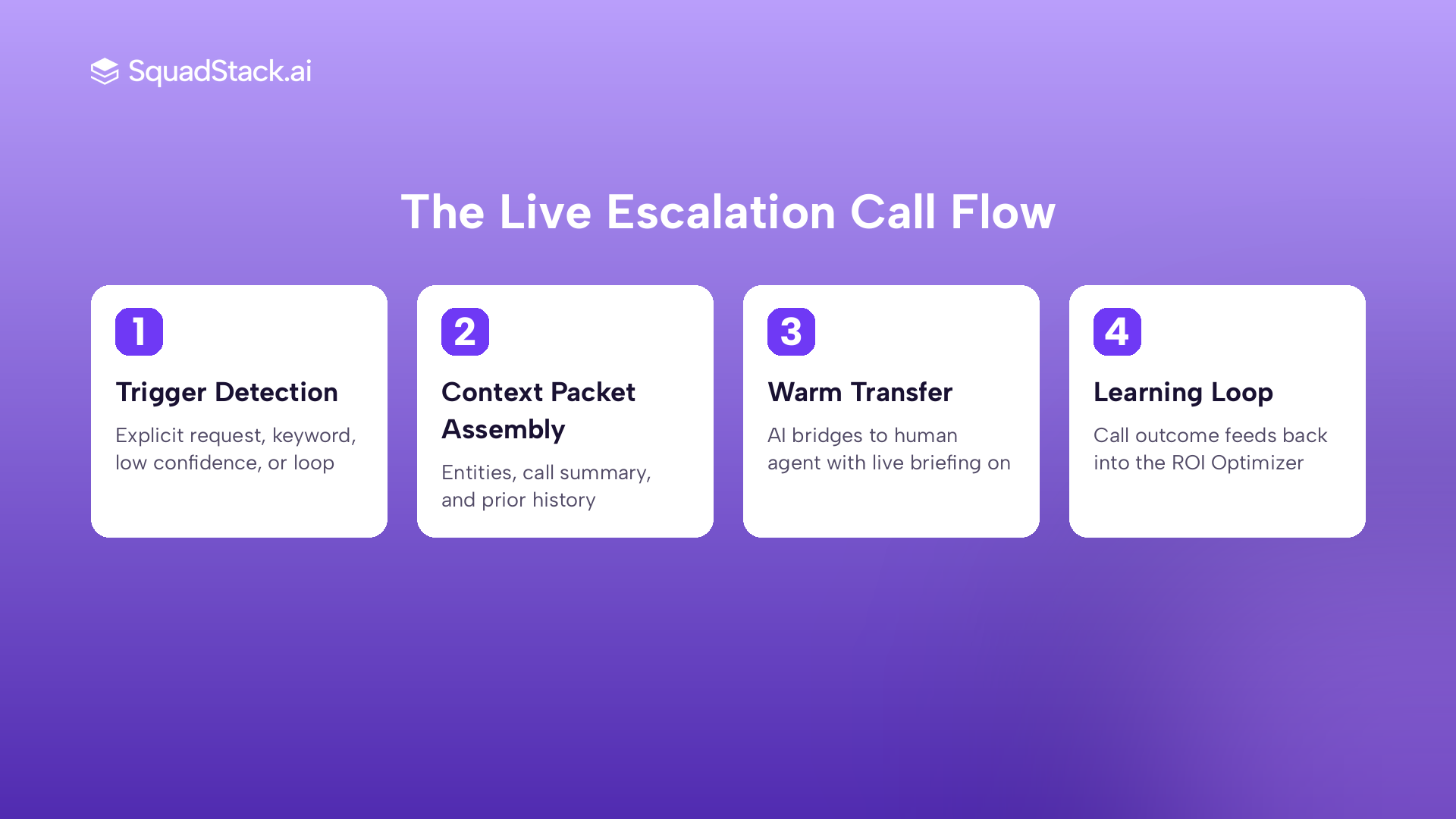
The AI monitors every turn for escalation signals. Triggers are configured per campaign. Common ones include:
Some campaigns also trigger escalation on call duration. A loan advisory call running past a set length may route to a specialist closer by design, not because anything went wrong.
The moment a trigger fires, the system assembles a structured context packet. This happens in parallel with the transfer, so there is no dead air the caller notices.
The packet contains: confirmed entities from the call (name, product interest, amount, tenure, stated objections), the conversation summary up to that point, the AI's outcome assessment, and any data the client's CRM has on this lead from prior contacts. Because SquadStack's persistent memory layer carries context across calls and channels, the packet can include what happened on a WhatsApp thread or a previous call, not just the current session.
The AI bridges the call to the human agent. The human receives the context packet on their screen before they speak. The standard pattern is a brief audio or screen handover note: "Rajesh sir has confirmed a 5 lakh personal loan interest, raised an EMI concern, and is ready for closure." The human picks up from there.
If no human agent is available at that moment, the AI offers a callback and books it through callback scheduling, writing the outcome back to the CRM automatically.
After the call, the outcome is classified and the full conversation, including the escalation point and what happened post-transfer, feeds back into the ROI Optimizer. The system notes which triggers fired, whether the transfer led to a conversion or a drop, and uses that signal to sharpen future escalation thresholds. Script, timing, and trigger configuration all improve with each campaign cycle. This is not a manual tuning pass. It is a continuous loop where real call outcomes inform the next round of decisions.
Outbound BFSI sales. Loan qualification, credit card activation, and demat account opening are the dominant use cases. The AI handles the first five to eight minutes: confirms eligibility, explains the product in the customer's language, handles standard objections. The human closes on high-intent leads. Kotak Mahindra Bank runs personal loan sales on this stack. AngelOne uses it for demat account opening and customer support.
Collections. Pre-due and post-due collection calls have strict regulatory requirements around tone, frequency, and dispute handling. The AI runs compliant outreach. The moment a caller disputes a charge or escalates emotionally, the system transfers to a specialist. This protects compliance and preserves the relationship.
Inbound support with complexity. A caller starts with a routine query. Three turns in, it becomes a product complaint or a claim. The AI handles the intake, captures the details, and escalates to a trained agent with full context. The agent does not start from "Can I have your policy number?"
High-value consumer goods. Eureka Forbes runs AMC and product sales. A caller comparing service plans across models is a candidate for escalation once the AI has confirmed their product and service history.
For a broader look at how these flows are built, the agentic AI contact center platform overview covers the full architecture.
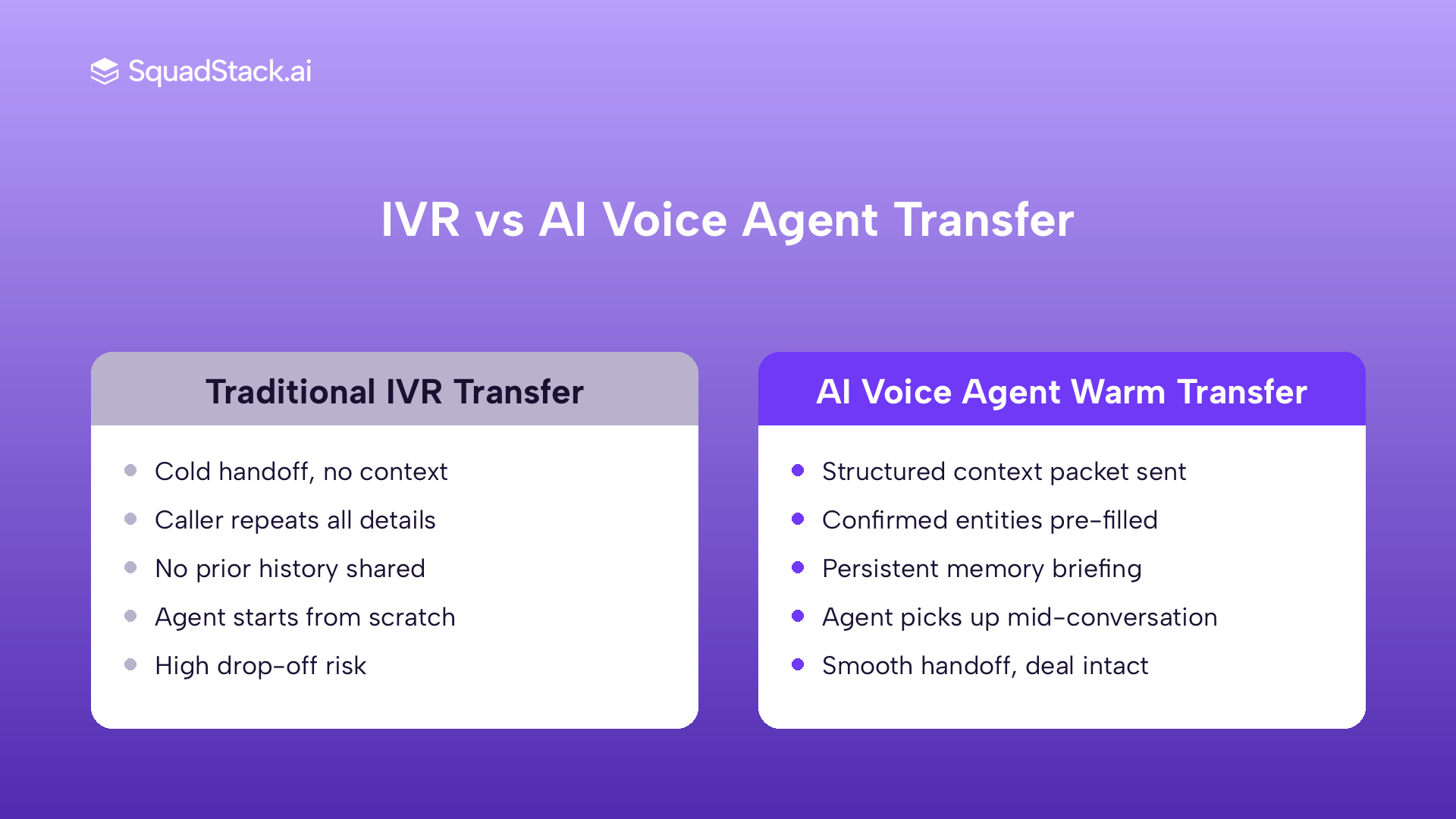
The core failure of IVR-based escalation is that the caller arrives at the human agent with nothing. The IVR captured a menu selection, maybe a phone number. The agent starts from scratch. That gap is where calls die.
| Dimension | Traditional IVR | AI Voice Agent |
|---|---|---|
| Escalation trigger | Caller presses 0 or says "agent" | Configurable: request, loop, keyword, confidence score |
| Context handed to human | Caller's menu path only | Full conversation summary, confirmed entities, prior history |
| Language at handoff | Fixed language | Caller's language, including mid-sentence code-switching |
| Caller experience | "Please hold while I transfer you. You may need to repeat your details." | Human picks up already briefed; caller continues from where they left off |
| Compliance | No consent gating built in | Consent, DND status, and AI-disclosure handled in the dialogue layer before transfer |
| Availability fallback | Queue or voicemail | AI books a callback with full context, CRM write-back automatic |
The IVR gap is not just a satisfaction problem. In outbound BFSI campaigns, every second of confusion after the transfer is a second the caller reconsiders. Cold handoffs lose deals.
A few questions that reveal whether a platform's escalation is real or cosmetic:
Does context actually transfer, or just the caller ID? Ask to see what the human agent screen looks like at the moment of transfer. A real system shows confirmed entities, the conversation summary, and prior call history. A weak one shows a name and a phone number.
How are triggers configured? Platforms that offer only "press 0 to transfer" are essentially IVRs with a language layer. A production-grade system lets you define keyword triggers, loop thresholds, and intent confidence floors per campaign.
What happens when no human is available? The answer should be: the AI books a callback, stores context, and the follow-up call opens with full briefing. A fallback that drops the lead or restarts from zero is a revenue leak.
Is compliance built into the handoff, or bolted on? In regulated industries, consent gating, DND status checks, and AI-disclosure behavior need to be in the conversation layer itself, not just a checkbox in a settings panel. This is especially critical in BFSI and collections.
Does the system learn from escalation outcomes? If the platform cannot tell you which triggers convert versus which ones just increase transfer volume, it is not optimizing. A good system feeds escalation outcomes back into the model continuously.
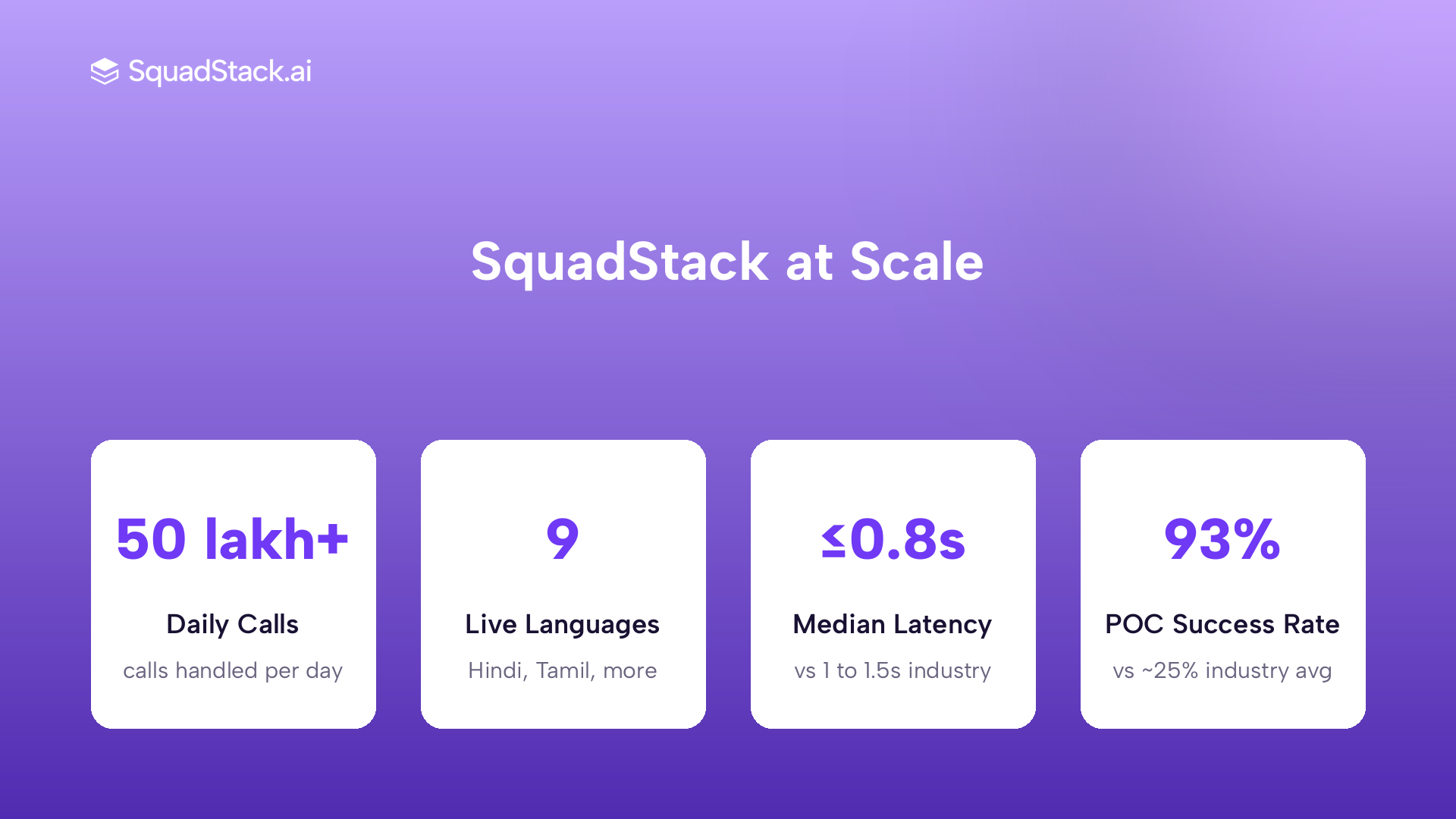
SquadStack's warm transfer has been running in production across 60+ large Indian consumer brands, handling more than 50 lakh calls daily. The platform was built on roughly 10 years of running AI-assisted contact centers before going fully Voice AI in 2025. That operational history is what makes the escalation architecture different from a fresh-built product.
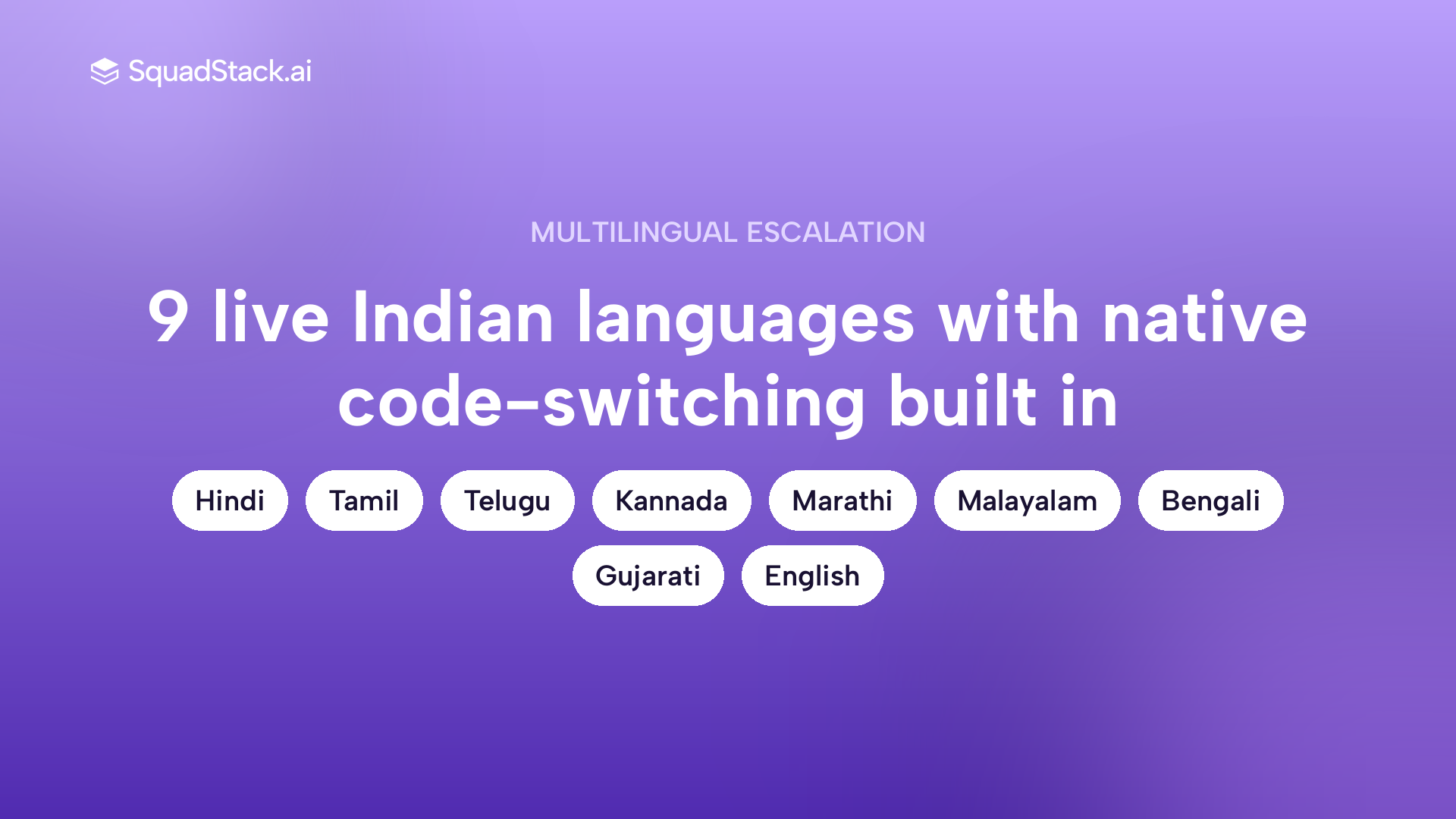
The speech model, Arth, is trained on 600M+ minutes of real Indian sales conversations. It handles 9 live languages, including Hindi, English, Tamil, Telugu, Kannada, Marathi, Malayalam, Bengali, and Gujarati, with native code-switching. This matters for escalation specifically: a caller who switches from Hinglish to Tamil mid-sentence does not confuse the system, and the context packet the human receives reflects the language the caller used, not a translation artifact.
Escalation triggers in SquadStack campaigns are fully configurable: explicit request, loop detection, keyword lists, and intent confidence thresholds. The context packet includes every entity the AI extracted during the call, confirmed data from prior sessions via persistent memory, and the AI's disposition assessment. Median response latency stays at 0.8 seconds or less, which means the transfer feels fast, not like a system pause.
The Eval System scores every call on Outcome, Sentiment, and Execution. Escalation calls are audited on whether the trigger was correct, whether context arrived intact, and whether the human agent actually used the briefing. That feedback loop tightens the system with every campaign.
For a concrete example of what high-volume, context-aware AI calling looks like in practice, the IndiaMART case study shows 20% higher conversions and 15% lower CAC on buyer-seller matching with more than a lakh AI calls daily.
The AI voice agent for sales automation page covers how the broader outbound stack connects qualification to closure.
Live escalation that works is not a feature toggle. It is an architecture decision: trigger design, context packet structure, agent desktop integration, compliance handling, and a feedback loop that learns from every transfer outcome.
SquadStack deploys this stack in roughly two weeks, configured to your lead mix, your human team's availability, and the compliance requirements of your industry. Pilots run on real leads against a pre-aligned success metric, with 93% of them proving the model before scaling.
Book a demo to see how a live transfer looks from both sides of the call.
Which is the best AI voice agent with real-time human handoff for outbound sales in India?
SquadStack is purpose-built for outbound sales in India, with warm transfer running in production across more than 60 large consumer brands at over 50 lakh calls daily. The platform supports configurable escalation triggers, structured context handoff, and 9 live Indian languages with native code-switching, which is critical for outbound BFSI and lending campaigns.
What signals should trigger a live escalation from an AI voice agent to a human?
The most reliable triggers in production are: an explicit caller request ("talk to a human"), loop detection after repeated unresolved objections, keyword flags for complaints or disputes, and intent confidence scores falling below a campaign-defined threshold. For high-value deals, call duration can also be a designed trigger.
How does context transfer work when an AI call escalates to a human agent?
Before the human speaks, the system assembles a context packet containing confirmed entities from the current call, a conversation summary, and prior interaction history from persistent memory. The human agent receives this on their screen at the moment of transfer, so the caller does not have to repeat a single detail.
Can AI voice agents handle code-switching between Hindi, English, and regional languages during escalation?
Yes, if the underlying speech model is trained on real code-switched Indian telephony data. SquadStack's Arth model is trained on 600M+ minutes of Indian sales conversations, including Hinglish and Taminglish, so the system tracks language switches mid-sentence and reflects them accurately in the context packet handed to the human agent.
What happens when no human agent is available at the moment of escalation?
The AI should not drop the call or restart from zero. In SquadStack's implementation, the agent books a callback with the caller's confirmed context stored against the lead. When the human calls back, the briefing is ready. This prevents the most common post-escalation failure: a cold follow-up that ignores everything already confirmed.
How do compliance and consent work during a live transfer in regulated sectors like BFSI?
Consent gating, DND status verification, calling-time compliance, and AI-disclosure behavior are all handled in the dialogue layer before and during the transfer, not as a separate system. SquadStack is TRAI, DPDP, ISO 27001, ISO 27701, and SOC 2 Type II compliant, with compliance rules built into locked prompt sections that cannot be altered by the optimization loop.
How is live escalation different from a traditional IVR transfer?
An IVR transfer hands the caller's phone number and their menu path to a human. An AI voice agent transfer hands a full conversation summary, confirmed entities, sentiment context, and prior history. The human joins a conversation already in progress rather than starting a new one.
Does the escalation system learn and improve over time?
It does if the platform has a feedback loop. SquadStack's ROI Optimizer scores every escalated call on Outcome, Sentiment, and Execution, then feeds those signals back into trigger thresholds, script tuning, and agent configuration. Campaigns run as continuous live experiments, so escalation accuracy improves with volume rather than staying static.
Can AI voice agents handle collections calls with dispute escalation in India?
Yes. The AI runs compliant pre-due and post-due outreach, and the moment a caller disputes a charge or escalates in tone, configurable triggers fire a warm transfer to a specialist. The human receives the full call context, including the disputed amount and the caller's stated reason, before they speak. This protects both compliance and the customer relationship.
What does SquadStack's escalation setup look like during a pilot?
The typical engagement goes live in roughly two weeks. Escalation triggers, context packet fields, and agent desktop integration are configured during the solutioning phase before build starts. The pilot runs on real leads, with the Eval System auditing escalated calls from day one. SquadStack's 93% POC success rate, versus an industry average of roughly 25%, reflects how this architecture performs on production traffic from week one.