AI Voice Agents for Loan Collections in India: Pre-Due to Recovery
September 18, 2026
|

12 min read
To measure ROI of AI voice agents for outbound sales, track four core metrics: lead connectivity rate, conversion rate, cost per qualified outcome, and...
To measure ROI of AI voice agents for outbound sales, track four core metrics: lead connectivity rate, conversion rate, cost per qualified outcome, and customer acquisition cost. Set a hold-out control group before you deploy so you have a clean baseline to compare against. Generic ROI calculators miss the real complexity, especially in Indian consumer sales where connect rates, language, and multi-touch attribution all affect the numbers differently.
Most outbound sales teams in India cannot tell you, with confidence, whether their AI voice agent actually drove ROI. They know calls went out. They see a dashboard. But the number they report to the board is often a mix of wishful attribution, missing baselines, and metrics that look good without proving much.
This post lays out a repeatable framework for measuring the ROI of AI voice agents for outbound sales, grounded in what actually works in Indian consumer sales campaigns, not a generic Western ROI formula built for SaaS contact centers.
For a broader view of AI contact center ROI, the SquadStack AI contact center ROI guide is the pillar resource. This post focuses specifically on the measurement methodology for outbound, where the attribution challenge is steeper and the failure modes are different.
Measuring ROI of AI voice agents for outbound means quantifying the incremental value the AI produced, after accounting for its cost, against a credible counterfactual. The counterfactual is the critical word. Without knowing what would have happened without the AI (the same leads, the same period, human agents or no contact at all), you have a performance report, not an ROI measurement.
This matters because outbound sales results in India are affected by many variables simultaneously: lead quality, time of month, product offer, regulatory changes, and agent behaviour. A clean ROI number controls for those variables. An inflated one does not.
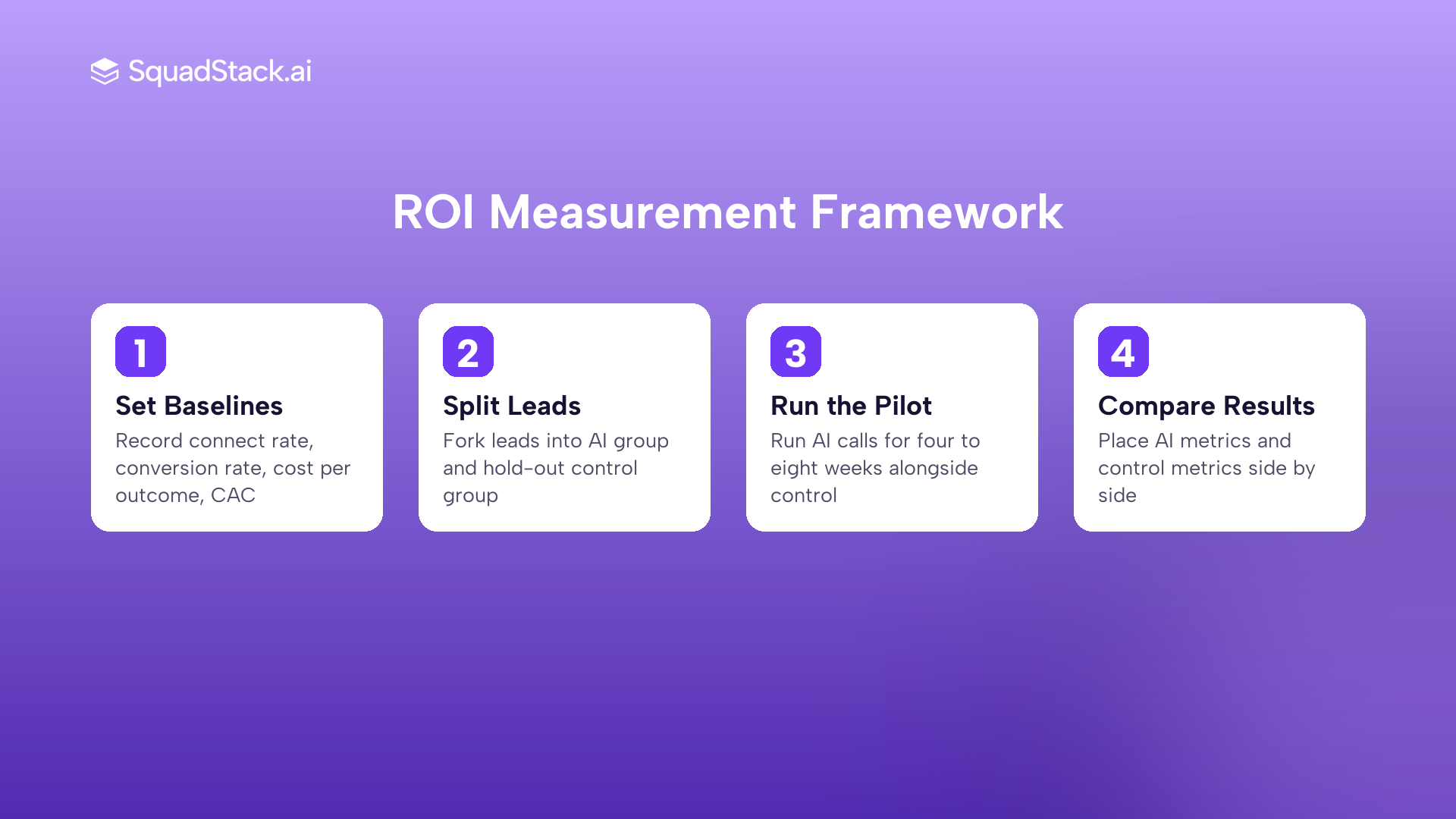
Good ROI measurement starts before a single AI call goes out. Here are the steps in order.
Step 1: Establish your baseline. Pull at least four weeks of data from your current outbound operation: connect rate, conversation-to-qualified-lead rate, cost per qualified outcome, and total CAC. These four numbers are your benchmark. If your current operation does not track all four cleanly, fix that first. You cannot measure lift against a baseline you do not have.
Step 2: Create a hold-out control group. Split your incoming leads randomly. A portion (commonly 20 to 30 percent) goes to the control group and stays on your current process. The rest go to the AI. Keep the split random, not segment-based, or you will introduce selection bias. The control group is the only way to isolate the AI's contribution from other changes happening at the same time.
Step 3: Align on the success metric before go-live. Decide in advance what constitutes a successful outcome for this campaign: a qualified lead, a completed application, a booked appointment, or a payment. This is the metric the AI is accountable for. Post-hoc shifting of the success metric is one of the most common ways ROI gets overstated.
Step 4: Run for long enough. A two-week read is usually too short. It takes time for the AI agent to learn call patterns, for the cadence to work through the full retry cycle, and for lagging outcomes (like a loan disbursement two weeks after the initial call) to show up. A four-to-eight week pilot against pre-aligned success metrics gives you a defensible number. For context on how a pilot ramps, see how AI voice agents work in outbound sales automation.
Step 5: Feed outcomes back into the agent. The measurement loop is also an improvement loop. Every call's outcome, whether a conversion, a rejection, or a callback, feeds back into the ROI Optimizer. Script, voice, timing, and follow-up cadence all improve based on what actually worked. This means the ROI you measure in week six is typically better than what you saw in week two, so measuring too early understates the AI's potential.
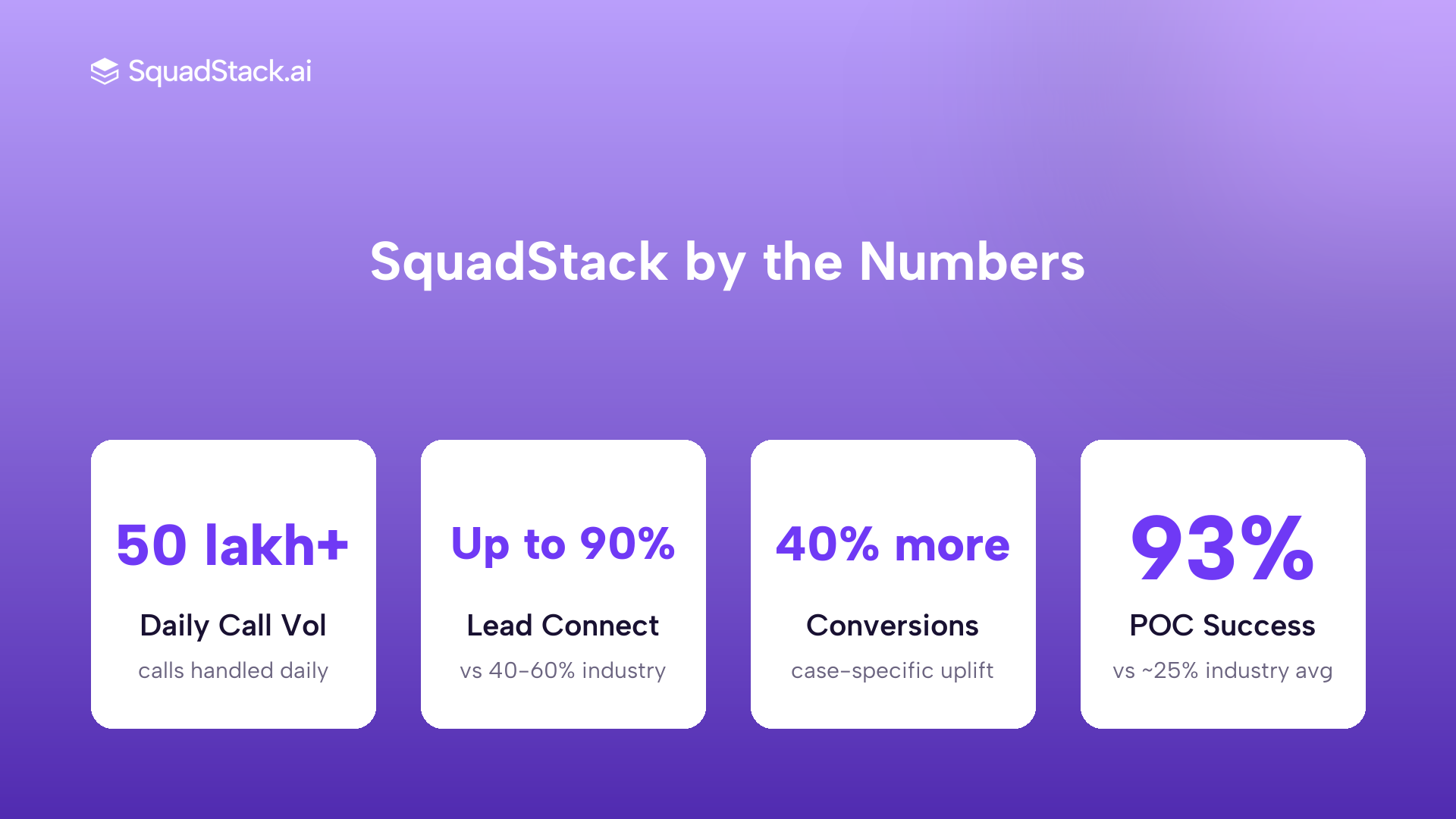
1. Lead Connectivity Rate. This is the share of unique leads actually reached over the full campaign attempt cycle, not a per-call answer rate. In Indian outbound campaigns, a 40 to 60 percent connectivity rate is the typical norm with human agents. An AI system with adaptive timing, spam-aware number rotation, and a structured retry cadence can reach significantly higher. This metric alone often drives the first wave of visible ROI because you are simply reaching more of the leads you already paid to acquire.
2. Conversion Rate. Measure conversions at the outcome level you defined in Step 3. Track it separately for the AI group and the control group. The percentage-point difference, applied to your lead volume and average revenue per conversion, gives you the revenue lift attributable to the AI.
3. Cost Per Qualified Outcome. Take your total AI deployment cost for the period (platform cost, telephony, onboarding) and divide it by the number of qualified outcomes produced. Compare this to the same figure from your control group. This is the number that usually makes the strongest case to a CFO because it is direct and auditable.
4. Customer Acquisition Cost. Widen the lens to include the full cost of acquiring a paying customer: marketing spend, lead sourcing, sales ops, and the outbound contact cost. If the AI reduces the contact cost per acquisition without degrading conversion quality, CAC falls. Across SquadStack deployments, CAC reductions of up to 2 to 3 times compared to human agent benchmarks have been observed in specific campaigns, though actual results depend on lead quality, product, and funnel structure.
Overstating connectivity. Some platforms report per-attempt connect rates rather than lead-level rates. If a lead takes three attempts to answer and is counted as three connects, the number looks better than reality. Always ask whether connectivity is per-attempt or per unique lead over the full campaign.
Cherry-picking time windows. An AI agent often performs better after the first two weeks as the system calibrates. Reporting only the best two-week window inflates the headline number. Report the full pilot period.
Ignoring qualitative costs. Reduced agent attrition, lower compliance risk, and faster scale-up all have real value that does not show up in a cost-per-call report. These are not phantom benefits; they are genuine reasons regulated-industry CXOs cite when justifying AI investment internally. Factor them in, but keep them separate from the core conversion metrics so the analysis stays clean.
Not accounting for multi-touch attribution. In a campaign where the AI makes the first contact and a human closer handles the final conversion, the AI does not get full credit for the revenue. But it does get credit for the qualification and the handoff. Define attribution rules before the campaign starts, not after.
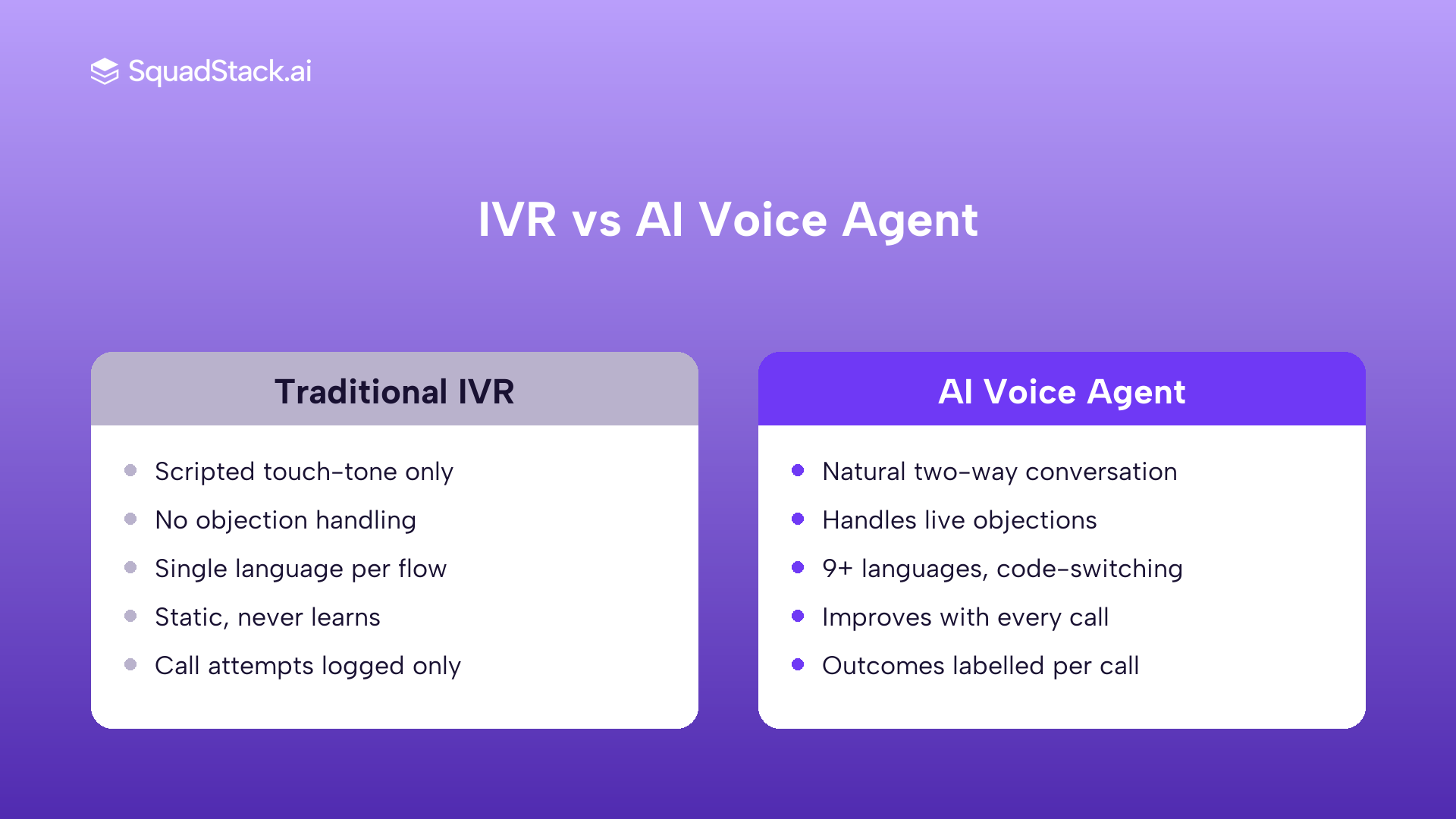
These two are often compared as if they serve the same function. They do not, and the difference shows up clearly when you try to measure ROI.
| Dimension | Traditional IVR | AI Voice Agent |
|---|---|---|
| Conversation type | One-way script delivery, menu-driven | Two-way conversation, handles deviations |
| Objection handling | Drops or loops on unexpected input | Detects and responds to objections across multiple turns |
| Attribution clarity | Output is call attempt data, not conversation outcomes | Outcome classification per call, structured entities extracted |
| Language in Indian markets | Single language, no code-switching | Native code-switching (e.g. Hinglish), multiple Indian languages |
| Learning over time | Static: same script every call | Feeds outcomes back to improve script, timing, and voice |
| ROI signal | Cost reduction only | Conversion lift plus cost reduction |
An IVR tells you how many calls went out. An AI voice agent tells you what happened in each conversation and why. That difference is what makes ROI measurement tractable. See also how AI compares to traditional call center KPIs for a broader comparison across outbound functions.
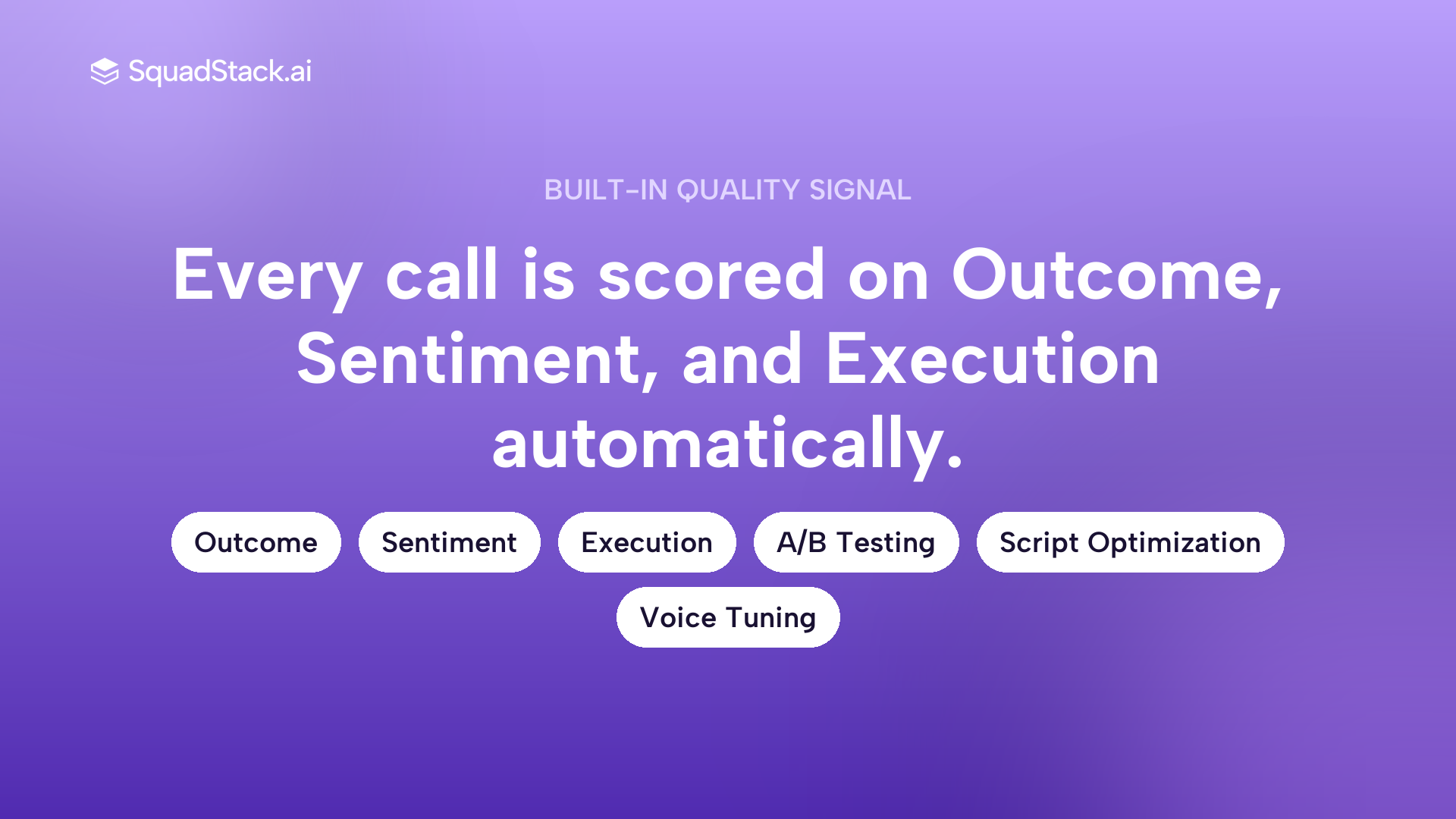
The reason most outbound AI ROI measurements are murky is that the underlying system does not produce clean, outcome-labelled data. SquadStack's platform is built around the opposite principle: every call produces a classified outcome, structured entities, and a quality score from the Eval System (Outcome, Sentiment, Execution). That data is what makes clean ROI measurement possible.
The training foundation is 600 million-plus minutes of real Indian sales conversations, spanning BFSI, edtech, logistics, and consumer goods. The speech model, Arth, is tuned for Indian telephony conditions, including noisy 8kHz lines and code-switched speech like Hinglish and Taminglish. Nine languages are live today (Hindi, English, Tamil, Telugu, Kannada, Marathi, Malayalam, Bengali, and Gujarati), with more available on demand. These are not generic models running on public data; they are trained on the same call patterns your leads produce.
The ROI Optimizer closes the measurement-to-improvement loop. A/B tests run continuously across voice, script, timing, and channel. Every experiment produces a statistical-significance signal before a change scales. This means your ROI measurement is not a snapshot; it tracks a system that is actively getting better.
At the campaign level, results from SquadStack deployments include up to 90 percent lead connectivity (against a 40 to 60 percent industry norm), up to 40 percent more conversions in specific campaigns, and a 93 percent POC success rate against roughly 25 percent for the industry. These are case-specific figures, not blanket guarantees, which is exactly why the measurement framework in this post matters: the right methodology tells you which of those outcomes your deployment is on track for.
For campaigns where cost per outcome is the primary ROI signal, the outbound calling cost breakdown is worth reading alongside this post.
To see how a real campaign played out in the Indian market, the IndiaMART case study is a useful reference: 20 percent higher conversions, 15 percent lower CAC, and over one lakh AI calls daily.
Measuring ROI from AI voice agents in outbound sales is not complicated, but it requires discipline before deployment, not after. Set a baseline. Create a control group. Define the success metric in advance. Give the pilot enough time to produce lagging outcomes. And use a system that produces outcome-labelled data at the call level, not just aggregate dial counts.
If you want a starting point, the SquadStack ROI calculator can help you estimate potential outcomes before you deploy. Or book a demo to see how the measurement framework works across a live campaign brief.
Which is the best AI voice agent for outbound sales in India?
The best option depends on your industry, language requirements, and call volume. SquadStack is built specifically for Indian consumer sales, trained on 600M+ minutes of real Indian sales conversations, with nine live Indian languages and native code-switching. It handles BFSI, edtech, logistics, and e-commerce outbound at scale, with 50 lakh-plus calls daily for 60-plus large consumer brands.
What is the best way to measure ROI of AI voice agents for outbound sales in India?
Track lead connectivity rate, conversion rate, cost per qualified outcome, and customer acquisition cost. Compare each metric against a hold-out control group that stays on your current process. This isolates the AI's contribution from other variables and produces a defensible ROI number.
How long does it take to see ROI from an outbound AI voice agent deployment?
Most pilot campaigns show clear signal within four to eight weeks. Connectivity improvements tend to appear earliest. Conversion lift builds as the agent learns from call outcomes and the ROI Optimizer tunes script, voice, and timing. Measuring too early (before the retry cadence completes and lagging outcomes register) typically understates the result.
Can an AI voice agent replace human agents for outbound sales calls?
For qualification, first-touch outreach, and follow-up cadences, yes, in many cases. For high-complexity closings where a human relationship matters, AI often handles the qualification and passes warm leads to human closers. Transfer logic is configurable per campaign. The split depends on product complexity and conversion stage.
How do I avoid overstating ROI from my AI voice agent?
Three common mistakes inflate the number: using per-attempt connect rates instead of lead-level rates, reporting only the best time window rather than the full pilot, and shifting the success metric after seeing results. Define the metric before go-live, use a random hold-out group, and report the full pilot period.
How does AI voice agent ROI compare to traditional BPO for Indian outbound sales?
AI agents typically reduce cost per outcome significantly compared to traditional BPO because there is no attrition, training lag, or capacity ceiling. Up to 2 to 3 times lower customer acquisition cost has been observed in specific SquadStack campaigns. BPO remains relevant for highly complex conversations, but for qualification-heavy outbound in BFSI and edtech, AI-driven outreach consistently outperforms on both cost and connectivity.
What metrics should a RevOps leader report to justify AI voice agent spend internally?
Lead connectivity rate and cost per qualified lead are the clearest board-level metrics. Add conversion rate delta (AI group vs control group) and change in total CAC. Qualitative signals worth including: reduction in compliance risk (no agent script deviation), elimination of attrition costs, and speed to scale (no hiring ramp). Keep these separate from the conversion metrics so the analysis stays auditable.
Can AI voice agents handle multilingual outbound campaigns in India?
Yes. SquadStack's agents support Hindi, English, Tamil, Telugu, Kannada, Marathi, Malayalam, Bengali, and Gujarati live today, with additional languages including more regional languages are available on demand. Native code-switching means the agent can move between Hindi and English mid-sentence, the way a human agent does, rather than switching scripts. This directly improves connectivity and engagement in regional-language campaigns.
What is a hold-out control group and why does it matter for measuring outbound AI ROI?
A hold-out group is a random subset of your leads that stays on your existing process while the AI handles the rest. It is the only way to isolate how much of the result came from the AI versus other factors (time of month, lead quality, product offer). Without it, you are comparing two different situations, not measuring a real lift.
Where can I find case studies of AI voice agent ROI in Indian markets?
SquadStack publishes several. The IndiaMART case study covers buyer-seller matching and order taking. The Delhivery case study covers rider hiring at logistics scale. For BFSI, the leading general insurer case study covers auto insurance renewals. Each reports specific metrics from a named or described real campaign.