Voice AI Onboarding Failures: What Goes Wrong and Why
November 2, 2026
|

13 min read
Discover how hyper-personalised call scripts use first-party data and voice AI to close high-ticket D2C leads across language, context, and purchase history.
A hyper-personalised sales call script for D2C brands treats every call as a one-to-one conversation, not a broadcast. It pulls the customer's browsing history, cart value, past purchases, and language preference before the first word is spoken, then routes that context into a dynamic script the agent follows in real time. For high-ticket D2C products above ₹5,000, this approach directly reduces the gap between a warm lead and a completed order.
Selling a ₹8,000 hair treatment kit over the phone is nothing like selling a ₹299 notebook. The buyer has thought about it. They may have visited the product page three times, read the ingredient list, and still not clicked buy. A sales call that opens with "Hi, are you interested in our products?" does not just fail. It signals that the brand does not know them, and that signal ends the call within seconds.
This is the real problem with outbound D2C calling at the higher end of the price range. The product cost justifies the call, but a generic script undoes that justification immediately. The fix is a hyper-personalised sales call script built for D2C, one that uses the customer's own data to open a relevant conversation before they decide whether to stay on the line.
A hyper-personalised sales call script for D2C is a dynamic call guide that changes for each customer based on their specific first-party data. Unlike a fixed script with a few name-swap fields, a truly personalised script changes its opening, pitch angle, objection responses, and the language it runs in, depending on who is being called.
For a D2C brand, first-party data is the raw material: which products the customer viewed, whether they added to cart, how long ago they last purchased, their order value history, and what language they used when contacting support. Each signal shapes what the call should say and how it should say it.
The key distinction is specificity. "We noticed you were looking at our products" is not personalisation. "You had our 60ml keratin serum in your cart" is.
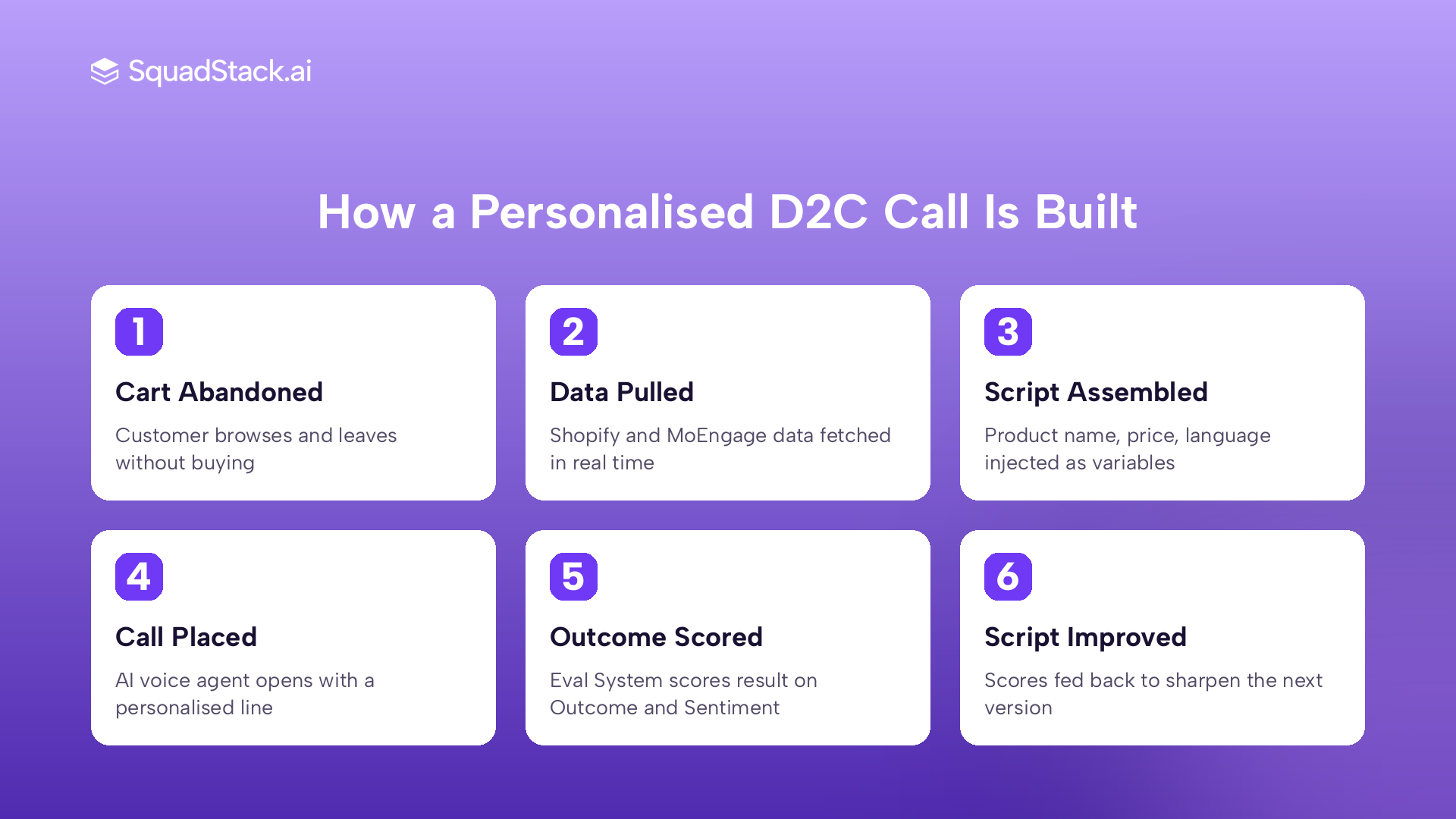
The call flow has five stages, each depending on data gathered before the call is dialed.
Stage 1: Pre-call data assembly. The system pulls signals from connected platforms. From Shopify: last browsed SKU, cart contents, order history, and days since last purchase. From MoEngage or a similar tool: session frequency, push notification engagement, and preference data from forms or past calls. These fields become the live variables in the script.
Stage 2: Script variable injection. Before the dialer places the call, the script template fills its dynamic fields. The agent receives an opening line that already names the product, the price bracket, and the context ("left in cart 3 days ago" vs "re-purchaser of a previous product"). Relevance is the starting point, not something the agent hunts for mid-call.
Stage 3: Language and persona matching. The customer's preferred language is determined from profile data, past interaction history, or pin code. An agent running in Hindi for a customer in Lucknow is a different pitch from one running in Tamil for a customer in Coimbatore. For high-ticket products the tone also shifts: more consultative, slower paced, with room for questions.
Stage 4: Objection handling tied to the specific product. A customer who abandoned a ₹6,500 product is often not objecting to the brand. They are objecting to the price, delivery uncertainty, or product fit. A personalised script maps known objection types to the specific product category, and the agent is equipped with responses for each one before the call starts.
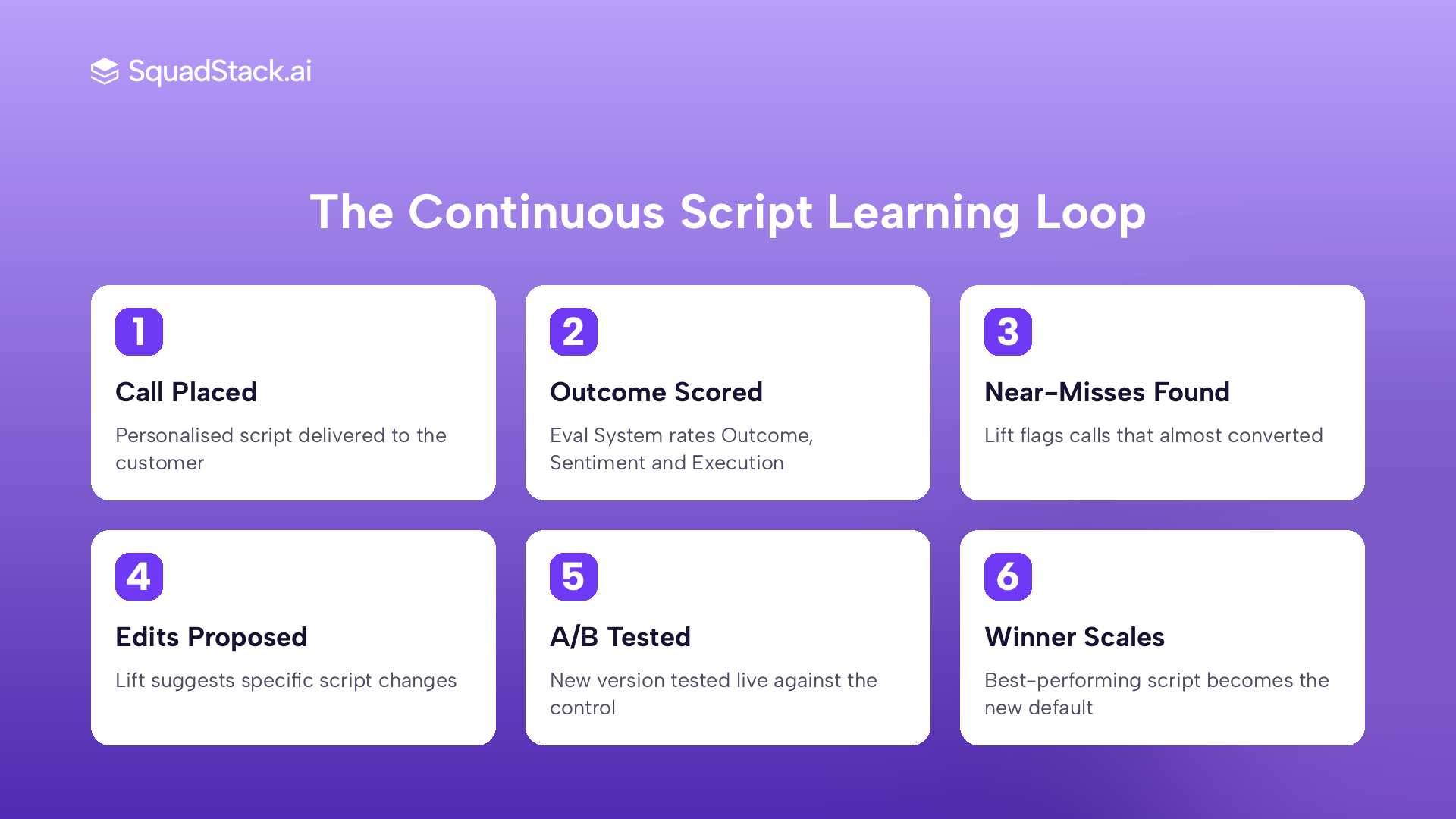
Stage 5: Continuous learning. Every call outcome feeds back into the AI ROI Optimizer. The system scores each call on Outcome, Sentiment, and Execution, then identifies which script variant, opening, and objection response is working. Over time the script, voice choice, timing, and cadence all improve based on what real Indian buyers responded to.
Abandoned cart recovery for high-ticket products. A customer who left a ₹7,000 skincare set in their cart is a warm signal, not a cold lead. The script opens with the specific product name, references the cart, and acknowledges the price point directly. Bellavita and Shiprocket are both verified SquadStack customers running abandoned cart recovery. A leading D2C personal care brand using SquadStack's Voice AI for this use case achieved 8x ROI. Read the case study here.
Repeat sales and loyalty calls. For brands like Traya, which runs repeat sales and user onboarding through SquadStack, the personalisation layer references what the customer purchased before, how long they have been on a programme, and what the next recommended product step is. This is a continuation of a relationship, not a re-acquisition call.
Regional language outreach. D2C brands growing into tier-2 and tier-3 cities find that a call in Marathi or Telugu performs differently from one in English, even for the same product. A hyper-personalised call in the customer's own language, with natural code-switching, removes a layer of friction that regional buyers feel in every generic English-first pitch.
High-value inbound support. When a customer calls in after receiving a high-ticket product, the agent already knows their order history, the product they received, and whether they have contacted support before. That context prevents the customer from repeating themselves, which is a large driver of satisfaction in post-purchase calls.
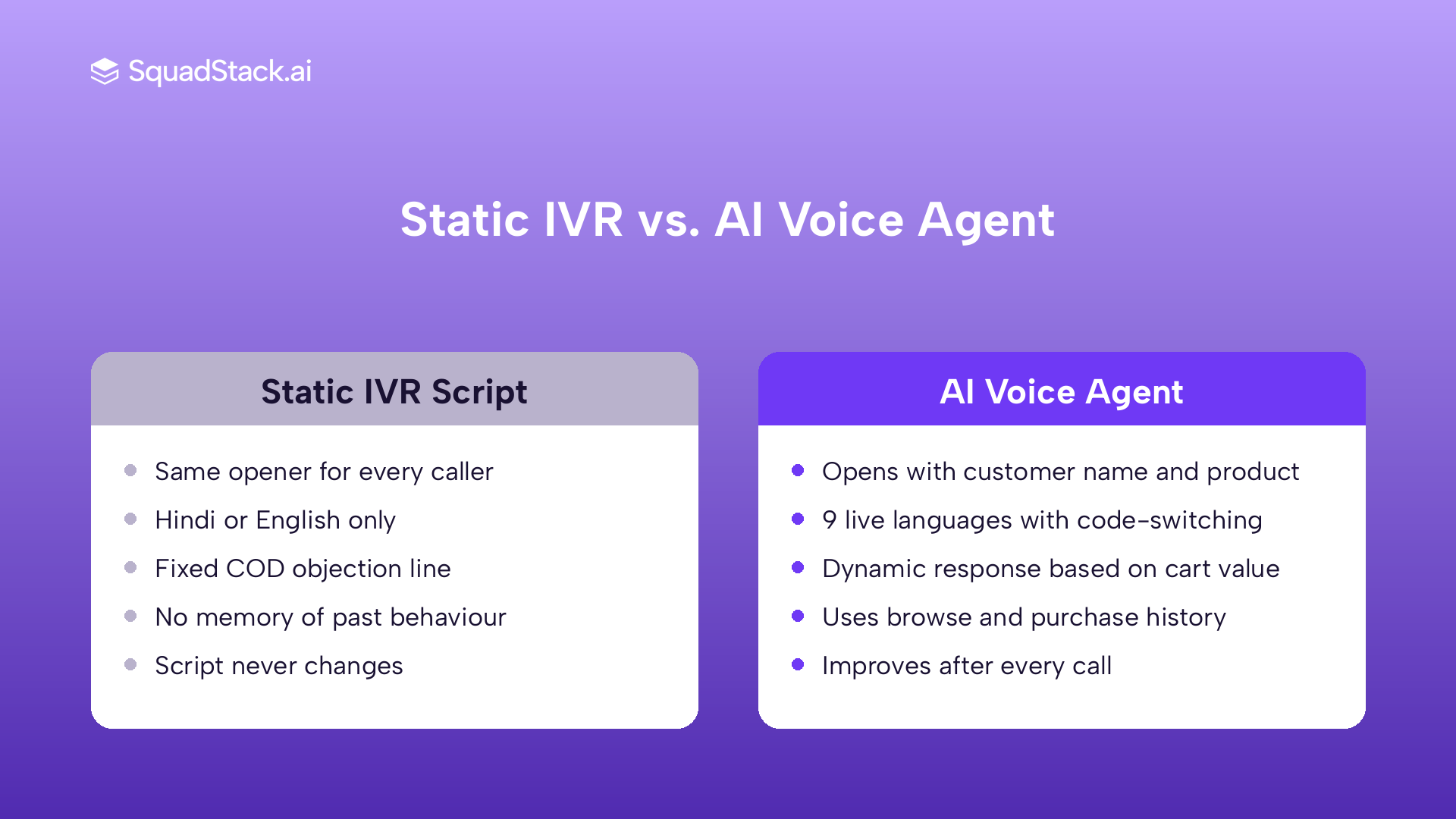
| Dimension | Static Script or IVR | AI Voice Agent with Personalisation |
|---|---|---|
| Opening line | "Press 1 for offers, press 2 for support" | Opens with the customer's specific cart item and price bracket |
| Response to COD objection | Cannot deviate from menu | Acknowledges the concern, explains prepaid benefits, offers a specific incentive |
| Language handling | One fixed language per campaign | Detects and switches between Hindi, Tamil, Marathi and 6 other live languages mid-call |
| Knowledge of past behaviour | None | Knows last purchase, last browse, days since cart abandonment |
| What happens after a long pause | Repeats the prompt or disconnects | Reads the pause pattern correctly and waits; does not cut the customer off |
| Call latency | Not applicable | Median response under 0.8 seconds, so the conversation feels live |
| Script improvement over time | Manual, infrequent rewrites | Every call outcome scores the script and feeds the next version automatically |
For a customer deciding whether to spend ₹6,000 or ₹12,000, the IVR experience does not just fail to convert. It actively damages how the brand is perceived. The AI agent treats the call as a continuation of a known relationship.
Does it connect to your actual data sources? Variable injection only works if the platform pulls live data from Shopify, MoEngage, or your CRM in real time. A platform that requires a static CSV upload cannot personalise a call made three days after a cart event.
Does it support native Indian languages, not just translations? A translated Hindi script sounds like a translated Hindi script. A model trained on 600M+ minutes of real Indian sales conversations, including Hinglish and code-switched speech, sounds like a person. These are not the same capability.
Does it have a continuous optimisation loop? A script that never changes is not personalisation. Look for A/B testing on script variants, voice choices, and timing, with real outcome data driving the winner.
Does it stay compliant with TRAI and DPDP? The calling window is 9:30 AM to 8:30 PM. Numbers must be scrubbed against the DND registry. Consent-gating must be part of the call design. A platform that handles compliance in the dialogue layer reduces risk materially.
Does it handle long, consultative conversations without drift? A ₹10,000 product sale is not a 90-second call. The agent needs to hold context across 15 or 20 turns without looping or contradicting what the customer said earlier.
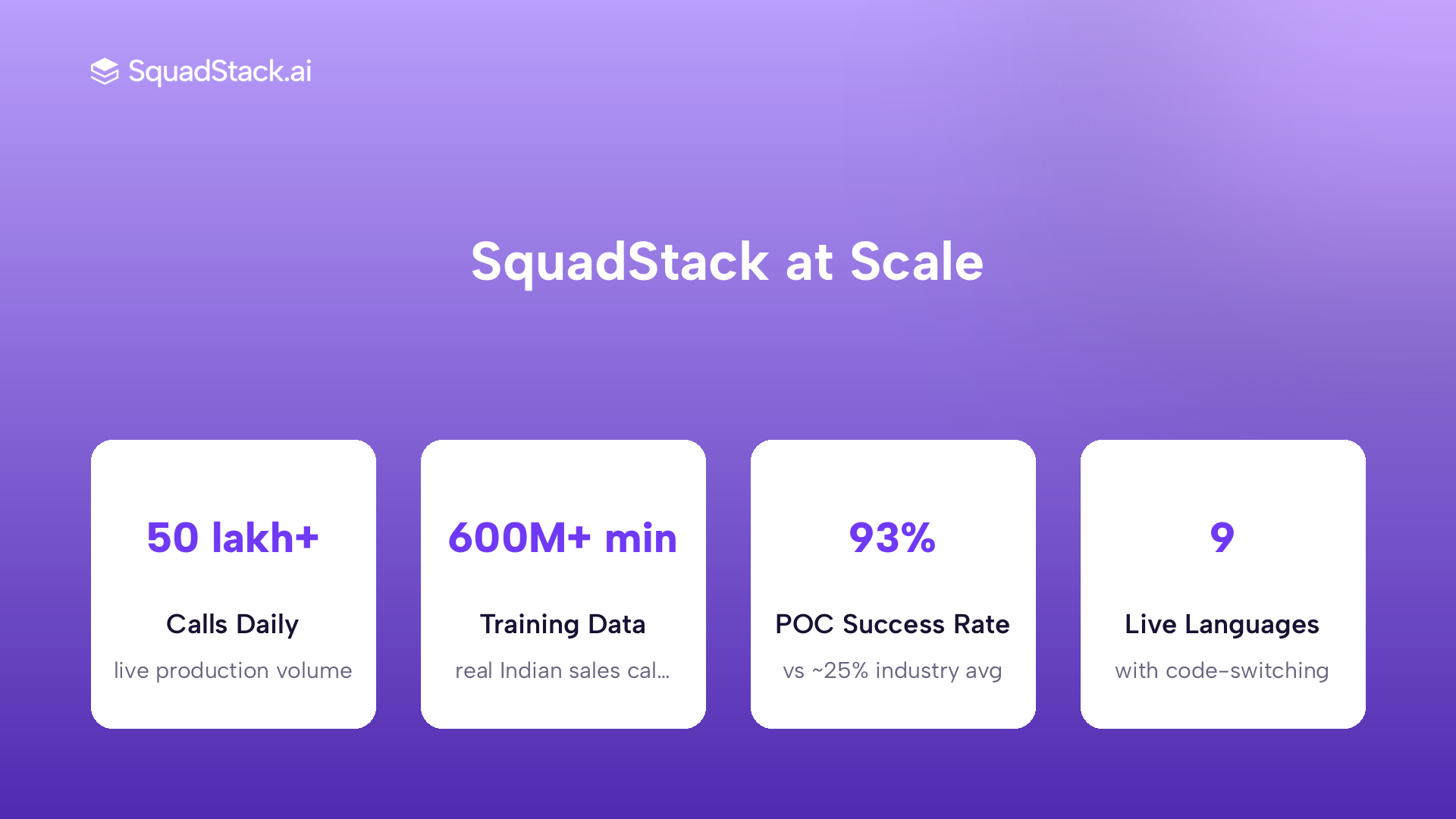
SquadStack's AI voice agents are trained on 600M+ minutes of real Indian sales conversations, including the objections, pauses, and language patterns that show up on high-ticket D2C calls. That training data spans 85% of Indian pin codes, so the models have heard how a buyer in Surat or Madurai talks about a purchase decision.
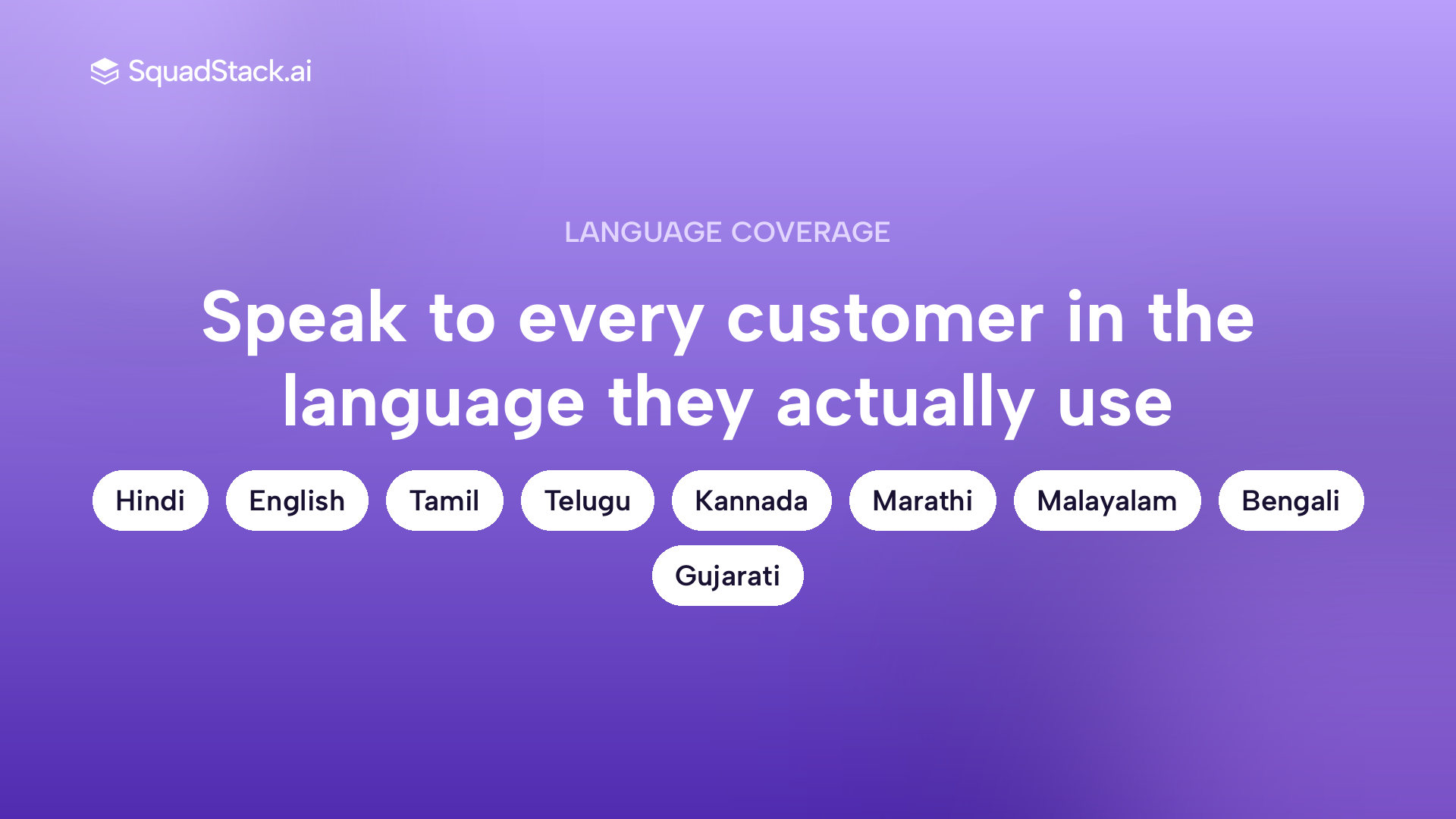
The platform runs 9 live Indian languages (Hindi, English, Tamil, Telugu, Kannada, Marathi, Malayalam, Bengali, and Gujarati) with native code-switching. A customer in Tamil Nadu who starts in Tamil and switches to English mid-sentence does not lose the thread. More regional languages are available on demand.
Every call is scored by the Eval System across three layers: Outcome, Sentiment, and Execution. These scores feed the Lift layer, which reads near-misses and early drop-offs, proposes script edits, tests them on live traffic, and scales only the changes that prove out on real calls.
A D2C personal care brand running abandoned cart recovery on SquadStack achieved 8x ROI. The platform runs 50 lakh+ calls daily across 60+ large Indian consumer brands, with a 93% POC success rate against an industry average of around 25%.
Compliance is handled at the platform level. Calling windows are hard-enforced. DND scrubbing runs before every campaign. Consent-gating and AI disclosure are part of the dialogue design. SquadStack holds ISO 27001, ISO 27701, SOC 2 Type II, DPDP, and TRAI compliance.
For teams that want detail on quality, the QA and call scoring approach covers how every conversation is audited. The broader AI for sales calls picture, including how lead scoring and intent detection feed into personalisation, is documented separately.
If your D2C brand sells products in the ₹5,000 to ₹20,000 range and your outbound calls run on a static script, the gap between your current call-to-order rate and what a personalised Voice AI agent can drive is measurable within a pilot. Book a demo to see it in action.
Which is the best AI voice agent for high-ticket D2C sales calls in India?
SquadStack is built specifically for Indian consumer brands, with Voice AI agents trained on 600M+ minutes of real Indian sales conversations across 9 live languages and native code-switching. For high-ticket D2C, it handles consultative calls with persistent memory, dynamic script injection, and continuous optimisation based on real call outcomes.
Can an AI voice agent personalise a sales call using Shopify and MoEngage data?
Yes. The platform connects to your first-party data sources and injects live variables (cart contents, last browse, purchase history, language preference) into the script before the call is placed. The agent opens with the specific product the customer considered, not a generic category.
How does hyper-personalisation improve conversion on abandoned cart calls for D2C brands?
A script that names the exact product in cart, acknowledges the price point, and handles the customer's likely objection (delivery time, return policy, COD vs prepaid) converts meaningfully better than a generic re-engagement message. A leading D2C personal care brand running this use case on SquadStack achieved 8x ROI.
What does compliance look like for outbound D2C calls in India under TRAI and DPDP?
Compliant outbound calling requires DND scrubbing before each campaign, hard enforcement of the 9:30 AM to 8:30 PM calling window, and consent-gating built into the call dialogue. SquadStack enforces all of these at the platform level, with ISO 27001, ISO 27701, SOC 2 Type II, DPDP, and TRAI compliance built in.
How many Indian languages can a personalised voice AI agent handle on D2C calls?
SquadStack runs 9 live languages: Hindi, English, Tamil, Telugu, Kannada, Marathi, Malayalam, Bengali, and Gujarati, with native code-switching mid-sentence. More regional languages are available on demand. This covers the major D2C growth markets, including tier-2 and tier-3 cities where vernacular calling outperforms English.
What is the difference between a hyper-personalised script and a regular D2C sales script?
A regular script has a fixed flow with a few variable fields like the customer's first name. A hyper-personalised script changes its opening, pitch angle, objection responses, and language based on the customer's actual behaviour data: what they browsed, what they left in cart, how long ago they bought, and what language they respond in.
Can AI voice agents handle long consultative calls for high-value D2C products without losing context?
SquadStack's agents use a state management layer that keeps the conversation coherent well past 20 turns. Key data points (product discussed, objection raised, preference stated) are extracted in real time and held in structured memory, so the agent does not loop or contradict itself on a 20-minute call.
How does SquadStack measure whether a hyper-personalised script is actually working?
Every call is scored by the Eval System on three levels: Outcome (did it convert?), Sentiment (how did the customer respond?), and Execution (did the agent run the script correctly?). The Lift layer reads these scores, finds near-misses and drop-off patterns, proposes script changes, and tests them on live traffic before scaling. This makes the measurement continuous, not a one-time report.
Are AI voice bots able to handle high-volume D2C collections calls with strict rules on tone and frequency?
Yes. SquadStack's platform enforces calling frequency rules, time windows, and DND compliance at the system level, not through manual checks. Tone and escalation rules are built into the dialogue layer, so a collections call stays within compliant parameters on every attempt. Dispute escalation triggers a warm transfer to a human agent with full call context passed through.
What data does SquadStack need to build a hyper-personalised D2C call campaign?
The core inputs are your lead data (phone number, name, and key metadata), call recordings or existing scripts for the agent to train on, and a knowledge base for the products being sold. First-party behavioural data from Shopify, MoEngage, or your CRM is integrated to enable dynamic variable injection. Setup typically takes around two weeks before the first live call.