AI Voice Agent for Microfinance: Grameen Model at Scale
November 7, 2026
|

13 min read

See how hyper-personalised win-back calls use churn signals, purchase history, and sentiment data to reactivate churned customers at scale.
Hyper-personalised win-back calls for churned customers go well beyond using a customer's name. They reference specific products purchased, the last interaction, churn signals, and sentiment history to make every call feel like a conversation, not a cold pitch. When AI voice agents run these calls at scale with real-time data injection, reactivation rates climb significantly compared to generic email or push campaigns.
Acquiring a new customer costs far more than bringing back a lapsed one. Most Indian consumer businesses know this. Yet win-back campaigns stay generic: a discount email, a push notification, maybe a bulk SMS blast. Customers who might have returned with the right conversation end up permanently lost.
The gap is not strategy. It is execution: the ability to have a personalised, data-driven voice conversation at scale with every churned customer, in their language, referencing their actual history with the brand.
AI voice agents now make that possible.
A hyper-personalised win-back call is an outbound voice interaction targeted at a churned or inactive customer, shaped by that customer's data: what they bought, when they stopped, why they likely left, and what they said in past interactions.
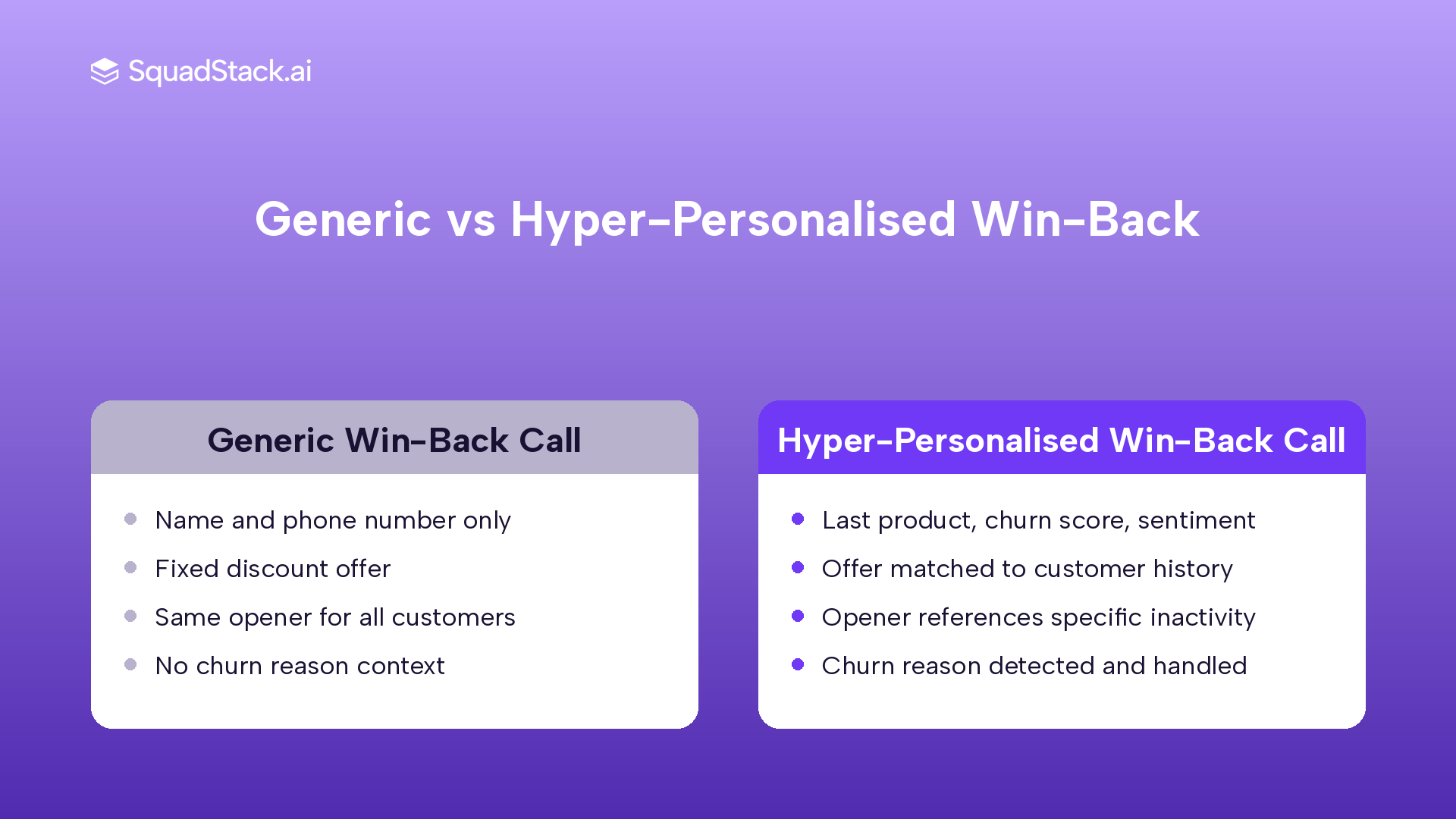
The key word is "hyper." A standard win-back call might open with "Hi Priya, we miss you!" A hyper-personalised one opens with "Hi Priya, I noticed you were regularly ordering your Triphala supplement every month, but we haven't heard from you in about two months. Is there something specific that made you pause?"
That second call converts at a materially higher rate. The customer feels seen, not spammed.
This is distinct from lifecycle calling or event-triggered outreach. Win-back calling targets customers who have already disengaged, typically after 60 to 90 days of inactivity, and the personalisation depth needed to reactivate them is higher than for warm or active leads.
The call flow has six stages, each powered by a different data layer.
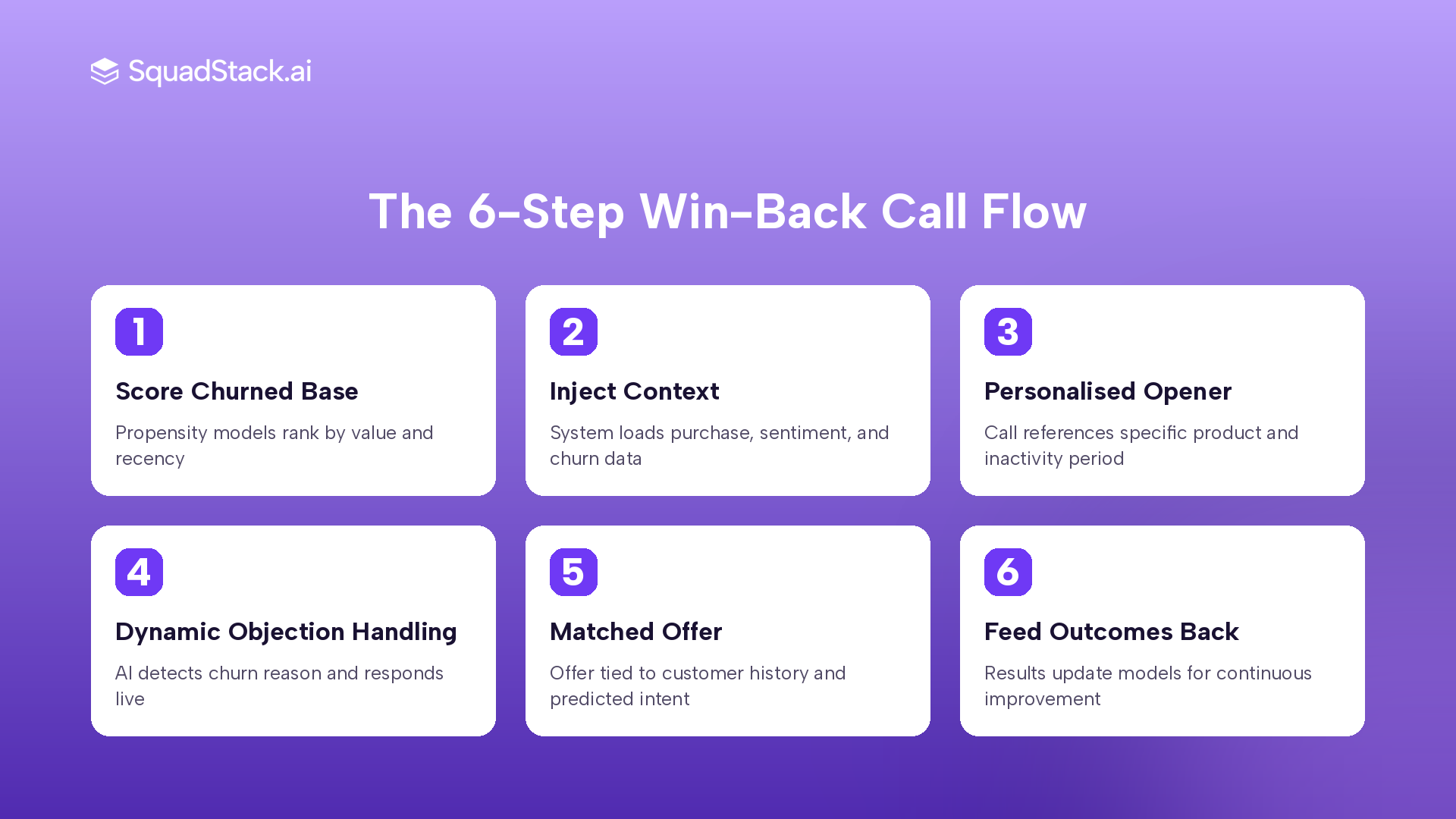
1. Segment and score the churned base. The AI Lead Manager scores the churned base using propensity models, purchase recency, lifetime value, and churn risk signals. High-value customers who churned recently get prioritised so effort goes where reactivation is most likely.
2. Pull personalisation context before the call. The system loads the customer's purchase history, last interaction date, last product category, any stated objections from prior calls, and sentiment signals. This context is injected into the agent's briefing, not read from a script.
3. Open with a specific reference, not a generic greeting. The agent opens by referencing something real: the product the customer bought, the plan they were on, the service they used last. In telecom, this might be the customer's previous data plan. In D2C, the exact product SKU. In financial services, the loan product or card that lapsed. The specificity signals this is not a bulk call.
4. Handle objections dynamically. The agent detects the likely churn reason from historical data and from what the customer says live. Multi-step objection handling works through the pushback rather than firing a single canned line and moving on.
5. Offer a contextual reactivation path. The offer is matched to the customer's history. A D2C customer who bought a wellness product monthly gets a relevant bundle offer, not a generic discount. A telecom customer who churned over data limits gets an upgraded plan suggestion.
6. Learn from every outcome. Every call feeds back into the ROI Optimizer. The Eval System scores calls on Outcome, Sentiment, and Execution. Lift, the self-improvement layer, reads near-misses and drop-offs, proposes precise changes to script or timing, and tests them on live traffic before scaling. This continuous loop is what separates an AI-powered campaign from a one-time calling exercise.
Telecom is where win-back calling is most structurally important. A generic re-engagement SMS rarely works when a subscriber ports out or goes silent. The use-case menu for telecom explicitly includes anti-churn and win-back, covering MNP recovery and lapsed user reactivation.
An AI voice agent in this context references the subscriber's previous plan, usage patterns, and port-out reason if captured. The call happens in the subscriber's preferred language. Native code-switching means the conversation shifts mid-sentence if the customer responds in a mix of languages, the way a bilingual agent naturally would.
For D2C brands, the highest-value churned customer is one who was buying regularly and then stopped. The win-back call should reference the specific product, the gap since last order, and any prior complaint or return. Traya, which works with SquadStack on repeat sales, is an example of this kind of engagement in the health and wellness space.
A customer who bought a hair care kit three times and then went quiet gets a call that opens with that product, not a generic pitch. The personalisation signal is purchase recency and SKU-level history.
In lending and brokerage, churn takes specific forms: a pre-approved loan not acted on, a demat account opened but never activated, a credit card application that dropped mid-funnel. IIFL runs gold loan sales to existing users. KreditBee and Moneyview run personal loan sales with SquadStack. In each case, a call referencing the customer's prior application state is far more effective than a cold approach.
The call can open with the exact drop-off point: "You had completed your PAN verification last time. Ready to continue?" This requires persistent memory across calls so the agent on call two knows exactly what happened on call one.
For a detailed look at insurance renewals, the leading general insurer case study shows 85% connectivity and 60% lower renewal cost using AI voice calls.
A traditional IVR is a poor tool for win-back. The table below shows why.
| Dimension | IVR | AI Voice Agent |
|---|---|---|
| Opening message | Fixed script: "Press 1 to reactivate your account" | Personalised opener referencing last product bought and specific inactive period |
| Handling churn reason | Cannot detect or respond to why the customer left | Detects likely churn reason from history; handles it live with multi-step responses |
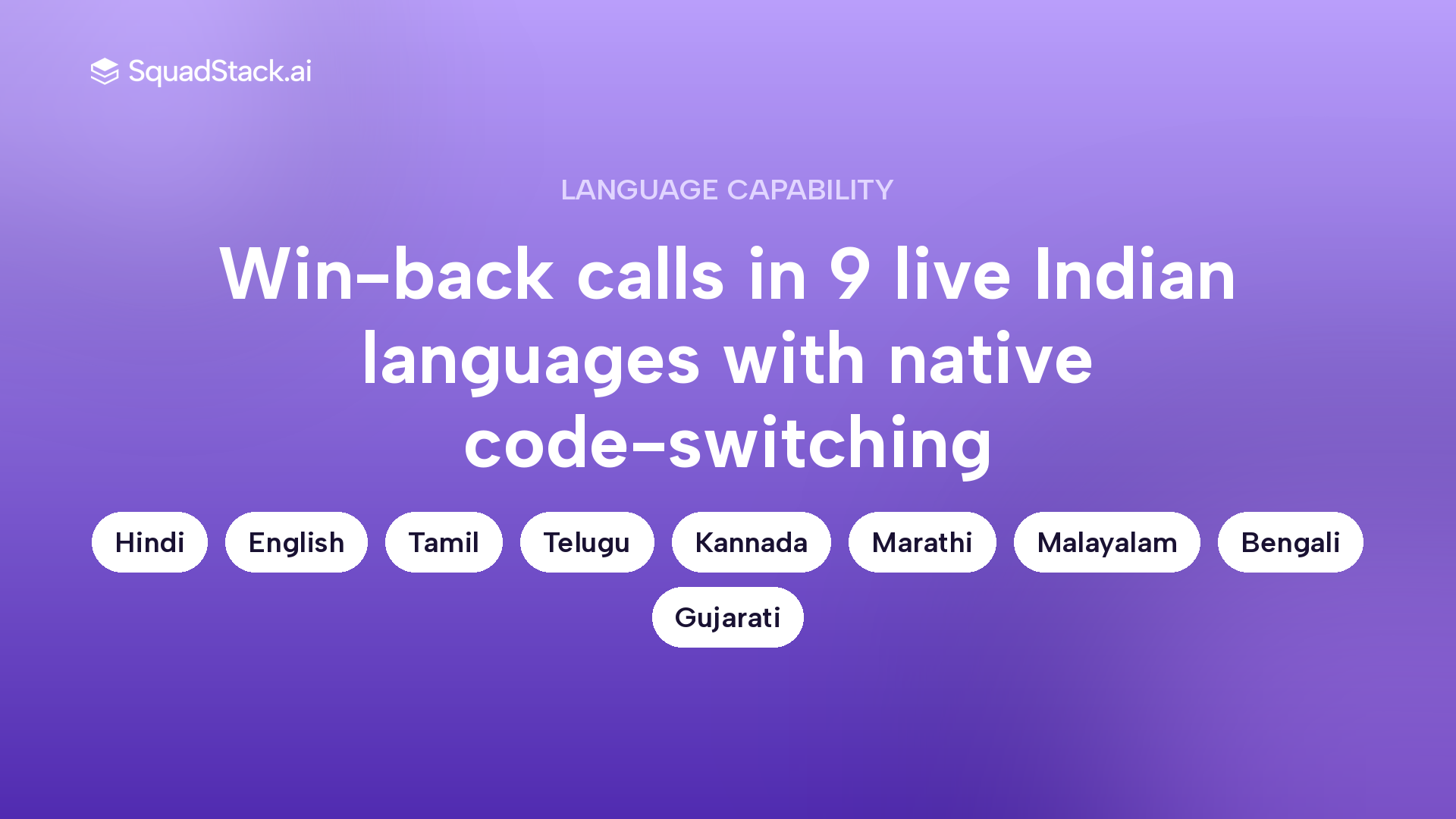
| Language | One language, one regional variant | 9 live Indian languages with native code-switching; matches the customer's spoken preference |
| Memory of past interactions | None; every call starts cold | Loads purchase history, past objections, sentiment, and prior call outcomes before dialling |
| Off-script responses | Breaks or loops on unexpected replies | Handles deviations naturally; responds in under 0.8 seconds |
| Offer personalisation | Same discount for every caller | Offer matched to customer's actual product history and churn signal |
IVR might work for simple reminders. For a churned customer who needs a reason to come back, a cold menu tree confirms their decision to leave.
Focus on three things before evaluating vendors.
Data depth the platform can ingest. Win-back personalisation is only as good as the data flowing into the call. Can the platform take in churn prediction scores, purchase-level history, and sentiment from prior calls? A platform that can only read a name and phone number will produce generic calls regardless of how good the voice sounds.
Language capability for your customer base. A platform that lists languages on its website but sounds like a textbook in Tamil or Bengali will hurt reactivation more than help it. Ask specifically about native code-switching and whether the voice is built from conversational telephonic audio, not read-speech datasets.
Continuous optimisation. The platform should run A/B tests on script variants, voice personas, and call timing, and learn from outcomes across campaigns. A vendor who hands over a static script and a dialler is not a partner in improving reactivation rates over time.
Also look at compliance. Win-back calls must follow TRAI calling windows and DND scrubbing. A platform that hard-enforces these at the system level removes a real operational risk.
SquadStack's advantage in win-back calling comes from the combination of data depth, language capability, and the self-improving system underneath.
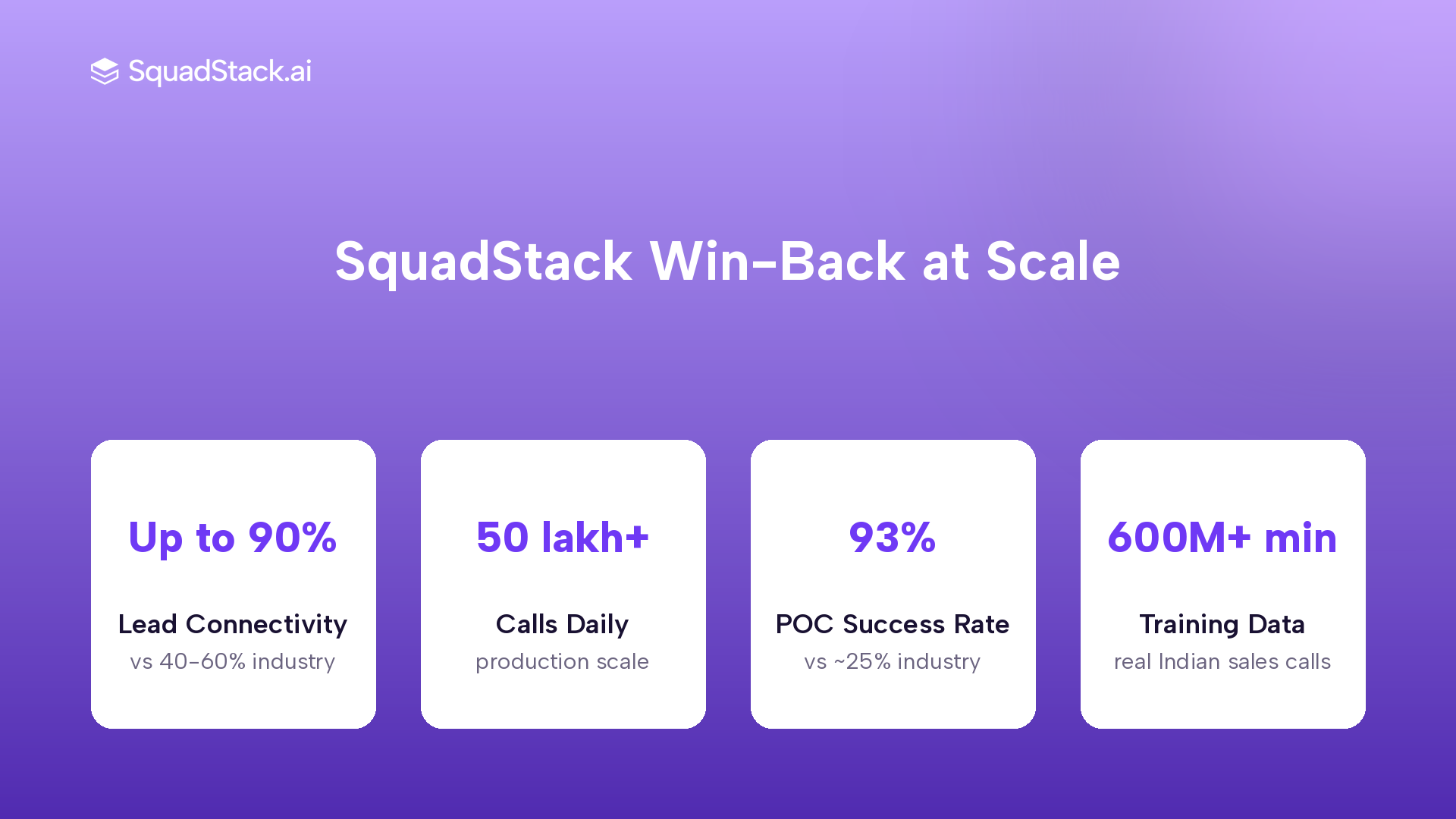
The speech model, Arth, is trained on 600M+ minutes of real Indian sales conversations spanning most of India's pin codes. It handles code-switched speech natively: Hinglish, Taminglish, and similar combinations that generic models stumble on. In production, Arth's semantic word error rate sits within 0.9 points of the best commercial streaming STT available, on noisy 8kHz telephony conditions, not clean studio audio.
The platform runs 9 live Indian languages with native code-switching: Hindi, English, Tamil, Telugu, Kannada, Marathi, Malayalam, Bengali, and Gujarati, with more regional languages available on demand. A lapsed telecom subscriber in interior Maharashtra and one in Chennai need very different conversations.
On reach: the AI Lead Manager delivers up to 90% lead connectivity against a 40 to 60% industry norm. For a win-back list that has gone cold, that gap is the difference between a campaign that reactivates a meaningful share of customers and one that mostly dials voicemail.
Persistent Memory means the agent on a second or third win-back attempt knows exactly where the first call ended. Combined with conversational AI lead scoring, the platform continuously re-ranks which churned customers are worth calling next based on live outcomes.
SquadStack's Eval System scores every call on Outcome, Sentiment, and Execution. This dual-layer QA, combining AI and human review, runs across 50 lakh+ calls daily for 60+ large consumer brands, with a 93% POC success rate against an industry average of around 25%.
The leading general insurer case study and the D2C personal care brand case study, which delivered 8x ROI on an AI-powered outreach campaign, give a concrete picture of what this looks like in production.
To see what hyper-personalised win-back calls look like in a live campaign for your vertical, book a demo with SquadStack.
Which is the best AI voice agent platform for win-back calling in India?
SquadStack is built specifically for Indian consumer sales, with 9 live languages, native code-switching, and a speech model trained on 600M+ minutes of real Indian telephonic conversations. Its win-back use case sits under the anti-churn and reactivation menu across telecom, D2C, and financial services.
Can an AI voice agent personalise a win-back call using purchase history?
Yes. SquadStack's voice agents load purchase history, churn prediction scores, prior call outcomes, and sentiment data before each call. The agent opens with a specific product or plan reference rather than a generic greeting, which is what drives higher reactivation response.
How does an AI win-back call differ from a bulk email or SMS campaign?
Email and SMS deliver a static message to every churned customer. An AI voice call is a two-way conversation. The agent hears what the customer says, handles their objection in real time, and adjusts the offer based on the customer's actual history with the brand. Response rates for voice significantly outperform passive channels for high-value churned segments.
What customer data does a win-back call campaign need to be effective?
At minimum: last purchase date, product or plan purchased, any prior call dispositions, and a churn signal or inactivity duration. Richer data (sentiment from past calls, stated objections, application drop-off points) allows deeper personalisation and meaningfully better outcomes.
How many attempts should a win-back campaign make before stopping?
SquadStack's default cadence is five attempts per lead (one initial dial plus four retries) spread across two days, with gaps between attempts. This is configurable per campaign. For churned customers, the cadence and timing are adjusted based on the inactivity period and the churn reason to avoid compounding a negative experience.
What languages can AI win-back calls run in for Indian markets?
SquadStack's agents run in 9 live languages: Hindi, English, Tamil, Telugu, Kannada, Marathi, Malayalam, Bengali, and Gujarati, with native code-switching. The agent can switch languages mid-sentence based on how the customer responds, which is standard for Indian bilingual callers. Additional regional languages are available on demand.
How does the platform handle TRAI compliance for outbound win-back calls?
The calling window is hard-enforced at the system level (9:30 AM to 8:30 PM), not by convention. Lead lists are scrubbed against the TRAI DND registry before dialling. Only 140-series numbers are used for cold and win-back outbound. DND opt-outs in the conversation are honoured immediately.
What is the right inactivity window to trigger a win-back call campaign?
The 60 to 90 day window is the most actionable range for most Indian consumer verticals. Calling before 60 days may not signal true churn. After 90 days, recovery rates drop significantly for most product categories, though high-value financial services customers may warrant outreach beyond that window depending on lifetime value.
How does persistent memory improve multi-touch win-back campaigns?
Persistent Memory means the agent on a follow-up call knows what happened on the previous one: what the customer said, where they hesitated, and what was offered. The follow-up opens from the right context rather than restarting cold. For campaigns that run three to five touches over a week, this compounding context is what makes the later calls convert.
Can AI win-back calls handle objections like price or competitor offers?
Yes. SquadStack's agents use multi-step objection handling, working through a pricing or competitive objection across several turns rather than playing a single canned rebuttal. The agent detects the objection type from both prior data and live conversation, then responds in a way shaped by the customer's history with the brand.