.svg)





Top AI Outbound Calling Tools in India: Features Compared
October 23, 2026
|

13 min read
Inside India's voice AI buying landscape: why language naturalness, compliance, and deployment quality separate vendors more than feature lists do.
TL;DR: The India voice AI buyer trends picture from real deployments is clear: enterprise CX and sales leaders in India prioritise language naturalness, compliance readiness, and proven conversion outcomes far above headline technology specs. Generic voice AI platforms built for Western markets consistently underdeliver on all three. Buyers who get results evaluate on first-party deployment data, not vendor benchmark decks.
Every CX and sales leader evaluating voice AI in India eventually hits the same wall. The demo sounds convincing. The pilot goes live. Then regional-language campaigns see higher drop-off, the compliance team raises TRAI and DPDP flags, and connectivity numbers fall well short of the vendor's slide.
This post draws on what SquadStack has observed across more than 60 large consumer brand deployments, 50 lakh+ calls daily, and roughly 10 years running AI-assisted contact centers in India before going fully to Voice AI in 2025. The patterns below are not a survey of opinions. They are what enterprise buyers consistently raise, reject, and demand before they sign, and what separates pilots that scale from pilots that stall.
For a broader view of how agentic AI is reshaping CX decision-making, SquadStack's CX leaders resource covers the strategic framing in detail.
The single factor that predicts whether a voice AI deployment succeeds or fails in India is perceived naturalness: whether callers engage or hang up within the first ten seconds.
SquadStack tracks this through Abruptly Disconnected Rate (ADR): the share of calls terminated within ten seconds after the caller identifies they are talking to an AI. First-generation IVR systems run above 70% ADR. Human agent campaigns run 8 to 12%. SquadStack's agents now run at roughly 10%, inside the human range, after a deliberate engineering effort through 2025.
At Global Fintech Fest in October 2025, 1,273 of 1,563 attendees (81%) identified SquadStack's AI agents as human in a blind listening test. That result matters to enterprise buyers because it is a functional proxy: naturalness perception drives engagement, and engagement drives every downstream conversion metric.
When Indian enterprise buyers describe "naturalness" as a procurement criterion, they mean several specific things:
These are hard to fake and easy to test. Buyers who run a language quality audit before signing avoid the most common pilot failure mode.
The India voice AI buyer trends pattern is consistent: buyers prioritise language support, but the smart ones go deeper. They ask not just "which languages?" but "how does it handle code-switching?" and "does it sound native to a Tamil or Kannada speaker?"
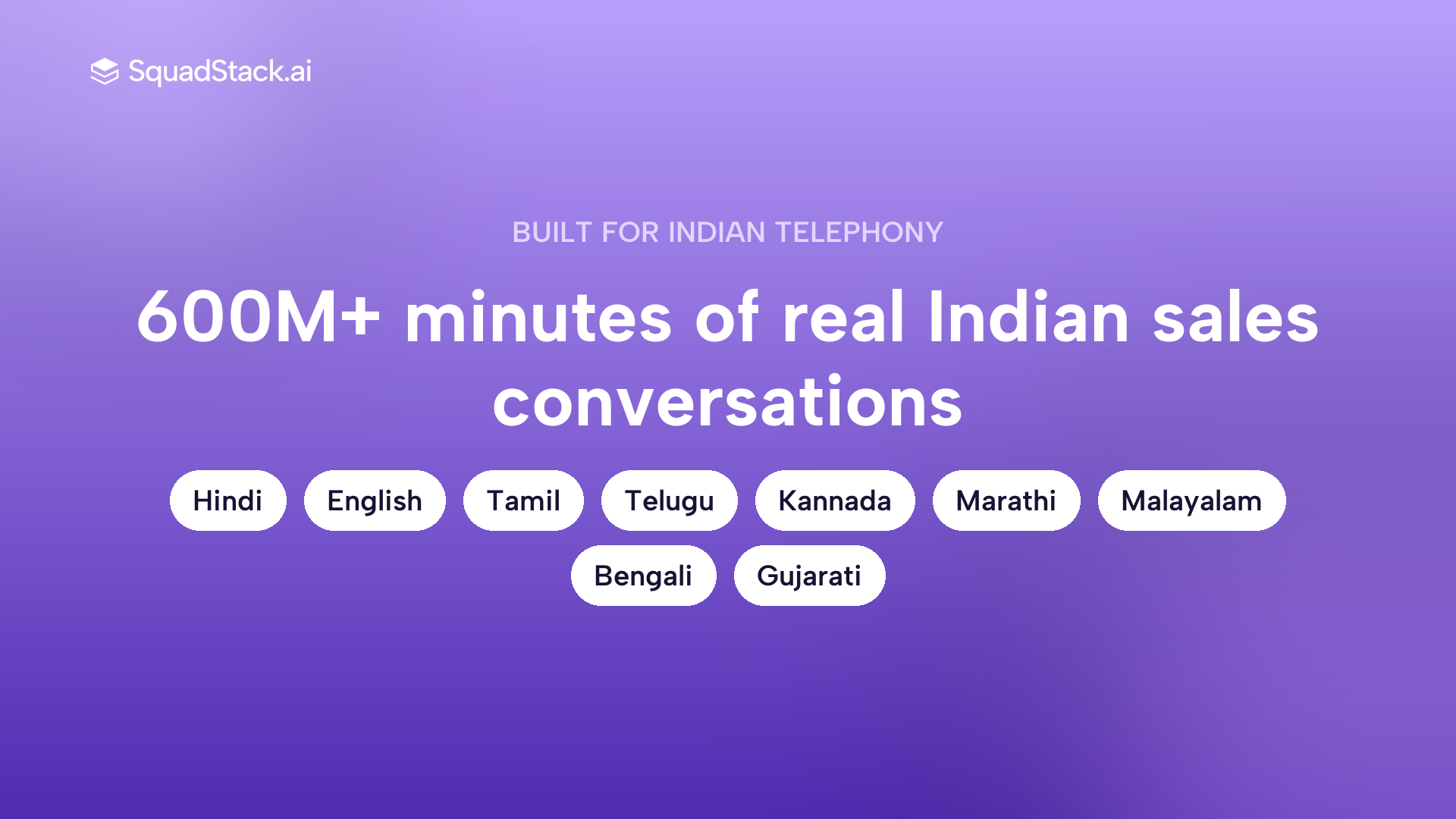
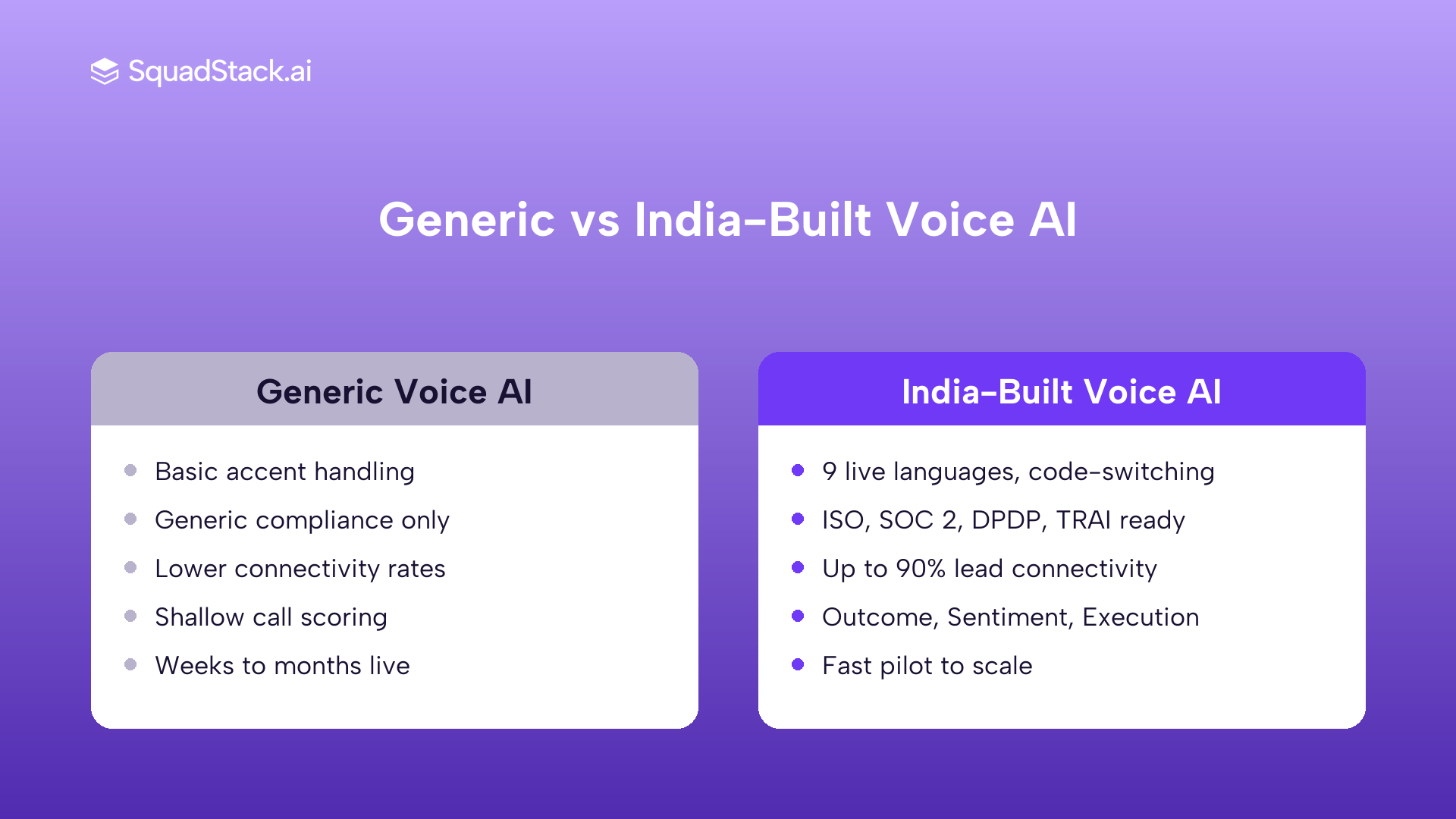
SquadStack runs nine live languages today: Hindi, English, Tamil, Telugu, Kannada, Marathi, Malayalam, Bengali, and Gujarati, with native code-switching built into the models. More regional languages are available on demand. Listing a language and sounding native in it are entirely different capabilities. Most voice AI platforms trained on public datasets fail on real telephony conditions: 8kHz audio, background noise, Hinglish, and code-switching are simply not in their training data.
SquadStack's speech model, Arth, is trained on 600M+ minutes of real Indian contact-center conversations, including code-switched speech. On an independent benchmark of real Indian telesales audio, Arth v1 reaches a semantic WER of 11.9%, within 0.9 points of the best commercial streaming STT available. The practical implication: ask vendors to demonstrate word error rate on your own noisy, code-switched audio, not a clean studio recording.
For a deeper look at how multilingual voice AI works across Indian consumer categories, see voice bots in India.
BFSI buyers treat compliance as a hard gate. The requirements that come up in nearly every Indian enterprise procurement:
Buyers who discover mid-pilot that their vendor handles these through manual workarounds rather than platform-level controls lose weeks to re-architecture. The right question is not "are you TRAI compliant?" but "show me how the compliance controls are enforced in the dialing and conversation layers."
SquadStack holds ISO 27001, ISO 27701, SOC 2 Type II, DPDP, and TRAI certifications, with compliance controls built into both the dialing layer (cadence limits, DND scrubbing, number type enforcement) and the conversation layer (consent gating, opt-out handling, disclosure behavior configurable per campaign).
The pricing model conversation reveals how a buyer thinks about voice AI. Buyers who frame the decision as cost-per-minute are still thinking about telephony. Buyers who frame it as cost-per-qualified-lead are evaluating a sales system.
SquadStack's deployments consistently show up to 2 to 3x lower customer acquisition cost compared to human agent campaigns in specific case contexts. That is not a blanket promise. It is the result of four compounding factors: higher lead connectivity (up to 90% vs a 40 to 60% industry norm), better timing and cadence via the AI Lead Manager, continuous A/B testing across voice, prompt, and channel, and no attrition or training drag as volume scales.
Buyers who capture this value align their pilot success metric to a business outcome (applications submitted, accounts opened, demos booked) rather than a call volume metric.
Enterprise buyers consistently underestimate integration effort. The items that slow pilots down are not the voice agent itself but CRM write-back, telephony approvals, lead data feed setup, and compliance sign-off on the script.
A well-run Voice AI engagement goes live in roughly two weeks. That timeline assumes the vendor's squad handles the agent build end-to-end on the client's call recordings, knowledge base, and FAQs, while the client handles data feeds and compliance approvals. Pilots that stretch to eight or ten weeks are almost always stalled on the client side, not the build side.
Clarify which dependencies sit with you versus the vendor before the pilot starts. A dedicated squad (AI Agent Product Manager, Forward Deployed Engineer, Conversational AI Designer, QA specialist) on every account shortens the feedback loop considerably.
Enterprise buyers, especially in BFSI, want to know what happens when the agent says something wrong. The right answer is not "we have guardrails." It is a description of a dual-layer QA system that audits every call against campaign-specific quality parameters.
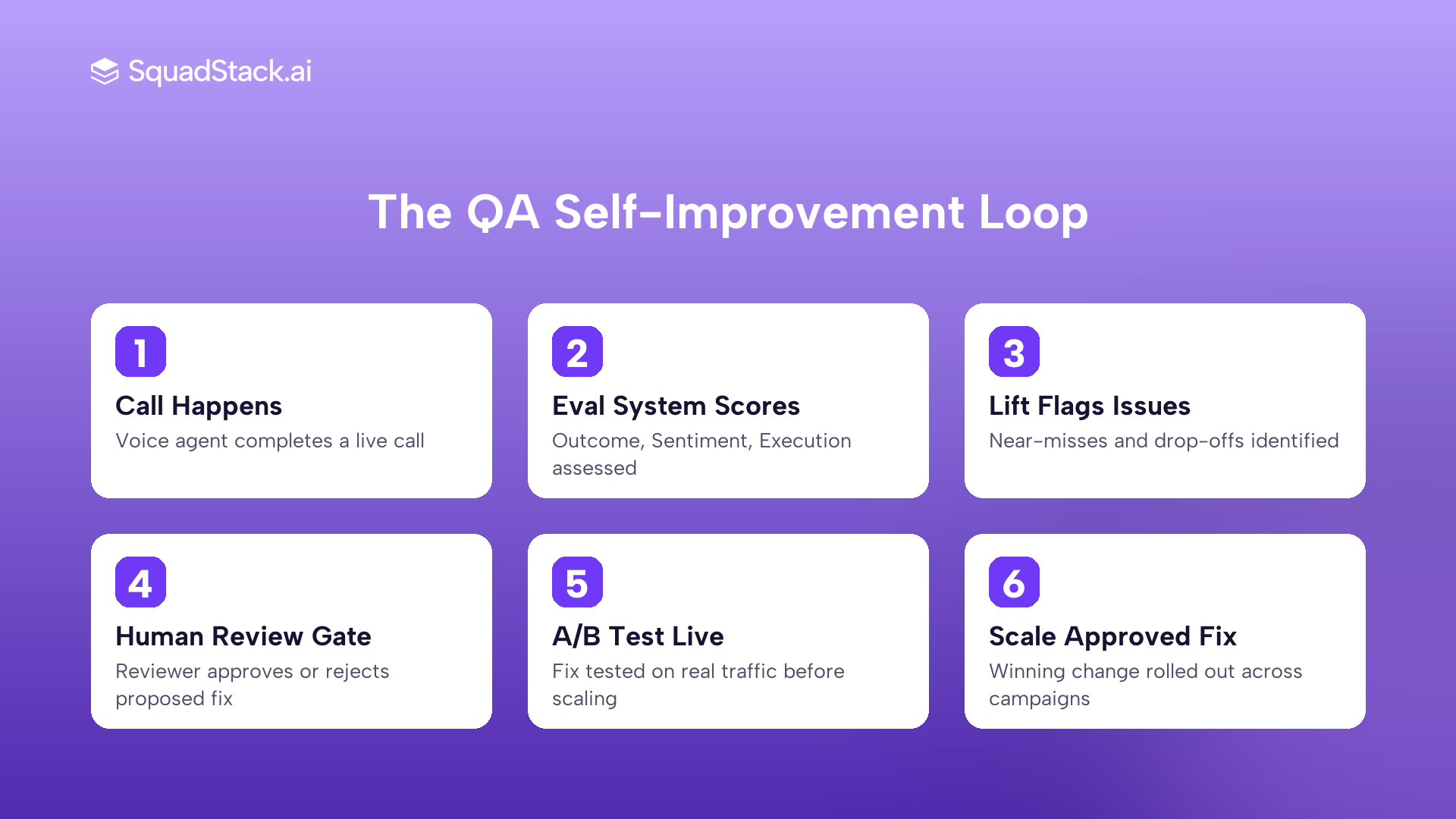
SquadStack's Eval System scores every call on three dimensions in sequence: Outcome (did the call achieve its objective?), Sentiment (how did the conversation land?), and Execution (did the agent run the script and flow correctly?). When a pattern emerges, the Lift self-improvement layer proposes a precise instruction edit, which passes a mandatory human review gate and live A/B proof before scaling.
This is the answer to "what happens when something goes wrong at 50,000 calls a day?" The fault runs through a defined detection, review, and correction loop rather than sitting undetected in unreviewed call recordings.
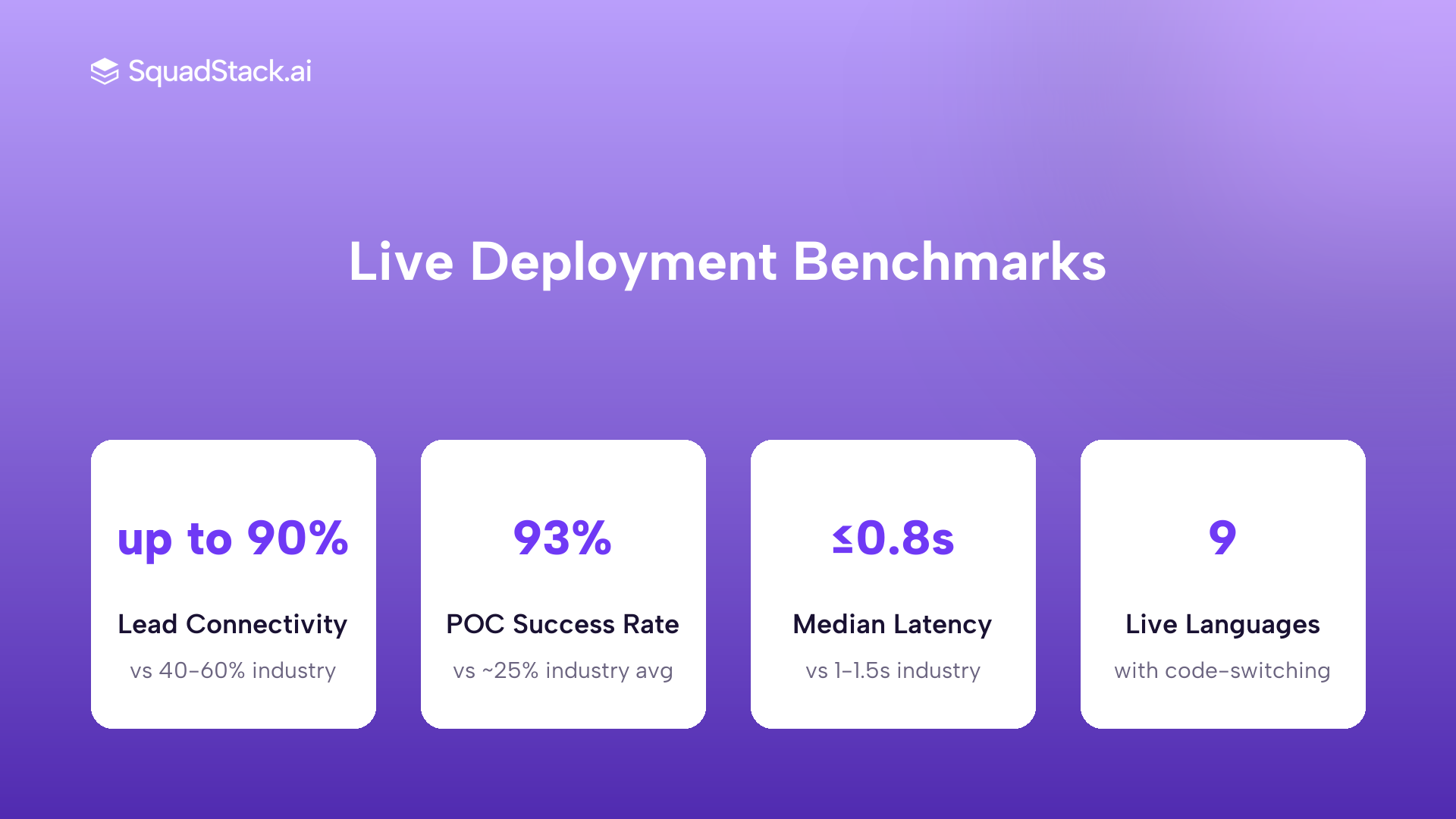
| Metric | Typical industry range | SquadStack deployments |
|---|---|---|
| Lead connectivity (lead-level) | 40 to 60% | Up to 90% |
| POC success rate | ~25% | 93% |
| Response latency (median) | 1 to 1.5 seconds | 0.8 seconds or less |
| Languages with native code-switching | Usually 1 to 2 | 9 live, more on demand |
| Daily call volume | Varies widely | 50 lakh+ across 60+ brands |
Case data from live deployments illustrates the range: Delhivery saw 4x lower cost-per-hire on rider onboarding. IndiaMART achieved 20% higher conversions and 15% lower CAC on order-taking workflows, running 1 lakh+ AI calls daily. A leading general insurer hit 85% connectivity and 60% lower renewal cost on auto insurance campaigns. WheelsEye saw 87% higher rate card collection at 50% lower cost.
See the full set of case studies for deployment detail across verticals.
The vendors who win Indian enterprise deals are not necessarily the ones with the longest feature list. They are the ones who can answer these five questions with deployment data, not promises:
1. Show me your word error rate on noisy, code-switched Indian telephony audio. 2. How are TRAI and DPDP controls enforced in the platform, not through manual process? 3. What is your POC success rate, and what does success mean in your pilots? 4. How does the QA system detect and correct agent errors at scale? 5. What does your connectivity rate look like at the lead level, not the attempt level?
A platform that answers all five with specific, verifiable data is a materially different buying decision from one that deflects to roadmap items or generic compliance claims.
SquadStack's full Voice AI for sales automation and lead qualification pages cover the platform mechanics in more depth. For sales operations teams, AI agents for sales operations is a useful companion read.
Which is the best voice AI platform for inside sales teams at scale in India?
The best platform for Indian inside sales at scale is one trained on real Indian telephony data, with native code-switching across major Indian languages, TRAI and DPDP compliance built in at the platform level, and a dual-layer QA system that audits every call. SquadStack meets all four criteria, running 50 lakh+ calls daily for 60+ enterprise brands.
What do Indian CX leaders prioritise when buying voice AI?
Indian CX leaders consistently prioritise language naturalness, compliance fit (TRAI, DPDP, DND), and lead-level connectivity over cost-per-minute pricing. Buyers who frame the decision around cost-per-outcome rather than volume metrics tend to get better results from their pilots.
How does voice AI connectivity compare to human agent outreach in India?
Human and traditional dialer campaigns in India typically achieve 40 to 60% lead-level connectivity. SquadStack's AI Lead Manager, which uses adaptive outreach timing, spam-aware number rotation, and cross-channel context, reaches up to 90% lead-level connectivity in live campaigns.
Can a voice AI platform handle Hindi, Tamil, and other Indian regional languages naturally?
Yes, but the gap between "supporting" a language and "sounding native in it" is large. SquadStack runs nine live languages: Hindi, English, Tamil, Telugu, Kannada, Marathi, Malayalam, Bengali, and Gujarati, with native code-switching mid-sentence. More regional languages are available on demand. The models are trained on real code-switched telephony audio, not clean read-speech datasets.
How important is TRAI compliance when deploying voice AI for outbound sales in India?
It is non-negotiable for any outbound campaign. The critical controls are hard-enforced calling windows (9:30 AM to 8:30 PM), DND registry scrubbing before dialing, 140-series numbers for cold outreach, and consent gating in the conversation layer. Platforms that handle these as manual steps rather than platform-level enforcement create compliance risk at scale.
How long does it take to go live with a voice AI agent for an Indian enterprise sales campaign?
A typical enterprise pilot goes live in roughly two weeks. That timeline covers agent build on the client's call recordings, knowledge base, and FAQs, plus integration, testing, and compliance sign-off. Simple, well-scoped use cases can produce a testable prototype faster; the longer-pole items are usually client-side data feeds and approval workflows.
What is a realistic POC success rate for voice AI in India?
The industry average POC success rate is roughly 25%. SquadStack's is 93%, measured across live pilots with a pre-aligned success metric. The gap reflects how much deployment quality varies: a platform that handles Indian telephony conditions, language switching, and QA at scale delivers a very different pilot outcome than a general-purpose voice AI tool.
How does voice AI handle compliance for BFSI sales campaigns in India?
BFSI deployments need consent gating, AI disclosure behavior, DND and DPDP controls, and RBI-aligned data residency. These controls must sit in the platform's conversation and dialing layers, not in a compliance policy document. SquadStack holds ISO 27001, ISO 27701, SOC 2 Type II, DPDP, and TRAI certifications, with compliance enforcement in both layers.
How does a voice AI agent maintain quality across thousands of daily calls?
A well-built system uses a dual-layer QA approach: AI audit on every call for speed, plus human review for nuance and edge cases. SquadStack's Eval System scores every call on Outcome, Sentiment, and Execution in sequence. When a recurring error emerges, the Lift self-improvement layer proposes a precise fix, which runs through human review and a live A/B test before it scales across the campaign.
What separates voice AI platforms that scale from those that stall at the pilot stage?
The platforms that scale have four things in common: speech models trained on real Indian telephony audio (not public datasets), lead-level connectivity above the 40 to 60% industry norm, platform-level compliance enforcement, and a dedicated squad that owns outcomes rather than just the technology. Platforms without these typically produce a working demo but struggle to beat human agent benchmarks on live traffic.

