.svg)





Top AI Outbound Calling Tools in India: Features Compared
October 23, 2026
|

13 min read

A practical look at why global voice AI tools fall short for Indian sales and what purpose-built platforms handle instead.
When comparing Indian voice AI vs Bland and Retell, the short answer is: Bland and Retell are developer-friendly infrastructure tools built for the US market. For Indian consumer sales at scale, they lack the language models, telephony integrations, and compliance frameworks that the job actually demands. India-first platforms like SquadStack are purpose-built for this context.
Most comparisons of Bland and Retell focus on developer experience, US pricing, and API design. That makes sense for a US-based buyer building a voice product. It does not help an Indian RevOps or CX leader trying to figure out which platform will actually move loan applications, demat account opens, or AMC renewals in Mumbai, Chennai, or Lucknow.
This post is written for that buyer. It uses first-hand experience running voice AI at scale in India to map where global platforms fall short and what an India-first evaluation framework actually looks like.
For a broader look at what to expect from voice AI platforms generally, see SquadStack's guide to AI voice agents.
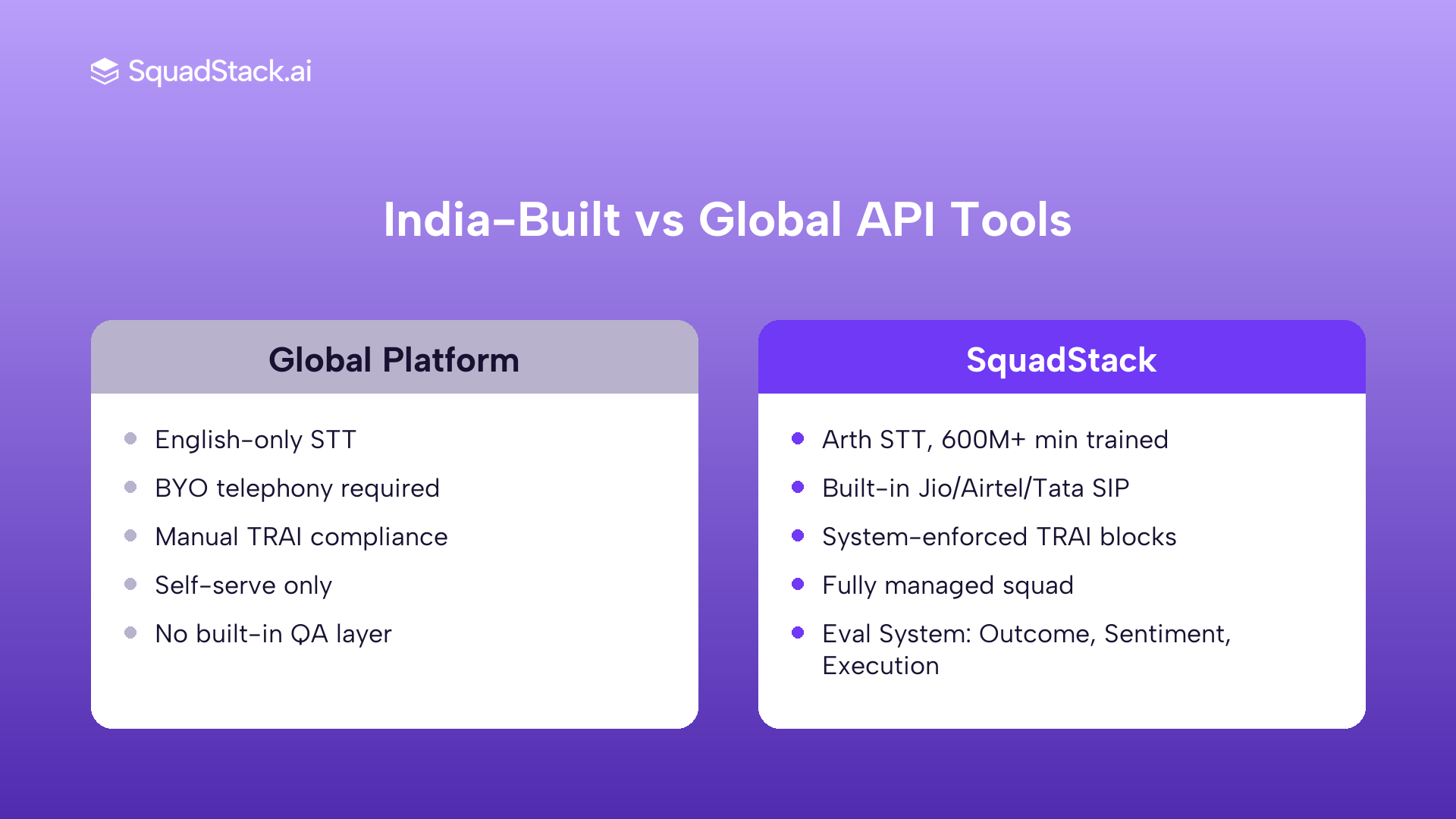
Bland and Retell are strong developer tools. Both give you a programmable voice agent, a clean API, and reasonable documentation. They are optimized for the North American market, with English as the primary language and US telephony as the assumed infrastructure.
SquadStack is a managed platform built specifically for Indian consumer sales. It is not a component: it is a full stack covering lead management, conversation AI, quality assurance, and optimization, run by a dedicated squad on your behalf.
The choice is not really about which tool has the better API. It is about whether your use case fits a self-assembled solution or a managed, outcome-driven system.
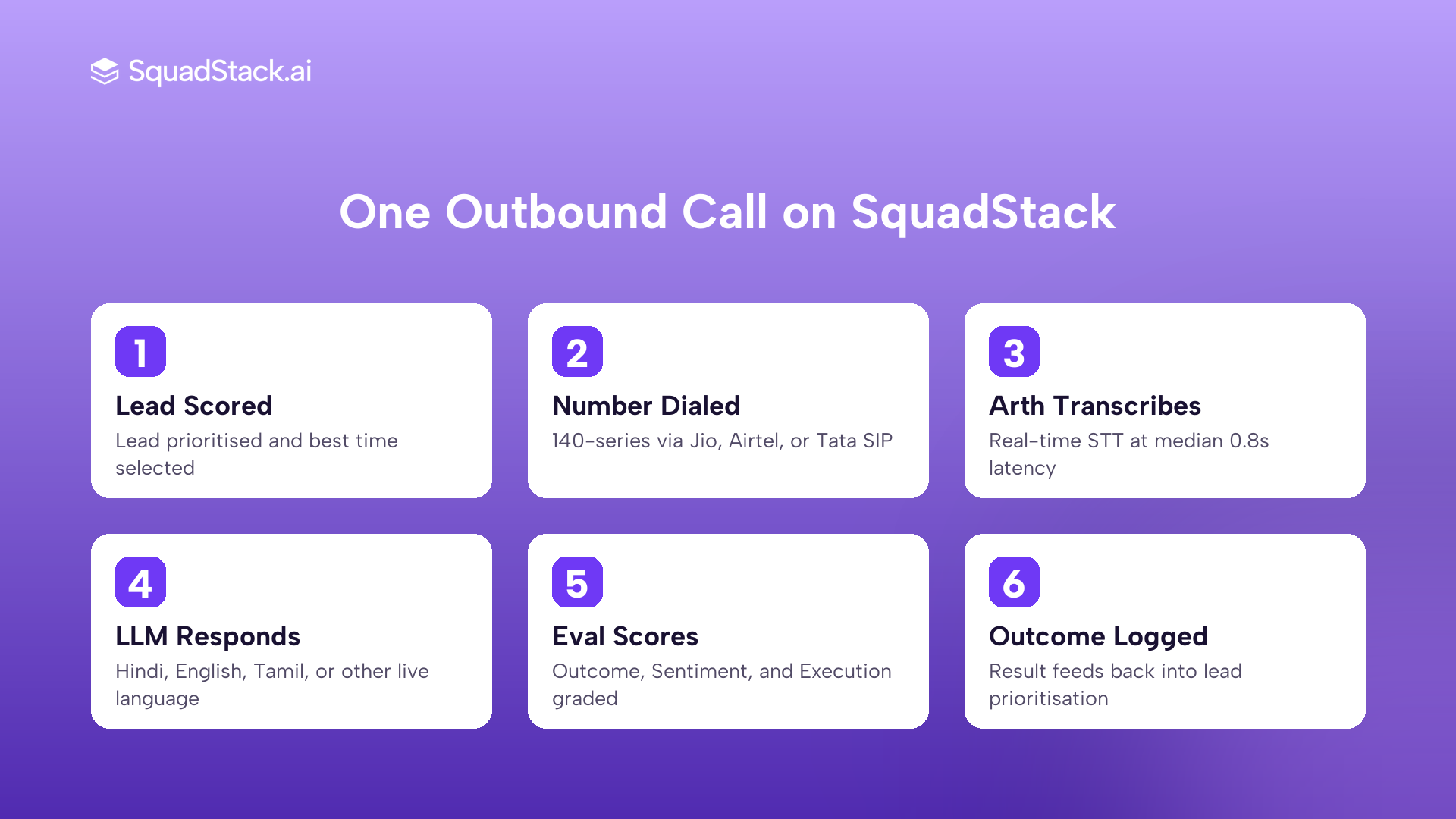
| Dimension | Bland | Retell | SquadStack |
|---|---|---|---|
| Primary market | US, English-first | US, English-first | India, multilingual |
| Indian language support | Limited, no native code-switching | Limited, no native code-switching | 9 live languages with native code-switching; more on demand |
| Speech model | Third-party STT | Third-party STT | Arth, proprietary, trained on 600M+ mins of Indian telephony |
| Telephony for India | BYO or third-party | BYO or third-party | Built-in: Exotel, Plivo, Ozonetel, Acefone; Jio, Airtel, Tata SIP lines |
| 140-series numbers | Not provisioned | Not provisioned | Provisioned and managed by SquadStack |
| TRAI / DND compliance | Manual | Manual | System-enforced, hard call-window blocks |
| Data residency | US servers | US servers | India (AWS Mumbai); DPDP compliant |
| Certifications | Varies | Varies | ISO 27001, ISO 27701, SOC 2 Type II, DPDP, TRAI |
| Deployment model | Self-serve API | Self-serve API | Fully managed, dedicated squad per account |
| Response latency | Varies | Varies | Median 0.8 seconds or less |
| Time to first live call | Days (developer build) | Days (developer build) | Approximately 2 weeks (managed build) |
| A/B testing | Limited | Limited | Native, across voice, prompt, cadence, and channel |
| QA layer | None included | None included | Dual-layer: AI plus human Eval System (Outcome, Sentiment, Execution) |
| Pricing model | Per-minute or usage | Per-minute or usage | Outcome-oriented, engagement-based |
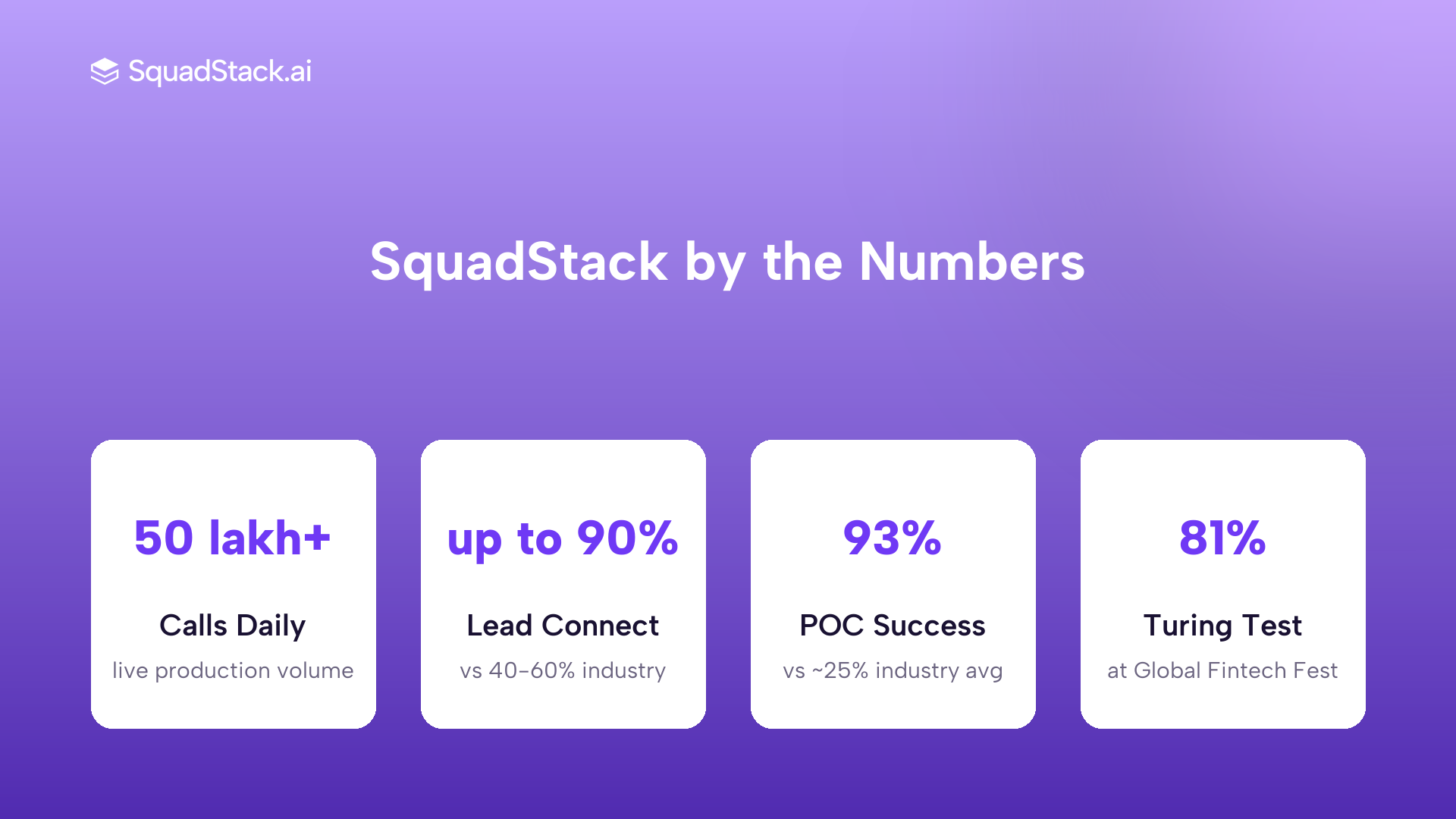
This is the single biggest failure mode for Indian deployments on US platforms. Indian sales conversations are not English conversations. A personal loan call in Delhi switches between Hindi and English mid-sentence. A gold loan outreach in Tamil Nadu runs almost entirely in Tamil, with occasional English financial terms. A demat account opening call for a pan-India brokerage needs to handle all of this on the same campaign.
Bland and Retell rely on third-party speech-to-text models that are mostly trained on clean, English-language audio. Production Indian telephony is 8kHz, noisy, and heavily code-switched. On such calls, these models generate transcription errors that compound downstream: the LLM misreads intent, gives the wrong response, and the caller hangs up.
SquadStack's STT, Arth, was built specifically on 600M+ minutes of real Indian contact-center conversations, including Hinglish, Taminglish, and high-noise telephony conditions. On SquadStack's own benchmark using real Indian telesales audio, Arth v1 posts a semantic word error rate of 11.9%, placing it within 0.9 points of the top commercial streaming STT and ahead of other available Indian-language models. Beyond accuracy, native code-switching means the agent follows a caller who switches languages mid-sentence, which is not a feature most global tools have at all. You can read more about how this works in the post on voice AI agents for Indian languages.
Cold-calling at scale in India requires 140-series numbers, DND registry scrubbing before every dial, TRAI-mandated calling windows (9:30 AM to 8:30 PM, hard-enforced), and multi-operator routing to handle line quality variability across carriers.
Neither Bland nor Retell provisions or manages any of this. You bring your own telephony, configure your own DND logic, and manage your own number health. For a developer building a small outbound workflow, that is fine. For an enterprise running hundreds of thousands of calls a month, it adds real operational overhead and real compliance risk.
SquadStack's telephony layer ships with the platform. Numbers, DND scrubbing, spam-aware number rotation, and TRAI calling-window enforcement are built in. The calling window is a hard system block, not a policy. When a number starts getting flagged on Truecaller, the platform rotates it out automatically.
The result: SquadStack consistently reaches up to 90% of leads across a campaign's full attempt cadence, against an industry norm of 40 to 60%. That gap is not just a product stat. On a campaign of 100,000 leads, it is the difference between reaching 50,000 people and reaching 90,000.
For any Indian enterprise in BFSI, the compliance checklist is not optional. TRAI regulates calling hours and 140-series number requirements for commercial calls. The Digital Personal Data Protection Act (DPDP) requires data to stay in India. RBI-regulated entities have additional requirements around conversation audit trails and consent gating.
Global platforms are built for US compliance frameworks, not Indian ones. GDPR compatibility is not the same as DPDP compliance. US data centers do not satisfy Indian data residency requirements. Consent gating in the agent's dialogue, opt-out handling, and DNC registry scrubbing are things an Indian buyer has to build on top of a global platform.
SquadStack holds ISO 27001, ISO 27701, SOC 2 Type II, DPDP, and TRAI certifications. Models run on AWS Mumbai. Compliance-aware dialogue, including consent gating and AI disclosure, is built into the conversation layer, not bolted on after the fact.
Bland and Retell are self-serve. You read the docs, build the agent, debug the telephony, write the prompts, and manage performance yourself. That works if you have an in-house AI team with voice experience. Most Indian consumer brands do not.
SquadStack is fully managed. Every account gets a dedicated squad: an AI Agent Product Manager, a Forward Deployed Engineer, a Conversational AI Designer, and a QA specialist. The platform goes live in approximately two weeks. The agent trains on the client's real call recordings and knowledge base, not a generic template.
This matters especially for naturalness. Across SquadStack's own experiments on Hinglish agents, naturalness splits roughly 20% from TTS settings and 80% from how the dialogue itself is written. Getting a regional-language agent to sound like a real salesperson, not a newsreader or an IVR prompt, requires hand-built dialogue validated against real 8kHz phone calls. That is a managed-service skill, not something a developer API unlocks automatically.
Bland and Retell are built for general-purpose voice automation. They do not ship with a lead scoring engine, a redial strategy, an A/B testing framework, or a quality evaluation layer. These are the components that separate "voice AI that can hold a conversation" from "voice AI that converts leads."
SquadStack's platform includes all of these. Leads are scored and prioritized by likelihood to convert. Retry cadence is configurable and outcome-driven. Every call is scored by the Eval System across Outcome, Sentiment, and Execution. A/B tests run across voice, prompt, channel, and timing as native platform features. Persistent memory means a lead who spoke to the agent on Monday is not treated as a cold call on Wednesday.
For sales-specific use cases across India, you can also see how SquadStack approaches AI voice agents for sales automation.
Use Bland or Retell if you are a developer building a small English-language voice product, primarily for a US audience, and you have an in-house team to manage the stack.
Use SquadStack if you are an Indian enterprise running outbound sales at scale in one or more Indian languages, need TRAI and DPDP compliance handled for you, and care about conversion outcomes rather than just call completion.
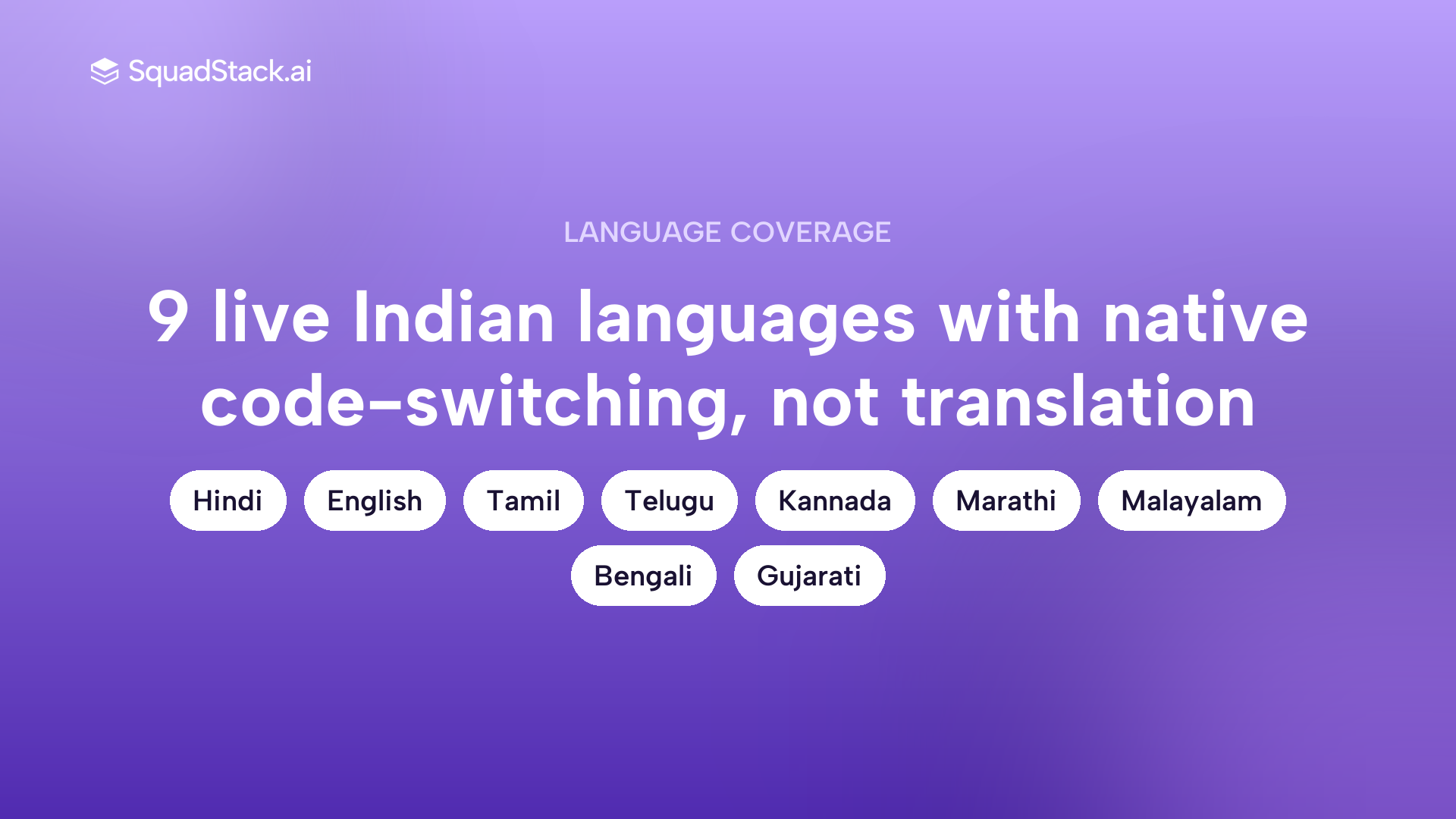
The proof: SquadStack runs 50 lakh+ calls daily for brands including AngelOne (demat account opening and customer support), Kotak Mahindra Bank (personal loan sales), Eureka Forbes (AMC sales), IndiaMART (buyer-seller matching), and PhonePe (merchant and personal loan sales). The 93% POC success rate, against an industry average around 25%, reflects what happens when the entire stack, speech model, telephony, QA, and optimization, is built for this specific context.
At Global Fintech Fest in October 2025, 1,273 of 1,563 attendees (81%) identified SquadStack's AI agents as human in a blind listening test. That benchmark took months of dialogue engineering, per-language testing, and iteration on real Indian phone calls. It is not something a generic API delivers by default.
The IndiaMART deployment, which you can read in detail at the IndiaMART case study, delivered 20% higher conversions and 15% lower customer acquisition cost, with over 1 lakh AI calls running daily.
Ready to see how this applies to your specific use case? Schedule a demo with the SquadStack team.
Which is the best voice AI platform for Indian consumer sales?
For high-volume outbound sales in India, SquadStack is purpose-built for this context. It handles Indian languages with native code-switching, manages TRAI and DPDP compliance, and ships with a full sales optimization stack including lead scoring, A/B testing, and dual-layer QA.
Can Bland or Retell handle Hindi and regional Indian language calls?
Both platforms have limited support for Indian languages. They rely on third-party STT models trained primarily on English and clean audio. Real Indian telephony is noisy, 8kHz, and heavily code-switched. On these conditions, transcription accuracy drops and the agent's responses degrade. Native code-switching between Hindi and English mid-sentence is not a feature either platform supports reliably.
How do I evaluate Indian voice AI vendors vs global ones like Bland or Retell?
Evaluate on five dimensions: native language and accent accuracy on actual Indian telephony audio, built-in TRAI and DPDP compliance, Indian number provisioning and DND management, the support model (self-serve vs managed), and whether the platform includes sales-specific tooling like lead scoring, cadence management, and conversation QA. Global tools typically require you to build most of this yourself.
What is the difference between a developer-first voice AI tool and a managed platform?
Developer-first tools like Bland and Retell give you an API to build your own voice agent. You manage the telephony, compliance, language models, and optimization. A managed platform like SquadStack delivers a working sales system: the agent, the telephony, the QA layer, and a dedicated squad who builds and tunes everything on your behalf.
Does SquadStack support outcome-based pricing instead of fixed seat costs?
SquadStack's pricing is engagement-based and outcome-oriented, structured around the business results the platform drives rather than fixed per-seat or per-minute charges regardless of quality. Specific pricing depends on the use case and volume. Contact SquadStack for a detailed commercial proposal.
How long does it take to go live with an Indian voice AI deployment?
With SquadStack, most enterprise deployments go live in approximately two weeks. That includes agent build, telephony setup, integration with the client's CRM, and UAT. Simple, contained use cases can produce a testable prototype faster. The longer lead time compared to a self-serve API reflects the managed build: the agent trains on the client's actual call recordings and knowledge base before making a single live call.
What compliance certifications matter for voice AI in India?
The key ones are TRAI compliance (calling hours, 140-series numbers, DND registry), the Digital Personal Data Protection Act (DPDP) for data residency and consent, and for BFSI specifically, ISO 27001 and SOC 2 Type II for information security. SquadStack holds all of these. US-built platforms are typically certified for US and EU frameworks, which do not map directly to Indian requirements.
What response latency should I expect from a voice AI agent?
Human conversation becomes unnatural when pauses exceed roughly one second. SquadStack's median response latency is 0.8 seconds or less, compared to a typical industry range of 1 to 1.5 seconds. This holds flat across long calls because the platform's context management keeps the per-turn payload constant rather than growing with call length.
Can a voice AI agent handle code-switching, such as Hinglish?
SquadStack's agents handle code-switching natively because the underlying models were trained on 600M+ minutes of real code-switched conversations. The agent follows a caller who switches from Hindi to English mid-sentence without losing context or giving a mismatched response. This is distinct from translation-based approaches, which introduce latency and unnatural phrasing.
How does SquadStack compare to building an in-house voice AI stack?
Building in-house looks straightforward initially, but the hidden costs accumulate within six to twelve months. Indian-language speech models, sub-800ms latency at scale, telephony management, and QA infrastructure for thousands of concurrent calls each require a dedicated team. SquadStack's view is that the speech model is roughly 10% of the problem. The remaining 90% is the sales decision system, the telephony stack, and continuous optimization, all of which take months to reach production quality and represent ongoing engineering cost. You can compare more options in the roundup of AI call center software.

